Thursday, March 07, 2013

Hubble Finds Birth Certificate of Oldest Known Star

This is a Digitized Sky Survey image of the oldest star with a well-determined age in our galaxy. The aging star, cataloged as HD 140283, lies 190.1 light-years away. Hubble Space Telescope was used to narrow the measurement uncertainty on the star's distance, and this helped refine the calculation of a more precise age of 14.5 billion years (plus or minus 800 million years).

The star is rapidly passing through our local stellar neighborhood. The star's orbit carries it through the plane of our galaxy from the galactic halo that has a population of ancient stars. The Anglo-Australian Observatory (AAO) UK Schmidt telescope photographed the star in blue light. Credit: Digitized Sky Survey (DSS), STScI/AURA, Palomar/Caltech, and UKSTU/AAO. More Images

A team of astronomers using NASA's Hubble Space Telescope has taken an important step closer to finding the birth certificate of a star that's been around for a very long time.

"We have found that this is the oldest known star with a well-determined age," said Howard Bond of Pennsylvania State University in University Park, Pa., and the Space Telescope Science Institute in Baltimore, Md.

The star could be as old as 14.5 billion years (plus or minus 0.8 billion years), which at first glance would make it older than the universe's calculated age of about 13.8 billion years, an obvious dilemma.

But earlier estimates from observations dating back to 2000 placed the star as old as 16 billion years. And this age range presented a potential dilemma for cosmologists. "Maybe the cosmology is wrong, stellar physics is wrong, or the star's distance is wrong," Bond said. "So we set out to refine the distance."
The new Hubble age estimates reduce the range of measurement uncertainty, so that the star's age overlaps with the universe's age — as independently determined by the rate of expansion of space, an analysis of the microwave background from the big bang, and measurements of radioactive decay.

This "Methuselah star," cataloged as HD 140283, has been known about for more than a century because of its fast motion across the sky. The high rate of motion is evidence that the star is simply a visitor to our stellar neighborhood. Its orbit carries it down through the plane of our galaxy from the ancient halo of stars that encircle the Milky Way, and will eventually slingshot back to the galactic halo.

This conclusion was bolstered by the 1950s astronomers who were able to measure a deficiency of heavier elements in the star as compared to other stars in our galactic neighborhood. The halo stars are among the first inhabitants of our galaxy and collectively represent an older population from the stars, like our Sun, that formed later in the disk. This means that the star formed at a very early time before the universe was largely "polluted" with heavier elements forged inside stars through nucleosynthesis. (The Methuselah star has an anemic 1/250th as much of the heavy element content of our Sun and other stars in our solar neighborhood.)
The star, which is at the very first stages of expanding into a red giant, can be seen with binoculars as a 7th-magnitude object in the constellation Libra.

Hubble's observational prowess was used to refine the distance to the star, which comes out to be 190.1 light-years. Bond and his team performed this measurement by using trigonometric parallax, where an apparent shift in the position of a star is caused by a change in the observer's position. The results are published in the February 13 issue of the Astrophysical Journal Letters.

The parallax of nearby stars can be measured by observing them from opposite points in Earth's orbit around the Sun. The star's true distance from Earth can then be precisely calculated through straightforward triangulation.

Once the true distance is known, an exact value for the star's intrinsic brightness can be calculated. Knowing a star's intrinsic brightness is a fundamental prerequisite to estimating its age.
Before the Hubble observation, the European Space Agency's Hipparcos satellite made a precise measurement of the star's parallax, but with an age measurement uncertainty of 2 billion years. One of Hubble's three Fine Guidance Sensors measured the position of the Methuselah star. It turns out that the star's parallax came out to be virtually identical to the Hipparcos measurements. But Hubble's precision is five times better than that of Hipparcos. Bond's team managed to shrink the uncertainty so that the age estimate was five times more precise.

With a better handle on the star's brightness Bond's team refined the star's age by applying contemporary theories about the star's burn rate, chemical abundances, and internal structure. New ideas are that leftover helium diffuses deeper into the core and so the star has less hydrogen to burn via nuclear fusion. This means it uses fuel faster and that correspondingly lowers the age.

Also, the star has a higher than predicted oxygen-to-iron ratio, and this too lowers the age. Bond thinks that further oxygen measurement could reduce the star's age even more, because the star would have formed at a slightly later time when the universe was richer in oxygen abundance. Lowering the upper age limit would make the star unequivocally younger than the universe.

"Put all of those ingredients together and you get an age of 14.5 billion years, with a residual uncertainty that makes the star's age compatible with the age of the universe," said Bond. "This is the best star in the sky to do precision age calculations by virtue of its closeness and brightness."

This Methuselah star has seen many changes over its long life. It was likely born in a primeval dwarf galaxy. The dwarf galaxy eventually was gravitationally shredded and sucked in by the emerging Milky Way over 12 billion years ago.

The star retains its elongated orbit from that cannibalism event. Therefore, it's just passing through the solar neighborhood at a rocket-like speed of 800,000 miles per hour. It takes just 1,500 years to traverse a piece of sky with the angular width of the full Moon. The star's proper motion angular rate is so fast (0.13 milliarcseconds an hour) that Hubble could actually photograph its movement in a few hours.

CONTACT

Ray Villard
Space Telescope Science Institute, Baltimore, Md.
410-338-4514

villard@stsci.edu

Barbara Kennedy
Pennsylvania State University, Space Park, Pa.
814-863-4682

science@psu.edu

Howard Bond
Space Telescope Science Institute, Baltimore, Md., and
Pennsylvania State University, Space Park, Pa.
410-561-0571

bond@stsci.edu


47 Tucanae: Probing Extreme Matter Through Observations of Neutron Stars

Neutron stars, the ultra-dense cores left behind after massive stars collapse, contain the densest matter known in the Universe outside of a black hole. New results from Chandra and other X-ray telescopes have provided one of the most reliable determinations yet of the relation between the radius of a neutron star and its mass. These results constrain how nuclear matter - protons and neutrons, and their constituent quarks - interact under the extreme conditions found in neutron stars.

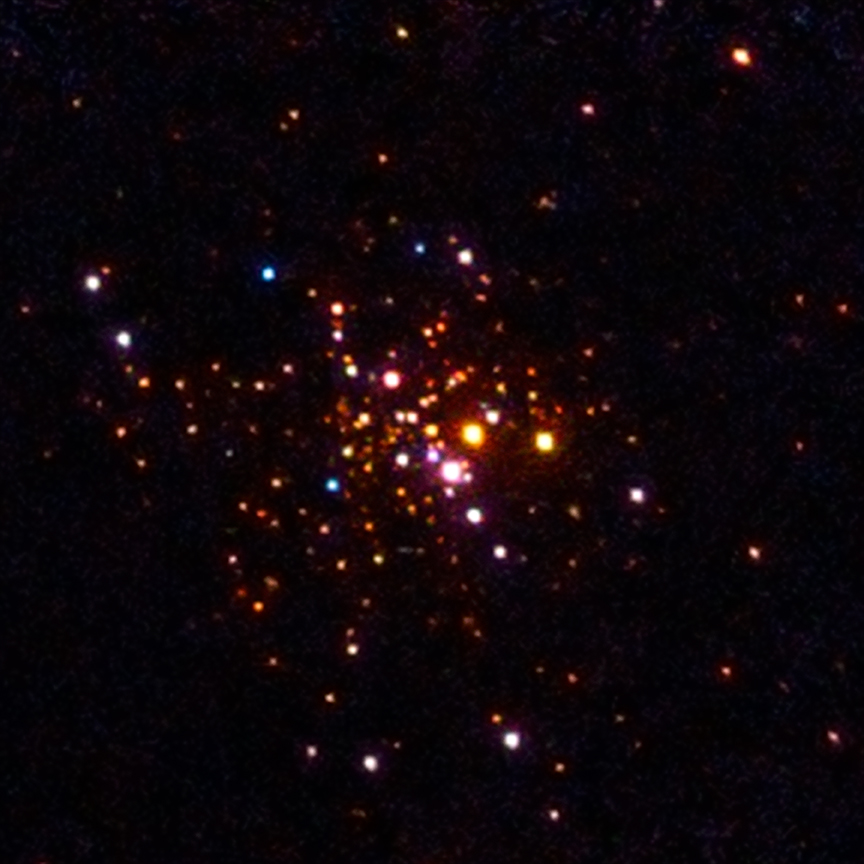
Three telescopes - Chandra, ESA's XMM-Newton, and NASA's Rossi X-ray Timing Explorer (RXTE) - were used to observe 8 neutron stars, including one in 47 Tucanae, a globular cluster located about 15,000 light years away in the outskirts of the Milky Way. The image shown here was constructed from a long Chandra observation of 47 Tucanae. Lower-energy X-rays are red, X-rays with intermediate energies are green, and the highest-energy X-rays are shown in blue.

In the image, the double, or binary, star system labeled as X7 contains a neutron star slowly pulling gas away from a companion star with a mass much lower than the Sun. In 2006, researchers used observations of the amount of X-rays from X7 at different energies together with theoretical models to determine a relationship between the mass and the radius of the neutron star. A similar procedure was used for Chandra observations of a neutron star in another globular cluster, NGC 6397, and for two other neutron stars in clusters observed by ESA's XMM-Newton.

Credit NASA/CXC/Michigan State/A.Steiner et al
JPEG (345.4 kb)   -  Large JPEG (6.9 MB)  -   Tiff (18.4 MB)
View on the Sky (WWT)

Four other neutron stars were observed with RXTE to undergo bursts of X-rays that cause the atmosphere of the neutron star to expand. By following the cooling of the star, its surface area can be calculated. Then, by folding in independent estimates of the distance to the neutron star, scientists were able to gather more information on the relationships between the masses and radii of these neutron stars.

Because the mass and radius of a neutron star is directly related to interactions between the particles in the interior of the star, the latest results give scientists new information about the inner workings of neutron stars.

The researchers used a wide range of different models for the structure of these collapsed objects and determined that the radius of a neutron star with a mass that is 1.4 times the mass of the Sun is between 10.4 and 12.9 km (6.5 to 8.0 miles). They also estimated the density at the center of a neutron star was about 8 times that of nuclear matter found in Earth-like conditions. This translates into a pressure that is over ten trillion trillion times the pressure required for diamonds to form inside the Earth.

Neutron stars, the ultra-dense cores left behind after massive stars collapse, contain the densest matter known in the Universe outside of a black hole. New results from Chandra and other X-ray telescopes have provided one of the most reliable determinations yet of the relation between the radius of a neutron star and its mass. These results constrain how nuclear matter - protons and neutrons, and their constituent quarks - interact under the extreme conditions found in neutron stars.

Three telescopes - Chandra, ESA's XMM-Newton, and NASA's Rossi X-ray Timing Explorer (RXTE) - were used to observe 8 neutron stars, including one in 47 Tucanae, a globular cluster located about 15,000 light years away in the outskirts of the Milky Way. The image shown here was constructed from a long Chandra observation of 47 Tucanae. Lower-energy X-rays are red, X-rays with intermediate energies are green, and the highest-energy X-rays are shown in blue.

In the image, the double, or binary, star system labeled as X7 contains a neutron star slowly pulling gas away from a companion star with a mass much lower than the Sun. In 2006, researchers used observations of the amount of X-rays from X7 at different energies together with theoretical models to determine a relationship between the mass and the radius of the neutron star. A similar procedure was used for Chandra observations of a neutron star in another globular cluster, NGC 6397, and for two other neutron stars in clusters observed by ESA's XMM-Newton.

The results apply whether the entire set of bursting sources, or the most extreme of the other sources, are removed from the sample. Previous studies have used smaller samples of neutron stars or have not accounted for as many uncertainties in using the models.

The new values for the neutron star's structure should hold true even if matter composed of free quarks exists in the core of the star. Quarks are fundamental particles that combine to form protons and neutrons and are not usually found in isolation. It has been postulated that free quarks may exist inside the centers of neutron stars, but no firm evidence for this has ever been found. 

The researchers also made an estimate of the distances between neutrons and protons in atomic nuclei here on earth. A larger neutron star radius naturally implies that, on average, neutrons and protons in a heavy nucleus are farther apart. Their estimate is being compared with values from terrestrial experiments.

The neutron star observations also provided new information about the so-called "symmetry energy" for nuclear matter, which is the energy cost required to create a system with a different number of protons than neutrons. The symmetry energy is important for neutron stars because they contain almost ten times as many neutrons as protons. It is also important for heavy atoms on Earth, like Uranium, because they often have more neutrons than protons. The results show that the symmetry energy does not change much with density.

These results will be published in a paper in the March 1st, 2013 issue of The Astrophysical Journal Letters. The authors are Andrew Steiner, from the Institute for Nuclear Theory at the University of Washington, James Lattimer from Stony Brook University in New York and Edward Brown from Michigan State University.

NASA's Marshall Space Flight Center in Huntsville, Ala., manages the Chandra program for NASA's Science Mission Directorate in Washington. The Smithsonian Astrophysical Observatory controls Chandra's science and flight operations from Cambridge, Mass.


Fast Facts for 47 Tucanae: 

Release Date: March 6, 2013 
Scale: Image is 2.3 arcmin across (about 10 light years) 
Category: Neutron Stars/X-ray Binaries
Coordinates: (J2000) RA 00h 24m 42.0s | Dec -72° 00' 00" 
Constellation: Tucana
Observation Date: 13 pointings between March 16, 2000 and Oct 11, 2002 
Observation Time: 100 (4 days, 4 hours). 
Obs. ID: 78, 953-956, 2735-2738, 3384-3387 
Instrument: ACIS
References: Steiner, A. et al 2013, ApJ 765, L5; arXiv:1205.6871
Color Code: X-ray (Red, Green, Blue)

Wednesday, March 06, 2013

Measuring the Universe More Accurately Than Ever Before


Artist’s impression of eclipsing binary

Explanation of eclipsing binaries

Map of the Large Magellanic Cloud

  Videos

Zooming in on an eclipsing binary in the Large Magellanic Cloud

Artist’s impression of eclipsing binary

New results pin down the distance to the galaxy next door


After nearly a decade of careful observations an international team of astronomers has measured the distance to our neighbouring galaxy, the Large Magellanic Cloud, more accurately than ever before. This new measurement also improves our knowledge of the rate of expansion of the Universe — the Hubble Constant — and is a crucial step towards understanding the nature of the mysterious dark energy that is causing the expansion to accelerate. The team used telescopes at ESO’s La Silla Observatory in Chile as well as others around the globe. These results appear in the 7 March 2013 issue of the journal Nature.

Astronomers survey the scale of the Universe by first measuring the distances to close-by objects and then using them as standard candles [1] to pin down distances further and further out into the cosmos. But this chain is only as accurate as its weakest link. Up to now finding an accurate distance to the Large Magellanic Cloud (LMC), one of the nearest galaxies to the Milky Way, has proved elusive. As stars in this galaxy are used to fix the distance scale for more remote galaxies, it is crucially important.

But careful observations of a rare class of double star have now allowed a team of astronomers to deduce a much more precise value for the LMC distance: 163 000 light-years.

I am very excited because astronomers have been trying for a hundred years to accurately measure the distance to the Large Magellanic Cloud, and it has proved to be extremely difficult,” says Wolfgang Gieren (Universidad de Concepción, Chile) and one of the leaders of the team. “Now we have solved this problem by demonstrably having a result accurate to 2%.

The improvement in the measurement of the distance to the Large Magellanic Cloud also gives better distances for many Cepheid variable stars [2]. These bright pulsating stars are used as standard candles to measure distances out to more remote galaxies and to determine the expansion rate of the Universe — the Hubble Constant. This in turn is the basis for surveying the Universe out to the most distant galaxies that can be seen with current telescopes. So the more accurate distance to the Large Magellanic Cloud immediately reduces the inaccuracy in current measurements of cosmological distances.

The astronomers worked out the distance to the Large Magellanic Cloud by observing rare close pairs of stars, known as eclipsing binaries [3]. As these stars orbit each other they pass in front of each other. When this happens, as seen from Earth, the total brightness drops, both when one star passes in front of the other and, by a different amount, when it passes behind [4].

By tracking these changes in brightness very carefully, and also measuring the stars’ orbital speeds, it is possible to work out how big the stars are, their masses and other information about their orbits. When this is combined with careful measurements of the total brightness and colours of the stars [5] remarkably accurate distances can be found.

This method has been used before, but with hot stars. However, certain assumptions have to be made in this case and such distances are not as accurate as is desirable. But now, for the first time, eight extremely rare eclipsing binaries where both stars are cooler red giant stars have been identified [6]. These stars have been studied very carefully and yield much more accurate distance values — accurate to about 2%.

ESO provided the perfect suite of telescopes and instruments for the observations needed for this project: HARPS for extremely accurate radial velocities of relatively faint stars, and SOFI for precise measurements of how bright the stars appeared in the infrared,” adds Grzegorz Pietrzyński (Universidad de Concepción, Chile and Warsaw University Observatory, Poland), lead author of the new paper in Nature.
 
We are working to improve our method still further and hope to have a 1% LMC distance in a very few years from now. This has far-reaching consequences not only for cosmology, but for many fields of astrophysics,” concludes Dariusz Graczyk, the second author on the new Nature paper.

Notes

[1] Standard candles are objects of known brightness. By observing how bright such an object appears astronomers can work out the distance — more distant objects appear fainter. Examples of such standard candles are Cepheid variables [2] and Type Ia supernovae. The big difficulty is calibrating the distance scale by finding relatively close examples of such objects where the distance can be determined by other means.

[2] Cepheid variables are bright unstable stars that pulsate and vary in brightness. But there is a very clear relationship between how quickly they change and how bright they are. Cepheids that pulsate more quickly are fainter than those that pulsate more slowly. This period-luminosity relation allows them to be used as standard candles to measure the distances of nearby galaxies.

[3] This work is part of the long-term Araucaria Project to improve measurements of the distances to nearby galaxies.

[4] The exact light variations depend on the relative sizes of the stars, their temperatures and colours and the details of the orbit.

[5] The colours are measured by comparing the brightness of the stars at different near-infrared wavelengths.

[6] These stars were found by searching the 35 million LMC stars that were studied by the OGLE project.

More information

This research was presented in a paper “An eclipsing binary distance to the Large Magellanic Cloud accurate to 2 per cent”, by G. Pietrzyński et al., to appear in the 7 March 2013 issue of the journal Nature.
The team is composed of G. Pietrzyński (Universidad de Concepción, Chile; Warsaw University Observatory, Poland), D. Graczyk (Universidad de Concepción), W. Gieren (Universidad de Concepción), I. B. Thompson (Carnegie Observatories, Pasadena, USA), B., Pilecki (Universidad de Concepción; Warsaw University Observatory), A. Udalski (Warsaw University Observatory), I. Soszyński (Warsaw University Observatory), S. Kozłowski (Warsaw University Observatory), P. Konorski (Warsaw University Observatory), K. Suchomska (Warsaw University Observatory), G. Bono (Università di Roma Tor Vergata, Rome, Italy; INAF-Osservatorio Astronomico di Roma, Italy), P. G. Prada Moroni (Università di Pisa, Italy; INFN, Pisa, Italy), S. Villanova (Universidad de Concepción ), N. Nardetto (Laboratoire Fizeau, UNS/OCA/CNRS, Nice, France),  F. Bresolin (Institute for Astronomy, Hawaii, USA), R. P. Kudritzki (Institute for Astronomy, Hawaii, USA), J. Storm (Leibniz Institute for Astrophysics, Potsdam, Germany), A. Gallenne (Universidad de Concepción), R. Smolec (Nicolaus Copernicus Astronomical Centre, Warsaw, Poland), D. Minniti (Pontificia Universidad Católica de Chile, Santiago, Chile; Vatican Observatory, Italy), M. Kubiak (Warsaw University Observatory), M. Szymański (Warsaw University Observatory), R. Poleski (Warsaw University Observatory), Ł. Wyrzykowski (Warsaw University Observatory), K. Ulaczyk (Warsaw University Observatory), P. Pietrukowicz (Warsaw University Observatory), M. Górski (Warsaw University Observatory), P. Karczmarek (Warsaw University Observatory).

ESO is the foremost intergovernmental astronomy organisation in Europe and the world’s most productive ground-based astronomical observatory by far. It is supported by 15 countries: Austria, Belgium, Brazil, the Czech Republic, Denmark, France, Finland, Germany, Italy, the Netherlands, Portugal, Spain, Sweden, Switzerland and the United Kingdom. ESO carries out an ambitious programme focused on the design, construction and operation of powerful ground-based observing facilities enabling astronomers to make important scientific discoveries. ESO also plays a leading role in promoting and organising cooperation in astronomical research. ESO operates three unique world-class observing sites in Chile: La Silla, Paranal and Chajnantor. At Paranal, ESO operates the Very Large Telescope, the world’s most advanced visible-light astronomical observatory and two survey telescopes. VISTA works in the infrared and is the world’s largest survey telescope and the VLT Survey Telescope is the largest telescope designed to exclusively survey the skies in visible light. ESO is the European partner of a revolutionary astronomical telescope ALMA, the largest astronomical project in existence. ESO is currently planning the 39-metre European Extremely Large optical/near-infrared Telescope, the E-ELT, which will become “the world’s biggest eye on the sky”.

Links

Contacts

Grzegorz Pietrzyński
Universidad de Concepción
Chile
Tel: +56 41 220 7268
Cell: +56 9 6245 4545
Email: pietrzyn@astrouw.edu.pl

Wolfgang Gieren
Universidad de Concepción
Chile
Tel: +56 41 220 3103
Cell: +56 9 8242 8925
Email: wgieren@astro-udec.cl

Richard Hook
ESO, Public Information Officer
Garching bei München, Germany
Tel: +49 89 3200 6655
Cell: +49 151 1537 3591
Email: rhook@eso.org

Soccer Balls in Interstellar Space

Figure 1: The structure of fullerene C60 
Credit: NAOJ

How much C60 exists in space? Since C60 is very stable, could there be much more C60 in celestial objects than on Earth? To answer these queries, the team focused on a class of dying stars called "planetary nebulae" (Note 2), because cosmic C60 has previously been detected in these objects. Otsuka analyzed all of the relevant spectroscopic data taken by the SST and analyzed spectral data from more than 300 planetary nebulae, checking each carefully for evidence of C60 infrared wavelengths. The team identified C60 in several planetary nebulae, including the first detection of C60 in M1-11 (Figure 2). Otsuka also found evidence for C60 in the archived spectra of M1-11 taken by the VLT and proceeded to estimate the total amount and the temperature of C60 in M1-11. Using data obtained with the SST and AKARI, he also investigated the dust grain composition in M1-11 and obtained the amount in each component. Although M1-11 is rich in carbon-bearing molecules and minerals, C60 makes up only 0.01 percent of the total dust mass. Therefore, he concluded that C60 is very rare in the interstellar medium.

Figure 2: Detection of C60 in M1-11. Arrows indicate the postions of the C60 emissions at 17.3 and 18.9 microns. (Credit: NAOJ)


How, then, did C60 form in space? Characterizing the physical conditions in the environments that contain C60 is an important step in understanding this process. Otsuka applied the method of elemental abundance analysis to unveil the evolutionary status of M1-11's nebula and its progenitor star, which were largely unknown until his research. The team used the 8.2 m Subaru Telescope's High Dispersion Spectrograph (HDS) and the Okayama 1.88 m telescope's near infrared imager and spectrograph (ISLE) to precisely measure line strengths of chemical elements such as carbon (C), phosphorous (P), and krypton (Kr). Detailed analysis of the spectra (Figure 3) revealed the relative amounts (abundances) of eleven elements. The team found that M1-11 is a very young planetary nebula, which formed from material ejected by the star ~1000 years ago; and it evolved from a star 50% more massive than the Sun. The obtained values in M1-11, namely, the C60 mass and temperature, the elemental composition of the gas in the nebula, the mass of the progenitor star, and the evolutionary status, are very similar to those seen in other planetary nebulae containing C60, e.g., Tc1, where the cosmic C60 was detected for the first time by the SST (Note 3). The team concluded that C60 is likely to form in carbon-rich dusty objects such as M1-11. They believe that chemical processing and the destruction of HAC (hydrogenated amorphous carbon) by the radiation as well as the strong wind from the central star of a planetary nebula produce the cosmic C60.

Figure 3: Detailed analysis of the spectra of M1-11 taken by the Subaru Telescope's High Dispersion Spectrograph (HDS) (upper panel) and the 1.88 m Okayama telescope's near-infrared imager and spectrograph (ISLE) (lower panel). The emission lines from the carbon (C) and the phosphorous (P) are indicated by the blue characters; those from hydrogen (Paβ), helium (He), and oxygen (O), are indicated by black characters. In the ISLE spectrum, molecular hydrogen (H2) is also noted. (Credit: NAOJ)


Using the Subaru Telescope's Cooled Mid-Infrared Camera and Spectrometer (COMICS), Otsuka has recently started a new project to investigate the spatial distribution of C60 in planetary nebulae to verify the C60 formation scenario. As Otsuka stated, "These new Subaru observations will further clarify the C60 formation process".

References:
The research paper on which this release is based was published in The Astrophysical Journal (Otsuka et al." The Detection of C60 in the Well-Characterized Planetary Nebula M1-11" The Astrophysical Journal, 764:77 (20pp), 2013 February 10).
The authors are:
  • Masaaki Otsuka (Academia Sinica Institute of Astronomy and Astrophysics [ASIAA]/Space Telescope Science Institute [STScI]), Taiwan/USA
  • Franciska Kemper (ASIAA), Taiwan
  • Siek Hyung (Chungbuk National University), Korea
  • Benjamin A. Sargent (Rochester Institute of Technology [RIT]/STScI), USA
  • Margaret Meixner (STScI), USA
  • Akito Tajitsu (Subaru Telescope), USA
  • Ken'shi Yanagisawa (Okayama Astrophysical Observatory [OAO]), Japan
Acknowledgements:
This research was supported by the following:
  • Space Telescope Science Institute (STScI) GO-1129.01-A, DDRFD0101.90128, USA
  • National Aeronautics and Space Administration (NASA) NAO-50-12595, USA
  • National Science Council NSC100-2112-M-001-023-MY3, Taiwan
  • National Research Foundation of Korea NRF-2011-005077, Korea
Notes:
  1. A fullerene is any carbon molecule with the chemical formula C60. It is patterned in a very specific way, like the pentagons and hexagons that make up the shape of a soccer ball. Named in homage to the designer, author, and inventor Buckminster Fuller, fullerenes resemble the geodesic domes that Fuller invented. C60 is nicknamed a "buckyball", once again in honor of Buckminster Fuller.
  2. Planetary nebulae are dying Sun-like stars that were initially one to eight times the mass of the Sun. They are clouds of glowing gas and dust surrounding a hot star (over 30,000 K).
  3. See http://www.sciencemag.org/content/329/5996/1180.abstract

Keck Observatory Completes $4 Million Adaptive Optics Fund

This animation dramatically displays the effect of Adaptive Optics (AO) on the Galactic Center.
Credit: UCLA Galactic Center Group
 
On the left is an image of the Galactic Center using the current Keck II LGS AO. On the right is a simulation of what the new system will capture. The new 20-watt, continuous wave laser will increase the coupling efficiency by more than 15 times and improve the relative Strehl ratio by a factor of 1.5 to 2.5. Credit: TMT/UCLA/WMKO. Hi-Res Image

Kamuela, Hawaii – The W. M. Keck Observatory has successfully completed a $4 million campaign that will give astronomers the most detailed Adaptive Optics images of the cosmos ever created by mankind. Furthermore, the campaign was funded entirely by private philanthropy.

The Gordon and Betty Moore Foundation, the W. M. Keck Foundation and The Bob & Renee Parsons Foundation awarded three grants totaling $3.7 million to significantly upgrade the Keck II Laser Guide Star Adaptive Optics (LGS AO) system. The balance of the campaign came from individual gifts from Friends of the Keck Observatory.

“We’re thrilled to support the Keck II Laser Guide Star Adaptive Optics, because we believe in the inherent value of science and the importance of basic research,” said Cyndi Atherton, Program Director for Science at the Moore Foundation. “Upgrading the Keck II instruments will help us answer — and even think of new ways to ask — fascinating and significant questions about our universe and the place we occupy within it.”

“Ever since Galileo, astronomers have been building bigger telescopes to collect more light to observe more distant objects,” said Peter Wizinowich, who leads the Adaptive Optics development at Keck Observatory. “In theory, the larger the telescope, the more detail you can see. However, because of the blurring caused by Earth’s atmosphere, a 10-inch or a 10-meter telescope sees about the same amount of detail.”

One rather expensive solution to this problem is to put a telescope in space. Another solution is to remove the atmospheric distortion using AO.

Keck Observatory, which operates the two biggest telescopes in the world, has been a prime innovator in the field of AO, currently delivering images three to four times sharper than the Hubble Space Telescope. Keck commissioned the first large Laser Guide Star (LGS) AO system on Keck II in 2004. It is the most productive LGS AO system in astrophysics, responsible for 70 percent of the refereed-science papers using laser AO published to date, revealing unprecedented details within our solar system, our galaxy, and beyond.
“In its Science and Engineering Research Program, the W. M. Keck Foundation has long focused on supporting cutting-edge research and the development of new technologies that may lead to breakthrough achievements in a particular field,” said Robert Day, Chairman of the W. M. Keck Foundation. “The Keck Foundation is pleased to make this award to the Keck Observatory in recognition of its outstanding work in the field of astronomy.”

The current LGS AO system on the Keck II Telescope projects a 13-Watt, pulsed dye laser beam to excite sodium atoms in the mesosphere, 90 kilometers above the Earth’s surface. Those excited sodium atoms couple with the laser photons and fluoresce — creating an artificial guide star — which is used to measure and remove the turbulence of Earth’s atmosphere, sharpening images by up to a factor of 20.

The new laser, designed with the collaboration of the European Southern Observatory (ESO), TOPTICA Photonics AG and MPB Communications Inc., is a state-of-the-art, 20-watt, continuous wave laser that will increase the coupling efficiency over the current laser by more than 15 times and improve the relative Strehl ratio by a factor of about two. 

“Since time began, humans have stared into the night sky wondering what is out there,” said Bob Parsons, who, together with his wife Renee, founded The Bob & Renee Parsons Foundation. “The Keck Observatory is a world leader in its field and this important upgrade will enable them to continue answering those questions for generations to come.”

Keck Observatory’s LGS AO system was instrumental in UCLA astronomer Andrea Ghez’s pioneering work in characterizing the super-massive black hole and several important stars in the center of our galaxy, which earned her the coveted Crafoord Prize in Astronomy in 2012. 

The new laser will be commissioned in mid-2015 and is the cornerstone of the Next Generation Adaptive Optics program.  

Many lines of research will make critical advances with the new LGS AO system, including:
• The study of brown dwarfs and low-mass stars, which are blurring the line between planets and stars;
• More precise measurements of stars orbiting closest to the Galactic Center’s super-massive black hole;
• Improved determination of the origins of gamma ray bursts and supernovae in extragalactic science; and
• A closer look at objects within our solar system in areas of research where Keck has already contributed, including weather aberrations on Uranus, and Kuiper Belt Objects like Eris, which led to the demotion of Pluto from planet to dwarf planet.  

“This is the first time private philanthropy will fund an instrument project for us in its entirety,” said Taft Armandroff, Director of the W. M. Keck Observatory. “They clearly see the value putting their resources into the Keck Observatory, and for that, we are delighted.” A combination of federal grants and private support fund most of the technology enhancements to the Observatory.

“The generous donations from the Gordon and Betty Moore Foundation, the W. M. Keck Foundation and The Bob & Renee Parsons Foundation come as we are poised to celebrate the Observatory’s 20th Anniversary this month,” said Debbie Goodwin, Director of Advancement for the W. M. Keck Observatory. “Hundreds of Keck’s supporters will be traveling to the Big Island from around the world to participate in Keck Week 2013. We are thrilled to have this opportunity to publicly thank representatives from these foundations and provide everyone with a look at what exciting science lies ahead with this new capability.”
For past news on this campaign, click here.
 
About the W.M. Keck Observatory:
The W. M. Keck Observatory operates the two biggest and most scientifically productive telescopes on Earth. The twin 10-meter optical/infrared telescopes located on the summit of Mauna Kea on the Island of Hawaii, feature a world-leading suite of advanced instruments including imagers, multi-object spectrographs, high-resolution spectrographs, integral-field spectroscopy and a laser guide star adaptive optics system. The Observatory is a private 501(c) 3 non-profit organization and a scientific partnership of the California Institute of Technology, the University of California and NASA. For more information, please visit http://www.keckobservatory.org.

About the Gordon and Betty Moore Foundation:

The Gordon and Betty Moore Foundation, established in 2000, seeks to advance environmental conservation, scientific research, and patient care.  For more information, please visit http://www.moore.org.

About the W. M. Keck Foundation:
Based in Los Angeles, the W. M. Keck Foundation was established in 1954 by the late W. M. Keck, founder of the Superior Oil Company. The Foundation’s grant making is focused primarily on pioneering efforts in the areas of medical research, science and engineering and undergraduate education. The Foundation also maintains a Southern California Grant Program that provides support for the Los Angeles community, with a special emphasis on children and youth. For more information, visit  http://www.wmkeck.org.

About The Bob & Renee Parsons Foundation:
The Bob & Renee Parsons Foundation inspires hope by providing critical funding at critical times to communities and organizations striving to make a difference. For more information, please visit http://www.tbrpf.org

Media Contact:
Steve Jefferson
Communications Officer, Advancement
W.M. Keck Observatory
sjefferson@keck.hawaii.edu
(808)881-3827


Tuesday, March 05, 2013

Gravitational Lens Creates Cartoon of Space Invader

 Abell 68
Credit: NASA, ESA, and the Hubble Heritage/ESA-Hubble Collaboration
Acknowledgment: N. Rose

The universe is eerie enough without giving us an apparition of a 1980s video game alien attacker. This oddball-looking object is really a mirage created by the gravitational field of a foreground cluster of galaxies warping space and distorting the background images of more distant galaxies. 

This effect, called gravitational lensing, can make multiple mirror image copies of the light coming from a far-flung galaxy. It is a powerful tool for seeing remote galaxies that otherwise would not be observable by Hubble because they are too dim and far away. In this Hubble photo a background spiral galaxy is warped into an image that resembles a cartoon of a simulated space invader. The foreground massive cluster, called Abell 68, lies 2 billion light-years away. The brightened and stretched lensed images come from galaxies far behind it.

***
The gravitational field surrounding this massive cluster of galaxies, Abell 68, acts as a natural lens in space to brighten and magnify the light coming from very distant background galaxies.

Like a funhouse mirror, lensing creates a fantasy landscape of arc-like images and mirror images of background galaxies. The foreground cluster is 2 billion light-years away, and the lensed images come from galaxies far behind it.

In this photo, the image of a spiral galaxy at upper left has been stretched and mirrored into a shape similar to that of a simulated alien from the classic 1970s computer game Space Invaders! A second, less distorted image of the same galaxy appears to the left of the large, bright elliptical galaxy.

In the upper right of the photo is another striking feature of the image that is unrelated to gravitational lensing. What appears to be purple liquid dripping from a galaxy is a phenomenon called ram-pressure stripping. The gas clouds within the galaxy are being stripped out and heated up as the galaxy passes through a region of denser intergalactic gas.

This image was taken in infrared light by Hubble's Wide Field Camera 3, and combined with near-infrared observations from Hubble's Advanced Camera for Surveys.
The image is based in part on data spotted by Nick Rose in the Hubble's Hidden Treasures image processing competition.

For additional information, contact:

Ray Villard
Space Telescope Science Institute, Baltimore, Md.
410-338-4514

villard@stsci.edu

Nicola Guttridge
Hubble/ESA, Garching, Germany
011-49-89-3200-6855

nguttrid@partner.eso.org

Astronomers Open Window Into Europa’s Ocean

Based on new data from the W. M. Keck Observatory about Jupiter's moon Europa, astronomers hypothesize that chloride salts bubble up from the icy moon's global liquid ocean and reach the frozen surface where they are bombarded with sulfur from volcanoes on Jupiter's largest moon, Io. This illustration of Europa (foreground), Jupiter (right) and Io (middle) is an artist's concept. Credit: NASA/JPL-Caltech. Hi-Res Image

KAMUELA, Hawaii—With data collected from the mighty W. M. Keck Observatory, California Institute of Technology (Caltech) astronomer Mike Brown — known as the Pluto killer for discovering a Kuiper-belt object that led to the demotion of Pluto from planetary status — and Kevin Hand from the Jet Propulsion Laboratory (JPL) have found the strongest evidence yet that salty water from the vast liquid ocean beneath Europa’s frozen exterior actually makes its way to the surface.

The data suggests there is a chemical exchange between the ocean and surface, making the ocean a richer chemical environment, and implies that learning more about the ocean could be as simple as analyzing the moon’s surface. The work is described in a paper that has been accepted for publication in the Astronomical Journal.

The findings were derived from spectroscopy delivered from the Keck Observatory, which operates the largest and most scientifically productive telescopes on Earth.

“We now have the best spectrum of this thing in the world,” Brown says. “Nobody knew there was this little dip in the spectrum because no one had the resolution to zoom in on it before.”

Ten-meter Keck II, fitted with Adaptive Optics (AO) to adjust for the blurring effect of Earth’s atmosphere, and its OH-Suppressing Infrared Integral Field Spectrograph (OSIRIS) produced details not capable of collection when NASA’s Galileo mission (1989–2003) was sent to study Jupiter and its moons. 

“We now have evidence that Europa’s ocean is not isolated—that the ocean and the surface talk to each other and exchange chemicals,” says Brown, the Richard and Barbara Rosenberg Professor and professor of planetary astronomy at Caltech. “That means that energy might be going into the ocean, which is important in terms of the possibilities for life there. It also means that if you’d like to know what’s in the ocean, you can just go to the surface and scrape some off.”

“The surface ice is providing us a window into that potentially habitable ocean below,” says Hand, deputy chief scientist for solar system exploration at JPL.

Since the days of the Galileo mission, when the spacecraft showed that Europa was covered with an icy shell, scientists have debated the composition of Europa’s surface. The infrared spectrometer aboard Galileo was not capable of providing the detail needed to definitively identify some of the materials present on the surface. Now, using current technology on ground-based telescopes, Brown and Hand have definitively identified a spectroscopic feature on Europa’s surface that indicates the presence of a magnesium sulfate salt, a mineral called epsomite, that could only originate from the ocean below.

“Magnesium should not be on the surface of Europa unless it’s coming from the ocean,” Brown says. “So that means ocean water gets onto the surface, and stuff on the surface presumably gets into the ocean water.”

Europa’s ocean is thought to be 100 kilometers deep and covers the entire globe. The moon remains locked in relation to Jupiter, with the same hemisphere always leading and the other trailing in its orbit. The leading hemisphere has a yellowish appearance, while the trailing hemisphere seems to be splattered and streaked with a red material.

The spectroscopic data from that red side has been a cause of scientific debate for 15 years. It is thought that one of Jupiter’s largest moons, Io, spews volcanic sulfur from its atmosphere, and Jupiter’s strong magnetic field sends some of that sulfur hurtling toward the trailing hemisphere of Europa, where it sticks. It was also clear from Galileo’s data that there is something other than pure water ice on the trailing hemisphere’s surface. The debate has focused on what that other something is—i.e., what has caused the spectroscopic data to deviate from the signature of pure water ice.

“From Galileo’s spectra, people knew something was there besides water. They argued for years over what it might be—sodium sulfate, hydrogen sulfate, sodium hydrogen carbonate, all these things that look more or less similar in this range of the spectrum,” says Brown. “But the really difficult thing was that the spectrometer on the Galileo spacecraft was just too coarse.”

Brown and Hand decided that the latest spectrometers on ground-based telescopes could improve the data pertaining to Europa, even from a distance of about 400 million miles. Using the Keck II telescope on Mauna Kea, they first mapped the distribution of pure water ice versus anything else on the moon. The spectra showed that even Europa’s leading hemisphere contains significant amounts of nonwater ice. Then, at low latitudes on the trailing hemisphere—the area with the greatest concentration of the nonwater ice material—they found a tiny dip in the spectrum that had never been detected before.

The two researchers racked their brains to come up with materials that might explain the new spectroscopic feature, and then tested everything from sodium chloride to Drano in Hand’s lab at JPL, where he tries to simulate the environments found on various icy worlds. “We tried to think outside the box to consider all sorts of other possibilities, but at the end of the day, the magnesium sulfate persisted,” Hand says.

Some scientists had long suspected that magnesium sulfate was on the surface of Europa. But, Brown says, “the interesting twist is that it doesn’t look like the magnesium sulfate is coming from the ocean.” Since the mineral he and Hand found is only on the trailing side, where the moon is being bombarded with sulfur from Io’s, they believe that there is a magnesium-bearing mineral everywhere on Europa that produces magnesium sulfate in combination with sulfur. The pervasive magnesium-bearing mineral might also be what makes up the nonwater ice detected on the leading hemisphere’s surface.

Brown and Hand believe that this mystery magnesium-bearing mineral is magnesium chloride. But magnesium is not the only unexpected element on the surface of Europa. Fifteen years ago, Brown showed that Europa is surrounded by an atmosphere of atomic sodium and potassium, presumably originating from the surface. The researchers reason that the sodium and potassium chlorides are actually the dominant salts on the surface of Europa, but that they are not detectable because they have no clear spectral features.

The scientists combined this information with the fact that Europa’s ocean can only be one of two types—either sulfate-rich or chlorine-rich. Having ruled out the sulfate-rich version since magnesium sulfate was found only on the trailing side, Brown and Hand hypothesize that the ocean is chlorine-rich and that the sodium and potassium must be present as chlorides.

Therefore, Brown says, they believe the composition of Europa’s sea closely resembles the salty ocean of Earth. “If you could go swim down in the ocean of Europa and taste it, it would just taste like normal old salt,” he says.

Hand emphasizes that, from an astrobiology standpoint, Europa is considered a premier target in the search for life beyond Earth; a NASA-funded study team led by JPL and the Johns Hopkins University Applied Physics Laboratory have been working with the scientific community to identify options to explore Europa further.  “If we’ve learned anything about life on Earth, it’s that where there’s liquid water, there’s generally life,” Hand says. “And of course our ocean is a nice salty ocean. Perhaps Europa’s salty ocean is also a wonderful place for life.”

The Astronomical Journal paper is titled “Salts and radiation products on the surface of Europa.” The work was supported by the Richard and Barbara Rosenberg Professorship at Caltech and by the NASA Astrobiology Institute through the Astrobiology of Icy Worlds node at JPL.

The W. M. Keck Observatory operates the two biggest and most scientifically productive telescopes on Earth. The twin 10-meter optical/infrared telescopes located on the summit of Mauna Kea on the Island of Hawaii, feature a world-leading suite of advanced instruments including imagers, multi-object spectrographs, high-resolution spectrographs, integral-field spectroscopy and a laser guide star adaptive optics system. The Observatory is a private 501(c) 3 non-profit organization and a scientific partnership of the California Institute of Technology, the University of California and NASA.

  
Science Contact:

Contact:
Deborah Williams-Hedges
California Institute of Technology
(626) 395-3227

debwms@caltech.edu

Observatory Contact:

W. M. Keck Observatory
(808)881-2837

sjefferson@keck.hawaii.edu
Steve Jefferson


High mass X-ray binaries trace the Milky Way's spiral arms

 Artist's impression of a highly obscured high-mass X-ray binary
Credit: ESA/AOES Medialab
Hi-Res [jpg] 620.95 kb

  
Distribution of high-mass X-ray binary stars and star-forming complexes.  
From A. Coleiro and S. Chaty, ApJ 764:185, 2013
Copyright 2013 IOP Publishing
Hi-Rers [jpg] 211.84 kb

 High-mass X-ray binary systems in the Milky Way.
Credit: Image courtesy of A. Coleiro and S. Chaty; 
Image of spiral arms: NASA/Adler/U. Chicago/Wesleyan/JPL-Caltech.
Hi-Res [jpg] 150.59 kb.

Our Galaxy is littered with pairs of massive stars, many of which contain the remnants of supernova explosions. A new study of these X-ray emitting binary systems, using data from ESA's INTEGRAL space observatory, has made it possible to reconstruct the locations of the Milky Way's spiral arms many millions of years ago. 

High mass X-ray binaries (HMXBs) contain stars which consume their hydrogen and helium fuel so quickly that they explode as supernovas within a few tens of millions of years – the blink of an eye in the history of the Universe.
These short-lived stellar systems comprise an extremely dense, compact object (a neutron star or a black hole) which is pulling in matter ejected from a massive companion – a process known as accretion. The stellar companion is usually either a main sequence Be star or an evolved supergiant which is nearing the end of its life.

Be stars are rapidly rotating objects which are surrounded by a disc of gas that is ejected by the stars themselves. When the neutron star passes periodically through this disc, gas is strongly heated during accretion onto its surface, creating a blast of X-rays. In the case of supergiant X-ray binaries, the accreted material is derived from the massive companions ejecting large amounts of material in their stellar winds.

Dedicated X-ray observations of the sky, particularly with the INTEGRAL spacecraft, have quintupled the known population of high mass supergiant X-ray binaries in the Galaxy. Some 35 supergiant HMXBs are currently catalogued, out of a total of more than 200 HMXBs.

Until now, their locations within the Milky Way have not been fixed very precisely. However, most of the sources are seen to lie in the Galactic Plane and observations made with INTEGRAL over the last decade show that HMXBs seem to be associated with the spiral structure of the Galaxy.

Taking advantage of the much larger number of detected HMXBs, two French researchers decided to carry out a statistical analysis of their distribution in the Milky Way. The first step was to determine the distances of a sample of HMXBs. This was done by comparing their apparent magnitudes (brightness) with their light spectrum – a signature of their likely temperature and energy output. The spectrum of each HMXB was compared with theoretical models to compute the distance of each source.

"By using this novel technique, we were able to find a strong correlation between the positions of HMXBs and star-forming complexes in the Milky Way," said Alexis Coleiro, a PhD student at Université Paris Diderot, France, and lead author of the paper in the Astrophysical Journal.

Their statistical study showed that HMXBs are clustered with star formation complexes - the largest regions of star creation in galaxies. These clusters are typically 1000 light years across, with an average distance between the clusters of about 5000 light years.

"As expected, the current distribution of high mass X-ray binaries is closely linked to the stellar nurseries where they were born, some tens of millions of years ago, because the HMXBs have not been in existence long enough to have migrated very far from their birthplaces," said Coleiro.

The separation of the HMXBs and the complexes where they formed is largely due to the momentum supplied when the more massive star in the binary exploded as a supernova. Since such explosions tend to be asymmetrical, the dying star receives a kick in a particular direction. As long as the supernova's initial velocity is not too high, the binary stars are held together by their mutual gravitational attraction.
The scientists also compared the positions of current star forming regions in the Galaxy's spiral arms and a sample of 13 HMXBs. This enabled them to constrain the ages and migration distances of the HMXBs as a result of the velocity boost from the supernovas.

"We know that HMXBs are born in star forming complexes, which are usually located in the Galaxy's spiral arms," said Sylvain Chaty, a professor at Université Paris Diderot, and Alexis Coleiro's research supervisor. "Star formation in the spiral arms is triggered by density waves, regions of enhanced density where interstellar gas and dust are slowed down and compressed.

"We also know that HMXBs are short-lived, surviving for only a few tens of millions of years, so it ought to be possible to link them to their birthplaces. As a result, we decided to investigate the relationship between the binary systems and the spiral structure of the Milky Way."

By assuming that the density waves rotate at a different speed to the matter (stars, dust etc.) in the Galaxy, it was possible to calculate the expected HMXB locations relative to the positions of the spiral arms at certain times in the past. The researchers then compared these positions with the current locations of 13 HMXBs in order to determine the effects of the kicks they received from the supernova explosions.

Their calculations showed that the mean age of four supernova HMXBs was 45 million years, with a mean migration distance of about 325 light years. The mean age of nine Be-class HMXBs was 51 million years, with a mean migration distance of about 360 light years.

"For the first time, we have accurately derived the distances and distribution of a large sample of high mass X-ray binaries in our Galaxy, bringing new constraints on their formation and evolution," said  Coleiro.
"These new methods will allow us to assess the influence of the environment on these high energy objects with unprecedented reliability," said Chris Winkler, ESA's INTEGRAL project scientist.

"This study was made possible because INTEGRAL is the only observatory with the sensitivity to observe numerous HMXBs in the Milky Way."

Notes for editors

The results presented here are reported in the paper "Distribution of High Mass X-ray Binaries in the Milky Way", by A. Coleiro and S. Chaty, published in The Astrophysical Journal, 764, 185, 2013. DOI:10.1088/0004-637X/764/2/185
INTEGRAL is an ESA project with instruments and science data centre funded by ESA Member States (especially the Principal Investigator countries: Denmark, France, Germany, Italy, Spain, Switzerland) and Poland, and with the participation of Russia and the USA.

Contacts

Alexis Coleiro
Laboratoire AIM - CEA CNRS
Université Paris Diderot, France
Email: alexis.coleiro@cea.fr

Sylvain Chaty
Laboratoire AIM - CEA CNRS
Université Paris Diderot, France
and Institut Universitaire de France, Paris, France
Email:
chaty@cea.fr

Chris Winkler
INTEGRAL Project Scientist
Research and Scientific Support Department
Directorate of Science and Robotic Exploration
ESA, The Netherlands
Email:
cwinkler@rssd.esa.int
Phone: +31-71-5653591

Monday, March 04, 2013

Accretion on a Very Rapidly Spinning White Dwarf Observed Using an L3CCD

 
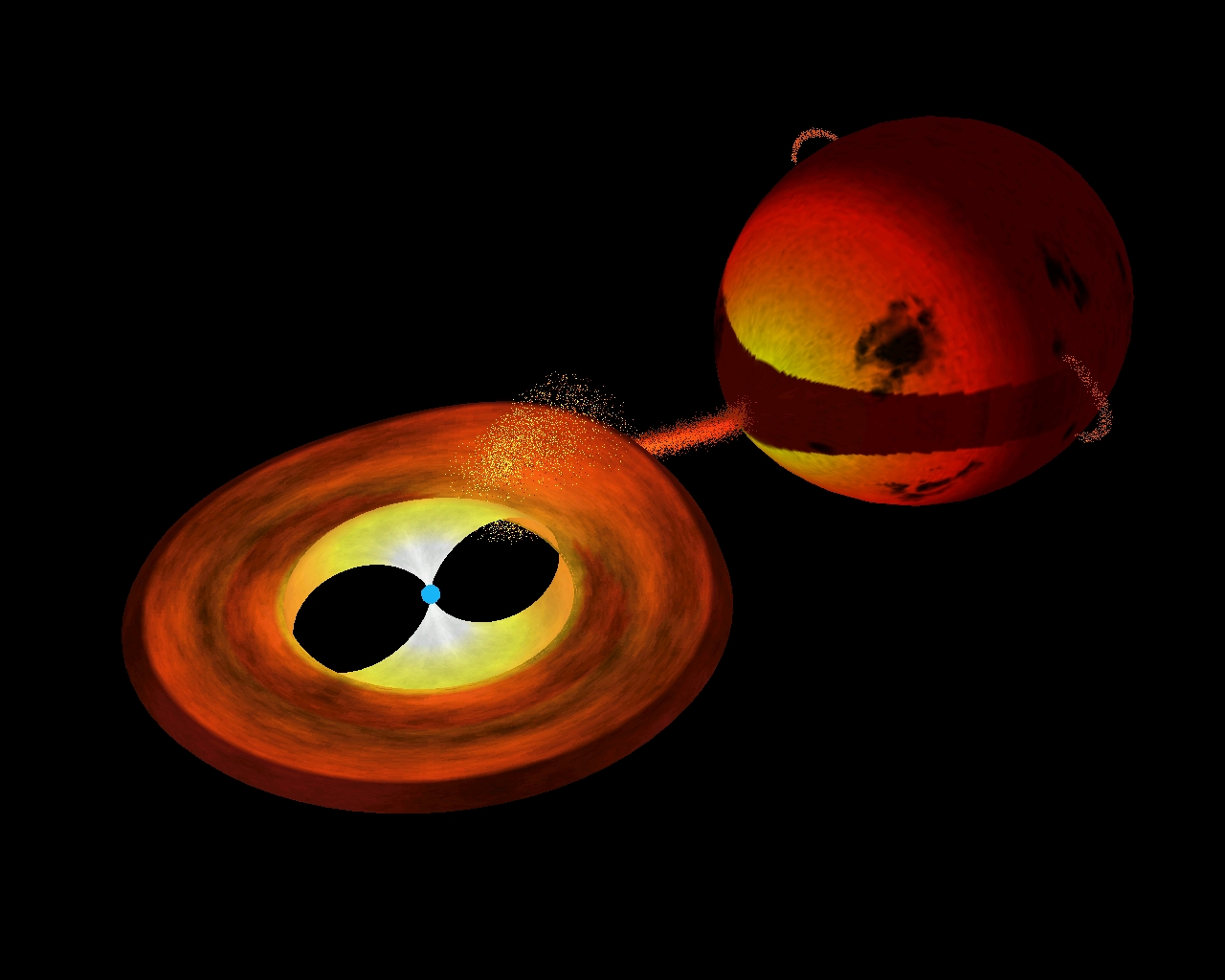
Figure 1. Artist impression of an intermediate polar. 
Image courtesy of Andrew Beardmore [JPEG ]. 
Astronomers from the University of Leuven (Belgium), the University of Warwick (UK) and the Universidad de La Laguna (Spain) have used the ISIS instrument at the WHT to monitor the accretion process in V455 And, an intermediate polar with a white dwarf that spins around its axis in just 67s. The team wanted to obtain optical spectra with integration times of only a few seconds, in order to clearly resolve the variations in the spectra during the spin period of the white dwarf.

Taking spectra with such short exposure times of a ~15th magnitude star is technically challenging but was possible by equipping ISIS with the QUCAM2 CCD instead of its standard chip. QUCAM2 is a Low Light Level CCD (L3CCD) that uses a special serial register which multiplies the number of electrons in the pixels before the readout takes place. Even a single photon then results in a signal that dwarfs readout noise in the final image. The CCD also has a frame transfer buffer, that allows one to store an image while it is being read out so that the CCD is immediately ready to take the next image, eliminating dead time between exposures.

 Figure 2. The average (black) spectrum of V455 And overplotted on a single spectrum (grey) [ JPEG ].
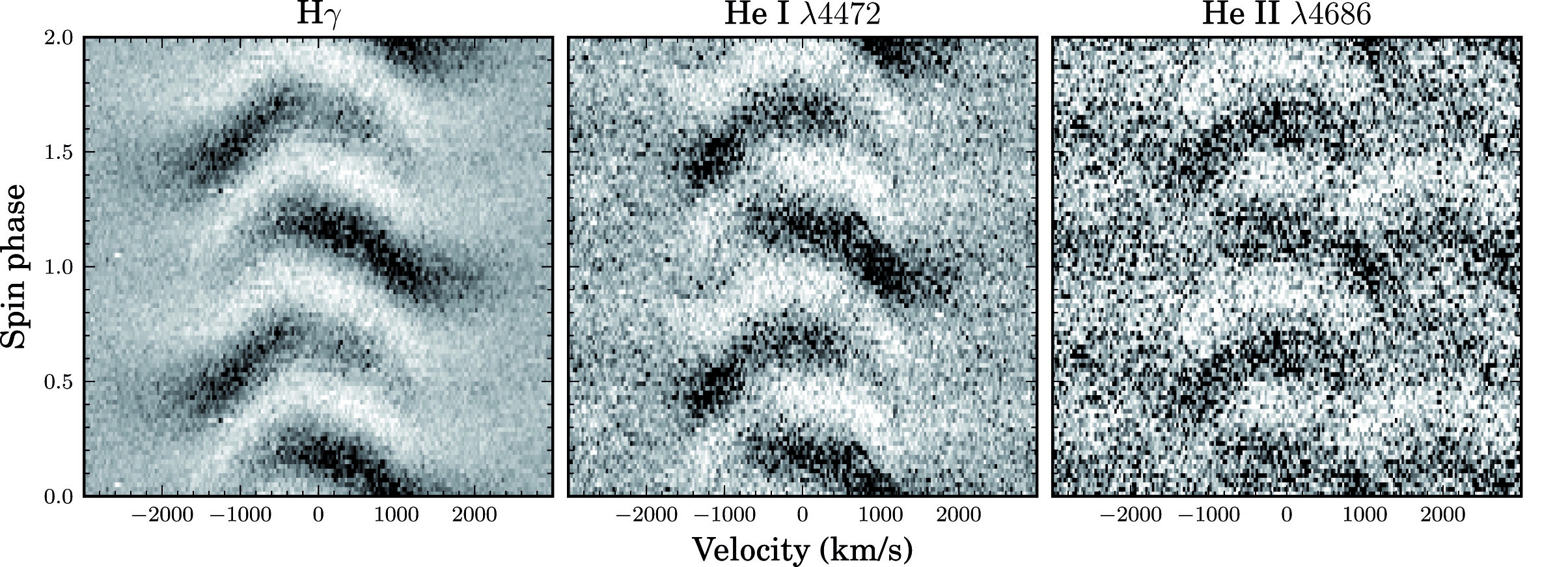
While a single spectrum with an integration time of 2 seconds does not reveal much signal, adding several spectra together easily allows detection of several spectral lines. This is shown in Figure 2, where a single spectrum is shown in grey and the average spectrum of the more than 15000 spectra the team obtained in black. By adding spectra together that were taken 67s apart, at identical spin phases of the white dwarf, the variations in the emission lines over the 67s cycle could be uncovered. 

The variations of the spectra compared to the average spectrum during two spin cycles are shown in Figure 3. While the variations can probably be explained by the emission from the magnetically controlled accretion near the surface of the white dwarf, e.g. emission from the accretion curtains, there is currently no specific model available that can reproduce the details uncovered in these observations. The data therefore present very valuable input for future modelling efforts of the accretion flows in intermediate polars with a short white dwarf spin period. This study also demonstrates the potential of L3CCDs, such as the QUCAM2 and QUCAM3 CCDs available for the WHT observers, for the study of rapid variability in relatively faint systems.

Figure 3. Normalised and mean subtracted line profiles, folded on the white dwarf spin period. White indicates lower than average fluxes, black higher than average [ JPEG ].


More information: 


Contact: Javier Méndez (Public Relations Officer) 


Friday, March 01, 2013

Fermi's Motion Produces a Study in Spirograph

NASA's Fermi Gamma-ray Space Telescope orbits our planet every 95 minutes, building up increasingly deeper views of the universe with every circuit. Its wide-eyed Large Area Telescope (LAT) sweeps across the entire sky every three hours, capturing the highest-energy form of light -- gamma rays -- from sources across the universe. These range from supermassive black holes billions of light-years away to intriguing objects in our own galaxy, such as X-ray binaries, supernova remnants and pulsars.

Now a Fermi scientist has transformed LAT data of a famous pulsar into a mesmerizing movie that visually encapsulates the spacecraft's complex motion.

The Vela pulsar outlines a fascinating pattern in this movie showing 51 months of position and exposure data from Fermi's Large Area Telescope (LAT). The pattern reflects numerous motions of the spacecraft, including its orbit around Earth, the precession of its orbital plane, the manner in which the LAT nods north and south on alternate orbits, and more. The movie renders Vela's position in a fisheye perspective, where the middle of the pattern corresponds to the central and most sensitive portion of the LAT's field of view. The edge of the pattern is 90 degrees away from the center and well beyond what scientists regard as the effective limit of the LAT's vision. Better knowledge of how the LAT's sensitivity changes across its field of view helps Fermi scientists better understand both the instrument and the data it returns. Credit: NASA/DOE/Fermi LAT Collaboration . › Download video in HD formats  -  › Watch this video on YouTube
 
Pulsars are neutron stars, the crushed cores of massive suns that destroyed themselves when they ran out of fuel, collapsed and exploded. The blast simultaneously shattered the star and compressed its core into a body as small as a city yet more massive than the sun. The result is an object of incredible density, where a spoonful of matter weighs as much as a mountain on Earth. Equally incredible is a pulsar's rapid spin, with typical rotation periods ranging from once every few seconds up to hundreds of times a second. Fermi sees gamma rays from more than a hundred pulsars scattered across the sky.

One pulsar shines especially bright for Fermi. Called Vela, it spins 11 times a second and is the brightest persistent source of gamma rays the LAT sees. Although gamma-ray bursts and flares from distant black holes occasionally outshine the pulsar, they don't have Vela's staying power. Because pulsars emit beams of energy, scientists often compare them to lighthouses, a connection that in a broader sense works especially well for Vela, which is both a brilliant beacon and a familiar landmark in the gamma-ray sky.
Fermi's Large Area Telescope is the spacecraft's main scientific instrument. This animation shows how a gamma ray (purple) entering the LAT is converted into an electron (red) and a positron (blue). High-precision detectors track the motion of the particles, whose paths point back to the gamma ray's source.  Credit: NASA's Goddard Space Flight Center Conceptual Image Lab . › Download video in HD formats

This image compresses the Vela movie sequence into a single snapshot by merging pie-slice sections from eight individual frames. Credit: NASA/DOE/Fermi LAT Collaboration . › Larger image 
 
Most telescopes focus on a very small region of the sky, but the LAT is a wide-field instrument that can detect gamma rays across a large portion of the sky at once. The LAT is, however, much more sensitive to gamma rays near the center of its field of view than at the edges. Scientists can use observations of a bright source like Vela to track how this sensitivity varies across the instrument's field of view.

With this in mind, LAT team member Eric Charles, a physicist at the Kavli Institute for Particle Astrophysics and Cosmology and the SLAC National Accelerator Laboratory at Stanford University in California, used the famous pulsar to produce a novel movie. He tracked both Vela's position relative to the center of the LAT’s field of view and the instrument's exposure of the pulsar during the first 51 months of Fermi’s mission, from Aug. 4, 2008, to Nov. 15, 2012.

The movie renders Vela’s position in a fisheye perspective, where the middle of the pattern corresponds to the central and most sensitive portion of the LAT’s field of view. The edge of the pattern is 90 degrees away from the center and well beyond what scientists regard as the effective limit of the LAT's vision.
The pulsar traces out a loopy, hypnotic pattern reminiscent of art produced by the colored pens and spinning gears of a Spirograph, a children's toy that produces geometric patterns.

The pattern created in the Vela movie reflects numerous motions of the spacecraft. The first is Fermi's 95-minute orbit around Earth, but there's another, subtler motion related to it. The orbit itself also rotates, a phenomenon called precession. Similar to the wobble of an unsteady top, Fermi's orbital plane makes a slow circuit around Earth every 54 days.

In order to capture the entire sky every two orbits, scientists deliberately nod the LAT in a repeating pattern from one orbit to the next. It first looks north on one orbit, south on the next, and then north again. Every few weeks, the LAT deviates from this pattern to concentrate on particularly interesting targets, such as eruptions on the sun, brief but brilliant gamma-ray bursts associated with the birth of stellar-mass black holes, and outbursts from supermassive black holes in distant galaxies.

The Vela movie captures one other Fermi motion. The spacecraft rolls to keep the sun from shining on and warming up the LAT's radiators, which regulate its temperature by bleeding excess heat into space.

The braided loops and convoluted curves drawn by Vela hint at the complexity of removing these effects from the torrent of data Fermi returns, but that’s a challenge LAT scientists long ago proved they could meet. Still going strong after more than four years on the job, Fermi continues its mission to map the high-energy sky, which is now something everyone can envision as a celestial Spriograph traced by a pulsar pen.

Related Links