Tuesday, October 27, 2009

The Evolving Search for the Nature of Dark Energy - Part 2

Up until about 400,000 years after the big bang the Universe was a liquid-like plasma of protons and electrons (“baryons”) in which photons of light were trapped; dark matter was also part of the mix. Imagine a single perturbation, like a stone dropped in a pond: baryons and photons ripple outward togther, traveling through the plasma in a sound wave. But when the Universe cooled enough for protons and electrons to recombine, it became transparent and the photons escaped, while the baryons, with nothing left to push them, stayed in place. The original perturbation and its echo form a unit on the baryon acoustic oscillation ruler. (Images from an animation by Martin White.)

The scale of variations in the cosmic microwave background and in the large-scale structure of the Universe constitute a ruler by which to measure the Universe's expansion history. (Images courtesy NASA’s Wilkinson Microwave Anisotropy Probe, left, and Sloan Digital Sky Survey, right. Click on image for best resolution)

Part 2 - Baryon Acoustic Oscillation: A Very Large Standard Ruler

If dark energy is real and not a flaw in our understanding of gravity, then the best way to understand it is by studying the expansion history of the Universe, according to Martin White, an astrophysicist at Berkeley Lab and a professor of astronomy and physics at UC Berkeley. “One way is with ‘standard candles’ – that is, supernovae,” White says. “Another way is with a ‘standard ruler.’”

Baryon acoustic oscillation, or BAO, may provide the ideal standard ruler. The scale is calibrated by the cosmic microwave background (CMB), which recorded the state of the Universe roughly 400,000 years after the Big Bang. At this early epoch, the standard ruler for BAO is detectable as periodic, minute variations in the temperature of the CMB. More recently, the ruler’s scale is evident in the regular clustering of galaxies and intergalactic gas, and is also present in the clumping of invisible dark matter. These oscillations can be measured both across the sky and in the line of sight (back in time).

Both signals have the same origin. The early universe was a liquid-like plasma of protons and electrons in which light was trapped, with dark matter also part of the mix. “Baryons” (ordinary matter) moved in “acoustic oscillations” (sound waves) through the plasma. When the Universe cooled enough for the protons and electrons to combine into hydrogen atoms, the photons were freed and the Universe became transparent. The dark matter stayed invisible, but variations in density left their mark in the CMB and were the seeds of large-scale structure in today’s universe, such as clusters of galaxies.

The first clear detection of a BAO signal was announced in 2005 by Daniel Eisenstein of the University of Arizona and his colleagues, who analyzed data from about 50,000 luminous red galaxies in the Sloan Digital Sky Survey (SDSS), plus some from a separate survey by the Two Degree Field Galaxy Redshift Survey based in Australia.

In a paper published in July 2007, Nikhil Padmanabhan, David Schlegel, and Uroš Seljak, all by then at Berkeley Lab, presented their work with colleagues in SDSS and members of the Australian survey to extend the analysis to 600,000 luminous red galaxies at distances up to 5.6 billion light-years. This report benefited from exploring the largest volume of space ever used for galaxy clustering measurements – approaching halfway back in time to the origin of the CMB. Although the survey did not depend on the redshifts of individual galaxies (instead estimating distance on the basis of the specific colors of the galaxies), it was able to establish a specific scale for the markings on the standard ruler: 450 light-years.

“Unfortunately it’s an inconveniently sized ruler, to put it mildly,” says Schlegel, a staff scientist in the Physics Division. “We had to sample a huge volume of the Universe just to fit the ruler inside.”

Big as the map was, and important as it was in establishing the real possibility of using the BAO standard ruler to measure the expansion history of the Universe, precision measurements were still a long way off. “We showed there was an effective ruler,” says Schlegel. “Now we had to use it.”

That effort got underway in September 2009, when the Baryon Oscillation Spectroscopic Survey, BOSS, recorded “first light” in what will be a five-year search to record the individual spectra of two million galaxies and quasars, plus variations in the density of the intergalactic gas, across a quarter of the entire sky. The oscillations of these “baryons” in many different forms, revealed in the periodicity of the large-scale structures of the Universe, will establish the accuracy of the cosmic ruler to a precision of one percent.

BOSS is the flagship survey of the third phase of the Sloan Digital Sky Survey, known as SDSS-III, which is headed by Daniel Eisenstein. Among other Berkeley Lab contributors to the collaboration, Schlegel is the principal investigator for BOSS, White is its survey scientist, and Natalie Roe of Berkeley Lab’s Physics Division is its instrument scientist.

The correlated results from supernovae and BAO measurements will home in on the expansion history of the Universe and make it possible to differentiate among the competing theories of its nature. But what if dark energy is an illusion, and what we take as evidence for dark energy is really just a flaw in our understanding of gravity?

Another technique, which relies upon the idea that large amounts of mass — whether visible or invisible — can distort our view of the light waves from even more distant objects beyond in known ways, may be the answer.

One way to find out is to measure the growth of structure in the Universe by means of weak gravitational lensing. Read on>

Additional information

The principles behind baryon acoustic oscillation are explained by Martin White at http://astro.berkeley.edu/~mwhite/bao/

Contact: Paul Preuss

The Evolving Search for the Nature of Dark Energy - Part 3

Mass can act like a lens: a mass like that of a star or giant planet can displace the apparent position of distant stars. Very massive objects like clumps of dark matter can be strong gravitational lenses. Weak lensing is less obvious but just as useful in “weighing” invisible dark matter. (Strong gravitational lens in Abell 2218 by Hubble Space Telescope; inset from Sean Carroll, “Spacetime and Geometry: An Introduction to General Relativity”)

Using weak lensing to deduce the large scale structure of the Universe at various epochs, researchers can measure the effects of dark energy on the growth of structure, a direct measurement of whether General Relativity gives the correct description of gravity.

Part 3 - Weak Gravitational Lensing: Using the Curvature of Space to Probe the Distant Universe

“Einstein’s theory of General Relativity is how we understand gravity,” says Martin White, “and it’s never a good idea to bet against Einstein.” Nevertheless, astronomers know a good way to test whether there’s a breakdown in General Relativity.

Gravitational lensing arises directly from Einstein’s realization that what we call gravity is the fact that mass curves the space-time fabric of the Universe. If there is a chunk of matter between us and a distant object – say, our Sun between us and a distant star – then the intervening mass of the Sun acts as a lens, bending space so as to enlarge and outwardly displace the distant star’s apparent position. In fact it was the displacement of stars during a solar eclipse, measured by Sir Arthur Eddington in 1919, that provided the first experimental evidence for Einstein’s revolutionary theory.

Obvious visible displacement is characteristic of a phenomenon known as strong gravitational lensing. Weak lensing is less obvious, but still measurable, as a statistical estimate of the distortion of the apparent size and shape (shear) of background galaxies behind an intervening mass – which may be a single galaxy, a cluster of galaxies, or a concentration of invisible dark matter.

“Because weak lensing can trace the evolution of all the matter in the Universe, visible and dark, a lot of people have been excited about using it to measure dark energy since at least the 1990s,” says Uroš Seljak, a member of Berkeley Lab’s Physics Division and a professor of astronomy and physics at UC Berkeley. “The problem is that for a long time it was difficult to implement on telescopes. It’s a subtle effect, and all sorts of distortions – in the atmosphere, the cameras, or the telescopes themselves – can interfere with good measurements.”

Weak lensing directly detects matter, including dark matter, but it can also be used to study dark energy, says Seljak, “because dark energy will affect how matter grows in time.”

In fact, says Seljak, “dark energy slows the growth of structure.” This is because structure results from the mutual gravitational attraction of matter; dense regions progressively grow more dense. But dark energy is “a sea of smooth energy” that uniformly expands space and everywhere acts against increasing density.

Seljak describes two ways that weak lensing can be measured. One, called “shear-shear” correlations, measures the combined effects of all the matter between us and the distant galaxies being observed – not the effect of any particular structure alone. “The farther away the galaxies we’re looking at are, the earlier in the history of the Universe we can observe,” he says. Effects of weak lensing have been detected at great distances, and there are even hints of weak lensing in the cosmic microwave background itself.

A different technique, for which Seljak uses the shorthand “galaxy-shear,” looks at weak lensing around galaxies or clusters of galaxies. This method is much less sensitive to spurious distortions than the cumulative shear-shear method, because with this technique many of the spurious distortions are self-canceling.


Using weak lensing to deduce the large scale structure of the Universe at various epochs, researchers can measure the effects of dark energy on the growth of structure, a direct measurement of whether General Relativity gives the correct description of gravity.

The two techniques are complementary; both require enormous databases, powerful computers, and programs that can derive the mass signature from the shear signal and find the constraints thus imposed on possible cosmologies, so that the results can be compared to the predicted effects of different theories of dark energy. Among the Berkeley Lab cosmologists who are investigating applications of weak lensing are Alexie Leauthaud and Reiko Nakajima of the Physics Division.

“Weak lensing is a powerful method for measuring the growth of structure over time,” says White. “General Relativity makes a unique prediction about the growth of structures. At a particular expansion rate, did structures grow according to Einstein? If Relativity is wrong, we’ll see it directly.”

More to come

Supernovae, baryon acoustic oscillations, and weak lensing are not the only techniques proposed for studying dark energy, although at present they are the most mature. So far, Type Ia supernovae have been the most used for measuring the expansion history of the Universe.

In addition to the Joint Dark Energy Mission satellite, which will apply all three methods, Berkeley Lab is participating in a number of other dark energy missions such as the multi-agency, multi-institutional, multinational Dark Energy Survey, in which a special red-sensitive camera will be mounted on a four-meter telescope in Chile with the stated goal of answering the question, “is the dark energy a cosmological constant?”

As in the beginning, the cosmological constant remains the favorite form of dark energy among many – although far from all – astronomers, astrophysicists, and cosmologists. But answering the question – cosmological constant or something else? – will be only the beginning of investigation into the nature of the biggest mystery in 21st-century physics.

Additional information
Weak lensing and other projects in cosmology are described by Uroš Seljak at http://www.physics.berkeley.edu/research/faculty/seljak.html

For more on weak lensing, watch Alexie Leauthaud and Reiko Nakajima’s Summer Lecture on “What is Gravitational Lensing” at http://www.youtube.com/berkeleylab#p/search/0/vIHDsrVECfE.

Contact: Paul Preuss

Thursday, October 22, 2009

JKCS041: Galaxy Cluster Smashes Distance Record

JKCS041 (1)
Credit X-ray: NASA/CXC/INAF/S.Andreon et al
Optical: DSS; ESO/VLT

JPEG (242 kb)
Tiff (5.6 MB)
PS (6.3 MB)
More Images
Press Room: JKCS041
Zoom-In (flash)

(1) This is a composite image of the most distant galaxy cluster yet detected. This image contains X-rays from NASA's Chandra X-ray Observatory, optical data from the Very Large Telescope (VLT) and optical and infrared data from the Digitized Sky Survey. This record-breaking object, known as JKCS041, is observed as it was when the Universe was just one quarter of its current age. X-rays from Chandra are displayed here as the diffuse blue region, while the individual galaxies in the cluster are seen in white in the VLT's optical data, embedded in the X-ray emission.

JKCS041 was originally detected in 2006 with infrared observations from the United Kingdom Infrared Telescope (UKIRT). The distance to the cluster was then determined from optical and infrared observations from UKIRT, the Canada-France-Hawaii telescope in Hawaii and NASA's Spitzer Space Telescope. However, scientists were not sure if it was a true galaxy cluster, rather than one that has been caught in the act of forming. The shape and extent of the X-ray emission in the Chandra data, however, provided the definitive evidence that showed that JKCS041 was, indeed, a galaxy cluster. The Chandra data also allowed scientists to rule out other possible explanations for the data, including a group of galaxies, or a filament of galaxies seen along the line of sight.

Galaxy clusters are the largest gravitationally-bound objects in the Universe. Scientists have calculated when they should start assembling in the early Universe, and JKCS041, at a distance of some 10.2 billion light years, is on the early edge of that epoch. Follow-on observations of JKCS041 will provide scientists with an opportunity to find important information about how the Universe evolved at this crucial stage.

Fast Facts for JKCS041:

Scale: Image is 370 arcmin across

Category:
Groups & Clusters of Galaxies
Coordinates: (J2000) RA 02h 26m 44s | Dec -04° 41' 45
Constellation:
Cetus
Observation Date: 11/23/2007
Observation Time: 20 hours and 50 minutes

Obs. ID: 9368

Color Code: X-ray (blue); Optical (Red, Green, Cyan)

Instrument:
ACIS
References: S.Andreon, et al., 2009, A&A, accepted
Distance Estimate: About 10.2 billion light years

Tuesday, October 20, 2009

Astronomers Do It Again: Find Organic Molecules Around Gas Planet

HD 209458b
Credit: NASA/JPL-Caltech/T. Pyle (SSC)

Peering far beyond our solar system, NASA researchers have detected the basic chemistry for life in a second hot gas planet, advancing astronomers toward the goal of being able to characterize planets where life could exist. The planet is not habitable but it has the same chemistry that, if found around a rocky planet in the future, could indicate the presence of life.

"It's the second planet outside our solar system in which water, methane and carbon dioxide have been found, which are potentially important for biological processes in habitable planets," said researcher Mark Swain of NASA's Jet Propulsion Laboratory, Pasadena, Calif. "Detecting organic compounds in two exoplanets now raises the possibility that it will become commonplace to find planets with molecules that may be tied to life."

Swain and his co-investigators used data from two of NASA's orbiting Great Observatories, the Hubble Space Telescope and Spitzer Space Telescope, to study HD 209458b, a hot, gaseous giant planet bigger than Jupiter that orbits a sun-like star about 150 light years away in the constellation Pegasus. The new finding follows their breakthrough discovery in December 2008 of carbon dioxide around another hot, Jupiter-size planet, HD 189733b. Earlier Hubble and Spitzer observations of that planet had also revealed water vapor and methane.

The detections were made through spectroscopy, which splits light into its components to reveal the distinctive spectral signatures of different chemicals. Data from Hubble's near-infrared camera and multi-object spectrometer revealed the presence of the molecules, and data from Spitzer's photometer and infrared spectrometer measured their amounts.

"This demonstrates that we can detect the molecules that matter for life processes," said Swain. Astronomers can now begin comparing the two planetary atmospheres for differences and similarities. For example, the relative amounts of water and carbon dioxide in the two planets is similar, but HD 209458b shows a greater abundance of methane than HD 189733b. "The high methane abundance is telling us something," said Swain. "It could mean there was something special about the formation of this planet."

Other large, hot Jupiter-type planets can be characterized and compared using existing instruments, Swain said. This work will lay the groundwork for the type of analysis astronomers eventually will need to perform in shortlisting any promising rocky Earth-like planets where the signatures of organic chemicals might indicate the presence of life.

Rocky worlds are expected to be found by NASA's Kepler mission, which launched earlier this year, but astronomers believe we are a decade or so away from being able to detect any chemical signs of life on such a body.

If and when such Earth-like planets are found in the future, "the detection of organic compounds will not necessarily mean there's life on a planet, because there are other ways to generate such molecules," Swain said. "If we detect organic chemicals on a rocky, Earth-like planet, we will want to understand enough about the planet to rule out non-life processes that could have led to those chemicals being there."

"These objects are too far away to send probes to, so the only way we're ever going to learn anything about them is to point telescopes at them. Spectroscopy provides a powerful tool to determine their chemistry and dynamics."

You can follow the history of planet hunting from science fiction to science fact with NASA's PlanetQuest Historic Timeline at http://planetquest.jpl.nasa.gov/timeline/timeline.html.

This interactive web feature, developed by JPL, conveys the story of exoplanet exploration through a rich tapestry of words and images spanning thousands of years, beginning with the musings of ancient philosophers and continuing through the current era of space-based observations by NASA's Spitzer and Kepler missions. The timeline highlights milestones in culture, technology and science, and includes a planet counter that tracks the pace of exoplanet discoveries over time.

More information about exoplanets and NASA's planet-finding program is at http://planetquest.jpl.nasa.gov.

The Hubble Space Telescope is a project of international cooperation between NASA and the European Space Agency and is managed by NASA's Goddard Space Flight Center in Greenbelt, Md. The Space Telescope Science Institute, Baltimore, Md., conducts Hubble science operations. The institute is operated for NASA by the Association of Universities for research in Astronomy, Inc., Washington, D.C.

Written by Mary Beth Murrill
Jet Propulsion Laboratory

Monday, October 19, 2009

32 New Exoplanets Found

ESO PR Photo 39a/09
The system Gliese 667
(Artist’s impression)

ESO PR Video 39a/09
ESOCast 11: 32 New
Exoplanets Found

ESO PR Video 39b/09
The system Gliese 667
(Artist’s impression)

ESO PR Video 39c/09
Video News Release:
32 New Exoplanets Found

Today, at an international ESO/CAUP exoplanet conference in Porto, the team who built the High Accuracy Radial Velocity Planet Searcher, better known as HARPS, the spectrograph for ESO's 3.6-metre telescope, reports on the incredible discovery of some 32 new exoplanets, cementing HARPS's position as the world’s foremost exoplanet hunter. This result also increases the number of known low-mass planets by an impressive 30%. Over the past five years HARPS has spotted more than 75 of the roughly 400 or so exoplanets now known.

"HARPS is a unique, extremely high precision instrument that is ideal for discovering alien worlds," says Stéphane Udry, who made the announcement. “We have now completed our initial five-year programme, which has succeeded well beyond our expectations.”

The latest batch of exoplanets announced today comprises no less than 32 new discoveries. Including these new results, data from HARPS have led to the discovery of more than 75 exoplanets in 30 different planetary systems. In particular, thanks to its amazing precision, the search for small planets, those with a mass of a few times that of the Earth — known as super-Earths and Neptune-like planets — has been given a dramatic boost. HARPS has facilitated the discovery of 24 of the 28 planets known with masses below 20 Earth masses. As with the previously detected super-Earths, most of the new low-mass candidates reside in multi-planet systems, with up to five planets per system.

In 1999, ESO launched a call for opportunities to build a high resolution, extremely precise spectrograph for the ESO 3.6-metre telescope at La Silla, Chile. Michel Mayor, from the Geneva Observatory, led a consortium to build HARPS, which was installed in 2003 and was soon able to measure the back-and-forward motions of stars by detecting small changes in a star’s radial velocity — as small as 3.5 km/hour, a steady walking pace. Such a precision is crucial for the discovery of exoplanets and the radial velocity method, which detects small changes in the radial velocity of a star as it wobbles slightly under the gentle gravitational pull from an (unseen) exoplanet, has been most prolific method in the search for exoplanets.

In return for building the instrument, the HARPS consortium was granted 100 observing nights per year during a five-year period to carry out one of the most ambitious systematic searches for exoplanets so far implemented worldwide by repeatedly measuring the radial velocities of hundreds of stars that may harbour planetary systems.

The programme soon proved very successful. Using HARPS, Mayor’s team discovered — among others — in 2004, the first super-Earth (around µ Ara; ESO 22/04); in 2006, the trio of Neptunes around HD 69830 (ESO 18/06); in 2007, Gliese 581d, the first super Earth in the habitable zone of a small star (ESO 22/07); and in 2009, the lightest exoplanet so far detected around a normal star, Gliese 581e (ESO 15/09). More recently, they found a potentially lava-covered world, with density similar to that of the Earth’s (ESO 33/09).

“These observations have given astronomers a great insight into the diversity of planetary systems and help us understand how they can form,” says team member Nuno Santos.

The HARPS consortium was very careful in their selection of targets, with several sub-programmes aimed at looking for planets around solar-like stars, low-mass dwarf stars, or stars with a lower metal content than the Sun. The number of exoplanets known around low-mass stars — so-called M dwarfs — has also dramatically increased, including a handful of super Earths and a few giant planets challenging planetary formation theory.

“By targeting M dwarfs and harnessing the precision of HARPS we have been able to search for exoplanets in the mass and temperature regime of super-Earths, some even close to or inside the habitable zone around the star,” says co-author Xavier Bonfils.

The team found three candidate exoplanets around stars that are metal-deficient. Such stars are thought to be less favourable for the formation of planets, which form in the metal-rich disc around the young star. However, planets up to several Jupiter masses have been found orbiting metal-deficient stars, setting an important constraint for planet formation models.

Although the first phase of the observing programme is now officially concluded, the team will pursue their effort with two ESO Large Programmes looking for super-Earths around solar-type stars and M dwarfs and some new announcements are already foreseen in the coming months, based on the last five years of measurements. There is no doubt that HARPS will continue to lead the field of exoplanet discoveries, especially pushing towards the detection of Earth-type planets.

More Information

This discovery was announced today at the ESO/CAUP conference “Towards Other Earths: perspectives and limitations in the ELT era", taking place in Porto, Portugal, on 19–23 October 2009. This conference discusses the new generation of instruments and telescopes that is now being conceived and built by different teams around the world to allow the discovery of other Earths, especially for the European Extremely Large Telescope (E-ELT). The new planets are simultaneously presented by Michel Mayor at the international symposium “Heirs of Galileo: Frontiers of Astronomy” in Madrid, Spain.

This research was presented in a series of eight papers submitted — or soon to be submitted — to the Astronomy and Astrophysics journal.

The team is composed of
  • Geneva Observatory: M. Mayor, S. Udry, D. Queloz, F. Pepe, C. Lovis, D. Ségransan, X. Bonfils
  • LAOG Grenoble: X. Delfosse, T. Forveille, X. Bonfils, C. Perrier
  • CAUP Porto: N.C. Santos
  • ESO: G. Lo Curto, D. Naef
  • University of Bern: W. Benz, C. Mordasini
  • IAP Paris: F. Bouchy, G. Hébrard
  • LAM Marseille: C. Moutou
  • Service d’aéronomie, Paris: J.-L. Bertaux
ESO, the European Southern Observatory, is the foremost intergovernmental astronomy organisation in Europe and the world’s most productive astronomical observatory. It is supported by 14 countries: Austria, Belgium, the Czech Republic, Denmark, France, Finland, Germany, Italy, the Netherlands, Portugal, Spain, Sweden, Switzerland and the United Kingdom. ESO carries out an ambitious programme focused on the design, construction and operation of powerful ground-based observing facilities enabling astronomers to make important scientific discoveries. ESO also plays a leading role in promoting and organising cooperation in astronomical research. ESO operates three unique world-class observing sites in Chile: La Silla, Paranal and Chajnantor. At Paranal, ESO operates the Very Large Telescope, the world’s most advanced visible-light astronomical observatory. ESO is the European partner of a revolutionary astronomical telescope ALMA, the largest astronomical project in existence. ESO is currently planning a 42-metre European Extremely Large optical/near-infrared Telescope, the E-ELT, which will become “the world’s biggest eye on the sky”.

Links

The web page of the conference “Towards Other Earths: perspectives and limitations in the ELT era" is at http://www.astro.up.pt/investigacao/conferencias/toe2009/

Contacts

Stéphane Udry
Geneva University, Switzerland
Phone: +41 22 379 2467
E-mail: stephane.udry@unige.ch

Xavier Bonfils
Université Joseph Fourier - Grenoble 1 / CNRS,
Laboratoire d'Astrophysique de Grenoble (LAOG), France
Phone : +33 47 65 14 215
E-mail: xavier.bonfils@obs.ujf-grenoble.fr

Nuno Santos
Centro de Astrofisica da Universidade do Porto,
Portugal
Phone: +351 226 089 893
E-mail: Nuno.Santos@astro.up.pt

ESO La Silla - Paranal - ELT Press Officer: Henri Boffin - +49 89 3200 6222 - hbofin@eso.org

ESO Press Officer in Chile: Valeria Foncea - +56 2 463 3123 - vfoncea@eso.org

National contacts for the media: http://www.eso.org/public/outreach/eson/

Thursday, October 15, 2009

IBEX Explores Galactic Frontier, Releases First-Ever All-Sky Map

This animation portrays how the entire sky is flattened to the two-dimensional maps that IBEX presents. Credit: NASA/Goddard Space Flight Center

This animation zooms in from a view of the Milky Way Galaxy to our heliosphere. It sets the scale for our home in the galaxy. Credit: NASA/Goddard Space Flight Center

NASA's Interstellar Boundary Explorer, or IBEX, spacecraft has made it possible for scientists to construct the first comprehensive sky map of our solar system and its location in the Milky Way galaxy. The new view will change the way researchers view and study the interaction between our galaxy and sun.

The sky map was produced with data that two detectors on the spacecraft collected during six months of observations. The detectors measured and counted particles scientists refer to as energetic neutral atoms.

The energetic neutral atoms are created in an area of our solar system known as the interstellar boundary region. This region is where charged particles from the sun, called the solar wind, flow outward far beyond the orbits of the planets and collide with material between stars. The energetic neutral atoms travel inward toward the sun from interstellar space at velocities ranging from 100,000 mph to more than 2.4 million mph. This interstellar boundary emits no light that can be collected by conventional telescopes.

The new map reveals the region that separates the nearest reaches of our galaxy, called the local interstellar medium, from our heliosphere -- a protective bubble that shields and protects our solar system from most of the dangerous cosmic radiation traveling through space.

"For the first time, we're sticking our heads out of the sun's atmosphere and beginning to really understand our place in the galaxy," said David J. McComas, IBEX principal investigator and assistant vice president of the Space Science and Engineering Division at Southwest Research Institute in San Antonio. "The IBEX results are truly remarkable, with a narrow ribbon of bright details or emissions not resembling any of the current theoretical models of this region."

NASA released the sky map image Oct. 15 in conjunction with publication of the findings in the journal Science. The IBEX data were complemented and extended by information collected using an imaging instrument sensor on NASA's Cassini spacecraft. Cassini has been observing Saturn, its moons and rings since the spacecraft entered the planet's orbit in 2004.

The IBEX sky maps also put observations from NASA's Voyager spacecraft into context. The twin Voyager spacecraft, launched in 1977, traveled to the outer solar system to explore Jupiter, Saturn, Uranus and Neptune. In 2007, Voyager 2 followed Voyager 1 into the interstellar boundary. Both spacecraft are now in the midst of this region where the energetic neutral atoms originate. However, the IBEX results show a ribbon of bright emissions undetected by the two Voyagers.

"The Voyagers are providing ground truth, but they're missing the most exciting region," said Eric Christian, the IBEX deputy mission scientist at NASA's Goddard Space Flight Center in Greenbelt, Md. "It's like having two weather stations that miss the big storm that runs between them."

The IBEX spacecraft was launched in October 2008. Its science objective was to discover the nature of the interactions between the solar wind and the interstellar medium at the edge of our solar system. The Southwest Research Institute developed and leads the mission with a team of national and international partners. The spacecraft is the latest in NASA's series of low-cost, rapidly developed Small Explorers Program. NASA's Goddard Space Flight Center manages the program for the agency's Science Mission Directorate at NASA Headquarters in Washington.

The Cassini-Huygens mission is a cooperative project of NASA and the European and Italian Space Agencies. NASA's Jet Propulsion Laboratory in Pasadena, Calif., provides overall management for Cassini and the Voyagers for the Science Mission Directorate.

Related Links:

Press Release
IBEX Briefing Visuals

Wednesday, October 14, 2009

The Milky Way's Tiny but Tough Galactic Neighbour

ESO PR Photo 38a/09
Barnard's Galaxy

ESO PR Video 38a/09
Zooming in on Barnard's Galaxy

Today ESO announces the release of a stunning new image of one of our nearest galactic neighbours, Barnard's Galaxy, also known as NGC 6822. The galaxy contains regions of rich star formation and curious nebulae, such as the bubble clearly visible in the upper left of this remarkable vista. Astronomers classify NGC 6822 as an irregular dwarf galaxy because of its odd shape and relatively diminutive size by galactic standards. The strange shapes of these cosmic misfits help researchers understand how galaxies interact, evolve and occasionally "cannibalise" each other, leaving behind radiant, star-filled scraps.

In the new ESO image, Barnard’s Galaxy glows beneath a sea of foreground stars in the direction of the constellation of Sagittarius (the Archer). At the relatively close distance of about 1.6 million light-years, Barnard’s Galaxy is a member of the Local Group (ESO 11/96), the archipelago of galaxies that includes our home, the Milky Way. The nickname of NGC 6822 comes from its discoverer, the American astronomer Edward Emerson Barnard, who first spied this visually elusive cosmic islet using a 125-millimetre aperture refractor in 1884.

Astronomers obtained this latest portrait using the Wide Field Imager (WFI) attached to the 2.2-metre MPG/ESO telescope at ESO’s La Silla Observatory in northern Chile. Even though Barnard’s Galaxy lacks the majestic spiral arms and glowing, central bulge that grace its big galactic neighbours, the Milky Way, the Andromeda and the Triangulum galaxies, this dwarf galaxy has no shortage of stellar splendour and pyrotechnics. Reddish nebulae in this image reveal regions of active star formation, where young, hot stars heat up nearby gas clouds. Also prominent in the upper left of this new image is a striking bubble-shaped nebula. At the nebula’s centre, a clutch of massive, scorching stars send waves of matter smashing into the surrounding interstellar material, generating a glowing structure that appears ring-like from our perspective. Other similar ripples of heated matter thrown out by feisty young stars are dotted across Barnard’s Galaxy.

At only about a tenth of the Milky Way's size, Barnard’s Galaxy fits its dwarfish classification. All told, it contains about 10 million stars — a far cry from the Milky Way’s estimated 400 billion. In the Local Group, as elsewhere in the Universe, however, dwarf galaxies outnumber their larger, shapelier cousins.

Irregular dwarf galaxies like Barnard’s Galaxy get their random, blob-like forms from close encounters with or "digestion" by other galaxies. Like everything else in the Universe, galaxies are in motion, and they often make close passes or even go through one another. The density of stars in galaxies is quite low, meaning that few stars physically collide during these cosmic dust-ups. Gravity's fatal attraction, however, can dramatically warp and scramble the shapes of the passing or crashing galaxies. Whole bunches of stars are pulled or flung from their galactic home, in turn forming irregularly shaped dwarf galaxies like NGC 6822.

More Information

ESO, the European Southern Observatory, is the foremost intergovernmental astronomy organisation in Europe and the world's most productive astronomical observatory. It is supported by 14 countries: Austria, Belgium, the Czech Republic, Denmark, France, Finland, Germany, Italy, the Netherlands, Portugal, Spain, Sweden, Switzerland and the United Kingdom. ESO carries out an ambitious programme focused on the design, construction and operation of powerful ground-based observing facilities enabling astronomers to make important scientific discoveries. ESO also plays a leading role in promoting and organising cooperation in astronomical research. ESO operates three unique world-class observing sites in Chile: La Silla, Paranal and Chajnantor. At Paranal, ESO operates the Very Large Telescope, the world’s most advanced visible-light astronomical observatory. ESO is the European partner of a revolutionary astronomical telescope ALMA, the largest astronomical project in existence. ESO is currently planning a 42-metre European Extremely Large optical/near-infrared Telescope, the E-ELT, which will become "the world's biggest eye on the sky".

Contact

Henri Boffin
ESO La Silla - Paranal - ELT Press Officer
Phone: +49 89 3200 6222
E-mail: hboffin@eso.org

ESO Press Officer in Chile: Valeria Foncea - +56 2 463 3123 - vfoncea@eso.org

National contacts for the media: http://www.eso.org/public/outreach/eson/

Tuesday, October 13, 2009

Sky merger yields sparkling dividends

Credit: NASA, ESA and A. Evans
(Stony Brook University, New York)

A recent NASA/ESA Hubble Space Telescope image captures what appears to be one very bright and bizarre galaxy, but is actually the result of a pair of spiral galaxies that resemble our own Milky Way smashing together at breakneck speeds. The product of this dramatic collision, called NGC 2623, or Arp 243, is about 250 million light-years away in the constellation of Cancer (the Crab).

Not surprisingly, interacting galaxies have a dramatic effect on each other. Studies have revealed that as galaxies approach one another massive amounts of gas are pulled from each galaxy towards the centre of the other, until ultimately, the two merge into one massive galaxy. The object in the image, NGC 2623, is in the late stages of the merging process with the centres of the original galaxy pair now merged into one nucleus. However, stretching out from the centre are two tidal tails of young stars showing that a merger has taken place. During such a collision, the dramatic exchange of mass and gases initiates star formation, seen here in both the tails.

The prominent lower tail is richly populated with bright star clusters — 100 of them have been found in these observations. The large star clusters that the team have observed in the merged galaxy are brighter than the brightest clusters we see in our own vicinity. These star clusters may have formed as part of a loop of stretched material associated with the northern tail, or they may have formed from debris falling back onto the nucleus. In addition to this active star-forming region, both galactic arms harbour very young stars in the early stages of their evolutionary journey.

Some mergers (including NGC 2623) can result in an active galactic nucleus, where one of the supermassive black holes found at the centres of the two original galaxies is stirred into action. Matter is pulled toward the black hole, forming an accretion disc. The energy released by the frenzied motion heats up the disc, causing it to emit across a wide swath of the electromagnetic spectrum.

NGC 2623 is so bright in the infrared that it belongs to the group of very luminous infrared galaxies (LIRG) and has been extensively studied as the part of the Great Observatories All-sky LIRG Survey (GOALS) project that combines data from some of the most advanced space-based telescopes, including Hubble. Additional data from infrared and X-ray telescopes can further characterise objects like active galactic nuclei and nuclear star formation by revealing what is unseen at visible wavelengths.

The GOALS project includes data from NASA/ESA's Hubble Space Telescope, NASA's Spitzer Space Telescope, NASA's Chandra X-ray Observatory and NASA's Galaxy Evolution Explorer (GALEX). The joint efforts of these powerful observing facilities have provided a clearer picture of our local Universe.

This data used for this colour composite were taken in 2007 by the Advanced Camera for Surveys (ACS) aboard Hubble. The observations were led by astronomer Aaron S. Evans. A team of over 30 astronomers, including Evans, recently published an important overview paper, detailing the first results of the GOALS project. Observations from ESA's X-ray Multi-Mirror Mission (XMM-Newton) telescope contributed to the astronomers' understanding of NGC 2623.

Notes for editors:

The Hubble Space Telescope is a project of international cooperation between ESA and NASA.

Image credit: NASA, ESA and A. Evans (Stony Brook University, New York & National Radio Astronomy Observatory, Charlottesville, USA)

Links:

GOALS
NGC 2623 paper
GOALS overview paper

Contacts:

Colleen Sharkey
Hubble/ESA, Garching, Germany
Tel: +49 89 3200 6306
Cell: +49 151 153 73591
E-mail: csharkey@eso.org

Aaron S. Evans
University of Virginia, Charlottesville, USA
National Radio Astronomy Observatory, Charlottesville, USA
Tel: +1-434-924-4896
E-mail: aevans@virginia.edu

Wednesday, October 07, 2009

NASA Space Telescope Discovers Largest Ring Around Saturn

Credit: NASA/JPL-Caltech/Univ. of Virginia

Credit:NASA/JPL-Caltech

Credit: NASA/JPL-Caltech/Keck

Credit: NASA/JPL-Caltech

PASADENA, Calif. — NASA's Spitzer Space Telescope has discovered an enormous ring around Saturn — by far the largest of the giant planet's many rings.

The new belt lies at the far reaches of the Saturnian system, with an orbit tilted 27 degrees from the main ring plane. The bulk of its material starts about six million kilometers (3.7 million miles) away from the planet and extends outward roughly another 12 million kilometers (7.4 million miles). One of Saturn's farthest moons, Phoebe, circles within the newfound ring, and is likely the source of its material.

Saturn's newest halo is thick, too — its vertical height is about 20 times the diameter of the planet. It would take about one billion Earths stacked together to fill the ring.

"This is one supersized ring," said Anne Verbiscer, an astronomer at the University of Virginia, Charlottesville. "If you could see the ring, it would span the width of two full moons' worth of sky, one on either side of Saturn." Verbiscer; Douglas Hamilton of the University of Maryland, College Park; and Michael Skrutskie, of the University of Virginia, Charlottesville, are authors of a paper about the discovery to be published online tomorrow by the journal Nature.

An artist's concept of the newfound ring is online at http://www.nasa.gov/mission_pages/spitzer/multimedia/spitzer-20091007a.html.

The ring itself is tenuous, made up of a thin array of ice and dust particles. Spitzer's infrared eyes were able to spot the glow of the band's cool dust. The telescope, launched in 2003, is currently 107 million kilometers (66 million miles) from Earth in orbit around the sun.

The discovery may help solve an age-old riddle of one of Saturn's moons. Iapetus has a strange appearance — one side is bright and the other is really dark, in a pattern that resembles the yin-yang symbol. The astronomer Giovanni Cassini first spotted the moon in 1671, and years later figured out it has a dark side, now named Cassini Regio in his honor. A stunning picture of Iapetus taken by NASA's Cassini spacecraft is online at http://photojournal.jpl.nasa.gov/catalog/PIA08384.

Saturn's newest addition could explain how Cassini Regio came to be. The ring is circling in the same direction as Phoebe, while Iapetus, the other rings and most of Saturn's moons are all going the opposite way. According to the scientists, some of the dark and dusty material from the outer ring moves inward toward Iapetus, slamming the icy moon like bugs on a windshield.

"Astronomers have long suspected that there is a connection between Saturn's outer moon Phoebe and the dark material on Iapetus," said Hamilton. "This new ring provides convincing evidence of that relationship."

Verbiscer and her colleagues used Spitzer's longer-wavelength infrared camera, called the multiband imaging photometer, to scan through a patch of sky far from Saturn and a bit inside Phoebe's orbit. The astronomers had a hunch that Phoebe might be circling around in a belt of dust kicked up from its minor collisions with comets — a process similar to that around stars with dusty disks of planetary debris. Sure enough, when the scientists took a first look at their Spitzer data, a band of dust jumped out.

The ring would be difficult to see with visible-light telescopes. Its particles are diffuse and may even extend beyond the bulk of the ring material all the way in to Saturn and all the way out to interplanetary space. The relatively small numbers of particles in the ring wouldn't reflect much visible light, especially out at Saturn where sunlight is weak.

"The particles are so far apart that if you were to stand in the ring, you wouldn't even know it," said Verbiscer.

Spitzer was able to sense the glow of the cool dust, which is only about 80 Kelvin (minus 316 degrees Fahrenheit). Cool objects shine with infrared, or thermal radiation; for example, even a cup of ice cream is blazing with infrared light. "By focusing on the glow of the ring's cool dust, Spitzer made it easy to find," said Verbiscer.

These observations were made before Spitzer ran out of coolant in May and began its "warm" mission.

Whitney Clavin 818-354-4673
Jet Propulsion Laboratory, Pasadena, Calif.

whitney.clavin@jpl.nasa.gov

ssc2009-19
jpl2009-150


Printable version (PDF) of this release

Tuesday, October 06, 2009

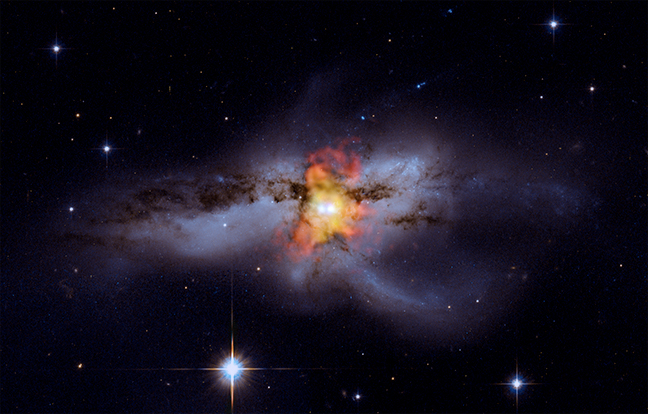
NGC 6240: Black Holes Go "Mano A Mano"


Credit X-ray (NASA/CXC/MIT/C.Canizares, M.Nowak);
Optical (NASA/STScI)


This image of NGC 6240 contains new X-ray data from Chandra (shown in red, orange, and yellow) that has been combined with an optical image from the Hubble Space Telescope originally released in 2008. In 2002, the discovery of two merging black holes was announced based on Chandra data in this galaxy. The two black holes are a mere 3,000 light years apart and are seen as the bright point-like sources in the middle of the image.

Scientists think these black holes are in such close proximity because they are in the midst of spiraling toward each other - a process that began about 30 million years ago. It is estimated that the two black holes will eventually drift together and merge into a larger black hole some tens or hundreds of millions of years from now.

Finding and studying merging black holes has become a very active field of research in astrophysics. Since 2002, there has been intense interest in follow-up observations of NGC 6240 by Chandra and other telescopes, as well as a search for similar systems. Understanding what happens when these exotic objects interact with one another remains an intriguing question for scientists.

The formation of multiple systems of supermassive black holes should be common in the Universe, since many galaxies undergo collisions and mergers with other galaxies, most of which contain supermassive black holes. It is thought that pairs of massive black holes can explain some of the unusual behavior seen by rapidly growing supermassive black holes, such as the distortion and bending seen in the powerful jets they produce. Also, pairs of massive black holes in the process of merging are expected to be the most powerful sources of gravitational waves in the Universe.

Fast Facts for NGC 6240:

Scale: Image is 124 arcmin across
Category: Black Holes, Normal Galaxies & Starburst Galaxies
Coordinates: (J2000) RA 16h 52m 59s | Dec +02° 24' 01.70
Constellation: Ophiuchus
Observation Date: May 11, 2006
Observation Time: 40 hours
Obs. ID: 6909
Color Code: red (0.5-1.5 keV); green (1.5-5 keV); blue (5-8 keV)
Instrument: ACIS
Distance Estimate: About 330 million light years (redshift = 0.0245)


Friday, October 02, 2009

Herschel views deep-space pearls on a cosmic string

HI-RES JPEG (Size: 863 kb)
Credits: ESA and the SPIRE & PACS consortia

Herschel has delivered spectacular vistas of cold gas clouds lying near the plane of the Milky Way, revealing intense, unexpected activity. The dark, cool region is dotted with stellar factories, like pearls on a cosmic string.

On 3 September, Herschel aimed its telescope at a reservoir of cold gas in the constellation of the Southern Cross near the Galactic Plane. As the telescope scanned the sky, the spacecraft’s Spectral and Photometric Imaging REceiver, SPIRE, and Photoconductor Array Camera and Spectrometer, PACS instruments snapped the pictures. The region is located about 60° from the Galactic Centre, thousands of light-years from Earth.

The five original infrared wavelengths have been colour-coded to allow scientists to differentiate extremely cold material (red) from the surrounding, slightly warmer stuff (blue).

The images reveal structure in cold material in our Galaxy, as we have never seen it before, and even before a detailed analysis, scientists have gleaned information on the quantity of the material, its mass, temperature, composition and whether it is collapsing to form new stars.

HI-RES JPEG (Size: 128 kb)
Credits: Left panel: ESA and the SPIRE consortium,
Right panel: ESA and the PACS consortium

That a dark, cool area such as this would be bustling with activity, was unexpected. But the images reveal a surprising amount of turmoil: the interstellar material is condensing into continuous and interconnected filaments glowing from the light emitted by new-born stars at various stages of development. Ours is a tireless Galaxy constantly forging new generations of stars.

Stars form in cold, dense environments, and in these images it is easy to locate the star-forming filaments that would be very difficult to isolate in a single-wavelength image.

Traditionally, in a crowded region like this, situated in the plane of our Galaxy and containing many molecular clouds along the line of sight, astronomers have had a difficult time resolving details. But Herschel’s sophisticated infrared instruments made short work of the task, seeing through the dust that is opaque to visible light, and seeing the glow from the dust itself. These observations are not possible from ground.

The result is a view of an incredible network of filamentary structures, and features indicating a chain of near-simultaneous star-formation events, glittering like strings of pearls deep in our Galaxy.

HI-RES JPEG (Size: 941 kb)
Credits: ESA and the PACS consortium

HI-RES JPEG (Size: 325 kb)
Credits: ESA and the SPIRE consortium

Thursday, October 01, 2009

First Light for BOSS – A New Kind of Search for Dark Energy

Optical image of one of the approximately 200 quasars captured in the first full focal plane exposure taken by BOSS (photo by David Hogg, New York University)

The spectrum of one of the quasars captured in the BOSS "first light" exposure.
Image: Bhardwaj, Hogg, Ross (best resolution)

One of the BOSS cartridges containing 1,000 optical fibers, which guide light from specific target galaxies and quasars to the spectrograph; Sloan Foundation telescope in background (photo by Dan Long, Senior Operations Engineer, Apache Point Observatory

Berkeley, CA - BOSS, the Baryon Oscillation Spectroscopic Survey, is the most ambitious attempt yet to map the expansion history of the Universe using the technique known as baryon acoustic oscillation (BAO). A part of the Sloan Digital Sky Survey III (SDSS-III), BOSS achieved “first light” on the night of September 14-15, when it acquired data with an upgraded spectrographic system across the entire focal plane of the Sloan Foundation 2.5-meter telescope at Apache Point Observatory in New Mexico.

BOSS is the largest of four surveys in SDSS-III, with 160 participants from among SDSS-III’s 350 scientists and 42 institutions. BOSS’s principal investigator is David Schlegel, its survey scientist is Martin White, and its instrument scientist is Natalie Roe; all three are with the Physics Division of the U.S. Department of Energy’s Lawrence Berkeley National Laboratory. Daniel Eisenstein of the University of Arizona is the director of SDSS-III.

“Baryon oscillation is a fast-maturing method for measuring dark energy in a way that’s complementary to the proven techniques of supernova cosmology,” says Schlegel. “The data from BOSS will be some of the best ever obtained on the large-scale structure of the Universe.”

BOSS’s first exposure was made after many nights of clouds and rain in the Sacramento Mountains when spectroscopy was obtained of some 800 galaxies and 200 quasars in the constellation Aquarius. Team member Vaishali Bhardwaj, a graduate student at the University of Washington fresh from a summer internship at Berkeley Lab, helped operate the telescope. Bhardwaj’s teammate, Berkeley Lab postdoc Nic Ross, quipped that given the constellation where first light was obtained, the accomplishment marked the “dawning of the Age of Aquarius.”

Measuring baryon oscillations

Baryon oscillations began as pressure waves propagated through the hot plasma of the early universe, creating regions of varying density that can be read today as temperature variations in the cosmic microwave background. The same density variations left their mark as the Universe evolved, in the periodic clustering of visible matter in galaxies, quasars, and intergalactic gas, as well as in the clumping of invisible dark matter.

Comparing these scales at different eras makes it possible to trace the details of how the Universe has expanded throughout its history – information that can be used to distinguish among competing theories of dark energy.

BOSS will measure 1.4 million luminous red galaxies at redshifts up to 0.7 (when the Universe was roughly seven billion years old) and 160,000 quasars at redshifts between 2.0 and 3.0 (when the Universe was only about three billion years old). BOSS will also measure variations in the density of hydrogen gas between the galaxies. The observation program will take five years.

“BOSS will survey the immense volume required to obtain percent-level measurements of the BAO scale and transform the BAO technique into a precision cosmological probe,” says survey scientist White. “The high precision, enormous dynamic range, and wide redshift span of the BOSS clustering measurements translate into a revolutionary data set, which will provide rich insights into the origin of cosmic structure and the contents of the Universe.”

Existing SDSS spectrographs were upgraded to include new red cameras more sensitive to the red portion of the spectrum, featuring CCDs designed and fabricated at Berkeley Lab, with much higher efficiency than standard astronomical CCDs in the near infrared.

“Visible light emitted by distant galaxies arrives at Earth redshifted into the near-infrared, so the improved sensitivity of these CCDs allows us to look much further back in time,” says BOSS instrument scientist Roe.

To make these measurements BOSS will craft two thousand metal plates to fit the telescope’s focal plane, plotting the precise locations of two million objects across the northern sky. Each morning astronomers begin plugging optical fibers into a thousand tiny holes in each of the “plug plates” to carry the light from each specific target object to an array of spectrographs.

Glitches met and surmounted

Steering each optical fiber to the right CCD was no trivial task, says Schlegel. “The new BOSS fiber cartridges are snake pits of a thousand fibers each. It would be a disaster if you didn’t know which one went where.”

With a thousand holes in each plug plate, stopping to seek out specific holes to plug a fiber into, or tracing where each fiber ends up, would take an impossibly long time. Instead a computer assigns the correct target identity to each fiber as a fiber-mapping laser beam moves over the plugged-in fibers and records where the light from each emerges.

Fast and simple – but not quite foolproof. “In our first test images it looked like we’d just taken random spectra from all over,” Schlegel says. After some hair-pulling, the problem turned out to be simple. “After we flipped the plus and minus signs in the program, everything worked perfectly.”

Now BOSS is on its way to generating data of unprecedented precision on two million galaxies and quasars, and density variations in the intergalactic gas. The SDSS tradition of releasing data to the public will continue, with the first release from SDSS-III planned for December 2010.

Funding for SDSS-III has been provided by the Alfred P. Sloan Foundation, the Participating Institutions, the National Science Foundation, and the U.S. Department of Energy. The SDSS-III web site is http://www.sdss3.org/. SDSS-III is managed by the Astrophysical Research Consortium for the Participating Institutions of the SDSS-III Collaboration: the University of Arizona, the Brazilian Participation Group, University of Cambridge, University of Florida, the French Participation Group, the German Participation Group, the Michigan State/Notre Dame/JINA Participation Group, Johns Hopkins University, Lawrence Berkeley National Laboratory, Max Planck Institute for Astrophysics, New Mexico State University, New York University, the Ohio State University, the Pennsylvania State University, University of Portsmouth, Princeton University, University of Tokyo, the University of Utah, Vanderbilt University, University of Virginia, and the University of Washington.

The extensive upgrade to the SDSS spectrographs and fiber cartridges was supported in large part by competitive grants to the SDSS-III collaboration from DOE’s Office of Science, which will also be helping to support the ongoing operations of BOSS in SDSS-III. The optical systems were designed and built at Johns Hopkins University, with new CCD cameras designed and built at Princeton University and the University of California at Santa Cruz/Lick Observatory. The University of Washington contributed new optical fiber systems, and Ohio State University designed and built an upgraded BOSS data-acquisition system. The unique “fully depleted” 16-megapixel CCDs for the red cameras evolved from Berkeley Lab research and development on radiation-hard particle detectors for high-energy physics experiments and were fabricated in Berkeley Lab’s MicroSystems Laboratory (MSL).

Berkeley Lab is a U.S. Department of Energy national laboratory located in Berkeley, California. It conducts unclassified scientific research for DOE’s Office of Science and is managed by the University of California. Visit our website at http://www.lbl.gov.

Scientific contact: David Schlegel, (510)495-2595
Media contact: Paul Preuss, (510) 486-6249