Showing posts with label massive black holes. Show all posts

Monday, May 04, 2026

Radiative Transfer Shapes Hydrogen Lines in Little Red Dots

Schematic illustration of resonance scattering in a hydrogen atom. Interactions with electrons in the ground state (1s–2p) are called Lyman-α (green), whereas excited electrons on n=2 contribute to the Balmer series (Hα and Hβ, red and blue). The next higher excitation level is then called the Paschen series (yellow). © MPA

Due to distinctive features in the spectra of the 'Little Red Dots', a new class of objects spotted by the James Webb Space Telescope, it was thought that these were distant galaxies with massive black holes at their centres. However, new research suggests that the light from these galaxies is shaped not only by the motion of gas near the central black hole, but also by the effects of radiation. MPA scientists have modelled three key processes – resonance, Raman, and Thomson scattering – and found that these, acting together, can explain the formation of hydrogen emission lines in the Little Red Dots.

Little Red Dots (LRDs) are among the most surprising discoveries of the James Webb Space Telescope. These compact, reddish sources appear in the early universe, within the first billion years of cosmic history, and exhibit unusual hydrogen spectra. Their light shows broad hydrogen emission lines, Balmer absorption features, and a pronounced break between ultraviolet and optical wavelengths. At first glance, these properties seem to point to active galactic nuclei, where broad hydrogen lines are typically interpreted as signatures of rapidly moving gas surrounding a supermassive black hole.

Yet this interpretation creates a major puzzle. If the widths of these hydrogen lines are directly interpreted as tracers of gas motion around a black hole, many Little Red Dots appear to host black holes that are unexpectedly massive compared to their young host galaxies. Such enormous black holes would challenge current ideas of how quickly black holes and galaxies could have formed and grown in the early universe. This tension raises an important question: do these spectral features truly provide a direct measure of black hole mass, or are they significantly shaped by the dense environments through which the radiation propagates?

This work explores a new possibility. Rather than assuming that hydrogen line widths primarily trace gas dynamics near a black hole, it investigates how radiative transfer through dense surrounding gas can fundamentally alter the observed spectrum. The presence of Balmer absorption and strong spectral breaks already hints that light in these systems may undergo substantial scattering and reprocessing. If so, some of the broad and complex hydrogen features in Little Red Dots may arise not only from fast-moving gas, but also from the way photons interact with thick, hydrogen-rich environments before escaping.

Understanding how radiative transfer shapes these spectral signatures therefore offers more than an alternative explanation for broad lines: it provides a new tool for probing the physical conditions, structure, and nature of Little Red Dots themselves, revealing how gas, radiation, and black hole growth interact in some of the earliest galaxies. Our focus is on three key processes:
  1. Resonance scattering, where photons interact with hydrogen atoms in the excited n=2 state.
  2. Raman scattering, where ultraviolet photons are converted into optical emission through inelastic scattering by atomic hydrogen.
  3. Thomson scattering, where photons scatter off free electrons. Each process contributes differently to the observed spectral features.
Resonance scattering: shaping line profiles and ratios

Resonance scattering plays a crucial role when hydrogen atoms populate the n=2 or Balmer state, as indicated by Balmer absorption features and strong Balmer breaks. In this regime, Balmer photons can undergo multiple scatterings before escaping, which significantly modifies the emerging line profiles. These repeated interactions can produce asymmetric line shapes, particularly in the presence of gas motions such as outflows.

Notably, the radiative transfer of Hα and Hβ differs due to the atomic structure of hydrogen. While Hα photons predominantly remain in the same transition, Hβ photons can be converted into other lines, such as Paschen-α and Hα, through cascades involving the n=3 state. Consequently, Hβ photons are efficiently depleted in optically thick gas, while more Hα photons are produced. This leads to enhanced Hα emission and naturally increases the Hα/Hβ flux ratio beyond its intrinsic value.


Left: schematic illustration of Raman scattering of far-ultraviolet photons and the energy levels involved in neutral hydrogen. An UV photon excites the atom near the n=3 or n=4 state (green). If the electron drops down again to the ground state, it emits a Rayleigh photon (blue). If it drops down to an intermediate energy level, it emits a Raman photon (yellow or red). Right: The width of the emission line around Hα and Hβ depends on the column density (coloured lines), with the Hα wings being approximately three times broader than the Hβ wings for the same column density.© MPA

Raman scattering: generating broad wings

Raman scattering introduces a distinct spectral signature. Ultraviolet (UV) photons near the hydrogen Lyman series can be inelastically scattered by neutral hydrogen into optical wavelengths, producing broad wings around emission lines and showing systematic differences between certain hydrogen transitions. In particular, Raman scattering predicts that the wings of Hα should be significantly broader than those of Hβ.

Although broad emission lines are a defining feature of the Little Red Dots, such strong differences between lines are not always observed. This suggests that, although Raman scattering may contribute to the observed spectra, it is unlikely to be the dominant origin of the broad emission features. than those of Hβ.
Thomson-scattered line profiles for different electron temperatures. The line width increases with electron temperature.
© MPA

Thomson scattering: similar broad wings in hydrogen emission lines

Among the processes considered, Thomson scattering by free electrons provides a particularly compelling explanation for the broad components observed. Since electrons move thermally, the scattering introduces a symmetric broadening that depends on the electron temperature rather than on the motion of the bulk gas. Under typical conditions, this naturally produces line widths of around 1000 km/s, which is consistent with observations of the Little Red Dots. than those of Hβ.

The resulting profiles often exhibit exponential wings — a distinctive feature of electron scattering that has also been identified in other astrophysical environments. Importantly, this mechanism affects all emission lines in a similar way, which is consistent with the observed spectra. than those of Hβ.

Simulated spectra of the Hα, Hβ and Paα lines (red, blue and yellow) in a model combining an inner ionised region producing Thomson scattering (green) and an outer neutral region producing resonance scattering (grey). The resulting profiles illustrate how multiple scattering processes shape the observed line features together. © MPA

Implications for interpreting the Little Red Dots

The combined effects of resonance, Raman and Thomson scattering demonstrate that the Little Red Dots' diverse spectral features can naturally arise from radiative transfer in dense gas. Broad wings, absorption features and differences between hydrogen lines do not necessarily require extreme gas velocities or a classical broad-line region.

This has important consequences. If line widths are interpreted purely as indicators of gas motion, the mass of black holes may be significantly overestimated. Instead, the spectra of Little Red Dots encode the physical properties of their surrounding gas, such as density, temperature and ionisation state, through radiative processes.

These results provide a new framework for interpreting the spectra of Little Red Dots and similar systems in the early universe, offering a new perspective on early galaxy evolution. Rather than being straightforward indicators of black hole dynamics, hydrogen emission lines can reflect the complex interplay between radiation and dense gas.

Understanding this interplay is essential for correctly inferring the physical properties of galaxies and black holes at high redshifts and for developing a consistent model of their co-evolution during the first billion years of cosmic history. Current work focuses on analysing observed line profiles and using these models to decode the physical conditions imprinted in their shapes.

Source:


Contact:

Dr. Seok-Jun Chang
Chang, Seok-Jun
Postdoc
2245

sjchang@mpa-garching.mpg.de


Original Publication

Chang, Seok-Jun; Gronke, Max; Matthee, Jorryt; Mason, Charlotte
Impact of resonance, Raman, and Thomson scattering on hydrogen line formation in Little Red Dots
MNRAS, 545, 4, id.staf2131, 21 pp


Source | DOI


Wednesday, December 17, 2025

Astronomers find first direct evidence of “Monster Stars” from the cosmic dawn

While measuring chemical signatures in galaxy GS 3073, scientists determined that the ratio of nitrogen to oxygen was too high to be explained by ordinary stars. Instead, the extreme levels of nitrogen point to primordial monster stars between 1,000 and 10,000 times the mass of the Sun. This simulated image shows the birth of a primordial quasar, or extraordinarily bright black hole, that was made possible by one of these giant stars. Credit: Nandal et al.

Scientists have found the first observational evidence of supermassive “first stars” that formed in rare, turbulent streams of cold gas in the early universe. This new data is helping scientists confirm theories about how quasars, or extremely bright black holes, 9174mwere able to form less than a billion years after the Big Bang. Credit: Nandal et al.
Download video here (174 Mb)


Using the James Webb Space Telescope, an international team of researchers led the Center for Astrophysics | Harvard & Smithsonian have discovered chemical fingerprints of gigantic primordial stars that were among the first to form after the Big Bang.

Cambridge, MA (December 9, 2025)— For two decades, astronomers have puzzled over how supermassive black holes, which are some of the brightest objects in the universe, could exist less than a billion years after the Big Bang. Normal stars simply couldn't create such massive black holes quickly enough.

Now, using NASA’s James Webb Space Telescope (JWST), an international team of astronomers has found the first compelling evidence that solves this cosmic mystery: “monster stars” weighing between 1,000 and 10,000 times the mass of our Sun existed in the early universe. The breakthrough came from examining chemical signatures in a galaxy called GS 3073.

A new study led by scientists from the Center for Astrophysics | Harvard & Smithsonian (CfA) and the University of Portsmouth in England has discovered an extreme imbalance of nitrogen to oxygen that cannot be explained by any known type of star.

In 2022, researchers published work in Nature predicting that supermassive stars naturally formed in rare, turbulent streams of cold gas in the early universe, explaining how quasars (extraordinarily bright black holes) could exist less than a billion years after the Big Bang.

“Our latest discovery helps solve a 20-year cosmic mystery,” said Daniel Whalen from the University of Portsmouth's Institute of Cosmology and Gravitation. “With GS 3073, we have the first observational evidence that these monster stars existed.

These cosmic giants would have burned brilliantly for a brief time before collapsing into massive black holes, leaving behind the chemical signatures we can detect billions of years later. A bit like dinosaurs on Earth, they were enormous and primitive. And they had short lives, living for just a quarter of a million years, a cosmic blink of an eye.”

The key to the discovery was measuring the ratio of nitrogen to oxygen in GS 3073. The galaxy contains a nitrogen-to-oxygen ratio of 0.46, far higher than can be explained by any known type of star or stellar explosion.

Devesh Nandal, a Swiss National Science Foundation postdoctoral fellow at the CfA’s Institute for Theory and Computation said, “Chemical abundances act like a cosmic fingerprint, and the pattern in GS 3073 is unlike anything ordinary stars can produce. Its extreme nitrogen matches only one kind of source we know of: primordial stars thousands of times more massive than our Sun. This tells us the first generation of stars included truly supermassive objects that helped shape the early galaxies and may have seeded today’s supermassive black holes.”

The researchers modeled how stars between 1,000 and 10,000 solar masses evolve and what eleme,brnts they produce. They found a specific mechanism that creates massive amounts of nitrogen:

  • These enormous stars burn helium in their cores, producing carbon;

  • The carbon leaks into a surrounding shell where hydrogen is burning;

  • The carbon combines with hydrogen to create nitrogen through the carbon/nitrogen/oxygen (CNO) cycle;

  • Convection currents distribute the nitrogen throughout the star; and,

  • Eventually, this nitrogen-rich material is shed into space, enriching the surrounding gas.

The process continues for millions of years during the star's helium-burning phase, creating the nitrogen excess observed in GS 3073.

The models, published in the Astrophysical Journal Letters, also predict what happens when these monster stars die. They don't explode. Instead, they collapse directly into massive black holes weighing thousands of solar masses.

Interestingly, GS 3073 contains an actively feeding black hole at its center, potentially the very remnant of one of these supermassive first stars. If confirmed, this would solve two mysteries at once: where the nitrogen came from and how the black hole formed.

The study also found that this nitrogen signature only appears in a specific mass range. Stars smaller than 1,000 solar masses or larger than 10,000 solar masses don't produce the right chemical pattern for the signature, suggesting a "sweet spot" for this type of enrichment.

These findings open a new window into the universe's first few hundred million years, a period astronomers call the "cosmic Dark Ages" when the first stars ignited and began transforming the simple chemistry of the early universe into the rich variety of elements we see today.

The researchers predict that JWST will find more galaxies with similar nitrogen excesses as it continues surveying the early universe. Each new discovery will strengthen the case for these ultra-massive first stars.


Resource:

Nandal, D. et al, “1000-10,000 M ⊙ Primordial Stars Created the Nitrogen Excess in GS 3073 at z = 5.55,” The Astrophysical Journal Letters, doi: 10.3847/2041-8213/ae1a63


About the Center for Astrophysics | Harvard & Smithsonian

The Center for Astrophysics | Harvard & Smithsonian is a collaboration between Harvard and the Smithsonian designed to ask—and ultimately answer—humanity's greatest unresolved questions about the nature of the universe. The Center for Astrophysics is headquartered in Cambridge, MA, with research facilities across the U.S. and around the world.


Media Contacts:

Amy C. Oliver, FRAS
Public Affairs Officer
Center for Astrophysics | Harvard & Smithsonian
+1 520 879 4406

amy.oliver@cfa.harvard.edu


Sunday, November 30, 2025

NuSTAR Observes a Nearby Obscured Black Hole

An artist's impression of the GRS 1915+105 black hole system, showing its companion star and massive accretion disk.  Image credit: NASA/GSFC.
Download Image

Over last week, NuSTAR observed the stellar-mass black hole GRS 1915+105, which resides in the Milky Way Galaxy. A fraction of massive black holes in active galaxies are largely hidden from view by intervening gas. In most cases, this is likely due to obscuration by a distant reservoir of cold gas and dust; however, a fraction of cases may be hidden by gas that is much closer to the black hole. In surveys, such black holes can only be directly detected via hard X-ray emission above 15 keV and indirectly detected using neutral iron emission lines at an energy of around 6.5 keV. GRS 1915+105 is a stellar-mass black hole in the Milky Way that was originally famous for being bright, but is now highly obscured, like some massive black holes in the centers of distant galaxies. NuSTAR accepted a Director's Discretionary Time request to observe the stellar-mass black hole GRS 1915+105 simultaneously with JAXA/NASA/ESA’s XRISM mission. The pairing of the two missions delivers exactly the hard X-ray sensitivity and sharp line response needed to study how and why black holes become obscured. Starting in January 2026, scientists will be able to submit joint observing proposals with XRISM observing time made available in the NuSTAR General Observer (GO) program, and a reciprocal agreement for NuSTAR time available in XRISM GO Cycle 3. In the future, surveys of obscured black holes with NuSTAR and XRISM will advance our understanding of black hole fueling, and how much accretion power is hidden from view in the local Universe.

Author: Jon Miller (Professor of Astronomy, University of Michigan), Daniel Stern (NuSTAR Deputy PI, Caltech)


Tuesday, June 25, 2024

Astronomers see a massive black hole awaken in real time

PR Image eso2409a
Artist’s impression: the galaxy SDSS1335+0728 lighting up

PR Image eso2409b
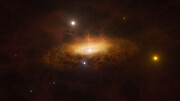
Artist’s impression: the black hole at the centre of the galaxy SDSS1335+0728 awakens


Videos

Zooming into the galaxy SDSS1335+0728 and its newly awakened black hole
PR Video eso2409a
Zooming into the galaxy SDSS1335+0728 and its newly awakened black hole

Artist’s animation of the black hole at the centre of SDSS1335+0728 awakening in real time
PR Video eso2409b
Artist’s animation of the black hole at the centre of SDSS1335+0728 awakening in real time


In late 2019 the previously unremarkable galaxy SDSS1335+0728 suddenly started shining brighter than ever before. To understand why, astronomers have used data from several space and ground-based observatories, including the European Southern Observatory’s Very Large Telescope (ESO’s VLT), to track how the galaxy’s brightness has varied. In a study out today, they conclude that they are witnessing changes never seen before in a galaxy — likely the result of the sudden awakening of the massive black hole at its core.

Imagine you’ve been observing a distant galaxy for years, and it always seemed calm and inactive,” says Paula Sánchez Sáez, an astronomer at ESO in Germany and lead author of the study accepted for publication in Astronomy & Astrophysics. “Suddenly, its [core] starts showing dramatic changes in brightness, unlike any typical events we've seen before.” This is what happened to SDSS1335+0728, which is now classified as having an ‘active galactic nucleus’ (AGN) — a bright compact region powered by a massive black hole — after it brightened dramatically in December 2019 [1].

Some phenomena, like supernova explosions or tidal disruption events — when a star gets too close to a black hole and is torn apart — can make galaxies suddenly light up. But these brightness variations typically last only a few dozen or, at most, a few hundreds of days. SDSS1335+0728 is still growing brighter today, more than four years after it was first seen to ‘switch on’. Moreover, the variations detected in the galaxy, which is located 300 million light-years away in the constellation Virgo, are unlike any seen before, pointing astronomers towards a different explanation.

The team tried to understand these brightness variations using a combination of archival data and new observations from several facilities, including the X-shooter instrument on ESO’s VLT in Chile’s Atacama Desert [2]. Comparing the data taken before and after December 2019, they found that SDSS1335+0728 is now radiating much more light at ultraviolet, optical, and infrared wavelengths. The galaxy also started emitting X-rays in February 2024. “This behaviour is unprecedented,” says Sánchez Sáez, who is also affiliated with the Millennium Institute of Astrophysics (MAS) in Chile.

The most tangible option to explain this phenomenon is that we are seeing how the [core] of the galaxy is beginning to show (...) activity,” says co-author Lorena Hernández García, from MAS and the University of Valparaíso in Chile. “If so, this would be the first time that we see the activation of a massive black hole in real time.

Massive black holes — with masses over one hundred thousand times that of our Sun — exist at the centre of most galaxies, including the Milky Way. “These giant monsters usually are sleeping and not directly visible,” explains co-author Claudio Ricci, from the Diego Portales University, also in Chile. “In the case of SDSS1335+0728, we were able to observe the awakening of the massive black hole, [which] suddenly started to feast on gas available in its surroundings, becoming very bright.

[This] process (...) has never been observed before,” Hernández García says. Previous studies reported inactive galaxies becoming active after several years, but this is the first time the process itself — the awakening of the black hole — has been observed in real time. Ricci, who is also affiliated with the Kavli Institute for Astronomy and Astrophysics at Peking University, China, adds: “This is something that could happen also to our own Sgr A*, the massive black hole (...) located at the centre of our galaxy," but it is unclear how likely this is to happen.

Follow-up observations are still needed to rule out alternative explanations. Another possibility is that we are seeing an unusually slow tidal disruption event, or even a new phenomenon. If it is in fact a tidal disruption event, this would be the longest and faintest such event ever observed. “Regardless of the nature of the variations, [this galaxy] provides valuable information on how black holes grow and evolve,” Sánchez Sáez says. “We expect that instruments like [MUSE on the VLT or those on the upcoming Extremely Large Telescope (ELT)] will be key in understanding [why the galaxy is brightening].”

Source: ESO/News


Notes

[1] The SDSS1335+0728 galaxy’s unusual brightness variations were detected by the Zwicky Transient Facility (ZTF) telescope in the US. Following that, the Chilean-led Automatic Learning for the Rapid Classification of Events (ALeRCE) broker classified SDSS1335+0728 as an active galactic nucleus.

[2] The team collected archival data from NASA’s Wide-field Infrared Survey Explorer (WISE) and Galaxy Evolution Explorer (GALEX), the Two Micron All Sky Survey (2MASS), the Sloan Digital Sky Survey (SDSS), and the eROSITA instrument on IKI and DLR’s Spektr-RG space observatory. Besides ESO’s VLT, the follow-up observations were conducted with the Southern Astrophysical Research Telescope (SOAR), the W. M. Keck Observatory, and NASA’s Neil Gehrels Swift Observatory and Chandra X-ray Observatory.


More information

This research was presented in a paper entitled “SDSS1335+0728: The awakening of a ∼ 106M⊙ black hole” published in Astronomy & Astrophysics (https://aanda.org/10.1051/0004-6361/202347957).

The team is composed of P. Sánchez-Sáez (European Southern Observatory, Garching, Germany [ESO] and Millenium Institute of Astrophysics, Chile [MAS]), L. Hernández-García (MAS and Instituto de Física y Astronomía, Universidad de Valparaíso, Chile [IFA-UV]), S. Bernal (IFA-UV and Millennium Nucleus on Transversal Research and Technology to Explore Supermassive Black Holes, Chile [TITANS]), A. Bayo (ESO), G. Calistro Rivera (ESO and German Space Agency [DLR]), F. E. Bauer (Instituto de Astrofísica, Pontificia Universidad Católica de Chile, Chile; Centro de Astroingeniería, Pontificia Universidad Católica de Chile, Chile; MAS; and Space Science Institute, USA), C. Ricci (Instituto de Estudios Astrofísicos, Universidad Diego Portales, Chile [UDP] and Kavli Institute for Astronomy and Astrophysics, China), A. Merloni (Max-Planck-Institut für Extraterrestrische Physik, Germany [MPE]), M. J. Graham (California Institute of Technology, USA), R. Cartier (Gemini Observatory, NSF National Optical-Infrared Astronomy Research Laboratory, Chile, and UDP), P. Arévalo (IFA-UV and TITANS), R.J. Assel (UDP), A. Concas (ESO and INAF - Osservatorio Astrofisico di Arcetri, Italy), D. Homan (Leibniz-Institut für Astrophysik Potsdam, Germany [AIP]), M. Krumpe (AIP), P. Lira (Departamento de Astronomía, Universidad de Chile, Chile [UChile], and TITANS), A. Malyali (MPE), M. L. Martínez-Aldama (Astronomy Department, Universidad de Concepción, Chile), A. M. Muñoz Arancibia (MAS and Center for Mathematical Modeling, University of Chile, Chile [CMM-UChile]), A. Rau (MPE), G. Bruni (INAF - Institute for Space Astrophysics and Planetology, Italy), F. Förster (Data and Artificial Intelligence Initiative, University of Chile, Chile; MAS; CMM-UChile; and UChile), M. Pavez-Herrera (MAS), D. Tubín-Arenas (AIP), and M. Brightman (Cahill Center for Astrophysics, California Institute of Technology, USA).

The European Southern Observatory (ESO) enables scientists worldwide to discover the secrets of the Universe for the benefit of all. We design, build and operate world-class observatories on the ground — which astronomers use to tackle exciting questions and spread the fascination of astronomy — and promote international collaboration for astronomy. Established as an intergovernmental organisation in 1962, today ESO is supported by 16 Member States (Austria, Belgium, Czechia, Denmark, France, Finland, Germany, Ireland, Italy, the Netherlands, Poland, Portugal, Spain, Sweden, Switzerland and the United Kingdom), along with the host state of Chile and with Australia as a Strategic Partner. ESO’s headquarters and its visitor centre and planetarium, the ESO Supernova, are located close to Munich in Germany, while the Chilean Atacama Desert, a marvellous place with unique conditions to observe the sky, hosts our telescopes. ESO operates three observing sites: La Silla, Paranal and Chajnantor. At Paranal, ESO operates the Very Large Telescope and its Very Large Telescope Interferometer, as well as survey telescopes such as VISTA. Also at Paranal ESO will host and operate the Cherenkov Telescope Array South, the world’s largest and most sensitive gamma-ray observatory. Together with international partners, ESO operates ALMA on Chajnantor, a facility that observes the skies in the millimetre and submillimetre range. At Cerro Armazones, near Paranal, we are building “the world’s biggest eye on the sky” — ESO’s Extremely Large Telescope. From our offices in Santiago, Chile we support our operations in the country and engage with Chilean partners and society.


Links


Contacts

Paula Sánchez Sáez
European Southern Observatory (ESO)
Garching bei München, Germany
Tel: +49 89 3200 6580
Email:
Paula.SanchezSaez@eso.org

Lorena Hernández García
Millennium Institute of Astrophysics (MAS)
Santiago, Chile
Email:
lorena.hernandez@uv.cl

Claudio Ricci
Diego Portales University
Santiago, Chile
Email:
claudio.ricci@mail.udp.cl

Bárbara Ferreira
ESO Media Manager
Garching bei München, Germany
Tel: +49 89 3200 6670
Cell: +49 151 241 664 00
Email:
press@eso.org