Credit: X-ray: NASA/CXC/Univ. of Hong Kong/S. Zhang et al.; Radio: ATNF/CSIRO/ATCA; H-alpha: UK STFC/Royal Observatory Edinburgh; Image Processing: NASA/CXC/SAO/N. Wolk
JPEG (488 kb) - Large JPEG (9.4 MB) - Tiff (24.7 MB) - More Images
A Tour of MSH 15-52 - More Videos
A Tour of MSH 15-52 - More Videos
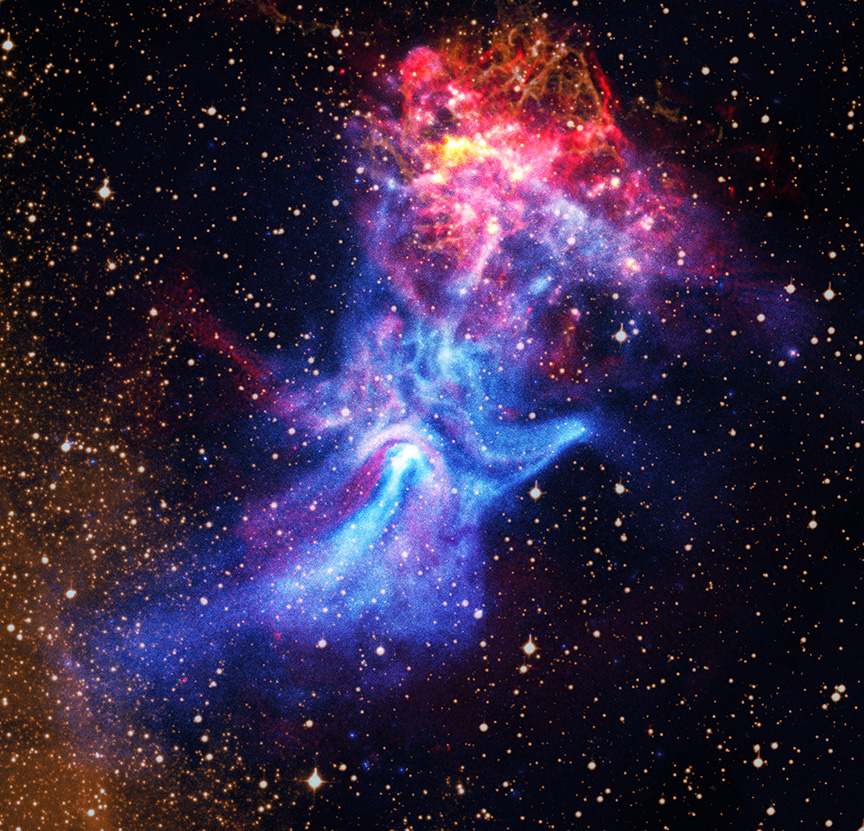
In 2009, NASA’s Chandra X-ray Observatory released a captivating image: a pulsar and its surrounding nebula that is shaped like a hand.
Since then, astronomers have used Chandra and other telescopes to continue to observe this object. Now, new radio data from the Australia Telescope Compact Array (ATCA), has been combined with Chandra’s X-ray data to provide a fresh view of this exploded star and its environment, to help understand its peculiar properties and shape.
At the center of this new image lies the pulsar B1509-58, a rapidly spinning neutron star that is only about 12 miles in diameter. This tiny object is responsible for producing an intricate nebula (called MSH 15-52) that spans over 150 light-years, or about 900 trillion miles. The nebula, which is produced by energetic particles, resembles a human hand with a palm and extended fingers pointing to the upper right in X-rays.
Since then, astronomers have used Chandra and other telescopes to continue to observe this object. Now, new radio data from the Australia Telescope Compact Array (ATCA), has been combined with Chandra’s X-ray data to provide a fresh view of this exploded star and its environment, to help understand its peculiar properties and shape.
At the center of this new image lies the pulsar B1509-58, a rapidly spinning neutron star that is only about 12 miles in diameter. This tiny object is responsible for producing an intricate nebula (called MSH 15-52) that spans over 150 light-years, or about 900 trillion miles. The nebula, which is produced by energetic particles, resembles a human hand with a palm and extended fingers pointing to the upper right in X-rays.

Credit: X-ray: NASA/CXC/Univ. of Hong Kong/S. Zhang et al.; Radio: ATNF/CSIRO/ATCA; H-alpha: UK STFC/Royal Observatory Edinburgh; Image Processing: NASA/CXC/SAO/N. Wolk
The collapse of a massive star created the pulsar when much of the star crashed inward once it burned through its sustainable nuclear fuel. An ensuing explosion sent the star’s outer layers outward into space as a supernova.
The pulsar spins around almost seven times every second and has a strong magnetic field, about 15 trillion times stronger than the Earth’s. The rapid rotation and strong magnetic field make B1509-58 one of the most powerful electromagnetic generators in the Galaxy, enabling it to drive an energetic wind of electrons and other particles away from the pulsar, creating the nebula.
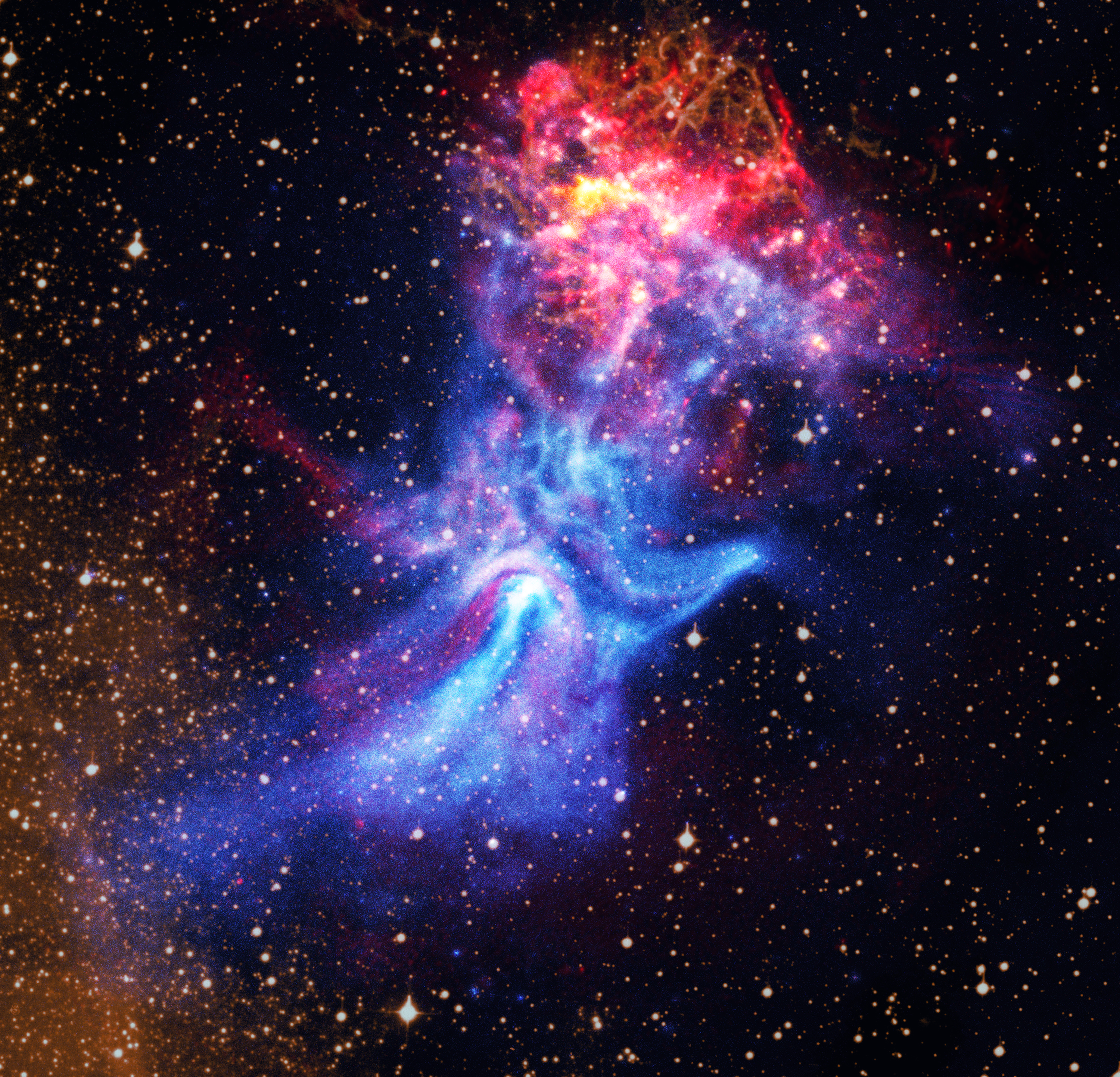
In this new composite image, the ATCA radio data (represented in red) has been combined with X-rays from Chandra (shown in blue, orange and yellow), along with an optical image of hydrogen gas (gold). The areas of overlap between the X-ray and radio data in MSH 15-52 show as purple. The optical image shows stars in the field of view along with parts of the supernova’s debris, the supernova remnant RCW 89. A labeled version of the figure shows the main features of the image.
Radio data from ATCA now reveals complex filaments that are aligned with the directions of the nebula’s magnetic field, shown by the short, straight, white lines in a supplementary image. These filaments could result from the collision of the pulsar’s particle wind with the supernova’s debris.
The collapse of a massive star created the pulsar when much of the star crashed inward once it burned through its sustainable nuclear fuel. An ensuing explosion sent the star’s outer layers outward into space as a supernova.
The pulsar spins around almost seven times every second and has a strong magnetic field, about 15 trillion times stronger than the Earth’s. The rapid rotation and strong magnetic field make B1509-58 one of the most powerful electromagnetic generators in the Galaxy, enabling it to drive an energetic wind of electrons and other particles away from the pulsar, creating the nebula.
In this new composite image, the ATCA radio data (represented in red) has been combined with X-rays from Chandra (shown in blue, orange and yellow), along with an optical image of hydrogen gas (gold). The areas of overlap between the X-ray and radio data in MSH 15-52 show as purple. The optical image shows stars in the field of view along with parts of the supernova’s debris, the supernova remnant RCW 89. A labeled version of the figure shows the main features of the image.
Radio data from ATCA now reveals complex filaments that are aligned with the directions of the nebula’s magnetic field, shown by the short, straight, white lines in a supplementary image. These filaments could result from the collision of the pulsar’s particle wind with the supernova’s debris.

Credit: X-ray: NASA/CXC/Univ. of Hong Kong/S. Zhang et al.; Radio: ATNF/CSIRO/ATCA; H-alpha: UK STFC/Royal Observatory Edinburgh; Image Processing: NASA/CXC/SAO/N. Wolk
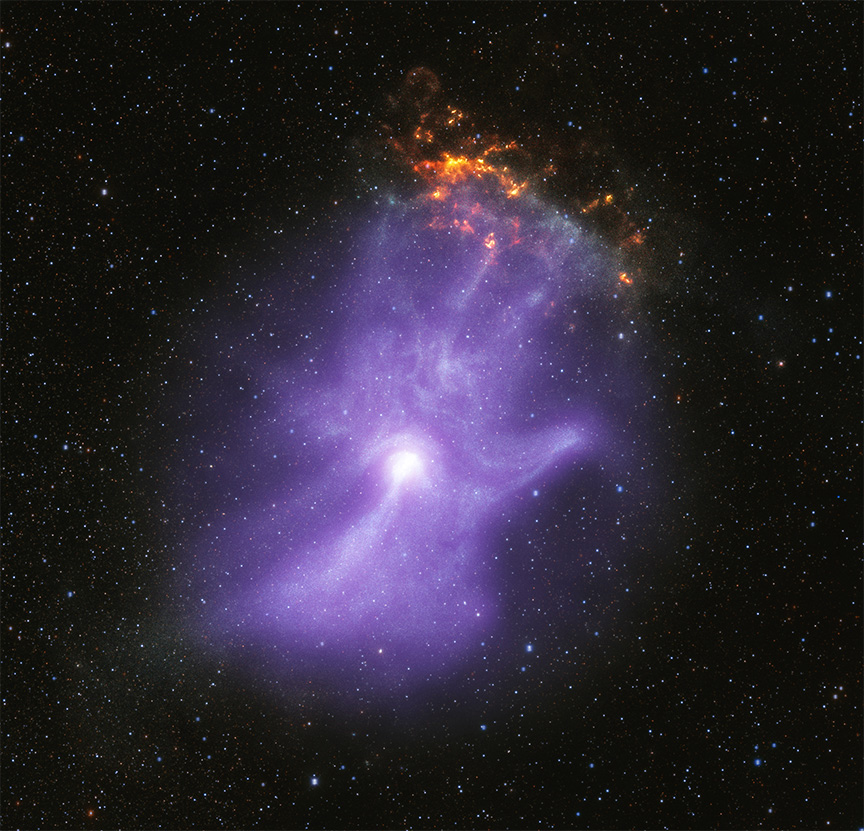
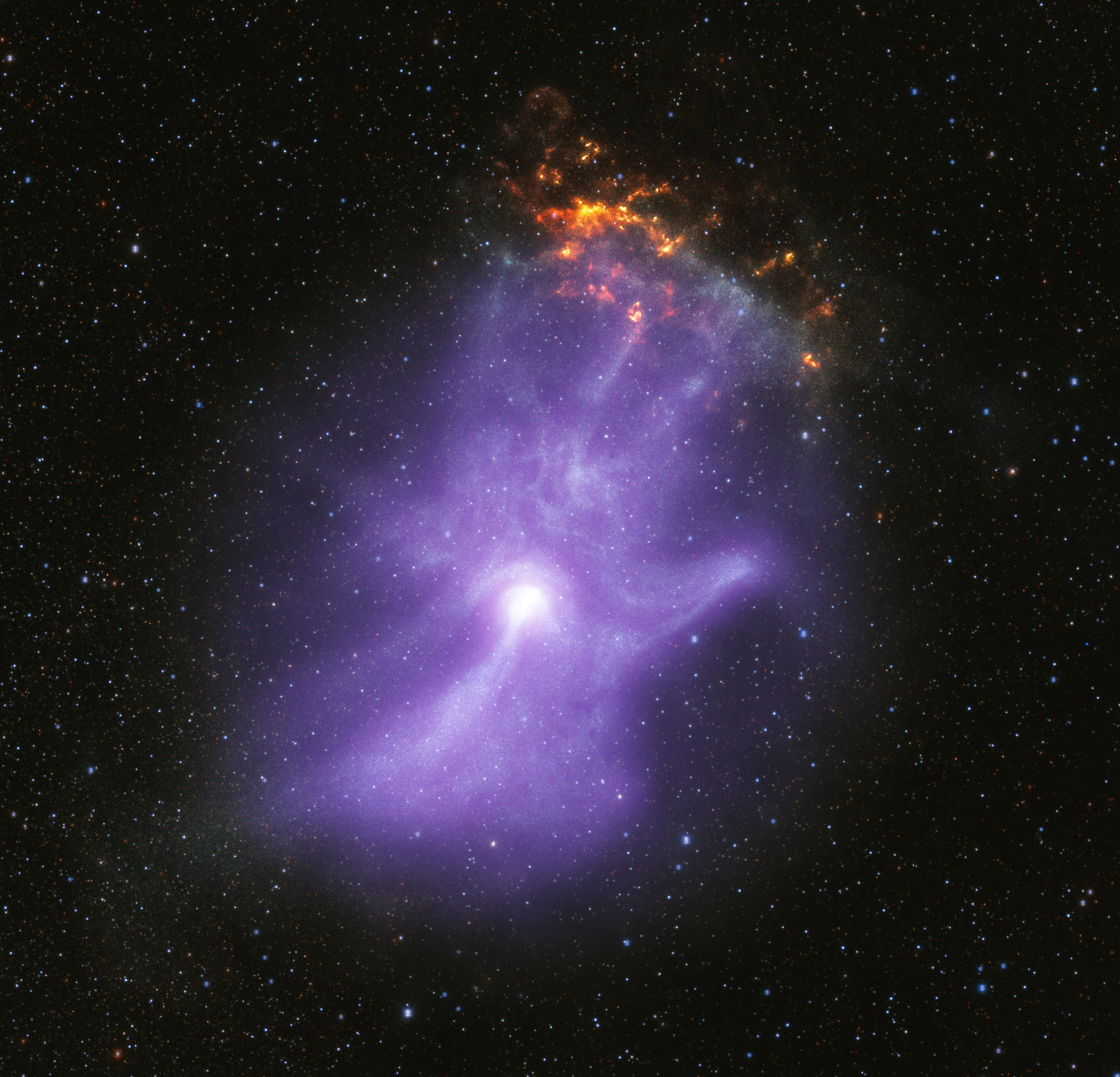
By comparing the radio and X-ray data, researchers identified key differences between the sources of the two types of light. In particular, some prominent X-ray features, including the jet towards the bottom of the image and the inner parts of the three “fingers” towards the top, are not detected in radio waves. This suggests that highly energetic particles are leaking out from a shock wave — similar to a supersonic plane’s sonic boom — near the pulsar and moving along magnetic field lines to create the fingers.
The radio data also shows that RCW 89’s structure is different from typical young supernova remnants. Much of the radio emission is patchy and closely matches clumps of X-ray and optical emission. It also extends well beyond the X-ray emission. All of these characteristics support the idea that RCW 89 is colliding with a dense cloud of nearby hydrogen gas.
However, the researchers do not fully understand all that the data is showing them. One area that is perplexing is the sharp boundary of X-ray emission in the upper right of the image that seems to be the blast wave from the supernova — see the labeled feature. Supernova blast waves are usually bright in radio waves for young supernova remnants like RCW 89, so it is surprising to researchers that there is no radio signal at the X-ray boundary.
MSH 15–52 and RCW 89 show many unique features not found in other young sources. There are, however, still many open questions regarding the formation and evolution of these structures. Further work is needed to provide better understanding of the complex interplay between the pulsar wind and the supernova debris.
A paper describing this work, led by Shumeng Zhang of the University of Hong Kong, with co-authors Stephen C.Y. Ng of the University of Hong Kong and Niccolo' Bucciantini of the Italian National Institute for Astrophysics, has been published in The Astrophysical Journal and is available at https://iopscience.iop.org/article/10.3847/1538-4357/adf333.
NASA's Marshall Space Flight Center in Huntsville, Alabama, manages the Chandra program. The Smithsonian Astrophysical Observatory's Chandra X-ray Center controls science operations from Cambridge, Massachusetts, and flight operations from Burlington, Massachusetts.
By comparing the radio and X-ray data, researchers identified key differences between the sources of the two types of light. In particular, some prominent X-ray features, including the jet towards the bottom of the image and the inner parts of the three “fingers” towards the top, are not detected in radio waves. This suggests that highly energetic particles are leaking out from a shock wave — similar to a supersonic plane’s sonic boom — near the pulsar and moving along magnetic field lines to create the fingers.
The radio data also shows that RCW 89’s structure is different from typical young supernova remnants. Much of the radio emission is patchy and closely matches clumps of X-ray and optical emission. It also extends well beyond the X-ray emission. All of these characteristics support the idea that RCW 89 is colliding with a dense cloud of nearby hydrogen gas.
However, the researchers do not fully understand all that the data is showing them. One area that is perplexing is the sharp boundary of X-ray emission in the upper right of the image that seems to be the blast wave from the supernova — see the labeled feature. Supernova blast waves are usually bright in radio waves for young supernova remnants like RCW 89, so it is surprising to researchers that there is no radio signal at the X-ray boundary.
MSH 15–52 and RCW 89 show many unique features not found in other young sources. There are, however, still many open questions regarding the formation and evolution of these structures. Further work is needed to provide better understanding of the complex interplay between the pulsar wind and the supernova debris.
A paper describing this work, led by Shumeng Zhang of the University of Hong Kong, with co-authors Stephen C.Y. Ng of the University of Hong Kong and Niccolo' Bucciantini of the Italian National Institute for Astrophysics, has been published in The Astrophysical Journal and is available at https://iopscience.iop.org/article/10.3847/1538-4357/adf333.
NASA's Marshall Space Flight Center in Huntsville, Alabama, manages the Chandra program. The Smithsonian Astrophysical Observatory's Chandra X-ray Center controls science operations from Cambridge, Massachusetts, and flight operations from Burlington, Massachusetts.
Source: NASA’s Chandra X-ray Observator
Visual Description:
This release features a composite image of a nebula and pulsar that strongly resembles a cosmic hand reaching for a neon red cloud.
The neon red cloud sits near the top of the image, just to our right of center. Breaks in the cloud reveal interwoven strands of gold resembling spiderwebs, or a latticework substructure. This cloud is the remains of the supernova that formed the pulsar at the heart of the image. The pulsar, a rapidly spinning neutron star only 12 miles in diameter, is far too small to be seen in this image, which represents a region of space over 150 light-years across.
The bottom half of the image is dominated by a massive blue hand reaching up toward the pulsar and supernova cloud. This is an intricate nebula called MSH 15-52, an energetic wind of electrons and other particles driven away from the pulsar. The resemblance to a hand is undeniable. Inside the nebula, streaks and swirls of blue range from pale to navy, evoking a medical X-ray, or the yearning hand of a giant, cosmic ghost.
The hand and nebula are set against the blackness of space, surrounded by scores of gleaming golden specks. At our lower left, a golden hydrogen gas cloud extends beyond the edges of the image. In this composite, gold represents optical data; red represents ATCA radio data; and blue, orange, and yellow represent X-ray data from Chandra. Where the blue hand of the nebula overlaps with the radio data in red, the fingers appear hazy and purple.
The bottom half of the image is dominated by a massive blue hand reaching up toward the pulsar and supernova cloud. This is an intricate nebula called MSH 15-52, an energetic wind of electrons and other particles driven away from the pulsar. The resemblance to a hand is undeniable. Inside the nebula, streaks and swirls of blue range from pale to navy, evoking a medical X-ray, or the yearning hand of a giant, cosmic ghost.
The hand and nebula are set against the blackness of space, surrounded by scores of gleaming golden specks. At our lower left, a golden hydrogen gas cloud extends beyond the edges of the image. In this composite, gold represents optical data; red represents ATCA radio data; and blue, orange, and yellow represent X-ray data from Chandra. Where the blue hand of the nebula overlaps with the radio data in red, the fingers appear hazy and purple.
Fast Facts for MSH 15-52:
Scale: Image is about 22 arcmin (110 light-years) across.
Category: Supernovas & Supernova Remnants, Neutron Stars/X-ray Binaries
Coordinates (J2000): RA 15h 13m 55.5s | Dec -59° 8´ 8.8"
Constellation: Circinus
Observation Dates: 20 observations from Aug 14, 2000 to Sep 23, 2022
Observation Time: 185 hours (7 days 17 hours)
Obs. ID: 754, 3833, 3834, 4384, 5515, 5534, 5535, 6116, 6117, 5562, 9138, 14805, 18023, 19299, 19300, 20910, 20932, 20933, 23540, 27448
Instrument: ACIS
Instrument: ACIS
References: Zhang, S., Ng, C.-Y., and Bucciantini, N., 2025, ApJ, accepted. https://iopscience.iop.org/article/10.3847/1538-4357/adf333
Color Code: X-ray: red, green, blue; Radio: red; H-alpha: orange
Distance Estimate: About 17,000 light-years
Color Code: X-ray: red, green, blue; Radio: red; H-alpha: orange
Distance Estimate: About 17,000 light-years