Showing posts with label Bok globules. Show all posts

Thursday, May 09, 2024

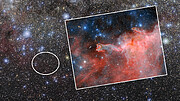
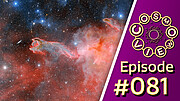
Dark Energy Camera Spies Cometary Globule Reaching for the Stars

PR Image noirlab2412a
Dark Energy Camera Images Cometary Globule CG 4

PR Image noirlab2412b
Excerpts from Giant Cometary Globule CG 4 Image


Videos

Cosmoview Episode 81: Dark Energy Camera Spies Cometary Globule Reaching for the Stars
PR Video noirlab2412a
Cosmoview Episode 81: Dark Energy Camera Spies Cometary Globule Reaching for the Stars

Cosmoview Episodio 81: Desde Tololo observan la “mano de Dios” emergiendo desde una nebulosa
PR Video noirlab2412b
Cosmoview Episodio 81: Desde Tololo observan la “mano de Dios” emergiendo desde una nebulosa

Pan on CG 4
PR Video noirlab2412c
Pan on CG 4

Zooming Into CG 4
PR Video noirlab2412d
Zooming Into CG 4


Dark Energy Camera captures the red glow of a cosmic ‘hand’ emerging from within the Gum Nebula

The dark, dusty cometary globule known as CG 4 is spotlighted in this image from the Department of Energy-fabricated Dark Energy Camera mounted on the U.S. National Science Foundation Víctor M. Blanco 4-meter Telescope at Cerro Tololo Inter-American Observatory, a Program of NSF NOIRLab. How these hard-to-detect clouds get their distinctive structure is still unclear, but astronomers speculate that it’s a consequence of the hot, massive stars that surround them.

About 1300 light-years away, in the constellation Puppis, a ghostly hand appears to be emerging from the interstellar medium and reaching out into the cosmos. This cloudy, ominous structure is CG 4, a cometary globule that has been given the nickname ‘God’s Hand’. CG 4 is one of many cometary globules present within the Milky Way, and how these objects get their distinctive form is still a matter of debate among astronomers.

Cometary globules are a subclass of the dark nebulae known as Bok globules — isolated clouds of dense cosmic gas and dust surrounded by hot, ionized material. When these clouds exhibit stripping of material that results in an extended tail, they are referred to as cometary globules because of their vague resemblance to a comet, though they have nothing in common. The features that classify CG 4 as a cometary globule are hard to miss in this image captured with the Department of Energy-fabricated Dark Energy Camera (DECam) mounted on the U.S. National Science Foundation Víctor M. Blanco 4-meter Telescope at Cerro Tololo Inter-American Observatory (CTIO), a Program of NSF NOIRLab. Its dusty head, which has a diameter of 1.5 light-years, and its long, faint tail, which is about eight light-years long, make CG 4 a comparatively small Bok globule, a general characteristic of cometary globules.

First recognized in 1976 from pictures taken with the UK Schmidt Telescope in Australia, cometary globules went undetected by astronomers for a long time because they are so faint. Their tails, shrouded in dark stellar dust, block most light from passing through. But with its special Hydrogen-alpha filter [1], DECam can pick up the faint red glow of ionized hydrogen present within CG 4’s head and around its outer rim. This light is produced when hydrogen becomes excited after being bombarded by radiation from nearby hot, massive stars.

The intense radiation generated by these neighboring massive stars, however, is gradually destroying the head of the globule and sweeping away the tiny particles that scatter the starlight. Still, the dusty cloud of CG 4 contains enough gas to feed the active formation of several new, Sun-sized stars.

While astronomers have observed these structures throughout the Milky Way, the overwhelming majority of them, including CG 4, are found within a huge patch of glowing gas called the Gum Nebula. Believed to be the expanding remains of a supernova that took place about a million years ago, the Gum Nebula is currently known to contain at least 31 cometary globules in addition to CG 4.

The mechanism by which these comet-like objects get their distinct shape is not entirely known, but astronomers have developed two main ideas about their origins. The first idea is that they could have originally been spherical nebulae — like the well-known Ring Nebula — which were then disrupted by a nearby supernova explosion, possibly the original explosion that created the Gum Nebula.

The second idea is that cometary globules are shaped by a combination of stellar winds and radiation pressure from nearby hot, massive stars. In fact, all of the cometary globules found within the Gum Nebula appear to have tails pointing away from the center of the nebula, which is where the Vela Supernova Remnant and Vela Pulsar are located. The Vela Pulsar is a rapidly spinning neutron star that was formed when a massive star collapsed, and it’s possible that its stellar winds and radiation pressure are shaping the nearby globules.

Also in this image it looks as if CG 4 is about to devour the edge-on spiral galaxy ESO 257-19 (PGC 21338), which appears to be placed so defenselessly in front of it. But in reality, this galaxy is more than a hundred million light-years beyond CG 4 and only appears to be close because of a chance alignment.


Notes

[1] At 62 cm (25 inches) in diameter, DECam’s narrow-band filters are some of the largest in operation anywhere. There are currently 11, centered on different wavelengths of interest, with 3 more being fabricated. Making narrow-band filters of this size that work in wide-field instruments like DECam is a significant technical challenge.


More information

NSF NOIRLab (U.S. National Science Foundation National Optical-Infrared Astronomy Research Laboratory), the U.S. center for ground-based optical-infrared astronomy, operates the International Gemini Observatory (a facility of NSF, NRC–Canada, ANID–Chile, MCTIC–Brazil, MINCyT–Argentina, and KASI–Republic of Korea), Kitt Peak National Observatory (KPNO), Cerro Tololo Inter-American Observatory (CTIO), the Community Science and Data Center (CSDC), and Vera C. Rubin Observatory (operated in cooperation with the Department of Energy’s SLAC National Accelerator Laboratory). It is managed by the Association of Universities for Research in Astronomy (AURA) under a cooperative agreement with NSF and is headquartered in Tucson, Arizona. The astronomical community is honored to have the opportunity to conduct astronomical research on I’oligam Du’ag (Kitt Peak) in Arizona, on Maunakea in Hawai‘i, and on Cerro Tololo and Cerro Pachón in Chile. We recognize and acknowledge the very significant cultural role and reverence that these sites have to the Tohono O’odham Nation, to the Native Hawaiian community, and to the local communities in Chile, respectively.


Links


Contacts

Josie Fenske
Jr. Public Information Officer
NSF NOIRLab
Email:
josie.fenske@noirlab.edu


Friday, December 22, 2023

New 1.5-billion-pixel ESO image shows Running Chicken Nebula in unprecedented detail

PR Image eso2320a
The Running Chicken Nebula

PR Image eso2320b
The Running Chicken Nebula, annotated

PR Image eso2320c
The Running Chicken Nebula in the constellation of Centaurus


Videos

The 1.5-billion-pixel Running Chicken Nebula
The 1.5-billion-pixel Running Chicken Nebula 
 
3D animation of the Running Chicken Nebula
3D animation of the Running Chicken Nebula 


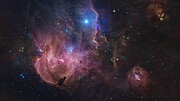
While many holiday traditions involve feasts of turkey, soba noodles, latkes or Pan de Pascua, this year, the European Southern Observatory (ESO) is bringing you a holiday chicken. The so-called Running Chicken Nebula, home to young stars in the making, is revealed in spectacular detail in this 1.5-billion-pixel image captured by the VLT Survey Telescope (VST), hosted at ESO’s Paranal site in Chile.

This vast stellar nursery is located in the constellation Centaurus (the Centaur), at about 6500 light-years from Earth. Young stars within this nebula emit intense radiation that makes the surrounding hydrogen gas glow in shades of pink.

The Running Chicken Nebula actually comprises several regions, all of which we can see in this vast image that spans an area in the sky of about 25 full Moons [1]. The brightest region within the nebula is called IC 2948, where some people see the chicken’s head and others its rear end. The wispy pastel contours are ethereal plumes of gas and dust. Towards the centre of the image, marked by the bright, vertical, almost pillar-like, structure, is IC 2944. The brightest twinkle in this particular region is Lambda Centauri, a star visible to the naked eye that is much closer to us than the nebula itself.

There are, however, many young stars within IC 2948 and IC 2944 themselves — and while they might be bright, they’re most certainly not merry. As they spit out vast amounts of radiation, they carve up their environment much like, well, a chicken. Some regions of the nebula, known as Bok globules, can withstand the fierce bombardment from the ultraviolet radiation pervading this region. If you zoom in to the image, you might see them: small, dark, and dense pockets of dust and gas dotted across the nebula.

Other regions pictured here include, to the upper right, Gum 39 and 40, and to the lower right, Gum 41. Aside from nebulae, there are countless orange, white and blue stars, like fireworks in the sky. Overall in this image, there are more wonders than can be described — zoom in and pan across, and you’ll have a feast for the eyes.

This image is a large mosaic comprising hundreds of separate frames carefully stitched together. The individual images were taken through filters that let through light of different colours, which were then combined into the final result presented here. The observations were conducted with the wide-field camera OmegaCAM on the VST, a telescope owned by the National Institute for Astrophysics in Italy (INAF) and hosted by ESO at its Paranal site in Chile’s Atacama Desert that is ideally suited for mapping the southern sky in visible light. The data that went into making this mosaic were taken as part of the VST Photometric Hα Survey of the Southern Galactic Plane and Bulge (VPHAS+), a project aimed at better understanding the life cycle of stars.

Source: ESO/News


Notes

[1] This image, edge to edge, is 270 light-years wide. It would take an average chicken almost 21 billion years to run across it. That’s much longer than our Universe has been around for.


More information

The European Southern Observatory (ESO) enables scientists worldwide to discover the secrets of the Universe for the benefit of all. We design, build and operate world-class observatories on the ground — which astronomers use to tackle exciting questions and spread the fascination of astronomy — and promote international collaboration for astronomy. Established as an intergovernmental organisation in 1962, today ESO is supported by 16 Member States (Austria, Belgium, the Czech Republic, Denmark, France, Finland, Germany, Ireland, Italy, the Netherlands, Poland, Portugal, Spain, Sweden, Switzerland and the United Kingdom), along with the host state of Chile and with Australia as a Strategic Partner. ESO’s headquarters and its visitor centre and planetarium, the ESO Supernova, are located close to Munich in Germany, while the Chilean Atacama Desert, a marvellous place with unique conditions to observe the sky, hosts our telescopes. ESO operates three observing sites: La Silla, Paranal and Chajnantor. At Paranal, ESO operates the Very Large Telescope and its Very Large Telescope Interferometer, as well as survey telescopes such as VISTA. Also at Paranal ESO will host and operate the Cherenkov Telescope Array South, the world’s largest and most sensitive gamma-ray observatory. Together with international partners, ESO operates ALMA on Chajnantor, a facility that observes the skies in the millimetre and submillimetre range. At Cerro Armazones, near Paranal, we are building “the world’s biggest eye on the sky” — ESO’s Extremely Large Telescope. From our offices in Santiago, Chile we support our operations in the country and engage with Chilean partners and society.


Links


Contacts

Juan Carlos Muñoz Mateos
ESO Media Officer
Garching bei München, Germany
Tel: +49 89 3200 6176
Email:
jmunoz@eso.org

Bárbara Ferreira
ESO Media Manager
Garching bei München, Germany
Tel: +49 89 3200 6670
Cell: +49 151 241 664 00
Email:
press@eso.org


Thursday, November 03, 2016

Pillars of Destruction

 PR Image eso1639a
Region R44 in the Carina Nebula 

Pillars of destruction
 
Region R18 in the Carina Nebula
 
Region R37 in the Carina Nebula
 
Region R45 in the Carina Nebula
 
Star cluster Trumpler 14
 
Bok Globule in the Carina Nebula
 
Mystic Mountain 


Videos

3D Animation of the Carina Nebula

Zooming in on the Carina Nebula


Colourful Carina Nebula blasted by brilliant nearby stars


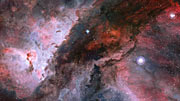
Spectacular new observations of vast pillar-like structures within the Carina Nebula have been made using the MUSE instrument on ESO’s Very Large Telescope. The different pillars analysed by an international team seem to be pillars of destruction — in contrast to the name of the iconic Pillars of Creation in the Eagle Nebula, which are of similar nature.

The spires and pillars in the new images of the Carina Nebula are vast clouds of dust and gas within a hub of star formation about 7500 light-years away. The pillars in the nebula were observed by a team led by Anna McLeod, a PhD student at ESO, using the MUSE instrument on ESO’s Very Large Telescope.

The great power of MUSE is that it creates thousands of images of the nebula at the same time, each at a different wavelength of light. This allows astronomers to map out the chemical and physical properties of the material at different points in the nebula.

Images of similar structures, the famous Pillars of Creation [1] in the Eagle Nebula and formations in NGC 3603, were combined with the ones displayed here. In total ten pillars have been observed, and in so doing a clear link was observed between the radiation emitted by nearby massive stars and the features of the pillars themselves.

In an ironic twist, one of the first consequences of the formation of a massive star is that it starts to destroy the cloud from which it was born. The idea that massive stars will have a considerable effect on their surroundings is not new: such stars are known to blast out vast quantities of powerful, ionising radiation — emission with enough energy to strip atoms of their orbiting electrons. However, it is very difficult to obtain observational evidence of the interplay between such stars and their surroundings. <

The team analysed the effect of this energetic radiation on the pillars: a process known as photoevaporation, when gas is ionised and then disperses away. By observing the results of photoevaporation — which included the loss of mass from the pillars — they were able to deduce the culprits. There was a clear correlation between the amount of ionising radiation being emitted by nearby stars, and the dissipation of the pillars.

This might seem like a cosmic calamity, with massive stars turning on their own creators. However the complexities of the feedback mechanisms between the stars and the pillars are poorly understood. These pillars might look dense, but the clouds of dust and gas which make up nebulae are actually very diffuse. It is possible that the radiation and stellar winds from massive stars actually help create denser spots within the pillars, which can then form stars.

These breathtaking celestial structures have more to tell us, and MUSE is an ideal instrument to probe them with. 


Notes


[1] The Pillars of Creation are an iconic image, taken with the NASA/ESA Hubble Space Telescope, making them the most famous of these structures. Also known as elephant trunks, they can be several light-years in length.


More Information

This research was presented in a paper entitled “Connecting the dots: a correlation between ionising radiation and cloud mass-loss rate traced by optical integral field spectroscopy“, by A. F. McLeod et al., published in the Monthly Notices of the Royal Astronomical Society.

The team is composed of A. F. McLeod (ESO, Garching, Germany), M. Gritschneder (Universitäts-Sternwarte, Ludwig-Maximilians-Universität, Munich, Germany), J. E. Dale (Universitäts-Sternwarte, Ludwig-Maximilians-Universität, Munich, Germany), A. Ginsburg (ESO, Garching, Germany), P. D.Klaassen (UK Astronomy Technology Centre, Royal Observatory Edinburgh, UK), J. C. Mottram (Max Planck Institute for Astronomy, Heidelberg, Germany), T. Preibisch (Universitäts-Sternwarte, Ludwig-Maximilians-Universität, Munich, Germany), S. Ramsay (ESO, Garching, Germany), M. Reiter (University of Michigan Department of Astronomy, Ann Arbor, Michigan, USA) and L. Testi (ESO, Garching, Germany).

ESO is the foremost intergovernmental astronomy organisation in Europe and the world’s most productive ground-based astronomical observatory by far. It is supported by 16 countries: Austria, Belgium, Brazil, the Czech Republic, Denmark, France, Finland, Germany, Italy, the Netherlands, Poland, Portugal, Spain, Sweden, Switzerland and the United Kingdom, along with the host state of Chile. ESO carries out an ambitious programme focused on the design, construction and operation of powerful ground-based observing facilities enabling astronomers to make important scientific discoveries. ESO also plays a leading role in promoting and organising cooperation in astronomical research. ESO operates three unique world-class observing sites in Chile: La Silla, Paranal and Chajnantor. At Paranal, ESO operates the Very Large Telescope, the world’s most advanced visible-light astronomical observatory and two survey telescopes. VISTA works in the infrared and is the world’s largest survey telescope and the VLT Survey Telescope is the largest telescope designed to exclusively survey the skies in visible light. ESO is a major partner in ALMA, the largest astronomical project in existence. And on Cerro Armazones, close to Paranal, ESO is building the 39-metre European Extremely Large Telescope, the E-ELT, which will become “the world’s biggest eye on the sky”.


Link


Contacts

Anna Faye McLeod
ESO
Garching bei München, Germany
Tel: +49 89 3200 6321
Email:
amcleod@eso.org

Mathias Jäger
Public Information Officer
Garching bei München, Germany
Tel: +49 176 62397500

Source: ESO

Tuesday, April 28, 2015

Water Could Have Been Abundant in the First Billion Years

This Hubble image features dark knots of gas and dust known as "Bok globules," which are dense pockets in larger molecular clouds. Similar islands of material in the early universe could have held as much water vapor as we find in our galaxy today, despite containing a thousand times less oxygen. Credit: NASA, ESA, and The Hubble Heritage Team. High Resolution (jpg) - Low Resolution (jpg)


How soon after the Big Bang could water have existed? Not right away, because water molecules contain oxygen and oxygen had to be formed in the first stars. Then that oxygen had to disperse and unite with hydrogen in significant amounts. New theoretical work finds that despite these complications, water vapor could have been just as abundant in pockets of space a billion years after the Big Bang as it is today.

"We looked at the chemistry within young molecular clouds containing a thousand times less oxygen than our Sun. To our surprise, we found we can get as much water vapor as we see in our own galaxy," says astrophysicist Avi Loeb of the Harvard-Smithsonian Center for Astrophysics (CfA).

The early universe lacked elements heavier than hydrogen and helium. The first generation of stars are believed to have been massive and short-lived. Those stars generated elements like oxygen, which then spread outward via stellar winds and supernova explosions. This resulted in "islands" of gas enriched in heavy elements. Even these islands, however, were much poorer in oxygen than gas within the Milky Way today.

The team examined the chemical reactions that could lead to the formation of water within the oxygen-poor environment of early molecular clouds. They found that at temperatures around 80 degrees Fahrenheit (300 Kelvin), abundant water could form in the gas phase despite the relative lack of raw materials.

"These temperatures are likely because the universe then was warmer than today and the gas was unable to cool effectively," explains lead author and PhD student Shmuel Bialy of Tel Aviv University.

"The glow of the cosmic microwave background was hotter, and gas densities were higher," adds Amiel Sternberg, a co-author from Tel Aviv University.

Although ultraviolet light from stars would break apart water molecules, after hundreds of millions of years an equilibrium could be reached between water formation and destruction. The team found that equilibrium to be similar to levels of water vapor seen in the local universe.

"You can build up significant quantities of water in the gas phase even without much enrichment in heavy elements," adds Bialy.

This current work calculates how much water could exist in the gas phase within molecular clouds that will form later generations of stars and planets. It doesn't address how much water would exist in ice form (which dominates within our galaxy) or what fraction of all the water might actually be incorporated into newly forming planetary systems

This work has been accepted for publication in the Astrophysical Journal Letters and is available online. The authors are Shmuel Bialy & Amiel Sternberg (Tel Aviv University) and Avi Loeb (CfA). This joint project was carried out as part of the Raymond and Beverly Sackler Tel Aviv University - Harvard Astronomy Program.

Headquartered in Cambridge, Mass., the Harvard-Smithsonian Center for Astrophysics (CfA) is a joint collaboration between the Smithsonian Astrophysical Observatory and the Harvard College Observatory. CfA scientists, organized into six research divisions, study the origin, evolution and ultimate fate of the universe.

For more information, contact:

Christine Pulliam
Public Affairs Specialist
Harvard-Smithsonian Center for Astrophysics
617-495-7463
cpulliam@cfa.harvard.edu


Wednesday, August 20, 2014

A Spectacular Landscape of Star Formation

PR Image eso1425a
Star formation in the southern Milky Way

Star formation regions in the constellation of Carina (The Keel) 

Star formation in the constellation of Carina 

 * * * * * * * * * * * * * * * * * * * * * *

Videos

Zooming in on star formation in the southern Milky Way

A close-up look at star formation in the southern Milky Way


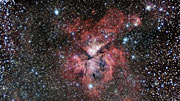
This image, captured by the Wide Field Imager at ESO’s La Silla Observatory in Chile, shows two dramatic star formation regions in the southern Milky Way. The first is of these, on the left, is dominated by the star cluster NGC 3603, located 20 000 light-years away, in the Carina–Sagittarius spiral arm of the Milky Way galaxy. The second object, on the right, is a collection of glowing gas clouds known as NGC 3576 that lies only about half as far from Earth.

NGC 3603 is a very bright star cluster and is famed for having the highest concentration of massive stars that have been discovered in our galaxy so far. At the centre lies a Wolf–Rayet multiple star system, known as HD 97950. Wolf–Rayet stars are at an advanced stage of stellar evolution, and start off with around 20 times the mass of the Sun. But, despite this large mass, Wolf–Rayet stars shed a considerable amount of their matter due to intense stellar winds, which blast the star’s surface material off into space at several million kilometres per hour, a crash diet of cosmic proportions.

NGC 3603 is in an area of very active star formation. Stars are born in dark and dusty regions of space, largely hidden from view. But as the very young stars gradually start to shine and clear away their surrounding cocoons of material they become visible and create glowing clouds in the surrounding material, known as HII regions. HII regions shine because of the interaction of ultraviolet radiation given off by the brilliant hot young stars with the hydrogen gas clouds. HII regions can measure several hundred light-years in diameter, and the one surrounding NGC 3603 has the distinction of being the most massive in our galaxy.

The cluster was first observed by John Herschel on 14 March 1834 during his three-year expedition to systematically survey the southern skies from near Cape Town. He described it as a remarkable object and thought that it might be a globular star cluster. Future studies showed that it is not an old globular, but a young open cluster, one of the richest known.

NGC 3576, on the right of the image, also lies in the Carina–Sagittarius spiral arm of the Milky Way. But it is located only about 9000 light-years from Earth — much closer than NGC 3603, but appearing next to it in the sky.

NGC 3576 is notable for two huge curved objects resembling the curled horns of a ram. These odd filaments are the result of stellar winds from the hot, young stars within the central regions of the nebula, which have blown the dust and gas outwards across a hundred light-years. Two dark silhouetted areas known as Bok globules are also visible in this vast complex of nebulae. These black clouds near the top of the nebula also offer potential sites for the future formation of new stars.

NGC 3576 was also discovered by John Herschel in 1834, making it a particularly productive and visually rewarding year for the English astronomer.

More information


ESO is the foremost intergovernmental astronomy organisation in Europe and the world’s most productive ground-based astronomical observatory by far. It is supported by 15 countries: Austria, Belgium, Brazil, the Czech Republic, Denmark, France, Finland, Germany, Italy, the Netherlands, Portugal, Spain, Sweden, Switzerland and the United Kingdom. ESO carries out an ambitious programme focused on the design, construction and operation of powerful ground-based observing facilities enabling astronomers to make important scientific discoveries. ESO also plays a leading role in promoting and organising cooperation in astronomical research. ESO operates three unique world-class observing sites in Chile: La Silla, Paranal and Chajnantor. At Paranal, ESO operates the Very Large Telescope, the world’s most advanced visible-light astronomical observatory and two survey telescopes. VISTA works in the infrared and is the world’s largest survey telescope and the VLT Survey Telescope is the largest telescope designed to exclusively survey the skies in visible light. ESO is the European partner of a revolutionary astronomical telescope ALMA, the largest astronomical project in existence. ESO is currently planning the 39-metre European Extremely Large optical/near-infrared Telescope, the E-ELT, which will become “the world’s biggest eye on the sky”.

Links


Contacts

Richard Hook
ESO Public Information Officer
Garching bei München, Germany

Tel: +49 89 3200 6655
Email:
rhook@eso.org

Source: ESO