Showing posts with label Pillars of Creation. Show all posts

Friday, October 28, 2022

Haunting Portrait: NASA’s Webb Reveals Dust, Structure in Pillars of Creation


Pillars of Creation (MIRI Image)
Credits: Science: NASA, ESA, CSA, STScI
Image Processing: Joseph DePasquale (STScI), Alyssa Pagan (STScI)

Release Images | Release Videos

This is not an ethereal landscape of time-forgotten tombs. Nor are these soot-tinged fingers reaching out. These pillars, flush with gas and dust, enshroud stars that are slowly forming over many millennia. NASA’s James Webb Space Telescope has snapped this eerie, extremely dusty view of the Pillars of Creation in mid-infrared light – showing us a new view of a familiar landscape.

Why does mid-infrared light set such a somber, chilling mood in Webb’s Mid-Infrared Instrument (MIRI) image? Interstellar dust cloaks the scene. And while mid-infrared light specializes in detailing where dust is, the stars aren’t bright enough at these wavelengths to appear. Instead, these looming, leaden-hued pillars of gas and dust gleam at their edges, hinting at the activity within.

Thousands and thousands of stars have formed in this region. This is made plain when examining Webb’s recent Near-Infrared Camera (NIRCam) image. In MIRI’s view, the majority of the stars appear missing. Why? Many newly formed stars are no longer surrounded by enough dust to be detected in mid-infrared light. Instead, MIRI observes young stars that have not yet cast off their dusty “cloaks.” These are the crimson orbs toward the fringes of the pillars. In contrast, the blue stars that dot the scene are aging, which means they have shed most of their layers of gas and dust.

Mid-infrared light excels at observing gas and dust in extreme detail. This is also unmistakable throughout the background. The densest areas of dust are the darkest shades of gray. The red region toward the top, which forms an uncanny V, like an owl with outstretched wings, is where the dust is diffuse and cooler. Notice that no background galaxies make an appearance – the interstellar medium in the densest part of the Milky Way’s disk is too swollen with gas and dust to allow their distant light to penetrate. How vast is this landscape? Trace the topmost pillar, landing on the bright red star jutting out of its lower edge like a broomstick. This star and its dusty shroud are larger than the size of our entire solar system.

This scene was first captured by NASA’s Hubble Space Telescope in 1995 and revisited in 2014, but many other observatories, like NASA’s Spitzer Space Telescope, have also gazed deeply at the Pillars of Creation. With every observation, astronomers gain new information, and through their ongoing research build a deeper understanding of this star-forming region. Each wavelength of light and advanced instrument delivers far more precise counts of the gas, dust, and stars, which inform researchers’ models of how stars form. As a result of the new MIRI image, astronomers now have higher resolution data in mid-infrared light than ever before, and will analyze its far more precise dust measurements to create a more complete three-dimensional landscape of this distant region.

The Pillars of Creation is set within the vast Eagle Nebula, which lies 6,500 light-years away.

The James Webb Space Telescope is the world's premier space science observatory. Webb will solve mysteries in our solar system, look beyond to distant worlds around other stars, and probe the mysterious structures and origins of our universe and our place in it. Webb is an international program led by NASA with its partners, ESA (European Space Agency) and CSA (Canadian Space Agency).


Credits:

Media Contact:

Claire Blome
Space Telescope Science Institute, Baltimore, Maryland

Christine Pulliam
Space Telescope Science Institute, Baltimore, Maryland

Permissions: Content Use Policy

Contact Us: Direct inquiries to the News Team.

Wednesday, October 19, 2022

NASA’s Webb Takes Star-Filled Portrait of Pillars of Creation

Pillars of Creation (NIRCam Image)
Credits: Science: NASA, ESA, CSA, STScI
Image Processing: Joseph DePasquale (STScI), Anton M. Koekemoer (STScI), Alyssa Pagan (STScI)

Pillars of Creation (Hubble and Webb Images Side by Side)
Credits: Science: NASA, ESA, CSA, STScI, Hubble Heritage Project (STScI, AURA)
Image Processing: Joseph DePasquale (STScI), Anton M. Koekemoer (STScI), Alyssa Pagan (STScI)


Release Images | Release Videos


NASA’s James Webb Space Telescope has captured a lush, highly detailed landscape – the iconic Pillars of Creation – where new stars are forming within dense clouds of gas and dust. The three-dimensional pillars look like majestic rock formations, but are far more permeable. These columns are made up of cool interstellar gas and dust that appear – at times – semi-transparent in near-infrared light.

Webb’s new view of the Pillars of Creation, which were first made famous when imaged by NASA’s Hubble Space Telescope in 1995, will help researchers revamp their models of star formation by identifying far more precise counts of newly formed stars, along with the quantities of gas and dust in the region. Over time, they will begin to build a clearer understanding of how stars form and burst out of these dusty clouds over millions of years.

Newly formed stars are the scene-stealers in this image from Webb’s Near-Infrared Camera (NIRCam). These are the bright red orbs that typically have diffraction spikes and lie outside one of the dusty pillars. When knots with sufficient mass form within the pillars of gas and dust, they begin to collapse under their own gravity, slowly heat up, and eventually form new stars.

What about those wavy lines that look like lava at the edges of some pillars? These are ejections from stars that are still forming within the gas and dust. Young stars periodically shoot out supersonic jets that collide with clouds of material, like these thick pillars. This sometimes also results in bow shocks, which can form wavy patterns like a boat does as it moves through water. The crimson glow comes from the energetic hydrogen molecules that result from jets and shocks. This is evident in the second and third pillars from the top – the NIRCam image is practically pulsing with their activity. These young stars are estimated to be only a few hundred thousand years old.

Although it may appear that near-infrared light has allowed Webb to “pierce through” the clouds to reveal great cosmic distances beyond the pillars, there are no galaxies in this view. Instead, a mix of translucent gas and dust known as the interstellar medium in the densest part of our Milky Way galaxy’s disk blocks our view of the deeper universe.

This scene was first imaged by Hubble in 1995 and revisited in 2014, but many other observatories have also stared deeply at this region. Each advanced instrument offers researchers new details about this region, which is practically overflowing with stars.
 
This tightly cropped image is set within the vast Eagle Nebula, which lies 6,500 light-years away.

The James Webb Space Telescope is the world's premier space science observatory. Webb will solve mysteries in our solar system, look beyond to distant worlds around other stars, and probe the mysterious structures and origins of our universe and our place in it. Webb is an international program led by NASA with its partners, ESA (European Space Agency) and CSA (Canadian Space Agency).


Credits:

Release: NASA, ESA, CSA, STScI

Media Contact:

Claire Blome
Space Telescope Science Institute, Baltimore, Maryland

Christine Pulliam
Space Telescope Science Institute, Baltimore, Maryland

Permissions:
Content Use Policy

Contact Us: Direct inquiries to the News Team.


Saturday, July 14, 2018

The Eagle Nebula (M16): "X"-ploring the Eagle Nebula and "Pillars of Creation"

Pillars of Creatio/M16
Credit: X-ray: NASA/CXC/INAF/M.Guarcello et al.; Optical: NASA/STScI
JPEG (797 kb) - Large JPEG (8 MB) -Tiff (15.8 MB) - More Images

Field of ViewX-ray/Optical
Credit: X-ray: NASA/CXC/INAF/M.Guarcello et al.; Optical: NASA/STScI

Optical and infrared identifications with stars were used to sort out chance interlopers in the foreground or background, and to determine that more than two-thirds of the sources are likely young stars that are members of the NGC 6611 cluster.

Chandra's unique ability to resolve and locate X-ray sources made it possible to identify hundreds of very young stars, and those still in the process of forming (known as "protostars"). Infrared observations from NASA's Spitzer Space Telescope and the European Southern Observatory indicate that 219 of the X-ray sources in the Eagle Nebula are young stars surrounded by disks of dust and gas and 964 are young stars without these disks.

Combined with the Chandra observations, the data show that X-ray activity in young stars with disks is, on average, a few times less intense that in young stars without disks. This behavior is likely due to the interaction of the disk with the magnetic field of the host star. Much of the matter in the disks around these protostars will eventually be blown away by radiation from their host stars, but, in certain cases, some of it may form into planets.

This new composite image shows the region around the Pillars, which are about 5,700 light years from Earth. The image combines X-ray data from NASA's Chandra X-ray Observatory and Hubble Space Telescope optical data. The optical image, taken with filters to emphasize the interstellar gas and dust, shows dusty brown nebula immersed in a blue-green haze, and a few stars that appear as pink dots in the image. The Chandra data reveal X-rays from hot outer atmospheres from stars. In this image, low, medium, and high-energy X-rays detected by Chandra have been colored red, green, and blue.

In the image, some of the X-ray sources appear to be located in the Pillars. However, an analysis of the absorption of X-rays from these sources indicates that almost all of these sources belong to the larger Eagle Nebula rather than being immersed in the Pillars.

Three X-ray sources appear to lie near the tip of the largest Pillar. Infrared observations show a protostar containing four or five times the mass of the Sun is located near one of these sources — the blue one near the tip of the Pillar. This source exhibits strong absorption of low-energy X-rays, consistent with a location inside the Pillar. Similar arguments show that one of these sources is associated with a disk-less star outside the Pillar, and one is a foreground object.

A paper by Mario Guarcello, currently at the National Institute for Astronomy in Italy, and colleagues describing these results appeared in The Astrophysical Journal. NASA's Marshall Space Flight Center in Huntsville, Alabama, manages the Chandra program for NASA's Science Mission Directorate in Washington. The Smithsonian Astrophysical Observatory in Cambridge, Massachusetts, controls Chandra's science and flight operations.


Fast Facts for The Eagle Nebula (M16):

Scale: Image is about 2.5 arcmin (5.13 light years across) across
Category: Normal Stars & Star Clusters
Coordinates (J2000): RA 18h 18m 51.79s | Dec -13º 49' 54.93"
Constellation: Serpens
Observation Date: 07/30/2001
Observation Time: 22 hours
Obs. ID: 978
Instrument: ACIS
References: M. Guarcello et al. 2012, ApJ, 753, 117; arXiv:1205.2111
Color Code: X-ray (larger point sources): Red (0.5-1.5 keV); Green (1.5-2.5 keV); Blue (2.5-7.0 keV); Optical (diffuse emission & smaller point sources): Red, Green and Blue
Distance Estimate: About 5,700 light years


Thursday, November 03, 2016

Pillars of Destruction

 PR Image eso1639a
Region R44 in the Carina Nebula 

Pillars of destruction
 
Region R18 in the Carina Nebula
 
Region R37 in the Carina Nebula
 
Region R45 in the Carina Nebula
 
Star cluster Trumpler 14
 
Bok Globule in the Carina Nebula
 
Mystic Mountain 


Videos

3D Animation of the Carina Nebula

Zooming in on the Carina Nebula


Colourful Carina Nebula blasted by brilliant nearby stars


Spectacular new observations of vast pillar-like structures within the Carina Nebula have been made using the MUSE instrument on ESO’s Very Large Telescope. The different pillars analysed by an international team seem to be pillars of destruction — in contrast to the name of the iconic Pillars of Creation in the Eagle Nebula, which are of similar nature.

The spires and pillars in the new images of the Carina Nebula are vast clouds of dust and gas within a hub of star formation about 7500 light-years away. The pillars in the nebula were observed by a team led by Anna McLeod, a PhD student at ESO, using the MUSE instrument on ESO’s Very Large Telescope.

The great power of MUSE is that it creates thousands of images of the nebula at the same time, each at a different wavelength of light. This allows astronomers to map out the chemical and physical properties of the material at different points in the nebula.

Images of similar structures, the famous Pillars of Creation [1] in the Eagle Nebula and formations in NGC 3603, were combined with the ones displayed here. In total ten pillars have been observed, and in so doing a clear link was observed between the radiation emitted by nearby massive stars and the features of the pillars themselves.

In an ironic twist, one of the first consequences of the formation of a massive star is that it starts to destroy the cloud from which it was born. The idea that massive stars will have a considerable effect on their surroundings is not new: such stars are known to blast out vast quantities of powerful, ionising radiation — emission with enough energy to strip atoms of their orbiting electrons. However, it is very difficult to obtain observational evidence of the interplay between such stars and their surroundings. <

The team analysed the effect of this energetic radiation on the pillars: a process known as photoevaporation, when gas is ionised and then disperses away. By observing the results of photoevaporation — which included the loss of mass from the pillars — they were able to deduce the culprits. There was a clear correlation between the amount of ionising radiation being emitted by nearby stars, and the dissipation of the pillars.

This might seem like a cosmic calamity, with massive stars turning on their own creators. However the complexities of the feedback mechanisms between the stars and the pillars are poorly understood. These pillars might look dense, but the clouds of dust and gas which make up nebulae are actually very diffuse. It is possible that the radiation and stellar winds from massive stars actually help create denser spots within the pillars, which can then form stars.

These breathtaking celestial structures have more to tell us, and MUSE is an ideal instrument to probe them with. 


Notes


[1] The Pillars of Creation are an iconic image, taken with the NASA/ESA Hubble Space Telescope, making them the most famous of these structures. Also known as elephant trunks, they can be several light-years in length.


More Information

This research was presented in a paper entitled “Connecting the dots: a correlation between ionising radiation and cloud mass-loss rate traced by optical integral field spectroscopy“, by A. F. McLeod et al., published in the Monthly Notices of the Royal Astronomical Society.

The team is composed of A. F. McLeod (ESO, Garching, Germany), M. Gritschneder (Universitäts-Sternwarte, Ludwig-Maximilians-Universität, Munich, Germany), J. E. Dale (Universitäts-Sternwarte, Ludwig-Maximilians-Universität, Munich, Germany), A. Ginsburg (ESO, Garching, Germany), P. D.Klaassen (UK Astronomy Technology Centre, Royal Observatory Edinburgh, UK), J. C. Mottram (Max Planck Institute for Astronomy, Heidelberg, Germany), T. Preibisch (Universitäts-Sternwarte, Ludwig-Maximilians-Universität, Munich, Germany), S. Ramsay (ESO, Garching, Germany), M. Reiter (University of Michigan Department of Astronomy, Ann Arbor, Michigan, USA) and L. Testi (ESO, Garching, Germany).

ESO is the foremost intergovernmental astronomy organisation in Europe and the world’s most productive ground-based astronomical observatory by far. It is supported by 16 countries: Austria, Belgium, Brazil, the Czech Republic, Denmark, France, Finland, Germany, Italy, the Netherlands, Poland, Portugal, Spain, Sweden, Switzerland and the United Kingdom, along with the host state of Chile. ESO carries out an ambitious programme focused on the design, construction and operation of powerful ground-based observing facilities enabling astronomers to make important scientific discoveries. ESO also plays a leading role in promoting and organising cooperation in astronomical research. ESO operates three unique world-class observing sites in Chile: La Silla, Paranal and Chajnantor. At Paranal, ESO operates the Very Large Telescope, the world’s most advanced visible-light astronomical observatory and two survey telescopes. VISTA works in the infrared and is the world’s largest survey telescope and the VLT Survey Telescope is the largest telescope designed to exclusively survey the skies in visible light. ESO is a major partner in ALMA, the largest astronomical project in existence. And on Cerro Armazones, close to Paranal, ESO is building the 39-metre European Extremely Large Telescope, the E-ELT, which will become “the world’s biggest eye on the sky”.


Link


Contacts

Anna Faye McLeod
ESO
Garching bei München, Germany
Tel: +49 89 3200 6321
Email:
amcleod@eso.org

Mathias Jäger
Public Information Officer
Garching bei München, Germany
Tel: +49 176 62397500

Source: ESO

Thursday, April 30, 2015

The Pillars of Creation Revealed in 3D

3D data visualisation of the Pillars of Creation

Colour composite view of the Pillars of Creation from MUSE data

The three-dimensional view of the Pillars of Creation from MUSE
 
Messier 16 in the constellation of Serpens Cauda (The Tail of the Serpent)
 
Digitized Sky Survey Image of the Eagle Nebula 

**************************************************************************************************

Videos

3D data visualisation of the Pillars of Creation

3D data visualisation of the Pillars of Creation
3D data visualisation of the Pillars of Creation 


New study suggests that iconic structures more aptly named the Pillars of Destruction

Using the MUSE instrument on ESO’s Very Large Telescope (VLT), astronomers have produced the first complete three-dimensional view of the famous Pillars of Creation in the Eagle Nebula, Messier 16. The new observations demonstrate how the different dusty pillars of this iconic object are distributed in space and reveal many new details — including a previously unseen jet from a young star. Intense radiation and stellar winds from the cluster’s brilliant stars have sculpted the dusty Pillars of Creation over time and should fully evaporate them in about three million years.

The original NASA/ESA Hubble Space Telescope image of the famous Pillars of Creation was taken two decades ago and immediately became one of its most famous and evocative pictures. Since then, these billowing clouds, which extend over a few light-years [1], have awed scientists and the public alike.

The jutting structures, along with the nearby star cluster, NGC 6611, are parts of a star formation region called the Eagle Nebula, also known as Messier 16 or M16. The nebula and its associated objects are located about 7000 light-years away in the constellation of Serpens (The Serpent).

The Pillars of Creation are a classic example of the column-like shapes that develop in the giant clouds of gas and dust that are the birthplaces of new stars. The columns arise when immense, freshly formed blue–white O and B stars give off intense ultraviolet radiation and stellar winds that blow away less dense materials from their vicinity.

Denser pockets of gas and dust, however, can resist this erosion for longer. Behind such thicker dust pockets, material is shielded from the harsh, withering glare of O and B stars. This shielding creates dark "tails" or “elephant trunks”, which we see as the dusky body of a pillar, that point away from the brilliant stars.

ESO's MUSE instrument on the Very Large Telescope has now helped illustrate the ongoing evaporation of the Pillars of Creation in unprecedented detail, revealing their orientation.

MUSE has shown that the tip of the left pillar is facing us, atop a pillar that is is actually situated behind NGC 6611, unlike the other pillars. This tip is bearing the brunt of the radiation from NGC 6611’s stars, and as a result looks brighter to our eyes than the bottom left, middle and right pillars, whose tips are all pointed away from our view.
Astronomers hope to better understand how young O and B stars like those in NGC 6611 influence the formation of subsequent stars. Numerous studies have identified protostars forming in these clouds — they are indeed Pillars of Creation. The new study also reports fresh evidence for two gestating stars in the left and middle pillars as well as a jet from a young star that had escaped attention up to now.
For more stars to form in environments like the Pillars of Creation, it is a race against time as intense radiation from the powerful stars that are already shining continues to grind away at the pillars.
By measuring the Pillars of Creation’s rate of evaporation, MUSE has given astronomers a time frame for when the pillars will be no more. They shed about 70 times the mass of the Sun every million years or so. Based on the their present mass of about 200 times that of the Sun, the Pillars of Creation have an expected lifetime of perhaps three million more years — an eyeblink in cosmic time. It seems that an equally apt name for these iconic cosmic columns might be the Pillars of Destruction.


Notes

[1] The left pillar, considered as a complete object from top to bottom, is estimated to be about four light-years in length. It is the longest pillar and about twice the height of the right pillar.


More Information


This research was presented in a paper entitled "The Pillars of Creation revisited with MUSE: gas kinematics and high-mass stellar feedback traced by optical spectroscopy" by A. F. McLeod et al., to appear in the journal Monthly Notices of the Royal Astronomical Society on 30 April 2015.
The team is composed of A. F. Mc Leod (ESO, Garching, Germany), J. E. Dale (Universitäts-Sternwarte München, München, Germany; Excellence Cluster Universe, Garching bei München, Germany), A. Ginsburg (ESO), B. Ercolano (Universitats-Sternwarte München,; Excellence Cluster Universe), M. Gritschneder (Universitats-Sternwarte München), S. Ramsay (ESO) and L. Testi (ESO; INAF/Osservatorio Astrofisico di Arcetri, Firenze, Italy).

ESO is the foremost intergovernmental astronomy organisation in Europe and the world’s most productive ground-based astronomical observatory by far. It is supported by 16 countries: Austria, Belgium, Brazil, the Czech Republic, Denmark, France, Finland, Germany, Italy, the Netherlands, Poland, Portugal, Spain, Sweden, Switzerland and the United Kingdom, along with the host state of Chile. ESO carries out an ambitious programme focused on the design, construction and operation of powerful ground-based observing facilities enabling astronomers to make important scientific discoveries. ESO also plays a leading role in promoting and organising cooperation in astronomical research. ESO operates three unique world-class observing sites in Chile: La Silla, Paranal and Chajnantor. At Paranal, ESO operates the Very Large Telescope, the world’s most advanced visible-light astronomical observatory and two survey telescopes. VISTA works in the infrared and is the world’s largest survey telescope and the VLT Survey Telescope is the largest telescope designed to exclusively survey the skies in visible light. ESO is a major partner in ALMA, the largest astronomical project in existence. And on Cerro Armazones, close to Paranal, ESO is building the 39-metre European Extremely Large Telescope, the E-ELT, which will become “the world’s biggest eye on the sky”.


Links

Contacts

Anna Faye Mc Leod
ESO
Garching bei München, Germany
Tel: +49 89 3200 6321
Email:
amcleod@eso.org

Richard Hook
ESO, Public Information Officer
Garching bei München, Germany
Tel: +49 89 3200 6655
Cell: +49 151 1537 3591
Email:
rhook@eso.org

Source: ESO 

Tuesday, January 06, 2015

Hubble Goes High Def to Revisit the Iconic 'Pillars of Creation'

M16, Eagle Nebula, NGC 6611
Credit for WFPC2 image: NASA, ESA, STScI, and J. Hester and P. Scowen (Arizona State University)
Credit for WFC3 image: NASA, ESA, and the Hubble Heritage Team (STScI/AURA)
 

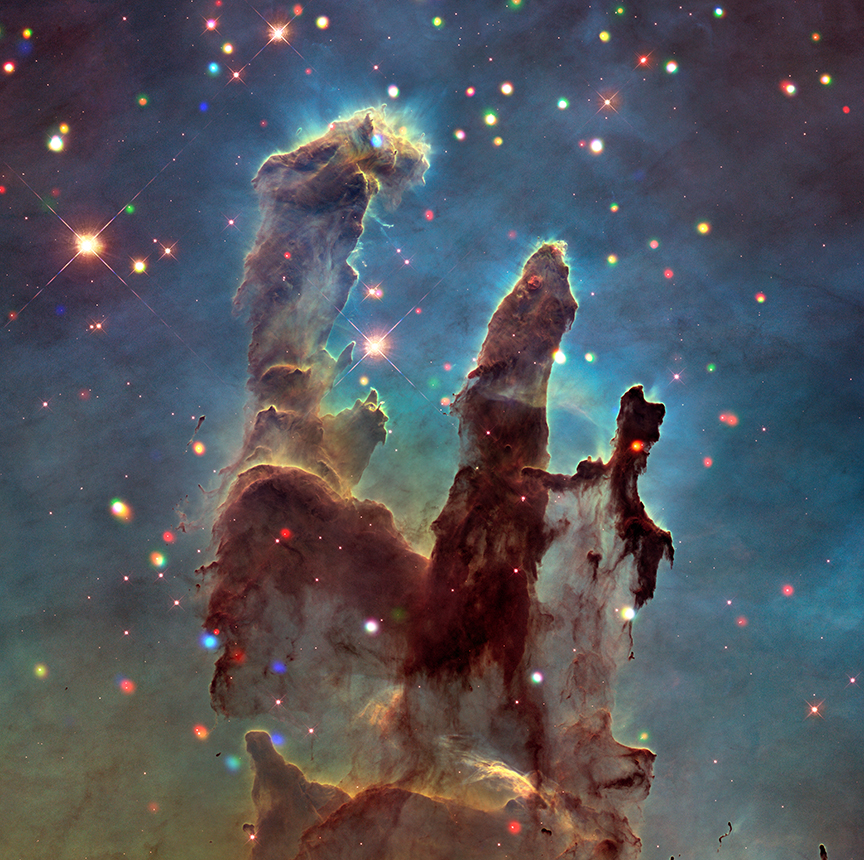
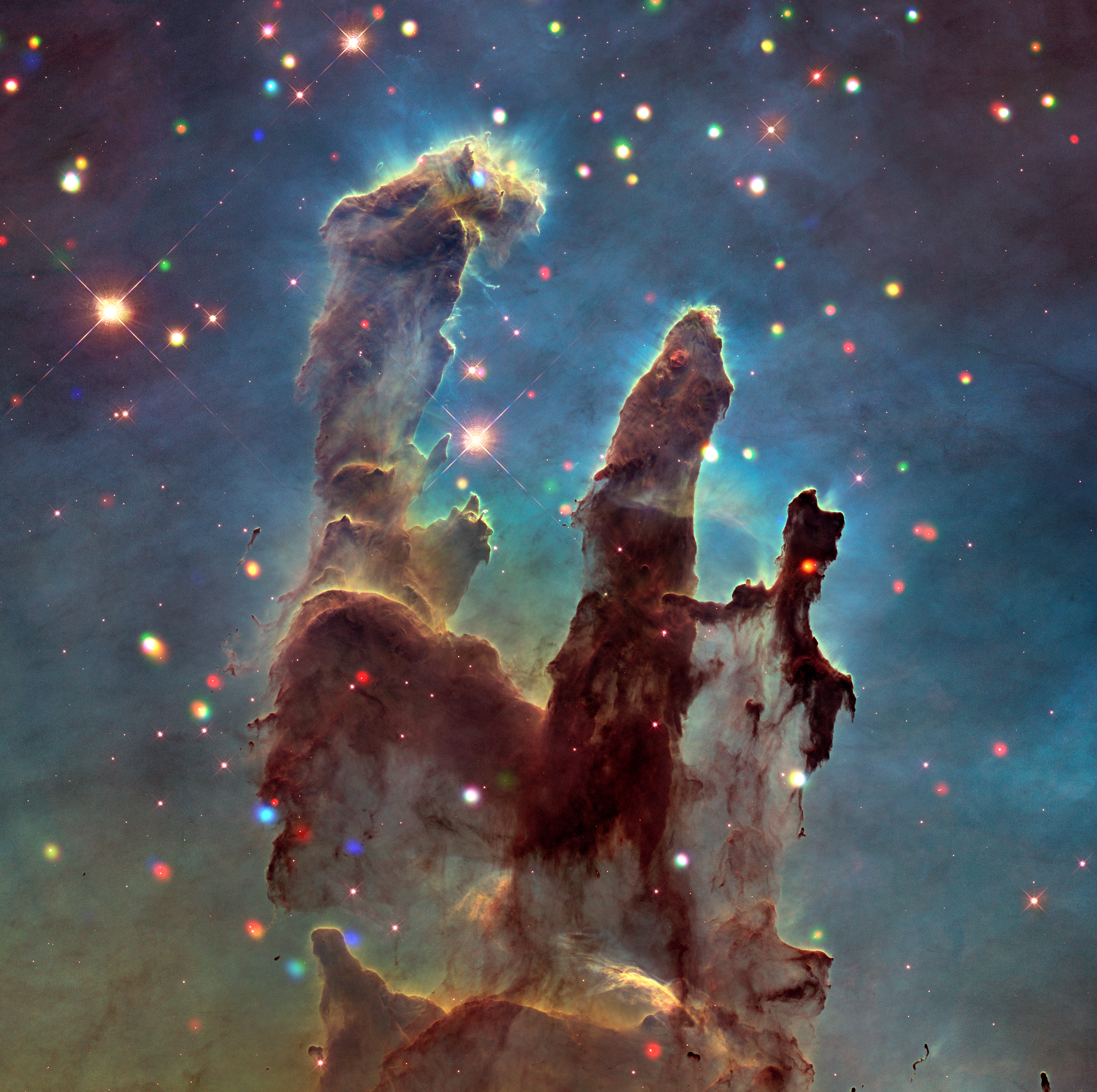
Although NASA's Hubble Space Telescope has taken many breathtaking images of the universe, one snapshot stands out from the rest: the iconic view of the so-called "Pillars of Creation." The jaw-dropping photo, taken in 1995, revealed never-before-seen details of three giant columns of cold gas bathed in the scorching ultraviolet light from a cluster of young, massive stars in a small region of the Eagle Nebula, or M16.

Though such butte-like features are common in star-forming regions, the M16 structures are by far the most photogenic and evocative. The Hubble image is so popular that it has appeared in movies and television shows, on tee-shirts and pillows, and even on a postage stamp.

And now, in celebration of its 25th anniversary, Hubble has revisited the famous pillars, providing astronomers with a sharper and wider view. As a bonus, the pillars have been photographed in near-infrared light, as well as visible light. The infrared view transforms the pillars into eerie, wispy silhouettes seen against a background of myriad stars. That's because the infrared light penetrates much of the gas and dust, except for the densest regions of the pillars. Newborn stars can be seen hidden away inside the pillars. The new images are being unveiled at the American Astronomical Society meeting in Seattle, Washington.

Although the original image was dubbed the Pillars of Creation, the new image hints that they are also pillars of destruction. "I'm impressed by how transitory these structures are. They are actively being ablated away before our very eyes. The ghostly bluish haze around the dense edges of the pillars is material getting heated up and evaporating away into space. We have caught these pillars at a very unique and short-lived moment in their evolution," explained Paul Scowen of Arizona State University in Tempe, who, with astronomer Jeff Hester, formerly of Arizona State University, led the original Hubble observations of the Eagle Nebula.

The infrared image shows that the reason the pillars exist is because the very ends of them are dense, and they shadow the gas below them, creating the long, pillar-like structures. The gas in between the pillars has long since been blown away by the ionizing winds from the central star cluster located above the pillars.

At the top edge of the left-hand pillar, a gaseous fragment has been heated up and is flying away from the structure, underscoring the violent nature of star-forming regions. "These pillars represent a very dynamic, active process," Scowen said. "The gas is not being passively heated up and gently wafting away into space. The gaseous pillars are actually getting ionized (a process by which electrons are stripped off of atoms) and heated up by radiation from the massive stars. And then they are being eroded by the stars' strong winds (barrage of charged particles), which are sandblasting away the tops of these pillars."

When Scowen and Hester used Hubble to make the initial observations of the Eagle Nebula in 1995, astronomers had seen the pillar-like structures in ground-based images, but not in detail. They knew that the physical processes are not unique to the Eagle Nebula because star birth takes place across the universe. But at a distance of just 6,500 light-years, M16 is the most dramatic nearby example, as the team soon realized.

As Scowen was piecing together the Hubble exposures of the Eagle, he was amazed at what he saw. "I called Jeff Hester on his phone and said, 'You need to get here now,'" Scowen recalled. "We laid the pictures out on the table, and we were just gushing because of all the incredible detail that we were seeing for the very first time."

The first features that jumped out at the team in 1995 were the streamers of gas seemingly floating away from the columns. Astronomers had previously debated what effect nearby massive stars would have on the surrounding gas in stellar nurseries. "There is only one thing that can light up a neighborhood like this: massive stars kicking out enough horsepower in ultraviolet light to ionize the gas clouds and make them glow," Scowen said. "Nebulous star-forming regions like M16 are the interstellar neon signs that say, 'We just made a bunch of massive stars here.' This was the first time we had directly seen observational evidence that the erosionary process, not only the radiation but the mechanical stripping away of the gas from the columns, was actually being seen."

By comparing the 1995 and 2014 pictures, astronomers also noticed a lengthening of a narrow jet-like feature that may have been ejected from a newly forming star. The jet looks like a stream of water from a garden hose. Over the intervening 19 years, this jet has stretched farther into space, across an additional 60 billion miles, at an estimated speed of about 450,000 miles per hour.

Our Sun probably formed in a similar turbulent star-forming region. There is evidence that the forming solar system was seasoned with radioactive shrapnel from a nearby supernova. That means that our Sun was formed as part of a cluster that included stars massive enough to produce powerful ionizing radiation, such as is seen in the Eagle Nebula. "That's the only way the nebula from which the Sun was born could have been exposed to a supernova that quickly, in the short period of time that represents, because supernovae only come from massive stars, and those stars only live a few tens of millions of years," Scowen explained. "What that means is when you look at the environment of the Eagle Nebula or other star-forming regions, you're looking at exactly the kind of nascent environment that our Sun formed in."


CONTACT

Felicia Chou
NASA Headquarters, Washington, D.C.
202-358-0257

felicia.chou@nasa.gov

Donna Weaver / Ray Villard
Space Telescope Science Institute, Baltimore, Md.
410-338-4493 / 410-338-4514

dweaver@stsci.edu / villard@stsci.edu

Source: HubbleSite