Showing posts with label Solar Flares. Show all posts

Thursday, January 23, 2025

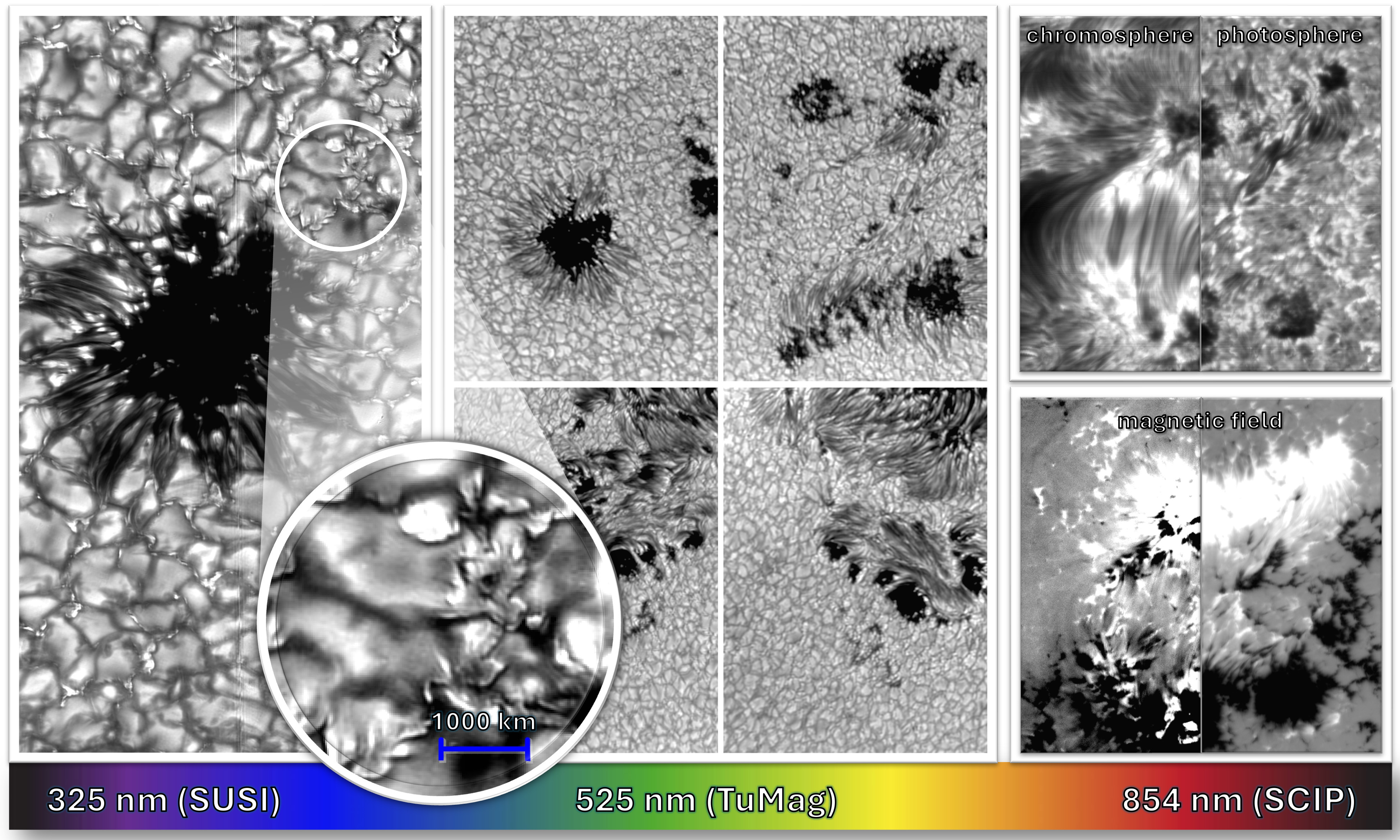
First Solar Images from Sunrise-Ⅲ

Left: The SUSI instrument shows the surface of the Sun in ultraviolet light. Here you can see a sunspot, its finely structured edge area, and the typical granulation of the solar surface. Center: The TuMag instrument images the surface of the Sun in visible light. The four images show different views of sunspots. Right: Infrared images of the chromosphere and photosphere taken by the SCIP instrument. In the upper image, elongated fibril-like structures can be seen in the chromosphere. The lower image shows the corresponding magnetic fields in the chromosphere and photosphere.  (Credit:MPS/Sunrise III/Teams: SUSI, TuMag, SCIP, CWS, Gondola).
Download image


The first images have been published from the Sunrise-Ⅲ balloon-borne solar telescope’s successful 6.5-day stratospheric flight in July 2024. The unprecedented huge amount of data (about 200 terabytes) recorded during the flight observations show structures down to only 50 kilometers in size on the Sun’s visible surface. The Sun is now in the maximum phase of its 11-year solar cycle (Cycle 25), so solar activity was high during the Sunrise-Ⅲ flight observations. Two solar flares were successfully observed as well as growing sunspots and various dynamical phenomena.

Within the international collaboration framework of the Sunrise-Ⅲ project, the near-infrared spectropolarimeter SCIP was developed under the leadership of the National Astronomical Observatory of Japan. SCIP observes many spectral lines simultaneously, including chromospheric and photospheric spectral lines, in the near-infrared wavelength bands. The images obtained by SCIP show the three-dimensional structures of the radiation intensity (Figure, right top) and magnetic field (Figure, right bottom) from the solar surface (photosphere) to the upper solar atmosphere (chromosphere). Elongated, fibril-like fine-scale structures in the vertical direction can be seen in the chromosphere, connecting the positive (white) and negative (black) polarity magnetic fields. Thanks to Sunrise-Ⅲ’s observations from a balloon in Earth’s stratosphere, the temporal evolution of these three-dimensional structures was successfully captured for several hours without interruption.

Furthermore, a Spanish team of amateur astronomers mounted four cameras on balloon’s gondola and took “selfies” of Sunrise-Ⅲ during the flight from takeoff to landing. Please take a look.


Related Link(s)


Saturday, June 01, 2024

The origin of the sun’s magnetic field could lie close to its surface

Surprise findings suggest sunspots and solar flares could be generated by a magnetic field within the Sun’s outermost layers. If confirmed, the findings could help scientists better predict space weather. This illustration lays a depiction of the sun's magnetic fields over an image captured by NASA’s Solar Dynamics Observatory on March 12, 2016. Credits: Image: NASA/SDO/AIA/LMSAL

Sunspots and flares could be a product of a shallow magnetic field, according to surprising new findings that may help scientists predict space weather.

The sun’s surface is a brilliant display of sunspots and flares driven by the solar magnetic field, which is internally generated through a process called dynamo action. Astrophysicists have assumed that the sun’s field is generated deep within the star. But an MIT study finds that the sun’s activity may be shaped by a much shallower process.

In a paper appearing today in Nature, researchers at MIT, the University of Edinburgh, and elsewhere find that the sun’s magnetic field could arise from instabilities within the sun’s outermost layers.

The team generated a precise model of the sun’s surface and found that when they simulated certain perturbations, or changes in the flow of plasma (ionized gas) within the top 5 to 10 percent of the sun, these surface changes were enough to generate realistic magnetic field patterns, with similar characteristics to what astronomers have observed on the sun. In contrast, their simulations in deeper layers produced less realistic solar activity.

The findings suggest that sunspots and flares could be a product of a shallow magnetic field, rather than a field that originates deeper in the sun, as scientists had largely assumed.

“The features we see when looking at the sun, like the corona that many people saw during the recent solar eclipse, sunspots, and solar flares, are all associated with the sun’s magnetic field,” says study author Keaton Burns, a research scientist in MIT’s Department of Mathematics. “We show that isolated perturbations near the sun’s surface, far from the deeper layers, can grow over time to potentially produce the magnetic structures we see.”

If the sun’s magnetic field does in fact arise from its outermost layers, this might give scientists a better chance at forecasting flares and geomagnetic storms that have the potential to damage satellites and telecommunications systems.

“We know the dynamo acts like a giant clock with many complex interacting parts,” says co-author Geoffrey Vasil, a researcher at the University of Edinburgh. “But we don't know many of the pieces or how they fit together. This new idea of how the solar dynamo starts is essential to understanding and predicting it.”

The study’s co-authors also include Daniel Lecoanet and Kyle Augustson of Northwestern University, Jeffrey Oishi of Bates College, Benjamin Brown and Keith Julien of the University of Colorado at Boulder, and Nicholas Brummell of the University of California at Santa Cruz.

Flow zone

The sun is a white-hot ball of plasma that’s boiling on its surface. This boiling region is called the “convection zone,” where layers and plumes of plasma roil and flow. The convection zone comprises the top one-third of the sun’s radius and stretches about 200,000 kilometers below the surface.

“One of the basic ideas for how to start a dynamo is that you need a region where there’s a lot of plasma moving past other plasma, and that shearing motion converts kinetic energy into magnetic energy,” Burns explains. “People had thought that the sun’s magnetic field is created by the motions at the very bottom of the convection zone.”

To pin down exactly where the sun’s magnetic field originates, other scientists have used large three-dimensional simulations to try to solve for the flow of plasma throughout the many layers of the sun’s interior. “Those simulations require millions of hours on national supercomputing facilities, but what they produce is still nowhere near as turbulent as the actual sun,” Burns says.

Rather than simulating the complex flow of plasma throughout the entire body of the sun, Burns and his colleagues wondered whether studying the stability of plasma flow near the surface might be enough to explain the origins of the dynamo process.

To explore this idea, the team first used data from the field of “helioseismology,” where scientists use observed vibrations on the sun’s surface to determine the average structure and flow of plasma beneath the surface.

“If you take a video of a drum and watch how it vibrates in slow motion, you can work out the drumhead’s shape and stiffness from the vibrational modes,” Burns says. “Similarly, we can use vibrations that we see on the solar surface to infer the average structure on the inside.”

Solar onion

For their new study, the researchers collected models of the sun’s structure from helioseismic observations. “These average flows look sort like an onion, with different layers of plasma rotating past each other,” Burns explains. “Then we ask: Are there perturbations, or tiny changes in the flow of plasma, that we could superimpose on top of this average structure, that might grow to cause the sun’s magnetic field

To look for such patterns, the team utilized the Dedalus Project — a numerical framework that Burns developed that can simulate many types of fluid flows with high precision. The code has been applied to a wide range of problems, from modeling the dynamics inside individual cells, to ocean and atmospheric circulations.

“My collaborators have been thinking about the solar magnetism problem for years, and the capabilities of Dedalus have now reached the point where we could address it,” Burns says.

The team developed algorithms that they incorporated into Dedalus to find self-reinforcing changes in the sun’s average surface flows. The algorithm discovered new patterns that could grow and result in realistic solar activity. In particular, the team found patterns that match the locations and timescales of sunspots that have been have observed by astronomers since Galileo in 1612.

Sunspots are transient features on the surface of the sun that are thought to be shaped by the sun’s magnetic field. These relatively cooler regions appear as dark spots in relation to the rest of the sun’s white-hot surface. Astronomers have long observed that sunspots occur in a cyclical pattern, growing and receding every 11 years, and generally gravitating around the equator, rather than near the poles.

In the team’s simulations, they found that certain changes in the flow of plasma, within just the top 5 to 10 percent of the sun’s surface layers, were enough to generate magnetic structures in the same regions. In contrast, changes in deeper layers produce less realistic solar fields that are concentrated near the poles, rather than near the equator.

The team was motivated to take a closer look at flow patterns near the surface as conditions there resembled the unstable plasma flows in entirely different systems: the accretion disks around black holes. Accretion disks are massive disks of gas and stellar dust that rotate in towards a black hole, driven by the “magnetorotational instability,” which generates turbulence in the flow and causes it to fall inward.

Burns and his colleagues suspected that a similar phenomena is at play in the sun, and that the magnetorotational instability in the sun’s outermost layers could be the first step in generating the sun’s magnetic field.

“I think this result may be controversial,” he ventures. “Most of the community has been focused on finding dynamo action deep in the sun. Now we’re showing there’s a different mechanism that seems to be a better match to observations.” Burns says that the team is continuing to study if the new surface field patterns can generate individual sunspots and the full 11-year solar cycle.

“This is far from the final word on the problem,” says Steven Balbus, a professor of astronomy at Oxford University, who was not involved with the study. “However, it is a fresh and very promising avenue for further study. The current findings are very suggestive and the approach is innovative, and not in line with the current received wisdom. When the received wisdom has not been very fruitful for an extended period, something more creative is indicated, and that is what this work offers.”

This research was supported, in part, by NASA.

Jennifer Chu | MIT News


Sunday, December 03, 2023

Solar Flares in Focus

Solar Flares

Solar flares, like the one photographed by the Solar Dynamics Observatory and shown above, are flashes of solar radiation powered by magnetic reconnection. Many solar flares are accompanied by immense eruptions of magnetized plasma called coronal mass ejections. In a recent research article, Maria Kazachenko (University of Colorado Boulder and National Solar Observatory) explored why some solar flares, called eruptive flares, come with a coronal mass ejection, while others, called confined flares, do not. Kazachenko analyzed 480 solar flares, from middle-of-the-pack C-class flares to the most energetic X-class flares, cataloging the thermodynamic and magnetic properties of each flare and noting whether it was eruptive or confined. Confined flares tend to arise from active regions — areas of the solar surface with strong magnetic fields — that are larger and more strongly magnetic, and a smaller fraction of the active region’s magnetic field undergoes magnetic reconnection during a confined flare. For the first time, Kazachenko showed that magnetic reconnection happens more rapidly in confined flares than eruptive flares. To learn more about the properties of confined and eruptive flares, be sure to check out the full research article linked below.

By Kerry Hensley

Citation

“A Database of Magnetic and Thermodynamic Properties of Confined and Eruptive Solar Flares,” Maria D. Kazachenko 2023 ApJ 958 104.
doi:10.3847/1538-4357/ad004e


Sunday, December 22, 2019

NASA’s SDO Sees New Kind of Magnetic Explosion on Sun

Forced magnetic reconnection, caused by a prominence from the Sun, was seen for the first time in images from NASA’s Solar Dynamics Observatory, or SDO. This image shows the Sun on May 3, 2012, with the inset showing a close-up of the reconnection event imaged by SDO’s Atmospheric Imaging Assembly instrument, where the signature X-shape is visible. Credit: NASA/SDO/Abhishek Srivastava/IIT(BHU).​

NASA’s Solar Dynamics Observatory has observed a magnetic explosion the likes of which have never been seen before. In the scorching upper reaches of the Sun’s atmosphere, a prominence — a large loop of material launched by an eruption on the solar surface — started falling back to the surface of the Sun. But before it could make it, the prominence ran into a snarl of magnetic field lines, sparking a magnetic explosion.

Scientists have previously seen the explosive snap and realignment of tangled magnetic field lines on the Sun — a process known as magnetic reconnection — but never one that had been triggered by a nearby eruption. The observation, which confirms a decade-old theory, may help scientists understand a key mystery about the Sun’s atmosphere, better predict space weather, and may also lead to breakthroughs in the controlled fusion and lab plasma experiments.

“This was the first observation of an external driver of magnetic reconnection,” said Abhishek Srivastava, solar scientist at Indian Institute of Technology (BHU), in Varanasi, India. “This could be very useful for understanding other systems.  For example, Earth’s and planetary magnetospheres, other magnetized plasma sources, including experiments at laboratory scales where plasma is highly diffusive and very hard to control.”

Previously a type of magnetic reconnection known as spontaneous reconnection has been seen, both on the Sun and around Earth. But this new explosion-driven type — called forced reconnection — had never been seen directly, thought it was first theorized 15 years ago. The new observations have just been published in the Astrophysical Journal.

The previously-observed spontaneous reconnection requires a region with just the right conditions — such as having a thin sheet of ionized gas, or plasma, that only weakly conducts electric current — in order to occur. The new type, forced reconnection, can happen in a wider range of places, such as in plasma that has even lower resistance to conducting an electric current. However, it can only occur if there is some type of eruption to trigger it. The eruption squeezes the plasma and magnetic fields, causing them to reconnect.

While the Sun’s jumble of magnetic field lines are invisible, they nonetheless affect the material around them — a soup of ultra-hot charged particles known as plasma. The scientists were able to study this plasma using observations from NASA’s Solar Dynamics Observatory, or SDO, looking specifically at a wavelength of light showing particles heated 1-2 million kelvins (1.8-3.6 million F).

The observations allowed them to directly see the forced reconnection event for the first time in the solar corona — the Sun’s uppermost atmospheric layer. In a series of images taken over an hour, a prominence in the corona could be seen falling back into the photosphere. En route, the prominence ran into a snarl of magnetic field lines, causing them to reconnect in a distinct X shape.

Forced magnetic reconnection, caused by a prominence from the Sun, was seen for the first time in images from NASA’s SDO. Credits: NASA's Goddard Space Flight Center. Download this video in HD formats from NASA Goddard's Scientific Visualization Studio

Spontaneous reconnection offers one explanation for how hot the solar atmosphere is — mysteriously, the corona is millions of degrees hotter than lower atmospheric layers, a conundrum that has led solar scientists for decades to search for what mechanism is driving that heat. The scientists looked at multiple ultraviolet wavelengths to calculate the temperature of the plasma during and following the reconnection event. The data showed that the prominence, which was fairly cool relative to the blistering corona, gained heat after the event. This suggests forced reconnection might be one way the corona is heated locally. Spontaneous reconnection also can heat plasma, but forced reconnection seems to be a much more effective heater — raising the temperature of the plasma quicker, higher, and in a more controlled manner.

While a prominence was the driver behind this reconnection event, other solar eruptions like flares and coronal mass ejections, could also cause forced reconnection. Since these eruptions drive space weather — the bursts of solar radiation that can damage satellites around Earth — understanding forced reconnection can help modelers better predict when disruptive high-energy charged particles might come speeding at Earth.

Understanding how magnetic reconnection can be forced in a controlled way may also help plasma physicists reproduce reconnection in the lab. This is ultimately useful in the field of laboratory plasma to control and stabilize them.
The scientists are continuing to look for more forced reconnection events. With more observations they can begin to understand the mechanics behind the reconnection and often it might happen.

“Our thought is that forced reconnection is everywhere,” Srivastava said. “But we have to continue to observe it, to quantify it, if we want prove that.”


Related Links 

By Mara Johnson-Groh
NASA’s Goddard Space Flight Center, Greenbelt, Md.

Editor: Rob Garner


Friday, August 04, 2017

Two Weeks in the Life of a Sunspot

A blended view of the sunspot in visible and extreme ultraviolet light reveals bright coils arcing over the active region — particles spiraling along magnetic field lines. Credit: NASA’s Goddard Space Flight Center/SDO

On July 5, 2017, NASA’s Solar Dynamics Observatory watched an active region — an area of intense and complex magnetic fields — rotate into view on the Sun. The satellite continued to track the region as it grew and eventually rotated across the Sun and out of view on July 17.  

With their complex magnetic fields, sunspots are often the source of interesting solar activity: During its 13-day trip across the face of the Sun, the active region — dubbed AR12665 — put on a show for NASA’s Sun-watching satellites, producing several solar flares, a coronal mass ejection and a solar energetic particle event. Watch the video below to learn how NASA’s satellites tracked the sunspot over the course of these two weeks.


Such sunspots are a common occurrence on the Sun, but less frequent at the moment, as the Sun is moving steadily toward a period of lower solar activity called solar minimum — a regular occurrence during its approximately 11-year cycle. Scientists track such spots because they can help provide information about the Sun’s inner workings. Space weather centers, such as NOAA’s Space Weather Prediction Center, also monitor these spots to provide advance warning, if needed, of the radiation bursts being sent toward Earth, which can impact our satellites and radio communications.

On July 9, a medium-sized flare burst from the sunspot, peaking at 11:18 a.m. EDT. Solar flares are explosions on the Sun that send energy, light and high-speed particles out into space — much like how earthquakes have a Richter scale to describe their strength, solar flares are also categorized according to their intensity. This flare was categorized as an M1. M-class flares are a tenth the size of the most intense flares, the X-class flares. The number provides more information about its strength: An M2 is twice as intense as an M1, an M3 is three times as intense and so on.

Days later, on July 14, a second medium-sized, M2 flare erupted from the Sun. The second flare was long-lived, peaking at 10:09 a.m. EDT and lasting over two hours.

This was accompanied by another kind of solar explosion called a coronal mass ejection, or CME. Solar flares are often associated with CMEs — giant clouds of solar material and energy. NASA’s Solar and Heliospheric Observatory, or SOHO, saw the CME at 9:36 a.m. EDT leaving the Sun at speeds of 620 miles per second and eventually slowing to 466 miles per second.

Following the CME, the turbulent active region also emitted a flurry of high-speed protons, known as a solar energetic particle event, at 12:45 p.m. EDT.

Research scientists at the Community Coordinated Modeling Center — located at NASA’s Goddard Space Flight Center in Greenbelt, Maryland — used these spacecraft observations as input for their simulations of space weather throughout the solar system. Using a model called ENLIL, they are able to map out and predict whether the solar storm will impact our instruments and spacecraft, and send alerts to NASA mission operators if necessary.

By the time the CME made contact with Earth’s magnetic field on July 16, the sunspot’s journey across the Sun was almost complete. As for the solar storm, it took this massive cloud of solar material two days to travel 93 million miles to Earth, where it caused charged particles to stream down Earth’s magnetic poles, sparking enhanced aurora.

After a large sunspot rotated out of Earth’s view on July 17, 2017, NASA instruments could still track its effects on the far side of the star. This imagery from NASA’s Solar Terrestrial Relations Observatory on July 23, 2017, captures an eruption of solar material — a coronal mass ejection — from that same active region. Credits: NASA’s Goddard Space Flight Center/STEREO/Bill Thompson


Related

Editor: Rob Garner


Tuesday, January 31, 2017

NASA's Fermi Sees Gamma Rays from 'Hidden' Solar Flares

An international science team says NASA's Fermi Gamma-ray Space Telescope has observed high-energy light from solar eruptions located on the far side of the sun, which should block direct light from these events. This apparent paradox is providing solar scientists with a unique tool for exploring how charged particles are accelerated to nearly the speed of light and move across the sun during solar flares.

"Fermi is seeing gamma rays from the side of the sun we're facing, but the emission is produced by streams of particles blasted out of solar flares on the far side of the sun," said Nicola Omodei, a researcher at Stanford University in California. "These particles must travel some 300,000 miles within about five minutes of the eruption to produce this light."

Omodei presented the findings on Monday, Jan. 30, at the American Physical Society meeting in Washington, and a paper describing the results will be published online in The Astrophysical Journal on Jan. 31.


On three occasions, NASA's Fermi Gamma-ray Space Telescope has detected gamma rays from solar storms on the far side of the sun, emission the Earth-orbiting satellite shouldn't be able to detect. Particles accelerated by these eruptions somehow reach around to produce a gamma-ray glow on the side of the sun facing Earth and Fermi. Watch to learn more. Credits: NASA's Goddard Space Flight Center/Scott Wiessinger, producer.
Download this video in HD formats from NASA Goddard's Scientific Visualization Studio

Fermi has doubled the number of these rare events, called behind-the-limb flares, since it began scanning the sky in 2008. Its Large Area Telescope (LAT) has captured gamma rays with energies reaching 3 billion electron volts, some 30 times greater than the most energetic light previously associated with these "hidden" flares.

Thanks to NASA's Solar Terrestrial Relations Observatory (STEREO) spacecraft, which were monitoring the solar far side when the eruptions occurred, the Fermi events mark the first time scientists have direct imaging of beyond-the-limb solar flares associated with high-energy gamma rays.
These solar flares were imaged in extreme ultraviolet light by NASA's STEREO satellites, which at the time were viewing the side of the sun facing away from Earth. All three events launched fast coronal mass ejections (CMEs). Although NASA's Fermi Gamma-ray Space Telescope couldn't see the eruptions directly, it detected high-energy gamma rays from all of them. Scientists think particles accelerated by the CMEs rained onto the Earth-facing side of the sun and produced the gamma rays. The central image was returned by the STEREO A spacecraft, all others are from STEREO B.Credits: NASA/STEREO
Combined images from NASA's Solar Dynamics Observatory (center) and the NASA/ESA Solar and Heliospheric Observatory (red and blue) show an impressive coronal mass ejection departing the far side of the sun on Sept. 1, 2014. This massive cloud raced away at about 5 million mph and likely accelerated particles that later produced gamma rays Fermi detected. Credits: NASA/SDO and NASA/ESA/SOHO


"Observations by Fermi's LAT continue to have a significant impact on the solar physics community in their own right, but the addition of STEREO observations provides extremely valuable information of how they mesh with the big picture of solar activity," said Melissa Pesce-Rollins, a researcher at the National Institute of Nuclear Physics in Pisa, Italy, and a co-author of the paper. 

The hidden flares occurred Oct. 11, 2013, and Jan. 6 and Sept. 1, 2014. All three events were associated with fast coronal mass ejections (CMEs), where billion-ton clouds of solar plasma were launched into space. The CME from the most recent event was moving at nearly 5 million miles an hour as it left the sun. Researchers suspect particles accelerated at the leading edge of the CMEs were responsible for the gamma-ray emission.

Large magnetic field structures can connect the acceleration site with distant part of the solar surface. Because charged particles must remain attached to magnetic field lines, the research team thinks particles accelerated at the CME traveled to the sun's visible side along magnetic field lines connecting both locations. As the particles impacted the surface, they generated gamma-ray emission through a variety of processes. One prominent mechanism is thought to be proton collisions that result in a particle called a pion, which quickly decays into gamma rays.

In its first eight years, Fermi has detected high-energy emission from more than 40 solar flares. More than half of these are ranked as moderate, or M class, events. In 2012, Fermi caught the highest-energy emission ever detected from the sun during a powerful X-class flare, from which the LAT detected high­energy gamma rays for more than 20 record-setting hours.

NASA's Fermi Gamma-ray Space Telescope is an astrophysics and particle physics partnership, developed in collaboration with the U.S. Department of Energy and with important contributions from academic institutions and partners in France, Germany, Italy, Japan, Sweden and the United States. 


For more information on Fermi, visit:  https://www.nasa.gov/fermi
 

By Francis Reddy
NASA's Goddard Space Flight Center
Editor: Rob Garner


Sunday, December 06, 2015

New Insights into Solar Flares

Particle acceleration in a solar flare.
Alexandra Angelich, NRAO/AUI/NSF
High Resolution (jpg) - Low Resolution (jpg)


Cambridge, MA - Astronomers have made a significant step toward confirming a proposed explanation for how solar flares accelerate charged particles to speeds nearly that of light. This important advance was made possible by the new capabilities of the National Science Foundation's Karl G. Jansky Very Large Array (VLA) radio telescope.

Solar flares, the most powerful explosions in the Solar System, can accelerate large numbers of charged particles like electrons and protons to nearly the speed of light. How they do that, however, has been uncertain.

"It has been thought that a specific type of shock produced by solar flares could be responsible for accelerating these particles, but there has been no convincing observational evidence for this mechanism. Now, using the raw power of the upgraded VLA, we have a fundamentally new result that strongly supports this theoretical scenario," said first author of the study, Bin Chen, of the Harvard-Smithsonian Center for Astrophysics (CfA).

Solar flares are often associated with powerful eruptions that throw huge amounts of material out from the Sun. Scientists think flares are produced by a sudden release of energy from solar magnetic fields. Magnetic fields in the Sun's atmosphere are churned and tangled. An enormous amount of energy is released when those fields snap and reconfigure themselves in a process called magnetic reconnection. Researchers were unclear, though, how the energy release process could propel the high-speed charged particles that emerge from the flares.

The new VLA observations support the idea that the acceleration occurs in a region of the flare where rapidly flowing solar gases impinge on dense magnetic field loops. This creates a shock wave, similar to the sonic boom of an airplane except that it remains in one place as a so-called "termination shock." Electrons are repeatedly pummeled by the shock into higher and higher speeds. The VLA observations of this shock closely match computer simulations that produce such a phenomenon in flares.

The scientists used the VLA, along with other telescopes at ultraviolet and X-ray wavelengths, to study a flare that erupted on 3 March 2012. The VLA can observe the Sun in a broad range of radio frequencies and in time slices of only 50 milliseconds each, producing more than 40,000 individual radio images for one second of observation. The researchers were able to determine that short-lived bursts of radio waves coming from energetic electrons were occurring where the termination shock was expected to be, according to the computer simulations performed by co-author Chengcai Shen, also a researcher at the CfA. Other details further supported the shock acceleration model.

"These new insights are a significant step forward in our understanding of particle acceleration, which is not only an important aspect of solar flares, but also a fundamental physical process occurring throughout the Universe," Chen said.

The scientists reported their findings in the 4 December issue of the journal Science.

This release is being issued jointly with the National Radio Astronomy Observatory.

The National Radio Astronomy Observatory is a facility of the National Science Foundation, operated under cooperative agreement by Associated Universities, Inc.

Headquartered in Cambridge, Mass., the Harvard-Smithsonian Center for Astrophysics (CfA) is a joint collaboration between the Smithsonian Astrophysical Observatory and the Harvard College Observatory. CfA scientists, organized into six research divisions, study the origin, evolution and ultimate fate of the universe.


For more information, contact:

Christine Pulliam
Media Relations Manager
Harvard-Smithsonian Center for Astrophysics
617-495-7463
cpulliam@cfa.harvard.edu

Dave Finley
Public Information Officer
National Radio Astronomy Observatory
575-835-7302
dfinley@nrao.edu