XMM-Newton discovers galactic ‘chimneys’
Copyright:
ESA/XMM-Newton/G. Ponti et al. 2019; ESA/Gaia/DPAC (Milky Way map),
CC BY-SA 3.0 IGO. Hi-res image
By surveying the centre of our Galaxy, ESA’s XMM-Newton has discovered
two colossal ‘chimneys’ funneling material from the vicinity of the
Milky Way’s supermassive black hole into two huge cosmic bubbles.
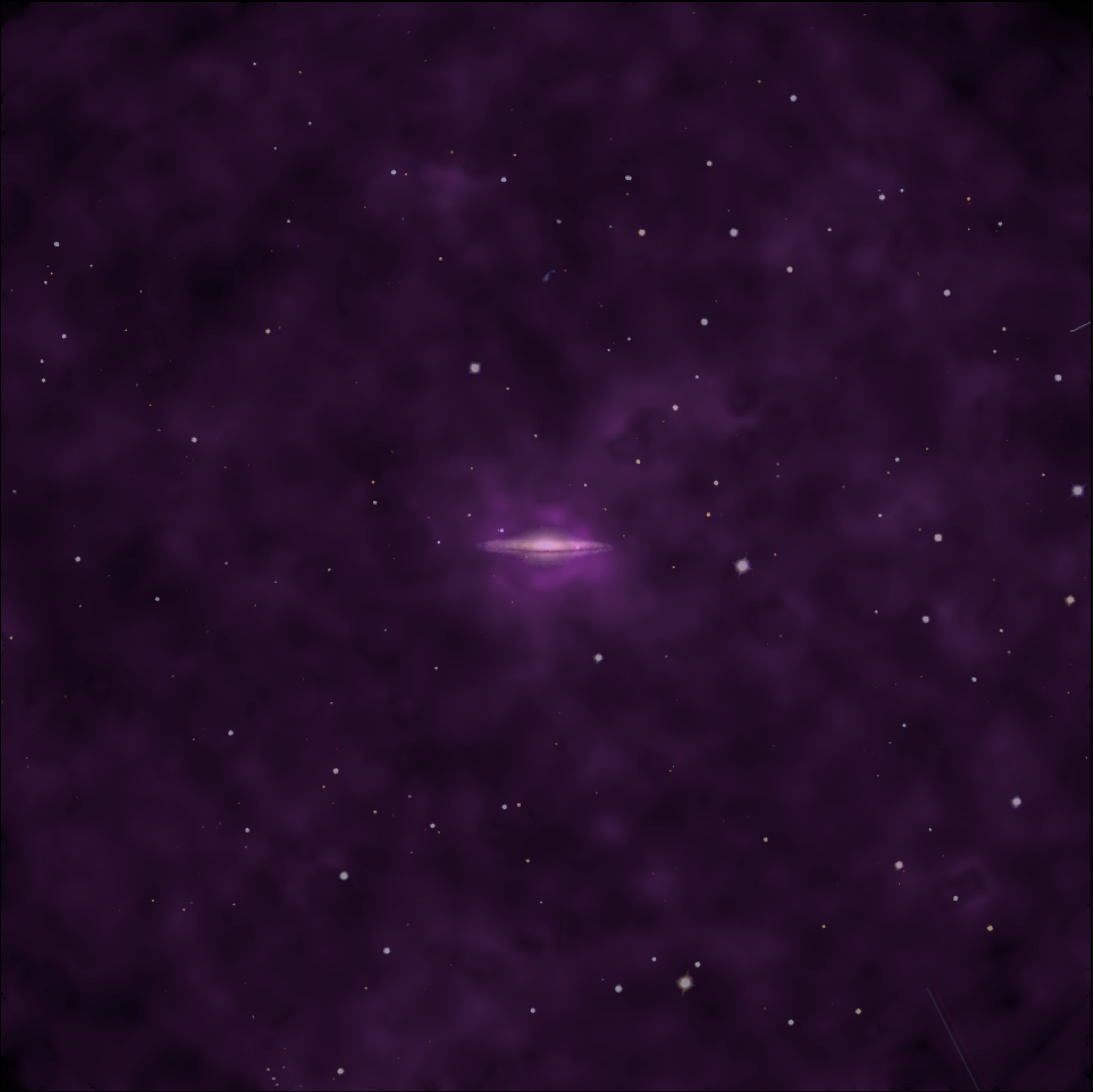
The giant bubbles were discovered in 2010 by NASA’s Fermi Gamma-ray
Space Telescope: one stretches above the plane of the Milky Way galaxy
and the other below, forming a shape akin to a colossal hourglass that
spans about 50 000 light years – around half the diameter of the entire
Galaxy. They can be thought of as giant ‘burps’ of material from the
central regions of our Milky Way, where its central black hole, known as
Sagittarius A*, resides.
Now, XMM-Newton has
discovered two channels of hot, X-ray emitting material streaming
outwards from Sagittarius A*, finally linking the immediate surroundings
of the black hole and the bubbles together.
“We know that outflows and winds of material and energy emanating from a
galaxy are crucial in sculpting and altering that galaxy’s shape over
time – they are key players in how galaxies and other structures form
and evolve throughout the cosmos,” says lead author Gabriele Ponti of
the Max Planck Institute for Extraterrestrial Physics in Garching,
Germany, and the National Institute for Astrophysics in Italy.
“Luckily, our Galaxy gives us a nearby laboratory to explore this in
detail, and probe how material flows out into the space around us. We
used data gathered by XMM-Newton between 2016 and 2018 to form the most
extensive X-ray map ever made of the Milky Way’s core.”

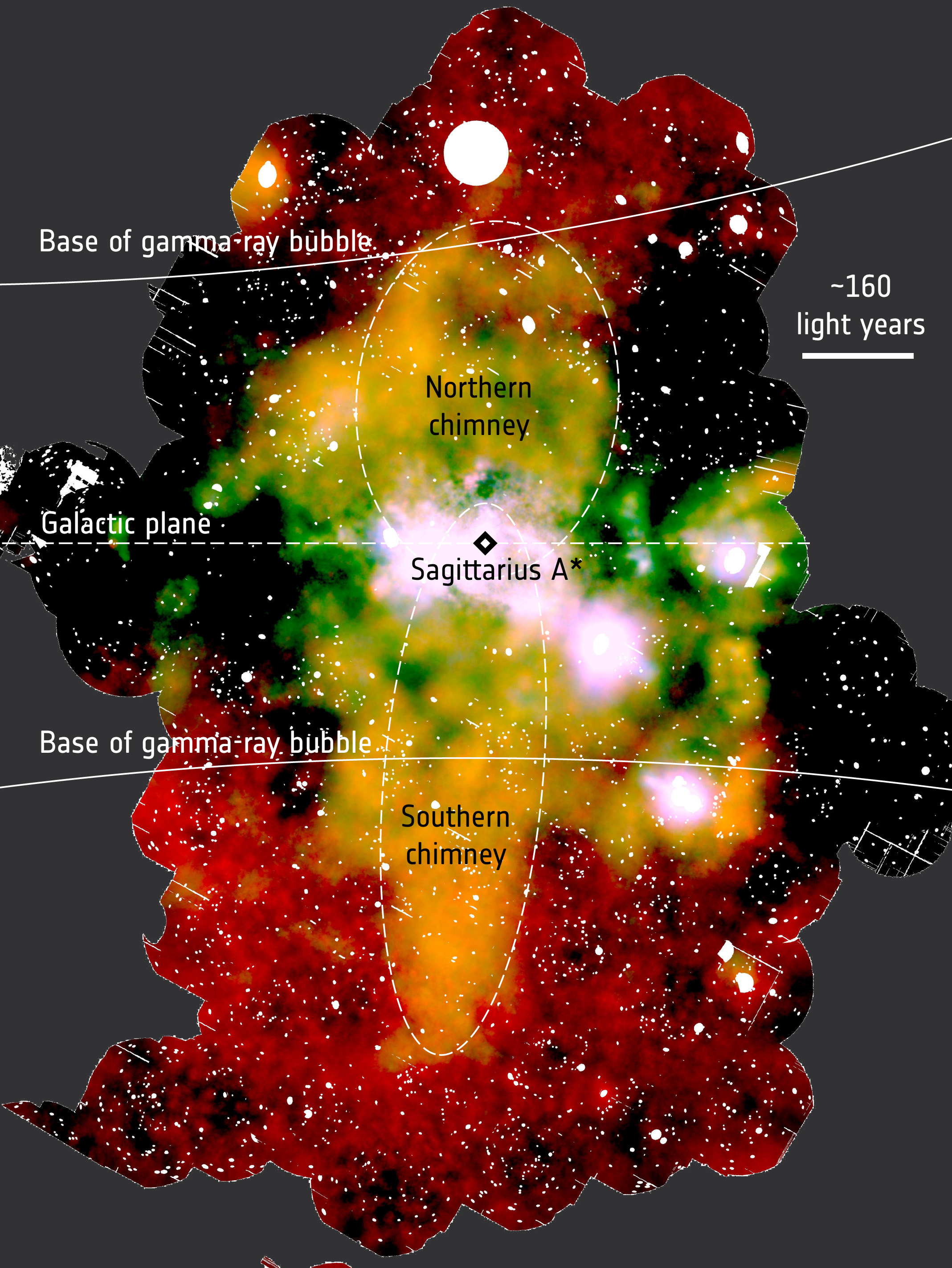
XMM-Newton’s view of the Galactic centre – annotated
Copyright:
ESA/XMM-Newton/G. Ponti et al. 2019, Nature. Hi-res image
This map revealed long channels of super-heated gas, each extending for
hundreds of light years, streaming above and below the plane of the
Milky Way.
Scientists think that these act as a set of exhaust pipes through which
energy and mass are transported from our Galaxy’s heart out to the base
of the bubbles, replenishing them with new material.
This finding clarifies how the activity occurring at the core of our
home Galaxy, both present and past, is connected to the existence of
larger structures around it.
The outflow might be a remnant from our Galaxy’s past, from a period
when activity was far more prevalent and powerful, or it may prove that
even ‘quiescent’ galaxies – those that host a relatively quiet
supermassive black hole and moderate levels of star formation like the
Milky Way – can boast huge, energetic outflows of material.
“The Milky Way is seen as a kind of prototype for a standard spiral
galaxy,” says co-author Mark Morris of the University of California, Los
Angeles, USA.
“In a sense, this finding sheds light on how all typical spiral galaxies – and their contents – may behave across the cosmos.”

XMM-Newton discovers galactic ‘chimneys’ – annotated
Copyright: ESA/XMM-Newton/G. Ponti et al. 2019; ESA/Gaia/DPAC (Milky Way map), CC BY-SA 3.0 IGO. Hi-res image
Copyright: ESA/XMM-Newton/G. Ponti et al. 2019; ESA/Gaia/DPAC (Milky Way map), CC BY-SA 3.0 IGO. Hi-res image
Despite its categorisation as quiescent on the cosmic scale of galactic activity, previous data from XMM-Newton
have revealed that our Galaxy’s core is still quite tumultuous and
chaotic. Dying stars explode violently, throwing their material out into
space; binary stars whirl around one another; and Sagittarius A*, a
black hole as massive as four million Suns, lies in wait for incoming
material to devour, later belching out radiation and energetic particles
as it does so.
Cosmic behemoths such as Sagittarius A* – and those even more massive –
hosted by galaxies across the cosmos will be explored in depth by
upcoming X-ray observatories like ESA’s Athena, the Advanced Telescope for High-Energy Astrophysics, scheduled for launch in 2031. Another future ESA mission, Lisa,
the Laser Interferometer Space Antenna, will search for gravitational
waves released by the merger of supermassive black holes at the core of
distant, merging galaxies.
“There’s still a great deal to be done with XMM-Newton – the telescope
could scan a significantly larger region of the Milky Way’s core, which
would help us to map the bubbles and hot gas surrounding our Galaxy as
well as their connections to the other components of the Milky Way, and
hopefully figure out how all of this is linked together,” adds Gabriele.
“Of course, we’re also looking forward to Athena and the breakthrough it will enable.”
Athena will combine extremely high-resolution X-ray spectroscopy with
excellent imaging capabilities over wide areas of the sky, allowing
scientists to probe the nature and movement of hot cosmic gas like never
before.
“This outstanding result from XMM-Newton gives us an unprecedented view
of what’s really happening at the core of the Milky Way, and presents
the most extensive X-ray map ever created of the entire central region,”
says ESA XMM-Newton project scientist Norbert Schartel.
“This is especially exciting in the context of our upcoming missions.
XMM-Newton is paving the way for the future generation of X-ray
observatories, opening up abundant opportunities for these powerful
spacecraft to make substantial new discoveries about our Universe.”
Notes for editors
“An X-ray Chimney extending hundreds of parsecs above and below the Galactic Centre” by G. Ponti et al. is published in the journal Nature.
XMM-Newton data were used in conjunction with archival data from NASA’s Chandra X-Ray Observatory.
The bubbles stretching above and below the Milky Way’s disc are known as Fermi bubbles, and were discovered in gamma-ray data gathered by NASA's Fermi Gamma-ray Space Telescope in 2010.
For more information, please contact:
Gabriele Ponti
Max Planck Institute for Extraterrestrial Physics, Germany
and INAF Brera Astronomical Observatory, Italy
Tel: +39 0272320425
Email: gabriele.ponti@inaf.it
Mark Morris
University of California, Los Angeles, USA
Tel: +1 310 825 3320
Email: morris@astro.ucla.edu
Norbert Schartel
XMM-Newton project scientist
European Space Agency
Email: norbert.schartel@sciops.esa.int
Markus Bauer
ESA Science Programme Communication Officer
Tel: +31 71 565 6799
Mob: +31 61 594 3 954
Email: markus.bauer@esa.int
Source: ESA/Space Science