Showing posts with label Abell 2261. Show all posts

Saturday, October 28, 2017

Hubble discovers “wobbling galaxies”

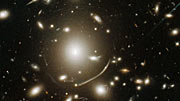
Abell S1063, the final frontier

Hubble image of galaxy cluster MACS J1206 

Lensing cluster Abell 383

Brightest galaxy in Abell 2261

Galaxy cluster MACS J1720+35

 
Wide-field image of Abell S1063 (ground-based image)

Wide field view of MACS 1206 (ground-based image)


Videos
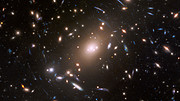
Pan across the galaxy cluster Abell S1063

Pan across Abell 383
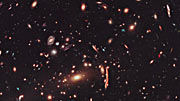

Pan across MACS 1206


Observations may hint at nature of dark matter


Using the NASA/ESA Hubble Space Telescope, astronomers have discovered that the brightest galaxies within galaxy clusters “wobble” relative to the cluster’s centre of mass. This unexpected result is inconsistent with predictions made by the current standard model of dark matter. With further analysis it may provide insights into the nature of dark matter, perhaps even indicating that new physics is at work.

Dark matter constitutes just over 25 percent of all matter in the Universe but cannot be directly observed, making it one of the biggest mysteries in modern astronomy. Invisible halos of elusive dark matter enclose galaxies and galaxy clusters alike. The latter are massive groupings of up to a thousand galaxies immersed in hot intergalactic gas. Such clusters have very dense cores, each containing a massive galaxy called the “brightest cluster galaxy” (BCG).

The standard model of dark matter (cold dark matter model) predicts that once a galaxy cluster has returned to a “relaxed” state after experiencing the turbulence of a merging event, the BCG does not move from the cluster’s centre. It is held in place by the enormous gravitational influence of dark matter.
But now, a team of Swiss, French, and British astronomers have analysed ten galaxy clusters observed with the NASA/ESA Hubble Space Telescope, and found that their BCGs are not fixed at the centre as expected [1].

The Hubble data indicate that they are “wobbling” around the centre of mass of each cluster long after the galaxy cluster has returned to a relaxed state following a merger. In other words, the centre of the visible parts of each galaxy cluster and the centre of the total mass of the cluster — including its dark matter halo — are offset, by as much as 40 000 light-years.

“We found that the BCGs wobble around centre of the halos,” explains David Harvey, astronomer at EPFL, Switzerland, and lead author of the paper. “This indicates that, rather than a dense region in the centre of the galaxy cluster, as predicted by the cold dark matter model, there is a much shallower central density. This is a striking signal of exotic forms of dark matter right at the heart of galaxy clusters.”

The wobbling of the BCGs could only be analysed as the galaxy clusters studied also act as gravitational lenses. They are so massive that they warp spacetime enough to distort light from more distant objects behind them. This effect, called strong gravitational lensing, can be used to make a map of the dark matter associated with the cluster, enabling astronomers to work out the exact position of the centre of mass and then measure the offset of the BCG from this centre.

If this “wobbling” is not an unknown astrophysical phenomenon and in fact the result of the behaviour of dark matter, then it is inconsistent with the standard model of dark matter and can only be explained if dark matter particles can interact with each other — a strong contradiction to the current understanding of dark matter. This may indicate that new fundamental physics is required to solve the mystery of dark matter.

Co-author Frederic Courbin, also at EPFL, concludes: “We’re looking forward to larger surveys — such as the Euclid survey — that will extend our dataset. Then we can determine whether the wobbling of BGCs is the result of a novel astrophysical phenomenon or new fundamental physics. Both of which would be exciting!”


Notes

[1] The study was performed using archive data from Hubble. The observations were originally made for the CLASH and LoCuSS surveys.


More Information

The Hubble Space Telescope is a project of international cooperation between ESA and NASA.

This research was presented in a paper entitled “A detection of wobbling Brightest Cluster Galaxies within massive galaxy clusters” by Harvey et al., which appeared in the Monthly Notices of the Royal Astronomical Society.

The international team of astronomers in this study consists of David Harvey (Laboratoire d’Astrophysique EPFL, Switzerland), F. Courbin (Laboratoire d’Astrophysique EPFL, Switzerland), J.P. Kneib (Laboratoire d’Astrophysique EPFL, Switzerland; CNRS, France), and Ian G. McCarthy (Liverpool John Moores University, UK).

Image credit: NASA, ESA, J. Lotz (STScI), M. Postman (STScI), J. Richard (CRAL) and J.-P. Kneib (LAM), T. Lauer (NOAO), S. Perlmutter (UC Berkeley, LBNL), A. Koekemoer (STScI), A. Riess (STScI/JHU), J. Nordin (LBNL, UC Berkeley), D. Rubin (Florida State), C. McCully (Rutgers University) and the CLASH Team


Links


Contacts

David Harvey
Laboratoire d’Astrophysique EPFL
Versoix, Switzerland
Tel: +41 22 37 92277

Frederic Courbin
Laboratoire d’Astrophysique EPFL
Versoix, Switzerland
Tel: +41 22 37 92418

Jean-Paul Kneib
Laboratoire d’Astrophysique - EPFL
Versoix, Switzerland
Tel: +41 79 733 21 11

Mathias Jäger
ESA/Hubble Public Information Officer
Garching bei München, Germany
Cell: +49 176 62397500


Friday, October 26, 2012

Monster Galaxy May Have Been Stirred Up By Black-hole Mischief

 Galaxy Cluster Abell 2261
Credit: NASA, ESA, M. Postman (STScI), 
T. Lauer (NOAO), and the CLASH team


Astronomers using NASA's Hubble Space Telescope have obtained a remarkable new view of a whopper of an elliptical galaxy that may have been puffed up by the actions of one or more black holes in its core.

Spanning a little more than one million light-years, the galaxy is about 10 times the diameter of our Milky Way galaxy. The bloated galaxy is a member of an unusual class of galaxies with a diffuse core filled with a fog of starlight where there would normally be a concentrated peak of light around a central black hole. Viewing the core is like seeing a city with no downtown, just houses sprinkled across a vast landscape.

Astronomers used Hubble's Advanced Camera for Surveys and Wide Field Camera 3 to measure the amount of starlight across the galaxy, dubbed A2261-BCG. The Hubble observations revealed that the galaxy's puffy core, measuring about 10,000 light-years, is the largest yet seen.

A galaxy's core size typically is correlated to the dimensions of its host galaxy, but in this case, the central region is much larger than astronomers would expect for the galaxy's size. In fact, the bloated core is more than three times larger than the center of other very luminous galaxies. Located three billion light-years away, the galaxy is the most massive and brightest galaxy in the Abell 2261 cluster.

Astronomers have proposed two possibilities for the puffy core. One scenario is that a pair of merging black holes gravitationally stirred up and scattered the stars. Another idea is that the merging black holes were ejected from the core. Left without an anchor, the stars began spreading out even more, creating the puffy-looking core.

Previous Hubble observations have revealed that supermassive black holes, weighing millions or billions times more than the Sun, reside at the centers of nearly all galaxies and may play a role in shaping those central regions.

"Expecting to find a black hole in every galaxy is sort of like expecting to find a pit inside a peach," explained astronomer Tod Lauer of the National Optical Astronomy Observatory in Tucson, Ariz., a co-author of the Hubble study. "With this Hubble observation, we cut into the biggest peach and we can't find the pit. We don't know for sure that the black hole is not there, but Hubble shows that there's no concentration of stars in the core."

Team leader Marc Postman of the Space Telescope Science Institute in Baltimore, Md., said the galaxy stood out in the Hubble image. "When I first saw the image of this galaxy, I knew right away it was unusual," Postman explained. "The core was very diffuse and very large. The challenge was then to make sense of all the data, given what we knew from previous Hubble observations, and come up with a plausible explanation for the intriguing nature of this particular galaxy."

The paper describing the results appeared in the Sept. 10 issue of The Astrophysical Journal. The astronomers expected to see a slight cusp of light in the galaxy's center, marking the location of the black hole and attendant stars. Instead, the starlight's intensity remained fairly even across the galaxy.

One possibility for the puffy core may be due to two central black holes orbiting each other. These black holes collectively could have been as massive as several billion suns. Though one of the black holes would be native to the galaxy, a second black hole could have been added from a smaller galaxy that was gobbled up by the massive elliptical.

In this scenario, stars circling in the giant galaxy's center came close to the twin black holes. The stars were then given a gravitational boot out of the core. Each gravitational slingshot robbed the black holes of momentum, moving the pair ever closer together, until finally they merged, forming one supermassive black hole that still resides in the galaxy's center.

Another related possibility is that the black-hole merger created gravity waves, which are ripples in the fabric of space. According to the theory of general relativity, a pair of merging black holes produce ripples of gravity that radiate away. If the black holes are of unequal mass, then some of the energy may radiate more strongly in one direction, producing the equivalent of a rocket thrust. The imbalance of forces would have ejected the merged black hole from the center at speeds of millions of miles an hour, resulting in the rarity of a galaxy without a central black hole. "The black hole is the anchor for the stars," Lauer explained. "If you take it out, all of a sudden you have a lot less mass. The stars don't get held down very well and they expand out, enlarging the core even more."

The team admits that the ejected black-hole scenario may sound far-fetched, "but that's what makes observing the universe so intriguing — sometimes you find the unexpected," said Postman.

Added Lauer: "This is a system that's interesting enough that it pushes against a lot of questions. We have thought an awful lot about what black holes do. But we haven't been able to test our theories. This is an interesting place where a lot of the ideas we've had can come together and can be tested, fairly exotic ideas about how black holes may interact with each other dynamically and how they would affect the surrounding stellar population."

The team is now conducting follow-up observations with the Very Large Array radio telescope (VLA) in New Mexico. The astronomers expect material falling onto a black hole to emit radio waves, among other types of radiation. They will compare the VLA data with the Hubble images to more precisely pin down the location of the black hole, if it indeed exists.

The Abell 2261 cluster is part of a multi-wavelength survey, led by Postman, called the Cluster Lensing And Supernova survey with Hubble (CLASH). The survey probes the distribution of dark matter in 25 massive galaxy clusters.

CONTACT

Ray Villard / Donna Weaver

Space Telescope Science Institute, Baltimore, Md.
410-338-4514 / 410-338-4493
villard@stsci.edu / dweaver@stsci.edu

Marc Postman
Space Telescope Science Institute, Baltimore, Md.
410-338-4340
postman@stsci.edu

Tod LauerNational
Optical Astronomy Observatory, Tucson, Ariz.
520-318-8920
lauer@noao.edu