Saturday, February 28, 2026

Young "Sun" Caught Blowing Bubbles by NASA's Chandra

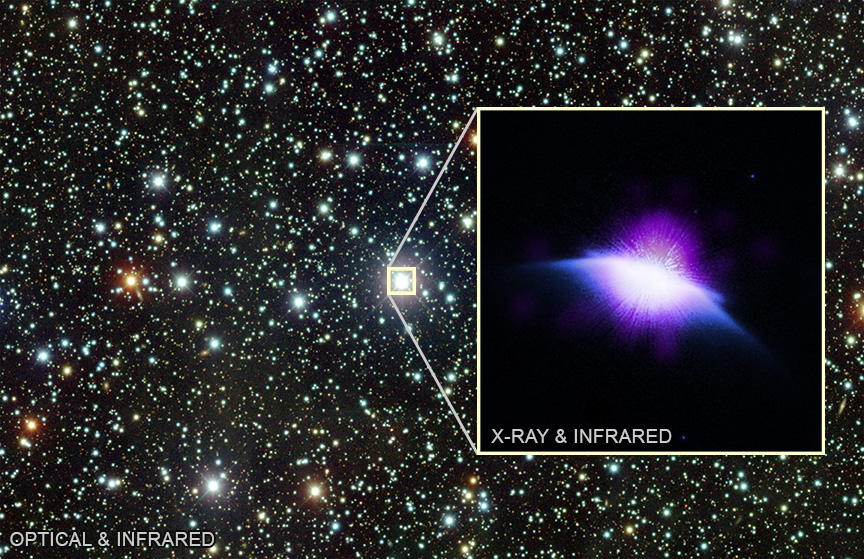
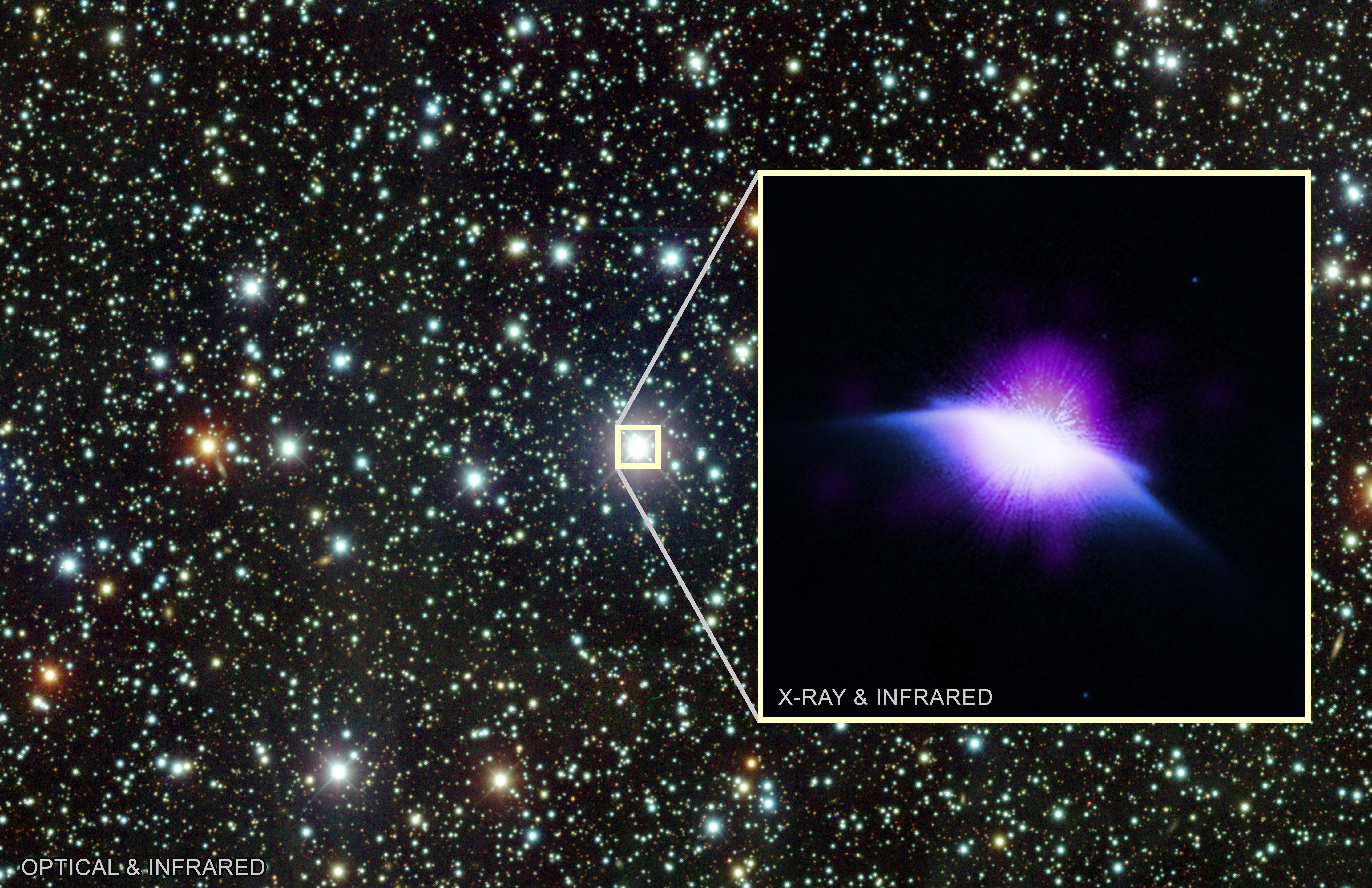
>HD 61005 in X-ray, infrared, and optical light, labeled. Credit: X-ray: NASA/CXC/John Hopkins Univ./C.M. Lisse et al.; Infrared: NASA/ESA/STIS; Optical: NSF/NoirLab/CTIO/DECaPS2; Image Processing: NASA/CXC/SAO/N. Wolk


An artist’s illustration depicts an astrosphere as a sphere, surrounding a star. The bow shock in blue — akin to a sonic boom in front of a supersonic plane — is caused by the motion of the star and its astrosphere as it pushes against and flies through gas in interstellar space. This illustration does not show the wings from the dusty debris.


This image contains the first “astrosphere,” or wind-blown bubble, that astronomers have captured surrounding a star that is a younger version of our Sun. This discovery was made using NASA’s Chandra X-ray Observatory and is described in our latest press release.

The astrosphere was found around a star called HD 61005, which is located only about 120 light-years from Earth. HD 61005 has roughly the same mass and temperature as the Sun but is much younger with an age of about 100 million years, compared to the Sun’s age of about 5 billion years. This commonality with the Sun is important because the Sun has a similar bubble, which scientists call the heliosphere. The discovery of the astrosphere around HD 61005 gives astronomers a chance to study a structure that may be similar to what the Sun was embedded in several billion years ago.

In this composite image of HD 61005 in the inset, X-rays from Chandra (purple and white) have been combined with infrared data from Hubble (blue and white). Chandra reveals a bright source of X-rays in the center of the image, which is the star itself surrounded by the star’s astrosphere. The wing-like structure sweeping away from the star in the infrared image is dusty material that remained behind after the formation of the star. These wings have been swept backwards as they fly through space. The larger view is an optical image from the Cerro Tololo Inter-American Observatory in Chile (red, green, and blue) showing the field HD 61005 is located in.

Artist's Concept of an astrosphere surrounding a Star. Illustration Credit: NASA/Goddard Space Flight Center, Conceptual Image Lab

Astronomers had previously nicknamed HD 61005 the “Moth” because the wings give it the appearance of this insect through infrared telescopes. Because it is so young, HD 61005 has winds of particles blowing from its surface that are about three times faster and 25 times denser than the wind from the Sun. These winds are blowing up the bubble and filling it with hot gas as it expands into much cooler gas and dust surrounding the star. This provides a window into how our Sun’s wind may have behaved early in its evolution.

HD 61005 in X-ray and Infrared light. Credit: X-ray: NASA/CXC/John Hopkins Univ./C.M. Lisse et al.; Infrared: NASA/ESA/STIS; Image Processing: NASA/CXC/SAO/N. Wolk

Since the 1990s, astronomers have been trying to capture an image of an astrosphere around a Sun-like star. Chandra was able to detect the astrosphere around HD 61005 because the star system is producing X-rays as the stellar wind runs into cooler dust and gas that surrounds the star.

Previous observations showed that the interstellar matter surrounding HD 61005 is about a thousand times denser than that around the Sun. This environment, combined with Chandra’s high-resolution X-ray vision and the star’s proximity enabled this discovery. The astrosphere around HD 61005 has a diameter about 200 times the distance from the Earth to the Sun.

A paper describing these results has been accepted for publication by The Astrophysical Journal, led by Casey Lisse of Johns Hopkins University.

NASA's Marshall Space Flight Center in Huntsville, Alabama, manages the Chandra program. The Smithsonian Astrophysical Observatory's Chandra X-ray Center controls science operations from Cambridge, Massachusetts, and flight operations from Burlington, Massachusetts.


Visual Description:

This release contains three main images, each offering a different take on the astrosphere surrounding a young star called HD 61005. An astrosphere is a wind-blown bubble full of gas and dust particles that encases a star as it pushes through interstellar space.

In this release, an optical image from the Cerro Tololo Inter-American Observatory in Chile shows HD 61005 in the context of its star field. Here, the star in question appears as a glowing, gleaming white dot surrounded by other glowing dots of similar and smaller sizes. The image is utterly packed with specks of light in shades of blue, white, gold, green, and red. At this distance, in an optical observation, the star's astrosphere is not discernible.

The second image is a composite, which presents a close-up of HD 61005 using infrared data from Hubble, and X-ray data from the Chandra X-ray Observatory. Here, the spherical star has a brilliant core bursting with white X-ray light. Ringing the white core is a neon purple glow; the astrosphere surrounding the star. A distinguishing feature of HD 61005 is a white, wedge-shaped tail with neon blue tips, which trails the fast-moving star. This tail is dusty material left behind after the star's formation. The wedge, or wing shape of the tail has earned the star the nickname 'Moth' by astronomers spying it through infrared telescopes.

The third image in this release is an artist's illustration of an astrosphere in action. Here, a large, pale purple ball soars from our right toward our left, into a misty brown cloud. The purple ball appears to be protected by a blue force field, which pushes the brown cloud aside as the ball dives in. In this illustration, the purple ball represents the astrosphere surrounding a star and the brown cloud is interstellar gas. The blue force field is a bow shock, a curved free-floating shock wave, similar to the sonic boom that travels in front of a supersonic plane. The bow shock is caused by the motion of the star and its astrosphere hurtling through space. This illustration features a series of faint lines representing wind patterns from HD 61005, but does not show the tail of debris found behind and beside HD 61005.


Fast Facts for HD 61005

Credit: X-ray: NASA/CXC/John Hopkins Univ./C.M. Lisse et al.; Infrared: NASA/ESA/STIS; Optical: NSF/NoirLab/CTIO/DECaPS2; Image Processing: NASA/CXC/SAO/N. Wolk
Release Date: February 23, 2026
Scale: Image is about 30 arcsec (0.017 light-years or 160 billion km) across.
Category: Normal Stars & Star Clusters
Coordinates (J2000): RA 07h 35m 47.5s | Dec -32° 12´ 14.1"
Constellation: Puppis
Observation Dates: 2 observations Feb 23, 2021 and Feb 25, 2021
Observation Time: 18 hours 42 minutes
Obs. ID: 22348, 22349
Instrument: ACIS
References: C.M. Lisse et al., ApJ, 2025, accepted.
Color Code: X-ray: purple and white; Infrared: blue and white; Optical: red, green, and blue
Distance Estimate: About 117 light-years from Earth


Friday, February 27, 2026

NASA’s Webb Telescope Locates Former Star That Exploded as Supernova

The main image at left shows a combined Webb and Hubble view of spiral galaxy NGC 1637. Panels at right show a detailed view of a red supergiant star before and after it exploded. Before exploding, it is not visible to Hubble, only to Webb. Hubble shows the glowing aftermath. Credit Image: NASA, ESA, CSA, STScI, Charles Kilpatrick (Northwestern), Aswin Suresh (Northwestern); Image Processing: Joseph DePasquale (STScI)

Image of galaxy NGC 1637 captured by Hubble’s WFC3 and Webb’s NIRCam, with compass arrows, scale bar, and color key for reference. Credit Image: NASA, ESA, CSA, STScI, Charles Kilpatrick (Northwestern), Aswin Suresh (Northwestern); Image Processing: Joseph DePasquale (STScI)


Forty million years ago, a star in a nearby galaxy exploded, spewing material across space and generating a brilliant beacon of light. That light traveled across the cosmos, reaching Earth June 29, 2025, where it was detected by the All-Sky Automated Survey for Supernovae. Astronomers immediately turned their resources to this new supernova, designated 2025pht, to learn more about it. But one team of scientists instead turned to archives, seeking to use pre-supernova images to identify exactly which star among many had exploded. And they succeeded.

Images of galaxy NGC 1637 taken by NASA’s James Webb Space Telescope showed a single red supergiant star located exactly where the supernova now shines. This represents the first published detection of a supernova progenitor by Webb. The results were published in the Astrophysical Journal Letters.

“We’ve been waiting for this to happen – for a supernova to explode in a galaxy that Webb had already observed. We combined Hubble and Webb data sets to completely characterize this star for the first time,” said lead author Charlie Kilpatrick of Northwestern University.

Case of missing red supergiants

By carefully aligning Hubble and Webb images taken of NGC 1637, the team was able to identify the progenitor star in images taken by Webb’s MIRI (Mid-Infrared Instrument) and NIRCam (Near-Infrared Camera) in 2024. They found that the star appeared surprisingly red – an indication that it was surrounded by dust that blocked shorter, bluer wavelengths of light.

“It’s the reddest, most dusty red supergiant that we’ve seen explode as a supernova,” said graduate student and co-author Aswin Suresh of Northwestern University.

This excess of dust could help explain a long-standing problem in astronomy that could be described as the case of the missing red supergiants. Astronomers expect the most massive stars that explode as supernovas to also be the brightest and most luminous. So, they should be easy to identify in pre-supernova images. However, that hasn’t been the case.

One potential explanation is that the most massive aging stars are also the dustiest. If they’re surrounded by large quantities of dust, their light could be dimmed to the point of undetectability. The Webb observations of supernova 2025pht support that hypothesis.

“I’ve been arguing in favor of that interpretation, but even I didn’t expect to see it as extreme as it was for supernova 2025pht. It would explain why these more massive supergiants are missing because they tend to be more dusty,” said Kilpatrick.

Carbon “burps”

The team was not only surprised by the amount of dust, but also by its composition. Applying computer models to the Webb observations indicated that the dust is likely carbon-rich, when astronomers would have expected it to be more silicate-rich. The team speculates that this carbon might have been dredged up from the star’s interior shortly before it exploded.

“Having observations in the mid-infrared was key to constraining what kind of dust we were seeing,” said Suresh.

The team now is working to look for similar red supergiants that may explode as supernovas in the future. Observations by NASA’s upcoming Nancy Grace Roman Space Telescope may help this search. Roman will have the resolution, sensitivity, and infrared wavelength coverage to not only see these stars, but also potentially witness their variability as they “burp” out large quantities of dust near the end of their lives.

The James Webb Space Telescope is the world’s premier space science observatory. Webb is solving mysteries in our solar system, looking beyond to distant worlds around other stars, and probing the mysterious structures and origins of our universe and our place in it. Webb is an international program led by NASA with its partners, ESA (European Space Agency) and CSA (Canadian Space Agency).


Details:

Last Updated: Feb 23, 2026
Location: NASA Goddard Space Flight Center

Contact Media:

Laura Betz
NASA’s Goddard Space Flight Center
Greenbelt, Maryland

laura.e.betz@nasa.gov

Christine Pulliam
Space Telescope Science Institute
Baltimore, Maryland


Related Links and Documents


Thursday, February 26, 2026

A Quintillion-to-One: Giant Stars, Tiny Dust

Artist’s impression of WR 112, a binary system containing a massive, evolved Wolf-Rayet star and an OB-type companion. As their stellar winds collide, dust forms and spirals outward, consisting mostly of extremely tiny, nanometer-sized grains along with a secondary population about 100 times larger. Credit: NSF/AUI/NSF NRAO/M. Weiss. Hi-Res File


ALMA and JWST reveal nanometer-scale carbon dust grains emanating from a massive binary star system

Telescope (JWST) have discovered that some of the most massive stars in our galaxy are emitting unbelievably tiny grains of carbon dust—dust that one day could form future stars and planets. Both powerful telescopes were required for this research, to reveal all of the dust being produced by these stars.

This new research focused on WR 112, a binary star system that contains a very rare, massive, intensely hot, and dying Wolf–Rayet star orbiting another star companion. Together, these stars blast out powerful stellar winds that collide and create dense, cooling regions where dust forms, before this dust is scattered into interstellar space by intense starlight.

While previous mid-infrared images from JWST revealed bright spiral arcs of dust in WR 112, researchers were surprised when they saw no dust at all in ALMA’s sensitive millimeter observations. Only warm, tiny dust grains could hide from ALMA’s view, one of the most powerful millimeter telescopes on Earth. Combined data from JWST and ALMA suggested that the dust grains in the extended spiral structures are largely smaller than one micrometer, and most of them should be only a few nanometers (or billionths of a meter) across.

“It’s amazing to know that some of the most massive stars in the Universe produce some of the tiniest dust particles before they die. The difference in size between the star and the dust it produces is about a quintillion to one,” shared Donglin Wu, an undergraduate at Yale University and the lead author of this new research.

The team also found evidence that the dust is not evenly made up of a range of sizes, but instead comes in two distinct sizes: a larger group of nanometer-sized grains, and a smaller group of grains about 0.1 micrometer across. This discovery reconciled decades of conflicting measurements of similar binary systems: some revealed only very tiny grains, while others only saw larger ones. Now, it is understood that this type of binary system can have both. The team explored several physical processes that can, in principle, break up or evaporate dust grains near the harsh radiation field of the stars, finding that these processes have a tendency to destroy grains that were in between these sizes under certain conditions.

Because WR 112 is one of the most prolific dust producers of its kind—producing as much as three Moons’ worth of dust every year—the new grain-size measurements have big implications for how much carbon dust massive binaries can contribute to the broader galaxy. By revealing that some of the Universe’s biggest stars are factories for some of its smallest solid particles, this study provides an important missing piece in the life cycle of cosmic dust.


Press Contacts:

Jill Malusky
Sr. Public Information Group Manager and Public Information Officer
Email | Phone


About NRAO

The National Radio Astronomy Observatory (NRAO) is a facility of the U.S. National Science Foundation, operated under cooperative agreement by Associated Universities, Inc.

About ALMA

The Atacama Large Millimeter/submillimeter Array (ALMA), an international astronomy facility, is a partnership of the European Southern Observatory (ESO), the U.S. National Science Foundation (NSF) and the National Institutes of Natural Sciences (NINS) of Japan in cooperation with the Republic of Chile. ALMA is funded by ESO on behalf of its Member States, by NSF in cooperation with the National Research Council of Canada (NRC) and the National Science and Technology Council (NSTC) in Taiwan and by NINS in cooperation with the Academia Sinica (AS) in Taiwan and the Korea Astronomy and Space Science Institute (KASI).

ALMA construction and operations are led by ESO on behalf of its Member States; by the National Radio Astronomy Observatory (NRAO), managed by Associated Universities, Inc. (AUI), on behalf of North America; and by the National Astronomical Observatory of Japan (NAOJ) on behalf of East Asia. The Joint ALMA Observatory (JAO) provides the unified leadership and management of the construction, commissioning and operation of ALMA.


Wednesday, February 25, 2026

Why some objects in space look like snowmen

This image was taken by NASA's New Horizons spacecraft on 1 January 2019 during a flyby of Kuiper belt object 2014 MU69, known as Arrokoth. It is the clearest view yet of this remarkable, ancient object in the far reaches of the solar system – and the first small "KBO" ever explored by a spacecraft. Credit: NASA 
Licence type: Attribution (CC BY 4.0)

Astronomers have long debated why so many icy objects in the outer solar system look like snowmen.

Now, thanks to a new computer simulation in a research paper published in Monthly Notices of the Royal Astronomical Society, Michigan State University (MSU) researchers have evidence of the surprisingly simple process that could be responsible for their creation.

Far beyond the violent, chaotic asteroid belt between Mars and Jupiter lies what is known as the Kuiper belt. There, past Neptune, are icy, untouched building blocks from the dawn of the solar system, known as planetesimals.

bout one in 10 of these objects are contact binaries, planetesimals that are shaped like two connected spheres – much like a snowman – including the most distant and most primitive object ever explored by a spacecraft, the ultra-red, 4 billion-year-old body known as Arrokoth, which was discovered in 2014 by NASA’s New Horizons spacecraft.

But just how objects such as Arrokoth came to be has long been a mystery.

Jackson Barnes, an MSU graduate student, has created the first simulation that reproduces the two-lobed shape naturally with gravitational collapse.

Earlier computational models treated colliding objects as fluid blobs that merged into spheres, making it impossible to form these unique shapes.

But with the help of MSU’s Institute for Cyber-Enabled Research (ICER) and its high-performance computing cluster, Barnes says his simulations produce a more realistic environment that allows objects to retain their strength and rest against one another.

Other formation theories involve special events or exotic phenomena that, while possible, aren’t likely to happen on a regular basis.

“If we think 10 per cent of planetesimal objects are contact binaries, the process that forms them can’t be rare,” said Earth and Environmental Science Professor Seth Jacobson, senior author on the paper. “Gravitational collapse fits nicely with what we’ve observed.”


Contact binaries were first imaged up close by the New Horizons spacecraft in January 2019. These images prompted scientists to take another look at other objects in the Kuiper belt, and it turned out that contact binaries accounted for about one in 10 of all planetesimals.

These distant objects float mostly undisturbed and safe from collisions in the sparsely populated Kuiper belt.

In the early days of the Milky Way, the galaxy was a disc of dust and gas. Remnants of the galaxy’s formation are found in the Kuiper belt, including dwarf planets such as Pluto, comets and planetesimals.

Planetesimals are the first large planetary objects to form from the disc of dust and pebbles. Much like individual snowflakes that are packed into a snowball, these first planetesimals are aggregates of pebble-sized objects pulled together by gravity from a cloud of tiny materials.

Occasionally as the cloud rotates, it falls inward on itself, ripping the object apart and forming two separate planetesimals that orbit one another.

Astronomers observe many binary planetesimals in the Kuiper belt. In Barnes’ simulation, the orbits of these objects spiral inward until the two gently make contact and fuse together while still maintaining their round shapes.

How do these two objects stay together throughout the history of the solar system? Barnes explains they’re simply unlikely to crash into another object. Without a collision, there’s nothing to break them apart. Most binaries aren’t even pocked with craters.

Scientists long suspected that gravitational collapse was responsible for forming these objects, but they couldn’t fully test the idea. Barnes’ model is the first to include the physics needed to reproduce contact binaries.

“We’re able to test this hypothesis for the first time in a legitimate way,” Barnes said. “That’s what’s so exciting about this paper.”

Barnes expects his model will help scientists understand binary systems of three or more objects. The team is also working to create a new simulation that better models the collapse process.


Media contacts:

Sam Tonkin
Royal Astronomical Society
Mob: +44 (0)7802 877 700

press@ras.ac.uk

Science contacts:

Jackson Barnes
Michigan State University

barne383@msu.edu

Professor Seth Jacobson
Michigan State University

seth@msu.edu


Images & captions

Arrokoth

Caption: This image was taken by NASA's New Horizons spacecraft on 1 January 2019 during a flyby of Kuiper belt object 2014 MU69, known as Arrokoth. It is the clearest view yet of this remarkable, ancient object in the far reaches of the solar system – and the first small "KBO" ever explored by a spacecraft. Credit: NASA


Further information

The paper 'Direct contact binary planetesimal formation from gravitational collapse' by J. Barnes et al. has been published in Monthly Notices of the Royal Astronomical Society. DOI: 10.1093/mnras/stag002.


Notes for editors

About the Royal Astronomical Society

The Royal Astronomical Society (RAS), founded in 1820, encourages and promotes the study of astronomy, solar-system science, geophysics and closely related branches of science.

The RAS organises scientific meetings, publishes international research and review journals, recognises outstanding achievements by the award of medals and prizes, maintains an extensive library, supports education through grants and outreach activities and represents UK astronomy nationally and internationally. Its more than 4,000 members (Fellows), a third based overseas, include scientific researchers in universities, observatories and laboratories as well as historians of astronomy and others.

The RAS accepts papers for its journals based on the principle of peer review, in which fellow experts on the editorial boards accept the paper as worth considering. The Society issues press releases based on a similar principle, but the organisations and scientists concerned have overall responsibility for their content.

Keep up with the RAS on Instagram, Bluesky, LinkedIn, Facebook and YouTube.

Download the RAS Supermassive podcast

Submitted by Sam Tonkin on Thu, 19/02/2026 - 19:00


Tuesday, February 24, 2026

Measuring the expansion of the universe with cosmic fireworks

High-resolution image taken with the Large Binocular Telescope on Mount Graham in Arizona, USA, displaying the two lens galaxies in a warm tone, and the five lensed copies of SN Winny in blue. © Credit: SN Winny Research Group

Munich astronomers image and model extremely rare gravitationally lensed supernova

That the universe is expanding has been known for almost a hundred years now, but how fast? The exact rate of that expansion remains hotly debated, even challenging the standard model of cosmology. A research team at the Technical University of Munich (TUM), the Ludwig Maximilians University (LMU) as well as the Max Planck Institutes for Astrophysics (MPA) and Extraterrestrial Physics (MPE) has now imaged and modelled an exceptionally rare supernova that could provide a new, independent way to measure how fast the universe is expanding.

  • An image that could solve a long lasting cosmic mystery

  • Unprecedented chance to measure the growth of the universe

  • Collaboration between TUM, LMU and Max Planck Institutes

The supernova is a rare superluminous stellar explosion, 10 billion lightyears away, and far brighter than typical supernovae. It is also special in another way: the single supernova appears five times in the night sky, like cosmic fireworks, due to a phenomenon known as gravitational lensing. Two foreground galaxies bend the supernova’s light as it travels toward Earth, forcing it to take different paths. Because these paths have slightly different lengths, the light arrives at different times. By measuring the time delays between the multiple copies of the supernova, researchers can determine the universe’s present-day expansion rate, known as the Hubble constant.

Sherry Suyu, Associate Professor of Observational Cosmology at TUM and Fellow at the Max Planck Institute for Astrophysics, explains: “We nicknamed this supernova SN Winny, inspired by its official designation SN 2025wny. It is an extremely rare event that could play a key role in improving our understanding of the cosmos. The chance of finding a superluminous supernova perfectly aligned with a suitable gravitational lens is lower than one in a million. We spent six years searching for such an event by compiling a list of promising gravitational lenses, and in August 2025, SN Winny matched exactly with one of them.”


Large Binocular Telescope auf dem Mount Graham in Arizona, USA
© Credit: Dr. Christoph Saulder / MPE

High-resolution color image of unique supernova

Because gravitationally lensed supernovae are so rare, only a handful of such measurements have been attempted to date. Their accuracy depends strongly on how well one can determine the masses of the galaxies acting as a lens, because these masses control how strongly the supernova’s light is bent. To measure those masses, the team obtained images with the Large Binocular Telescope in Arizona, USA, using its two 8.4-meter diameter mirrors and an adaptive optics system that corrects for atmospheric blurring. The result is the first high-resolution color image of this system published to date.

The observations reveal the two foreground lens galaxies in the center and five bluish copies of the supernova - reminiscent of a firework exploding. This comes as a surprise, since galaxy-scale lens systems normally produce only two or four copies. Using the positions of all five copies, Allan Schweinfurth and Leon Ecker, junior researchers in the team, built the first model of the lens mass distribution.

“Until now, most lensed supernovae were magnified by massive galaxy clusters, whose mass distributions are complex and hard to model,“ says Allan Schweinfurth. “SN Winny, however, is lensed by just two individual galaxies. We find overall smooth and regular light and mass distributions for these galaxies, suggesting that they have not yet collided in the past despite their close apparent proximity. The overall simplicity of the system offers an exciting opportunity to measure the universe’s expansion rate with high accuracy.”

Members of the SN Winny Research Group at Research Campus Garching (from left): Stefan Taubenberger, Allan Schweinfurth, Alejandra Melo, Elias Mamuzic, Sherry Suyu, Christoph Saulder, Roberto Saglia, Leon Ecker, Limeng Deng. © Credit: Dr. Robert Reich / TUM

Two methods, two very different results

So far, scientists have mostly relied on two methods to measure the Hubble constant, but these methods yield conflicting results. This puzzle is known as the Hubble tension.

The first is the local method, which measures distances to galaxies one step at a time, much like climbing a ladder, where each step depends on the previous one; hence, it is referred to as the cosmic distance ladder. It uses objects with well-known brightness to estimate distances and then compares those distances with how fast galaxies are moving away. Because this method involves many calibration steps, even small errors can accumulate and affect the final result.

The second method looks much farther back in time. It studies the cosmic microwave background, the faint afterglow of the Big Bang, and uses models of the early universe to calculate today’s expansion rate. This approach is highly precise, but it relies heavily on assumptions about how the universe evolved, and these assumptions are still subject to debate.

SN Winny
Credit: Elias Mamuzic / MPA / TUM

A new, one-step approach

Animation (available in several languages) showing the gravitational lensing effect of the pair of foreground galaxies on the host galaxy of SN Winny. The host galaxy is lensed into multiple images, which are distorted and stretched out to form a bluish ring around the lens. The explosion of SN Winny itself and the time-delayed arrival of its multiple lensed copies on Earth are also simulated. Ultimately, the animation fades to a real observation of SN Winny, captured at the Large Binocular Telescope in Arizona.

A third, independent method now enters the picture: using a gravitationally lensed supernova. Stefan Taubenberger, a leading member of Professor Suyu’s team and first author of the supernova-identification study, explains that by measuring the time delays between the multiple copies of the supernova and knowing the mass distribution of the lensing galaxy, scientists can directly calculate the Hubble constant: “Unlike the cosmic distance ladder, this is a one-step method, with fewer and completely different sources of systematic uncertainties.”

Astronomers worldwide are currently observing SN Winny in detail using both ground-based and space-based telescopes. Their results will provide crucial new insights and help clarify the long-standing Hubble tension.


Contacts:

Prof. Dr. Sherry Suyu
Scientific Staff
Tel:
2015

Stefan Taubenberger
Tel: 2019
tauben@mpa-garching.mpg.de


Original publication

1. Taubenberger et al.
HOLISMOKES XIX: SN 2025wny at z = 2, the first strongly lensed superluminous supernova
accepted by Astronomy & Astrophysics (A&A), December 2025


Source

2. Ecker, Schweinfurth et al.
HOLISMOKES XX. Lens models of binary lens galaxies with five images of Supernova Winny
submitted to Astronomy & Astrophysics (A&A)


Source


Monday, February 23, 2026

NASA’s Hubble Identifies One of Darkest Known Galaxies

The low-surface-brightness galaxy CDG-2, within the dashed red circle at right, is dominated by dark matter and contains only a sparse scattering of stars. Credit Image: NASA, ESA, Dayi Li (UToronto); Image Processing: Joseph DePasquale (STScI)

"Dark Galaxy" Identified by Hubble (Video)
An elusive object, dubbed CDG-2, may be among the most heavily dark matter-dominated galaxies ever discovered.
Credits: Producer:
Paul Morris (eMITS) and Technical support: Aaron E. Lepsch (ADNET Systems, Inc.)

This image of dark galaxy CDG-2 was captured by the Hubble Space Telescope’s ACS (Advanced Camera for Surveys) with additional data from the European Space Agency’s Euclid space mission. The image shows a scale bar, compass arrows, and color key for reference. Credit Science: NASA, ESA, Dayi Li (UToronto); Image Processing: Joseph DePasquale (STScI)


In the vast tapestry of the universe, most galaxies shine brightly across cosmic time and space. Yet a rare class of galaxies remains nearly invisible — low-surface-brightness galaxies dominated by dark matter and containing only a sparse scattering of faint stars.

One such elusive object, dubbed CDG-2, may be among the most heavily dark matter-dominated galaxies ever discovered. (Dark matter is an invisible form of matter that does not reflect, emit, or absorb light.) The science paper detailing this finding was published in The Astrophysical Journal Letters.

Detecting such faint galaxies is extraordinarily difficult. Using advanced statistical techniques, David Li of the University of Toronto, Canada, and his team identified 10 previously confirmed low-surface-brightness galaxies and two additional dark galaxy candidates by searching for tight groupings of globular clusters — compact, spherical star groups typically found orbiting normal galaxies. These clusters can signal the presence of a faint, hidden stellar population.

To confirm one of the dark galaxy candidates, astronomers employed a trio of observatories: NASA’s Hubble Space Telescope, ESA’s (European Space Agency) Euclid space observatory, and the ground-based Subaru Telescope in Hawaii. Hubble’s high-resolution imaging revealed a close collection of four globular clusters in the Perseus galaxy cluster, 300 million light-years away. Follow-up studies using Hubble, Euclid, and Subaru data then revealed a faint, diffuse glow surrounding the star clusters — strong evidence of an underlying galaxy.

“This is the first galaxy detected solely through its globular cluster population,” said Li. “Under conservative assumptions, the four clusters represent the entire globular cluster population of CDG-2.”

Preliminary analysis suggests CDG-2 has the luminosity of roughly 6 million Sun-like stars, with the globular clusters accounting for 16% of its visible content. Remarkably, 99% of its mass, which includes both visible matter and dark matter, appears to be dark matter. Much of its normal matter to enable star formation — primarily hydrogen gas — was likely stripped away by gravitational interactions with other galaxies inside the Perseus cluster.

Globular clusters possess immense stellar density and are gravitationally tightly bound. This makes the clusters more resistant to gravitational tidal disruption, and therefore reliable tracers of such ghostly galaxies.

As sky surveys expand with missions like Euclid, NASA’s upcoming Nancy Grace Roman Space Telescope, and the Vera C. Rubin Observatory, astronomers are increasingly turning to machine learning and statistical methods to sift through vast datasets.

The Hubble Space Telescope has been operating for more than three decades and continues to make ground-breaking discoveries that shape our fundamental understanding of the universe. Hubble is a project of international cooperation between NASA and ESA (European Space Agency). NASA’s Goddard Space Flight Center in Greenbelt, Maryland, manages the telescope and mission operations. Lockheed Martin Space, based in Denver, also supports mission operations at Goddard. The Space Telescope Science Institute in Baltimore, which is operated by the Association of Universities for Research in Astronomy, conducts Hubble science operations for NASA.


Details:

Last Updated: Feb 18, 2026
Editor: Andrea Gianopoulos
Location: NASA Goddard Space Flight Center

Contact Media:

Claire Andreoli
NASA’s Goddard Space Flight Center
Greenbelt, Maryland

claire.andreoli@nasa.gov

Christine Pulliam
Space Telescope Science Institute
Baltimore, Maryland


Related Links and Documents


Sunday, February 22, 2026

A Triple Black Hole System Caught in the Act of Self-Quenching

Composite X-ray and optical image of SDSS J0849+1114, a trio of merging galaxies though to contain three active galactic nuclei — an extremely rare configuration. Credit: X-ray: NASA/CXC/George Mason Univ./R. Pfeifle et al.; Optical: SDSS & NASA/STScI)

Authors: Xiaoyu Xu (许啸宇) et al.
First Author’s Institution: Nanjing University
Status: Published in ApJ

When Galaxies Collide

Galaxies are social creatures; they interact and merge (more astrobites talking about this are here and here)! When galaxies collide, the gravitational chaos acts like a funnel, driving massive amounts of cold gas toward the center. This gas rush has two major consequences: it triggers intense bursts of star formation (known as starbursts), and it feeds the central supermassive black holes, activating them as active galactic nuclei (AGNs).

But the story doesn’t end there. These powerful AGNs don’t just sit and feast on the gas. They launch high-velocity winds or jets that push back against the incoming gas, a process known as AGN feedback. (Read more about it in Astrobites here and here.) This feedback is thought to be the key mechanism by which supermassive black holes regulate their host galaxies, either by heating and expelling the gas (negative feedback, which starves star formation) or, in some cases, by compressing it (positive feedback, which promotes star formation).

While binary AGNs (two AGNs in one merging system) are rare, finding systems with three AGNs in one system is fascinatingly rare. The galaxy SDSS J0849+1114 (J0849+1114) is one such system, featuring three Seyfert 2 AGNs, a type of active galaxy with a bright, compact nucleus whose spectrum shows only narrow emission lines, within a tight region of about 5 kiloparsecs (kpc) or 16,000 light-years. Studying this system gives us a front-row seat to how multiple black holes interact and regulate their host environment during a complex merger. Very Large Array observations reveal that nucleus A (see Figure 1) contains two jets, inner and outer. In contrast, nucleus C has one jet, providing further evidence for the presence of an AGN.

Figure 1: Left: Hubble Space Telescope image taken in ultraviolet light. Right: Optical image from the VLT/MUSE instrument. The three black holes, nuclei A, B, and C, are marked with black crosses. The white contours are from Hubble, like on the left, and the yellow contours are of the MUSE instrument. We can observe the complex and disturbed morphology resulting from the ongoing merger. Adapted from Xu et al. 2025

Peering into the Triple Core with VLT/MUSE

To understand the gas dynamics in J0849+1114, the authors used the Very Large Telescope (VLT) and its Multi-Unit Spectroscopic Explorer (MUSE) instrument. MUSE is an integral-field spectrograph, meaning it provides spectra for every single spatial pixel (or “spaxel”) across the field of view. This allows astronomers to map not just where the light is coming from, but how the gas is moving and what is causing it to glow, all resolved spatially across the galaxy

The main technique employed was two-component Gaussian fitting of key emission lines like hydrogen alpha (Hα) and ionized oxygen ([O III]λλ4959,5007), which can be seen in Figure 2. The width of a Gaussian line (or its velocity dispersion) in a spectrum tells us how fast the gas is moving. A narrow line means the gas is relatively calm, with most of it moving at similar speeds. A broader line, on the other hand, means the gas velocities are more spread out — some parts are racing toward us, others away — indicating turbulence or outflows. By comparing the widths of different components, astronomers can separate quiet, rotating gas from the high-speed winds launched by the active black holes.

Figure 2: Zoomed-in spectra showing the Hβ and [O III] (left) and Hα, [N II], and [S II] (right) emission lines from the spot marked with an “X” in the MUSE image in Figure 1. The blue line shows the observed data, the orange line shows the best-fit model, and the two colored curves (light blue and red) represent the two components of the gas. The pink line shows the leftover differences between the data and the model. The First Component is narrow, representing gas that is relatively settled, often showing signs of rotation or slow movements associated with gravitational disturbances, like tidal tails (low velocity dispersion, σ1 ≤ 50 km/s). The Second Component is broad, representing highly turbulent or fast-moving gas, characteristic of powerful outflows or winds driven by the central AGNs (high velocity dispersion, σ2 > σ1). Adapted from Xu et al. 2025

What They Found: Gas Tails and Outflows

The VLT/MUSE observations successfully characterized both the undisturbed (First Component) and turbulent (Second Component) gas across the system.

1. Galactic-Scale Tidal Tails

The slow-moving gas (First Component) revealed extended structures of ionized gas stretching over 10 kpc (33,000 light-years), and in some directions, even more than 15 kpc (49,000 light-years) away from nucleus A. These large, low-velocity gas clouds align well with features known as tidal tails: the stretched-out arms of gas and stars pulled away by the violent gravitational forces of the merger.

2. Two Distinct Outflows Driven by Radio Jets

The fast-moving gas (Second Component) clearly showed two distinct sites: outflows originating from nucleus A and nucleus C.
  • Outflow A: This outflow extends over 5 kpc (16,000 light-years) around nucleus A. The gas kinematics and geometry strongly suggest that this outflow is being driven by nucleus A’s radio jet. This finding is key, as the measured kinetic power of the outflow is about 10 times stronger than what star formation alone could supply, and the current luminosity of the AGN is also insufficient to power it.

  • Outflow C: A smaller but detectable outflow extends about 5.9 kpc (19,000 light-years) around nucleus C, with a lower kinetic power compared to Outflow A. But, like Outflow A, the energetics and velocity gradients suggest this outflow is also linked to nucleus C’s radio jet.

A Black Hole That’s Recently Gone Quiet

The most striking implication of this study relates to the timing of nucleus A’s activity. The presence of extended ionized gas far from the nucleus (in the tidal tails, >10 kpc or 33,000 light-years away) provides a fascinating glimpse into the AGN’s recent past.

The physical conditions of this distant gas were determined using emission line ratios ([O III]/Hα and [N II]/Hα) on the Baldwin, Phillips, and Terlevich (BPT) diagram. A BPT diagram uses emission line ratios to diagnose the energy source that ionizes the gas: star formation, AGN, or shocks. The BPT diagram of J0849+1114 indicates that an AGN currently photoionizes the gas.

By running sophisticated photoionization models, the scientists calculated how luminous nucleus A must have been to ionize the gas currently found 10–15 kpc (33,000–49,000 light-years) away. They discovered that this required nucleus A to be 20–100 times more luminous than it currently is! Since light takes time to travel, and the ionized gas quickly recombines (on timescales of less than 100 years for this gas), this luminous phase must have ended very recently, approximately 30,000–50,000 years ago. This is a long time for us, but just a blink of an eye on cosmic timescales.

The Episode of Self-Regulation

By integrating the findings across different wavelengths and timescales, the current faint luminosity state, the past luminous state inferred from the distant gas, and the presence of radio jets of different ages, the authors propose a model of episodic AGN feedback in nucleus A:

1. Past Activity (150,000 years ago): An active phase likely launched an outer radio jet, which subsequently drove the large-scale ionized gas outflow observed today.

2. Peak Ionization (30,000–50,000 years ago): A subsequent burst of high accretion reached its peak, ionizing the distant tidal tails.

3. Fading and Quenching (Today): The energy released by the jet and/or outflow during the active phase likely expelled or heated the surrounding gas (negative feedback), causing the central accretion disk to run out of fuel. The AGN has since faded rapidly to its current low-accretion state, marked by the appearance of a young inner radio jet.

A Quiet Ending After a Loud Beginning

J0849+1114 is not just a statistical anomaly as a triple AGN candidate; it serves as a crucial case study demonstrating the powerful and rapid effects of AGN feedback. High-resolution observations confirm that violent galaxy mergers trigger both powerful outflows and episodic bursts of extreme luminosity. Crucially, these outflows clear the gas and cause the central supermassive black hole to quickly fade from a luminous quasar phase to a quiet, low-accretion state within tens of thousands of years. This system provides strong, spatially resolved evidence that AGN feedback rapidly suppresses accretion onto the supermassive black hole and shapes the host galaxy on kiloparsec scales during the chaotic drama of galactic mergers.

Original astrobite edited by Lindsey Gordon.


About the author, Sowkhya Shanbhog:

I am currently a first-year PhD student at Scuola Normale Superiore in Pisa, Italy, where I am focusing on studying high-redshift quasars. Prior to this, I completed a dual BS-MS degree at the Indian Institute of Science Education and Research in Pune, India. Now, I am eager to expand my involvement in science communication and outreach initiatives. I have recently developed an interest in cooking, particularly since moving to a new city. I find solace in listening to music during my leisure time.


Editor’s Note: Astrobites is a graduate-student-run organization that digests astrophysical literature for undergraduate students. As part of the partnership between the AAS and astrobites, we occasionally repost astrobites content here at AAS Nova. We hope you enjoy this post from astrobites; the original can be viewed at astrobites.org.


Saturday, February 21, 2026

NuSTAR Observes a Transient Magnetar


During the past week, NuSTAR observed the transient magnetar 1E 1547.0-5408, a highly magnetized neutron star that previously exhibited Fast Radio Bursts (FRBs) accompanied by X-ray burst activity. Earlier joint NuSTAR and NICER ToO observations revealed a dynamic outburst of this magnetar in 2022, including a forest of short X-ray bursts and a pair of rotational glitches occurring before and after the FRB emission. The association of magnetars with FRBs represents a major breakthrough in understanding these mysterious powerful millisecond radio flashes. Yet, the exact mechanism that powers FRBs in magnetars remains an open question. X-ray monitoring of outbursts through this week’s and upcoming NuSTAR DDT observations aims to further probe the FRB-magnetar connection, including potential trigger mechanisms, and search for similar burst and glitch behavior. Coordinated observations with NASA’s Imaging X-ray Polarimetry Explorer (IXPE) are also planned, promising unique insights into magnetar outbursts and FRBs through spectro-polarimetry. This may also reveal signatures of physics in extreme magnetic fields, including potential quantum electrodynamic (QED) effects in the magnetar environment. Download Image

Author: Demet Kirmizibayrak (Caltech, Postdoctoral Scholar Research Associate)


Friday, February 20, 2026

A Cosmic Heart Where New Stars Thrive

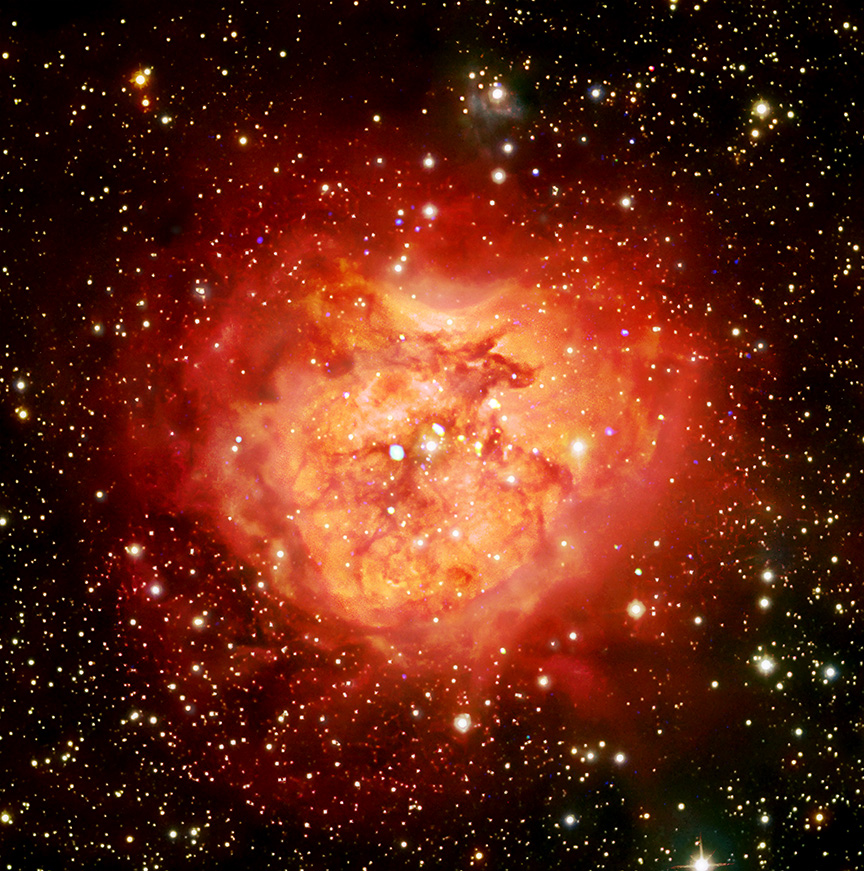
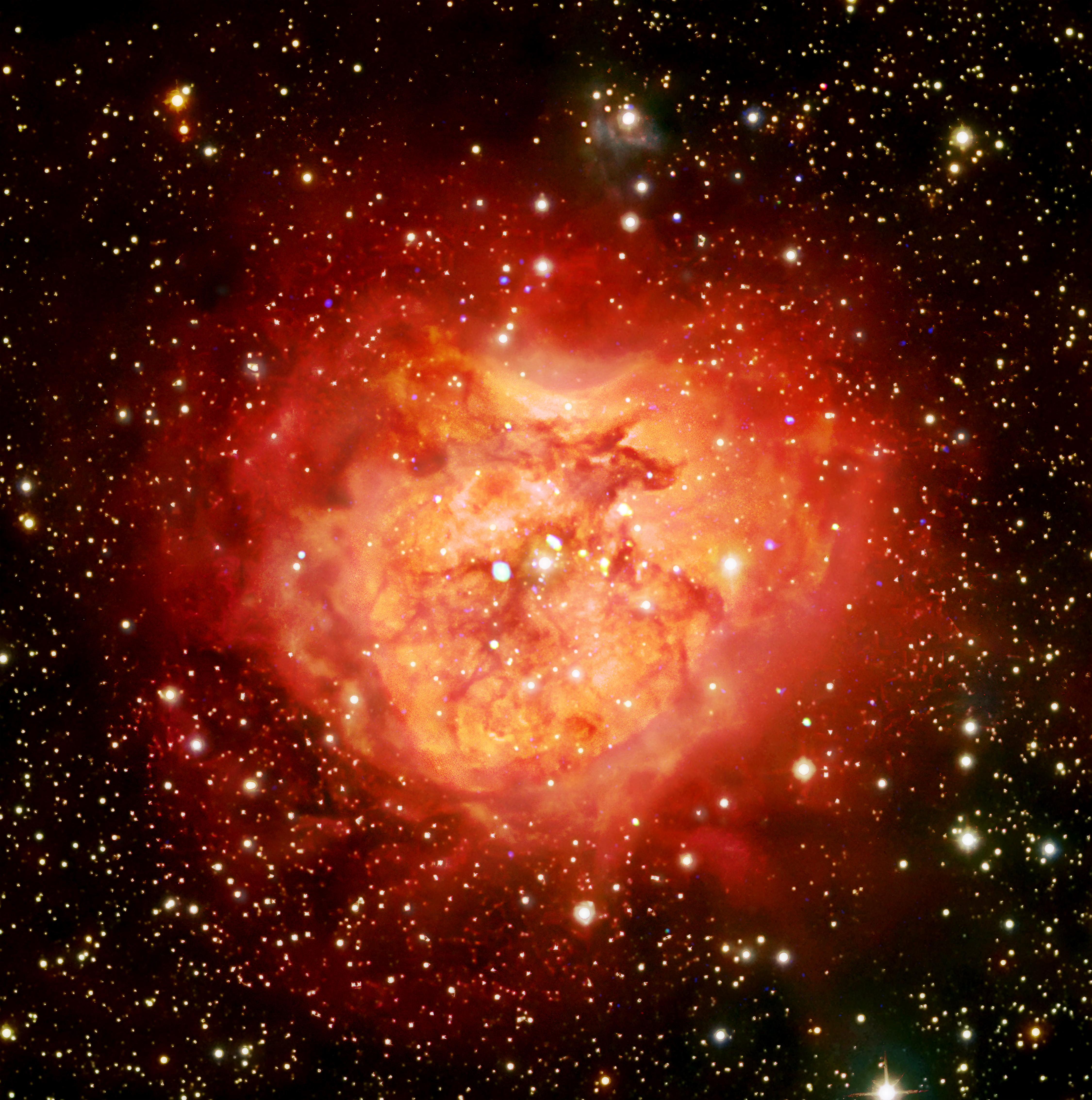
A Cosmic Heart Where New Stars Thrive - Cocoon Nebula, IC 514
Credit: X-ray: NASA/CXC/SAO; Infrared: NASA/JPL/Caltech(WISE); Optical: M. Adler, B. Wilson; Image Processing: NASA/CXC/SAO/L. Frattare


To celebrate Valentine's Day, we are releasing a new image of the Cocoon Nebula (officially named IC 5146). This heart-shaped nebula is a region in the Milky Way galaxy where new stars are forming. X-ray data from NASA’s Chandra X-ray Observatory (red, green, and blue) reveal a cluster of new stars that are just poking through the stunning nebula. Young stars, like those in the Cocoon Nebula, are very active and give off large amounts of X-rays that Chandra can detect.

The nebula itself glows from a combination of light that is emitted by the young stars as well as light that is reflected off the dust in the nebula. This composite image of the Cocoon Nebula contains an optical-light image (red, green, and blue) from astrophotographers Michael Adler and Barry Wilson, as well as infrared light data (red, yellow, and cyan) from NASA’s Wide-field Infrared Survey Explorer (WISE) mission.

The Cocoon Nebula is about 15 light-years across and is located about 2,650 light-years from Earth in the constellation of Cygnus.

NASA's Marshall Space Flight Center in Huntsville, Alabama, manages the Chandra program. The Smithsonian Astrophysical Observatory's Chandra X-ray Center controls science operations from Cambridge, Massachusetts, and flight operations from Burlington, Massachusetts.


Visual Description:

This image shows the Cocoon Nebula (IC 5146) as a glowing, heart-shaped cloud set against a dense backdrop of countless stars scattered across the Milky Way. The nebula's center is filled with warm reds, oranges, and golds, forming a luminous cocoon of gas and dust with soft, uneven edges that fade into the surrounding darkness.

Embedded within this glowing cloud are many young stars, some appearing as bright white or bluish points, while others are hidden and revealed only through X-ray light detected by NASA's Chandra X-ray Observatory. These X-rays trace a cluster of newly formed, highly active stars concentrated near the nebula's core.

The heart-shaped nebula itself shines through a mix of light emitted by these young stars and starlight reflected off surrounding dust. Optical data from two astrophotographers and infrared observations from NASA's Wide-field Infrared Survey Explorer provide depth and texture, revealing a sparkling star field and the thick, dusty structures where new stars continue to form.


Fast Facts for IC 5146, Cocoon Nebula

Credit: X-ray: NASA/CXC/SAO; Infrared: NASA/JPL/Caltech(WISE); Optical: M. Adler, B. Wilson; Image Processing: NASA/CXC/SAO/L. Frattare
Release Date: February 12, 2026
Scale: Image is about 23 arcmin (17.7 light-years) across.
Category: Normal Stars & Star Clusters
Coordinates (J2000): RA 21h 53m 28.7s | Dec +47° 16´ 16.01"
Constellation: Cygnus
Observation Dates: 2 observations: Feb 22, 2006 and Feb 24, 2015
Observation Time: 17 hours 47 minutes
Obs. ID: 6401, 15723
Instrument: ACIS
Color Code: X-ray: red, green, and blue; Infrared: red, yellow, and cyan; Optical: red, green, and blue
Distance Estimate: 50 light-years from Earth


Thursday, February 19, 2026

Supermassive black hole heartbeat hosts surprising mini-flares in new X-ray discovery

When a star passes too close to a supermassive black hole, the enormous tidal forces can tear it apart, creating a temporary disk of glowing gas. Such tidal disruption events offer a fleeting opportunity to study otherwise invisible black holes. In recent years, X-ray observatories have revealed that some of these events display repeating bursts of X-rays — known as quasi-periodic eruptions (QPEs). These intense and regular pulses occur only in a handful of known sources and remain an open mystery in high-energy astrophysics. They have quasi-periodicities ranging from a few hours to a few days. In a new study led by MPE PhD student Pietro Baldini, astronomers report that J2344 exhibits QPE-like eruptions— but with unprecedented behaviour uncovered thanks to follow-up observations with the Einstein Probe and XMM-Newton satellites. “Quasi-periodic eruptions are extremely rare, so I was already excited when I saw the Einstein Probe light curve,” says Pietro Baldini. “But when the XMM-Newton data came in, my jaw dropped: not only had we discovered a new QPE source, but its behaviour was completely unprecedented.”

Zoom on the features of the XMM-Newton lightcurve of J2344: A crest of narrow flares can be distinctively observed over the broader modulations (the QPEs)

Astronomers have uncovered a rare and unexpectedly complex pattern of X-ray eruptions in the source eRASSt J2344, the most luminous tidal disruption event discovered by SRG/eROSITA. Follow-up observations with Einstein Probe and XMM-Newton reveal powerful outbursts repeating every twelve hours - the hallmark of quasi-periodic eruptions (QPEs) - but with an unprecedented addition: shorter, hotter mini-flares embedded within them. This layered behavior challenges current models of how matter behaves in the closest regions around supermassive black holes.

Cosmic ECG of J2344
Animation of the X-ray lightcurve of J2344. The sequence is sped up by a factor of 10,000, revealing rhythmic eruptions and brief, intense mini-flares appearing at the beginning, middle, and end of the lightcurve – like a cosmic electrocardiogram.

The observations revealed a sequence of main X-ray eruptions lasting about two hours and recurring every twelve hours, a typical pattern for known QPEs. However, J2344 also produced a series of much shorter and hotter flares, lasting only a few minutes — a feature never observed before in such systems. The leading explanation for QPEs involves a smaller object, such as a star, orbiting the supermassive black hole and interacting periodically with its accretion disk. While this model explains the regular main eruptions, it cannot account for the additional rapid flares seen in J2344. Their presence indicates that the physics of matter near black holes may be more complex than previously thought. To better understand the mechanisms at work, the team has been awarded additional observation time to monitor J2344 over longer timescales and explore how the two types of flares are connected.

Since its launch in January 2024, the Einstein Probe (EP) has been continuously surveying the variable X-ray sky. Its wide-field optics and high-cadence observations, together with its sensitive follow-up X-ray telescopes. make it uniquely capable of capturing rare and transient events such as QPEs. “Since launch, Einstein Probe has opened an entirely new discovery space in X-ray astronomy,” says Arne Rau (MPE). “This result is just a first glimpse of the kind of rare and unexpected phenomena we expect to find, and we are very excited about what comes next.” As Einstein Probe continues its mission, astronomers expect to uncover more of these enigmatic systems, providing fresh insights into the dynamic behaviour of supermassive black holes — and the extreme environments around them.


Contacts:

Pietro Baldini
PhD-student
Tel:
+49 89 30000-3269
Email: baldini@mpe.mpg.de

Arne Rau
scientist
Tel:
+49 89 30000-3851
Fax: +49 89 30000-3569
Email: arau@mpe.mpg.de

Kirpal Nandra
managing director
Tel:
+49 89 30000-3401
Fax:
+49 89 30000-3569
knandra@mpe.mpg.de


Publication

P. Baldini, A. Rau, A. Merloni, B. Trakhtenbrot, R. Arcodia, M. Giustini, G. Miniutti, S. J. Brennan, M. Freyberg, P. Sánchez-Sáez, I. Grotova, Z. Liu, T. Lian, K. Nandra
Discovery of crested quasi-periodic eruptions following the most luminous SRG/eROSITA tidal disruption event
https://doi.org/10.1051/0004-6361/202558241


Wednesday, February 18, 2026

New method could reveal hidden supermassive black hole binaries

Artistic impression of gravitationally lensed starlight (orange) by a supermassive black hole binary. The Einstein ring is shown in blue.Credit: Physics simulation enhanced using AI


To the point:

  • New method: Researchers at Oxford University and the Max Planck Institute for Gravitational Physics (Albert Einstein Institute) in the Potsdam Science Park propose a new way to detect supermassive black hole binaries using gravitational lensing.

  • Gravitational lensing: Black holes act as natural telescopes, bending light with their gravity. This magnification creates bright images of stars from the same galaxy that lie behind the supermassive black hole binary.

  • Detectable signals: As the binary orbits, it produces repeating flashes of lensed starlight. Current and upcoming wide-field surveys may detect these bursts in the future. These bursts can provide information about the black holes’ properties and enabling entirely new studies.


Bright flashes of lensed starlight guide the way

New method

Tightly bound supermassive black hole binaries form naturally when galaxies merge, but only widely separated systems have confidently been observed to date. In a paper published today in Physical Review Letters, the researchers suggest hunting down the hidden systems by searching for repeating flashes of light from individual stars lying behind the black holes as they are temporarily magnified by gravitational lensing as the binary orbits.

Supermassive black holes reside at the centers of most galaxies. When two galaxies collide and merge, their central black holes eventually form a bound pair, known as a supermassive black hole binary. These systems play a crucial role in galaxy evolution and are among the most powerful sources of gravitational waves in the Universe. While future space-based gravitational-wave observatories like LISA will be able to probe such binaries directly, researchers are now showing that they may already be detectable using existing and upcoming electromagnetic surveys.

Gravitational lensing

“Supermassive black holes act as natural telescopes,” says Miguel Zumalacárregui from the Max Planck Institute for Gravitational Physics. “Because of their enormous mass and compact size, they strongly bend passing light. Starlight from the same host galaxy can be focused into extraordinarily bright images, a phenomenon known as gravitational lensing.”

For a single supermassive black hole, extremely strong lensing occurs only when a star lies almost exactly along the line of sight. In contrast, a supermassive black hole binary acts as a pair of lenses. This produces a diamond-shaped structure, known as a caustic curve, along which stars can experience dramatic magnification.

“The chances of starlight being hugely amplified increase enormously for a binary compared to a single black hole,” explains Bence Kocsis from the University of Oxford’s Department of Physics and a co-author of the study.

A further key difference is that black hole binaries are not static. While the pair orbits under gravity the system slowly loses energy by emitting gravitational waves. As a result, the binary separation shrinks over time and the orbit gradually speeds up.

“As the binary moves, the caustic curve rotates and changes shape, sweeping across a large volume of stars behind it. If a bright star lies within this region, it can produce an extraordinarily bright flash each time the caustic passes over it,” says Hanxi Wang, a PhD student in Kocsis’ group who led the study “This leads to repeating bursts of starlight, which provide a clear and distinctive signature of a supermassive black hole binary.”

Valuable information from detectable signals

The researchers show that the timing and brightness of these bursts encode valuable information about the black hole binary. As the binary inspirals, gravitational-wave emission subtly alters the caustic structure, imprinting a characteristic modulation in both the frequency and peak brightness of the flashes. By measuring these patterns, astronomers could infer key properties of the underlying black hole binary, including its masses and orbital evolution.

With powerful wide-field surveys coming online such as the Vera C. Rubin Observatory and the Nancy Grace Roman Space Telescope, researchers are optimistic that such repeating lensing bursts could be observed in the coming years.

“The prospect of identifying inspiraling supermassive black hole binaries years before future space-based gravitational wave detectors come online is extremely exciting,” concludes Kocsis. “It opens the door to true multi-messenger studies of black holes, allowing us to test gravity and black hole physics in entirely new ways.”


Media contact:

Dr. Elke Müller
Press Officer AEI Potsdam, Scientific Coordinator
Tel:
+49 331 567-7303
Email: elke.mueller@aei.mpg.de

Science contact:

Dr. Miguel Zumalacarregui
Group; Leader
Tel:
+49 331 567-7322
Fax: +49 331 567-7298
Email: miguel.zumalacarregui@aei.mpg.de


Publication

Wang, H.; Zumalacarregui, M.; Kocsis, B.
Black holes as telescopes: Discovering supermassive binaries through quasi-periodic lensed starlight. Physical Review Letters 136, 061403 (2026)


MPG.PuRe - pre-print - publisher-version


Tuesday, February 17, 2026

Unseen planet or brown dwarf may have hidden 'rare' fading star

An artist’s impression of the stellar dimming event caused by a brown dwarf or super-Jupiter with massive rings (foreground) forming an opaque “saucer” through which some light from the star ASASSN-24fw (background) shines. A red dwarf star (left) was also discovered in the neighbourhood during the research. Credit: S. Shah et al.
Licence type: Attribution (CC BY 4.0)

One of the longest stellar dimming events ever observed was likely caused by the gigantic saucer-like rings of either an unseen brown dwarf or 'super-Jupiter' blocking its host star's light, astronomers say.

For decades the star – which sits 3,200 light-years from Earth and is about twice as big as our Sun – had been observed as stable, but at the end of 2024 it faded dramatically.

It then remained this way for more than nine months, far longer than is normal for an event like this, sparking confusion among researchers and prompting speculation as to what could have caused such an "extremely rare" phenomenon.

Now, in a new study published today in Monthly Notices of the Royal Astronomical Society, a team of international researchers believe they may have solved the riddle of this mysterious star in the Monoceros constellation.

They think it was most likely a brown dwarf with Saturn-like rings that caused ASASSN-24fw to dim by about 97 per cent.

This ring system is so enormous it extends out about 0.17 astronomical units, comparable to half the distance between our Sun and Mercury.

Brown dwarfs are mysterious objects that are too big to be considered a planet but also too small to be a star because they lack the mass to keep fusing atoms and blossom into fully-fledged suns.

The other option, the researchers say, is that it may have been a super-Jupiter – defined as massive gas giant exoplanets which exceed the mass of Jupiter and bridge the gap between brown dwarfs and planets.

Their findings offer a glimpse into complex planetary-scale structures beyond our Solar System, paving a new way to study how planets and their rings may form and evolve around other stars.

Unlike typical eclipses, which usually last days or weeks, this dimming continued for nearly 200 days, making it one of the longest ever observed.

An artist’s impression of ASASSN-24fw after the eclipse is over, where the star is seen shining unobstructed - with its own remnants from possible planetary collisions along with its companion red dwarf star and the dark “saucer”. S. Shah et al.
Licence type: Attribution (CC BY 4.0)

"Various models made by our group show that the most likely explanation for the dimming is a brown dwarf – an object heavier than a planet but lighter than a star – surrounded by a vast and dense ring system. It is orbiting the star at a farther distance with the ring," said lead author Dr Sarang Shah, a post-doctoral researcher at the Inter-University Centre for Astronomy and Astrophysics (IUCAA), in Pune, India.

"Long-lasting dimming events like this are exceptionally uncommon as they require very perfect line-ups. The dimming began gradually because the outer parts of the rings are thin, and only became obvious when the denser regions passed in front of the star."

Analysis of photometric and spectroscopic studies of the event suggests that the companion object has a mass of more than three times that of Jupiter.

The analysis also shows that ASASSN-24fw itself has a circumstellar environment (possibly remnants from past or ongoing planetary collisions) very near to it, which is unusual for a star of this age (likely more than 1 billion years).

"Large ring systems are expected around massive objects, but they are very difficult to observe directly to determine their characteristics," said Dr Jonathan Marshall, an independent post-doctoral researcher affiliated with Academia Sinica, Taiwan, whose expertise is in circumstellar material and debris discs.

"This rare event allows us to study such a complex system in remarkable detail. In fact, while studying this dimming, we also serendipitously discovered that ASASSN-24fw also has a red dwarf star in its vicinity."

The team of researchers now want to measure the temperature, evolutionary status, chemical composition, and age of the star which dimmed.

They then hope to obtain more data from the European Southern Observatory’s Very Large Telescope in Chile and the James Webb Space Telescope to better understand the evolution of such systems and relate them to planetary formation theories.

The researchers expect the star to dim again in about 42 or 43 years' time, at which point further analysis can be carried out to find out more about this fascinating system.


Media contacts:

Sam Tonkin
Royal Astronomical Society
Mob: +44 (0)7802 877 700

press@ras.ac.uk


Science contacts:

Dr Sarang Shah
Inter-University Centre for Astronomy and Astrophysics, Pune, India

sarang.shah@iucaa.in

Dr Jonathan Marshall
Academia Sinica, Taiwan

jmarshall@asiaa.sinica.edu.tw


Images captions

Dimming star

One of the longest stellar dimming events ever observed was likely caused by the gigantic saucer-Caption: An artist's impression of the stellar dimming event caused by a brown dwarf or super-Jupiter with massive rings (foreground) forming an opaque "saucer" through which some light from the star ASASSN-24fw (background) shines. A red dwarf star (left) was also discovered in the neighbourhood during the research. Credit: S. Shah et al.

After dimming

Caption: An artist's impression of ASASSN-24fw after the eclipse is over, where the star is seen shining unobstructed – with its own remnants from possible planetary collisions along with its companion red dwarf star and the dark "saucer". Credit: S. Shah et al.


Further information

The paper 'The nature of ASASSN-24fw's occultation: modelling the event as dimming by optically thick rings around a sub-stellar companion' by S. Shah et al. has been published in Monthly Notices of the Royal Astronomical Society. DOI: 10.1093/mnras/staf2251.


Notes for editors

About the Royal Astronomical Society

The Royal Astronomical Society (RAS), founded in 1820, encourages and promotes the study of astronomy, solar-system science, geophysics and closely related branches of science.

The RAS organises scientific meetings, publishes international research and review journals, recognises outstanding achievements by the award of medals and prizes, maintains an extensive library, supports education through grants and outreach activities and represents UK astronomy nationally and internationally. Its more than 4,000 members (Fellows), a third based overseas, include scientific researchers in universities, observatories and laboratories as well as historians of astronomy and others.

The RAS accepts papers for its journals based on the principle of peer review, in which fellow experts on the editorial boards accept the paper as worth considering. The Society issues press releases based on a similar principle, but the organisations and scientists concerned have overall responsibility for their content.

Keep up with the RAS on Instagram, Bluesky, LinkedIn, Facebook and YouTube.

Download the RAS Supermassive podcast

Submitted by  Sam Tonkin on Thu, 12/02/2026 - 00:01