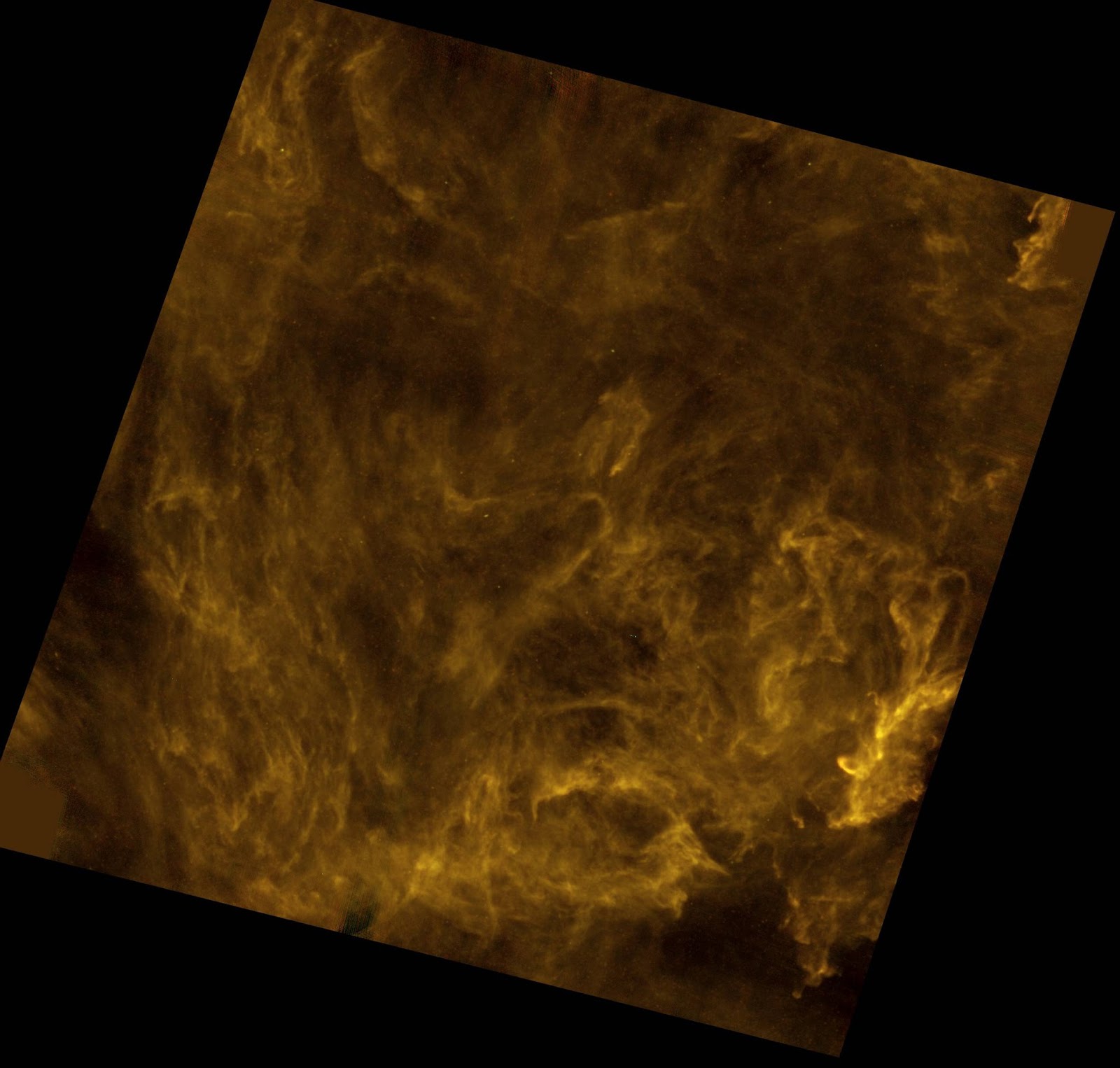
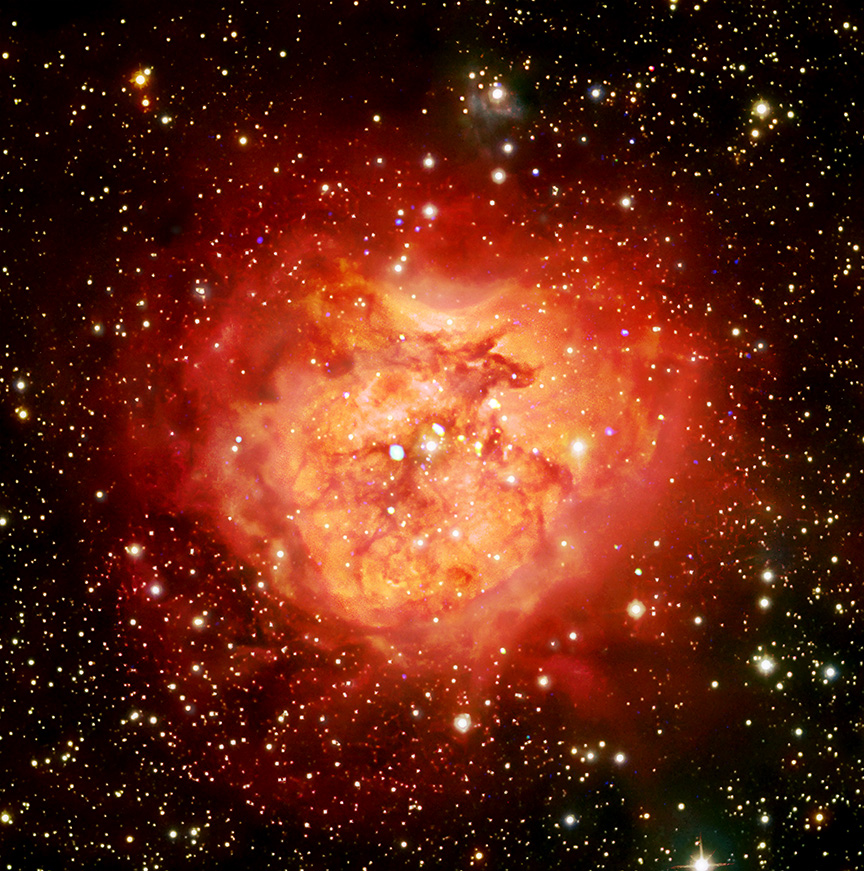
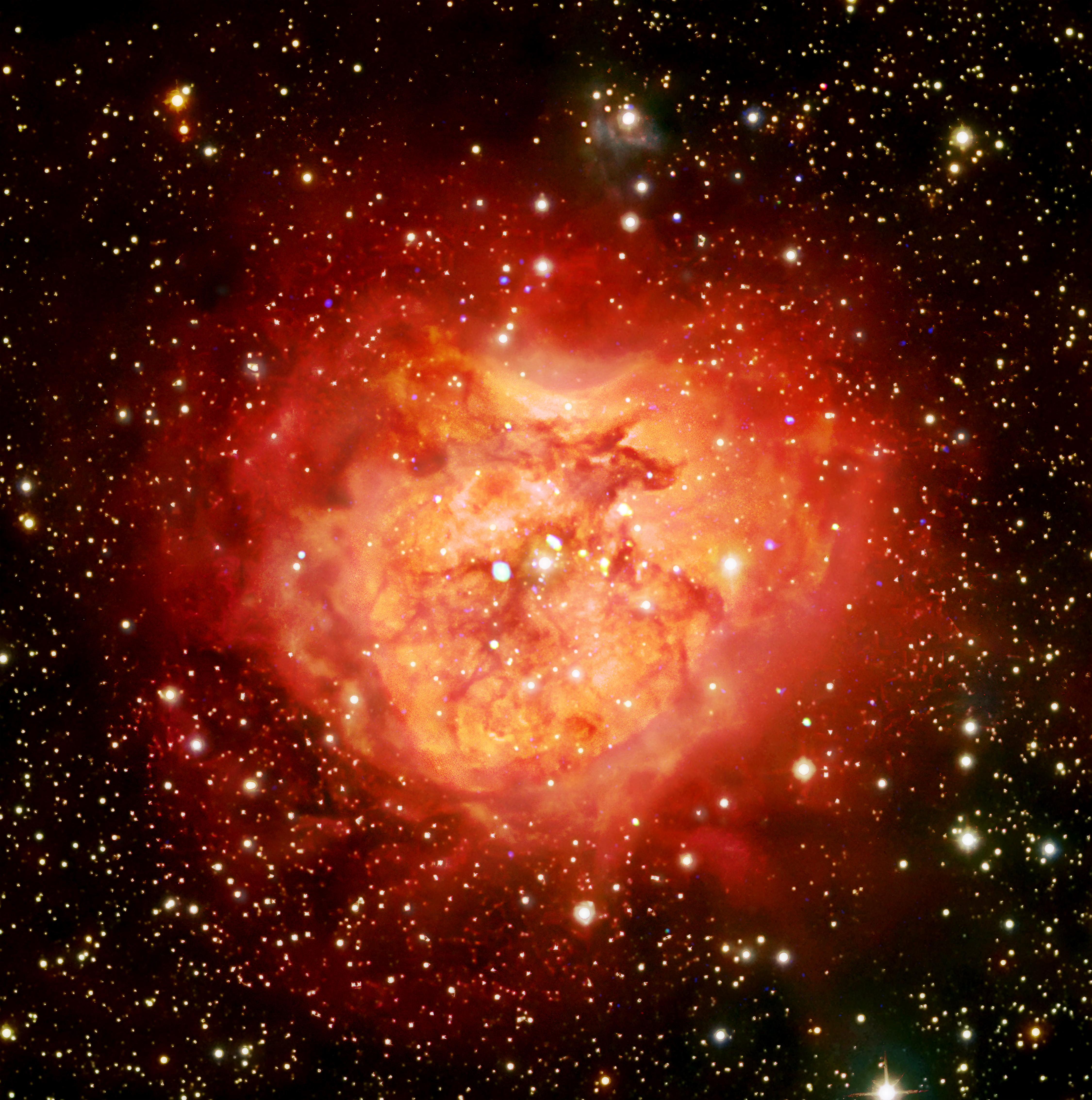
Left: The Aquila Rift. Credit: ESA/Herschel/SPIRE/PACS/Ph. André for the 'Gould Belt survey' Key Programme Consortium. Right: The star-forming cloud IC 5146. Credit: ESA/Herschel/SPIRE/PACS/D. Arzoumanian for the "Gould Belt survey" Key Programme Consortium
The Orion A Molecular Cloud.
Credit: ESA/Herschel/Ph. André, D. Polychroni, A. Roy, V. Könyves, N. Schneider for the Gould Belt survey Key Programme
Credit:
ESA/Herschel/SPIRE/Ph. André for the "Gould Belt survey" Key Programme
Consortium and A. Abergel for the "Evolution of Interstellar Dust" Key
Programme Consortium
Observations with ESA's Herschel space
observatory have revealed that our Galaxy is threaded with filamentary
structures on every length scale. From nearby clouds hosting tangles of
filaments a few light-years long to gigantic structures stretching
hundreds of light-years across the Milky Way's spiral arms, they appear
to be truly ubiquitous. The Herschel data have rekindled the interest of
astronomers in studying filaments, emphasising the crucial role of
these structures in the process of star formation.
Stars are born in the densest pockets of
the interstellar medium, a diffuse mixture of gas and dust that pervades
galaxies, including our Milky Way. One of the most intriguing questions
in astrophysics concerns understanding how this material, which is
typically characterised by very low density, can come together, creating
denser concentrations that later evolve into compact cores and,
finally, give birth to stars.
In the search for answers, astronomers observe giant molecular clouds,
the cosmic incubators where gas and dust are transformed into stars.
While these studies are performed using a variety of techniques, one
crucial approach is the observation of infrared light, since the
interstellar material shines brightly at these long wavelengths.
In this context, ESA's Herschel space observatory has been a true game
changer. Probing the portion of the electromagnetic spectrum that ranges
from the far-infrared to sub-millimetre wavelengths, it has collected
unprecedented data during its three and a half years of observing. One
of the key aspects that emerged from these observations is the presence
of a filamentary network nearly everywhere in our Galaxy's interstellar
medium. The picture that is emerging is that these structures are
closely linked to the formation of stars.
Prior to Herschel, astronomers had already identified several filaments
in interstellar clouds and recognised their potential importance for
star formation. However, only with the increased sensitivity and spatial
resolution granted by this observatory, combined with its large-scale
surveys, could they reveal the full extent of filamentary patterns in
the Milky Way.
One of the surveys performed with Herschel – the Gould Belt Survey –
focussed on a giant ring of star-forming regions, all located no more
than 1500 light-years away from the Sun. The vicinity of these clouds
allowed astronomers to obtain exceptionally detailed images using
Herschel, unearthing intricate webs of filaments in each region that
they examined.
“The greatest surprise was the ubiquity of filaments in these nearby clouds and their intimate connection with star formation,” explains Philippe André from CEA/IRFU, France, Principal Investigator for the Herschel Gould Belt Survey.
“But there is more: these observations revealed that filaments,
which may extend to several light-years in length, appear to have a
universal width of about one third of a light year. This suggests that
something fundamental is lurking underneath.”
The astronomers are still trying to understand the details of the star
formation processes taking place in these clouds, aided by the abundance
and variety of data collected with Herschel.
While most filaments are dotted with compact cores, suggesting that
stars are readily taking shape in these dense 'fibres' of the
interstellar medium, there are also regions that exhibit complex tangles
of filaments but no signs of on-going star formation. A study of the
most spectacular example of this phenomenon, the Polaris Flare,
indicates that filaments must somehow precede the onset of star
formation.
The scenario that has emerged from the new Herschel data suggests that
star formation proceeds in two steps: first, turbulent motions of the
interstellar gas and dust create an intricate web of filamentary
structures; then, gravity takes over, causing only the densest filaments
to contract and fragment, eventually leading to the formation of stars.
Indeed, the universal width of filaments seems to correspond, at least
in the nearby clouds of the Gould Belt Survey, to the scale at which
interstellar material undergoes the transition from supersonic to
subsonic state.
In addition, the material along filaments is not at all static:
astronomers have detected what appear to be accretion flows, with the
most prominent filaments drawing matter from their surroundings through a
network of smaller filaments. A striking example of such processes is
seen in the Taurus Molecular Cloud, where the B211/B213 filament
exhibits a series of so-called 'striations' perpendicular to the main
filament.
This pattern is very similar to that predicted from numerical
simulations that model the process of star formation in molecular
clouds. According to these simulations, interstellar material flows
towards dense filaments along routes that are parallel to the direction
of the local magnetic field, as was observed, so the new data indicate
the importance of interstellar magnetic fields in shaping these
structures.
The B211/B213 filament in the Taurus Molecular Cloud.
Credit: ESA/Herschel/PACS, SPIRE/Gould Belt survey Key Programme/Palmeirim et al. 2013
However, star formation does not appear to
take place only in filaments. While these structures seem to be the
preferred sites for stellar birth, the extraordinary data from Herschel
confirmed that a small fraction of stars may also form far away from
dense filaments.
In particular, a detailed study of the L1641 molecular clouds in the
Orion A complex suggests that star formation along filaments is the
preferential channel to produce typical solar-type stars, while stars
that are born away from these dense, elongated structures tend to have
lower masses. This dichotomy could be a result of the greater
availability of raw material to protostars that are forming on a
filament compared to those that take shape in less dense environments.
Another of Herschel's key findings is that the presence and abundance
of filaments are not limited to our immediate neighbourhood. In fact,
these structures appear everywhere also in the Herschel infrared
Galactic Plane Survey (Hi-GAL), which scanned the distribution of the
interstellar medium in the huge disc – about 100 000 light-years across –
where most of the Milky Way's stars form and reside.
The filamentary structure of the Galactic Plane.
Credit: ESA/PACS & SPIRE Consortium, S. Molinari, Hi-GAL Project
“We detected a wealth of huge
filaments, with lengths ranging from a few to a hundred light-years,
revealing what seems to be the 'skeleton' of our Galaxy,” explains Sergio Molinari from IAPS/INAF, Italy, Principal Investigator for the Hi-GAL Project.
“While it is possible that these structures arose from different
physical processes than those giving rise to the small-scale filaments
observed in the Sun's vicinity, the omnipresent aspect of filamentary
structures in the Milky Way is beyond doubt.”
In the post-Herschel era, one thing is certain: filaments play a
leading role in the build-up of galactic material, creating favourable
hubs for the formation of stars. This is likely a hierarchical process,
starting on very large scales and propagating onwards, to smaller and
smaller scales, funnelling interstellar gas and dust into increasingly
denser concentrations and thus fostering stellar birth across the
Galaxy.
Filaments in outer regions of the Galactic Plane
Credit: ESA/Herschel/PACS, SPIRE/Hi-GAL Project/Schisano et al. 2014
Large-scale filaments fragmenting into
compact cores that later evolve into stars have been detected all across
the Galactic Plane, even in its outermost, peripheral regions. As
filaments grow more massive, the material within them contracts and
forms smaller structures, preserving the filamentary pattern on all
length scales.
Further investigation of the Hi-GAL survey has revealed new and even
more prominent filaments, extending over hundreds of light-years and
weaving their way through the spiral arms of the Milky Way. The study
revealed nine filaments in some very dense, inner regions of the
Galactic Plane, detecting these for the first time through the direct
emission of dust within them, allowing an accurate determination of
their mass, size and physical characteristics. Astronomers believe that
almost a hundred similar, gigantic structures are still hiding in the
data.
Some of the most prominent filaments detected in the Milky Way: G49 (top), G47 (bottom left) and G64 (bottom right).
Credit: ESA/Herschel/PACS/SPIRE/Ke Wang et al. 2015
“The intricate distribution of filaments in the interstellar medium
revealed by Herschel has definitely revolutionised our view of how
stars form in the Milky Way and, presumably, also in other similar
galaxies,” comments Göran Pilbratt, ESA Herschel Project Scientist.
“An increasingly coherent picture is now emerging from combining
the analysis of these data with predictions from theory and numerical
simulations, as astronomers continue to study the physical processes
underlying the fascinating origin of stars and planets.”
More information
Herschel is an ESA space observatory with science instruments provided
by European-led Principal Investigator consortia and with important
participation from NASA.
Herschel was launched on 14 May 2009 and completed science observations on 29 April 2013.
Related publications
Ph. André et al. 2010, Astronomy & Astrophysics, 518, L102
S. Molinari et al. 2010, Astronomy & Astrophysics, 518, L100
D. Arzoumanian et al. 2011, Astronomy & Astrophysics, 529, L6
D. Polychroni et al. 2013, Astrophysical Journal Letters, 777, L33
P. Palmeirim et al. 2013, Astronomy & Astrophysics, 550, A38
D. Arzoumanian et al. 2013, Astronomy & Astrophysics, 553, A119
Ph. André et al. 2014, in Protostars and Planets VI, p. 27
D. Elia et al. 2013, Astrophysical Journal, 772, 45
E. Schisano et al. 2014, Astrophysical Journal, 791, 27
K. Wang et al. 2015, Monthly Notices of the Royal Astronomical Society, 450, 4043
Contacts
Philippe André
CEA/DSM/IRFU Service d'Astrophysique
Centre d'Etudes de Saclay
Gif-sur-Yvette Cedex, France
E-mail: pandre@cea.fr
Phone: +33-1-6908-9265
Sergio Molinari
IAPS/INAF
Roma, Italy
Email: Sergio.molinari@iaps.inaf.it
Phone: +39-06-4993-4396
Göran Pilbratt
Herschel Project Scientist
Scientific Support Office
Science and Robotic Exploration Directorate
ESA, The Netherlands
Email: gpilbratt@cosmos.esa.int
Phone: +31-71-565-3621