Artist’s impression of WR 112, a binary system containing a massive, evolved Wolf-Rayet star and an OB-type companion. As their stellar winds collide, dust forms and spirals outward, consisting mostly of extremely tiny, nanometer-sized grains along with a secondary population about 100 times larger. Credit: NSF/AUI/NSF NRAO/M. Weiss. Hi-Res File
ALMA and JWST reveal nanometer-scale carbon dust grains emanating from a massive binary star system
Telescope (JWST) have discovered that some of the most massive stars in our galaxy are emitting unbelievably tiny grains of carbon dust—dust that one day could form future stars and planets. Both powerful telescopes were required for this research, to reveal all of the dust being produced by these stars.
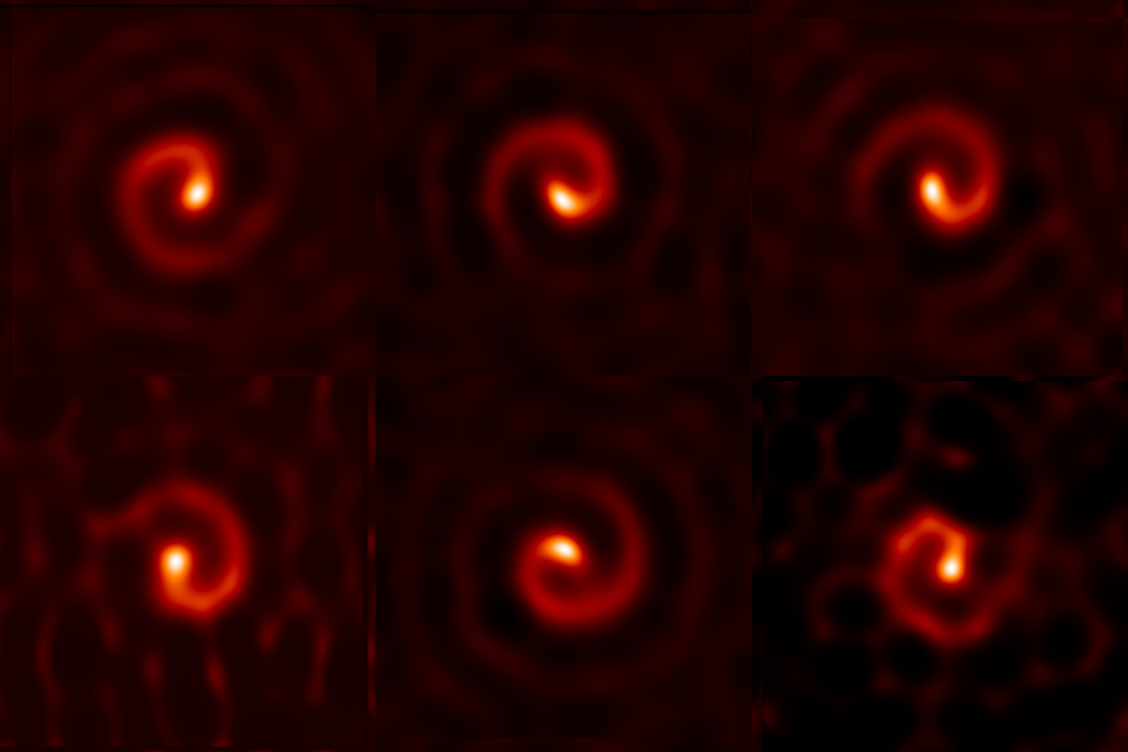
This new research focused on WR 112, a binary star system that contains a very rare, massive, intensely hot, and dying Wolf–Rayet star orbiting another star companion. Together, these stars blast out powerful stellar winds that collide and create dense, cooling regions where dust forms, before this dust is scattered into interstellar space by intense starlight.
While previous mid-infrared images from JWST revealed bright spiral arcs of dust in WR 112, researchers were surprised when they saw no dust at all in ALMA’s sensitive millimeter observations. Only warm, tiny dust grains could hide from ALMA’s view, one of the most powerful millimeter telescopes on Earth. Combined data from JWST and ALMA suggested that the dust grains in the extended spiral structures are largely smaller than one micrometer, and most of them should be only a few nanometers (or billionths of a meter) across.
“It’s amazing to know that some of the most massive stars in the Universe produce some of the tiniest dust particles before they die. The difference in size between the star and the dust it produces is about a quintillion to one,” shared Donglin Wu, an undergraduate at Yale University and the lead author of this new research.
The team also found evidence that the dust is not evenly made up of a range of sizes, but instead comes in two distinct sizes: a larger group of nanometer-sized grains, and a smaller group of grains about 0.1 micrometer across. This discovery reconciled decades of conflicting measurements of similar binary systems: some revealed only very tiny grains, while others only saw larger ones. Now, it is understood that this type of binary system can have both. The team explored several physical processes that can, in principle, break up or evaporate dust grains near the harsh radiation field of the stars, finding that these processes have a tendency to destroy grains that were in between these sizes under certain conditions.
Because WR 112 is one of the most prolific dust producers of its kind—producing as much as three Moons’ worth of dust every year—the new grain-size measurements have big implications for how much carbon dust massive binaries can contribute to the broader galaxy. By revealing that some of the Universe’s biggest stars are factories for some of its smallest solid particles, this study provides an important missing piece in the life cycle of cosmic dust.
This new research focused on WR 112, a binary star system that contains a very rare, massive, intensely hot, and dying Wolf–Rayet star orbiting another star companion. Together, these stars blast out powerful stellar winds that collide and create dense, cooling regions where dust forms, before this dust is scattered into interstellar space by intense starlight.
While previous mid-infrared images from JWST revealed bright spiral arcs of dust in WR 112, researchers were surprised when they saw no dust at all in ALMA’s sensitive millimeter observations. Only warm, tiny dust grains could hide from ALMA’s view, one of the most powerful millimeter telescopes on Earth. Combined data from JWST and ALMA suggested that the dust grains in the extended spiral structures are largely smaller than one micrometer, and most of them should be only a few nanometers (or billionths of a meter) across.
“It’s amazing to know that some of the most massive stars in the Universe produce some of the tiniest dust particles before they die. The difference in size between the star and the dust it produces is about a quintillion to one,” shared Donglin Wu, an undergraduate at Yale University and the lead author of this new research.
The team also found evidence that the dust is not evenly made up of a range of sizes, but instead comes in two distinct sizes: a larger group of nanometer-sized grains, and a smaller group of grains about 0.1 micrometer across. This discovery reconciled decades of conflicting measurements of similar binary systems: some revealed only very tiny grains, while others only saw larger ones. Now, it is understood that this type of binary system can have both. The team explored several physical processes that can, in principle, break up or evaporate dust grains near the harsh radiation field of the stars, finding that these processes have a tendency to destroy grains that were in between these sizes under certain conditions.
Because WR 112 is one of the most prolific dust producers of its kind—producing as much as three Moons’ worth of dust every year—the new grain-size measurements have big implications for how much carbon dust massive binaries can contribute to the broader galaxy. By revealing that some of the Universe’s biggest stars are factories for some of its smallest solid particles, this study provides an important missing piece in the life cycle of cosmic dust.
Press Contacts:
Jill Malusky
Sr. Public Information Group Manager and Public Information Officer
Email | Phone
About NRAO
About ALMA
About NRAO
The National Radio Astronomy Observatory (NRAO) is a facility of the U.S. National Science Foundation, operated under cooperative agreement by Associated Universities, Inc.
About ALMA
The Atacama Large Millimeter/submillimeter Array (ALMA), an international astronomy facility, is a partnership of the European Southern Observatory (ESO), the U.S. National Science Foundation (NSF) and the National Institutes of Natural Sciences (NINS) of Japan in cooperation with the Republic of Chile. ALMA is funded by ESO on behalf of its Member States, by NSF in cooperation with the National Research Council of Canada (NRC) and the National Science and Technology Council (NSTC) in Taiwan and by NINS in cooperation with the Academia Sinica (AS) in Taiwan and the Korea Astronomy and Space Science Institute (KASI).
ALMA construction and operations are led by ESO on behalf of its Member States; by the National Radio Astronomy Observatory (NRAO), managed by Associated Universities, Inc. (AUI), on behalf of North America; and by the National Astronomical Observatory of Japan (NAOJ) on behalf of East Asia. The Joint ALMA Observatory (JAO) provides the unified leadership and management of the construction, commissioning and operation of ALMA.
ALMA construction and operations are led by ESO on behalf of its Member States; by the National Radio Astronomy Observatory (NRAO), managed by Associated Universities, Inc. (AUI), on behalf of North America; and by the National Astronomical Observatory of Japan (NAOJ) on behalf of East Asia. The Joint ALMA Observatory (JAO) provides the unified leadership and management of the construction, commissioning and operation of ALMA.