Wednesday, November 28, 2018

Behind the Scenes of Recovering NASA's Hubble

DSF2237b
The first image captured by Hubble after returning to science on October 27, 2018, shows a field of galaxies in the constellation Pegasus. The observations were taken with the Wide Field Camera 3 to study very distant galaxies in the field. Image: NASA, ESA, and A. Shapley (UCLA)

In the early morning of October 27, 2018, the Hubble Space Telescope targeted a field of galaxies not far from the Great Square in the constellation Pegasus. Contained in the field were star-forming galaxies up to 11 billion light-years away. With the target in its sights, Hubble's Wide Field Camera 3 recorded an image. It was the first picture captured by the telescope since it closed its eyes on the universe three weeks earlier, and it was the result of an entire team of engineers and experts working tirelessly to get the telescope exploring the cosmos once again.

"This has been an incredible saga, built upon the heroic efforts of the Hubble team," stated Hubble senior project scientist, Jennifer Wiseman, at NASA Goddard. "Thanks to this work, the Hubble Space Telescope is back to full science capability that will benefit the astronomical community and the public for years to come."

On the evening of Friday, October 5, the orbiting observatory had put itself into "safe mode" after one of its gyroscopes (or "gyros") failed. Hubble stopped taking science observations, oriented its solar panels toward the Sun, and waited for further instructions from the ground.

It was the beginning of a three-day holiday weekend when members of the spacecraft's operations team started receiving text messages on their phone, alerting them that something was wrong with Hubble. In less than an hour, more than a dozen team members had gathered in the control room at NASA's Goddard Space Flight Center in Greenbelt, Maryland, to assess the situation. After unsuccessfully reviving the failed gyro, they activated a backup gyro on the spacecraft. However, the gyro soon began reporting impossibly high rotation rates — around 450 degrees per hour, when Hubble was actually turning less than a degree per hour.

"This is something we've never seen before on any other gyros — rates this high," stated Dave Haskins, Hubble's mission operations manager at Goddard.

Hubble has six gyros aboard, and it typically uses three at a time to collect the most science. However, two of its six gyros had previously failed. This was Hubble's final backup gyro. The operations team either had to figure out how to get it working, or turn to a previously developed and tested "one-gyro mode," which is proven to work but would limit Hubble's efficiency and how much of the sky the telescope could observe at a given time of the year — something both the operations team and astronomers want to avoid until there is no other choice.

As they decided what to do next, team members stayed in the control center continuously to monitor the health and safety of the spacecraft. Because Hubble's control center had switched to automated operations back in 2011, there were no longer people in place to monitor Hubble 24 hours a day.

"The team pulled together to staff around the clock, something we haven't done in years," Haskins shared. Team members stepped in to take shifts — several of Hubble's systems engineers, others who help run tests and checkouts of Hubble's ground systems, and some who used to staff Hubble's control room but hadn't in a long time. "It's been years since they've been on console doing that kind of shift work," Haskins said. "To me it was seamless. It shows the versatility of the team."

Meanwhile, during the holiday weekend, Hubble's Project Manager, Pat Crouse, was busy recruiting a team of experts from Goddard and around the country to analyze the backup gyro's unusual behavior and determine whether it could be corrected. This anomaly review board met for the first time that Tuesday, October 9, and contributed valuable insight throughout Hubble's recovery.

It took weeks of creative thinking, continued tests, and minor setbacks to solve the problem of the misbehaving gyro. Members of the operations team and the review board suspected there might be some sort of obstruction in the gyro affecting its readings. Attempting to dislodge such a blockage, the team repeatedly tried switching the gyro between different operational modes and rotating the spacecraft by large amounts. In response, the extremely high rotation rates from the gyro gradually fell until they were close to normal.

Encouraged but cautious, the team uploaded new software safeguards on Hubble to protect the telescope in case the gyro reports unduly high rates again, and then sent the telescope through some practice maneuvers to simulate real science observations. They kept a close watch to make sure everything on the spacecraft performed correctly. It did.

"Early on we had no idea whether we'd be able to resolve that issue or not," Hubble's deputy mission operations manager, Mike Myslinski, said about the high gyro rates.

In the background, other team members at Goddard and the Space Telescope Science Institute had begun preparing in case Hubble would have to switch to using just a single gyro, with the other working gyro held in reserve as a backup. Fortunately, the results of their efforts weren't needed this time, but their work wasn't for naught. "We know that we'll have to go to one gyro someday, and we want to be as prepared as possible for that," Myslinski explained. "We'd always said that once we got down to three gyros we would do as much up-front work as possible for one-gyro science. That day has come."

For now, however, Hubble is back to exploring the universe with three working gyros, thanks to the hard work of a multitude of people on the ground.

"Many team members made personal sacrifices to work long shifts and off-shifts to ensure the health and safety of the observatory, while identifying a path forward that was both safe and effective," Crouse said of the efforts to return to science. "The recovery of the gyro is not only vital for the life expectancy of the observatory, but Hubble is most productive in three-gyro mode, and extending this historic period of productivity is a main objective for the mission. Hubble will continue to make amazing discoveries when it is time to operate in one-gyro mode, but due to the tremendous effort and determination of the mission team, now is not the time."

The Hubble Space Telescope is a project of international cooperation between NASA and ESA (European Space Agency). NASA's Goddard Space Flight Center in Greenbelt, Maryland, manages the telescope. The Space Telescope Science Institute (STScI) in Baltimore, Maryland, conducts Hubble science operations. STScI is operated for NASA by the Association of Universities for Research in Astronomy, in Washington, D.C.


Related Links

This site is not responsible for content found on external links


Contact 

Vanessa Thomas
NASA Goddard Space Flight Center, Greenbelt, Maryland

vanessa.j.thomas@nasa.gov


Source:  HubbleSite/News


Friday, November 23, 2018

XMM-Newton's view of pulsar J1826-1256

XMM-Newton's view of pulsar J1826-1256
Credit: ESA/XMM-Newton/J. Li, DESY, Germany

Based on a new theoretical model, a team of scientists explored the rich data archive of ESA's XMM-Newton and NASA's Chandra space observatories to find pulsating X-ray emission from three sources. The discovery, relying on previous gamma-ray observations of the pulsars, provides a novel tool to investigate the mysterious mechanisms of pulsar emission, which will be important to understand these fascinating objects and use them for space navigation in the future. 

Lighthouses of the Universe, pulsars are fast-rotating neutron stars that emit beams of radiation. As pulsars rotate and the beams alternatively point towards and away from Earth, the source oscillates between brighter and dimmer states, resulting in a signal that appears to 'pulse' every few milliseconds to seconds, with a regularity rivalling even atomic clocks.

Pulsars are the incredibly dense, extremely magnetic, relics of massive stars, and are amongst the most extreme objects in the Universe. Understanding how particles behave in such a strong magnetic field is fundamental to understanding how matter and magnetic fields interact more generally.

Originally detected through their radio emission, pulsars are now known to also emit other types of radiation, though typically in smaller amounts. Some of this emission is standard thermal radiation – the type that everything with a temperature above absolute zero emits. Pulsars release thermal radiation when they accrete matter, for example from another star.

But pulsars also emit non-thermal radiation, as is often produced in the most extreme cosmic environments. In pulsars, non-thermal radiation can be created via two processes: synchrotron emission and curvature emission. Both processes involve charged particles being accelerated along magnetic field lines, causing them to radiate light that can vary in wavelength from radio waves to gamma-rays.

Non-thermal X-rays result mostly from synchrotron emission, while gamma-rays may come from so-called synchro-curvature emission – a combination of the two mechanisms. It is relatively easy to find pulsars that radiate gamma-rays – NASA's Fermi Gamma-Ray Space Telescope has detected more than 200 of them over the past decade, thanks to its ability to scan the whole sky. But only around 20 have been found to pulse in non-thermal X-rays.

"Unlike gamma-ray detecting survey instruments, X-ray telescopes must be told exactly where to point, so we need to provide them with some sort of guidance," says Diego Torres, from the Institute of Space Sciences in Barcelona, Spain.

Aware that there should be many pulsars emitting previously undetected non-thermal X-rays, Torres developed a model that combined synchrotron and curvature radiation to predict whether pulsars detected in gamma-rays could also be expected to appear in X-rays.

"Scientific models describe phenomena that can't be experienced directly," explains Torres.

"This model in particular helps explain the emission processes in pulsars and can be used to predict the X-ray emission that we should observe, based on the known gamma-ray emission.
"
The model describes the gamma-ray emission of pulsars detected by Fermi – specifically, the brightness observed at different wavelengths – and combines this information with three parameters that determine the pulsar emission. This allows a prediction of their brightness at other wavelengths, for instance in X-rays.

Torres partnered with a team of scientists, led by Jian Li from the Deutsches Elektronen Synchrotron in Zeuthen near Berlin, Germany, to select three known gamma-ray emitting pulsars that they expected, based on the model, to also shine brightly in X-rays. They dug into the data archives of ESA's XMM-Newton and NASA's Chandra X-ray observatories to search for evidence of non-thermal X-ray emission from each of them.

"Not only did we detect X-ray pulsations from all three of the pulsars, but we also found that the spectrum of X-rays was almost the same as predicted by the model," explains Li.
"This means that the model very accurately describes the emission processes within a pulsar."

Non-thermal X-ray emission from three pulsars
Credit: Adapted from J. Li et al. (2018)

In particular, XMM-Newton data showed clear X-ray emission from PSR J1826-1256 – a radio quiet gamma-ray pulsar with a period of 110.2 milliseconds. The spectrum of light received from this pulsar was very close to that predicted by the model. X-ray emission from the other two pulsars, which both rotate slightly more quickly, was revealed using Chandra data.

This discovery already represents a significant increase in the total number of pulsars known to emit non-thermal X-rays. The team expects that many more will be discovered over the next few years as the model can be used to work out where exactly to look for them.

Finding more X-ray pulsars is important for revealing their global properties, including population characteristics. A better understanding of pulsars is also essential for potentially taking advantage of their accurate timing signals for future space navigation endeavours.

The result is a step towards understanding the relationships between the emission by pulsars in different parts of the electromagnetic spectrum, enabling a robust way to predict the brightness of a pulsar at any given wavelength. This will help us better comprehend the interaction between particles and magnetic fields in pulsars and beyond.

"This model can make accurate predictions of pulsar X-ray emission, and it can also predict the emission at other wavelengths, for example visible and ultraviolet," Torres continues.
"In the future, we hope to find new pulsars leading to a better understanding of their global properties."

The study highlights the benefits of XMM-Newton's vast data archive to make new discoveries and showcases the impressive abilities of the mission to detect relatively dim sources. The team is also looking forward to using the next generation of X-ray space telescopes, including ESA's future Athena mission, to find even more pulsars emitting non-thermal X-rays.

"As the flagship of European X-ray astronomy, XMM-Newton is detecting more X-ray sources than any previous satellite. It is amazing to see that it is helping to solve so many cosmic mysteries," concludes Norbert Schartel, XMM-Newton Project Scientist at ESA.


Notes for Editors

DOI: 10.3847/2041-8213/aae92b

The prepint is available on the arXiv/astro-ph server (arXiv:1811.08339).


For more information, please contact:

Jian Li
Deutsches Elektronen Synchrotron DESY
Zeuthen, Germany
Email: jian.li@desy.de

Diego Torres
Institute of Space Sciences (ICE, CSIC)
Institut d'Estudis Espacials de Catalunya (IEEC)
Institució Catalana de Recerca i Estudis Avanc¸ats (ICREA)
Barcelona, Spain
Email: dtorres@ice.csic.es

Norbert Schartel
XMM-Newton Project Scientist
European Space Agency
Email: norbert.schartel@esa.int


Thursday, November 22, 2018

Exoplanet Stepping Stones

Exoplanet HR 8799c
Credit: W. M. Keck Observatory/Adam Makarenko

Researchers are Perfecting Technology to One Day Look for Signs of Alien Life

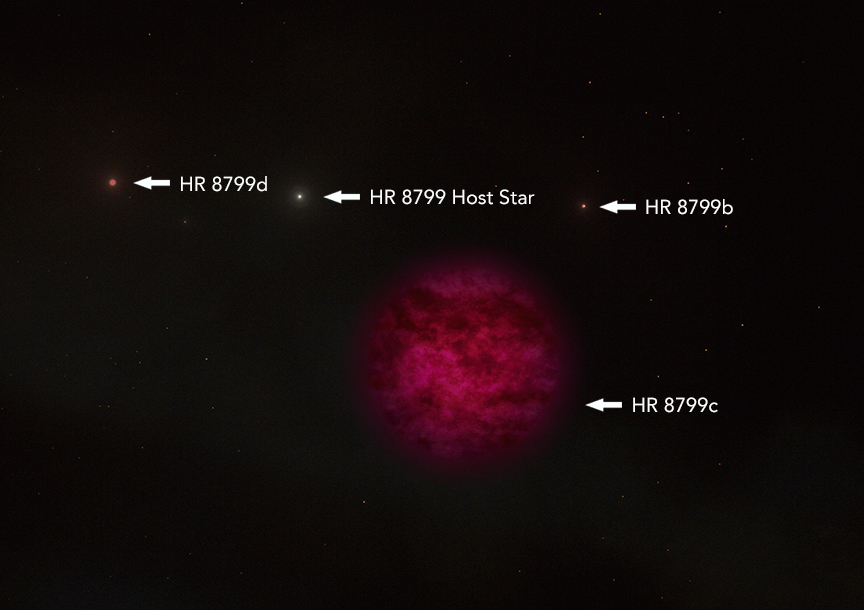
Maunakea, Hawaii – Astronomers have gleaned some of the best data yet on the composition of a planet known as HR 8799c—a young giant gas planet about 7 times the mass of Jupiter that orbits its star every 200 years.

The team used state-of-the art instrumentation at the W. M. Keck Observatory on Maunakea, Hawaii to confirm the existence of water in the planet’s atmosphere, as well as a lack of methane.

While other researchers had previously made similar measurements of this planet, these new, more robust data demonstrate the power of combining high-resolution spectroscopy with a technique known as adaptive optics, which corrects for the blurring effect of Earth’s atmosphere.

“This type of technology is exactly what we want to use in the future to look for signs of life on an Earth-like planet. We aren’t there yet but we are marching ahead,” says Dimitri Mawet, an associate professor of astronomy at Caltech and a research scientist at JPL, which Caltech manages for NASA.

Mawet is co-author of a new paper on the findings published today in The Astronomical Journal.

The lead author is Ji Wang, formerly a postdoctoral scholar at Caltech and now an assistant professor at Ohio State University.

Artist’s impression based on published scientific data on the HR 8799 solar system. The magenta, HR 8799c planet is in the foreground. Compared to Jupiter, this gas giant is about seven times more massive and has a radius that is 20 percent larger. HR 8799c’s planetary companions, d and b are in the background, orbiting their host star. Credit: W.M. Keck Observatory/Adam Makarenko/C.Alvarez

Taking pictures of planets that orbit other stars—exoplanets—is a formidable task. Light from the host stars far outshines the planets, making them difficult to see.

More than a dozen exoplanets have been directly imaged so far, including HR 8799c and three of its planetary companions. In fact, HR 8799 is the only multiple-planet system to have its picture taken. Discovered using adaptive optics on the Keck II telescope, the direct images of HR8799 are the first-ever of a planetary system orbiting a star other than our sun.

Once an image is obtained, astronomers can use instruments, called spectrometers, to break apart the planet’s light, like a prism turning sunlight into a rainbow, thereby revealing the fingerprints of chemicals. So far, this strategy has been used to learn about the atmospheres of several giant exoplanets.

The next step is to do the same thing only for smaller planets that are closer to their stars (the closer a planet is to its star and the smaller its size, the harder is it to see).

The ultimate goal is to look for chemicals in the atmospheres of Earth-like planets that orbit in the star’s “habitable zone”—including any biosignatures that might indicate life, such as water, oxygen, and methane.

Mawet’s group hopes to do just this with an instrument on the upcoming Thirty Meter Telescope, a giant telescope being planned for the late 2020s by several national and international partners, including Caltech.

But for now, the scientists are perfecting their technique using Keck Observatory —and, in the process, learning about the compositions and dynamics of giant planets.

“Right now, with Keck, we can already learn about the physics and dynamics of these giant exotic planets, which are nothing like our own solar system planets,” says Wang.

In the new study, the researchers used an instrument on the Keck II telescope called NIRSPEC (near-infrared cryogenic echelle spectrograph), a high-resolution spectrometer that works in infrared light.

They coupled the instrument with Keck Observatory’s powerful adaptive optics, a method for creating crisper pictures using a guide star in the sky as a means to measure and correct the blurring turbulence of Earth’s atmosphere.

This is the first time the technique has been demonstrated on directly imaged planets using what’s known as the L-band, a type of infrared light with a wavelength of around 3.5 micrometers, and a region of the spectrum with many detailed chemical fingerprints.

“The L-band has gone largely overlooked before because the sky is brighter at this wavelength,” says Mawet. “If you were an alien with eyes tuned to the L-band, you’d see an extremely bright sky. It’s hard to see exoplanets through this veil.”

The researchers say that the addition of adaptive optics made the L-band more accessible for the study of the planet HR 8799c. In their study, they made the most precise measurements yet of the atmospheric constituents of the planet, confirming it has water and lacks methane as previously thought.

“We are now more certain about the lack of methane in this planet,” says Wang. “This may be due to mixing in the planet’s atmosphere. The methane, which we would expect to be there on the surface, could be diluted if the process of convection is bringing up deeper layers of the planet that don’t have methane.”

The L-band is also good for making measurements of a planet’s carbon-to-oxygen ratio—a tracer of where and how a planet forms. Planets form out of swirling disks of material around stars, specifically from a mix of hydrogen, oxygen, and carbon-rich molecules, such as water, carbon monoxide, and methane.

These molecules freeze out of the planet-forming disks at different distances from the star—at boundaries called snowlines. By measuring a planet’s carbon-to-oxygen ratio, astronomers can thus learn about its origins.

Mawet’s team is now gearing up to turn on their newest instrument at Keck Observatory, called the Keck Planet Imager and Characterizer (KPIC). It will also use adaptive optics-aided high-resolution spectroscopy but can see planets that are fainter than HR 8799c and closer to their stars.

“KPIC is a springboard to our future Thirty Meter Telescope instrument,” says Mawet. “For now, we are learning a great deal about the myriad ways in which planets in our universe form.”

The HR 8799 planetary system is the first solar system beyond our own that astronomers directly imaged. Captured in 2008 using Keck Observatory’s near-infrared adaptive optics, the picture revealed three planets (labeled ‘b’, ‘c’, and ‘d’) orbiting a dusty young star named HR 8799 (center). In 2010, the team announced they detected a fourth planet in the system (labeled ‘e’). The HR 8799 system is located 129 light-years away from Earth. Credit: NRC-HIA/C. Marois/W.M. Keck Observatory


About NIRSPEC

The Near-Infrared Spectrograph (NIRSPEC) is a unique, cross-dispersed echelle spectrograph that captures spectra of objects over a large range of infrared wavelengths at high spectral resolution. Built at the UCLA Infrared Laboratory by a team led by Prof. Ian McLean, the instrument is used for radial velocity studies of cool stars, abundance measurements of stars and their environs, planetary science, and many other scientific programs. A second mode provides low spectral resolution but high sensitivity and is popular for studies of distant galaxies and very cool low-mass stars. NIRSPEC can also be used with Keck II’s adaptive optics (AO)system to combine the powers of the high spatial resolution of AO with the high spectral resolution of NIRSPEC. Support for this project was provided by the Heising-Simons Foundation. Learn more at www.heisingsimons.org.

About Adaptative Optics

W. M. Keck Observatory is a distinguished leader in the field of adaptive optics (AO), a breakthrough technology that removes the distortions caused by the turbulence in the Earth’s atmosphere. Keck Observatory pioneered the astronomical use of both natural guide star (NGS) and laser guide star adaptive optics (LGS AO) on large telescopes and current systems now deliver images three to four times sharper than the Hubble Space Telescope. Keck AO has imaged the four massive planets orbiting the star HR8799, measured the mass of the giant black hole at the center of our Milky Way Galaxy, discovered new supernovae in distant galaxies, and identified the specific stars that were their progenitors. Support for this technology was generously provided by the Bob and Renee Parsons Foundation, Change Happens Foundation, Gordon and Betty Moore Foundation, Mt. Cuba Astronomical Foundation, NASA, NSF, and W. M. Keck Foundation.

About W.M. Keck Observatory

The W. M. Keck Observatory telescopes are among the most scientifically productive on Earth. The two, 10-meter optical/infrared telescopes atop Maunakea on the Island of Hawaii feature a suite of advanced instruments including imagers, multi-object spectrographs, high-resolution spectrographs, integral-field spectrometers, and world-leading laser guide star adaptive optics systems. The data presented herein were obtained at Keck Observatory, which is a private 501(c) 3 non-profit organization operated as a scientific partnership among the California Institute of Technology, the University of California, and the National Aeronautics and Space Administration. The Observatory was made possible by the generous financial support of the W. M. Keck Foundation. The authors recognize and acknowledge the very significant cultural role and reverence that the summit of Maunakea has always had within the Native Hawaiian community. We are most fortunate to have the opportunity to conduct observations from this mountain.


Wednesday, November 21, 2018

The Most Luminous Galaxy Is Eating Its Neighbors

This artist's impression shows galaxy WISE J224607.55-052634.9, the most luminous galaxy ever discovered. A new study using data from the Atacama Large Millimeter/submillimeter Array (ALMA) shows that this galaxy is syphoning dust and other material from three of its smaller galactic neighbors. (NRAO/AUI/NSF) S. Dagnello.  › Full image and caption
 
The most luminous galaxy ever discovered is cannibalizing not one, not two, but at least three of its smaller neighbors, according to a new study published today (Nov. 15) in the journal Science and coauthored by scientists from NASA's Jet Propulsion Laboratory in Pasadena, California. The material that the galaxy is stealing from its neighbors is likely contributing to its uber-brightness, the study shows.

Discovered by NASA's space-based Wide-field Infrared Survey Explorer (WISE) in 2015, the galaxy, called WISE J224607.55-052634.9, is by no means the largest or most massive galaxy we know of, but it radiates at 350 trillion times the luminosity of the Sun. If all galaxies were positioned an equal distance from us, WISE J224607.55-052634.9 (or W2246-0526 for short) would be the brightest.

New observations using the Atacama Large Millimeter/submillimeter Array (ALMA) in Chile reveal distinct trails of dust being pulled from three smaller galaxies into W2246-0526. The trails contain about as much material as the smaller galaxies themselves, and it's unclear whether those galaxies will escape their current fate or will be completely consumed by their luminous neighbor. 

This image, created using radio data from the Atacama Large Millimeter/submillimeter Array (ALMA), shows W2246-0526 as it syphons material away from three smaller galaxies. W2246-0526 and one of its companions are in the center; the second galaxy is above them; the third is to the lower left. Image Credit: ALMA (ESO/NAOJ/NRAO); S. Dagnello (NRAO/AUI/NSF) .  Larger view 
 
Most of W2246-0526's record-breaking luminosity comes not only from stars, but also a collection of hot gas and dust concentrated around the center of the galaxy. At the heart of this cloud is a supermassive black hole, recently determined to be 4 billion times more massive than the Sun. In the intense gravity, matter falls toward the black hole at high speeds, crashing together and heating up to millions of degrees, causing the material to shine with incredible brilliance. Galaxies that contain these types of luminous, black-hole-fueled structures are known as quasars.

Like any engine on Earth, W2246-0526's enormous energy output requires an equally high fuel input. In this case, that means gas and dust to form stars and to replenish the cloud around the central black hole. The new study shows that the amount of material being accreted by WJ2246-0526 from its neighbors is enough to replenish what is being consumed, thereby sustaining the galaxy's tremendous luminosity.

"It is possible that this feeding frenzy has already been ongoing for some time, and we expect the galactic feast to continue for at least a few hundred million years," said Tanio Diaz-Santos of the Universidad Diego Portales in Santiago, Chile, lead author of the study.

In the new study, the scientists used images from ALMA - a collection of individual radio antennas that work together as single telescope - to identify the dusty trails of material. The position of the accretion trails strongly suggests they contain material flowing between W2246-0526 and the other galaxies. In addition, the trails exhibit the right morphology - that is, the shape of the trails is consistent with how the material should flow if it is being pulled from one galaxy into another.

This annotated image made using radio data from the Atacama Large Millimeter/submillimeter Array (ALMA) shows how W2246-0526 is being fed by three companion galaxies (C1, C2, and C3). A large tidal tail connects C2 with the main galaxy; dust bridges connect the other two galaxies to W2246-0526. Image Credit: T. Diaz-Santos et al.; N. Lira; ALMA (ESO/NAOJ/NRAO) .Larger view

This kind of galactic cannibalism is not uncommon. Astronomers have previously observed galaxies merging with or accreting matter from their neighbors in the nearby universe. For example, the pair of galaxies collectively known as "the Mice" are so named because each has a long, thin tail of accreting material stretching away from it. 

W2246-0526 is the most distant galaxy ever found to be accreting material from multiple sources. The light from W2246-0526 took 12.4 billion years to reach us, so astronomers are seeing the object as it was when our universe was only a tenth of its present age of 13.8 billion years. At that distance, the streams of material falling into W2246-0526 are particularly faint and difficult to detect. The study relies on 2.5 hours of observation time using 40 of ALMA's 12-meter radio dishes. 

"We knew from previous data that there were three companion galaxies, but there was no evidence of interactions between these neighbors and the central source," said Diaz-Santos. "We weren't looking for cannibalistic behavior and weren't expecting it, but this deep dive with the ALMA observatory makes it very clear."

W2246-0526 falls into a special category of particularly luminous quasars known as hot, dust-obscured galaxies, or Hot DOGs. Astronomers think that most quasars get some of their fuel from external sources. One possibility is that these objects receive a slow trickle of material from the space between galaxies. Another is that they feed in bursts by eating up other galaxies, which appears to be occurring with W2246-0526. It's unclear whether W2246-0526 is representative of other obscured quasars (those with their central engines obscured by thick clouds of dust) or if it is a special case. 

"This galaxy may be one of a kind, because it's nearly twice as luminous as any other galaxy we've found with WISE and it formed very early in the universe's history," said Peter Eisenhardt, JPL project scientist for WISE and a coauthor on the new paper. "But we've discovered many other galaxies with WISE that are similar to this one: distant, dusty and thousands of times more luminous than typical galaxies are today. So with W2246-0526, we may be seeing what goes on during a key stage in the evolution of galaxies and obscured quasars."

Ultimately, the galaxy's gluttony may only lead to self-destruction. Scientists hypothesize that obscured quasars that gather too much material around them end up vomiting gas and dust back out through the galaxy. This onslaught of material halts the formation of new stars, essentially pushing the galaxy into retirement while other galaxies continue to renew themselves with the birth of new stars. 

A companion study about W2246-0526, published on Nov. 14 in the Astrophysical Journal, provided the mass measurement for the supermassive black hole at the galaxy's center - 4 billion times the mass of the Sun. This mass is large, but the extreme luminosity of W2246-0526 was thought to require a supermassive black hole with a mass at least three times larger, according to the paper authors. Solving this apparent contradiction will require more observations.

The Atacama Large Millimeter/submillimeter Array (ALMA), an international astronomy facility, is a partnership of the European Southern Observatory (ESO), the U.S. National Science Foundation (NSF) and the National Institutes of Natural Sciences (NINS) of Japan in cooperation with the Republic of Chile. ALMA is funded by ESO on behalf of its Member States, by NSF in cooperation with the National Research Council of Canada (NRC) and the Ministry of Science and Technology (MOST) in Taiwan and by NINS in cooperation with the Academia Sinica (AS) in Taiwan and the Korea Astronomy and Space Science Institute (KASI).

NASA's Jet Propulsion Laboratory in Pasadena, California, managed and operated WISE for NASA's Science Mission Directorate in Washington. The spacecraft operated until 2011. In September 2013, WISE was reactivated, renamed NEOWISE and assigned a new mission to assist NASA's efforts to identify potentially hazardous near-Earth objects.


News Media Contact

Calla Cofield
Jet Propulsion Laboratory, Pasadena, Calif.
626-808-2469
calla.e.cofield@jpl.nasa.gov

Charles Blue
NRAO Public Information Officer
434-296-0314
cblue@nrao.edu


Tuesday, November 20, 2018

Cosmic Serpent

Coils of Apep

Apep in the constellation of Norm
Digitized Sky Survey image around Apep


Videos

ESOcast 185 Light: Cosmic Serpent

Zooming in on Apep
Zooming in on Apep


ESO’s VLT captures details of an elaborate serpentine system sculpted by colliding stellar winds


The VISIR instrument on ESO’s Very Large Telescope has captured this stunning image of a newly discovered massive triple star system. Nicknamed Apep after an ancient Egyptian deity, this may be the first ever gamma-ray burst progenitor found.

This serpentine swirl, captured by the VISIR instrument on ESO’s Very Large Telescope (VLT), has an explosive future ahead of it; it is a Wolf-Rayet star system, and a likely source of one of the most energetic phenomena in the Universe — a long-duration gamma-ray burst (GRB).

“This is the first such system to be discovered in our own galaxy,” explains Joseph Callingham of the Netherlands Institute for Radio Astronomy (ASTRON), lead author of the study reporting this system. “We never expected to find such a system in our own backyard” [1].

The system, which comprises a nest of massive stars surrounded by a “pinwheel” of dust, is officially known only by unwieldy catalogue references like 2XMM J160050.7-514245. However, the astronomers chose to give this fascinating object a catchier moniker — “Apep”.

Apep got its nickname for its sinuous shape, reminiscent of a snake coiled around the central stars. Its namesake was an ancient Egyptian deity, a gargantuan serpent embodying chaos — fitting for such a violent system. It was believed that Ra, the Sun god, would battle with Apep every night; prayer and worship ensured Ra’s victory and the return of the Sun.

GRBs are among the most powerful explosions in the Universe. Lasting between a few thousandths of a second and a few hours, they can release as much energy as the Sun will output over its entire lifetime. Long-duration GRBs — those which last for longer than 2 seconds — are believed to be caused by the supernova explosions of rapidly-rotating Wolf-Rayet stars.

Some of the most massive stars evolve into Wolf-Rayet stars towards the end of their lives. This stage is short-lived, and Wolf-Rayets survive in this state for only a few hundred thousand years — the blink of an eye in cosmological terms. In that time, they throw out huge amounts of material in the form of a powerful stellar wind, hurling matter outwards at millions of kilometres per hour; Apep’s stellar winds were measured to travel at an astonishing 12 million km/h.

These stellar winds have created the elaborate plumes surrounding the triple star system — which consists of a binary star system and a companion single star bound together by gravity. Though only two star-like objects are visible in the image, the lower source is in fact an unresolved binary Wolf-Rayet star. This binary is responsible for sculpting the serpentine swirls surrounding Apep, which are formed in the wake of the colliding stellar winds from the two Wolf-Rayet stars.

Compared to the extraordinary speed of Apep’s winds, the dust pinwheel itself swirls outwards at a leisurely pace, “crawling” along at less than 2 million km/h. The wild discrepancy between the speed of Apep’s rapid stellar winds and that of the unhurried dust pinwheel is thought to result from one of the stars in the binary launching both a fast and a slow wind — in different directions.

This would imply that the star is undergoing near-critical rotation — that is, rotating so fast that it is nearly ripping itself apart. A Wolf-Rayet star with such rapid rotation is believed to produce a long-duration GRB when its core collapses at the end of its life.


Notes


[1] Callingham, now at the Netherlands Institute for Radio Astronomy (ASTRON), did part of this research while at the University of Sydney working with research team leader Peter Tuthill. In addition to observations from ESO telescopes, the team also used the Anglo-Australian Telescope at Siding Spring Observatory, Australia.


More information

This research was presented in a paper entitled “Anisotropic winds in Wolf-Rayet binary identify potential gamma-ray burst progenitor” which appeared in Nature Astronomy on 19 November 2018.

The team was composed of: J. R. Callingham (ASTRON, Dwingeloo, the Netherlands), P. G. Tuthill (Sydney Institute for Astronomy [SIfA], University of Sydney, Australia), B. J. S. Pope (SIfA; Center for Cosmology and Particle Physics, New York University, USA; NASA Sagan Fellow), P. M. Williams (Institute for Astronomy, University of Edinburgh, UK), P. A. Crowther (Department of Physics & Astronomy, University of Sheffield, UK), M. Edwards (SIfA), B. Norris (SIfA), and L. Kedziora-Chudczer (School of Physics, University of New South Wales, Australia).

ESO is the foremost intergovernmental astronomy organisation in Europe and the world’s most productive ground-based astronomical observatory by far. It has 16 Member States: Austria, Belgium, the Czech Republic, Denmark, France, Finland, Germany, Ireland, Italy, the Netherlands, Poland, Portugal, Spain, Sweden, Switzerland and the United Kingdom, along with the host state of Chile and with Australia as a Strategic Partner. ESO carries out an ambitious programme focused on the design, construction and operation of powerful ground-based observing facilities enabling astronomers to make important scientific discoveries. ESO also plays a leading role in promoting and organising cooperation in astronomical research. ESO operates three unique world-class observing sites in Chile: La Silla, Paranal and Chajnantor. At Paranal, ESO operates the Very Large Telescope and its world-leading Very Large Telescope Interferometer as well as two survey telescopes, VISTA working in the infrared and the visible-light VLT Survey Telescope. ESO is also a major partner in two facilities on Chajnantor, APEX and ALMA, the largest astronomical project in existence. And on Cerro Armazones, close to Paranal, ESO is building the 39-metre Extremely Large Telescope, the ELT, which will become “the world’s biggest eye on the sky”.


Links


Contacts

Joseph Callingham

Postdoctoral Research Fellow — Netherlands Institute for Radio Astronomy (ASTRON)
Dwingeloo, The Netherlands
Tel: +31 6 2929 7915

Calum Turner
ESO Public Information Officer
Garching bei München, Germany
Tel: +49 89 3200 6670
Email: pio@eso.org


Source: ESO/News


Monday, November 19, 2018

Astronomers Find Possible Elusive Star Behind Supernova

Artist's Illustration of SN 2017ein
Credits: NASA, ESA, and J. Olmsted (STScI)

SN 2017ein in NGC 3938
Credits: NASA, ESA, S. Van Dyk (Caltech), and W. Li (University of California)


Astronomers may have finally uncovered the long-sought progenitor to a specific type of exploding star by sifting through NASA Hubble Space Telescope archival data. The supernova, called a Type Ic, is thought to detonate after its massive star has shed or been stripped of its outer layers of hydrogen and helium.

These stars could be among the most massive known — at least 30 times heftier than our Sun. Even after shedding some of their material late in life, they are expected to be big and bright. So it was a mystery why astronomers had not been able to nab one of these stars in pre-explosion images.

Finally, in 2017, astronomers got lucky. A nearby star ended its life as a Type Ic supernova. Two teams of astronomers pored through the archive of Hubble images to uncover the putative precursor star in pre-explosion photos taken in 2007. The supernova, catalogued as SN 2017ein, appeared near the center of the nearby spiral galaxy NGC 3938, located roughly 65 million light-years away.

This potential discovery could yield insight into stellar evolution, including how the masses of stars are distributed when they are born in batches.

"Finding a bona fide progenitor of a supernova Ic is a big prize of progenitor searching," said Schuyler Van Dyk of the California Institute of Technology (Caltech) in Pasadena, lead researcher of one of the teams. "We now have for the first time a clearly detected candidate object." His team's paper was published in June in The Astrophysical Journal.

A paper by a second team, which appeared in the Oct. 21, 2018, issue of the Monthly Notices of the Royal Astronomical Society, is consistent with the earlier team's conclusions.

"We were fortunate that the supernova was nearby and very bright, about 5 to 10 times brighter than other Type Ic supernovas, which may have made the progenitor easier to find," said Charles Kilpatrick of the University of California, Santa Cruz, leader of the second team. "Astronomers have observed many Type Ic supernovas, but they are all too far away for Hubble to resolve. You need one of these massive, bright stars in a nearby galaxy to go off. It looks like most Type Ic supernovas are less massive and therefore less bright, and that's the reason we haven't been able to find them."

An analysis of the object's colors shows that it is blue and extremely hot. Based on that assessment, both teams suggest two possibilities for the source's identity. The progenitor could be a single hefty star between 45 and 55 times more massive than our Sun. Another idea is that it could have been a massive binary-star system in which one of the stars weighs between 60 and 80 solar masses and the other roughly 48 suns. In this latter scenario, the stars are orbiting closely and interact with each other. The more massive star is stripped of its hydrogen and helium layers by the close companion, and eventually explodes as a supernova.

The possibility of a massive double-star system is a surprise. "This is not what we would expect from current models, which call for lower-mass interacting binary progenitor systems," Van Dyk said.

Expectations on the identity of the progenitors of Type Ic supernovas have been a puzzle. Astronomers have known that the supernovas were deficient in hydrogen and helium, and initially proposed that some hefty stars shed this material in a strong wind (a stream of charged particles) before they exploded. When they didn't find the progenitors stars, which should have been extremely massive and bright, they suggested a second method to produce the exploding stars that involves a pair of close-orbiting, lower-mass binary stars. In this scenario, the heftier star is stripped of its hydrogen and helium by its companion. But the "stripped" star is still massive enough to eventually explode as a Type Ic supernova. "Disentangling these two scenarios for producing Type Ic supernovas impacts our understanding of stellar evolution and star formation, including how the masses of stars are distributed when they are born, and how many stars form in interacting binary systems," explained Ori Fox of the Space Telescope Science Institute (STScI) in Baltimore, Maryland, a member of Van Dyk's team. "And those are questions that not just astronomers studying supernovas want to know, but all astronomers are after."

Type Ic supernovas are just one class of exploding star. They account for about 20 percent of massive stars that explode from the collapse of their cores.

The teams caution that they won't be able to confirm the source's identity until the supernova fades in about two years. The astronomers hope to use either Hubble or the upcoming NASA James Webb Space Telescope to see whether the candidate progenitor star has disappeared or has significantly dimmed. They also will be able to separate the supernova's light from that of stars in its environment to calculate a more accurate measurement of the object's brightness and mass.

SN 2017ein was discovered in May 2017 by Tenagra Observatories in Arizona. But it took the sharp resolution of Hubble to pinpoint the exact location of the possible source. Van Dyk's team imaged the young supernova in June 2017 with Hubble's Wide Field Camera 3. The astronomers used that image to pinpoint the candidate progenitor star nestled in one of the host galaxy's spiral arms in archival Hubble photos taken in December 2007 by the Wide Field Planetary Camera 2.

Kilpatrick's group also observed the supernova in June 2017 in infrared images from one of the 10-meter telescopes at the W. M. Keck Observatory in Hawaii. The team then analyzed the same archival Hubble photos as Van Dyk's team to uncover the possible source.

The Hubble Space Telescope is a project of international cooperation between NASA and ESA (European Space Agency). NASA's Goddard Space Flight Center in Greenbelt, Maryland, manages the telescope. The Space Telescope Science Institute (STScI) in Baltimore, Maryland, conducts Hubble science operations. STScI is operated for NASA by the Association of Universities for Research in Astronomy in Washington, D.C.


Related Links

This site is not responsible for content found on external links


Contacts

Donna Weaver / Ray Villard
Space Telescope Science Institute, Baltimore, Maryland
410-338-4493 / 410-338-4514

dweaver@stsci.edu / villard@stsci.edu

Schuyler Van Dyk
Caltech/IPAC, Pasadena, California
626-395-1881

vandyk@ipac.caltech.edu

Charles Kilpatrick
University of California, Santa Cruz, California
831-459-5098

cdkilpat@ucsc.edu


Sunday, November 18, 2018

Exploding Stars Make Key Ingredient in Sand, Glass

This image of supernova remnant G54.1+0.3 includes radio, infrared and X-ray light. 
Credit: NASA/JPL-Caltech/CXC/ESA/NRAO/J. Rho (SETI Institute) › Full image and caption


We are all, quite literally, made of star dust. Many of the chemicals that compose our planet and our bodies were formed directly by stars. Now, a new study using observations by NASA's Spitzer Space Telescope reports for the first time that silica - one of the most common minerals found on Earth - is formed when massive stars explode.

Look around you right now and there's a good chance you will see silica (silicon dioxide, SiO2) in some form. A major component of many types of rocks on Earth, silica is used in industrial sand-and-gravel mixtures to make concrete for sidewalks, roads and buildings. One form of silica, quartz, is a major component of sand found on beaches along the U.S. coasts. Silica is a key ingredient in glass, including plate glass for windows, as well as fiberglass. Most of the silicon used in electronic devices comes from silica.

In total, silica makes up about 60 percent of Earth's crust. Its widespread presence on Earth is no surprise, as silica dust has been found throughout the universe and in meteorites that predate our solar system. One known source of cosmic dust is AGB stars, or stars with about the mass of the Sun that are running out of fuel and puff up to many times their original size to form a red giant star. (AGB stars are one type of red giant star.) But silica is not a major component of AGB star dust, and observations had not made it clear if these stars could be the primary producer of silica dust observed throughout the universe.

The new study reports the detection of silica in two supernova remnants, called Cassiopeia A and G54.1+0.3. A supernova is a star much more massive than the Sun that runs out of the fuel that burns in its core, causing it to collapse on itself. The rapid in-fall of matter creates an intense explosion that can fuse atoms together to create "heavy" elements, like sulfur, calcium and silicon.

Chemical Fingerprints

To identify silica in Cassiopeia A and G54.1+0.3, the team used archival data from Spitzer's IRS instrument and a technique called spectroscopy, which takes light and reveals the individual wavelengths that compose it. (You can observe this effect when sunlight passes through a glass prism and produces a rainbow: The different colors are the individual wavelengths of light that are typically blended together and invisible to the naked eye.)

Chemical elements and molecules each emit very specific wavelengths of light, meaning they each have a distinct spectral "fingerprint" that high-precision spectrographs can identify. In order to discover the spectral fingerprint of a given molecule, researchers often rely on models (typically done with computers) that re-create the molecule's physical properties. Running a simulation with those models then reveals the molecule's spectral fingerprint.

But physical factors can subtly influence the wavelengths that molecules emit. Such was the case with Cassiopeia A. Although the spectroscopy data of Cassiopeia A showed wavelengths close to what would be expected from silica, researchers could not match the data with any particular element or molecule.

Jeonghee Rho, an astronomer at the SETI Institute in Mountain View, California, and the lead author on the new paper, thought that perhaps the shape of the silica grains could be the source of the discrepancy, because existing silica models assumed the grains were perfectly spherical.

She began building models that included some grains with nonspherical shapes. It was only when she completed a model that assumed all the grains were not spherical but, rather, football-shaped that the model "really clearly produced the same spectral feature we see in the Spitzer data," Rho said.

Rho and her coauthors on the paper then found the same feature in a second supernova remnant, G54.1+0.3. The elongated grains may tell scientists something about the exact processes that formed the silica.

The authors also combined the observations of the two supernova remnants from Spitzer with observations from the European Space Agency's Herschel Space Observatory in order to measure the amount of silica produced by each explosion. Herschel detects different wavelengths of infrared light than Spitzer. The researchers looked at the entire span of wavelengths provided by both observatories and identified the wavelength at which the dust has its peak brightness. That information can be used to measure the temperature of dust, and both brightness and temperature are necessary in order to measure the mass. The new work implies that the silica produced by supernovas over time was significant enough to contribute to dust throughout the universe, including the dust that ultimately came together to form our home planet.

The study was published on Oct. 24, 2018, in the Monthly Notices of the Royal Astronomical Society, and it confirms that every time we gaze through a window, walk down the sidewalk or set foot on a pebbly beach, we are interacting with a material made by exploding stars that burned billions of years ago.

NASA's Herschel Project Office is based at NASA's Jet Propulsion Laboratory in Pasadena, California. The NASA Herschel Science Center, part of IPAC, supports the U.S. astronomical community. Caltech manages JPL for NASA.

The JPL manages the Spitzer Space Telescope mission for NASA's Science Mission Directorate in Washington. Science operations are conducted at the Spitzer Science Center at Caltech in Pasadena, California. Spacecraft operations are based at Lockheed Martin Space in Littleton, Colorado. Data are archived at the Infrared Science Archive housed at IPAC at Caltech.

For more information about Herschel and Spitzer, visit:

http://www.herschel.caltech.edu - http://www.spitzer.caltech.edu - https://www.nasa.gov/spitzer


News Media Contact

Calla Cofield
Jet Propulsion Laboratory, Pasadena, Calif.
626-808-2469
calla.e.cofield@jpl.nasa.gov

Rebecca McDonald
Director of Communications, SETI Institute
650-960-4526
rmcdonald@seti.org


A Galaxy-scale Fountain of Cold Molecular Gas Pumped by a Black Hole

An image of the bright cluster galaxy Abell 2597 in the X-ray (blue), hydrogen line emission (red), and optical (yellow). Astronomers using multi-wavelength observations from the millimeter to the X-ray have concluded, in agreement with predictions, that this galaxy is both accreting gas from its surroundings and ejecting material out from its supermasssive black hole, thus acting like a cosmic fountain. Credit: X-ray: NASA/CXC/Michigan State Univ/G.Voit et al; Optical: NASA/STScI & DSS; H-alpha: Carnegie Obs./Magellan/W.Baade Telescope/U.Maryland/M.McDona

Most galaxies lie in clusters containing from a few to thousands of other galaxies. Our Milky Way, for example, belongs to the Local Group cluster of about fifty galaxies whose other large member, the Andromeda galaxy, is about 2.3 million light-years away. Clusters are the most massive gravitationally bound objects in the universe and form (according to current ideas) in a "bottoms-up" fashion with smaller structures developing first and with dark matter playing an important role. Exactly how they grow and evolve, however, depends on several competing physical processes including the behavior of the hot intracluster gas.

The galaxy Abell 2597 lies near the center of a cluster about one billion light-years away in the midst of a hot nebula (tens of millions of degrees) of cluster gas. Astronomers have long theorized that intergalactic matter like the plasma around Abell 2597 can fall onto galaxies, cool, and provide fresh material for the galaxy's star formation. They have, however, also discovered the opposite activity: galaxies’ central supermassive black holes are ejecting jets of material back out into the hot intracluster medium. CfA astronomers Grant Tremblay, Paul Nulsen, Esra Bulbul, Laurence David, Bill Forman, Christine Jones, Ralph Kraft, Scott Randall, and John ZuHone led a large team of colleagues studying the behavior of the hot gas and these competing processes in Abell 2597 using a wide range of observations including new and archival ALMA millimeter observations, optical spectroscopy, and deep Chandra X-Ray Observatory images.

The sensitive and wide-ranging datasets enabled the scientists to probe the thermodynamic character and motions of the hot gas (including both infall and outflow streams), the cold, star forming dust clouds in the galaxy, and the relative spatial arrangement of all these ingredients. They find detailed support for the models, including both infall of hot material into the galaxy and its subsequent conversion into new stars and as well the outflow of gas driven by jets from the central supermassive black hole. They show that the warm and cold material are actually found together in this galaxy (although they are of different densities), with clouds of cold gas likely feeding the black hole and apparently coupling to the powerful jets ejected from the nucleus. The result is that the molecular and ionized nebula at the heart of Abell 2597 is what they term a galaxy-scale "fountain:" cold gas drains into the reservoir created by the presence of the black hole at the center, and this powers outflowing jets that, in turn, later cool and sink, raining back down. Because the outflowing material does not move quickly enough to escape the galaxy's gravity, they conclude that this dramatic galactic fountain seems likely to be long-lived. It may also be a common occurrence in these massive clusters, helping to explain the cosmic evolution of galaxies.

Reference(s):

"A Galaxy-scale Fountain of Cold Molecular Gas Pumped by a Black Hole," G. R. Tremblay et al. ApJ 865, 13, 2018.


Saturday, November 17, 2018

Comet 17P/Holmes which exhibited a Great Outburst in October 2007 was Born in a Region of the Solar Nebula Far from the Sun

Figure 1: Mid-infrared image of Comet 17P/Holmes on October 25, 2007. The mid-infrared observations of the comet by COMICS on the Subaru Telescope were carried out for four consecutive nights from two days to five days after its great outburst on October 23, 2007 UT. (Credit: NAOJ)

A team of astronomers led by Yoshiharu Shinnaka of Koyama Astronomical Observatory of Kyoto Sangyo University, Japan, has discovered that Comet 17P/Holmes formed in a cold region of the solar nebula far from the Sun. This suggests that Comet 17P/Holmes probably includes highly volatile species abundantly (with low sublimation temperatures below ~50 K) and that sublimation of these volatiles could be responsible for the comet's explosive releases of dust grains. These new insights come from re-analysing mid-infrared spectra of the comet taken by the Cooled Mid-Infrared Camera and Spectrograph (COMICS) on the Subaru Telescope during October 25 to 28, 2007.

Comet 17P/Holmes is a short-period comet with an orbital period of ~7 years. The comet underwent a great outburst starting on October 23, 2007 (when the comet was 2.5 au from the Sun), five months after perihelion at 2.05 au on May 5, 2007. The total magnitude of this outburst reached a maximum brightness of ~2-3 mag in V-band within two days after the outburst, increasing from an initial brightness of ~17 mag. This huge outburst, with a 15 mag brightness increase, was unlike any other. Other than the outburst in 2007, Comet 17P/Holmes had exhibited outbursts in November 1892, when the comet was discovered by E. Holmes, and January 1893.

This research focuses on the dust components released from Comet 17P/Holmes. A cometary nucleus includes minerals called silicates. Cometary silicates consist of both amorphous and crystalline forms. Silicates in amorphous form exist in interstellar space and might have been incorporated into the cometary nucleus in the solar nebula in the early Solar System. Meanwhile, it has been thought that crystalline silicates formed by the annealing of amorphous silicate grains or direct condensation of gaseous materials in hot regions of the solar nebula near the Sun and were incorporated into cometary nuclei in the cold comet-forming region (~5—30 au from the Sun) after radial transportation of the silicate grains in the solar nebula. Because the mass fraction of crystalline silicates with respect to the total (amorphous + crystalline) silicates is expected to be smaller for further distances from the Sun in the solar nebula, it is thought that a smaller mass fraction of crystalline silicates in a comet indicates that the comet formed at a further distance from the Sun in the solar nebula.

The researchers found that dust grains of Comet 17P/Holmes contain a large amount of amorphous silicates (less crystalline silicates) compared with grains of other comets. This result is evidence that Comet 17P/Holmes formed in a farther, colder region in the solar nebula than other comets. At such a region, it is expected that much CO ice (which has a low sublimation temperature of ~30 K) and amorphous water ices (which through crystallization in the low temperature conditions become an energy source for explosive sublimation) would have existed. 

Figure 2: The mid-infrared spectrum of Comet 17P/Holmes on October 25, 2007. Four striking thermal emission features of silicate dust grains are seen around 10 microns. Narrow peaks originate from crystalline silicate and the peak position depends on the Mg/Fe ratio of the silicate grains. The sets of six vertical lines (red, orange, green, blue, purple, and black in order from left to right) indicate peak wavelengths of the 10.0, 10.4, 11.2 and 11.9 microns lines with Mg/(Mg + Fe) ratios of 100% to 0% in 20% intervals. The vertical gray bar is the absorption band of telluric ozone (O3). (Credit: NAOJ)

These results were published on October 31, 2018 in The Astronomical Journal (Shinnaka et al., 156, 242, "Mid-infrared Spectroscopic Observations of Comet 17P/Holmes Immediately After Its Great Outburst in 2007"). This research paper is also available as a preprint (Shinnaka et al., arxiv: 1808.07606) on arxiv.org. This research is supported by Grants-in-Aid from Japan Society for the Promotion of Science Fellows, 15J10864 (YS) and for Scientific Research (C), 17K05381 (TO). This paper is based on data collected at the Subaru Telescope and obtained from SMOKA, which is operated by the National Astronomical Observatory of Japan.

Links:


Friday, November 16, 2018

Abell 1033: To Boldly Go into Colliding Galaxy Clusters

Abell 1033
Credit: X-ray: NASA/CXC/Leiden Univ./F. de Gasperin et al;  Optical: SDSS; Radio: LOFAR/ASTRON, NCRA/TIFR/GMRT


Enterprise NCC 1701 USS Enterprise NCC 1701 
Credit: Smithsonian National Air & Space Museum


Hidden in a distant galaxy cluster collision are wisps of gas resembling the starship Enterprise — an iconic spaceship from the "Star Trek" franchise.

Galaxy clusters — cosmic structures containing hundreds or even thousands of galaxies — are the largest objects in the Universe held together by gravity. Multi-million-degree gas fills the space in between the individual galaxies. The mass of the hot gas is about six times greater than that of all the galaxies combined. This superheated gas is invisible to optical telescopes, but shines brightly in X-rays, so an X-ray telescope like NASA's Chandra X-ray Observatory is required to study it. 

By combining X-rays with other types of light, such as radio waves, a more complete picture of these important cosmic objects can be obtained. A new composite image of the galaxy cluster Abell 1033, including X-rays from Chandra (purple) and radio emission from the Low-Frequency Array (LOFAR) network in the Netherlands (blue), does just that. Optical emission from the Sloan Digital Sky Survey is also shown. The galaxy cluster is located about 1.6 billion light years from Earth. 

Using X-ray and radio data, scientists have determined that Abell 1033 is actually two galaxy clusters in the process of colliding. This extraordinarily energetic event, happening from the top to the bottom in the image, has produced turbulence and shock waves, similar to sonic booms produced by a plane moving faster than the speed of sound.

In Abell 1033, the collision has interacted with another energetic cosmic process — the production of jets of high-speed particles by matter spiraling into a supermassive black hole, in this case one located in a galaxy in one of the clusters. These jets are revealed by radio emission to the left and right sides of the image. The radio emission is produced by electrons spiraling around magnetic field lines, a process called synchrotron emission.

The electrons in the jets are traveling at very close to the speed of light. As the galaxy and its black hole moved toward the lower part of the image, the jet on the right slowed down as it crashed into hot gas in the other galaxy cluster. The jet on the left did not slow down because it encountered much less hot gas, giving a warped appearance for the jets, rather than the straight line that is typically seen.

This image of Abell 1033 also provides an example of "pareidolia", a psychological phenomenon where familiar shapes and patterns are seen in otherwise random data. In Abell 1033, the structures in the data create an uncanny resemblance to many of the depictions of the fictional Starship Enterprise from Star Trek.

In terms of astrophysical research, a detailed study of the image shows that the energy of the electrons in the "saucer section" and neck of the starship-shaped radio emission in Abell 1033 is higher than that found in the stardrive section towards the lower left (see labels). This suggests that the electrons have been reenergized, presumably when the jets interact with turbulence or shock waves in the hot gas. The energetic electrons producing the radio emission will normally lose substantial amounts of energy over tens to hundreds of millions of years as they radiate. The radio emission would then become undetectable. However, the vastly extended radio emission observed in Abell 1033, extending over about 500,000 light years, implies that energetic electrons are present in larger quantities and with higher energies than previously thought. One idea is that the electrons have been given a further boost in energy by extra bouts of shocks and turbulence.

Other sources of radio emission in the image besides the starship-shaped object are the shorter jets from another galaxy (labeled "short jets") and a "radio phoenix" consisting of a cloud of electrons that faded in radio emission but was then reenergized when shock waves compressed the cloud. This caused the cloud to once again shine at radio frequencies, as we reported back in 2015.

The team who made this study will use observations with Chandra and LOFAR to look for further examples of colliding galaxy clusters with warped radio emission, to further their understanding of these energetic objects.


A paper describing this result was published in the October 4th, 2017 issue of Science Advances and is available online. The authors of the paper are Francesco de Gasperin, Huib Intema, Timothy Shimwell (Leiden University, the Netherlands), Gianfranco Brunetti (Institute of Radio Astronomy, Italy), Marcus Bruggen (University of Hamburg, Germany), Torsten Enblin (Max Planck Institute for Astrophysics, Germany), Reinout van Weeren (Leiden), Annalisa Bonafede (Hamburg), and Huub Rottgering (Leiden). 

NASA's Marshall Space Flight Center in Huntsville, Alabama, manages the Chandra program for NASA's Science Mission Directorate in Washington. The Smithsonian Astrophysical Observatory in Cambridge, Massachusetts, controls Chandra's science and flight operations.


Fast Facts for Abell 1033:

Scale: Image is about 7.4 arcmin across (about 3.3 million light years)
Category: Groups & Clusters of Galaxies
Coordinates (J2000): RA 10h 31m 33.70s | Dec +35° 04´ 33.96"
Constellation: Leo Minor
Observation Date: 19 and 21 Feb 2013
Observation Time: 17 hours 35 min
Obs. ID: 15084, 15614
Instrument: ACIS
References: de Gasperin, F et al., Sci. Adv. 2017, 3, 1701634; arXiv:1710.06796
Color Code: X-ray (Pink); Optical (Red, Green, Blue); Radio (Blue)
Distance Estimate: About 1.62 billion light years (z=0.1259)