Showing posts with label Abell 1033. Show all posts

Friday, November 16, 2018

Abell 1033: To Boldly Go into Colliding Galaxy Clusters

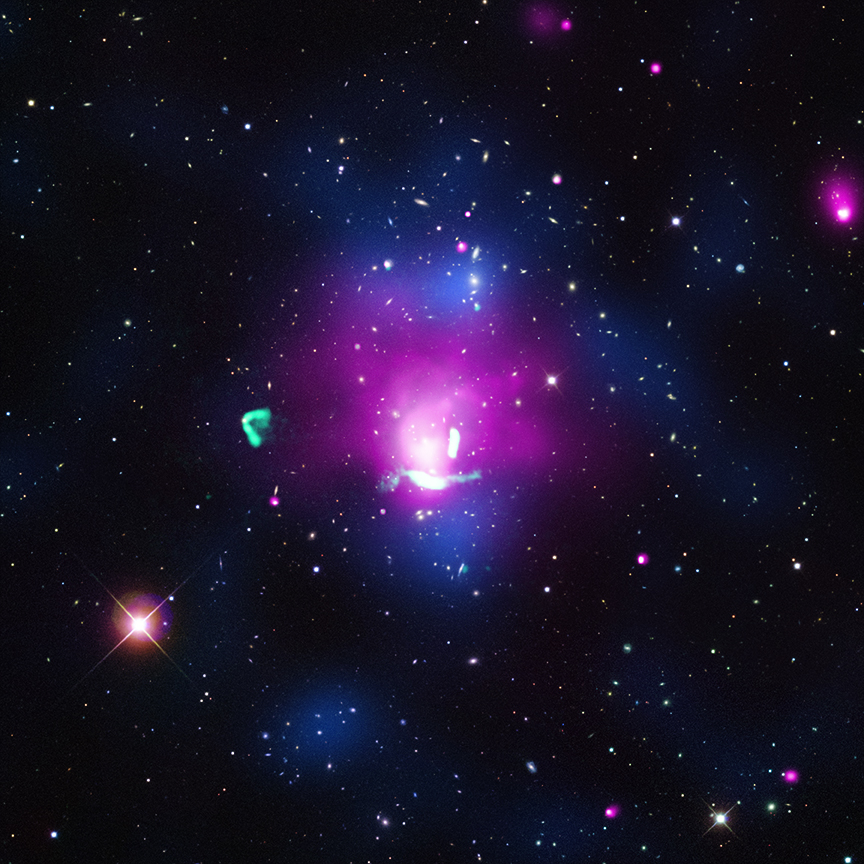
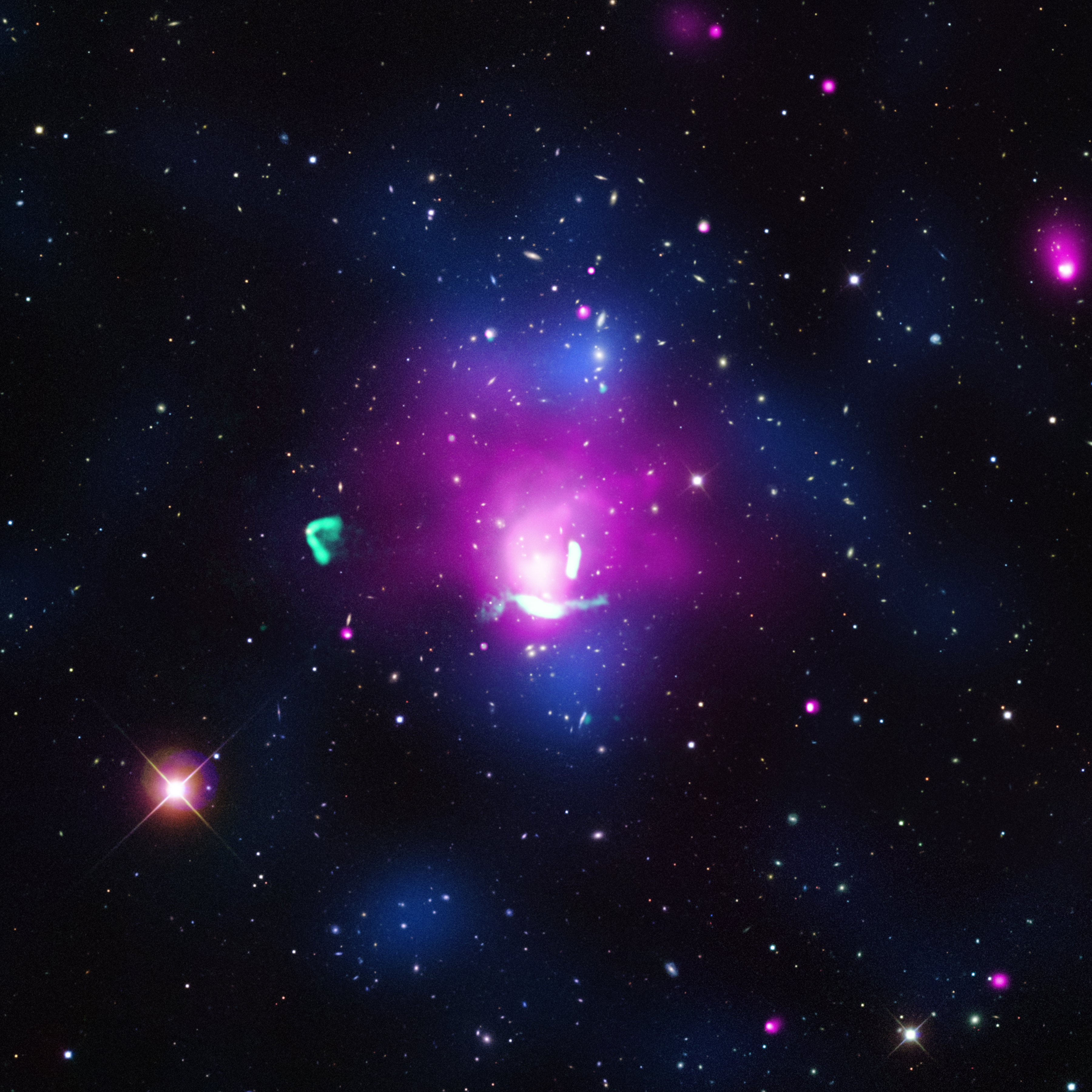
Abell 1033
Credit: X-ray: NASA/CXC/Leiden Univ./F. de Gasperin et al;  Optical: SDSS; Radio: LOFAR/ASTRON, NCRA/TIFR/GMRT


Enterprise NCC 1701 USS Enterprise NCC 1701 
Credit: Smithsonian National Air & Space Museum


Hidden in a distant galaxy cluster collision are wisps of gas resembling the starship Enterprise — an iconic spaceship from the "Star Trek" franchise.

Galaxy clusters — cosmic structures containing hundreds or even thousands of galaxies — are the largest objects in the Universe held together by gravity. Multi-million-degree gas fills the space in between the individual galaxies. The mass of the hot gas is about six times greater than that of all the galaxies combined. This superheated gas is invisible to optical telescopes, but shines brightly in X-rays, so an X-ray telescope like NASA's Chandra X-ray Observatory is required to study it. 

By combining X-rays with other types of light, such as radio waves, a more complete picture of these important cosmic objects can be obtained. A new composite image of the galaxy cluster Abell 1033, including X-rays from Chandra (purple) and radio emission from the Low-Frequency Array (LOFAR) network in the Netherlands (blue), does just that. Optical emission from the Sloan Digital Sky Survey is also shown. The galaxy cluster is located about 1.6 billion light years from Earth. 

Using X-ray and radio data, scientists have determined that Abell 1033 is actually two galaxy clusters in the process of colliding. This extraordinarily energetic event, happening from the top to the bottom in the image, has produced turbulence and shock waves, similar to sonic booms produced by a plane moving faster than the speed of sound.

In Abell 1033, the collision has interacted with another energetic cosmic process — the production of jets of high-speed particles by matter spiraling into a supermassive black hole, in this case one located in a galaxy in one of the clusters. These jets are revealed by radio emission to the left and right sides of the image. The radio emission is produced by electrons spiraling around magnetic field lines, a process called synchrotron emission.

The electrons in the jets are traveling at very close to the speed of light. As the galaxy and its black hole moved toward the lower part of the image, the jet on the right slowed down as it crashed into hot gas in the other galaxy cluster. The jet on the left did not slow down because it encountered much less hot gas, giving a warped appearance for the jets, rather than the straight line that is typically seen.

This image of Abell 1033 also provides an example of "pareidolia", a psychological phenomenon where familiar shapes and patterns are seen in otherwise random data. In Abell 1033, the structures in the data create an uncanny resemblance to many of the depictions of the fictional Starship Enterprise from Star Trek.

In terms of astrophysical research, a detailed study of the image shows that the energy of the electrons in the "saucer section" and neck of the starship-shaped radio emission in Abell 1033 is higher than that found in the stardrive section towards the lower left (see labels). This suggests that the electrons have been reenergized, presumably when the jets interact with turbulence or shock waves in the hot gas. The energetic electrons producing the radio emission will normally lose substantial amounts of energy over tens to hundreds of millions of years as they radiate. The radio emission would then become undetectable. However, the vastly extended radio emission observed in Abell 1033, extending over about 500,000 light years, implies that energetic electrons are present in larger quantities and with higher energies than previously thought. One idea is that the electrons have been given a further boost in energy by extra bouts of shocks and turbulence.

Other sources of radio emission in the image besides the starship-shaped object are the shorter jets from another galaxy (labeled "short jets") and a "radio phoenix" consisting of a cloud of electrons that faded in radio emission but was then reenergized when shock waves compressed the cloud. This caused the cloud to once again shine at radio frequencies, as we reported back in 2015.

The team who made this study will use observations with Chandra and LOFAR to look for further examples of colliding galaxy clusters with warped radio emission, to further their understanding of these energetic objects.


A paper describing this result was published in the October 4th, 2017 issue of Science Advances and is available online. The authors of the paper are Francesco de Gasperin, Huib Intema, Timothy Shimwell (Leiden University, the Netherlands), Gianfranco Brunetti (Institute of Radio Astronomy, Italy), Marcus Bruggen (University of Hamburg, Germany), Torsten Enblin (Max Planck Institute for Astrophysics, Germany), Reinout van Weeren (Leiden), Annalisa Bonafede (Hamburg), and Huub Rottgering (Leiden). 

NASA's Marshall Space Flight Center in Huntsville, Alabama, manages the Chandra program for NASA's Science Mission Directorate in Washington. The Smithsonian Astrophysical Observatory in Cambridge, Massachusetts, controls Chandra's science and flight operations.


Fast Facts for Abell 1033:

Scale: Image is about 7.4 arcmin across (about 3.3 million light years)
Category: Groups & Clusters of Galaxies
Coordinates (J2000): RA 10h 31m 33.70s | Dec +35° 04´ 33.96"
Constellation: Leo Minor
Observation Date: 19 and 21 Feb 2013
Observation Time: 17 hours 35 min
Obs. ID: 15084, 15614
Instrument: ACIS
References: de Gasperin, F et al., Sci. Adv. 2017, 3, 1701634; arXiv:1710.06796
Color Code: X-ray (Pink); Optical (Red, Green, Blue); Radio (Blue)
Distance Estimate: About 1.62 billion light years (z=0.1259)


Saturday, October 14, 2017

Astronomical airplane trails do not evade but lighten up

The image shows a galaxy in orange that moves to the left and leaves a gas trail. The trail seems to extinguish slowly, but lightens up again near the second, white-yellow galaxy. Most white dots in the image are complete galaxies. (c) Francesco de Gasperin (Leiden University).  Source


An international team of astronomers led by Francesco de Gasperin (Leiden University, the Netherlands) has witnessed an unexpected phenomenon in a merger of a two clusters of galaxies. The astronomers discovered a gas trail that slowly extinguished, but then lit up again. It is unclear where the energy for the rejuvenation of this trail comes from. The researchers publish their findings in Science Advances.

The astronomers investigated Abell 1033. This is a cluster of galaxies consisting of two smaller clusters that are in the process of merging. Abell 1033 is located in the northern constellation of Leo Minor (near Ursa Major). Clusters of galaxies are the largest structures in the universe. They can contain hundreds to thousands of galaxies similar to our Milky Way. Smaller clusters can merge together to form a larger cluster.

The astronomers observed that an individual galaxy in Abell 1033 leaves a trail of gas as it traveled through the cluster. On astronomical scale, such a trail resembles the trail of colored smoke behind a stunt plane.

The astronomers had expected that the gas trail, like the ones behind a stunt plane, would slowly fade and eventually disappear. To their astonishment they saw that the end of the gas trail was brighter than the middle.

"This was totally unexpected," says Francesco de Gasperin, the first author of the research paper that is published in Science Advances. "As these clouds of electrons radiate away their energy over time, they should become fainter and disappear. Instead, in this case, after more than a hundred million years, the trail of electrons is glowing brightly."

There is no precise explanation for this phenomenon, yet. It seems that the trail brightens near the center of the cluster of galaxies. De Gasperin: "Part of the energy released in the merger event must have been transferred to rejuvenate the cloud of electrons." The research on merging clusters of galaxies is complicated because astronomers only see a snapshot of a process that takes billions of years to complete. In addition to that, the telescopes that are needed for the investigation must receive signals at extremely low frequencies. The astronomers combined data from the Indian Giant Metrewave Radio Telescope and LOFAR, the Low Frequency Array. LOFAR was designed and built by the Dutch research institute ASTRON. The telescope consists of thousands of antennas spread across eight countries. The heart of LOFAR is in Drenthe in the north-east of the Netherlands.

"It’s like being among the last explorers. As soon as we move in uncharted territories, or in this case at unexplored frequencies, our universe is still full of surprises," says De Gasperin. "And this is just a first step. Much is still to be done to understand the complexity of galaxy clusters, and find what is lurking at low radio frequencies"

Reference

Gentle re-energisation of electrons in merging galaxy clusters. By: F. de Gasperin, H.T. Intema, T.W. Shimwell, G. Brunetti, M. Brüggen, T.A. Enßlin, R.J. van Weeren, A. Bonafede, H.J.A. Röttgering. Accepted for publication in Science Advances. (open access)


Thursday, August 27, 2015

Abell 1033: Chandra Data Suggest Giant Collision Triggered "Radio Phoenix"

 Abell 1033
Credit  X-ray: NASA/CXC/Univ of Hamburg/F. de Gasperin et al; 
Optical: SDSS; Radio: NRAO/VLA 

JPEG (574.7 kb) - Large JPEG (5.6 MB) - Tiff (16.5 MB) - More Images - View on the Sky (WWT)

A Tour of NGC 5813


Astronomers have found evidence for a faded electron cloud "coming back to life," much like the mythical phoenix, after two galaxy clusters collided. This "radio phoenix," so-called because the high-energy electrons radiate primarily at radio frequencies, is found in Abell 1033. The system is located about 1.6 billion light years from Earth.

By combining data from NASA's Chandra X-ray Observatory, the Westerbork Synthesis Radio Telescope in the Netherlands, NSF's Karl Jansky Very Large Array (VLA), and the Sloan Digital Sky Survey (SDSS), astronomers were able to recreate the scientific narrative behind this intriguing cosmic story of the radio phoenix.

Galaxy clusters are the largest structures in the Universe held together by gravity. They consist of hundreds or even thousands of individual galaxies, unseen dark matter, and huge reservoirs of hot gas that glow in X-ray light. Understanding how clusters grow is critical to tracking how the Universe itself evolves over time.

Astronomers think that the supermassive black hole close to the center of Abell 1033 erupted in the past. Streams of high-energy electrons filled a region hundreds of thousands of light years across and produced a cloud of bright radio emission. This cloud faded over a period of millions of years as the electrons lost energy and the cloud expanded.

The radio phoenix emerged when another cluster of galaxies slammed into the original cluster, sending shock waves through the system. These shock waves, similar to sonic booms produced by supersonic jets, passed through the dormant cloud of electrons. The shock waves compressed the cloud and re-energized the electrons, which caused the cloud to once again shine at radio frequencies.

A new portrait of this radio phoenix is captured in this multi wavelength image of Abell 1033. X-rays from Chandra are in pink and radio data from the VLA are colored green. The background image shows optical observations from the SDSS. A map of the density of galaxies, made from the analysis of optical data, is seen in blue. Mouse over the image above to see the location of the radio phoenix.

The Chandra data show hot gas in the clusters, which seems to have been disturbed during the same collision that caused the re-ignition of radio emission in the system. The peak of the X-ray emission is seen to the south (bottom) of the cluster, perhaps because the dense core of gas in the south is being stripped away by surrounding gas as it moves. The cluster in the north may not have entered the collision with a dense core, or perhaps its core was significantly disrupted during the merger. On the left side of the image, a so-called wide-angle tail radio galaxy shines in the radio. The lobes of plasma ejected by the supermassive black hole in its center are bent by the interaction with the cluster gas as the galaxy moves through it.

Astronomers think they are seeing the radio phoenix soon after it had reborn, since these sources fade very quickly when located close to the center of the cluster, as this one is in Abell 1033. Because of the intense density, pressure, and magnetic fields near the center of Abell 1033, a radio phoenix is only expected to last a few tens of millions of years.

A paper describing these results was published in a recent issue of the Monthly Notices of the Royal Astronomical Society and a preprint is available online. The authors are Francesco de Gasperin from the University of Hamburg, Germany; Georgiana Ogrean and Reinout van Weeren from the Harvard-Smithsonian Center for Astrophysics; William Dawson from the Lawrence Livermore National Lab in Livermore, California; Marcus Brüggen and Annalisa Bonafede from the University of Hamburg, Germany, and Aurora Simionescu from the Japan Aerospace Exploration Agency in Sagamihara, Japan.

NASA's Marshall Space Flight Center in Huntsville, Alabama, manages the Chandra program for NASA's Science Mission Directorate in Washington. The Smithsonian Astrophysical Observatory in Cambridge, Massachusetts, controls Chandra's science and flight operations.


Fast Facts for Abell 1033:

Scale: Image is about 17 arcmin across (about 7.5 million light years)
Category: Groups & Clusters of Galaxies
Coordinates (J2000): RA 10h 31m 33.70s | Dec +35° 04' 33.96"
Constellation: Leo Minor
Observation Date: 19 and 21 Feb 2013
Observation Time: 17 hours 35 min.
Obs. ID: 15084, 15614
Instrument: ACIS
References: de Gasperin, F. et al, 2015, MNRAS (accepted); arXiv:1501.00043
Color Code: X-ray (Pink); Optical (Red, Green, Blue); Radio (Green); Density Map (Blue)
Distance Estimate: About 1.62 billion light years (z=0.1259)


Monday, April 27, 2015

Birth of a Radio Phoenix

A false-color X-ray image of the galaxy cluster Abell 1033. The white contours help identify the X-ray flux levels, and the red contours trace the radio emission. The elongated red structure in the lower center is a radio phoenix: fossil gas that has been reheated by shocks from a nearby galaxy merger (obscured in this view). Credit: Chandra, VLA


Abell 1033 is a cluster of over 350 galaxies located about 1.7 billion light-years away. Collisions between galaxies in clusters are common events, and each merger heats and shocks the nearby gas. The rapidly moving, ionized gas then radiates intensely at radio wavelengths. There are three types of radio sources found in these clusters. The first, called radio relics, are found in the outskirts of galaxies and have radiation signatures characteristic of shocked material over large scales. The second type, called radio haloes, are centrally located in the cluster and are probably the result of large turbulent motions set up during collisions. 

A radio phoenix is the third type of cluster radio source, and is much less well studied. After the initial effects of a collision have died down and the gas has cooled, the radio emission subsides. But a subsequent merger nearby can produce a strong shock wave, and if that passes through the fossil material it can compress and re-energize it to emit in the radio again. 

CfA astronomers Georgiana Ogrean and Reinout van Weeren, with five colleagues, used data from the Chandra X-ray Observatory, the Westerbork Synthesis Radio Telescope, the Very Large Array ad the optical Sloan Digital Sky Survey to study the Abell 1033 cluster and its family of galaxies. They discovered two subclusters in the source that seem to have recently collided; they were spotted from their X-ray emission. Close to this region, and to a galactic nucleus, the team spotted a radio source with the emission and charged particle characteristics of a radio phoenix. The scientists conclude that shocks from the recent merger have propagated into old gas, reinvigorating this fossil remnant to new life.
Reference(s):
"Abell 1033: Birth of a Radio Phoenix," F. de Gasperin, G. A. Ogrean, R. J. van Weeren, W. A. Dawson, M. Bruggen, A. Bonafede1 and A. Simionescu, MNRAS 448, 2197, 2015.