Friday, October 12, 2018

Dying Star Emits a Whisp

The three panels represent moments before, during, and after the faint supernova iPTF14gqr, visible in the middle panel, appeared in the outskirts of a spiral galaxy located 920 million light years away. The massive star that died in the supernova left behind a neutron star in a very tight binary system. These dense stellar remnants will ultimately spiral into each other and merge in a spectacular explosion, giving off gravitational and electromagnetic waves. Credit: SDSS/Caltech/Keck


The death of a massive star and the birth of a compact neutron star binary


A Caltech-led team of researchers has observed the peculiar death of a massive star that exploded in a surprisingly faint and rapidly fading supernova. These observations suggest that the star has an unseen companion, gravitationally siphoning away the star's mass to leave behind a stripped star that exploded in a quick supernova. The explosion is believed to have resulted in a dead neutron star orbiting around its dense and compact companion, suggesting that, for the first time, scientists have witnessed the birth of a compact neutron star binary system.

The research was led by graduate student Kishalay De and is described in a paper appearing in the October 12 issue of the journal Science. The work was done primarily in the laboratory of Mansi Kasliwal (MS '07, PhD '11), assistant professor of astronomy. Kasliwal is the principal investigator of the Caltech-led Global Relay of Observatories Watching Transients Happen (GROWTH) project.

When a massive star—at least eight times the mass of the sun—runs out of fuel to burn in its core, the core collapses inwards upon itself and then rebounds outward in a powerful explosion called a supernova. After the explosion, all of the star's outer layers have been blasted away, leaving behind a dense neutron star—about the size of a small city but containing more mass than the sun. A teaspoon of a neutron star would weigh as much as a mountain.

During a supernova, the dying star blasts away all of the material in its outer layers. Usually, this is a few times the mass of the sun. However, the event that Kasliwal and her colleagues observed, dubbed iPTF 14gqr, ejected matter only one fifth of the mass of the sun.

"We saw this massive star's core collapse, but we saw remarkably little mass ejected," Kasliwal says. 
"We call this an ultra-stripped envelope supernova and it has long been predicted that they exist. This is the first time we have convincingly seen core collapse of a massive star that is so devoid of matter."

The fact that the star exploded at all implies that it must have previously been enveloped in lots of material, or its core would never have become heavy enough to collapse. But where, then, was the missing mass?

The researchers inferred that the mass must have been stolen—the star must have some kind of dense, compact companion, either a white dwarf, neutron star, or black hole—close enough to gravitationally siphon away its mass before it exploded. The neutron star that was left behind from the supernova must have then been born into orbit with that dense companion. Observing iPTF 14gqr was actually observing the birth of a compact neutron star binary. Because this new neutron star and its companion are so close together, they will eventually merge in a collision similar to the 2017 eventthat produced both gravitational waves and electromagnetic waves. 

Not only is iPTF 14gqr a notable event, the fact that it was observed at all was fortuitous since these phenomena are both rare and short-lived. Indeed, it was only through the observations of the supernova's early phases that the researchers could deduce the explosion's origins as a massive star.

"You need fast transient surveys and a well-coordinated network of astronomers worldwide to really capture the early phase of a supernova," says De. "Without data in its infancy, we could not have concluded that the explosion must have originated in the collapsing core of a massive star with an envelope about 500 times the radius of the sun."

The event was first seen at Palomar Observatory as part of the intermediate Palomar Transient Factory (iPTF), a nightly survey of the sky to look for transient, or short-lived, cosmic events like supernovae. Because the iPTF survey keeps such a close eye on the sky, iPTF 14gqr was observed in the very first hours after it had exploded. As the earth rotated and the Palomar telescope moved out of range, astronomers around the world collaborated to monitor iPTF 14gqr, continuously observing its evolution with a number of telescopes that today form the GROWTH network of observatories.

The Zwicky Transient Facility, the successor of iPTF at Palomar Observatory, is examining the sky even more broadly and frequently in the hopes of catching more of these rare events, which make up only one percent of all observed explosions. Such surveys, in partnership with coordinated follow-up networks like GROWTH, will enable astronomers to better understand how compact binary systems evolve from binary massive stars. 

The research was primarily funded by the National Science Foundation under the PIRE GROWTH project. A full list of funding sources and co-authors can be found in the Science study, titled "A hot and fast ultra-stripped supernova that likely formed a compact neutron star binary." In addition to De and Kasliwal, other Caltech co-authors are Gary Doran of the Jet Propulsion Laboratory; graduate student Gina Duggan; Shri Kulkarni, George Ellery Hale Professor of Astronomy and Planetary Science; and Russ Laher and Frank Masci of Caltech's Infrared Processing and Analysis Center.

For more about GROWTH, visit: http://growth.caltech.edu.

Written by Lori Dajose


Contact: 

Whitney Clavin
(626) 395-1856 wclavin@caltech.edu

Source: Caltech/News


Wednesday, October 10, 2018

‘Pulsar in a Box’ Reveals Surprising Picture of a Neutron Star’s Surroundings

Electrons (blue) and positrons (red) from a computer-simulated pulsar. These particles become accerlated to extreme energies in a pulsar's powerful magnetic and electric fields; lighter tracks show particles with higher energies. Each particle seen here actually represents trillions of electrons or positrons. Better knowledge of the particle environment around neutron stars will help astronomers understand how they behave like cosmic lighthouses, producing precisely timed radio and gamma-ray pulses. Credit: NASA's Goddard Space Flight Center

An international team of scientists studying what amounts to a computer-simulated “pulsar in a box” are gaining a more detailed understanding of the complex, high-energy environment around spinning neutron stars, also called pulsars. The model traces the paths of charged particles in magnetic and electric fields near the neutron star, revealing behaviors that may help explain how pulsars emit gamma-ray and radio pulses with ultraprecise timing. 

“Efforts to understand how pulsars do what they do began as soon as they were discovered in 1967, and we’re still working on it,” said Gabriele Brambilla, an astrophysicist at NASA’s Goddard Space Flight Center in Greenbelt, Maryland, and the University of Milan who led a study of the recent simulation. “Even with the computational power available today, tracking the physics of particles in the extreme environment of a pulsar is a considerable challenge
.”
A pulsar is the crushed core of a massive star that ran out of fuel, collapsed under its own weight and exploded as a supernova. Gravity forces more mass than the Sun’s into a ball no wider than Manhattan Island in New York City while also revving up its rotation and strengthening its magnetic field. Pulsars can spin thousands of times a second and wield the strongest magnetic fields known.
 Source: NASA/Pulsar


Tuesday, October 09, 2018

A Pristine Star

Pristine_221.8781+9.7844 and its surroundings
Credits: N. Martin and the Pristine collaboration, DECam Legacy Survey, Aladin Sky Atlas."

The spectrum observed with the William Herschel Telescope on La Palma for Pristine_221.8781+9.7844, compared to the spectrum of the Sun. As can be seen, the spectrum of Pristine_221.8781+9.7844 contains far fewer feature. Only hydrogen (the large dips) and a small amount of Calcium (the small dip) can be seen in the spectrum of Pristine_221.8781+9.7844. This tells us that the star is ultra metal-poor, it has an unusual lack of heavy elements in its atmosphere, which means that it belongs to an early generation of stars formed in the Galaxy. Credits: E. Starkenburg and the Pristine collaboration.


An international team of researchers using Megacam at the Canada-France-Hawaii Telescope discovered a star that is among the least polluted by heavy elements. Such stars are extremely rare survivors of the early ages of the universe, when the gas stars are formed from hadn't yet been contaminated by the remnants of successive generations of dead stars. This new discovery opens a window onto star formation at the beginning of our universe.

For the study of the early universe, astronomers have different methods at their disposal. One is to look far into the Universe and back in time, to see the first stars and galaxies growing. Another option is to examine the oldest surviving stars of our home galaxy, the Milky Way, for information from the early universe. The "Pristine" survey, led by Nicolas Martin (CNRS/INSU, University of Strasbourg) and Else Starkenburg (Leibniz Institute for Astrophysics, Potsdam) is looking for exactly these pristine stars.

The early universe contained almost exclusively hydrogen and helium. Throughout the life of any star, the thermonuclear reactions takes place at their core create elements heavier than helium (carbon, oxygen, calcium, iron, etc.) from the hydrogen and helium making up the vast majority of their gas. When these stars explode at the end of their lifetime, they enrich the surrounding gas of with these “heavy” elements. This newly enriched gas serves as the birthplace for the next generation of stars. Each subsequent generation becomes more and more enriched with heavy elements created by their ancestors. Our sun, for example, is made up of about 2% of these heavy elements. On the contrary, very old stars contain very small quantities of heavy elements. They are however extremely rare and extremely difficult to find in our cosmic neighborhood.

The discovery of the star unveiled by the "Pristine" team was made possible thanks to a new mapping of the night sky conducted at the Canada-France-Hawaii Telescope, located in Hawaii. The Pristine team uses Megacam at CFHT to observea small part of the ultra-violet light that is very sensitive to the abundance in heavy elements and enables a discrimination of the rare, pristine stars from the much more common stars polluted in heavy elements. The team estimates that less than one star in a million is as pristine as the newly discovered star. Follow up observations with spectrographs of the Isaac Newton Group, located in Spain, and the European Southern Observatory, located in Chile, confirmed that star Pristine_221.8781+9.7844 is almost void of heavy elements, with the concentration of heavy elements being 10,000 to 100,000 times lower than those found in the atmosphere of our sun.

This star, whose discovery is presented in a publication of the Monthly Notices of the Royal Astronomical Society, Oxford University Press, brings strongly needed constraints on star formation models of the very first stars and opens a window onto an epoch that is still poorly understood. The discovery of Pristine_221.8781+9.7844 at the start of the "Pristine" project bodes well for the discovery of many such stars in the years to come.


Additional information

Link to the Paper

Contact Information:

Media contacts

Mary Beth Laychak, Outreach manager
Canada-France-Hawaii Telescope
mary@cfht.hawaii.edu

Science contacts

Else Starkenburg
Leibniz-Institut fur Astrophysik Potsdam
estarkenburg@aip.de

Nicolas Martin
Observatory Astrononomy de Strasbourg
nicolas.martin@astro.unistra.fr


Monday, October 08, 2018

When Is a Nova Not a ‘Nova’? When a White Dwarf and a Brown Dwarf Collide

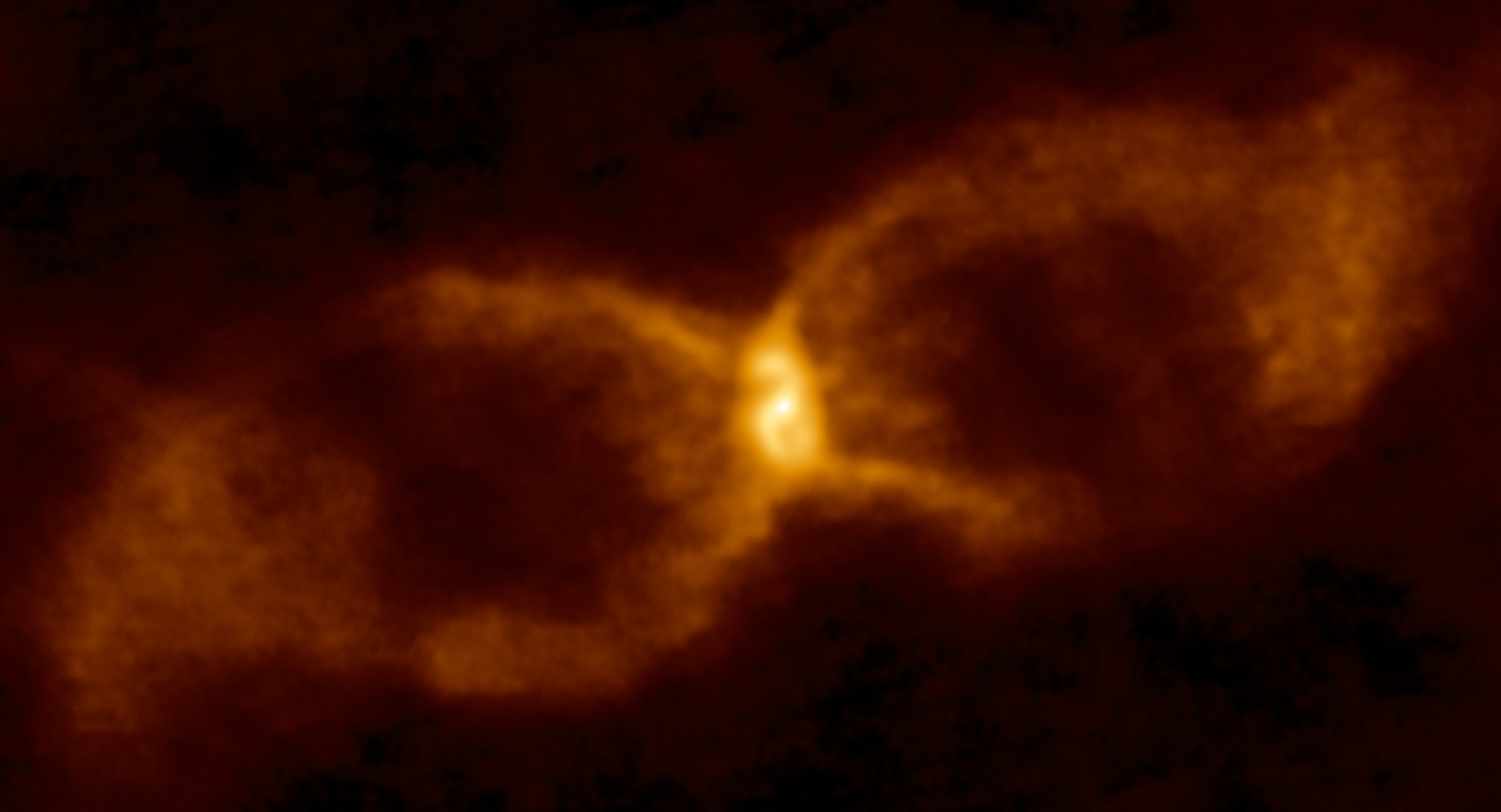
ALMA image of CK Vulpeculae. New research indicates that this hourglass-like object is the result of the collision of a brown dwarf and a white dwarf. Credit: ALMA (ESO/NAOJ/NRAO)/S. P. S. Eyres.  Hi-res image

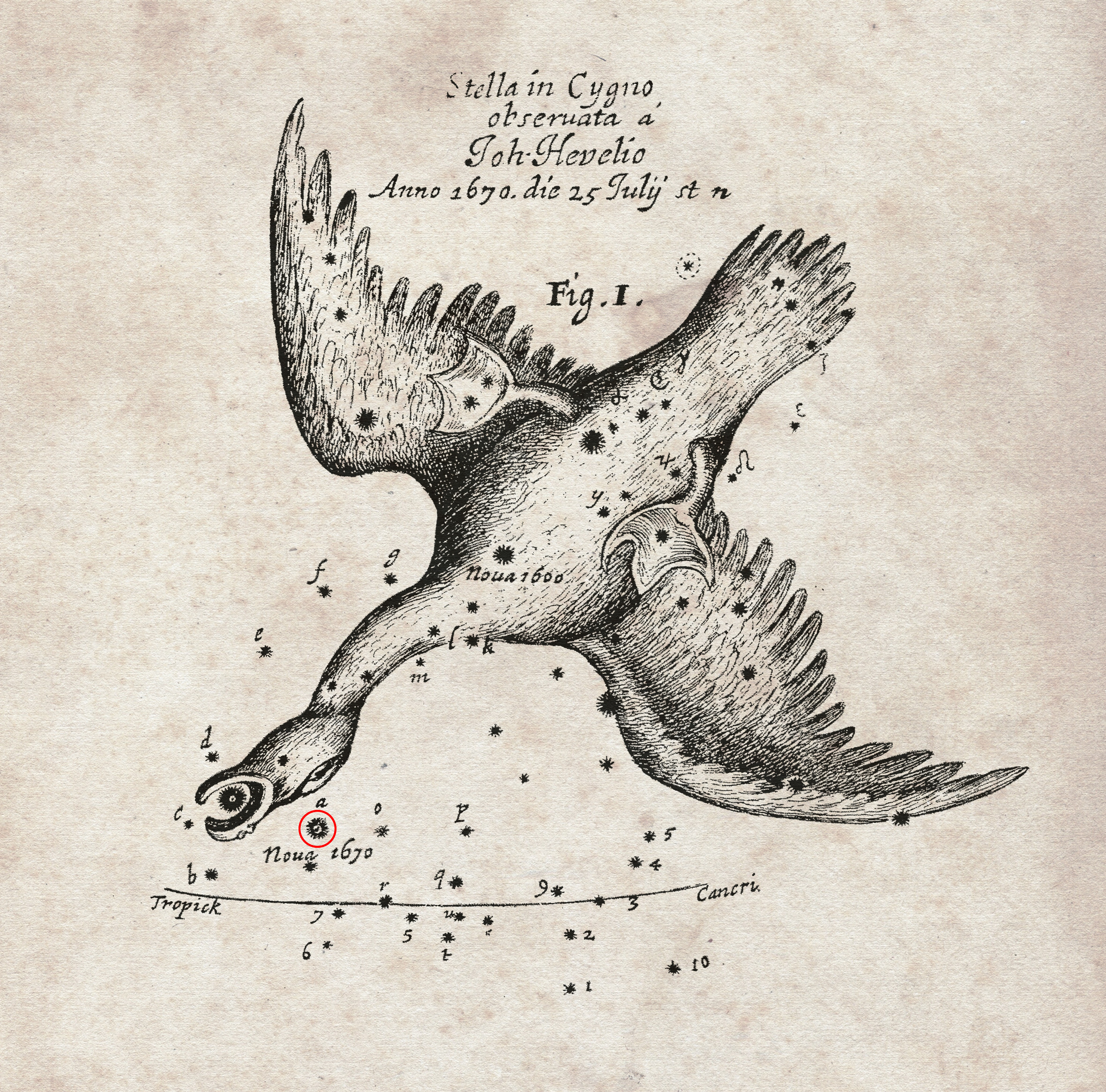
Johannes Hevelius, Figure 1 of ‘An extract of a letter of M. Hevelius, written to the publisher from Dantzick, August 17/27 1670, published in the Philosophical Transactions of the Royal Society, 1670, vol. 5, number 65, pp. 2087-2091; doi:10.1098/rstl.1670.0062 2053-9207. Hi-res image


In July of 1670, observers on Earth witnessed a “new star,” or nova, in the constellation Cygnus. Where previously there was dark sky, a bright pinprick of light appeared, faded, reappeared, and then disappeared entirely from view. Modern astronomers studying the remains of this cosmic event initially thought it heralded the merging of two main sequence stars – stars on the same evolutionary path as our Sun.

New observations with the Atacama Large Millimeter/submillimeter Array (ALMA) point to a more intriguing explanation. By studying the debris from this explosion, which takes the form of dual rings of dust and gas resembling an hourglass with a compact central object, the researchers concluded that a brown dwarf (a so-called failed star without the mass to sustain nuclear fusion) merged with a white dwarf (the elderly, cooling remains of a Sun-like star).

“It now seems what was observed centuries ago was not what we would today describe as a classic ‘nova.’ Instead, it was the merger of two stellar objects, a white dwarf and a brown dwarf. When these two objects collided, they spilled out a cocktail of molecules and unusual isotopes, which gave us new insights into the nature of this object,” said Sumner Starrfield, an astronomer at Arizona State University and co-author on a paper appearing in the Monthly Notices of the Royal Astronomical Society.

According to the researchers, the white dwarf would have been about ten times more massive than the brown dwarf, though much smaller in size. As the brown dwarf spiraled inward, intense tidal forces exerted by the white dwarf would have ripped it apart. “This is the first time such an event has been conclusively identified,” remarked Starrfield.

Since most star systems in the Milky Way are binary, stellar collisions are not that rare, the astronomers note. The new ALMA observations reveal new details about the 1670 event. By studying the light from two, more-distant stars as it shines through the dusty remains of the merger, the researchers were able to detect the telltale signature of the element lithium, which is easily destroyed in the interior of a main sequence star, but not inside a brown dwarf.

“The presence of lithium, together with unusual isotopic ratios of the elements carbon, nitrogen, and oxygen point to material from a brown dwarf star being dumped on the surface of a white dwarf. The thermonuclear ‘burning’ and an eruption of this material resulted in the hourglass we see today,” said Stewart Eyres, Deputy Dean of the Faculty of Computing, Engineering and Science at the University of South Wales and lead author on the paper.

Intriguingly, the hourglass is also rich in organic molecules such as formaldehyde (H2CO) and formamide (NH2CHO), which is derived from formic acid. These molecules would not survive in an environment undergoing nuclear fusion and must have been produced in the debris from the explosion. This lends further support to the conclusion that a brown dwarf met its demise in a star-on-star collision with a white dwarf.

The National Radio Astronomy Observatory is a facility of the National Science Foundation, operated under cooperative agreement by Associated Universities, Inc.


Contact:

Charles Blue, 
Public Information Officer
(434) 296-0314; 
cblue@nrao.edu


The Atacama Large Millimeter/submillimeter Array (ALMA), an international astronomy facility, is a partnership of the European Organisation for Astronomical Research in the Southern Hemisphere (ESO), the U.S. National Science Foundation (NSF) and the National Institutes of Natural Sciences (NINS) of Japan in cooperation with the Republic of Chile. ALMA is funded by ESO on behalf of its Member States, by NSF in cooperation with the National Research Council of Canada (NRC) and the National Science Council of Taiwan (NSC) and by NINS in cooperation with the Academia Sinica (AS) in Taiwan and the Korea Astronomy and Space Science Institute (KASI).

ALMA construction and operations are led by ESO on behalf of its Member States; by the National Radio Astronomy Observatory (NRAO), managed by Associated Universities, Inc. (AUI), on behalf of North America; and by the National Astronomical Observatory of Japan (NAOJ) on behalf of East Asia. The Joint ALMA Observatory (JAO) provides the unified leadership and management of the construction, commissioning and operation of ALMA.

Reference:


“ALMA Reveals the Aftermath of a White Dwarf—Brown Dwarf Merger in CK Vulpeculae,” Steward Eyres, University of Central Lancashire; Aneurin Evans, Keele University; Albert Zijlstra, Adam Avison, University of Manchester; Robert Gehrz, Charles Woodward, University of Minnesota; Marcin Hajduk, University of Warmia and Mazury; Sumner Starrfield, Arizona State University; Shazrene Mohamed, South African Astronomical Observatory; and R. Mark Wagner, The Ohio State University; Monthly Notices of the Royal Astronomical Society [Preprint: https://arxiv.org/abs/1809.05849]


Saturday, October 06, 2018

VLA Discovers Powerful Jet Coming from “Wrong” Kind of Star

Artist's conception shows magnetic field lines around neutron star, accretion disk of material orbiting the neutron star, and jets of material propelled outward. Credit: ICRAR/Universiteit van Amsterdam. Hi-res image

Artist's conception illustrates superdense neutron star, right, drawing material off its "normal" companion. Material forms an accretion disk rotating around the neutron star. Jets of material are launched perpendicular to the disk. Credit: ICRAR/Universiteit van Amsterdam. Hi-res image


Astronomers using the National Science Foundation’s Karl G. Jansky Very Large Array (VLA) have discovered a fast-moving jet of material propelled outward from a type of neutron star previously thought incapable of launching such a jet. The discovery, the scientists said, requires them to fundamentally revise their ideas about how such jets originate.

Neutron stars are superdense objects, the remnants of massive stars that exploded as supernovas. When in binary pairs with “normal” stars, their powerful gravity can pull material away from their companions. That material forms a disk, called an accretion disk, rotating around the neutron star. Jets of material are propelled at nearly the speed of light, perpendicular to the disk.

“We’ve seen jets coming from all types of neutron stars that are pulling material from their companions, with a single exception. Never before have we seen a jet coming from a neutron star with a very strong magnetic field,” said Jakob van den Eijnden of the University of Amsterdam. “That led to a theory that strong magnetic fields prevent jets from forming,” he added.

The new discovery contradicts that theory.

The scientists studied an object called Swift J0243.6+6124 (Sw J0243), discovered on October 3, 2017, by NASA’s orbiting Neil Gehrels Swift Observatory, when the object emitted a burst of X-rays. The object is a slowly-spinning neutron star pulling material from a companion star that is likely significantly more massive than the Sun. The VLA observations began a week after the Swift discovery and continued until January 2018.

Both the fact that the object’s emission at X-ray and radio wavelengths weakened together over time and the characteristics of the radio emission itself convinced the astronomers that they were seeing radio waves produced by a jet.

“This combination is what we see in other jet-producing systems. Alternative mechanisms just don’t explain it,” van den Eijnden said.

Common theories for jet formation in systems like Sw J0243 say the jets are launched by magnetic field lines anchored in the inner parts of the accretion disks. In this scenario, if the neutron star has a very strong magnetic field, that field is overpowering and prevents the jet from forming.

“Our clear discovery of a jet in Sw J0243 disproves that longstanding idea,” van den Eijnden said.

Alternatively, the scientists suggest that Sw J0243’s jet-launching region of the accretion disk could be much farther out than in other types of systems, where the star’s magnetic field is weaker. Another idea, they said, is that the jets may be powered by the neutron star’s rotation, instead of being launched by magnetic field lines in the inner accretion disk.

“Interestingly, the rotation-powered idea predicts that the jet will be significantly weaker from more slowly rotating neutron stars, which is exactly what we see in Sw J0243,” Nathalie Degenaar, also of the University of Amsterdam, said.

The new discovery also implies that Sw J0243 may represent a large group of objects whose radio emission has been too weak to detect until new capabilities provided by the VLA’s major upgrade, completed in 2012, were available. If more such objects are found, the scientists said, they could test the idea that jets are produced by the neutron star’s spin.

The astronomers added that a jet from SwJ0243 may mean that another category of objects, called ultra-luminous X-ray pulsars, also highly magnetized, might produce jets.

“This discovery not only means we have to revise our ideas about jets from such systems, but also opens up exciting new areas of research,” Degenaar said.

Van den Eijnden, Degenaar, and their colleagues are reporting their discovery in the journal Nature.

The National Radio Astronomy Observatory is a facility of the National Science Foundation, operated under cooperative agreement by Associated Universities, Inc.

Media Contact:

Dave Finley, Public Information Officer
(575) 835-7302

dfinley@nrao.edu


Friday, October 05, 2018

VLA Sky Survey Reveals First “Orphan” Gamma Ray Burst

Artist's conception of a gamma ray burst. Jet of fast-moving material is propelled outward through spherical shell of ejected material from initial explosion of a massive star and its collapse into a black hole. Credit: Bill Saxton, NRAO/AUI/NSF. Hi-res image

Series of radio images of FIRST J1419+3940 from 1993 to 2017 show its slow fade.
Credit: Law et al., Bill Saxton, NRAO/AUI/NSF 
Animation of images from 1993 to 2017 shows radio emission from suspected "orphan" gamma ray burst fading with time.
Credit: Law et al., Bill Saxton, NRAO/AUI/NSF


Astronomers comparing data from an ongoing major survey of the sky using the National Science Foundation’s Karl G. Jansky Very Large Array (VLA) to data from earlier surveys likely have made the first discovery of the afterglow of a powerful gamma ray burst that produced no gamma rays detectable at Earth. The unprecedented discovery of this “orphan” gamma ray burst (GRB) offers key clues to understanding the aftermath of these highly energetic events.

“GRBs emit their gamma rays in narrowly focused beams. In this case, we believe the beams were pointed away from Earth, so gamma ray telescopes did not see this event. What we found is the radio emission from the explosion’s aftermath, acting over time much as we expect for a GRB,” said Casey Law, of the University of California, Berkeley.

While searching through data from the first epoch of observing for the VLA Sky Survey (VLASS) in late 2017, the astronomers noted that an object that appeared in images from an earlier VLA survey in 1994 did not appear in the VLASS images. They then searched for additional data from the VLA and other radio telescopes. They found that observations of the object’s location in the sky dating back as far as 1975 had not detected it until it first appeared in a VLA image from 1993.

The object then appeared in several images made with the VLA and the Westerbork telescope in the Netherlands from 1993 through 2015. The object, dubbed FIRST J1419+3940, is in the outskirts of a galaxy more than 280 million light-years from Earth.

“This is a small galaxy with active star formation, similar to others in which we have seen the type of GRBs that result when a very massive star explodes,” Law said.

The strength of the radio emission from J1419+3940 and the fact that it slowly evolved over time support the idea that it is the afterglow of such a GRB, the scientists said. They suggested that the explosion and burst of gamma rays should have been seen sometime in 1992 or 1993.

However, after searching databases from gamma ray observatories, “We could find no convincing candidate for a detected GRB from this galaxy,” Law said.

While there are other possible explanations for the object’s behavior, the scientists said that a GRB is the most likely.

“This is exciting, and not just because it probably is the first ‘orphan’ GRB to be discovered. It also is the oldest well-localized GRB, and the long time period during which it has been observed means it can give us valuable new information about GRB afterglows,” Law said.

“Until now, we’ve never seen how the afterglows of GRBs behave at such late times,” noted Brian Metzger of Columbia University, co-author of the study. “If a neutron star is responsible for powering the GRB and is still active, this might give us an unprecedented opportunity to view this activity as the expanding ejecta from the supernova explosion finally becomes transparent.”

“I’m delighted to see this discovery, which I expect will be the first of many to come from the unique investment the National Radio Astronomy Observatory (NRAO) and the National Science Foundation are making in VLASS,” said NRAO Director Tony Beasley.

VLASS is the largest observing project in the history of the VLA. Begun in 2017, the survey will use 5,500 hours of observing time over seven years. The survey will make three complete scans of the sky visible from the VLA, roughly 80 percent of the sky. Initial images from the first round of observations now are available to astronomers.

VLASS follows two earlier sky surveys done with the VLA. The NRAO VLA Sky Survey (NVSS), like VLASS, was an all-sky survey done from 1993 to 1996, and the FIRST (Faint Images of the Radio Sky at Twenty centimeters) survey studied a smaller portion of the sky in more detail from 1993 to 2002. The astronomers discovered FIRST J1419+3940 by comparing a 1994 image from the FIRST survey to the VLASS 2017 data.

From 2001 to 2012, the VLA underwent a major upgrade, greatly increasing its sensitivity, or ability to image faint objects. The upgrade made possible a new, improved survey offering a rich scientific payoff. The earlier surveys have been cited more than 4,500 times in scientific papers, and scientists expect VLASS to be a valuable resource for research in the coming years.

Law and his colleagues are publishing their findings in the Astrophysical Journal Letters.

The National Radio Astronomy Observatory is a facility of the National Science Foundation, operated under cooperative agreement by Associated Universities, Inc.


Media Contact:

Dave Finley, Public Information Officer
(575) 835-7302

dfinley@nrao.edu


Thursday, October 04, 2018

Hubble finds compelling evidence for a moon outside the Solar System


Exomoon orbiting its planet (artist’s impression)


Videos 

Transit of exoplanet and exomoon


Neptune-sized moon orbits Jupiter-sized planet

Using the NASA/ESA Hubble Space Telescope and older data from the Kepler Space Telescope two astronomers have found the first compelling evidence for a moon outside our own Solar System. The data indicate an exomoon the size of Neptune, in a stellar system 8000 light-years from Earth. The new results are presented in the journal Science Advances.

The hunt for exoplanets — planets outside our own Solar System — provided its first results only 30 years ago. While astronomers now find these planets on a regular basis, the search for moons orbiting exoplanets wasn’t successful — until today.

In 2017 NASA’s Kepler Space Telescope detected hints of an exomoon orbiting the planet Kepler-1625b. Now, two scientists from Columbia University in New York (USA) have used the incomparable capabilities of the NASA/ESA Hubble Space Telescope to study the star Kepler-1625, 8000 light-years away, and its planet in more detail. The new observations made with Hubble show compelling evidence for a large exomoon orbiting the only known planet of Kepler-1625. If confirmed, this would be the first discovery of a moon outside our Solar System.

The candidate moon, with the designation Kepler-1625b-i, is unusual because of its large size; it is comparable in diameter to the planet Neptune. Such gargantuan moons are unknown in our own Solar System. “This may yield new insights into the development of planetary systems and may cause astronomers to revisit theories of how moons form,” Alex Teachey, a graduate student who led the study, explained excitedly [1].

Like its moon, Kepler-1625b is also bigger than its counterparts in the Solar System. The exoplanet is a gas giant, several times more massive than Jupiter [2]. It orbits its parent star at a distance similar to the distance between the Sun and Earth, which puts it — and its candidate moon — at the inner edge of the habitable zone of the star system [3].

To find evidence for the existence of the exomoon, the team observed the planet while it was in transit in front of its parent star, causing a dimming of the starlight. “We saw little deviations and wobbles in the light curve that caught our attention,” David Kipping, second author of the study, said.

The planet was observed by Hubble before and during its 19-hour-long transit. After the transit ended, Hubble detected a second and much smaller decrease in the star’s brightness approximately 3.5 hours later, consistent with the effect of a moon trailing the planet. “It was definitely a shocking moment to see that light curve — my heart started beating a little faster and I just kept looking at that signature,” David Kipping described his feelings. Unfortunately, the scheduled Hubble observations ended before the complete transit of the moon could be captured.

In addition to this second dip in the light curve, Hubble provided compelling supporting evidence for the moon hypothesis by detecting the planet’s transit more than an hour earlier than predicted. This is consistent with a model of the system in which the planet and its moon orbit a common centre of gravity, causing the planet to wobble away from its predicted location [4].

In principle this anomaly could also be caused by the gravitational pull of a hypothetical second planet in the system, but the Kepler Space Telescope found no evidence for additional planets around the star during its four year mission. Still, further observations by Hubble are needed to fully confirm the existence of Kepler-1625b-i.

“If confirmed, Kepler-1625b-i will certainly provide an interesting puzzle for theorists to solve,” said Kipping. Teachey concluded: “It is an exciting reminder of how little we really know about distant planetary systems and the great spirit of discovery exoplanetary science embodies.”


Notes


[1] The moons of Jupiter and Saturn likely formed through the agglomeration into a disc of material orbiting the planets, so it is possible that this exomoon also formed in a circumplanetary disc. Another possibility is that a passing object was captured by the planet’s gravity. Tidal forces between the two objects would rob momentum from the less massive companion and eventually pull it into a permanent orbit. There are no indications of tidal capture among our Solar System’s moons. In the case of the Earth–Moon system, an early collision with a larger body is hypothesised to have blasted off material that later coalesced into a moon. However, Kepler-1625b and its candidate moon are gaseous, not rocky, so such a collision would not have led to the condensation of a satellite.

[2] Despite its size, the mass of the candidate moon is estimated to be only 1.5 percent of the mass of its companion planet. This value is close to the mass ratio between Earth and the Moon.

[3] While both the planet and its candidate moon are within the habitable zone, where moderate temperatures allow for the existence of liquid water, both bodies are considered to be gaseous and therefore unsuitable for life as we know it.

[4] A distant observer watching the Earth and Moon transit the Sun would note similar anomalies in the timing of Earth’s transit.


More Information


The Hubble Space Telescope is a project of international cooperation between ESA and NASA.
The results were presented in the paper Evidence for a large exomoon orbiting Kepler-1625b in the journal Science Advances.

The team of astronomers in this study consists of Alex Teachey and David M. Kipping (Columbia University, New York, USA).

Image credit: NASA, ESA


Links


Contacts
Alex Teachey
Columbia University
New York, USA
Email:
ateachey@astro.columbia.edu

David M. Kipping
Columbia University
New York, USA
Email:
dkipping@astro.columbia.edu

Mathias Jäger
ESA/Hubble, Public Information Officer
Garching, Germany
Cell: +49 176 62397500
Email: mjaeger@partner.eso.org


Wednesday, October 03, 2018

Computer simulation follows light to supermassive black holes RIT-led study draws a cosmic roadmap

Gas glows brightly in this screengrab of a computer simulation of supermassive black holes only 40 orbits from merging. Credit: NASA’s Goddard Space Flight Center


The hunt is on for orbiting pairs of supermassive black holes on the verge of collision. Researchers at Rochester Institute of Technology have built the first simulation that could lead scientists to them.

The predictive model tells astronomers how supermassive black hole binaries nearing merger at the center of active galaxies would look like through a modern telescope. The strong gravitational pull drawing the two supermassive black holes together creates violent shocks in surrounding gas producing light in the ultraviolet and X-ray wavelengths. Because current technology is unable to directly observe the gravitational wave frequency made by supermassive black hole binaries, scientists observe and measure light emitted along the electromagnetic spectrum and infer the boundaries of what they can yet see.

Predicting the characteristic light signals and the timing of their occurrence will help scientists identify these monster collisions with existing and future telescopes and better understand what is happening at the hearts of most galaxies, according to Manuela Campanelli, director of RIT’s Center for Computational Relativity and Gravitation and a co-author of the new study.

Findings from the paper, “Electromagnetic emission from supermassive binary black holes approaching merger,” appeared in the Oct. 2 issue of The Astrophysical Journal.

The study builds on a prior RIT study that suggests three gas disks as the light sources: two small companion disk of accreting gas feed each supermassive black hole; and a larger disk that contains the scenario playing out within its boundaries.

The computational model applies multi-messenger astronomy by combining information gathered from light- and gravitational waves, and high-energy particles. The mini-movies illustrating the simulation are the first to fully visualize the effects of Einstein’s general theory of relativity on the light and particles surrounding and passing between supermassive black holes orbiting each other.
“These are really beautiful images,” said Stéphane d’Ascoli, first author on the paper and a doctoral student at École Normale Supérieure in Paris. D’Ascoli collaborated with researchers at RIT’s Center for Computational Relativity and Gravitation, where he was a Visiting Scholar and Graduate Student Intern.

“You can see gravitational lensing and subtle effects we weren’t expecting, like ‘eyebrows,’ these secondary images of a black hole created by the way that light passes through the system,” he said.

D’Ascoli worked closely with Campanelli, who had initiated the project nine years ago, and with co-author and former post-doctoral fellow Scott Noble, now at NASA Goddard Space Flight Center. Additional co-authors on the paper include Dennis Bowen and Vassilios Mewes, Ph.D. students at RIT; and Julian Krolik from Johns Hopkins University.

“Identifying the light signatures from supermassive black hole binaries by some of the many electromagnetic telescopes operating now could jump-start the field of multimessenger astronomy and sharply refine our estimates of the population and evolution of supermassive black holes as well as guiding planning and development of space-based gravitational wave observatories,” Campanelli said.

Campanelli’s early research was instrumental to the first direct detection of stellar-mass binary black holes and discovery of gravitational waves by the LIGO-Virgo Collaboration. Stellar mass black holes result from supernovae explosions; supermassive black holes form when galaxies merge and drag along an entourage of gas and dust clouds, stars and planets.

“We know galaxies with central supermassive black holes combine all the time in the universe, yet we only see a small fraction of galaxies with two supermassive black holes near their center,” Noble said. “The ones we do see are not close enough to be emitting strong gravitational wave signals because they are too far away from each other. We are after seeing—with light—the close pairs, what we call binaries, for the first time.”

Campanelli’s team was one of the first to computationally simulate and predict gravitational wave signals from a stellar mass black hole merger a decade before LIGO directly observed the waveforms.
Future observatories like the Laser Interferometer Space Antenna (LISA), led by the European Space Agency, someday could directly detect gravitational waves from merging supermassive black holes. Ground-based observatories are unable to capture the long wavelengths of supermassive black holes. RIT’s Center for Computational Relativity are members of the LISA consortium.

The simulation ran on the National Center for Supercomputing Applications’ Blue Waters supercomputer at the University of Illinois at Urbana Champaign. Campanelli’s team was recently awarded additional time on Blue Waters to continue developing their models.

by Susan Gawlowicz
Follow Susan Gawlowicz on Twitter
Follow RITNEWS on Twitter


Videos available:

Simulation Reveals Spiraling Supermassive Black Holes: Gas glows brightly in this computer simulation of supermassive black holes only 40 orbits from merging. Models like this may eventually help scientists pinpoint real examples of these powerful binary systems. Credit: NASA’s Goddard Space Flight Center

360-degree Simulated View of the Sky Between Two Supermassive Black Holes: This 360-degree video places the viewer in the middle of two circling supermassive black holes around 18.6 million miles (30 million kilometers) apart with an orbital period of 46 minutes. The simulation shows how the black holes distort the starry background and capture light, producing black hole silhouettes. A distinctive feature called a photon ring outlines the black holes. The entire system would have around 1 million times the Sun’s mass. Credit: NASA’s Goddard Space Flight Center; background, ESA/Gaia/DPAC


Tuesday, October 02, 2018

A Universe Aglow

Digitized Sky Survey image around the Hubble ultra Deep Field

The Hubble Ultra Deep Field in the constellation of Fornax


Videos

ESOcast 178 Light: A Universe Aglow (4K UHD)


MUSE spectrograph reveals that nearly the entire sky in the early Universe is glowing with Lyman-alpha emission

Deep observations made with the MUSE spectrograph on ESO’s Very Large Telescope have uncovered vast cosmic reservoirs of atomic hydrogen surrounding distant galaxies. The exquisite sensitivity of MUSE allowed for direct observations of dim clouds of hydrogen glowing with Lyman-alpha emission in the early Universe — revealing that almost the whole night sky is invisibly aglow.

An unexpected abundance of Lyman-alpha emission in the Hubble Ultra Deep Field (HUDF) region was discovered by an international team of astronomers using the MUSE instrument on ESO’s Very Large Telescope (VLT). The discovered emission covers nearly the entire field of view — leading the team to extrapolate that almost all of the sky is invisibly glowing with Lyman-alpha emission from the early Universe [1].

Astronomers have long been accustomed to the sky looking wildly different at different wavelengths, but the extent of the observed Lyman-alpha emission was still surprising. “Realising that the whole sky glows in optical when observing the Lyman-alpha emission from distant clouds of hydrogen was a literally eye-opening surprise,” explained Kasper Borello Schmidt, a member of the team of astronomers behind this result.

This is a great discovery!” added team member Themiya Nanayakkara. “Next time you look at the moonless night sky and see the stars, imagine the unseen glow of hydrogen: the first building block of the universe, illuminating the whole night sky.”

The HUDF region the team observed is an otherwise unremarkable area in the constellation of Fornax (the Furnace), which was famously mapped by the NASA/ESA Hubble Space Telescope in 2004, when Hubble spent more than 270 hours of precious observing time looking deeper than ever before into this region of space.

The HUDF observations revealed thousands of galaxies scattered across what appeared to be a dark patch of sky, giving us a humbling view of the scale of the Universe. Now, the outstanding capabilities of MUSE have allowed us to peer even deeper. The detection of Lyman-alpha emission in the HUDF is the first time astronomers have been able to see this faint emission from the gaseous envelopes of the earliest galaxies. This composite image shows the Lyman-alpha radiation in blue superimposed on the iconic HUDF image.

MUSE, the instrument behind these latest observations, is a state-of-the-art integral field spectrograph installed on Unit Telescope 4 of the VLT at ESO’s Paranal Observatory [2]. When MUSE observes the sky, it sees the distribution of wavelengths in the light striking every pixel in its detector. Looking at the full spectrum of light from astronomical objects provides us with deep insights into the astrophysical processes occurring in the Universe [3].

"With these MUSE observations, we get a completely new view on the diffuse gas 'cocoons' that surround galaxies in the early Universe," commented Philipp Richter, another member of the team.
The international team of astronomers who made these observations have tentatively identified what is causing these distant clouds of hydrogen to emit Lyman-alpha, but the precise cause remains a mystery. However, as this faint omnipresent glow is thought to be ubiquitous in the night sky, future research is expected to shed light on its origin.

In the future, we plan to make even more sensitive measurements,” concluded Lutz Wisotzki, leader of the team. “We want to find out the details of how these vast cosmic reservoirs of atomic hydrogen are distributed in space.


Notes


[1] Light travels astonishingly quickly, but at a finite speed, meaning that the light reaching Earth from extremely distant galaxies took a long time to travel, giving us a window to the past, when the Universe was much younger.

[2] Unit Telescope 4 of the VLT, Yepun, hosts a suite of exceptional scientific instruments and technologically advanced systems, including the Adaptive Optics Facility, which was recently awarded the 2018 Paul F. Forman Team Engineering Excellence Award by the American Optical Society.

[3] The Lyman-alpha radiation that MUSE observed originates from atomic electron transitions in hydrogen atoms which radiate light with a wavelength of around 122 nanometres. As such, this radiation is fully absorbed by the Earth’s atmosphere. Only red-shifted Lyman-alpha emission from extremely distant galaxies has a long enough wavelength to pass through Earth’s atmosphere unimpeded and be detected using ESO’s ground-based telescopes.


More Information

This research was presented in a paper titled “Nearly 100% of the sky is covered by Lyman-α emission around high redshift galaxies” which was published today in the journal Nature.

The team is composed of Lutz Wisotzki (Leibniz-Institut für Astrophysik Potsdam, Germany), Roland Bacon (CRAL - CNRS, Université Claude Bernard Lyon 1, ENS de Lyon, Université de Lyon, France), Jarle Brinchmann (Universiteit Leiden, the Netherlands; Instituto de Astrofísica e Ciências do Espaço, Universidade do Porto, Portugal), Sebastiano Cantalupo (ETH Zürich, Switzerland), Philipp Richter (Universität Potsdam, Germany), Joop Schaye (Universiteit Leiden, the Netherlands), Kasper B. Schmidt (Leibniz-Institut für Astrophysik Potsdam, Germany), Tanya Urrutia (Leibniz-Institut für Astrophysik Potsdam, Germany), Peter M. Weilbacher (Leibniz-Institut für Astrophysik Potsdam, Germany), Mohammad Akhlaghi (CRAL - CNRS, Université Claude Bernard Lyon 1, ENS de Lyon, Université de Lyon, France), Nicolas Bouché (Université de Toulouse, France), Thierry Contini (Université de Toulouse, France), Bruno Guiderdoni (CRAL - CNRS, Université Claude Bernard Lyon 1, ENS de Lyon, L’Université de Lyon, France), Edmund C. Herenz (Stockholms universitet, Sweden), Hanae Inami (L’Université de Lyon, France), Josephine Kerutt (Leibniz-Institut für Astrophysik Potsdam, Germany), Floriane Leclercq (CRAL - CNRS, Université Claude Bernard Lyon 1, ENS de Lyon,L’Université de Lyon, France), Raffaella A. Marino (ETH Zürich, Switzerland), Michael Maseda (Universiteit Leiden, the Netherlands), Ana Monreal-Ibero (Instituto Astrofísica de Canarias, Spain; Universidad de La Laguna, Spain), Themiya Nanayakkara (Universiteit Leiden, the Netherlands), Johan Richard (CRAL - CNRS, Université Claude Bernard Lyon 1, ENS de Lyon,L’Université de Lyon, France), Rikke Saust (Leibniz-Institut für Astrophysik Potsdam, Germany), Matthias Steinmetz (Leibniz-Institut für Astrophysik Potsdam, Germany), and Martin Wendt (Universität Potsdam, Germany).

ESO is the foremost intergovernmental astronomy organisation in Europe and the world’s most productive ground-based astronomical observatory by far. It has 16 Member States: Austria, Belgium, the Czech Republic, Denmark, France, Finland, Germany, Ireland, Italy, the Netherlands, Poland, Portugal, Spain, Sweden, Switzerland and the United Kingdom, along with the host state of Chile and with Australia as a strategic partner. ESO carries out an ambitious programme focused on the design, construction and operation of powerful ground-based observing facilities enabling astronomers to make important scientific discoveries. ESO also plays a leading role in promoting and organising cooperation in astronomical research. ESO operates three unique world-class observing sites in Chile: La Silla, Paranal and Chajnantor. At Paranal, ESO operates the Very Large Telescope and its world-leading Very Large Telescope Interferometer as well as two survey telescopes, VISTA working in the infrared and the visible-light VLT Survey Telescope. ESO is also a major partner in two facilities on Chajnantor, APEX and ALMA, the largest astronomical project in existence. And on Cerro Armazones, close to Paranal, ESO is building the 39-metre Extremely Large Telescope, the ELT, which will become “the world’s biggest eye on the sky”.


Links


Contacts

Lutz Wisotzki
Leibniz-Institut für Astrophysik Potsdam
Potsdam, Germany
Tel: +49 331 7499 532
Email: lwisotzki@aip.de

Roland Bacon
MUSE Principal Investigator / Lyon Centre for Astrophysics Research (CRAL)
Lyon, France
Cell: +33 6 08 09 14 27
Email: rmb@obs.univ-lyon1.fr

Calum Turner
ESO Public Information Officer
Garching bei München, Germany
Tel: +49 89 3200 6670
Email: pio@eso.org


Source: ESO/News


Monday, October 01, 2018

The formation of (very) slowly rotating stars

The famous star forming filament B211 in the Taurus molecular cloud, as observed with the Herschel satellite. Above and below the filament threads called 'striations' are faintly visible, they trace out the magnetic field of the cloud. Radio telescopes show that gas flows towards the filament along these striations, guided by the magnetic field. In the dense gas accumulating in the filament itself stars are forming, a few are already visible as bright dots. Credit: ESA/Herschel

Some stars are observed to rotate with extremely long periods, the ‘slow rotation problem’. A theory developed at MPA now shows how the magnetic field of a star’s ‘birth cloud’ can cause some stars to accumulate mass without acquiring significant rotation.

Some stars rotate much faster than the Sun. The star CU Virginis, a single star in the constellation Virgo for example, has a rotation period of only half a day. At the other extreme are stars like Gamma Equulei (the nose of the little horse), which rotates with a period of at least 70 years. That's more than 50 000 times slower. Both stars are members of a special class, the so-called ’magnetic Ap stars’. (Both are just visible with the naked eye.) The rotation period of Ap stars can be measured from changes of the observed strength of the magnetic field on its surface, as the field configuration rotates into and out of view.

But also ‘normal’ stars more like the Sun show something related: already at a very young age they rotate with periods ranging all the way from a half a day to some 100 days. The rapidly rotating ones are easily explained: small random motions in a star forming cloud are amplified by ‘angular momentum conservation’, in parts of the cloud that contract to form protostars. If this were the only effect, however, it would produce only very rapidly rotating stars.

Schematic showing the expected shape of the magnetic field lines around a protostar in objects like the B211 filament of Fig. 1. The field lines, still connected at large distances to the star forming cloud, have a kink at the midplane. This distortion is due to the weight of the gas (green) under the force of gravity of the protostar (yellow). The kinks are subject to diffusion of gas across the field lines, allowing the gas to accrete onto the protostar (arrows). © MPA

But the contracting gas also has a magnetic field, which gets amplified by the same contraction. At some stage(s) of the star formation process (in particular inside the Herschel filament of Fig.1), this field will be ‘bent’ (see the sketch in Fig. 2). This magnetically dominated form of accretion is sometimes called a pseudodisk, as it differs from the standard view of stars building up their mass through an accretion disk without a strong magnetic field. This view assumes that the magnetic field has largely left the gas already at an early stage. In such a disk the host star’s gravitational attraction is balanced by orbital rotation of the gas (like planets orbiting their host star).

In a pseudodisk, however, the magnetic tension force between the contracting core and the birth cloud to which it is still connected tries to maintain the very slow rotation of the cloud. The balance between angular momentum conservation and magnetic tension now determines whether the star formed will be a slowly or a rapidly rotating one. Observations appear to show that the balance can tip either way. The work reported here explains how this balance works, and how it can lead even to extremely long rotation periods.

Orbital frequency of the gas drifting towards the protostar, in units of the frequency of a local Kepler orbit, as a function of distance r from its centre. Starting at the right boundary (r=1), with a frequency just below that of a Kepler orbit, the calculations show how the rotation of the gas changes as it approaches the protostar (at r=0). With only small differences in the initial rotation, there are two possible outcomes: either the tendency to conserve angular momentum wins and the gas ends up on a Kepler orbit (upper curve), or magnetic torques win and the gas loses its rotation (lower two curves). © MPA

Minor differences in the random velocities in the initial state of the star forming gas cloud can lead to opposite outcomes: either very fast or very slowly rotating stars (see Fig. 3). The very slowly rotating ones have accreted mass without accreting angular momentum. Key to the explanation of this result is the observation that it does not take much of a magnetic connection to extract the angular momentum of already slowly rotating gas. The slower the gas rotates, the more effective is the connection to the birth cloud in slowing it to even longer periods. Once this sequence of events is on its way, the gas will end up rotating on typical time scales just like the birth cloud, well before it ends up on the protostar. Its remaining path to the protostar is then determined by gravitational attraction, the opposing magnetic tension, and diffusion of gas across the field lines. A magnetic connection extending to a distance like the orbit of Pluto, for example, would be sufficient to explain final rotation periods of centuries. The calculations show that this unexpected outcome depends critically on the initial rotation of the gas: it has to be a bit slower than a Kepler orbit.

Observations of protostars indicate that they probably form episodically, in bursts rather than as a continuous process. This may also explain the range of intermediate rotation periods observed in young star clusters, if the balance tips randomly a few times between bursts of accretion with opposite outcomes. This speculation can probably be tested with the large new data sets becoming available from observatories like the Kepler satellite or ALMA.


Author

Spruit, Hendrik C.
Scientist emeritus
Phone: 2220
Email: hspruit@mpa-garching.mpg.de
Room: 246