Monday, September 14, 2015

Astronomers Discover How Lowly Dwarf Galaxy Becomes Star-Forming Powerhouse

ALMA discovers an unexpected population of compact interstellar clouds inside the dwarf irregular galaxy WLM. These star-forming clouds provide the necessary nurturing environment to form star clusters. As seen in relation to an optical image of the galaxy taken with the Blanco 4-meter telescope, (box upper left) an overlaying blanket of hydrogen gas (red) imaged with NRAO's VLA telescope provides the pressure necessary to concentrate molecules of carbon monoxide (yellow) as seen with ALMA. These regions correspond to dense cores capable of forming clusters like those found in the Milky Way and other large galaxies. Credit: B. Saxton (NRAO/AUI/NSF); M. Rubio et al., Universidad de Chile, ALMA (NRAO/ESO/NAOJ); D. Hunter and A. Schruba, VLA (NRAO/AUI/NSF); P. Massey/Lowell Observatory and K. Olsen (NOAO/AURA/NSF)


Video explains how an irregular dwarf galaxy is able to form star clusters similar to those found in larger galaxies. Artist animation revealing an emerging star cluster in the WLM galaxy. The optical image of the galaxy was taken with the Blanco 4-meter telescope. ALMA data reveal the presence of dense clouds of star-forming dust and gas. The zoom-in illustrates how a collection of stars would appear within one such cloud. Credit: Animation by B. Saxton (NRAO/AUI/NSF), editing by J. Hellerman (NRAO/AUI/NSF); Optical data: P. Massey/Lowell Observatory and K. Olsen (NOAO/AURA/NSF); ALMA data: M. Rubio et al., Universidad de Chile, ALMA (NRAO/ESO/NAOJ); Fly-in animation: B. Kent (NRAO/AUI/NSF)


The ALMA telescope as seen at night. Its superior resolution and sensitivity allow it to detect and image the faint millimeter-wavelength light emitted by molecules in space. Credit: C. Padilla (NRAO/AUI/NSF)


A nearby dwarf galaxy poses an intriguing mystery: How is it able to form brilliant star clusters without the dusty, gas-rich environments found in larger galaxies? The answer, astronomers believe, lies in densely packed and previously unrecognized nuggets of star-forming material sprinkled throughout the galaxy.

An international team of astronomers [1] using the Atacama Large Millimeter/submillimeter Array (ALMA) has discovered an unexpected population of compact interstellar clouds hidden within the nearby dwarf irregular galaxy [2] Wolf—Lundmark—Melotte, more commonly known as WLM.

These clouds, which are nestled within a heavy blanket of interstellar material, help explain how dense star clusters [3] are able to form in the tenuous environs of a galaxy thousands of times smaller and far more diffuse than our own Milky Way.

"For many reasons, dwarf irregular galaxies like WLM are poorly equipped to form star clusters," noted Monica Rubio, an astronomer with the University of Chile and lead author on a paper to appear in the scientific journal Nature. "These galaxies are fluffy with very low densities. They also lack the heavy elements that contribute to star formation. Such galaxies should only form dispersed stars rather than concentrated clusters, but that is clearly not the case."

By studying this galaxy with ALMA, the astronomers were able to locate, for the first time, compact regions that appear able to emulate the nurturing environments found in larger galaxies.

These regions were discovered by pinpointing the almost imperceptible and highly localized millimeter wavelength light emitted by carbon monoxide (CO) molecules, which are typically associated with star-forming interstellar clouds.

Earlier, an affiliated team of astronomers led by Deidre Hunter at the Lowell Observatory in Flagstaff, Ariz., first detected CO in the WLM galaxy with the single-dish Atacama Pathfinder Experiment (APEX) telescope [4]. These initial, low-resolution observations could not resolve where the molecules reside, but they did confirm that WLM contains the lowest abundance of CO ever detected in any galaxy. This lack of CO and other heavy elements should put a serious damper on star formation, the astronomers note.

"Molecules, and carbon monoxide in particular, play an important role in star formation," said Rubio. "As gas clouds begin to collapse, temperatures and densities rise, pushing back against gravity. That's where these molecules and dust particles come to the rescue by absorbing some of the heat through collisions and radiating it into space at infrared and submillimeter wavelengths." This cooling effect enables gravity to continue the collapse until a star forms.

The problem previously was that in WLM and similar galaxies with very low abundances of heavy elements, astronomers simply didn't see enough of this material to account for the new star clusters they observed.

The reason the CO was initially so difficult to see, the researchers discovered, is that unlike in normal galaxies, the WLM clouds are very tiny compared to their overlying envelopes of molecular and atomic gas.

To become viable star factories, the concentrated CO clouds need these enormous envelopes of transitional gas to bear down on them, giving the cores of CO a high enough density to allow them to form a normal cluster of stars.

"Like a diver being squeezed at the bottom of a deep abyss, these bundles of star-forming gas are under tremendous pressure, even though the surrounding ocean of interstellar gas is much more shallow," said Bruce Elmegreen, a co-author on the paper and researcher at the IBM T.J. Watson Research Center in Yorktown Heights, N.Y. "By discovering that the carbon monoxide is confined to highly concentrated regions within a vast expanse of transitional gas, we could finally understand the mechanisms that led to the impressive stellar neighborhoods we see in the galaxy today."

Further studies with ALMA will also help determine the conditions that formed the globular clusters found in the halo of the Milky Way. Astronomers believe these much larger clusters may have originally formed in dwarf galaxies and later migrated to the halo after their host dwarf galaxies dispersed.

WLM is a relatively isolated dwarf galaxy located approximately 3 million light-years away on the outer edges of the Local Group: the collection of galaxies that includes the Milky Way, the Magellanic Clouds, Andromeda, M33, and dozens of smaller galaxies.

The National Radio Astronomy Observatory is a facility of the National Science Foundation, operated under cooperative agreement by Associated Universities, Inc.

# # #

[1] Collaborators in the present study include Monica Rubio, Universidad de Chile, Santiago; Bruce G. Elmegreen, IBM T.J. Watson Research Center, Yorktown Heights, N.Y.; Deidre A. Hunter, Lowell Observatory, Flagstaff, Ariz; Elias Brinks, University of Hertfordshire, UK; Juan R. Cortes, Joint ALMA Observatory and National Radio Astronomy Observatory, Santiago, Chile; and Phil Cigan, New Mexico Institute of Mining and Technology, Socorro.

[2] Irregular galaxies lack the distinctive shapes of spiral and elliptical galaxies. Dwarf irregulars, like WLM, are hundreds of times smaller than the larger variety and contain only a few hundred million stars instead of tens of billions. Though small, some are now known to harbor massive black holes at their centers.

[3] Star clusters, like the Pleiades found in our own Milky Way galaxy, are made up of hundreds of stars. Others, like globular clusters, can contain hundreds of thousands to a few million stars. Though many stars in the Milky Way originally form in clusters, some – like the Sun – drift away from their stellar nurseries and move freely throughout their home galaxy. Stars in the largest and densest clusters, like those observed in WLM, remain relatively close together.

[4] The APEX team was led by Deidre Hunter at the Lowell Observatory in Flagstaff, Ariz., and Elias Brinks at the University of Hertfordshire, U.K. It also included Monica Rubio; Bruce Elmegreen; Andreas Schruba, California Institute of Technology, Pasadena, Calif.; and Celia Verdugo, University of Chile.


The Atacama Large Millimeter/submillimeter Array (ALMA), an international astronomy facility, is a partnership of the European Organisation for Astronomical Research in the Southern Hemisphere (ESO), the U.S. National Science Foundation (NSF) and the National Institutes of Natural Sciences (NINS) of Japan in cooperation with the Republic of Chile. ALMA is funded by ESO on behalf of its Member States, by NSF in cooperation with the National Research Council of Canada (NRC) and the National Science Council of Taiwan (NSC) and by NINS in cooperation with the Academia Sinica (AS) in Taiwan and the Korea Astronomy and Space Science Institute (KASI).

ALMA construction and operations are led by ESO on behalf of its Member States; by the National Radio Astronomy Observatory (NRAO), managed by Associated Universities, Inc. (AUI), on behalf of North America; and by the National Astronomical Observatory of Japan (NAOJ) on behalf of East Asia. The Joint ALMA Observatory (JAO) provides the unified leadership and management of the construction, commissioning and operation of ALMA.


Contact: 

Charles Blue
(434) 296-0314;
Email: cblue@nrao.edu


Saturday, September 12, 2015

Neutral Hydrogen Gas in Galaxy Clusters

A composite image of the 'Sausage' merging cluster CIZA J2242.8+5310, made using data from the Subaru and Canada France Hawaii Telescopes. Yellow circles are cluster galaxies, where accelerated star formation is taking place; white circles indicate galaxies outside of the cluster; green marks regions of radio emission that traces shocks; purple marks the hot X-ray emitting gas. The cluster is one of the most massive in the Universe. Credit: Andra Stroe


Most galaxies are members of a cluster, a grouping of several to thousands of galaxies. Our Milky Way, for example, is a member of the "Local Group," a set of about fifty galaxies whose other large member is the Andromeda galaxy about 2.3 million light-years away. The closest large cluster of galaxies to us is the Virgo Cluster, with about 2000 members; its center is about 50 million light-years away. The clustering of galaxies influences how any particular member galaxy will evolve, but what happens and how it happens are not well understood. The cluster's influences on the star-formation activity within its galaxies is a particularly interesting question because the star formation rate helps set the luminosity of a galaxy, its supernovae activity, and the processing of its hydrogen gas into heavier elements.

Astronomers think that when clusters merge, whatever effects they have on star formation should be accentuated. Published results, however, have arrived at divergent conclusions on what these effects are. Most research finds that cluster mergers enhance the star formation activity, but a few studies have concluded that it quenches it, while at least one has argued there is little effect either way.

CfA astronomer Reinout van Weeren and his five colleagues used the Westerbork Synthesis Radio Telescope for very deep studies of the atomic hydrogen gas in the cluster CIZAJ2242.8+5301, nicknamed the "Sausage." Hydrogen gas is the fuel for star formation, and they find, contrary to previous results, that there are comparable amounts of it in star-forming cluster galaxies as in non-cluster galaxies, implying that the cluster merger does not reduce the amount of the gas. Moreover, the scientists find that supernova activity confirms that star formation has been underway in these galaxies for about one hundred million years (not an unusual span for a starburst) and that at the current rate of activity the gas would not be depleted for about a billion years. The new results mark an important milestone in the study of cluster mergers because they show that member galaxies are still gas rich and thus can form stars and stimulate the nuclear engine for a long time. The results also can exclude some previously viable models.

Reference(s):

"Neutral Hydrogen Gas, Past and Future Star Formation in Galaxies in and around the 'Sausage' Merging Galaxy Cluster," Andra Stroe, Tom Oosterloo, Huub J. A. Rottgering, David Sobral, Reinout van Weeren, and William Dawson, MNRAS 452, 2731, 2015.


Friday, September 11, 2015

A galactic sunflower

Credit: ESA/Hubble & NASA


The arrangement of the spiral arms in the galaxy Messier 63, seen here in a new image from the NASA/ESA Hubble Space Telescope, recall the pattern at the centre of a sunflower. So the nickname for this cosmic object — the Sunflower Galaxy — is no coincidence.

Discovered by Pierre Mechain in 1779, the galaxy later made it as the 63rd entry into fellow French astronomer Charles Messier’s famous catalogue, published in 1781. The two astronomers spotted the Sunflower Galaxy’s glow in the small, northern constellation Canes Venatici (the Hunting Dogs). We now know this galaxy is about 27 million light-years away and belongs to the M51 Group — a group of galaxies, named after its brightest member, Messier 51, another spiral-shaped galaxy dubbed the Whirlpool Galaxy.

Galactic arms, sunflowers and whirlpools are only a few examples of nature’s apparent preference for spirals. For galaxies like Messier 63 the winding arms shine bright because of the presence of recently formed, blue–white giant stars, readily seen in this Hubble image.


Thursday, September 10, 2015

NASA Telescopes Find Galaxy Cluster with Vibrant Heart

Credit: NASA, ESA, STScI, JPL-Caltech, and T. Webb (McGill University)

A massive cluster of galaxies, called SpARCS1049+56, can be seen in this two-panel, multi-wavelength view from NASA's Hubble and Spitzer space telescopes. At the middle of the picture is the largest, central member of the family of galaxies (upper right red dot of central pair). Unlike other central galaxies in clusters, this one is bursting with the birth of new stars.

Scientists say this star birth was triggered by a collision between a smaller galaxy and the giant, central galaxy. The smaller galaxy's wispy, shredded parts, called a tidal tail, can be seen coming out below the larger galaxy. Throughout this region are features called "beads on a string," which are areas where gas has clumped to form new stars.

This type of "feeding" mechanism for galaxy clusters — where gas from the merging of galaxies is converted to new stars — is rare.

The Hubble data in this image show infrared light with a wavelength of 1 micron in blue and 1.6 microns in green. The Spitzer data show infrared light of 3.6 microns in red.


Astronomers have discovered a rare beast of a galaxy cluster whose heart is bursting with new stars. The unexpected find, made with the help of NASA's Spitzer and Hubble space telescopes, suggests that behemoth galaxies at the cores of these massive clusters can grow significantly by feeding off gas stolen from other galaxies.

"Usually, the stars at the centers of galaxy clusters are old and dead, essentially fossils," said Tracy Webb of McGill University, Montreal, Canada, lead author of a new paper on the findings published in the Aug. 20 issue of The Astrophysical Journal. "But we think the giant galaxy at the center of this cluster is furiously making new stars after merging with a smaller galaxy."

Galaxy clusters are vast families of galaxies bound and grouped by the ties of gravity. Our own Milky Way resides in a small galaxy group, called the Local Group, which itself is on the periphery of the vast Laniakea supercluster of 100,000 galaxies. (Laniakea is Hawaiian for "immeasurable heaven.")

The cluster in the new study, referred to by astronomers as SpARCS1049+56, has at least 27 galaxy members, and a combined mass equal to nearly 400 trillion suns. It is located 9.8 billion light-years away in the Ursa Major constellation. The object was initially discovered using Spitzer and the Canada-France-Hawaii Telescope, located on Mauna Kea in Hawaii, and confirmed using the W.M. Keck Observatory, also on Mauna Kea.

What makes this cluster unique is its luminous heart of new stars. At the core of most massive galaxy clusters lies one hulking galaxy that usually doesn't produce new stars very quickly. The galaxy dominating the cluster SpARCS1049+56 is rapidly spitting out an enormous number of stars — about 860 new ones a year. For reference, our Milky Way makes only about one to two stars per year.

"With Spitzer's infrared camera, we can actually see the ferocious heat from all these hot young stars," said co-author Jason Surace from NASA's Spitzer Science Center at the California Institute of Technology in Pasadena, California. Spitzer detects infrared light, so it can see the warm glow of hidden, dusty regions where stars form.

Follow-up studies with Hubble in visible light helped confirm the source of the fuel, or gas, for the new stars. 

A smaller galaxy seems to have recently merged with the monster galaxy in the middle of the cluster, lending its gas to the larger galaxy and igniting a fury of new stars.

"Hubble found a train wreck of a merger at the center of this galaxy," said Webb.

Hubble specifically detected features in the smaller, merging galaxy called "beads on a string," which are pockets of gas that condense where new stars are forming. Beads on a string are telltale signs of collisions between gas-rich galaxies, a phenomenon known to astronomers as wet mergers, where "wet" refers to the presence of gas. In these smash-ups, the gas is quickly converted to new stars.

Dry mergers, by contrast, occur when galaxies with little gas collide and no new stars are formed. Typically, galaxies at the centers of clusters grow in mass through dry mergers at their core, or by siphoning gas into their centers.

The new discovery is one of the first known cases of a wet merger at the core of a distant galaxy cluster. Hubble previously discovered another, closer galaxy cluster containing a wet merger, but it wasn't forming stars as vigorously.

The researchers are planning more studies to find out how common galaxy clusters like SpARCS1049+56 are. The cluster may be an outlier — or it may represent an early time in our universe when gobbling up gas-rich galaxies was the norm.


Contact

Whitney Clavin
Jet Propulsion Laboratory, Pasadena, California
818-354-4673

whitney.clavin@jpl.nasa.gov

Ray Villard
Space Telescope Science Institute, Baltimore, Maryland
410-338-4514

villard@stsci.edu

Felicia Chou
NASA Headquarters, Washington, D.C.
202-358-0257

felicia.chou@nasa.gov

Source: HubbleSite

Hubble Uncovers Clues of Earliest Galaxies

The three panels show different components of near-infrared background light detected by the Hubble Space Telescope in deep-sky surveys. The one on the left is a mosaic of images taken over a 10-year period. When all the stars and galaxies are masked, the background signals can be isolated, as seen in the second and third panels. The middle panel reveals "intra-halo light" from rogue stars torn from their host galaxies, and the panel on the right captures the signature of the first galaxies formed in the universe. Credit: NASA, ESA, and K. Mitchell-Wynne (University of California, Irvine).  Released Images


Astronomers at the University of California at Irvine (UCI) and the Space Telescope Science Institute have made the most accurate statistical estimate of the number of faint, small galaxies that existed only 500 million years after the big bang. This was culled from an analysis of the deepest Hubble Space Telescope sky survey, CANDELS (Cosmic Assembly Near-Infrared Deep Extragalactic Legacy Survey). Previously, studies using Caltech's CIBER (the Cosmic Infrared Background Experiment) rocket-borne instrument and NASA's Spitzer Space Telescope images confirmed the presence of "intra-halo light" from stars distributed outside of galaxies. The Hubble data found a new component in the infrared background in addition to intra-halo light — the collective glow of entire galaxies that formed first in the universe. UCI's Asantha Cooray believes that these early galaxies are very different from the well-defined spiral and disk-shaped galaxies seen in the present-day universe. They were more diffuse and populated by giant stars. This discovery paves the way for NASA's James Webb Space Telescope to see these very faint galaxies individually, after its launch in 2018. 


Source: HubbleSite

Wednesday, September 09, 2015

Hot Jupiters courting baby stars?

Formation of stars and their planets in the Taurus nursery as seen at millimeter wavelengths by the APEX telescope in Chile 
Credits ESO/APEX


Star surface and planet (top) and magnetic field lines (bottom) at the surface of V830 Tau as reconstructed from ESPaDOnS observations.

ESPaDOnS observations of V830 Tau - a baby star in the Taurus nursery. Once the polluting effect of spots is removed, the residual shift of the spectrum (red dots and error bars) varies with time with a 6-day period. This spectral motion is compatible with that expected from a 1.4 Jupiter-mass planet orbiting at only 1/15 of the Sun-Earth distance (light blue curve). More densely-sampled observations are necessary to validate this preliminary result.

CFHT with a CAD view of SPIRou - the forthcoming spectropolarimeter in construction at OMP/IRAP
(not to scale - credit JC Cuillandre for the CFHT image)


Although first detected 20 years ago, hot Jupiters are still enigmatic bodies. These celestial objects are giant Jupiter-like exoplanets that orbit 20 times closer to their host stars than the Earth does to the Sun. Using the ESPaDOnS spectro-polarimeter on the Canada-France-Hawaii Telescope, the Matysse(1) team led by Dr J.-F. Donati (Toulouse, CNRS) reports the preliminary evidence that a hot Jupiter orbits a 2-My star of the Taurus star forming region. This planet, yet to be confirmed, has a mass of 1.4 Jupiter mass and a 6-day period orbit and is unveiled by the gravitational pull it imprints on its star(2), once the stellar activity features are modeled. This discovery(3) could help us better understand how planetary systems like (or unlike) the solar system form and evolve into maturity. This could also be the first exoplanet ever revealed by CFHT, a nice introduction to the coming SPIRou(4) planet search survey.

In our solar system, rocky planets like the Earth or Mars are found near the Sun whereas giant planets like Jupiter and Saturn orbit much further out. "Hence the surprise in 1995 when Mayor & Queloz first unveiled a giant planet sitting very close to its host star" says Dr C. Moutou, CNRS astronomer at CFHT and co-author of this new study. Since then, astronomers demonstrated that such planets must form in the outer regions of the protoplanetary disc, then migrate inwards and yet avoid falling into their host star. This could happen either very early in their lives, when still embedded within their primordial disc. Or much later, once multiple planets are formed and mutually interact in a rather unstable choreography - with some being pushed inwards at the immediate vicinity of their stars.

An international team of astronomers led by Dr J.-F. Donati just secured preliminary evidence supporting the first of these two scenarios. Using ESPaDOnS, a spectropolarimeter built by IRAP / OMP for the CFHT, they looked at newly-born stars in the Taurus stellar nursery about 450 light-years away from us. They showed that the latest baby star they scrutinized, nicknamed V830 Tau, exhibits signatures that closely resemble those caused by a 1.4 Jupiter-mass planet orbiting 15 times closer to its host star than the Earth does to the Sun. This discovery, published in MNRAS, provides preliminary evidence that hot Jupiters may be extremely young and far more frequent around very young stars than around mature Sun-like stars.

Although potentially very informative about planet formation, young stars are extremely challenging to observe. "Being enormously active and strongly magnetic, baby stars are covered with huge spots hundreds of times wider than those of our Sun, which generate perturbations in their spectra much larger than those caused by orbiting planets. As a result, their planets are quite tricky to detect, even in the case of hot Jupiters", outlines E. Hebrard, PhD student at IRAP / OMP and co-author of the study. To address this issue, the team initiated the MaTYSSE survey aimed at mapping the surfaces of baby stars and at looking for the potential presence of hot Jupiters. "By monitoring these stars and using tomographic techniques inspired from medical imaging, we can unveil how dark and bright features are distributed across their surfaces, and how their magnetic fields expand into space. This modeling allows us to compensate for the perturbations that spots and fields generate in the spectra of young stars, and thus to regain the power of diagnosing the presence of close-in giant planets", explains Dr G. Hussain (ESO, UFTMiP), co-author of the study. In the case of V830 Tau, the authors accurately modeled the surface field and spots in order to clean out their polluting effects, enabling them to discover the much weaker signal that hints at the presence of a giant planet. 

Although more data are required for a definite validation, this promising first result clearly demonstrates that the technique the team devised is powerful enough to solve the puzzling question of how hot Jupiters form. " SPIRou, the new instrument currently built for CFHT by our team and scheduled for first light in 2017, will offer vastly superior performances thanks to its operation at near infrared wavelengths, at which young stars are far brighter, and will allow us to address this long-standing problem with unprecedented accuracy", Dr J.-F. Donati concludes. 


Additional information 

- 1. Matysse (Magnetic Topologies of Young Stars and the Survival of close-in giant Exoplanets) is a CFHT Large Program started in 2013 with ESPaDOnS. Matysse is a collaboration led by J.F. Donati (IRAP, Obs Midi-Pyrenees, France) with astronomers from IPAG (Grenoble, F), ENS (Lyon, F), CEA (Saclay, F), LAM (Marseille, F), OCA (Nice, F), UdM (Montreal, C), UFMG (Belo Horizonte, B), ASIAA (Taipei, T), NAO (Beijing, C) and many associated scientists outside the CFHT community.


- 2. The radial-velocity method uses the gravitational pull on the star by the planet modulated by its orbital motion, and measures the resulting spectral shift of the star with respect to the observer using the Doppler effect. This effect is of the order of 100 m/s for a hot Jupiter as the putative V 830 b and is repeatable at the period of the orbit - here, about 6 days.


- 3. The full paper is accepted in the Monthly Notices of the Royal Astronomical Society (MNRAS, Oxford University Press); it is entitled: "Magnetic activity and hot Jupiters of young Suns: the weak-line T Tauri stars V819 Tau and V830 Tau", by J.-F. Donati, E. Hebrard, G. Hussain, C. Moutou, L. Malo, K. Grankin, A. Vidotto, S. Alencar, S.G. Gregory, MM. Jardine, G. Herczeg, J. Morin, R. Fares, F. Menard, J. Bouvier, X. Delfosse, R. Doyon, M. Takami, P. Figueira, P. Petit, I. Boisse and the MaTYSSE collaboration, and is accessible here.


- 4. SPIRou i is a near-infrared spectropolarimeter and a high-precision velocimeter optimized for both the detection of habitable Earth twins orbiting around nearby red dwarf stars, and the study of forming Sun-like stars and their planets. SPIRou is managed in the framework of an international consortium led by France and involving, in addition to the Canada-France-Hawaii Telescope (CFHT), Canada, Switzerland, Brazil, Taiwan and Portugal. The construction of SPIRou has started in 2015, with integration in Toulouse, France, scheduled for 2016 and first light at CFHT for 2017. 

- This press release is also available as a pdf file with complementary illustrations.


Contacts

Dr. Claire Moutou (CFHT, Hawaii)
moutou@cfht.hawaii.edu
1-808-885-7944
 
 
Dr. Lison Malo (CFHT, Hawaii)
malo@cfht.hawaii.edu
1-808-885-7944  
 

Dr. Jean-Francois Donati (IRAP, Toulouse, France)
jean-francois.donati@irap.omp.eu
33-561-332-917  


Tuesday, September 08, 2015

Volunteer black hole hunters as good as the experts

The Radio Galaxy Zoo interface illustrating the three steps required to make a classification
(a) Step 1: select the radio components that belong to a single radio source. (b) Step 2: select the associated infrared galaxy that corresponds to the selected radio source. (c) Step 3: either continue classifying the remaining radio sources in the image or move on to the next subject. Hi-res image

   A narrow-angled tail radio galaxy, where the bi-conical jets have been bent back somehow

A wide-angled tail radio galaxy from the Radio Galaxy Zoo project

This is a galaxy we refer to as the Mickey Mouse radio galaxy because it looks like a pair of MM ears from Disneyland! But we truly have no idea what this is at this point. Optical and radio images of Centaurus A reveal the complex morphology of the galaxy.


Trained volunteers are as good as professional astronomers at finding jets shooting from massive black holes and matching them to their host galaxies, research suggests.

Scientists working on citizen science project Radio Galaxy Zoo developed an online tutorial to teach volunteers how to spot black holes and other objects that emit large amounts of energy through radio waves.

Through the project, volunteers are given telescope images taken in both the radio and infrared part of the electromagnetic spectrum and asked to compare the pictures and match the “radio source” to the galaxy it lives in.

The results from the first year of the Radio Galaxy Zoo project, led by Dr Julie Banfield of the ARC Centre of Excellence for All-Sky Astrophysics and Dr Ivy Wong at the International Centre for Radio Astronomy Research, were published today in the Monthly Notices of the Royal Astronomical Society.

Before unleashing the eager crowd of online volunteers, the research team tested the same 100 images on both the trained citizen scientists and an expert team of ten professional astronomers.

“With this early study we’ve comfortably shown that anyone, once we’ve trained them through our tutorial, are as good as our expert panel,” Dr Banfield said.

“The volunteers have already ‘eyeballed’ more than 1.2 million radio images from the Very Large Array in New Mexico and CSIRO’s Australia Telescope Compact Array, and infrared images from NASA’s Spitzer and WISE Space Telescopes."

In one year, the citizen scientists managed to match 60,000 radio sources to their host galaxy—a feat that would have taken a single astronomer working 40 hours a week roughly 50 years to complete.

“In the upcoming all-sky radio surveys, we are expecting 70 million sources – 10 per cent of which will not be classifiable by any of the computer algorithms currently available,” Dr Wong said.

"These 10 per cent will have weird and complex structures that need a human brain to interpret and understand rather than a computer program.”

"We have asked our volunteers to identify 170,000 radio sources that are most likely to have unusual structures using current datasets, so we are better prepared for what we could find in the upcoming next generation radio surveys.”

At Radio Galaxy Zoo, professional astronomers talk to the participants every day on a dedicated forum and often ask them to look out for objects of interest.

“One member of the Radio Galaxy Zoo science team in Mexico loves looking for ‘giants’—jets longer than a megaparsec, or about 125 times the distance from Earth to the centre of the Milky Way. These are typically very, very old radio jets,” Dr Wong said.

More Information

Dr Ivy Wong is based at the UWA node of the International centre for Radio Astronomy Research (ICRAR), a joint venture between Curtin University and The University of Western Australia with support and funding from the State Government of Western Australia. 

Dr Banfield is part of “The Evolving Universe” research theme of the Australian Research Council Centre of Excellence for All-sky Astrophysics (CAASTRO).

Radio Galaxy Zoo is an online project in which citizen scientists are helping scientists identify galaxies hosting jet-emitting massive black holes. See radio.galaxyzoo.org for more.


Original Publication Details

A‘Radio Galaxy Zoo: host galaxies and radio morphologies derived from visual inspection’ published in the Monthly Notices of the Royal Astronomical Society, Oxford University Press on 7/09/2015. 

Available online at http://arxiv.org/abs/1507.07272.


Contact Details:

Dr Ivy Wong, ICRAR - UWA
Ph: +61 402 828 363 | E: Ivy.Wong@icrar.org

Dr Julie Banfield, ARC Centre of Excellence for All-Sky Astrophysics
Ph: +61 415 753 414 | E: Julie.Banfield@anu.edu.au

Pete Wheeler, ICRAR Media Contact
Ph: +61 423 982 018 | E: Pete.Wheeler@icrar.org

Dr Wiebke Ebeling, ARC Centre of Excellence for All-Sky Astrophysics
Ph: +61 423 933 444 | E: Wiebke.Ebeling@curtin.edu.au

David Stacey, UWA Media & Public Relations
Ph: +61 432 637 716 | E: David.Stacey@uwa.edu.au


Monday, September 07, 2015

The Magellanic Clouds and an interstellar filament

The Magellanic Clouds and an interstellar filament
Copyright: ESA and the Planck Collaboration


Portrayed in this image from ESA’s Planck satellite are the two Magellanic Clouds, among the nearest companions of our Milky Way galaxy. The Large Magellanic Cloud, about 160 000 light-years away, is the large red and orange blob close to the centre of the image. The Small Magellanic Cloud, some 200 000 light-years from us, is the vaguely triangular-shaped object to the lower left.

At around ten and seven billion times the mass of our Sun, respectively, these are classed as dwarf galaxies. As a comparison, the Milky Way and another of its neighbours, the Andromeda galaxy, boast masses of a few hundred billion solar masses each.

The Magellanic Clouds are not visible from high northern latitudes and were introduced to European astronomy only at the turn of the 16th century. However, they were known long before by many civilisations in the southern hemisphere, as well as by Middle Eastern astronomers.

Planck detected the dust between the stars pervading the Magellanic Clouds while surveying the sky to study the cosmic microwave background – the most ancient light in the Universe – in unprecedented detail. In fact, Planck detected emission from virtually anything that shone between itself and the cosmic background at its sensitive frequencies.

These foreground contributions include many galaxies, near and far, as well as interstellar material in the Milky Way. Astronomers need to remove them in order to access the wealth of cosmic information contained in the ancient light. But, as a bonus, they can use the foreground observations to learn more about how stars form in galaxies, including our own.

Interstellar dust from the diffuse medium that permeates our Galaxy can be seen as the mixture of red, orange and yellow clouds in the upper part of this image, which belong to a large star-forming complex in the southern constellation, Chameleon.

In addition, a filament can also be seen stretching from the dense clouds of Chameleon, in the upper left, towards the opposite corner of the image.

Apparently located between the two Magellanic Clouds as viewed from Planck, this dusty filament is in fact much closer to us, only about 300 light-years away. The image shows how well this structure is aligned with the galaxy’s magnetic field, which is represented as the texture of the image and was estimated from Planck’s measurements.

By comparing the structure of the magnetic field and the distribution of interstellar dust in the Milky Way, scientists can study the relative distribution of interstellar clouds and the ambient magnetic field. While in the case of the filamentary cloud portrayed in this image, the structure is aligned with the direction of the magnetic field, in the denser clouds where stars form filaments tend to be perpendicular to the interstellar magnetic field.

The lower right part of the image is one of the faintest areas of the sky at Planck’s frequencies, with the blue hues indicating very low concentrations of cosmic dust. Similarly, the eddy-like structure of the texture is caused primarily by instrument noise rather than by actual features in the magnetic field.

The emission from dust is computed from a combination of Planck observations at 353, 545 and 857 GHz, whereas the direction of the magnetic field is based on Planck polarisation data at 353 GHz. The image spans about 40º.

Source: ESA

Stunning deep space photo reveals new details of Orion nebulae

High resolution image of Messier 43 taken with the 6.5 meter Magellan telescope in Chile and the MMIRS, which sees into the near-infrared spectrum.
Credit: Yuri Beletsky and Igor Chilingarian

The Magellan Clay Telescope at the Las Campanas Observatory in Chile 
(Photo by Igor Chilingarian)

Recently crowned the “astronomy photo of the year” by Slate’s Bad Astronomy blog, a new image of a region of Orion’s belt reveals the deepest look yet into this part of space by piercing through a cloudy veil.

Composed by two astronomers, Igor Chilingarian, with the Smithsonian Astrophysical Observatory in Cambridge, Mass., and Yuri Beletsky with the Carnegie Observatories, who is also a well-known astrophotographer, the dreamscape image resulted from what was only supposed to be a test of a new instrument.

Mounted on the Magellan Clay Telescope at the Las Campanas Observatory in Chile, the Multiple Mirror Telescope (MMT) and Magellan Infrared Spectrograph (MMIRS) is an advanced imaging and spectroscopic tool that makes observations in infrared light. This means the camera is not restricted to what can be seen by the human eye, but can penetrate barriers like dust and clouds to reveal previously unseen detail.

Scheduling time with the telescope is difficult as it is in high demand by astronomers from around the world. Yet finding themselves with some precious extra hours, Chilingarian suggested they point the instrument at an area of the sky that had previously yielded some stunning space photos. Their target: two nebulae, M42 and M43, in the sword of Orion’s Belt that are part of a notorious star-forming region.

The researchers weren’t planning on making a big scientific splash; they merely wanted to put the camera through its paces.


This short video shows the difference between two images of Messier 43, the first taken by the Hubble Space Telescope and the second by the Magellan Clay Telescope and Magellan Infrared Spectrograph. Youtube
       

“We wanted to take some pretty pictures to attract attention to the instrument we have,” Chilingarian recalls. “We didn’t think there was any particular research that could be carried out with it. We were mainly concerned with how to make observations and calibrate the data to reach this level of detail.”

Focused on a patch of sky that from our earthbound perspective takes up an area about half the size of the moon; MMIRS spent several hours over two days in 2012 peering at an exceptionally dusty area of space in the Orion Complex. This hotspot of star formation is hundreds of light-years across, parts of which can be seen with the naked eye or a good pair of binoculars. The complex holds nebulae, young stars and discs of forming planets; as seen by the human eye in the visible spectrum of light, these areas alternate between bright and dark zones.

The dark zones are areas where dust and gas–the stuff stars and planets are made of–obscure visible light. But they are no barrier to an infrared camera, which sees the hot clouds of gas as bright, hazy swirls. The camera also captures starlight from beyond the complex, revealing a glitzy panorama astronomers hadn’t seen before.

“You can see details that you can’t see with the Hubble space telescope,” Chilingarian adds. “This is the deepest observation anyone has ever made of the Orion star-forming region.”

With a bit of false coloration to distinguish the different formations and temperature zones, Beletsky stitched together two images into one cohesive mosaic, showing hot stars as white or blue, and cooler zones in red and orange. A crimson stain shaped like a butterfly shows jets of gas from protostellar objects—stars in the process of being born.

“The image quality is really excellent,” Chilingarian says.  “It’s a bit worse than the resolution from Hubble, but among the best images you can obtain from the ground. It’s the kind of picture that happens once every two decades, and there’s a lot of noise in the community about it.”

Ironically, the image went unnoticed by science for several years. Prints adorned the walls of offices at Carnegie headquarters in Pasadena, Calif., Harvard-Smithsonian Center for Astrophysics in Massachusetts, and at the Las Campanas Observatory in Chile–mere decorations, until Beletsky decided to finish retouching the photo. He submitted it to a popular online space photography board, NASA’s Astronomy Picture of the Day, where it was immediately posted.

“My colleagues in Cambridge contacted me a few days later, amazed by the quality of the image,” Chilingarian says. “We’d never used this photo for any type of scientific research, but the people who work in star formation were really excited about the dataset we collected along with the observations we made to create this picture.”

MMIRS was moved back to the MMT Observatory at Mt. Hopkins, Arizona, in March of 2015 after a five-year stint in Chile, and will begin making its first scientific observations starting in September.
“We’ll probably get some more nice pictures like this, and we should get some good scientific data as well,” Chilingarian adds.


by  Michelle Z. Donahue


Friday, September 04, 2015

A galactic maelstrom

Credit: ESA/Hubble & NASA and the LEGUS Team
Acknowledgement:
R. Gendler


This new NASA/ESA Hubble Space Telescope shows Messier 96, a spiral galaxy just over 35 million light-years away in the constellation of Leo (The Lion). It is of about the same mass and size as the Milky Way. It was first discovered by astronomer Pierre Méchain in 1781, and added to Charles Messier’s famous catalogue of astronomical objects just four days later.

The galaxy resembles a giant maelstrom of glowing gas, rippled with dark dust that swirls inwards towards the nucleus. Messier 96 is a very asymmetric galaxy; its dust and gas is unevenly spread throughout its weak spiral arms, and its core is not exactly at the galactic centre. Its arms are also asymmetrical, thought to have been influenced by the gravitational pull of other galaxies within the same group as Messier 96.

This group, named the M96 Group, also includes the bright galaxies Messier 105 and Messier 95, as well as a number of smaller and fainter galaxies. It is the nearest group containing both bright spirals and a bright elliptical galaxy (Messier 105).


Thursday, September 03, 2015

Hubble Survey Unlocks Clues to Star Birth in Neighboring Galaxy

Star Clusters in the Andromeda Galaxy
Credit: NASA, ESA, J. Dalcanton, B.F. Williams, and L.C. Johnson (University of Washington), the PHAT team, and R. Gendler
Release Images

About this image: [Top] — This is a Hubble Space Telescope mosaic of 414 photographs of the nearest major galaxy to our Milky Way galaxy, the Andromeda galaxy (M31). The vast panorama was assembled from nearly 8,000 separate exposures taken in near-ultraviolet, visible, and near-infrared light. Embedded within this view are 2,753 star clusters. The view is 61,600 light-years across and contains images of 117 million stars in the galaxy's disk.

[Bottom-Left] — An enlargement of the boxed field in the top image reveals myriad stars and numerous open star clusters as bright blue knots. Hubble's bird's-eye view of M31 allowed astronomers to conduct a larger-than-ever sampling of star clusters that are all at the same distance from Earth, 2.5 million light-years. The view is 4,400 light-years across.

[Bottom-Right] — This is a view of six bright blue clusters extracted from the field. Hubble astronomers discovered that, for whatever reason, nature apparently cooks up stars with a consistent distribution from massive stars to small stars (blue supergiants to red dwarfs). This remains a constant across the galaxy, despite the fact that the clusters vary in mass by a factor of 10 and range in age from 4 million to 24 million years old. Each cluster square is 150 light-years across.


In a survey of NASA's Hubble Space Telescope images of 2,753 young, blue star clusters in the neighboring Andromeda galaxy (M31), astronomers have found that M31 and our own galaxy have a similar percentage of newborn stars based on mass.

By nailing down what percentage of stars have a particular mass within a cluster, or the Initial Mass Function (IMF), scientists can better interpret the light from distant galaxies and understand the formation history of stars in our universe.

The intensive survey, assembled from 414 Hubble mosaic photographs of M31, was a unique collaboration between astronomers and "citizen scientists," volunteers who provided invaluable help in analyzing the mountain of data from Hubble.

"Given the sheer volume of Hubble images, our study of the IMF would not have been possible without the help of citizen scientists," said Daniel Weisz of the University of Washington in Seattle. Weisz is lead author on a paper that appeared in the June 20 issue of The Astrophysical Journal.

Measuring the IMF was the primary driver behind Hubble's ambitious panoramic survey of our neighboring galaxy, called the Panchromatic Hubble Andromeda Treasury (PHAT) program. Nearly 8,000 images of 117 million stars in the galaxy's disk were obtained from viewing Andromeda in near-ultraviolet, visible, and near-infrared wavelengths.

Stars are born when a giant cloud of molecular hydrogen, dust, and trace elements collapses. The cloud fragments into small knots of material that each precipitate hundreds of stars. The stars are not all created equally: their masses can range from 1/12th to a couple hundred times the mass of our sun.

Prior to Hubble's landmark survey of the star-filled disk of M31, astronomers only had IMF measurements made in the local stellar neighborhood within our own galaxy. But Hubble's bird's-eye view of M31 allowed astronomers to compare the IMF among a larger-than-ever sampling of star clusters that are all at approximately the same distance from Earth, 2.5 million light-years. The survey is diverse because the clusters are scattered across the galaxy; they vary in mass by factors of 10, and they range in age from 4 million to 24 million years old.

To the researchers' surprise, the IMF was very similar among all the clusters surveyed. Nature apparently cooks up stars like batches of cookies, with a consistent distribution from massive blue supergiant stars to small red dwarf stars. "It's hard to imagine that the IMF is so uniform across our neighboring galaxy given the complex physics of star formation," Weisz said.

Curiously, the brightest and most massive stars in these clusters are 25 percent less abundant than predicted by previous research. Astronomers use the light from these brightest stars to weigh distant star clusters and galaxies and to measure how rapidly the clusters are forming stars. This result suggests that mass estimates using previous work were too low because they assumed that there were too few faint, low-mass stars forming along with the bright, massive stars.

This evidence also implies that the early universe did not have as many heavy elements for making planets, because there would be fewer supernovae from massive stars to manufacture heavy elements for planet building. It is critical to know the star-formation rate in the early universe — about 10 billion years ago — because that was the time when most of the universe's stars formed.

The PHAT star cluster catalog, which forms the foundation of this study, was assembled with the help of 30,000 volunteers who sifted through the thousands of images taken by Hubble to search for star clusters.

The Andromeda Project is one of the many citizen science efforts hosted by the Zooniverse organization. Over the course of 25 days, the citizen-scientist volunteers submitted 1.82 million individual image classifications (based on how concentrated the stars were, their shapes, and how well the stars stood out from the background), which roughly represents 24 months of constant human attention. Scientists used these classifications to identify a sample of 2,753 star clusters, increasing the number of known clusters by a factor of six in the PHAT survey region. "The efforts of these citizen scientists open the door to a variety of new and interesting scientific investigations, including this new measurement of the IMF," Weisz said.


Contacts

Ray Villard
Space Telescope Science Institute, Baltimore, Maryland
410-338-4514
villard@stsci.edu

Felicia Chou
NASA Headquarters, Washington, D.C.
202-358-0257
felicia.chou@nasa.gov

Daniel Weisz
University of Washington, Seattle, Washington
612-226-4953
dweisz@uw.edu

Source: HubbleSite

Wednesday, September 02, 2015

Cosmic Recycling

PR Image eso1535a
The Prawn Nebula in close-up

The Prawn Nebula IC 4628 in the constellation of Scorpius


Videos
 
Zooming in on the Prawn Nebula

A close-up look at the Prawn Nebula


Dominating this image is part of the gigantic nebula Gum 56, illuminated by the hot bright young stars that were born within it. For millions of years stars have been created out of the gas in this nebula, material which is later returned to the stellar nursery when the aging stars either expel their material gently into space or eject it more dramatically as supernova explosions. This image was taken with the MPG/ESO 2.2-metre telescope at the La Silla Observatory in Chile as part of ESO’s Cosmic Gems programme. 

Dominating this image is part of the gigantic nebula Gum 56, illuminated by the hot bright young stars that were born within it. For millions of years stars have been created out of the gas in this nebula, material which is later returned to the stellar nursery when the aging stars either expel their material gently into space or eject it more dramatically as supernova explosions. This image was taken with the MPG/ESO 2.2-metre telescope at the La Silla Observatory in Chile as part of ESO’s Cosmic Gems programme.

Deeply immersed in this huge stellar nursery are three clusters of hot young stars — only a few million years old — which glow brightly in ultraviolet light. It is the light from these stars that causes the nebula’s gas clouds to glow. The radiation strips electrons from atoms — a process known as ionisation — and when they recombine they release energy in the form of light. Each chemical element emits light in characteristic colours and the large clouds of hydrogen in the nebula are the cause of its rich red glow.

Gum 56 — also known as IC 4628 or by its nickname, the Prawn Nebula — is named after the Australian astronomer Colin Stanley Gum, who, in 1955, published a catalogue of H II regions. H II regions such as Gum 56 are huge, low density clouds containing a large amount of ionised hydrogen.

A large portion of the ionisation in Gum 56 is done by two O-type stars, which are hot blue–white stars, also known as blue giants because of their colour [1]. This type of star is rare in the Universe as the very large mass of blue giants means that they do not live for long. After only roughly a million years these stars will collapse in on themselves and end their lives as supernovae, as will many of the other massive stars within the nebula.

Besides the many newborn stars nestled in the nebula, this large region is still filled with enough dust and gas to create an even newer generation of stars. The regions of the nebula giving birth to new stars are visible in the image as dense clouds. The material forming these new stars includes the remains of the most massive stars from an older generation that have already ended their lives and ejected their material in violent supernova explosions. Thus the cycle of stellar life and death continues.

Given the two very unusual blue giants in this area and the prominence of the nebula at infrared and radio wavelengths, it is perhaps surprising that this region has been comparatively little studied as yet by professional astronomers. Gum 56 has a diameter of around 250 light-years, but despite its huge size it has also often been overlooked by visual observers due to its faintness, and because most of the light it emits is at wavelengths not visible to the human eye.

The nebula is at a distance of about 6000 light-years from Earth. In the sky it can be found in the constellation Scorpius (The Scorpion) where it has a projected size which is four times the size of the full Moon [2].

This image, which only captures a part of the nebula, was taken with the 2.2-metre MPG/ESO telescope using the Wide Field Imager (WFI) camera as part of the ESO Cosmic Gems programme. The programme makes use of telescope time that cannot be used for science observations to produce images of interesting, intriguing or visually attractive objects. All data collected may also be suitable for scientific purposes, and are made available to astronomers through ESO’s science archive.


Notes

[1] Note that these stars fall outside the field of view of this particular image and do not appear in the picture.

[2] A wide-angle view of the Prawn Nebula taken by the VLT Survey Telescope was published earlier (eso1340a).
 

More Information

ESO is the foremost intergovernmental astronomy organisation in Europe and the world’s most productive ground-based astronomical observatory by far. It is supported by 16 countries: Austria, Belgium, Brazil, the Czech Republic, Denmark, France, Finland, Germany, Italy, the Netherlands, Poland, Portugal, Spain, Sweden, Switzerland and the United Kingdom, along with the host state of Chile. ESO carries out an ambitious programme focused on the design, construction and operation of powerful ground-based observing facilities enabling astronomers to make important scientific discoveries. ESO also plays a leading role in promoting and organising cooperation in astronomical research. ESO operates three unique world-class observing sites in Chile: La Silla, Paranal and Chajnantor. At Paranal, ESO operates the Very Large Telescope, the world’s most advanced visible-light astronomical observatory and two survey telescopes. VISTA works in the infrared and is the world’s largest survey telescope and the VLT Survey Telescope is the largest telescope designed to exclusively survey the skies in visible light. ESO is a major partner in ALMA, the largest astronomical project in existence. And on Cerro Armazones, close to Paranal, ESO is building the 39-metre European Extremely Large Telescope, the E-ELT, which will become “the world’s biggest eye on the sky”.


Links 


Contacts

Richard Hook
ESO education and Public Outreach Department
Garching bei München, Germany
Tel: +49 89 3200 6655
Cell: +49 151 1537 3591
Email:
rhook@eso.org


Source: ESO

Tuesday, September 01, 2015

Simona Vegetti starts her own junior research group at MPA

The strong gravitational lens system the "Clone", imaged with the HST/WFPC2 camera (false-colour image). The galaxy G4, which is part of the foreground group of galaxies creates an additional perturbation in the lensed arc of the background galaxy. Credit: Lin et al. 2009 NASA / HST

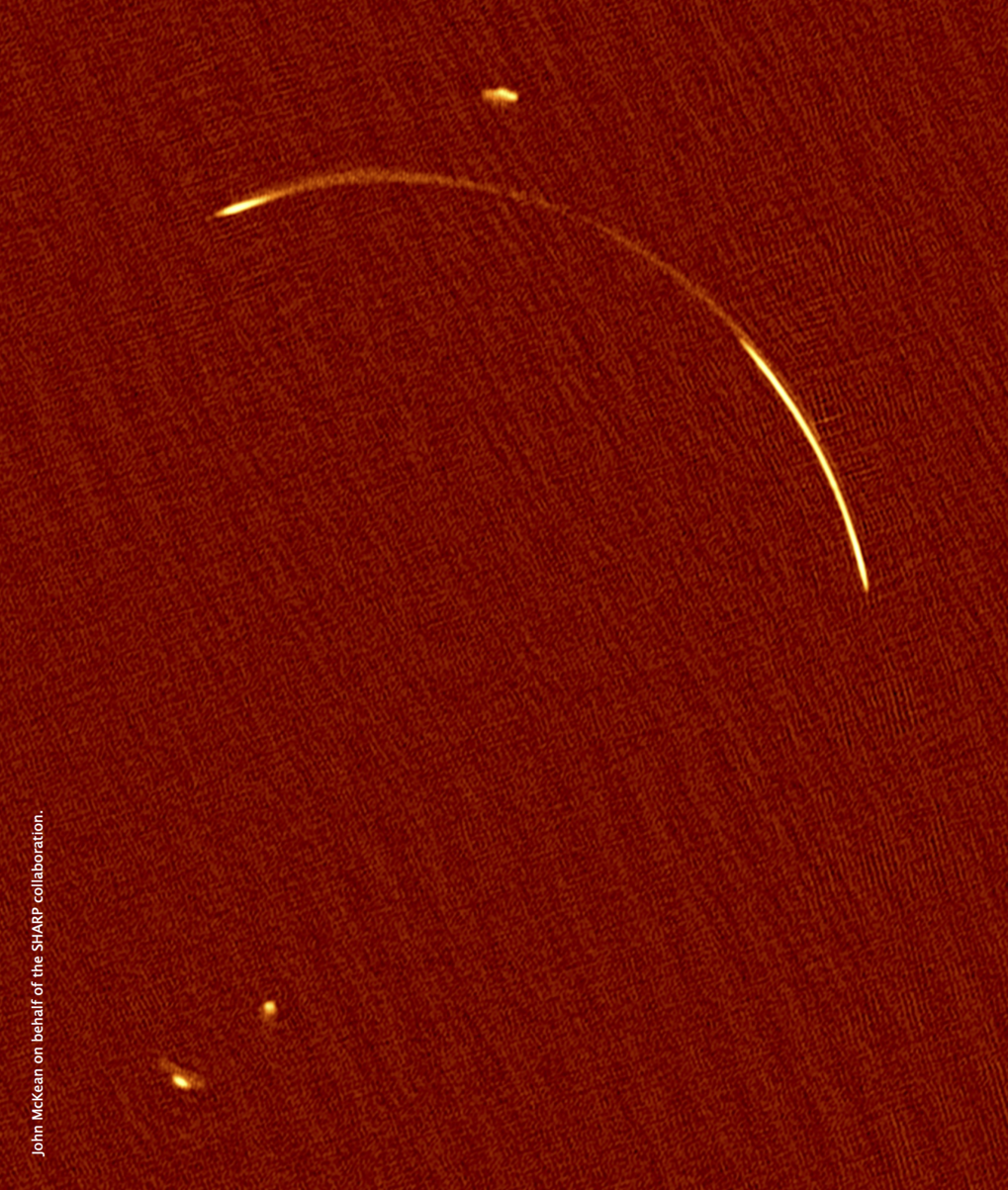
Using radio interferometry, the astronomers can resolve the lensed structures in much more detail.
© John McKean on behalf of the SHARP collaboration. Hi-Res Image


Using gravitational lensing to constrain the distribution of dark matter is by now a well-established tool in astrophysics. Simona Vegetti, however, uses it for a very specific purpose: using high-resolution images of strong gravitational lenses, she tries to find and constrain the properties of small satellite galaxies in the distant universe. Recently she has been awarded a Max Planck Junior Research Group position at MPA, which will allow her much more extensive studies using this technique with her own small group.

The nature of dark matter and how galaxies form are two major issues of modern Cosmology. Numerical simulations of galaxy formation have shown that the amount of mass substructure in galaxies strongly depends on the assumed nature of dark matter. However, dark matter cannot be directly observed and using luminous matter as a tracer is not always reliable. Therefore, Simona Vegetti will use the gravitational lensing effect, where light from a distant source galaxy is deflected (and distorted) by a large mass concentration on its way to the observer.

Already during her PhD in Groningen and later as a postdoc at MIT she developed the technique: In strong gravitational lens systems, such as galaxy clusters, individual (small) galaxies can induce small perturbations on the observed lensing features, such as arcs. These perturbations then reveal details about the lensing galaxy, allowing the scientist to measure the mass substructures in gravitational lens galaxies, galaxy-groups and galaxy-clusters.

Recently, her technique could be extended to also study in great details high-redshift lensed galaxies observed with new radio interferometers (see Link to MPA News on the right). While her research so far has been confined to fairly massive substructures, the advent of much more sensitive and high resolution data from radio interferometry systems will allow her to study much smaller galaxies, down to about 106 solar masses, and a wide range of cosmological epochs.

“By extending our studies to lower masses, we reach a regime where the predictions from different dark matter and galaxy formation models differ significantly,” explains Simona Vegetti. “Therefore this will allow us to constrain the properties of dark matter and test the standard cosmological theory of galaxy formation.”

Max Planck Junior Research Groups are established as smaller, independent research units, often supplementing departments at Max Planck Institutes, such as at MPA. The groups offer young junior scientists who hold a doctorate an exceptional opportunity to further qualify themselves on a very high level. Simona Vegetti has been appointed for a five-year term and from October, when she officially starts her new position, she will build up her own small group of two PhD students and two postdocs to work together on this specific research topic.

“Gravitational lensing and cosmology have always held a special fascination for me,” Simona points out, “ever since the first course that I attended during my undergraduate studies at Turin University. It is great that I can really delve into this subject now with my own group.” And MPA pprovides not only the perfect professional environment to do this; it is also close to the Alps, where she likes to go backpacking, and closer to Italy to visit friends and family.