NGC 602
Credit: X-ray: NASA/CXC; Infrared: ESA/Webb, NASA & CSA, P. Zeilder, E.Sabbi, A. Nota, M. Zamani; Image Processing: NASA/CXC/SAO/L. Frattare and K. Arcand
Since antiquity, wreaths have symbolized the cycle of life, death,
and rebirth. It is fitting then that one of the best places for
astronomers to learn more about the stellar lifecycle resembles a giant
holiday wreath itself.
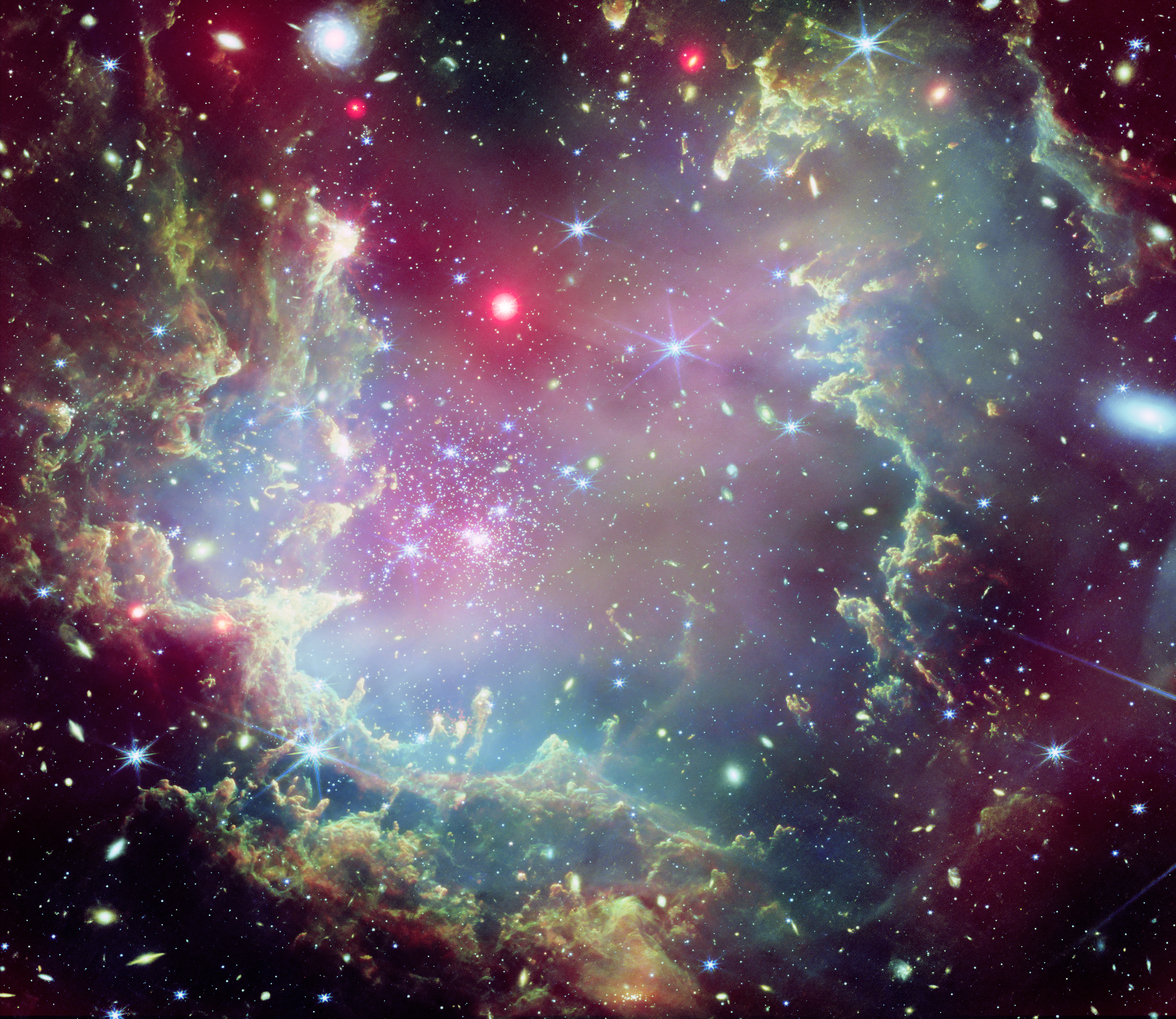
The star cluster NGC 602 lies on the outskirts of the Small Magellanic Cloud, which is one of the closest galaxies to the Milky Way, about 200,000 light-years from Earth. The stars in NGC 602 have fewer heavier elements compared to the Sun and most of the rest of the galaxy. Instead, the conditions within NGC 602 mimic those for stars found billions of years ago when the universe was much younger.
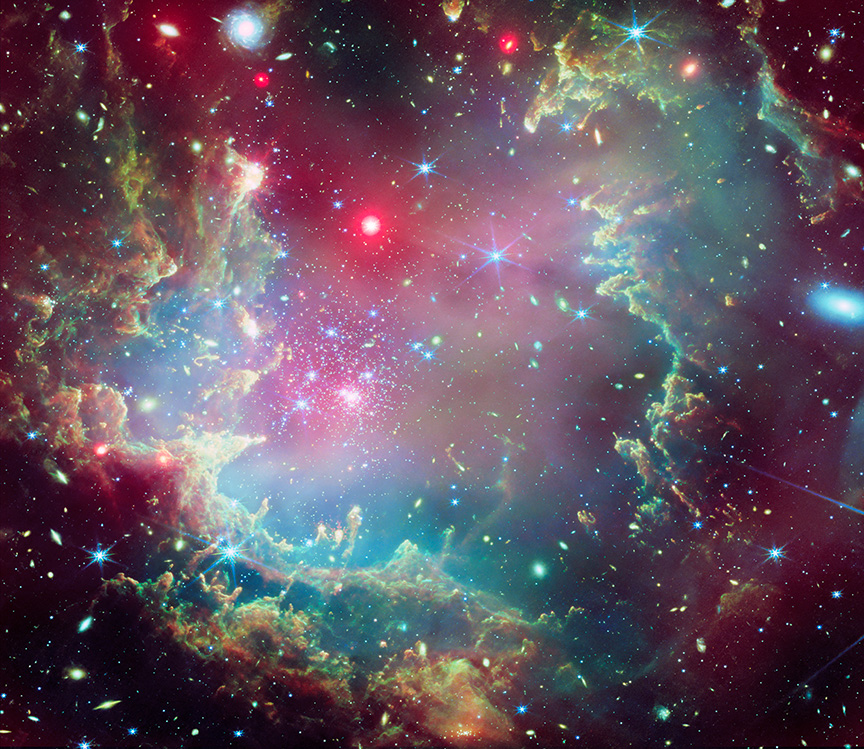
This new image combines data from NASA’s Chandra X-ray Observatory with a previously released image from the agency’s James Webb Space Telescope. The dark ring-like outline of the wreath seen in Webb data (represented as orange, yellow, green, and blue) is made up of dense clouds of filled dust.
Meanwhile, X-rays from Chandra (red) show young, massive stars that are illuminating the wreath, sending high-energy light into interstellar space. These X-rays are powered by winds flowing from the young, massive stars that are sprinkled throughout the cluster. The extended cloud in the Chandra data likely comes from the overlapping X-ray glow of thousands of young, low-mass stars in the cluster.
The star cluster NGC 602 lies on the outskirts of the Small Magellanic Cloud, which is one of the closest galaxies to the Milky Way, about 200,000 light-years from Earth. The stars in NGC 602 have fewer heavier elements compared to the Sun and most of the rest of the galaxy. Instead, the conditions within NGC 602 mimic those for stars found billions of years ago when the universe was much younger.
This new image combines data from NASA’s Chandra X-ray Observatory with a previously released image from the agency’s James Webb Space Telescope. The dark ring-like outline of the wreath seen in Webb data (represented as orange, yellow, green, and blue) is made up of dense clouds of filled dust.
Meanwhile, X-rays from Chandra (red) show young, massive stars that are illuminating the wreath, sending high-energy light into interstellar space. These X-rays are powered by winds flowing from the young, massive stars that are sprinkled throughout the cluster. The extended cloud in the Chandra data likely comes from the overlapping X-ray glow of thousands of young, low-mass stars in the cluster.

NGC 2264, the “Christmas Tree Cluster”
Credit: X-ray: NASA/CXC/SAO; Optical: Clow, M.; Image Processing: NASA/CXC/SAO/L. Frattare and K. Arcand);
View Animated Version
Credit: X-ray: NASA/CXC/SAO; Optical: Clow, M.; Image Processing: NASA/CXC/SAO/L. Frattare and K. Arcand);
View Animated Version
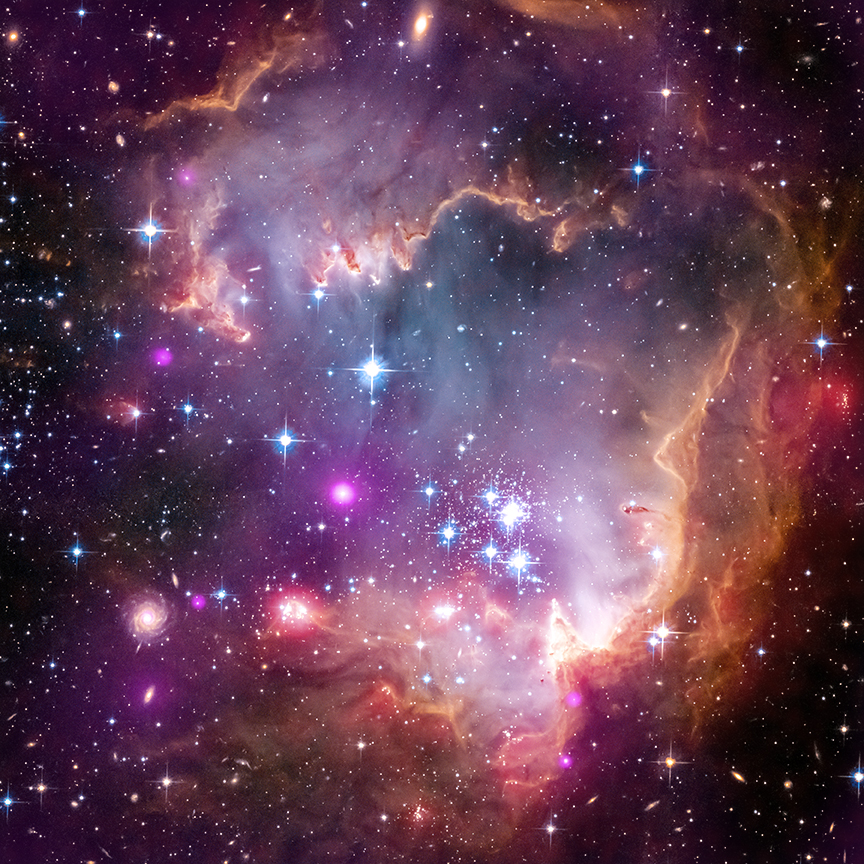
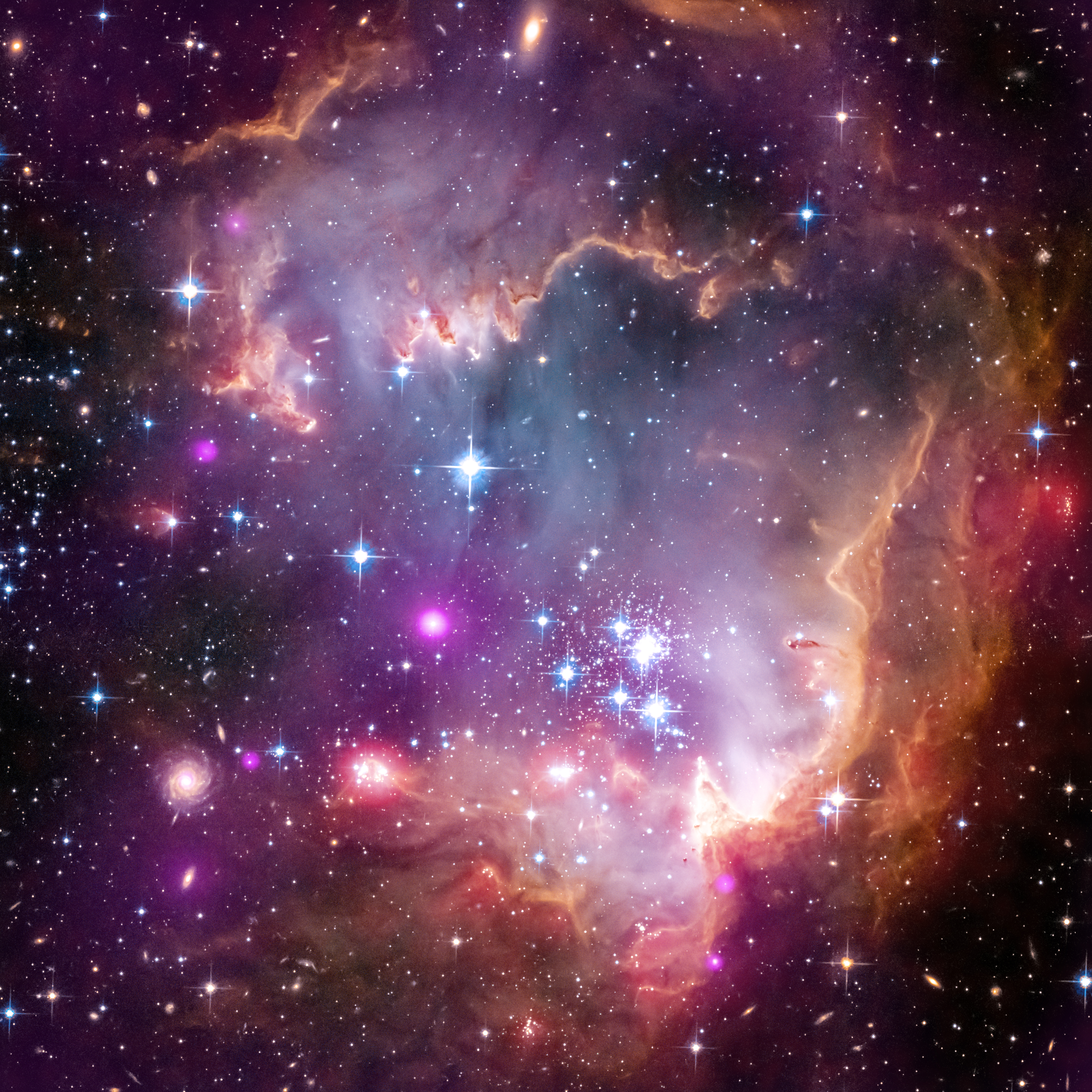
In addition to this cosmic wreath, a new version of the “Christmas tree cluster” is also now available. Like NGC 602, NGC 2264 is a cluster of young stars between one and five million years old. (For comparison, the Sun is a middle-aged star about 5 billion years old — about 1,000 times older.) In this image of NGC 2264, which is much closer than NGC 602 at a distance of about 2,500 light-years from Earth, Chandra data (red, purple, blue, and white) has been combined with optical data (green and violet) captured from by astrophotographer Michael Clow from his telescope in Arizona in November 2024.
NASA's Marshall Space Flight Center in Huntsville, Alabama, manages the Chandra program. The Smithsonian Astrophysical Observatory's Chandra X-ray Center controls science operations from Cambridge, Massachusetts, and flight operations from Burlington, Massachusetts.
NASA's Marshall Space Flight Center in Huntsville, Alabama, manages the Chandra program. The Smithsonian Astrophysical Observatory's Chandra X-ray Center controls science operations from Cambridge, Massachusetts, and flight operations from Burlington, Massachusetts.
Quick Look: NASA Missions Spot Cosmic 'Wreath' Displaying Stellar Circle of Life
Source: NASA's Chandra X-Ray Observatory
Visual Description:
This release includes two composite images, each featuring a star cluster that strongly resembles holiday greenery.
The first image depicts star cluster NGC 602 in vibrant and festive colors. The cluster includes a giant dust cloud ring, shown in greens, yellows, blues, and oranges. The green hues and feathery edges of the ring cloud create the appearance of a wreath made of evergreen boughs. Hints of red representing X-rays provide shading, highlighting layers within the wreath-like ring cloud.
The image is aglow with specks and dots of colorful, festive light, in blues, golds, whites, oranges, and reds. These lights represent stars within the cluster. Some of the lights gleam with diffraction spikes, while others emit a warm, diffuse glow. Upon closer inspection, many of the glowing specks have spiraling arms, indicating that they are, in fact, distant galaxies.
The second image in today's release is a new depiction of NGC 2264, known as the "Christmas Tree Cluster". Here, wispy green clouds in a conical shape strongly resemble an evergreen tree. Tiny specks of white, blue, purple, and red light, stars within the cluster, dot the structure, turning the cloud into a festive, cosmic Christmas tree!
The image is aglow with specks and dots of colorful, festive light, in blues, golds, whites, oranges, and reds. These lights represent stars within the cluster. Some of the lights gleam with diffraction spikes, while others emit a warm, diffuse glow. Upon closer inspection, many of the glowing specks have spiraling arms, indicating that they are, in fact, distant galaxies.
The second image in today's release is a new depiction of NGC 2264, known as the "Christmas Tree Cluster". Here, wispy green clouds in a conical shape strongly resemble an evergreen tree. Tiny specks of white, blue, purple, and red light, stars within the cluster, dot the structure, turning the cloud into a festive, cosmic Christmas tree!
Fast Facts for NGC 602:
Credit: X-ray: NASA/CXC; Infrared: ESA/Webb, NASA & CSA, P. Zeilder, E.Sabbi, A. Nota, M. Zamani; Image Processing: NASA/CXC/SAO/L. Frattare and K. Arcand
Scale: Image is about 3 arcmin (175 light-years) across.
Category: Normal Stars & Star Clusters
Coordinates (J2000): RA 01h 29m 28.7s | Dec -73° 33´ 40.8"
Constellation: Hydrus
Observation Dates: 11 pointings between 31 March and 29 April, 2010
Observation Time: 80 hours 45 minutes (3 days 8 hours 45 minutes)
Obs. ID: 10985-10986, 11978-11979, 11988-11989, 12130-12131, 12134, 12136, 12207
Instrument: ACIS
References: Oskinova, L. et al, 2013, ApJ, 765 73; arXiv:1301.3500
Color Code: X-ray: red; Infrared: orange, yellow, green, and blue
Distance Estimate: About 200,000 light-years
Fast Facts for NGC 2264:
Credit: X-ray: NASA/CXC/SAO; Optical: Clow, M.; Image Processing: NASA/CXC/SAO/L. Frattare and K. Arcand
Scale: Image is about 77 arcmin (56 light-years) across.
Category: Normal Stars & Star Clusters
Coordinates (J2000): RA: 06h 40m 42.8s | Dec: +09° 49' 3.6"
Constellation: Monoceros
Observation Dates: 8 observations from February 2002 to December 2011
Observation Time: 137 hours 26 minutes ( 5 days 17 hours 26 mintues)
Obs. IDs: 2540, 2550, 9768, 9769, 13610, 13611, 14368, 14369
Instrument: ACIS
References: Ramirez, S.V., et al., 2004, AJ, 127,2659; arXiv:astro-ph:0401533
Color Code: X-ray: red, green, and blue; Optical: green and white
Distance Estimate: About 2,500 light-years