Showing posts with label Hercules A. Show all posts

Monday, August 23, 2021

Most detailed-ever images of galaxies revealed using LOFAR


A compilation of the science results. Credit from left to right starting at the top: N. Ramírez-Olivencia et el. [radio]; NASA, ESA, the Hubble Heritage Team (STScI/AURA)-ESA/Hubble Collaboration and A. Evans (University of Virginia, Charlottesville/NRAO/Stony Brook University), edited by R. Cumming [optical], C. Groeneveld, R. Timmerman; LOFAR & Hubble Space Telescope,. Kukreti; LOFAR & Sloan Digital Sky Survey, A. Kappes, F. Sweijen; LOFAR & DESI Legacy Imaging Survey, S. Badole; NASA, ESA & L. Calcada, Graphics: W.L. Williams.

After almost a decade of work, an international team of astronomers has published the most detailed images yet seen of galaxies beyond our own, revealing their inner workings in unprecedented detail. The images were created from data collected by the Low Frequency Array (LOFAR), a radio telescope built and maintained by ASTRON, LOFAR is a network of more than 70,000 small antennae spread across nine European counties, with its core in Exloo, the Netherlands. The results come from the team’s years of work, led by Dr Leah Morabito at Durham University. The team was supported in the UK by the Science and Technology Facilities Council (STFC).

As well as supporting science exploitation, STFC also funds the UK subscription to LOFAR including upgrade costs and operation of its LOFAR station in Hampshire.

Revealing a hidden universe of light in HD

The universe is awash with electromagnetic radiation, of which visible light comprises just the tiniest slice. From short-wavelength gamma rays and X-rays, to long-wavelength microwave and radio waves, each part of the light spectrum reveals something unique about the universe. The LOFAR network captures images at FM radio frequencies that, unlike shorter wavelength sources like visible light, are not blocked by the clouds of dust and gas that can cover astronomical objects. Regions of space that seem dark to our eyes, actually burn brightly in radio waves – allowing astronomers to peer into star-forming regions or into the heart of galaxies themselves.

The new images, made possible because of the international nature of the collaboration, push the boundaries of what we know about galaxies and super-massive black holes. A special issue of the scientific journal Astronomy & Astrophysics is dedicated to 11 research papers describing these images and the scientific results.

Better resolution by working together

The images reveal the inner-workings of nearby and distant galaxies at a resolution 20 times sharper than typical LOFAR images. This was made possible by the unique way the team made use of the array.

The 70,000+ LOFAR antennae are spread across Europe, with the majority being located in the Netherlands. In standard operation, only the signals from antennae located in the Netherlands are combined, and creates a ‘virtual’ telescope with a collecting ‘lens' with a diameter of 120 km. By using the signals from all of the European antennae, the team have increased the diameter of the ‘lens’ to almost 2,000 km, which provides a twenty-fold increase in resolution.

Unlike conventional array antennae that combine multiple signals in real time to produce images, LOFAR uses a new concept where the signals collected by each antenna are digitised, transported to central processor, and then combined to create an image. Each LOFAR image is the result of combining the signals from more than 70,000 antennae, which is what makes their extraordinary resolution possible.


This shows real radio galaxies from Morabito et al. (2021). The gif fades from the standard resolution to the high resolution, showing the detail we can see by using the new techniques. Credit: L.K. Morabito; LOFAR Surveys KSP.

Revealing jets and outflows from super-massive black holes

Super-massive black holes can be found lurking at the heart of many galaxies and many of these are ‘active’ black holes that devour in-falling matter and belch it back out into the cosmos as powerful jets and outflows of radiation. These jets are invisible to the naked eye, but they burn bright in radio waves and it is these that the new high-resolution images have focused upon.

Dr Neal Jackson of The University of Manchester, said: “These high resolution images allow us to zoom in to see what’s really going on when super-massive black holes launch radio jets, which wasn’t possible before at frequencies near the FM radio band,”

The team’s work forms the basis of nine scientific studies that reveal new information on the inner structure of radio jets in a variety of different galaxies.


Hercules A is powered by a supermassive black hole located at its centre, which feeds on the surrounding gas and channels some of this gas into extremely fast jets. Our new high-resolutions observations taken with LOFAR have revealed that this jet grows stronger and weaker every few hundred thousand years. This variability produces the beautiful structures seen in the giant lobes, each of which is about as large as the Milky Way galaxy. Credit: R. Timmerman; LOFAR & Hubble Space Telescope

A decade-long challenge

Even before LOFAR started operations in 2012, the European team of astronomers began working to address the colossal challenge of combining the signals from more than 70,000 antennae located as much as 2,000 km apart. The result, a publicly-available data-processing pipeline, which is described in detail in one the scientific papers, will allow astronomers from around the world to use LOFAR to make high-resolution images with relative ease.

Dr Leah Morabito of Durham University, said: “Our aim is that this allows the scientific community to use the whole European network of LOFAR telescopes for their own science, without having to spend years to become an expert.”

Super images require supercomputers

The relative ease of the experience for the end user belies the complexity of the computational challenge that makes each image possible. Because LOFAR doesn’t just ‘take pictures’ of the night sky, it must stitch together the data gathered by more than 70,000 antennae, which is a huge computational task. To produce a single image, more than 13 terabits of raw data per second – the equivalent of more than a three hundred DVDs – must be digitised, transported to a central processor and then combined.

Frits Sweijen of Leiden University, said: “To process such immense data volumes we have to use supercomputers. These allow us to transform the terabytes of information from these antennas into just a few gigabytes of science-ready data, in only a couple of days.”

Media

All images and video's belonging to this press release can be found in high resolution here.

Links to Arxiv (free) papers can be found here.

About LOFAR

The International LOFAR Telescope is a trans-European network of radio antennas, with a core located in Exloo in the Netherlands. LOFAR works by combining the signals from more than 70,000 individual antenna dipoles, located in ‘antenna stations’ across the Netherlands and in partner European countries. The stations are connected by a high-speed fibre optic network, with powerful computers used to process the radio signals in order to simulate a trans-European radio antenna that stretches over 1,300 kilometres. The International LOFAR Telescope is unique, given its sensitivity, wide field-of-view, and image resolution or clarity. The LOFAR data archive is the largest astronomical data collection in the world.

LOFAR was designed, built and is presently operated by ASTRON, the Netherlands Institute for Radio Astronomy. France, Germany, Ireland, Italy, Latvia, the Netherlands, Poland, Sweden and the UK are all partner countries in the International LOFAR Telescope.


Source: ASTRON/News


Thursday, February 15, 2018

Supermassive Black Holes Are Outgrowing Their Galaxies

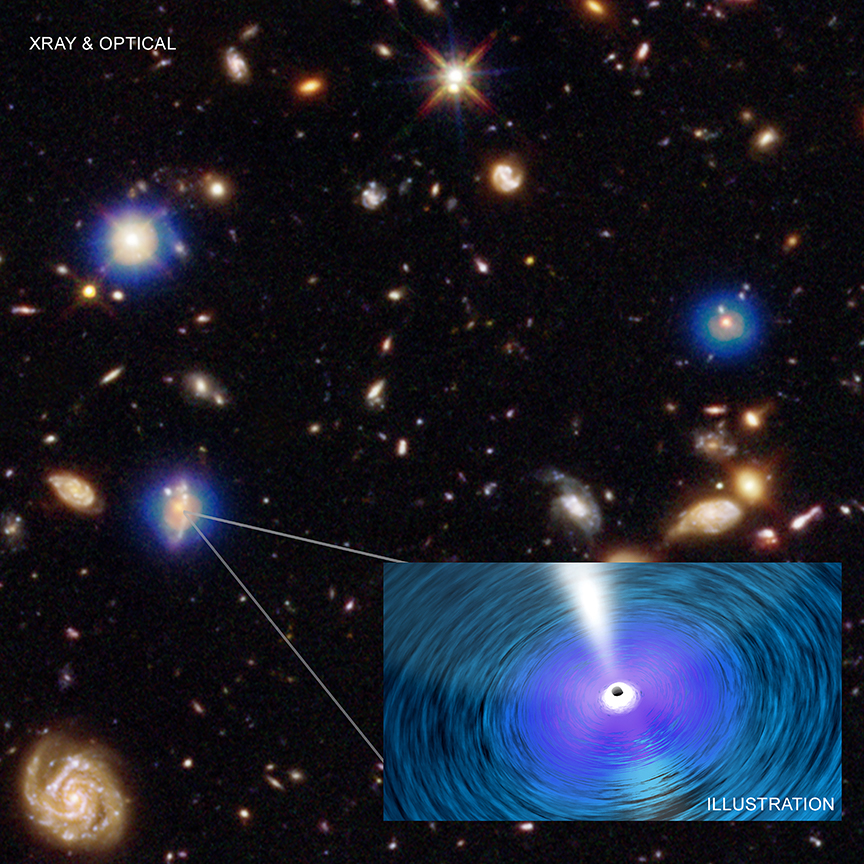
Chandra Deep Field South 
Credit  X-ray: NASA/CXC/Penn. State/G. Yang et al & NASA/CXC/ICE/M. Mezcua et al.; 
Optical: NASA/STScI; Illustration: NASA/CXC/A. Jubett


The growth of the biggest black holes in the Universe is outrunning the rate of formation of stars in the galaxies they inhabit, according to two new studies using data from NASA's Chandra X-ray Observatory and other telescopes and described in our latest press release.

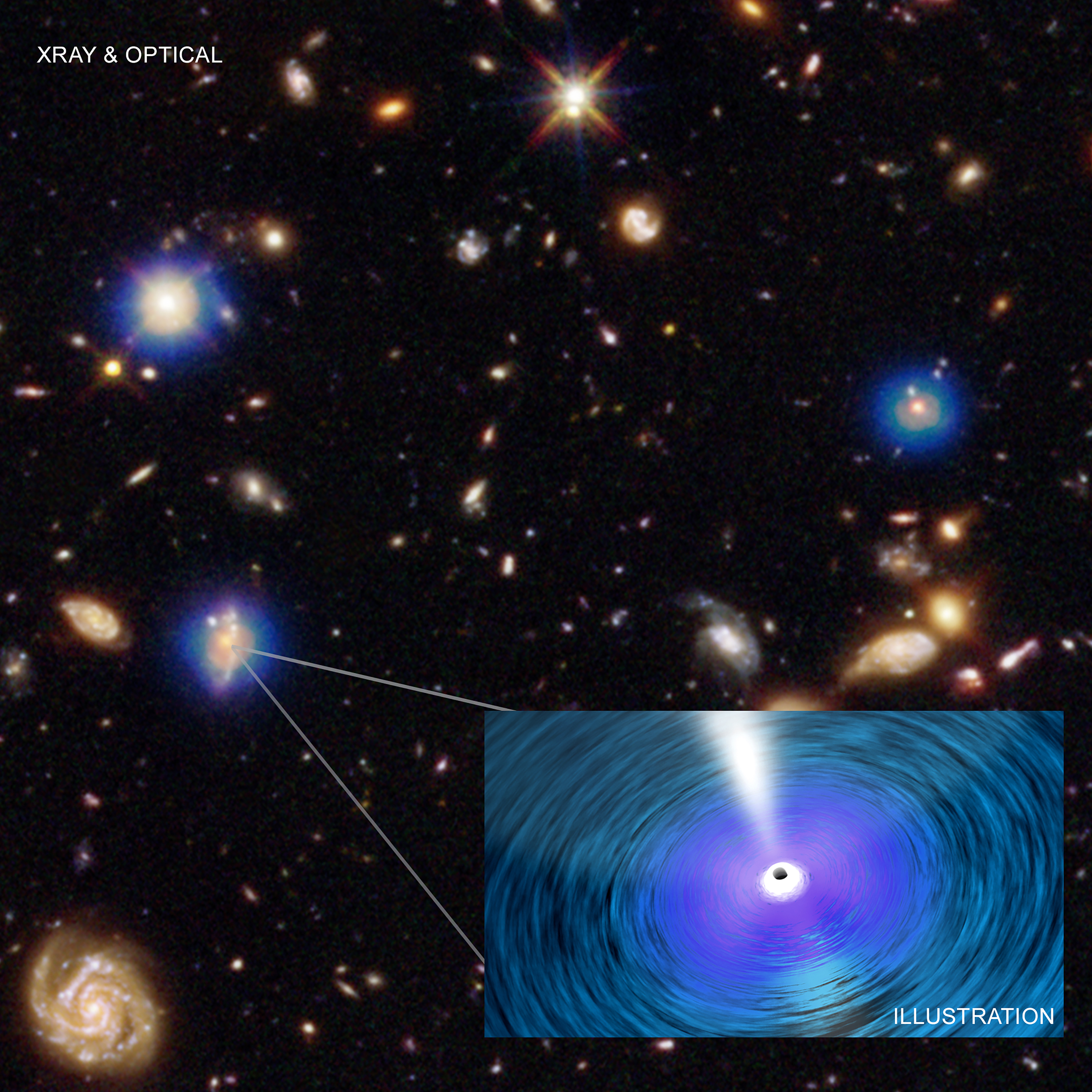
In this graphic an image from the Chandra Deep Field-South is shown. The Chandra image (blue) is the deepest ever obtained in X-rays. It has been combined with an optical and infrared image from the Hubble Space Telescope (HST), colored red, green, and blue. Each Chandra source is produced by hot gas falling towards a supermassive black hole in the center of the host galaxy, as depicted in the artist's illustration.

One team of researchers, led by Guang Yang at Penn State, calculated the ratio between a supermassive black hole's growth rate and the growth rate of stars in its host galaxy and found it is much higher for more massive galaxies. For galaxies containing about 100 billion solar masses worth of stars, the ratio is about ten times higher than it is for galaxies containing about 10 billion solar masses worth of stars.
Using large amounts of data from Chandra, HST and other observatories, Yang and his colleagues studied the growth rate of black holes in galaxies at distances of 4.3 to 12.2 billion light years from Earth. The X-ray data included the Chandra Deep Field-South and North surveys and the COSMOS-Legacy surveys.

Another group of scientists, led by Mar Mezcua of the Institute of Space Sciences in Spain, independently studied 72 galaxies located at the center of galaxy clusters at distances ranging up to about 3.5 billion light years from Earth and compared their properties in X-ray and radio waves. Their work indicates that the black hole masses were about ten times larger than masses estimated by another method using the assumption that the black holes and galaxies grew in tandem.

Hercules A
Credit: X-ray: NASA/CXC/SAO, Optical: NASA/STScI, Radio: NSF/NRAO/VLA


The Mezcua study used X-ray data from Chandra and radio data from the Australia Telescope Compact Array, the Karl G. Jansky Very Large Array (VLA) and Very Long Baseline Array. One object in their sample is the large galaxy in the center of the Hercules galaxy cluster. The image shown above includes Chandra data (purple), VLA data (blue) and HST optical data (appearing white).

Two papers describing these results have been accepted in the Monthly Notices of the Royal Astronomical Society (MNRAS). The work by Mezcua et al. was published in the February 2018 issue MNRAS (available online: https://arxiv.org/abs/1710.10268). The paper by Yang et al. will appear in its April 2018 issue (available online: https://arxiv.org/abs/1710.09399).

NASA's Marshall Space Flight Center in Huntsville, Alabama, manages the Chandra program for NASA's Science Mission Directorate in Washington. The Smithsonian Astrophysical Observatory in Cambridge, Massachusetts, controls Chandra's science and flight operations.


Fast Facts for Chandra Deep Field South:

Scale: Image is 9.25 arcsec (About 574,000 light years) across;
Category: Cosmology/Deep Fields/X-ray Background, Black Holes
Constellation: Fornax
Observation Date: 54 pointings between Oct 15, 1999 to Jul 22, 2010
Observation Time: 1111 hours 6 minutes (46 days 7 hours 6 min)
Obs. ID: 441, 581-582, 1431, 1672, 2239, 2312-2313, 2405-2406, 2409, 8591-8597, 9575, 9578, 9593, 9596, 9718, 12043-12055, 12123, 12128-12129, 12135, 12137-12138, 12213, 12218-12220, 12222-12223, 12227, 12230-12234
Instrument: ACIS
References: "Linking black hole growth with host galaxies: the accretion-stellar mass relation and its cosmic evolution",G. Yang et al., 2018, MNRAS, 475, 1887. arXiv:1710.09399 "The most massive black holes on the Fundamental Plane of Black Hole Accretion", M. Mazcua et al., 2018, MNRAS, 474, 1342. arXiv:1710.10268
Color Code: X-ray (Blue); IR (Red, Green); Optical (Green, Blue)
Distance Estimate: Range of about 12.7 - 12.9 billion light years


Tuesday, November 17, 2015

A supermassive black hole in action

A supermassive black hole in action
Copyright: NASA, ESA, S. Baum & C. O’Dea (RIT), R. Perley & W. Cotton (NRAO/AUI/NSF), and the Hubble Heritage Team (STScI/AURA)


Scientists often use the combined power of multiple telescopes to reveal the secrets of the Universe – and this image is a prime example of when this technique is strikingly effective.

The yellow-hued object at the centre of the frame is an elliptical galaxy known as Hercules A, seen by the Earth-orbiting NASA/ESA Hubble Space Telescope. In normal light, an observer would only see this object floating in the inky blackness of space.

However, view Hercules A with a radio telescope, and the entire region is completely transformed. Stunning red–pink jets of material can be seen billowing outwards from the galaxy – jets that are completely invisible in visible light. They are shown here as seen by the Karl G. Jansky Very Large Array radio observatory in New Mexico, USA. These radio observations were combined with the Hubble visible-light data obtained with the Wide Field Camera 3 to create this striking composite.

The two jets are composed of hot, high-energy plasma that has been flung from the centre of Hercules A, a process that is driven by a supermassive black hole lurking at the galaxy’s heart. This black hole is some 2.5 billion times the mass of the Sun, and around a thousand times more massive than the black hole at the centre of our Milky Way galaxy.

Hercules A’s black hole heats material and accelerates it to nearly the speed of light, sending it flying out into space at phenomenally high speeds. These highly focused jets lose energy as they travel, eventually slowing down and spreading out to form the cloud-like lobes seen here.

The multiple bright rings and knots seen within these lobes suggest that the black hole has sent out numerous successive bursts of material over the course of its history. The jets stretch for around 1.5 million light-years – roughly 15 times the size of the Milky Way.

Hercules A, also known as 3C 348, lies around two billion light-years away. It is one of the brightest sources of radio emission outside our Galaxy.

This image was originally published in November 2012.

Source: ESA

Wednesday, October 22, 2014

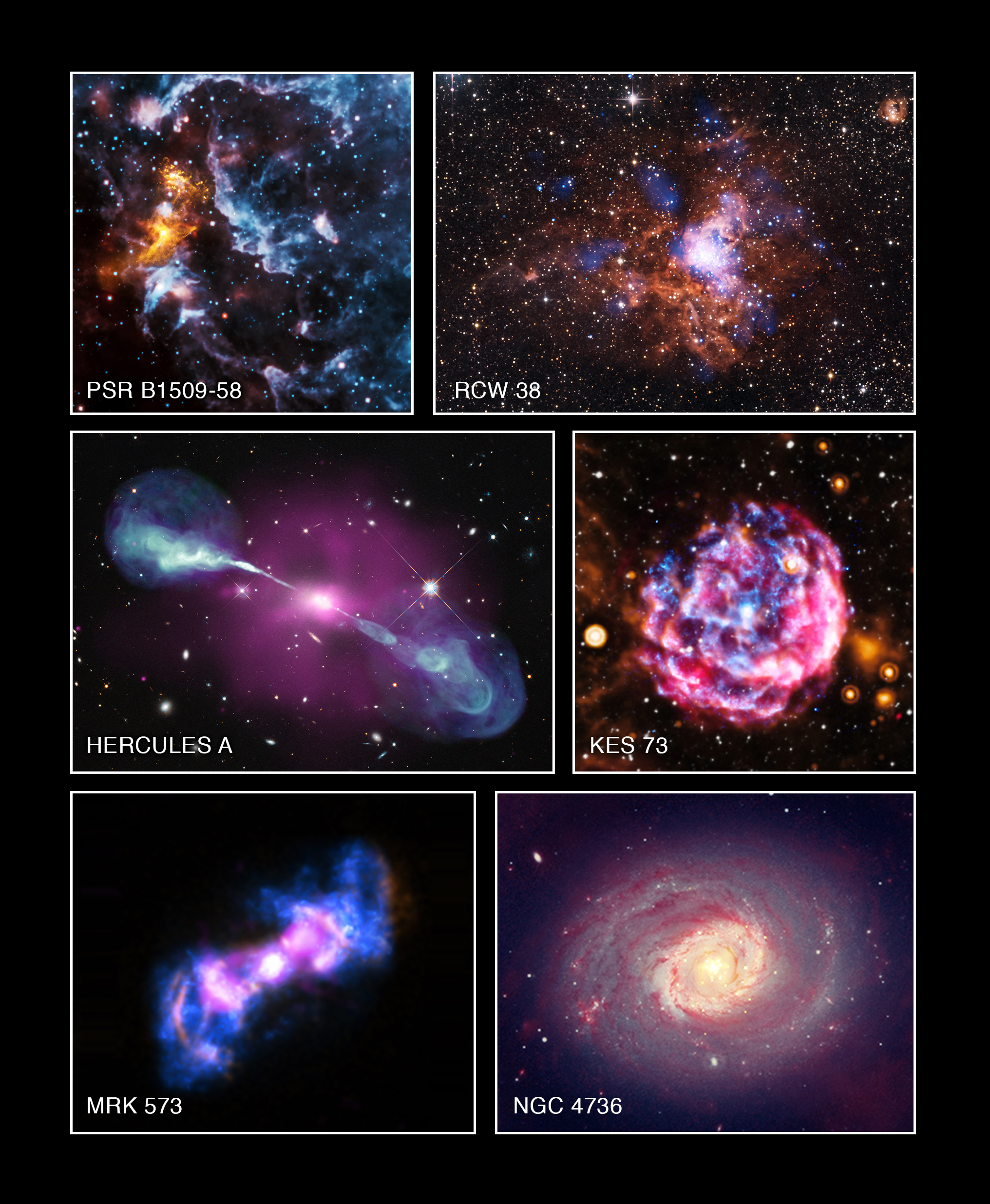
Chandra Archive Collection: Chandra's Archives Come to Life

Chandra Archive Collection
Credit NASA/CXC/SAO 
Instrument: ACIS 


JPEG (293.8 kb) - Large JPEG (2.2 MB) - More Images
(23 Out 13)


Every year, NASA's Chandra X-ray Observatory looks at hundreds of objects throughout space to help expand our understanding of the Universe. Ultimately, these data are stored in the Chandra Data Archive, an electronic repository that provides access to these unique X-ray findings for anyone who would like to explore them. With the passing of Chandra's 15th anniversary in operation on August 26, 1999, the archive continues to grow as each successive year adds to the enormous and invaluable dataset.

To celebrate Chandra's decade and a half in space, and to honor October as American Archives Month, a variety of objects have been selected from Chandra's archive. Each of the new images we have produced combines Chandra data with those from other telescopes. This technique of creating "multiwavelength" images allows scientists and the public to see how X-rays fit with data of other types of light, such as optical, radio, and infrared. As scientists continue to make new discoveries with the telescope, the burgeoning archive will allow us to see the high-energy Universe as only Chandra can. 

PSR B1509-58
PSR B1509-58 (upper left)
Pareidolia is the psychological phenomenon where people see recognizable shapes in clouds, rock formations, or otherwise unrelated objects or data. When Chandra's image of PSR B1509-58, a spinning neutron star surrounded by a cloud of energetic particles, was released in 2009, it quickly gained attention because many saw a hand-like structure in the X-ray emission. In this new image of the system, X-rays from Chandra in gold are seen along with infrared data from NASA's Wide-field Infrared Survey Explorer (WISE) telescope in red, green, and blue. Pareidolia may strike again in this image as some people report seeing a shape of a face in WISE's infrared data.

RCW 38
RCW 38 (upper right)
A young star cluster about 5,500 light years from Earth, RCW 38 provides astronomers a chance to closely examine many young, rapidly evolving stars at once. In this composite image, X-rays from Chandra are blue, while infrared data from NASA's Spitzer Space Telescope are orange and additional infrared data from the 2MASS survey appears white. There are many massive stars in RCW 38 that will likely explode as supernovas. Astronomers studying RCW 38 are hoping to better understand this environment as our Sun was likely born into a similar stellar nursery.

Hercules A
Hercules A (middle left):
Some galaxies have extremely bright cores, suggesting that they contain a supermassive black hole that is pulling in matter at a prodigious rate. Astronomers call these "active galaxies," and Hercules A is one of them. In visible light (colored red, green and blue, with most objects appearing white), Hercules A looks like a typical elliptical galaxy. In X-ray light, however, Chandra detects a giant cloud of multimillion-degree gas (purple). This gas has been heated by energy generated by the infall of matter into a black hole at the center of Hercules A that is over 1,000 times as massive as the one in the middle of the Milky Way. Radio data (blue) show jets of particles streaming away from the black hole. The jets span a length of almost one million light years.

Kes 73
Kes 73 (middle right):
The supernova remnant Kes 73, located about 28,000 light years away, contains a so-called anomalous X-ray pulsar, or AXP, at its center. Astronomers think that most AXPs are magnetars, which are neutron stars with ultra-high magnetic fields. Surrounding the point-like AXP in the middle, Kes 73 has an expanding shell of debris from the supernova explosion that occurred between about 750 and 2100 years ago, as seen from Earth. The Chandra data (blue) reveal clumpy structures along one side of the remnant, and appear to overlap with infrared data (orange). The X-rays partially fill the shell seen in radio emission (red) by the Very Large Array. Data from the Digitized Sky Survey optical telescope (white) show stars in the field-of-view.

Mrk 573
Mrk 573 (lower left):
Markarian 573 is an active galaxy that has two cones of emission streaming away from the supermassive black hole at its center. Several lines of evidence suggest that a torus, or doughnut of cool gas and dust may block some of the radiation produced by matter falling into supermassive black holes, depending on how the torus is oriented toward Earth. Chandra data of Markarian 573 suggest that its torus may not be completely solid, but rather may be clumpy. This composite image shows overlap between X-rays from Chandra (blue), radio emission from the VLA (purple), and optical data from Hubble (gold).

NGC 4736
NGC 4736 (lower right):
NGC 4736 (also known as Messier 94) is a spiral galaxy that is unusual because it has two ring structures. This galaxy is classified as containing a "low ionization nuclear emission region," or LINER, in its center, which produces radiation from specific elements such as oxygen and nitrogen. Chandra observations (gold) of NGC 4736, seen in this composite image with infrared data from Spitzer (red) and optical data from Hubble and the Sloan Digital Sky Survey (blue), suggest that the X-ray emission comes from a recent burst of star formation. Part of the evidence comes from the large number of point sources near the center of the galaxy, showing that strong star formation has occurred. In other galaxies, evidence points to supermassive black holes being responsible for LINER properties. Chandra's result on NGC 4736 shows LINERs may represent more than one physical phenomenon.

NASA's Marshall Space Flight Center in Huntsville, Alabama, manages the Chandra program for NASA's Science Mission Directorate in Washington, DC. The Smithsonian Astrophysical Observatory in Cambridge, Massachusetts, controls Chandra's science and flight operations.


Thursday, November 29, 2012

A Multi-Wavelength View of Radio Galaxy Hercules A

 
Radio Galaxy Hercules A
Credit: NASA, ESA, S. Baum and C. O'Dea (RIT), R. Perley and W. Cotton (NRAO/AUI/NSF), and the Hubble Heritage Team (STScI/AURA) .    


 A 3-D Perspective on Hercules A
Credit: NASA, ESA, and Z. Levay, F. Summers, G. Bacon, T. Davis, and L. Frattare (Viz 3D Team/STScI)  .  See All the Videos

This video envisions a three-dimensional look at the combined visible light and radio emission from the active galaxy Hercules A. Unusually, this giant elliptical galaxy is not found in a large cluster of galaxies, but rather within a comparatively small group of galaxies. The supermassive black hole in its core, however, spews out strong jets of energetic particles that produce enormous lobes of radio emission. The size of these radio lobes dwarfs the large galaxy and extends throughout the volume of the galaxy group. This visualization is intended only to be a scientifically reasonable illustration of the three-dimensional structures. In particular, the galaxy distances are based on a statistical model, and not measured values.

Spectacular jets powered by the gravitational energy of a supermassive black hole in the core of the elliptical galaxy Hercules A illustrate the combined imaging power of two of astronomy's cutting-edge tools, the Hubble Space Telescope's Wide Field Camera 3, and the recently upgraded Karl G. Jansky Very Large Array (VLA) radio telescope in New Mexico.

Some two billion light-years away, the yellowish elliptical galaxy in the center of the image appears quite ordinary as seen by Hubble in visible wavelengths of light. The galaxy is roughly 1,000 times more massive than the Milky Way and harbors a 2.5-billion-solar-mass central black hole that is 1,000 times more massive than the black hole in the Milky Way. But the innocuous-looking galaxy, also known as 3C 348, has long been known as the brightest radio-emitting object in the constellation Hercules. Emitting nearly a billion times more power in radio wavelengths than our Sun, the galaxy is one of the brightest extragalactic radio sources in the entire sky.

The VLA radio data reveal enormous, optically invisible jets that, at one-and-a-half million light-years wide, dwarf the visible galaxy from which they emerge. The jets are very-high-energy plasma beams, subatomic particles and magnetic fields shot at nearly the speed of light from the vicinity of the black hole. The outer portions of both jets show unusual ring-like structures suggesting a history of multiple outbursts from the supermassive black hole at the center of the galaxy.

The innermost parts of the jets are not visible because of the extreme velocity of the material, which causes relativistic effects that beam the light away from us. Far from the galaxy, the jets become unstable and break up into the rings and wisps.

The entire radio source is surrounded by a very hot, X-ray-emitting cloud of gas, not seen in this optical-radio composite.
<
Hubble's view of the field also shows a companion elliptical galaxy very close to the center of the optical-radio source, which may be merging with the central galaxy. Several other elliptical and spiral galaxies that are visible in the Hubble data may be members of a cluster of galaxies. Hercules A is by far the brightest and most massive galaxy in the cluster.

For more information, contact:

Ray Villard
Space Telescope Science Institute, Baltimore, Md.
410-338-4514
villard@stsci.edu

John Stoke
National Radio Astronomy Observatory, Charlottesville, Va.
434-244-6896
jstoke@nrao.edu

Dave Finley
National Radio Astronomy Observatory, Socorro, N.M.
575-835-7302
dfinley@nrao.edu