Fig. 1:
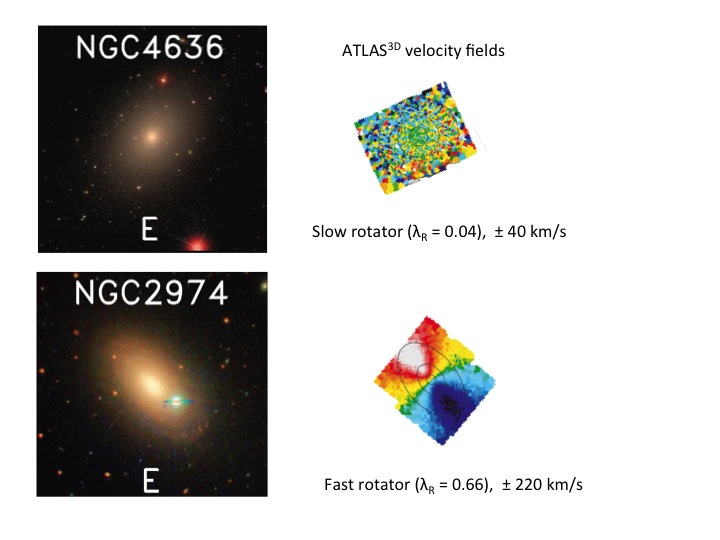
Postage stamp of a slowly rotating galaxy (top, NGC4636) and a fast
rotating galaxy (bottom, NGC2974) with the corresponding observed
two-dimensional ATLAS3D velocity fields (right). NGC4636 has no
rotation patterns and the measured velocities do not exceed 40
km/s. NGC2974 shows regular fast (~ 200 km/s) rotation (Krajnovic et
al. 2011).

Fig. 2:
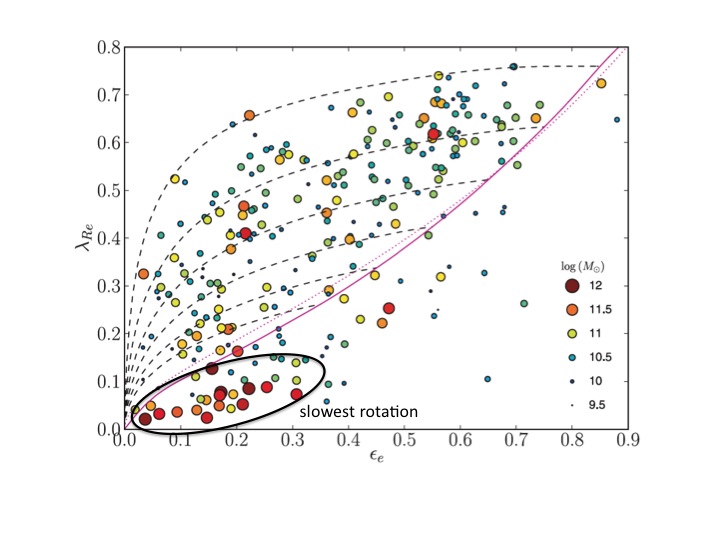
Rotation properties of all early-type galaxies in the ATLAS3D sample
measured by the spin parameter λR. This parameter measures
the angular momentum of stellar components of the galaxies and is
derived from the two-dimensional velocity fields (see Fig. 1). Most
early-type galaxies rotate fast (high λR values) but the rare
massive systems (largest symbols in the plot) are slow rotators
(Emsellem et al. 2011).

Fig. 3:
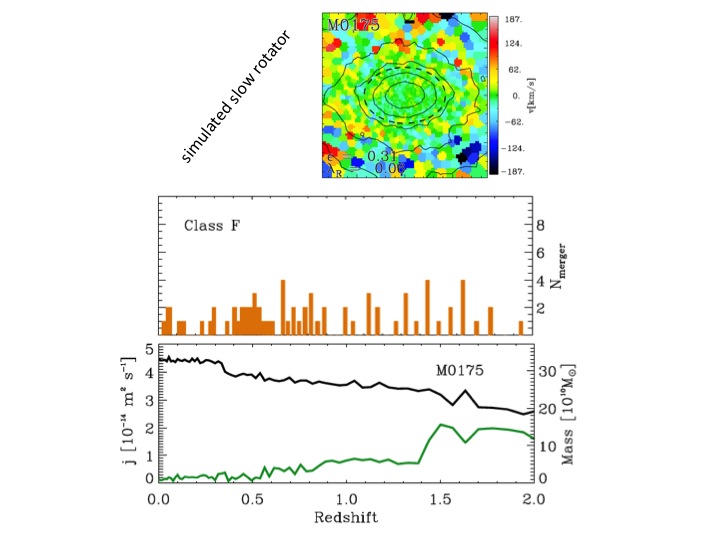
Two dimensional velocity field of a non-rotating rotating galaxy from
a cosmological simulation (top panel). These galaxies have special
formation histories (class F in Naab et al. 2013). Since redshift z ~
2 they have experienced repeated minor mergers (~ 100 in this case)
with mass ratios larger than 4:1 (counted by the orange histogram,
middle panel) and no late major mergers. The galaxies continuously
grow in mass (black line, bottom panel) and loose angular momentum
(green line) until they stand still.
Over the last two years an international team of astronomers
participating in the ATLAS3D project
has presented the
rotation properties of all early-type (elliptical and lenticular)
galaxies in a well defined volume (42Mpc) of the nearby Universe. To
the surprise of the team the stellar components of the most massive
observed galaxies (~ 1011 Msun) in our neighbourhood show no
global rotation signatures, in contrast to the regular rotation
patterns observed for the majority of lower mass early-type
galaxies. With the help of cosmological galaxy formation simulations
performed by MPA scientists the team was now able to demonstrate that
the giant non rotating galaxies might have special formation
histories. Simulated galaxies most consistent with the rare class of
non-rotating round early-type galaxies grow by gas-poor minor mergers
alone. More than half of their stars were born in other galaxies which
then have been eaten by the giants. The simulations indicate that over
the last 10 Gyrs repeated minor mergers have continuously slowed these
initially rotating giants down until they come to a halt.
Within the ATLAS3D project
(Cappellari et
al. 2011) 260 nearby early-type galaxies within a local volume of 42
Mpc have been observed at optical, radio, and millimeter
wavelengths. The multi-wavelength coverage enabled the team to
determine the dynamics, the star-formation histories, ages and
metallicities of the stellar populations as well as a full census of
the gas phase (molecular, neutral and ionised) properties. The
integral-field observations of the stellar kinematics (Emsellem et
al. 2011, see Fig. 1) have revealed a surprising result. Whereas most
early-type galaxies (~ 80 per cent) rotate quite regularly - similar
to thick stellar disks - the most massive ones rotate very slowly (see
Fig. 2) and some of them (7 out of 260) are very round and show no
sign of ordered rotation at all (Krajnovic et al. 2011). They stand
still.
The absence of rotation is difficult to reconcile with current
standard formation scenarios and has caused theorists quite a
headache. Traditionally, it is assumed that early-type galaxies are
burned out spiral galaxies or they formed and evolved by mergers of
disk-like or even early-type galaxies of comparable mass. Many
studies, however, have demonstrated that these formation paths mostly
result in rotating or very elongated galaxies, inconsistent with
properties of the observed non-rotating early-type galaxies.
As part of the theoretical efforts within ATLAS3D a group of MPA
scientists have carried out a number of high resolution computer
simulations of the formation and evolution of massive galaxies (Naab
et al. 2013). Analysing the stellar kinematics of the simulated
galaxies in the same way as the observers made it possible to identify
direct links between the formation history of the galaxies - as
recorded by the simulations - and the resulting kinematic
properties. The study reveals a surprising wealth of formation
histories which are consistent with observations and the scientists
were able to demonstrate that every formation history leaves its
characteristic imprint on the observable two-dimensional kinematic
properties. A most valuable result to interpret the observations.
Similar to the real Universe most simulated galaxies of lower mass are
fast rotating. They either form a thick stellar disk from accreted
gas or are still rotating after collisions with companion galaxies of
similar size. At higher galaxy masses (~ 1011 Msun), however, the
majority of the stars in a typical simulated galaxy do not form in the
galaxy itself but formed in other galaxies that have merged with the
galaxy progenitor. Some of the major collision wrecks rotate slowly
but their very elongated shapes do not agree with observed
non-rotators. Only galaxies with a special formation history resemble
the observed round and non-rotating galaxies. They acquire about half
of their stars from many mergers with much smaller galaxies and
experience not late major merger. The many repeated merger events over
the last ~ 10 Gyrs slow the giant galaxies down continuously so that
they stand sill today (Fig. 3).
Thorsten Naab (MPA), Ludwig Oser (MPA, Columbia University) and the ATLAS3D team
References
Cappellari et al.,
"The ATLAS3D project - I. A volume-limited sample of 260 nearby
early-type galaxies: science goals and selection criteria",
2011, MNRAS, 413, 813,
http://adsabs.harvard.edu/abs/2011MNRAS.413..813C
Krajnovic et al., "The ATLAS3D project - II. Morphologies, kinemetric features and alignment between photometric and kinematic axes of early-type galaxies", 2011, MNRAS, 414, 2923, http://adsabs.harvard.edu/abs/2011MNRAS.414.2923K
Emsellem et al.,
"The ATLAS3D project - III. A census of the stellar angular
momentum within the effective radius of early-type galaxies: unveiling
the distribution of fast and slow rotators",
2011, MNRAS, 414, 888,
http://adsabs.harvard.edu/abs/2011MNRAS.414..888E
Naab et al., "The ATLAS3D project - XXV: Two-dimensional kinematic analysis of simulated galaxies and the cosmological origin of fast and slow rotators", 2013, astro-ph