Showing posts with label SPIRE. Show all posts

Monday, December 16, 2013

Herschel spies active argon in Crab Nebula

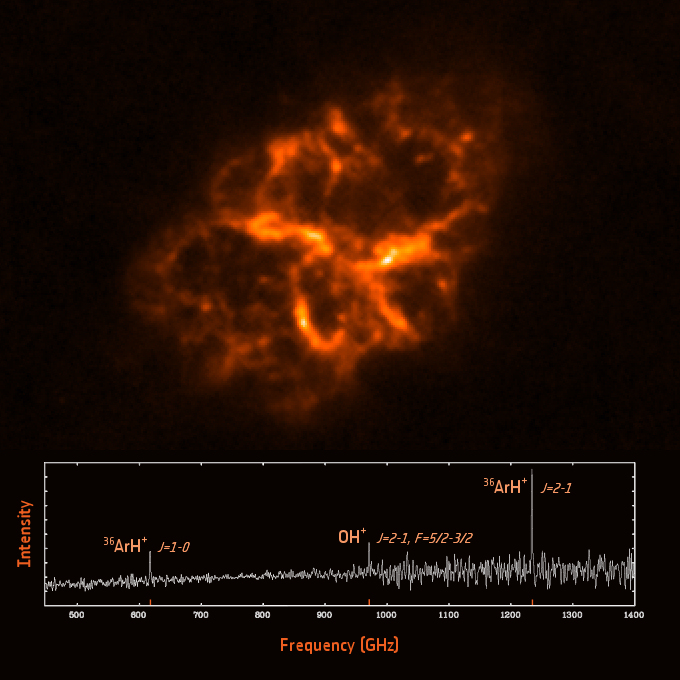
Herschel image and spectrum of the Crab Nebula, with emission lines from the molecular ion argon hydride. Credit: ESA/Herschel/PACS, SPIRE/MESS Key Programme Supernova Remnant Team.  Hi-Res Image
 
Herschel (red) and Hubble (blue) composite image of the Crab Nebula. Credit: ESA/Herschel/PACS/MESS Key Programme Supernova Remnant Team; NASA, ESA and Allison Loll/Jeff Hester (Arizona State University). Hi-Res Image

Using ESA's Herschel Space Observatory, a team of astronomers has found first evidence of a noble-gas based molecule in space. A compound of argon, the molecule was detected in the gaseous filaments of the Crab Nebula, one of the most famous supernova remnants in our Galaxy. While argon is a product of supernova explosions, the formation and survival of argon-based molecules in the harsh environment of a supernova remnant is an unforeseen surprise. 

Just like a group of people, the periodic table of chemical elements has its share of team players and loners. While some elements tend to react more easily with other species, forming molecules and other compounds, others hardly ever take part in chemical reactions and are mainly found in isolation. 'Inert' elements par excellence are the noble gases: helium, neon, argon, krypton, xenon and radon.

The name of one of them – argon – derives from the Greek word for idle, to emphasise its highly inert nature. But noble gases are not entirely inactive. While at first scientists doubted that chemical compounds could even contain noble gases, several such species are now known and have been extensively studied in the laboratory.

Things are more complex in space. Over the decades, astronomers have detected atoms and ions of noble gases in a variety of cosmic environments, ranging from the Solar System to the atmospheres of stars, from dense nebulae to the diffuse interstellar medium. But the search for noble-gas based compounds had until now proved unsuccessful, suggesting that these almost inert elements might have a hard time reacting with other species in space.

A new study, led by Michael Barlow from University College London, UK, and based on data from ESA's Herschel Space Observatory, has found the first evidence of such a compound in space. The results are published in the journal Science.

The team of astronomers has detected emission from argon hydride (ArH+), a molecular ion containing the noble gas argon, in the Crab Nebula. A wispy and filamentary cloud of gas and dust, the Crab Nebula is the remnant of a supernova explosion that was observed by Chinese astronomers in the year 1054.

"At first, the discovery seemed bizarre," comments Barlow.

"With hot gas still expanding at high speeds after the explosion, a supernova remnant is a harsh, hostile environment, and one of the places where we least expected to find a noble-gas based molecule," he adds.

Argon hydride is produced when ions of argon (Ar+) react with hydrogen molecules (H2), but these two species are usually found in different regions of a nebula. While ions form in the most energetic regions, where radiation from a star or stellar remnant ionises the gas, molecules take shape in the denser, colder pockets of gas that are shielded from this powerful radiation.


"But we soon realised that even in the Crab Nebula, there are places where the conditions are just right for a noble gas to react and combine with other elements.

"There, in the transition regions between ionised and molecular gas, argon hydride can form and survive," explains Barlow.

This new picture was supported by the comparison of the Herschel data with observations of the Crab Nebula performed at other wavelengths, which revealed that the regions where they had found ArH+ also exhibit higher concentrations of both Ar+ and H2. There, argon ions can react with hydrogen molecules forming argon hydride and atomic hydrogen.

In the partly ionised gas filling these regions, molecules collide frequently with ions and free electrons. These collisions excite the molecular structure of ArH+ making it rotate; in turn, molecular rotations produce the emission features detected in the spectrum of the Crab Nebula by Herschel.

"The discovery was truly serendipitous: we were observing the Crab Nebula to study its dust content. But then, on top of the emission from dust, we found two emission lines that had never been seen before," says co-author Bruce Swinyard, also from University College London.

The identification of these lines was a challenging task. To this end, the astronomers exploited two extensive databases of molecular spectra and, after lengthy investigation, they matched the observed features with two characteristic lines emitted by ArH+.

"And there's icing on the cake: from a molecule's emission, we can determine the isotope of the elements that form it – something that we can't do when we see only ions," adds Swinyard.

The Herschel data indicate that the argon hydride found in the Crab Nebula is made up of the argon isotope 36Ar. This is the first time that astronomers could identify the isotopic nature of an element in a supernova remnant.

"Finding that argon in the Crab Nebula consists of 36Ar was not surprising because this is the dominant isotope of argon across the Universe.

"And it's also the main argon isotope to be synthesised in the nuclear reactions during supernova explosions, so its detection in the Crab Nebula confirms that this iconic nebula was created by the explosive death of a massive star," explains Barlow.

The astronomers are planning further observations with other facilities to seek new emission lines in the Crab Nebula's spectrum, possibly from molecules containing different isotopes of argon. The detection of such a molecule would enable them to study the ratio of different isotopes produced by supernovae and to learn more about the nuclear reactions that take place when a massive star dies.

"This is not only the first detection of a noble-gas based molecule in space, but also a new perspective on the Crab Nebula. Herschel has directly measured the argon isotope we expect to be produced via explosive nucleosynthesis in a core-collapse supernova, refining our understanding of the origin of this supernova remnant," concludes Göran Pilbratt, Herschel Project Scientist at ESA.

Background information

The results described in this article are reported in "Detection of a Noble Gas Molecular Ion, 36ArH+, in the Crab Nebula", by M. J. Barlow et al., published in Science, 342, 6163, 1343-1345, 13 December 2013. DOI: 10.1126/science.124358213.

The argon isotope found in the Crab Nebula is different from the one that dominates in Earth's atmosphere, 40Ar, which derives from the decay of a radioactive isotope of potassium (40K) present in our planet's rocks. 
At almost one per cent, argon is the third most abundant gas in the atmosphere of Earth after nitrogen and oxygen, and was discovered at the end of the 19th century.

The study is based on data collected with the Spectral and Photometric Imaging Receiver (SPIRE) on board ESA's Herschel Space Observatory. The team of astronomers detected two emission lines corresponding to the first two rotational transitions of argon hydride (ArH+) at frequencies of 617.5 GHz and 1234.6 GHz, respectively. To identify the lines, they made use of two extensive databases of molecular lines: the Cologne Database for Molecular Spectroscopy (CDMS) and the Madrid Molecular Spectroscopy Excitation (MADEX) code.

Herschel is an ESA space observatory with science instruments provided by European-led Principal Investigator consortia and with important participation from NASA.

The SPIRE instrument contains an imaging photometer (camera) and an imaging spectrometer. The camera operates in three wavelength bands centred on 250, 350 and 500 µm, and so can make images of the sky simultaneously in three sub-millimetre colours; the spectrometer covers the wavelength range between 194 and 671 μm. SPIRE has been developed by a consortium of institutes led by Cardiff Univ. (UK) and including Univ. Lethbridge (Canada); NAOC (China); CEA, LAM (France); IFSI, Univ. Padua (Italy); IAC (Spain); Stockholm Observatory (Sweden); Imperial College London, RAL, UCL-MSSL, UKATC, Univ. Sussex (UK); Caltech, JPL, NHSC, Univ. Colorado (USA). This development has been supported by national funding agencies: CSA (Canada); NAOC (China); CEA, CNES, CNRS (France); ASI (Italy); MCINN (Spain); SNSB (Sweden); STFC, UKSA  (UK); and NASA (USA).

Herschel was launched on 14 May 2009 and completed science observations on 29 April 2013.

Contacts

Michael J. Barlow
Department of Physics & Astronomy
University College London
London, UK
Email:
mjb@star.ucl.ac.uk
Phone: +44-20-7679-7160
Mobile: +44-77-5894-5482


Bruce M. Swinyard
Department of Physics & Astronomy
University College London
London, UK
Email
: bms@star.ucl.ac.uk; bruce.swinyard@stfc.ac.uk
Phone: +44-20-7679-1352
Mobile: +44-79-0834-3567


Göran Pilbratt
Herschel Project Scientist
Research and Scientific Support Department
Science and Robotic Exploration Directorate
ESA, The Netherlands
Email:
gpilbratt@rssd.esa.int
Phone: +31-71-565-3621


Tuesday, January 29, 2013

Cool, New Views of Andromeda Galaxy

The ring-like swirls of dust filling the Andromeda galaxy stand out colorfully in this new image from the Herschel Space Observatory, a European Space Agency mission with important NASA participation. Image credit: ESA/NASA/JPL-Caltech/NHSC . › Full image and caption

In this new view of the Andromeda galaxy from the Herschel space observatory, cool lanes of forming stars are revealed in the finest detail yet. Herschel is a European Space Agency mission with important NASA participation. Image credit: ESA/Herschel/PACS & SPIRE Consortium, O. Krause, HSC, H. Linz . › Full image and caption  -  enlarge image

Two new eye-catching views from the Herschel space observatory are fit for a princess. They show the elegant spiral galaxy Andromeda, named after the mythical Greek princess known for her beauty.

The Andromeda galaxy, also known as Messier 31, lies 2 million light-years away, and is the closest large galaxy to our own Milky Way. It is estimated to have up to one trillion stars, whereas the Milky Way contains hundreds of billions. Recent evidence suggests Andromeda's overall mass may in fact be less than the mass of the Milky Way, when dark matter is included.

Herschel, a European Space Agency mission with important NASA contributions, sees the longer-wavelength infrared light from the galaxy, revealing its rings of cool dust. Some of this dust is the very coldest in the galaxy -- only a few tens of degrees above absolute zero.

In both views, warmer dust is highlighted in the central regions by different colors. New stars are being born in this central, crowded hub, and throughout the galaxy's rings in dusty knots. Spokes of dust can also be seen between the rings.

One view, seen at http://www.jpl.nasa.gov/spaceimages/details.php?id=PIA16682 , is a mosaic of data from Herschel's Photodetecting Array Camera and Spectrometer (PACS) and spectral and photometric imaging receiver (SPIRE).

The second view, seen at http://www.jpl.nasa.gov/spaceimages/details.php?id=PIA16681 , shows data from only the SPIRE instrument, which captures the longest of wavelengths detectable by Herschel.

Herschel is a European Space Agency cornerstone mission, with science instruments provided by consortia of European institutes and with important participation by NASA. NASA's Herschel Project Office is based at NASA's Jet Propulsion Laboratory, Pasadena, Calif. JPL contributed mission-enabling technology for two of Herschel's three science instruments. The NASA Herschel Science Center, part of the Infrared Processing and Analysis Center at the California Institute of Technology in Pasadena, supports the United States astronomical community. Caltech manages JPL for NASA.


Whitney Clavin 818-354-4673
Jet Propulsion Laboratory, Pasadena, Calif.
 whitney.clavin@jpl.nasa.gov

Monday, February 14, 2011

Galactic Plane - Vulpecular

The Constellation of Vulpecula

This image combines data from PACS and SPIRE to form a three-colour image. PACS images at 70 microns (blue), 160microns (green) are combined with the SPIRE 250 microns channel (red). Cooler material is shown in red, while warmer material is blue - but all just 10-50 degreen above absolute zero. This image is taken in constellation of Vulpecula and shows the entire assembly line of newborn stars. The diffuse glow reveals the widespread cold reservoir of raw material which our Galaxy has in stock for the production of new stars.

As this cool material flows around, it collides with itself and forms filaments of dust threading through the Galaxy. These filaments house denser clumps, with the gas and dust radiating away its heat. When the clumps get large enough and dense enough, their own gravity causes a stellar embryo to form, eventually becoming a star in its own right.

This image is taken as part of a project called "Hi-GAL", which aims to image a strip across the plane of our Galaxy towards its central regions. This is a section 60 degrees away from the centre of our Galaxy.

Detailed Information

Object Name: Galactic Plane
Type of Object: Interstellar Medium
Image Scale: Image is 2 degrees across
Coordinates: Right Ascension: 19h 41m 44.30s ; Declination: +23° 1′ 22″
Constellation: Vulpecular the Fox
Instrument: PACS and SPIRE
Observation Date/Time: Wed, 28/04/2010 (All day)
Wavelengths: 70, 160, 250 microns
Date of Release: 06/05/2010
Key Programme: Hi-GAL

Friday, December 17, 2010

Herschel looks back in time to see today's stars bursting into life

An artist's rendition of the new SPIRE 'hot starburst'
Credit: NASA/CXC/M.Weiss

A UK-led international team of astronomers have presented the first conclusive evidence for a dramatic surge in star birth in a newly discovered population of massive galaxies in the early Universe. Their measurements confirm the idea that stars formed most rapidly about 11 billion years ago, or about three billion years after the Big Bang, and that the rate of star formation is much faster than was thought.


The scientists used the European Space Agency's Herschel Space Observatory, an infrared telescope carrying the largest mirror ever launched into space. They studied the distant objects in detail with the Spectral and Photometric Imaging Receiver (SPIRE) camera, obtaining solid evidence that the galaxies are forming stars at a tremendous rate and have large reservoirs of gas that will power the star formation for hundreds of millions of years. Their observations also confirm that these galaxies represent a crucial episode in the build up of large galaxies around us today, such as our own Milky Way.

Dr. Scott Chapman, from the Institute of Astronomy in Cambridge, has presented the new results in a paper in a special edition of the journal Monthly Notices of the Royal Astronomical Society focusing on results from Herschel.

Scott comments "These Herschel-SPIRE measurements have revealed the new population of galaxies to be hotter than expected, due to stars forming far much more rapidly than we previously believed."

The galaxies are so distant that the light we detect from them has been travelling for more than 11 billion years. This means that we see them as they were about three billion years after the Big Bang. The key to the new results is the recent discovery of a new type of extremely luminous galaxy in the early Universe. These galaxies are very faint in visible light, as the newly-formed stars are still cocooned in the clouds of gas and dust within which they were born. This cosmic dust, which has a temperature of around -240 degrees C, is much brighter at the longer, far infrared wavelengths observed by the Herschel satellite.

Herschel SPIRE image of galaxies
Credit: ESA/SPIRE/HerMES
Hi-Res Image

A related type of galaxy was first found in 1997 (but not well understood until 2003) using the "SCUBA" camera attached to the James Clerk Maxwell Telescope on Hawaii, which detects radiation emitted at even longer submillimeter wavelengths. But these distant "submillimeter galaxies" were thought to only represent half the picture of star formation in the early Universe. Since SCUBA preferentially detects colder objects, it was suggested that similar galaxies with slightly warmer temperatures could exist but have gone largely unnoticed.

Dr. Chapman and others measured their distances using the Keck optical telescope on Hawaii and the Plateau de Bure submillimeter observatory in France, but were unable to show that they were in the throes of rapid star formation.

The new galaxies have prodigious rates of star formation, far higher than anything seen in the present-day Universe. They probably developed through violent encounters between hitherto undisturbed galaxies, after the first stars and galaxy fragments had already formed. None the less, studying these new objects gives astronomers an insight into the earliest epochs of star formation after the Big Bang.

Team colleague Dr. Isaac Roseboom from the University of Sussex sums up the work. "It was amazing and surprising to see the Herschel-SPIRE observations uncover such a dramatic population of previously unseen galaxies". Professor Seb Oliver, also from Sussex, adds: "We are really blown away by the tremendous capability of Herschel to probe the distant universe. This work by Scott Chapman gives us a real handle on how the cosmos looked early in its life."

With the new discovery, the UK-led astronomers have provided a much more accurate census of some of the most extreme galaxies in the Universe at the peak of their activity. Future observations will investigate the details of the galaxies' power source and try to establish how they will develop once their intense bursts of activity come to an end.

Friday, July 10, 2009

Herschel's UK-led SPIRE instrument returns first images

M66 and M74
Credit:ESA

M66 SPIRE 250 microns and M66 Spitzer 160 microns
Credit:SPIRE: ESA, Spitzer: NASA

M74 SPIRE 250 microns and M74 Spitzer 160 microns
Credit:SPIRE: ESA, Spitzer: NASA

SPIRE images of M74 at three different wavelengths
Credit:ESA
More Images

The UK-led SPIRE instrument on board the Herschel Space Observatory has made its first astronomical observations, with spectacular results. The first SPIRE images, together with first light observations from the other two Herschel instruments, are released today (Friday 10th July) by the European Space Agency (ESA)

The SPIRE camera responds to light at wavelengths between 250 and 500 microns (500-1000 times longer than the wavelength of visible light). It is designed to look for emission from clouds of dust in regions where stars are forming in our own and other galaxies.

On June 24, SPIRE was able to observe the sky for the first time. The telescope was trained on two galaxies to get a first impression of what the instrument could see. The results were better than anyone expected from first observations, made before any attempt to set up the instrument or to tune the image-making software. The target galaxies showed up prominently, providing by far the best images yet seen at these wavelengths. Many other, more distant, galaxies were also seen in the field of view.

The images show two galaxies, M66 and M74, at a wavelength of 250 microns. The images trace emission by dust in clouds where star formation is active, and the nucleus and spiral arms show up clearly. Dust is part of the interstellar material that fuels star formation, and these images effectively show the reservoirs of gas and dust that are ready to be turned into stars in the galaxies. Very significantly, the frames are also filled with many other galaxies which are much more distant and only show up as point sources, and there are also some extended structures, possibly due to clouds of dust in our own galaxy.

These images have given astronomers an exciting foretaste of the important scientific studies planned with SPIRE: the instrument will look at star formation close up in our own galaxy and in nearby galaxies, and it will search for star-forming galaxies in the very distant Universe. Because these galaxies are so far away, their light has taken a very long time to reach us, so by detecting them we are looking into the past and learning how and when galaxies like the Milky Way were formed.

Professor Matt Griffin of Cardiff University, who is the SPIRE Principal Investigator, said: “These quick first light observations have produced dramatic results when we consider that they were made on day one. Astronomers planning to use SPIRE are delighted because they can see straight away that the main scientific studies planned with the instrument are going to work extremely well. In fact all three instruments on Herschel have now shown what they can do, and the results are spectacular all round.”

Professor Robert Kennicutt of Cambridge University, who will use Herschel to study nearby galaxies, including the two selected for SPIRE first light, said: “I am thrilled by the quality of these first images from SPIRE. They reveal the cold dust and star formation in these galaxies in stunning detail, and are a sneak preview of future observations that promise to revolutionise our understanding of star formation in the Universe.”

Dr. Laurent Vigroux of CEA/IRFU Saclay and Institut d'Astrophysique de Paris, who is the Co-Principal Investigator for the SPIRE Team, said: “We have dreamed of seeing such images for a very long time, more than ten years. And they are an achievement: the first real images in the far infrared, opening a new window in astronomy. These images are the start of another ten years or more of work to exploit all the scientific results that SPIRE will produce."

Professor Keith Mason, Chief Executive of the Science and Technology Facilities Council (STFC), which provides the UK funding for Herschel, said, “We are delighted to see that the SPIRE instrument is working so effectively and returning such detailed, high quality images. UK researchers have put a great deal of hard work into this complicated camera and these amazing new images are proof of the skill and expertise we have here in the UK and why we continue to be at the forefront of new technology development for Europe’s growing space exploration activities.”

Notes for editors

Image

SPIRE images of two galaxies, M66 and M74, at a wavelength of 250 microns.
The images trace emission by dust in clouds where star formation is active, and the nucleus and spiral arms show up clearly.

M66 SPIRE 250 microns (ESA) and M66 Spitzer 160 microns (Credit: NASA)

M74 SPIRE 250 microns (ESA) and M74 Spitzer 160 microns (Credit: NASA)
To illustrate the advance made by Herschel, the pictures compare the SPIRE images with the best previous images of these galaxies in this part of the spectrum, made by NASA’s Spitzer space observatory at a wavelength of 160 microns. The huge difference in image quality is attributable to the much larger Herschel telescope (3.5 m compared to Spitzer’s 85 cm) and to SPIRE’s highly sensitive detectors.

SPIRE images of M74 at three different wavelengths (equivalent to three different colours).
These images are scaled to show up the extended nature of the galaxies and the rich detail in the background sky. The image quality is best at 250 microns because telescopes produce sharper images at their shortest wavelengths. By combining the three images, astronomers can measure the properties of the emitting dust and identify the nature of the many distant galaxies that also appear in the pictures

Herschel and SPIRE

The European Space Agency’s Herschel satellite carries the largest telescope to be flown in space and will study the Universe at far infrared wavelengths. It will reveal the early stages of star birth and galaxy formation; it will examine the composition and chemistry of comets and planetary atmospheres in the Solar System; and it will examine the star-dust ejected by dying stars into interstellar space which form the raw material for planets like the Earth.

The SPIRE instrument has been built by a consortium of 18 institutes in eight countries (UK, France, Italy, Spain, Sweden, USA, and China), led by Prof. Matt Griffin of Cardiff University. The instrument was assembled at the STFC’s Rutherford Appleton Laboratory in the UK.

Galaxies in SPIRE first light observations

M74 (also known as NGC 628) is a face-on spiral galaxy located about 24 million light years from Earth in the constellation Pisces. In visible light, produced mainly by the stars within the galaxy, we see a bright nucleus and well-defined spiral arms that contain many small, bright regions young massive stars have formed recently. The submillimetre SPIRE images trace the cold dust between the stars, and the spiral arms appear much more enhanced. They also contain many faint dots that are actually distant galaxies in the background. These galaxies also contain dust that radiates at submillimetre wavelengths, but because they are much further away, we cannot actually see the structure in the galaxies.

M66 (also known as NGC 3627) is a barred spiral galaxy located about 36 million light years away in the constellation Leo. The bar is a structure made out of stars, gas, and dust. In visible light, we see the starlight tracing both the bar and the spiral arms attached to the bar, but we also see many dark lanes in the starlight caused by interstellar dust that absorbs the starlight. In the submillimetre SPIRE images, we see the thermal radiation from that dust. SPIRE shows show that most of the dust is located in the center and near the ends of the bar, with additional dust found in the spiral arms. The bar exerts forces on other objects within the disk of the galaxy and causes gas and dust to accumulate in the center and near the ends of the bar, which is why these locations look so bright in the SPIRE image. Again we see many other galaxies within the field of view.

Herschel Mission timeline:

Herschel and Planck were launched on an Ariane 5 from Europe’s Spaceport in Kourou, French Guiana, on 14 May 2009.
Commissioning Phase: In the first few days after launch basic spacecraft checks were done.
One to two weeks after launch, the Herschel scientific instruments were switched on for the first time and detailed commissioning of the instruments began. This will continue until around the end of July. The satellite is already nearing its operational orbit, about 1.5 million km from the Earth.
Performance Verification Phase: This will begin about 60 days after launch, and will involve tests to ensure that the instrument operational modes and scientific data processing software are thoroughly checked and optimised.
Science Demonstration Phase: About 150 days into the mission, spacecraft and instrument testing will be complete and comprehensive trial scientific observations will begin, involving execution of a selection of different kinds of observations and processing the data to produce scientific results.
Routine Operations Phase: About six months after launch, routine operations will begin, and will last for at least three years. The observational programmes for the first 18 months have already been selected.

UK Participation in Herschel

The UK contribution to Herschel includes leadership of the international consortium that designed and built the SPIRE instrument. The UK SPIRE team is also responsible for the development of software for instrument control and processing of the scientific data, and leads the in-flight testing and operation of SPIRE. The Herschel programme in the UK is funded by the Science and Technology Facilities Council.

SPIRE comprises a three band imaging photometer and an imaging Fourier transform spectrometer and has been designed and built by a consortium of institutes including a number from the UK (Cardiff University; Imperial College, London; the Mullard Space Science Laboratory; the University of Sussex; and STFC’s Rutherford Appleton Laboratory and UK Astronomy Technology Centre). The UK is also leading the development of software for controlling the instrument from the ground and processing the data to produce scientific results. The SPIRE Operations Centre, responsible for delivering all instrument software to ESA, and for day-to-day instrument monitoring, operation, and calibration, is located at the Rutherford Appleton Laboratory with contributions from the Imperial College and Cardiff groups. The UK SPIRE institutes, together with astronomers in many other UK universities, are also strongly involved in the Herschel scientific programmes which have already been selected for the first 18 months of Herschel observations, and cover a wide range of science topics from our own solar system to the most distant galaxies.

Contact

Julia Short
Press Officer
STFC
Tel: + 44 (0)1793 442012

Prof. Matt Griffin
Herschel-SPIRE Principal Investigator
School of Physics and Astronomy
Cardiff University
Tel: +44 (0)29 2087 4203

Prof. Robert Kennicutt
Cambridge University
Institute of Astronomy
University of Cambridge
Tel: +44 (0)1223-765844

Dr Laurent Vigroux
Institut d'Astrophysique de Paris
Tel: +33 1 44 32 80 00

About STFC