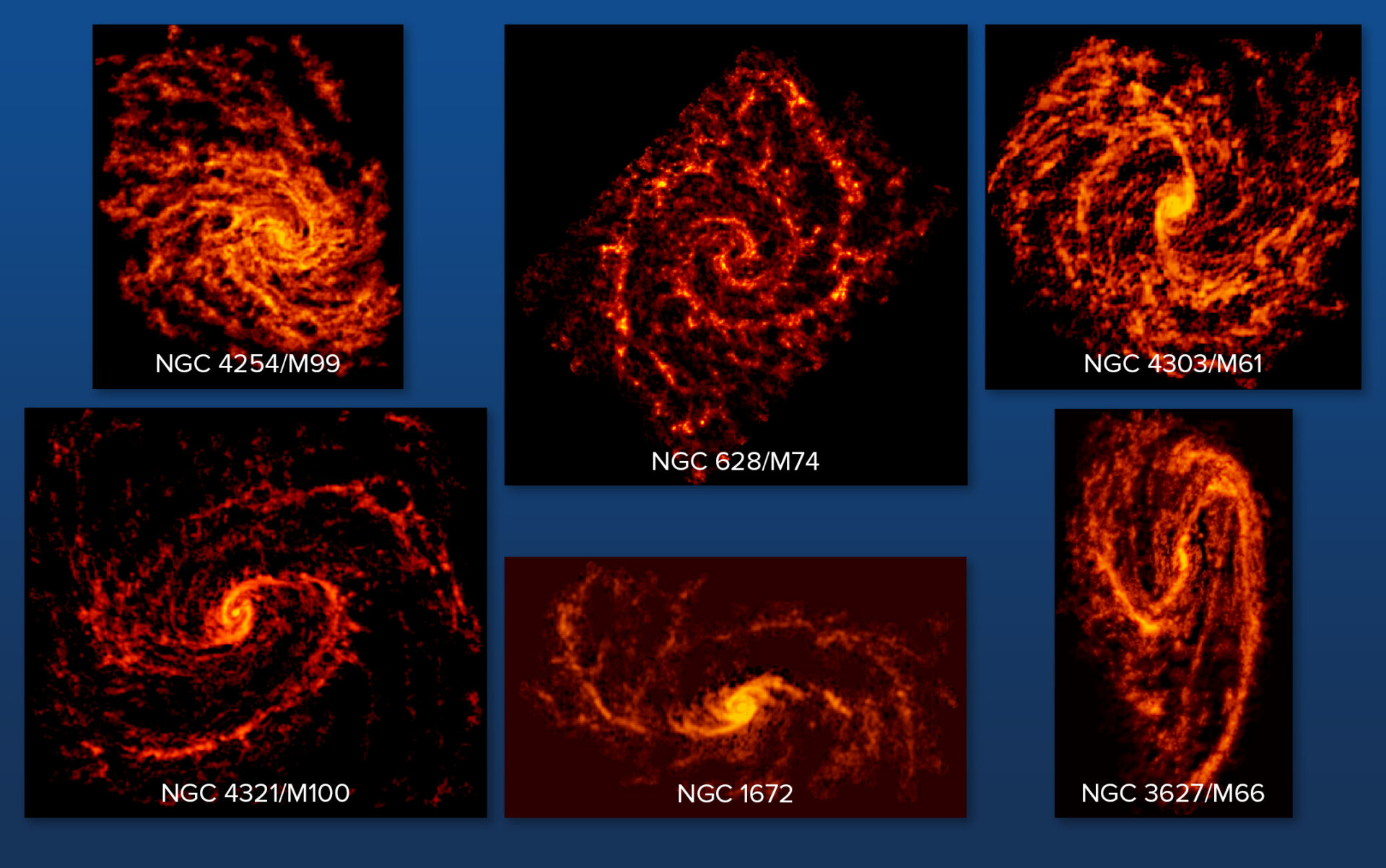
Galaxies come in a wide variety of shapes and sizes. Some of the most significant differences among galaxies, however, relate to where and how they form new stars. Compelling research to explain these differences has been elusive, but that is about to change. The Atacama Large Millimeter/submillimeter Array (ALMA) is conducting an unprecedented survey of nearby disk galaxies to study their stellar nurseries. With it, astronomers are beginning to unravel the complex and as-yet poorly understood relationship between star-forming clouds and their host galaxies.
A vast, new research project with ALMA, known as PHANGS-ALMA (Physics
at High Angular Resolution in Nearby GalaxieS), delves into this
question with far greater power and precision than ever before by
measuring the demographics and characteristics of a staggering 100,000
individual stellar nurseries spread throughout 74 galaxies.
PHANGS-ALMA, an unprecedented and ongoing research campaign, has
already amassed a total of 750 hours of observations and given
astronomers a much clearer understanding of how the cycle of star
formation changes, depending on the size, age, and internal dynamics of
each individual galaxy. This campaign is ten- to one-hundred-times more
powerful (depending on your parameters) than any prior survey of its
kind.
“Some galaxies are furiously bursting with new stars while others
have long ago used up most of their fuel for star formation. The origin
of this diversity may very likely lie in the properties of the stellar
nurseries themselves,” said Erik Rosolowsky, an astronomer at the
University of Alberta in Canada and a co-Principal Investigator of the
PHANGS-ALMA research team.
He presented initial findings of this research at the 233rd meeting of the American Astronomical Society being held this week in Seattle, Washington. Several papers based on this campaign have also been published in the Astrophysical Journal and the Astrophysical Journal Letters.
“Previous observations with earlier generations of radio telescopes provide some crucial insights about the nature of cold, dense stellar nurseries,” Rosolowsky said. “These observations, however, lacked the sensitivity, fine-scale resolution, and power to study the entire breadth of stellar nurseries across the full population of local galaxies. This severely limited our ability to connect the behavior or properties of individual stellar nurseries to the properties of the galaxies that they live in.”
For decades, astronomers have speculated that there are fundamental
differences in the way disk galaxies of various sizes convert hydrogen
into new stars. Some astronomers theorize that larger, and generally
older galaxies, are not as efficient at stellar production as their
smaller cousins. The most logical explanation would be that these big
galaxies have less efficient stellar nurseries. But testing this idea
with observations has been difficult.
For the first time, ALMA is allowing astronomers to conduct the
necessary wide-ranging census to determine how the large-scale
properties (size, motion, etc.) of a galaxy influence the cycle of star
formation on the scale of individual molecular clouds. These clouds are
only about a few tens to a few hundreds of light-years across, which is
phenomenally small on the scale of an entire galaxy, especially when
seen from millions of light-years away.
“Stars form more efficiently in some galaxies than others, but the
dearth of high-resolution, cloud-scale observations meant our theories
were weakly tested, which is why these ALMA observations are so
critical,” said Adam Leroy, an astronomer at The Ohio State University
and co-Principal Investigator on the PHANGS-ALMA team.
Part of the mystery of star formation, the astronomers note, has to
do with the interstellar medium – all the matter and energy that fills
the space between the stars.
Astronomers understand that there is an ongoing feedback loop in and
around the stellar nurseries. Within these clouds, pockets of dense gas
collapse and form stars, which disrupts the interstellar medium.
“Indeed, comparing early PHANGS observations with the locations of
newly formed stars shows that the newly formed stars quickly destroy
their birth clouds,” said Rosolowsky. “The PHANGS team is studying how
this disruption plays out in different types of galaxies, which may be a
key factor in star-forming efficiency.”
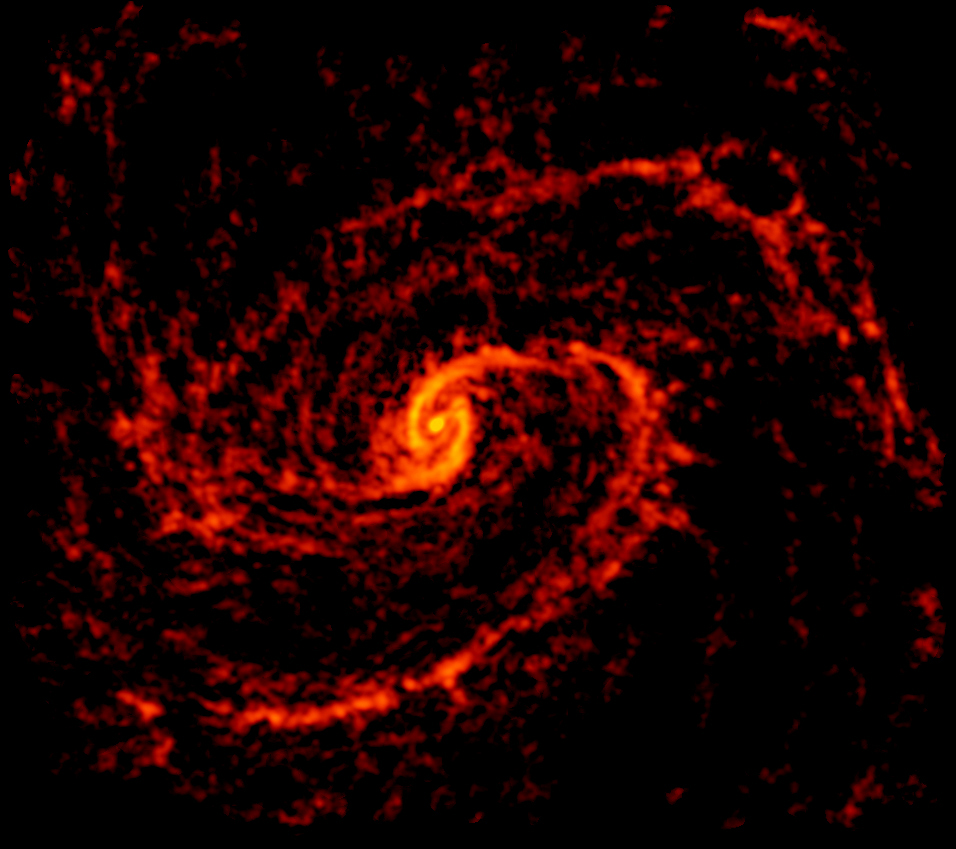
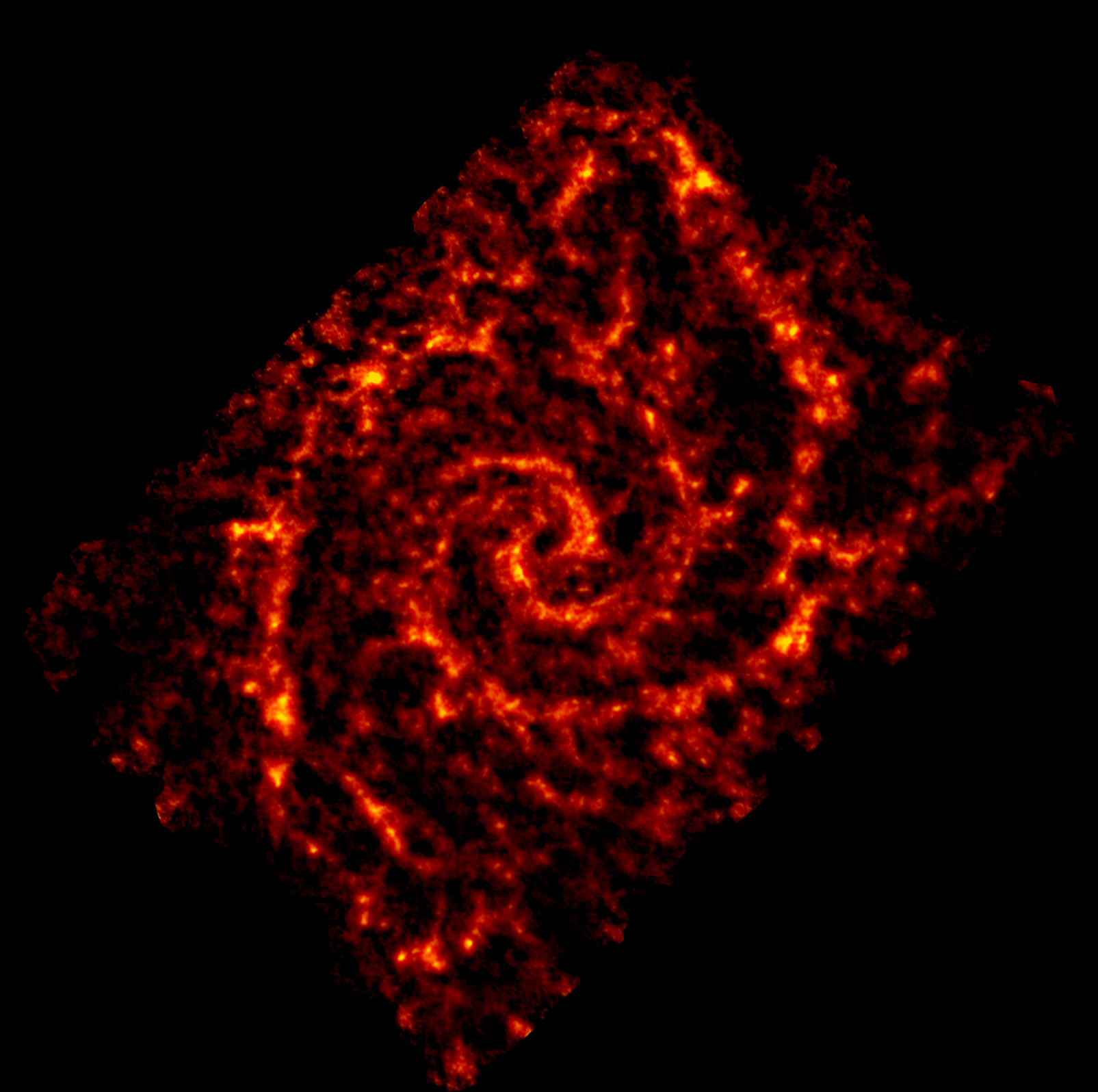
For this research, ALMA is observing molecules of carbon monoxide
(CO) from all relatively massive, generally face-on spiral galaxies
visible from the Southern Hemisphere. Molecules of CO naturally emit the
millimeter-wavelength light that ALMA can detect. They are particularly
effective at highlighting the location of star-forming clouds.
“ALMA is a stunningly efficient machine to map carbon monoxide over
large areas in nearby galaxies,” said Leroy. “It was able to perform
this survey because of the combined power of the 12-meter dishes, which
study fine-scale features, and the smaller, 7-meter dishes at the center
of the array, which are sensitive to large-scale features, essentially
filling in the gaps.”
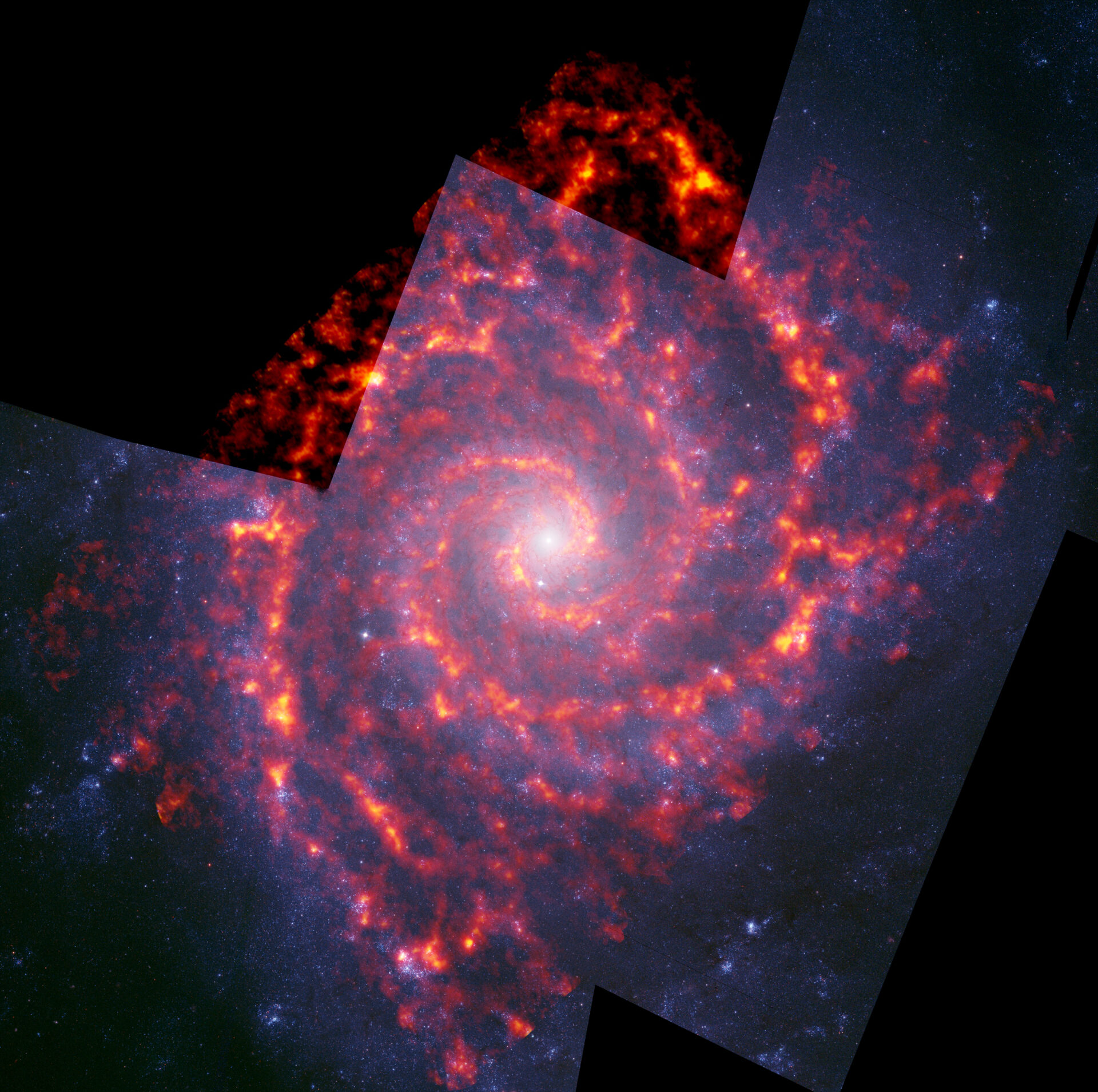
A companion survey, PHANGS-MUSE, is using the Very Large Telescope to
obtain optical imaging of the first 19 galaxies observed by ALMA. MUSE
stands for the Multi-Unit Spectroscopic Explorer. Another survey,
PHANGS-HST uses the Hubble Space Telescope to survey 38 of these
galaxies to find their youngest stellar clusters. Together, these three
surveys give a startlingly complete picture of how well galaxies form
stars by probing cold molecular gas, its motion, the location of ionized
gas (regions where stars are already forming), and the galaxies’
complete stellar populations.
“In astronomy, we have no ability to watch the cosmos change over
time; the timescales simply dwarf human existence,” noted Rosolowsky.
“We can’t watch one object forever, but we can observe hundreds of
thousands of star-forming clouds in galaxies of different sizes and ages
to infer how galactic evolution works. That is the real value of the
PHANGS-ALMA campaign.”
“We also look at thousands to tens of thousands of star-forming
regions within each galaxy, catching them across their life cycle. This
lets us build a picture of the birth and death of stellar nurseries
across galaxies, something almost impossible before ALMA,” added Leroy.
So far, PHANGS-ALMA has studied about 100,000 Orion Nebula-like
objects in the nearby universe. It is expected that the campaign will
eventually observe around 300,000 star-forming regions.
Additional Information
These results are being published in a series of papers in the
Astrophysical Journal and the Astrophysical Journal Letters. Already
accepted and published:
“Cloud-scale Molecular Gas Properties in 15 Nearby Galaxies,” J. Sun,
et al., 2018 June. 25, Astrophysical Journal
[http://iopscience.iop.org/article/10.3847/1538-4357/aac326]
“Star Formation Efficiency per Free-fall Time in nearby Galaxies,” D.
Utomo, et al., 2018 July 11, Astrophysical Journal Letters
[http://iopscience.iop.org/article/10.3847/2041-8213/aacf8f/meta]
“A 50 pc Scale View of Star Formation Efficiency across NGC 628,” K.
Kreckel, et al., 2018 August 14, Astrophysical Journal Letters
[http://iopscience.iop.org/article/10.3847/2041-8213/aad77d]
The Atacama Large Millimeter/submillimeter Array (ALMA), an
international astronomy facility, is a partnership of the European
Southern Observatory (ESO), the U.S. National Science Foundation (NSF)
and the National Institutes of Natural Sciences (NINS) of Japan in
cooperation with the Republic of Chile. ALMA is funded by ESO on behalf
of its Member States, by NSF in cooperation with the National Research
Council of Canada (NRC) and the Ministry of Science and Technology
(MOST) in Taiwan and by NINS in cooperation with the Academia Sinica
(AS) in Taiwan and the Korea Astronomy and Space Science Institute
(KASI).
ALMA construction and operations are led by ESO on behalf of its
Member States; by the National Radio Astronomy Observatory (NRAO),
managed by Associated Universities, Inc. (AUI), on behalf of North
America; and by the National Astronomical Observatory of Japan (NAOJ) on
behalf of East Asia. The Joint ALMA Observatory (JAO) provides the
unified leadership and management of the construction, commissioning and
operation of ALMA.
Contacts
Nicolás Lira
Education and Public Outreach Coordinator
Joint ALMA Observatory, Santiago - Chile
Phone: +56 2 2467 6519
Cell phone: +56 9 9445 7726
Email: nicolas.lira@alma.cl
Charles E. Blue
Public Information Officer
National Radio Astronomy Observatory Charlottesville, Virginia - USA
Phone: +1 434 296 0314
Cell phone: +1 202 236 6324
Email: cblue@nrao.edu
Calum Turner
ESO Assistant Public Information Officer
Garching bei München, Germany
Phone: +49 89 3200 6670
Email: calum.turner@eso.org
Masaaki Hiramatsu
Education and Public Outreach Officer, NAOJ Chile
Observatory , Tokyo - Japan
Phone: +81 422 34 3630
Email: hiramatsu.masaaki@nao.ac.jp
Contacts
Nicolás Lira
Education and Public Outreach Coordinator
Joint ALMA Observatory, Santiago - Chile
Phone: +56 2 2467 6519
Cell phone: +56 9 9445 7726
Email: nicolas.lira@alma.cl
Charles E. Blue
Public Information Officer
National Radio Astronomy Observatory Charlottesville, Virginia - USA
Phone: +1 434 296 0314
Cell phone: +1 202 236 6324
Email: cblue@nrao.edu
Calum Turner
ESO Assistant Public Information Officer
Garching bei München, Germany
Phone: +49 89 3200 6670
Email: calum.turner@eso.org
Masaaki Hiramatsu
Education and Public Outreach Officer, NAOJ Chile
Observatory , Tokyo - Japan
Phone: +81 422 34 3630
Email: hiramatsu.masaaki@nao.ac.jp