Showing posts with label M66. Show all posts

Wednesday, January 16, 2019

What 100,000 Star Factories in 74 Galaxies Tell Us about Star Formation across the Universe

 
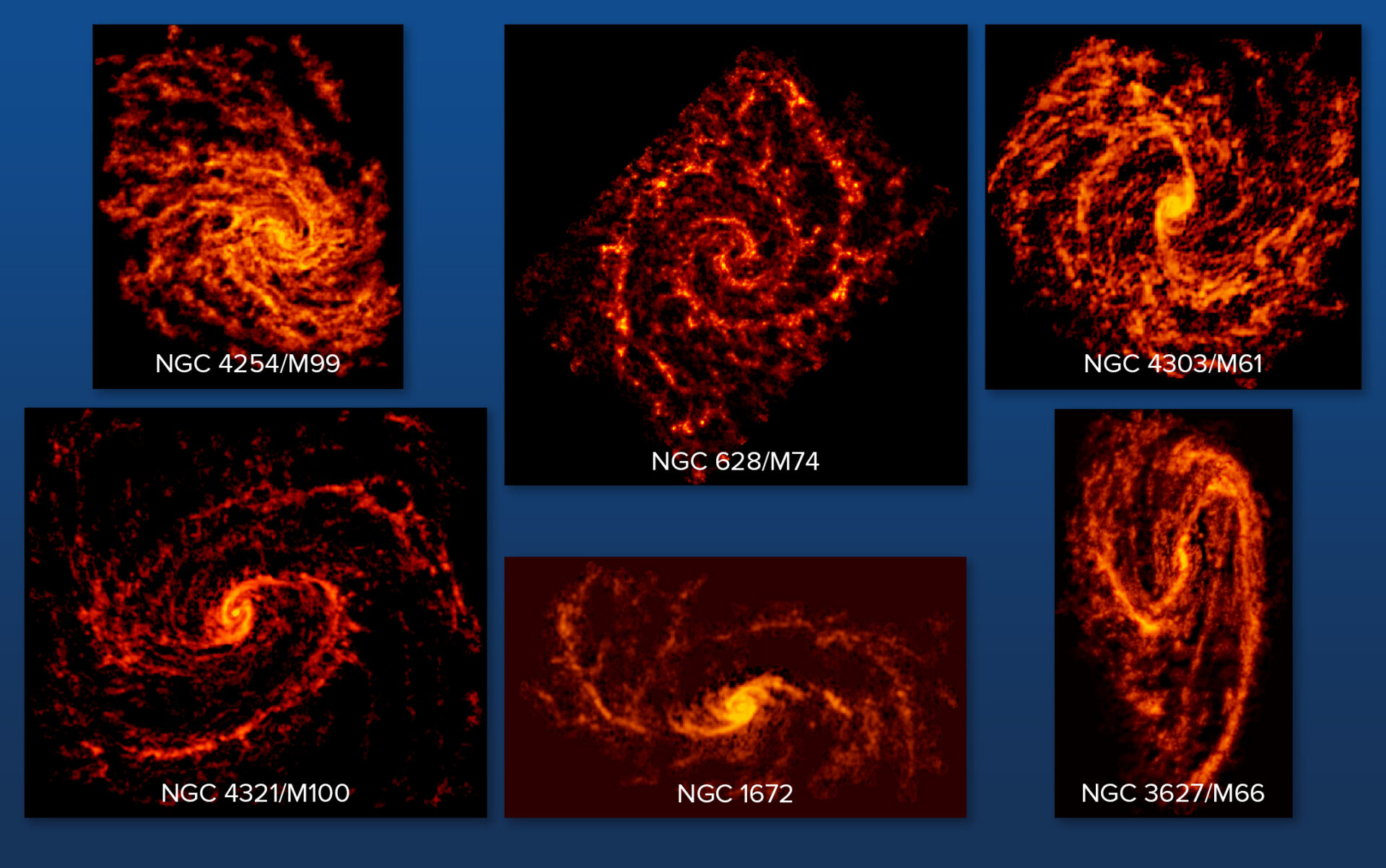
Six ALMA-imaged galaxies out of a collection of the 74. The images were taken as part of the PHANGS-ALMA survey to study the properties of star-forming clouds in disk galaxies. Credit: ALMA (ESO/NAOJ/NRAO); NRAO/AUI/NSF, B. Saxton. Hi-res image

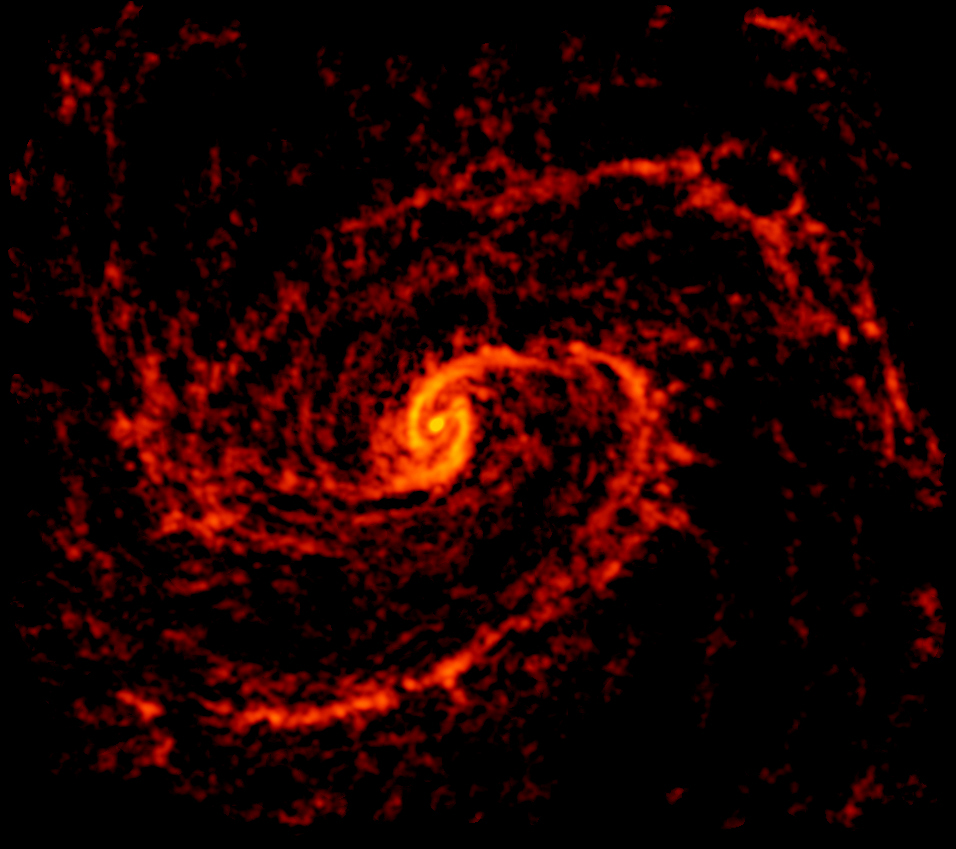
ALMA image of galaxy NGC 4321, also known as Messier 100, an intermediate spiral galaxy located about 55 million light-years from Earth in the constellation Coma Berenices. It is imaged as part of the PHANGS-ALMA survey to study the properties of star-forming clouds in disk galaxies. Credit: ALMA (ESO/NAOJ/NRAO); NRAO/AUI/NSF, B. Saxton. Hi-res image

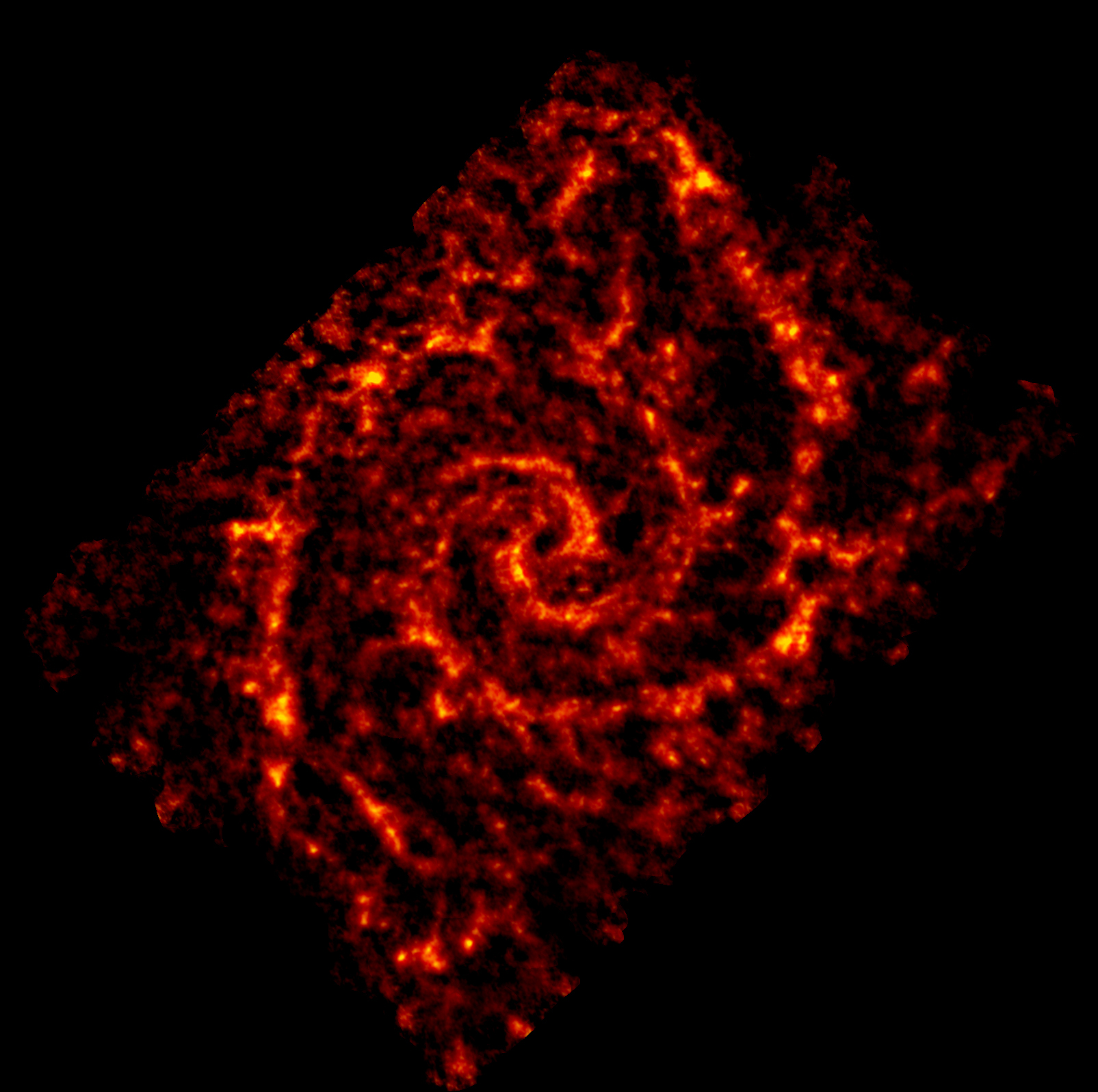
ALMA image of NGC 628, also known as Messier 74, a spiral galaxy in the constellation Pisces, located approximately 32 million light-years from Earth. It is imaged as part of the PHANGS-ALMA survey to study the properties of star-forming clouds in disk galaxies. Credit: ALMA (ESO/NAOJ/NRAO); NRAO/AUI/NSF, B. Saxton. Hi-res image

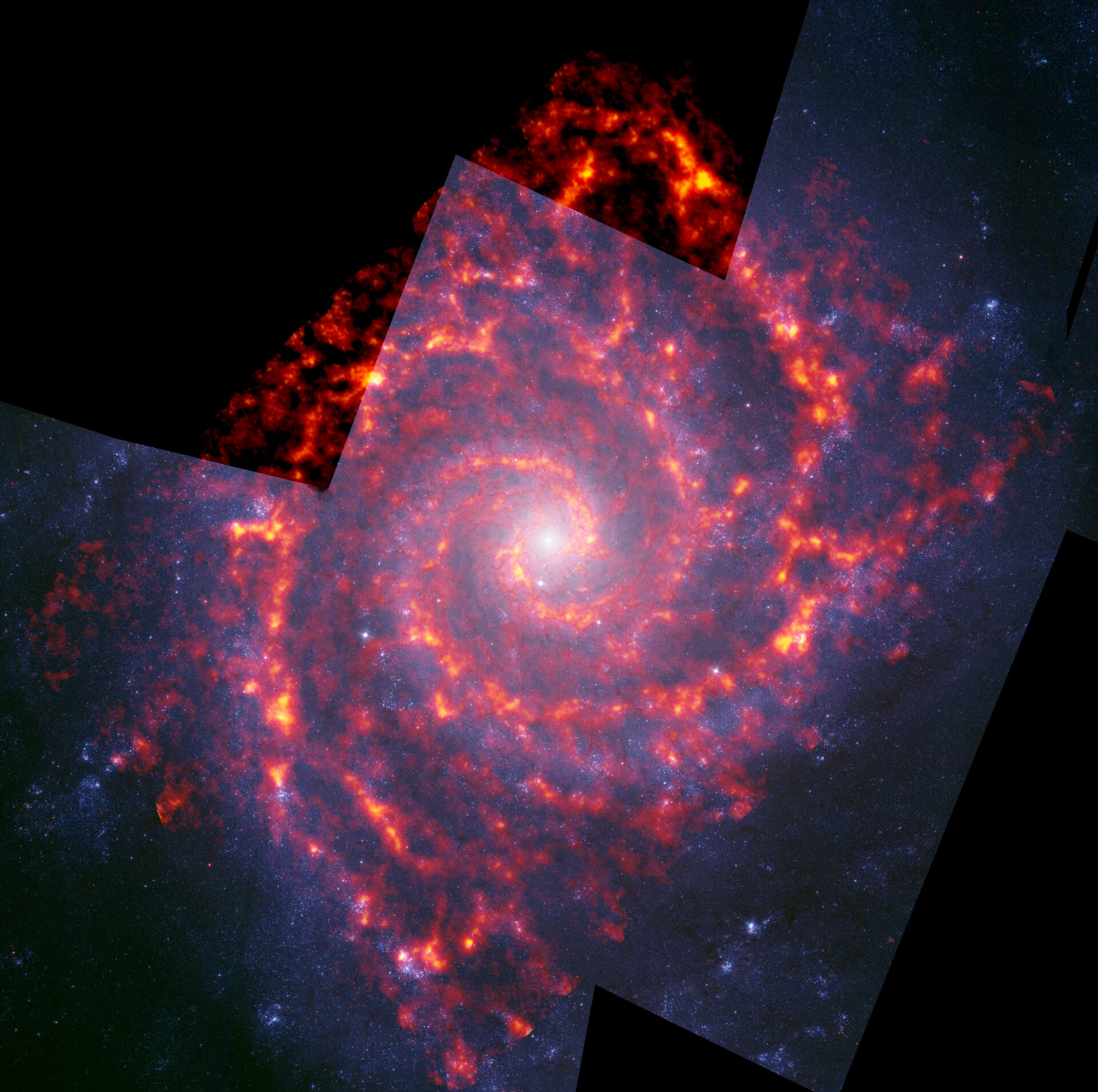
Composite ALMA (orange) and Hubble (blue) image of NGC 628, also known as Messier 74, a spiral galaxy in the constellation Pisces, located approximately 32 million light-years from Earth. It is imaged as part of the PHANGS-ALMA survey to study the properties of star-forming clouds in disk galaxies. Credit: NRAO/AUI/NSF, B. Saxton: ALMA (ESO/NAOJ/NRAO); NASA/Hubble. Hi-res image


Galaxies come in a wide variety of shapes and sizes. Some of the most significant differences among galaxies, however, relate to where and how they form new stars. Compelling research to explain these differences has been elusive, but that is about to change. The Atacama Large Millimeter/submillimeter Array (ALMA) is conducting an unprecedented survey of nearby disk galaxies to study their stellar nurseries. With it, astronomers are beginning to unravel the complex and as-yet poorly understood relationship between star-forming clouds and their host galaxies.

A vast, new research project with ALMA, known as PHANGS-ALMA (Physics at High Angular Resolution in Nearby GalaxieS), delves into this question with far greater power and precision than ever before by measuring the demographics and characteristics of a staggering 100,000 individual stellar nurseries spread throughout 74 galaxies.

PHANGS-ALMA, an unprecedented and ongoing research campaign, has already amassed a total of 750 hours of observations and given astronomers a much clearer understanding of how the cycle of star formation changes, depending on the size, age, and internal dynamics of each individual galaxy. This campaign is ten- to one-hundred-times more powerful (depending on your parameters) than any prior survey of its kind.

“Some galaxies are furiously bursting with new stars while others have long ago used up most of their fuel for star formation. The origin of this diversity may very likely lie in the properties of the stellar nurseries themselves,” said Erik Rosolowsky, an astronomer at the University of Alberta in Canada and a co-Principal Investigator of the PHANGS-ALMA research team.

He presented initial findings of this research at the 233rd meeting of the American Astronomical Society being held this week in Seattle, Washington. Several papers based on this campaign have also been published in the Astrophysical Journal and the Astrophysical Journal Letters. 

“Previous observations with earlier generations of radio telescopes provide some crucial insights about the nature of cold, dense stellar nurseries,” Rosolowsky said. “These observations, however, lacked the sensitivity, fine-scale resolution, and power to study the entire breadth of stellar nurseries across the full population of local galaxies. This severely limited our ability to connect the behavior or properties of individual stellar nurseries to the properties of the galaxies that they live in.”

For decades, astronomers have speculated that there are fundamental differences in the way disk galaxies of various sizes convert hydrogen into new stars. Some astronomers theorize that larger, and generally older galaxies, are not as efficient at stellar production as their smaller cousins. The most logical explanation would be that these big galaxies have less efficient stellar nurseries. But testing this idea with observations has been difficult.

For the first time, ALMA is allowing astronomers to conduct the necessary wide-ranging census to determine how the large-scale properties (size, motion, etc.) of a galaxy influence the cycle of star formation on the scale of individual molecular clouds. These clouds are only about a few tens to a few hundreds of light-years across, which is phenomenally small on the scale of an entire galaxy, especially when seen from millions of light-years away.

“Stars form more efficiently in some galaxies than others, but the dearth of high-resolution, cloud-scale observations meant our theories were weakly tested, which is why these ALMA observations are so critical,” said Adam Leroy, an astronomer at The Ohio State University and co-Principal Investigator on the PHANGS-ALMA team.

Part of the mystery of star formation, the astronomers note, has to do with the interstellar medium – all the matter and energy that fills the space between the stars.

Astronomers understand that there is an ongoing feedback loop in and around the stellar nurseries. Within these clouds, pockets of dense gas collapse and form stars, which disrupts the interstellar medium.

“Indeed, comparing early PHANGS observations with the locations of newly formed stars shows that the newly formed stars quickly destroy their birth clouds,” said Rosolowsky. “The PHANGS team is studying how this disruption plays out in different types of galaxies, which may be a key factor in star-forming efficiency.”

For this research, ALMA is observing molecules of carbon monoxide (CO) from all relatively massive, generally face-on spiral galaxies visible from the Southern Hemisphere. Molecules of CO naturally emit the millimeter-wavelength light that ALMA can detect. They are particularly effective at highlighting the location of star-forming clouds.

“ALMA is a stunningly efficient machine to map carbon monoxide over large areas in nearby galaxies,” said Leroy. “It was able to perform this survey because of the combined power of the 12-meter dishes, which study fine-scale features, and the smaller, 7-meter dishes at the center of the array, which are sensitive to large-scale features, essentially filling in the gaps.”

A companion survey, PHANGS-MUSE, is using the Very Large Telescope to obtain optical imaging of the first 19 galaxies observed by ALMA. MUSE stands for the Multi-Unit Spectroscopic Explorer. Another survey, PHANGS-HST uses the Hubble Space Telescope to survey 38 of these galaxies to find their youngest stellar clusters. Together, these three surveys give a startlingly complete picture of how well galaxies form stars by probing cold molecular gas, its motion, the location of ionized gas (regions where stars are already forming), and the galaxies’ complete stellar populations.

“In astronomy, we have no ability to watch the cosmos change over time; the timescales simply dwarf human existence,” noted Rosolowsky. “We can’t watch one object forever, but we can observe hundreds of thousands of star-forming clouds in galaxies of different sizes and ages to infer how galactic evolution works. That is the real value of the PHANGS-ALMA campaign.”

“We also look at thousands to tens of thousands of star-forming regions within each galaxy, catching them across their life cycle. This lets us build a picture of the birth and death of stellar nurseries across galaxies, something almost impossible before ALMA,” added Leroy.

So far, PHANGS-ALMA has studied about 100,000 Orion Nebula-like objects in the nearby universe. It is expected that the campaign will eventually observe around 300,000 star-forming regions.


Additional Information

These results are being published in a series of papers in the Astrophysical Journal and the Astrophysical Journal Letters. Already accepted and published:

“Cloud-scale Molecular Gas Properties in 15 Nearby Galaxies,” J. Sun, et al., 2018 June. 25, Astrophysical Journal [http://iopscience.iop.org/article/10.3847/1538-4357/aac326]

“Star Formation Efficiency per Free-fall Time in nearby Galaxies,” D. Utomo, et al., 2018 July 11, Astrophysical Journal Letters [http://iopscience.iop.org/article/10.3847/2041-8213/aacf8f/meta]

“A 50 pc Scale View of Star Formation Efficiency across NGC 628,” K. Kreckel, et al., 2018 August 14, Astrophysical Journal Letters [http://iopscience.iop.org/article/10.3847/2041-8213/aad77d]

The Atacama Large Millimeter/submillimeter Array (ALMA), an international astronomy facility, is a partnership of the European Southern Observatory (ESO), the U.S. National Science Foundation (NSF) and the National Institutes of Natural Sciences (NINS) of Japan in cooperation with the Republic of Chile. ALMA is funded by ESO on behalf of its Member States, by NSF in cooperation with the National Research Council of Canada (NRC) and the Ministry of Science and Technology (MOST) in Taiwan and by NINS in cooperation with the Academia Sinica (AS) in Taiwan and the Korea Astronomy and Space Science Institute (KASI).

ALMA construction and operations are led by ESO on behalf of its Member States; by the National Radio Astronomy Observatory (NRAO), managed by Associated Universities, Inc. (AUI), on behalf of North America; and by the National Astronomical Observatory of Japan (NAOJ) on behalf of East Asia. The Joint ALMA Observatory (JAO) provides the unified leadership and management of the construction, commissioning and operation of ALMA.


Contacts

Nicolás Lira
Education and Public Outreach Coordinator
Joint ALMA Observatory, Santiago - Chile
Phone: +56 2 2467 6519
Cell phone: +56 9 9445 7726
Email: nicolas.lira@alma.cl

Charles E. Blue
Public Information Officer
National Radio Astronomy Observatory Charlottesville, Virginia - USA
Phone: +1 434 296 0314
Cell phone: +1 202 236 6324
Email: cblue@nrao.edu

Calum Turner
ESO Assistant Public Information Officer
Garching bei München, Germany
Phone: +49 89 3200 6670
Email: calum.turner@eso.org

Masaaki Hiramatsu
Education and Public Outreach Officer, NAOJ Chile
Observatory
, Tokyo - Japan
Phone: +81 422 34 3630
Email: hiramatsu.masaaki@nao.ac.jp


Thursday, April 26, 2012

Dusty Stellar Nurseries from the Dark Side of a Galaxy

Left-hand panel: The red colors in this image show the galaxy M66 as it appears at the sub-mm wavelength of 850 microns, while the white background shows the galaxy as it appears in visible light. Regions of cold dust that appear as dark streaks in the white image glow brightly in the red image. Right-hand panel: The SCUBA-2 image at 850 microns seen on its own. Credit: VLT/ESO, JAC, G. Bendo. Full size image (JPG, 1.5MB)

One of the world’s most powerful cameras, SCUBA-2 is producing its first detailed images of our neighbouring galaxies, revealing previously undetected vast pockets of star formation where the next generation of stars is being created. The light from these stars is usually obscured by dust, but at the sub-millimetre wavelengths that the camera is designed for, these dust lanes actually glow brightly. The images are revealed in the week of the 25th anniversary of the James Clerk Maxwell Telescope (27 April 2012) on which SCUBA-2 is mounted.

"This exquisite image from the galaxy M66 in the constellation Leo is exactly the promising start we were hoping for," said Dr. Stephen Serjeant, the team's co-leader from The Open University. "This is a wonderfully exciting taste of things to come."

When looking up at the Milky Way, an irregular pattern of dark regions obscures the light of the stars. The dark patches are caused by clouds of dust trailing through the spiral arms and blocking out the starlight that would otherwise reveal vast pockets of star formation, or stellar nurseries. These dark lanes are not exclusive to the Milky Way, but can be found in all spiral galaxies.

SCUBA-2, led by STFC’s UK Astronomy Technology Centre in Edinburgh is the most powerful camera ever developed for observing light at sub-milimetre wavelengths, 1000 times longer than we can see with our eyes. This makes it possible to detect stellar nurseries usually obscured by dust that are so remote the light they emit left them within the first billion years after the big bang.

University of Edinburgh astrophysicist Professor James Dunlop said: "These beautiful new images from SCUBA-2 show energy conservation in action, as the same dust which absorbs the blue optical light (obscuring the stars in the optical images) can be seen to re-emit at the much longer wavelengths accessible to SCUBA-2."

This image promises to be the first of many stunning results from the James Clerk Maxwell Telescope Nearby Galaxy Legacy Survey (NGLS). The main aim of the survey is to understand how the broader environment of a galaxy affects its gas and dust content. For example, galaxies in dense clusters can lose their gas and dust through interactions with other galaxies in the cluster or simply by the head wind they feel while moving through the hot gas trapped inside the cluster. The NGLS is an international collaboration led by astronomers from Canada, the Netherlands, and the United Kingdom which is using SCUBA-2 to observe 150 galaxies in the local universe.

The NGLS team has spent much of the last five years studying molecular hydrogen emission using another instrument on the James Clerk Maxwell Telescope. "It is very exciting to now see the first results from the SCUBA-2 side of our programme starting to come in," says Professor Christine Wilson, the Principal Investigator from McMaster University in Canada. "We have a unique sample of galaxies that we are studying and having SCUBA-2 data will let us measure their gas and dust content. Gas and dust usually go hand-in-hand in galaxies, but from time to time, you find a surprise."

The James Clerk Maxwell Telescope
is situated at 14,000 feet atop Mauna Kea in Hawaii

Credit: Nik Szymanek. Full size image (JPG, 1.5MB)


Notes

Sub-millimetre Light

Sub-millimetre wavelengths are much smaller wavelengths than emitted by a typical radio station, but longer wavelengths than light waves or infrared wavelengths.

They are typically measured in microns, also called micrometres. One micron is one millionth of a metre, one 10,000th of a centimetre, or one 25,000th of an inch.

Submillimetre astronomy is most sensitive to very cold gas and dust. For example, a source with a temperature of 10 K (-263°C) emits most of its energy in a broad spectral region centred around 300 microns. Such very cold material is associated with objects in formation, that is, the mysterious earliest evolutionary stages of galaxies, stars and planets. If one wants to understand the origins of these most fundamental of astronomical structures, the submillimetre is the waveband of choice.

SCUBA-2 Key Facts

  • Size: 3m (height), 2.4m (width), 2.6m (depth)
  • Weight: 4.5 tonnes (about three times the weight of a typical car)
  • Temperature of detectors: 0.1K = -272.9°C = -459.2°F
  • Submillimetre camera with 5120 pixels (4 sub arrays x 1280 pixels) at each wavelength band
  • Provides a unique wide-field submillimetre imaging capability at 450 and 850 microns
  • Hundreds of times faster at mapping large areas of sky than predecessor SCUBA to the same signal-to-noise
  • Uses superconducting transition edge sensors as the light-sensitive elements
  • Addresses a wide-range of scientific issues including how galaxies, stars and planets form
  • Acts as a wide-field "pathfinder" for the new generation of submillimetre interferometers (e.g. SMA and ALMA)
A 2001 survey by the US-based Space Telescope Science Institute revealed that scientific results from SCUBA-2's predecessor, SCUBA had been cited almost as often as those from the Hubble Space Telescope, and much more so than those from any other ground-based facility or satellite project.

The project was funded by the Science and Technology Facilities Council (STFC), the Joint Astronomy Centre (JAC), and the Canada Foundation for Innovation (CFI).

James Clerk Maxwell Telescope

  • The James Clerk Maxwell Telescope (JCMT) is the world's largest single-dish submillimetre-wave telescope.
  • It collects faint submillimetre-wavelength signals with its 15 metre diameter dish.
  • It is situated near the summit of Mauna Kea on the Big Island of Hawaii, at an altitude of approximately 4000 metres (14000 feet) above sea level.
  • It is operated by the Joint Astronomy Centre, on behalf of the UK Science and Technology Facilities Council, the Canadian National Research Council, and the Netherlands Organisation for Scientific Research.

The JCMT webpage can be found at http://www.jach.hawaii.edu/JCMT/

McMaster University

The McMaster Physics and Astronomy webpage can be found at www.physics.mcmaster.ca

The Open University

The Open University Physical Sciences webpage can be found at www8.open.ac.uk/science/physical-science

Leiden Observatory
The Leiden Observatory webpage can be found at www.strw.leidenuniv.nl

Images

Images can be found and downloaded here


Contacts

Lucy Stone
Press Officer
STFC Rutherford Appleton Laboratory
Tel: +44 (0)1235 445627/07920870125

Please note that it is best to contact these individuals by email.

Stephanie Hills
STFC Media Manager
Desk: +44 (0)1235 445398
Email: stephanie.hills@stfc.ac.uk

Dr Holly Thomas
Joint Astronomy Centre
Desk: +1 808-969-6531
Fax: +1 808-961-6516
Email: h.thomas@jach.hawaii.edu

Science Contacts

Please note that it is best to contact these individuals by email.

Prof. Christine Wilson (NGLS PI)
Department of Physics and Astronomy,
McMaster University,
Hamilton, Ontario, L8S 4M1
Canada
Tel: 1 905 525 9140 (ext)27483
email: wilson@physics.mcmaster.ca

Dr Stephen Serjeant
Head of Astronomy,
The Open University,
Milton Keynes, MK7 6AA, UK
Tel: +44 (0)1908 652724
Mob: +44 (0)7946 605913
email: s.serjeant@open.ac.uk

Dr Antonio Chrysostomou
Associate Director, JCMT
Joint Astronomy Centre
Desk: +1 808-969-6512
Email: a.chrysostomou@jach.hawaii.edu

Further Information

University of Edinburgh's Institute for Astronomy
The Open University
McMaster University
Leiden Observatory
STFC