Showing posts with label NGC 300. Show all posts

Sunday, January 26, 2025

DECam and Gemini South Discover Three Tiny ‘Stellar-Ghost-Town’ Galaxies

PR Image noirlab2502a
Sculptor Galaxies


Videos

Cosmoview Episode 92: DECam and Gemini South Discover Three Tiny ‘Stellar-Ghost-Town’ Galaxies
PR Video noirlab2502a
Cosmoview Episode 92: DECam and Gemini South Discover Three Tiny ‘Stellar-Ghost-Town’ Galaxies

Cosmoview Episodio 92: DECam y Gemini Sur descubren tres diminutas ciudades fantasmas
PR Video noirlab2502b
Cosmoview Episodio 92: DECam y Gemini Sur descubren tres diminutas ciudades fantasmas

The Sculptor galaxies relative to NGC 300 (3D Visualization)
PR Video noirlab2502c
The Sculptor galaxies relative to NGC 300 (3D Visualization)

Panning across the Sculptor galaxies
PR Video noirlab2502d
Panning across the Sculptor galaxies


Rare ultra-faint dwarf galaxies beyond the influence of other galaxies show evidence that star formation was stifled long ago

By combining data from the DESI Legacy Imaging Surveys and the Gemini South telescope, astronomers have investigated three ultra-faint dwarf galaxies that reside in a region of space isolated from the environmental influence of larger objects. The galaxies, located in the direction of NGC 300, were found to contain only very old stars, supporting the theory that events in the early Universe cut star formation short in the smallest galaxies.

Ultra-faint dwarf galaxies are the faintest type of galaxy in the Universe. Typically containing just a few hundred to a thousand stars — compared with the hundreds of billions that make up the Milky Way — these small diffuse structures usually hide inconspicuously among the many brighter residents of the sky. For this reason, astronomers have previously had the most luck finding them nearby, in the vicinity of our own Milky Way Galaxy.

But this presents a problem for understanding them; the Milky Way’s gravitational forces and hot corona can strip away the dwarf galaxies’ gas and interfere with their natural evolution. Additionally, further out beyond the Milky Way, ultra-faint dwarf galaxies increasingly become too diffuse and unresolvable for astronomers and traditional computer algorithms to detect.

That’s why a manual, by-eye search by University of Arizona astronomer David Sand was needed to discover three faint and ultra-faint dwarf galaxies located in the direction of spiral galaxy NGC 300 and the Sculptor constellation. “It was during the pandemic,” recalls Sand. “I was watching TV and scrolling through the DESI Legacy Survey viewer, focusing on areas of sky that I knew hadn't been searched before. It took a few hours of casual searching, and then boom! They just popped out.”

The images uncovered by Sand were taken for the DECam Legacy Survey (DECaLS), one of three public surveys, known as the DESI Legacy Imaging Surveys [1], that jointly imaged 14,000 square degrees of sky to provide targets for the ongoing Dark Energy Spectroscopic Instrument (DESI) Survey. DECals was conducted using the 570-megapixel Department of Energy-fabricated Dark Energy Camera (DECam), mounted on the U.S. National Science Foundation (NSF) Víctor M. Blanco 4-meter Telescope at Cerro Tololo Inter-American Observatory (CTIO) in Chile, a Program of NSF NOIRLab.

The Sculptor galaxies, as they are referred to in the paper, are among the first ultra-faint dwarf galaxies found in a pristine, isolated environment free from the influence of the Milky Way or other large structures. To investigate the galaxies further, Sand and his team used the Gemini South telescope, one half of the International Gemini Observatory, partly funded by the NSF and operated by NSF NOIRLab. The results from their study are presented in a paper appearing in The Astrophysical Journal Letters, as well as at a press conference at the AAS 245 meeting in National Harbor, Maryland.

Gemini South’s Gemini Multi-Object Spectrograph (GMOS) captured all three galaxies in exquisite detail. An analysis of the data showed that they appear to be empty of gas and contain only very old stars, suggesting that their star formation was stifled a long time ago. This bolsters existing theories that ultra-faint dwarf galaxies are stellar ‘ghost towns’ where star formation was cut off in the early Universe.

This is exactly what astronomers would expect for such tiny objects. Gas is the crucial raw material required to coalesce and ignite the fusion of a new star. But ultra-faint dwarf galaxies just have too little gravity to hold onto this all-important ingredient, and it is easily lost when they are buffeted by the dynamic Universe they are part of.

But the Sculptor galaxies are far from any larger galaxies, meaning their gas could not have been removed by giant neighbors. An alternative explanation is an event called the Epoch of Reionization — a period not long after the Big Bang when high-energy ultraviolet photons filled the cosmos, potentially boiling away the gas in the smallest galaxies. Another possibility is that some of the earliest stars in the dwarf galaxies underwent energetic supernova explosions, emitting ejecta at up to 35 million kilometers per hour (about 20 million miles per hour) and pushing the gas out of their own hosts from within.

If reionization is responsible, these galaxies would open a window into studying the very early Universe. “We don’t know how strong or uniform this reionization effect is,” explains Sand. “It could be that reionization is patchy, not occurring everywhere all at once. We’ve found three of these galaxies, but that isn’t enough. It would be nice if we had hundreds of them. If we knew what fraction was affected by reionization, that would tell us something about the early Universe that is very difficult to probe otherwise.”

“The Epoch of Reionization potentially connects the current day structure of all galaxies with the earliest formation of structure on a cosmological scale,” says Martin Still, NSF program director for the International Gemini Observatory. “The DESI Legacy Surveys and detailed follow-up observations by Gemini allow scientists to perform forensic archeology to understand the nature of the Universe and how it evolved to its current state.”

To speed up the search for more ultra-faint dwarf galaxies, Sand and his team are using the Sculptor galaxies to train an artificial intelligence system called a neural network to identify more. The hope is that this tool will be able to automate and accelerate discoveries, offering a much vaster dataset from which astronomers can draw stronger conclusions.


Notes

[1] The DESI Legacy Imaging Surveys data are served to the astronomical community via the Astro Data Lab at NSF NOIRLab’s Community Science and Data Center (CSDC).


More information

TThis research was presented in a paper entitled “Three Quenched, Faint Dwarf Galaxies in the Direction of NGC 300: New Probes of Reionization and Internal Feedback” to appear in The Astrophysical Journal Letters. DOI: 10.3847/2041-8213/ad927c

The team is composed of David J. Sand (University of Arizona), Burçin Mutlu-Pakdil (Dartmouth College), Michael G. Jones (University of Arizona), Ananthan Karunakaran (University of Toronto), Jennifer E. Andrews (International Gemini Observatory/NSF NOIRLab), Paul Bennet (Space Telescope Science Institute), Denija Crnojević (University of Tampa), Giuseppe Donatiello (Unione Astrofili Italiani), Alex Drlica-Wagner (Fermi National Accelerator Laboratory, Kavli Institute for Cosmological Physics, University of Chicago), Catherine Fielder (University of Arizona), David Martínez-Delgado (Unidad Asociada al CSIC), Clara E. Martínez-Vázquez (International Gemini Observatory/NSF NOIRLab), Kristine Spekkens (Queen’s University), Amandine Doliva-Dolinsky (Dartmouth College, University of Tampa), Laura C. Hunter (Dartmouth College), Jeffrey L. Carlin (AURA/Rubin Observatory), William Cerny (Yale University), Tehreem N. Hai (Rutgers, the State University of New Jersey), Kristen B.W. McQuinn (Space Telescope Science Institute, Rutgers, the State University of New Jersey), Andrew B. Pace (University of Virginia), and Adam Smercina (Space Telescope Science Institute)

Data for DECaLS were obtained at the U.S. National Science Foundation Víctor M. Blanco 4-meter telescope at NSF Cerro Tololo Inter-American Observatory, a Program of NSF NOIRLab. Pipeline processing and analyses of the data were supported by NOIRLab and the Lawrence Berkeley National Laboratory (LBNL). The Legacy Surveys project is supported by the U.S. Department of Energy (DOE) Office of Science, DOE Office of High Energy Physics, the National Energy Research Scientific Computing Center and by the U.S. National Science Foundation, Division of Astronomical Sciences.


NSF NOIRLab, the U.S. National Science Foundation center for ground-based optical-infrared astronomy, operates the International Gemini Observatory (a facility of NSF, NRC–Canada, ANID–Chile, MCTIC–Brazil, MINCyT–Argentina, and KASI–Republic of Korea), NSF Kitt Peak National Observatory (KPNO), NSF Cerro Tololo Inter-American Observatory (CTIO), the Community Science and Data Center (CSDC), and NSF–DOE Vera C. Rubin Observatory (in cooperation with DOE’s SLAC National Accelerator Laboratory). It is managed by the Association of Universities for Research in Astronomy (AURA) under a cooperative agreement with NSF and is headquartered in Tucson, Arizona.

The scientific community is honored to have the opportunity to conduct astronomical research on I’oligam Du’ag (Kitt Peak) in Arizona, on Maunakea in Hawai‘i, and on Cerro Tololo and Cerro Pachón in Chile. We recognize and acknowledge the very significant cultural role and reverence of I’oligam Du’ag (Kitt Peak) to the Tohono O’odham Nation, and Maunakea to the Kanaka Maoli (Native Hawaiians) community.


Links


Contacts

David Sand
Professor & Astronomer
University of Arizona/Steward Observatory
Email:
dsand@arizona.edu

Josie Fenske
Jr. Public Information Officer
NSF NOIRLab
Email:
josie.fenske@noirlab.edu


Sunday, January 19, 2025

DECam and Gemini South Discover Three Tiny ‘Stellar-Ghost-Town’ Galaxies

PR Image noirlab2502a
Sculptor Galaxies


PR Image noirlab2502d
Sculptor C


Videos

Cosmoview Episode 93: DECam and Gemini South Discover Three Tiny ‘Stellar-Ghost-Town’ Galaxies
PR Video noirlab2502a
Cosmoview Episode 93: DECam and Gemini South Discover Three Tiny ‘Stellar-Ghost-Town’ Galaxies

Cosmoview Episodio 93: DECam y Gemini Sur descubren tres diminutas ciudades fantasmas
PR Video noirlab2502b
Cosmoview Episodio 93: DECam y Gemini Sur descubren tres diminutas ciudades fantasmas

The Sculptor galaxies relative to NGC 300 (3D Visualization)
PR Video noirlab2502c
The Sculptor galaxies relative to NGC 300 (3D Visualization)

Panning across the Sculptor galaxies
PR Video noirlab2502d
Panning across the Sculptor galaxies


Rare ultra-faint dwarf galaxies beyond the influence of other galaxies show evidence that star formation was stifled long ago

By combining data from the DESI Legacy Imaging Surveys and the Gemini South telescope, astronomers have investigated three ultra-faint dwarf galaxies that reside in a region of space isolated from the environmental influence of larger objects. The galaxies, located in the direction of NGC 300, were found to contain only very old stars, supporting the theory that events in the early Universe cut star formation short in the smallest galaxies.

Ultra-faint dwarf galaxies are the faintest type of galaxy in the Universe. Typically containing just a few hundred to a thousand stars — compared with the hundreds of billions that make up the Milky Way — these small diffuse structures usually hide inconspicuously among the many brighter residents of the sky. For this reason, astronomers have previously had the most luck finding them nearby, in the vicinity of our own Milky Way Galaxy.

But this presents a problem for understanding them; the Milky Way’s gravitational forces and hot corona can strip away the dwarf galaxies’ gas and interfere with their natural evolution. Additionally, further out beyond the Milky Way, ultra-faint dwarf galaxies increasingly become too diffuse and unresolvable for astronomers and traditional computer algorithms to detect.

That’s why a manual, by-eye search by University of Arizona astronomer David Sand was needed to discover three faint and ultra-faint dwarf galaxies located in the direction of spiral galaxy NGC 300 and the Sculptor constellation. “It was during the pandemic,” recalls Sand. “I was watching TV and scrolling through the DESI Legacy Survey viewer, focusing on areas of sky that I knew hadn't been searched before. It took a few hours of casual searching, and then boom! They just popped out.”

The images uncovered by Sand were taken for the DECam Legacy Survey (DECaLS), one of three public surveys, known as the DESI Legacy Imaging Surveys [1], that jointly imaged 14,000 square degrees of sky to provide targets for the ongoing Dark Energy Spectroscopic Instrument (DESI) Survey. DECals was conducted using the 570-megapixel Department of Energy-fabricated Dark Energy Camera (DECam), mounted on the U.S. National Science Foundation (NSF) Víctor M. Blanco 4-meter Telescope at Cerro Tololo Inter-American Observatory (CTIO) in Chile, a Program of NSF NOIRLab.

The Sculptor galaxies, as they are referred to in the paper, are among the first ultra-faint dwarf galaxies found in a pristine, isolated environment free from the influence of the Milky Way or other large structures. To investigate the galaxies further, Sand and his team used the Gemini South telescope, one half of the International Gemini Observatory, partly funded by the NSF and operated by NSF NOIRLab. The results from their study are presented in a paper appearing in The Astrophysical Journal Letters, as well as at a press conference at the AAS 245 meeting in National Harbor, Maryland.

Gemini South’s Gemini Multi-Object Spectrograph (GMOS) captured all three galaxies in exquisite detail. An analysis of the data showed that they appear to be empty of gas and contain only very old stars, suggesting that their star formation was stifled a long time ago. This bolsters existing theories that ultra-faint dwarf galaxies are stellar ‘ghost towns’ where star formation was cut off in the early Universe.

This is exactly what astronomers would expect for such tiny objects. Gas is the crucial raw material required to coalesce and ignite the fusion of a new star. But ultra-faint dwarf galaxies just have too little gravity to hold onto this all-important ingredient, and it is easily lost when they are buffeted by the dynamic Universe they are part of.

But the Sculptor galaxies are far from any larger galaxies, meaning their gas could not have been removed by giant neighbors. An alternative explanation is an event called the Epoch of Reionization — a period not long after the Big Bang when high-energy ultraviolet photons filled the cosmos, potentially boiling away the gas in the smallest galaxies. Another possibility is that some of the earliest stars in the dwarf galaxies underwent energetic supernova explosions, emitting ejecta at up to 35 million kilometers per hour (about 20 million miles per hour) and pushing the gas out of their own hosts from within.

If reionization is responsible, these galaxies would open a window into studying the very early Universe. “We don’t know how strong or uniform this reionization effect is,” explains Sand. “It could be that reionization is patchy, not occurring everywhere all at once. We’ve found three of these galaxies, but that isn’t enough. It would be nice if we had hundreds of them. If we knew what fraction was affected by reionization, that would tell us something about the early Universe that is very difficult to probe otherwise.”

“The Epoch of Reionization potentially connects the current day structure of all galaxies with the earliest formation of structure on a cosmological scale,” says Martin Still, NSF program director for the International Gemini Observatory. “The DESI Legacy Surveys and detailed follow-up observations by Gemini allow scientists to perform forensic archeology to understand the nature of the Universe and how it evolved to its current state.”

To speed up the search for more ultra-faint dwarf galaxies, Sand and his team are using the Sculptor galaxies to train an artificial intelligence system called a neural network to identify more. The hope is that this tool will be able to automate and accelerate discoveries, offering a much vaster dataset from which astronomers can draw stronger conclusions.


Notes

[1] The DESI Legacy Imaging Surveys data are served to the astronomical community via the Astro Data Lab at NSF NOIRLab’s Community Science and Data Center (CSDC).


More information

This research was presented in a paper entitled “Three Quenched, Faint Dwarf Galaxies in the Direction of NGC 300: New Probes of Reionization and Internal Feedback” to appear in The Astrophysical Journal Letters. DOI: 10.3847/2041-8213/ad927c

The team is composed of David J. Sand (University of Arizona), Burçin Mutlu-Pakdil (Dartmouth College), Michael G. Jones (University of Arizona), Ananthan Karunakaran (University of Toronto), Jennifer E. Andrews (International Gemini Observatory/NSF NOIRLab), Paul Bennet (Space Telescope Science Institute), Denija Crnojević (University of Tampa), Giuseppe Donatiello (Unione Astrofili Italiani), Alex Drlica-Wagner (Fermi National Accelerator Laboratory, Kavli Institute for Cosmological Physics, University of Chicago), Catherine Fielder (University of Arizona), David Martínez-Delgado (Unidad Asociada al CSIC), Clara E. Martínez-Vázquez (International Gemini Observatory/NSF NOIRLab), Kristine Spekkens (Queen’s University), Amandine Doliva-Dolinsky (Dartmouth College, University of Tampa), Laura C. Hunter (Dartmouth College), Jeffrey L. Carlin (AURA/Rubin Observatory), William Cerny (Yale University), Tehreem N. Hai (Rutgers, the State University of New Jersey), Kristen B.W. McQuinn (Space Telescope Science Institute, Rutgers, the State University of New Jersey), Andrew B. Pace (University of Virginia), and Adam Smercina (Space Telescope Science Institute)

NSF NOIRLab, the U.S. National Science Foundation center for ground-based optical-infrared astronomy, operates the International Gemini Observatory (a facility of NSF, NRC–Canada, ANID–Chile, MCTIC–Brazil, MINCyT–Argentina, and KASI–Republic of Korea), NSF Kitt Peak National Observatory (KPNO), NSF Cerro Tololo Inter-American Observatory (CTIO), the Community Science and Data Center (CSDC), and NSF–DOE Vera C. Rubin Observatory (in cooperation with DOE’s SLAC National Accelerator Laboratory). It is managed by the Association of Universities for Research in Astronomy (AURA) under a cooperative agreement with NSF and is headquartered in Tucson, Arizona.

The scientific community is honored to have the opportunity to conduct astronomical research on I’oligam Du’ag (Kitt Peak) in Arizona, on Maunakea in Hawai‘i, and on Cerro Tololo and Cerro Pachón in Chile. We recognize and acknowledge the very significant cultural role and reverence of I’oligam Du’ag (Kitt Peak) to the Tohono O’odham Nation, and Maunakea to the Kanaka Maoli (Native Hawaiians) community.


Links


Contacts:

David Sand
Professor & Astronomer
University of Arizona/Steward Observatory
Email:
dsand@arizona.edu

Josie Fenske
Jr. Public Information Officer
NSF NOIRLab
Email:
josie.fenske@noirlab.edu


Monday, February 25, 2019

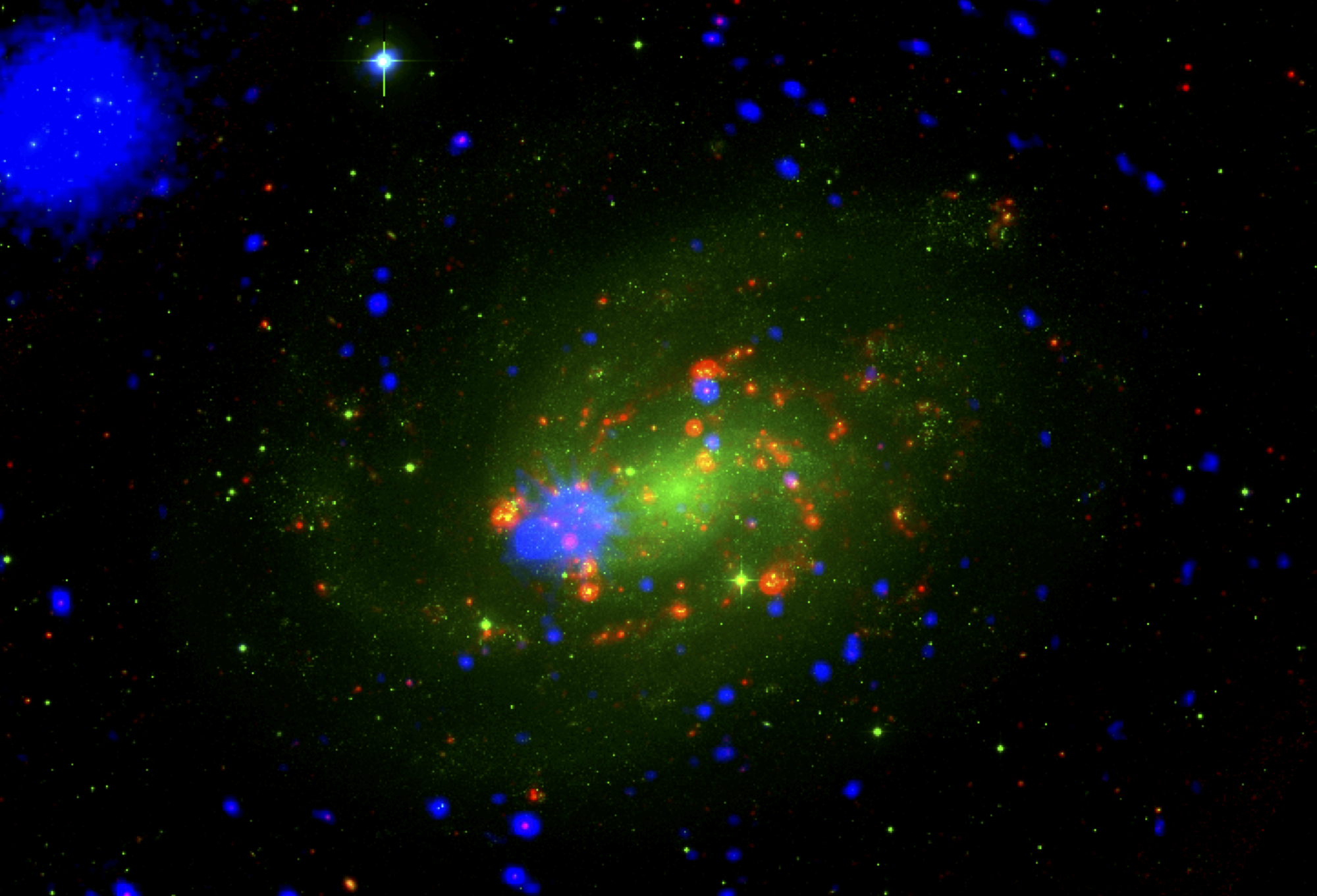
Past and future generations of stars in NGC 300

Past and future generations of stars in NGC 300
Copyright: ESA/XMM-Newton (X-rays); MPG/ESO (optical); NASA/Spitzer (infrared)
Acknowledgement: S. Carpano, Max-Planck Institute for Extraterrestrial Physics

JPG - (1.48 MB) / PNG - (7.99 MB)

This swirling palette of colours portrays the life cycle of stars in a spiral galaxy known as NGC 300.

Located some six million light-years away, NGC 300 is relatively nearby. It is one of the closest galaxies beyond the Local Group – the hub of galaxies to which our own Milky Way galaxy belongs. Due to its proximity, it is a favourite target for astronomers to study stellar processes in spiral galaxies.

The population of stars in their prime is shown in this image in green hues, based on optical observations performed with the Wide Field Imager (WFI) on the MPG/ESO 2.2-metre telescope at La Silla, Chile. Red colours indicate the glow of cosmic dust in the interstellar medium that pervades the galaxy: this information derives from infrared observations made with NASA’s Spitzer space telescope, and can be used to trace stellar nurseries and future stellar generations across NGC 300.

A complementary perspective on this galaxy’s composition comes from data collected in X-rays by ESA’s XMM-Newton space observatory, shown in blue. These represent the end points of the stellar life cycle, including massive stars on the verge of blasting out as supernovas, remnants of supernova explosions, neutron stars, and black holes. Many of these X-ray sources are located in NGC 300, while others – especially towards the edges of the image – are foreground objects in our own Galaxy, or background galaxies even farther away.

The sizeable blue blob immediately to the left of the galaxy’s centre is especially interesting, featuring two intriguing sources that are part of NGC 300 and shine brightly in X-rays.

One of them, known as NGC 300 X-1, is in fact a binary system, consisting of a Wolf-Rayet star – an ageing hot, massive and luminous type star that drives strong winds into its surroundings – and a black hole, the compact remains of what was once another massive, hot star. As matter from the star flows towards the black hole, it is heated up to temperatures of millions of degrees or more, causing it to shine in X-rays.

The other source, dubbed NGC 300 ULX1, was originally identified as a supernova explosion in 2010. However, later observations prompted astronomers to reconsider this interpretation, indicating that this source also conceals a binary system comprising a very massive star and a compact object – a neutron star or a black hole – feeding on material from its stellar companion.

Data obtained in 2016 with ESA’s XMM-Newton and NASA’s NuSTAR observatories revealed regular variations in the X-ray signal of NGC 300 ULX1, suggesting that the compact object in this binary system is a highly magnetized, rapidly spinning neutron star, or pulsar.

The large blue blob in the upper left corner is a much more distant object: a cluster of galaxies more than one billion light years away, whose X-ray glow is caused by the hot diffuse gas interspersed between the galaxies.

Explore NGC 300 in ESASky


Wednesday, September 08, 2010

A Nearby Galactic Exemplar

PR Image eso1037a
Wide Field Imager view of the southern spiral NGC 300

PR Image eso1037b
NGC 300 in the constellation of Sculptor

PR Video eso1037a
Panning across the southern spiral NGC 300
Zooming into the southern spiral NGC 300

ESO has released a spectacular new image of NGC 300, a spiral galaxy similar to the Milky Way, and located in the nearby Sculptor Group of galaxies. Taken with the Wide Field Imager (WFI) at ESO’s La Silla Observatory in Chile, this 50-hour exposure reveals the structure of the galaxy in exquisite detail. NGC 300 lies about six million light-years away and appears to be about two thirds the size of the full Moon on the sky.

Originally discovered from Australia by the Scottish astronomer James Dunlop early in the nineteenth century, NGC 300 is one of the closest and most prominent spiral galaxies in the southern skies and is bright enough to be seen easily in binoculars. It lies in the inconspicuous constellation of Sculptor, which has few bright stars, but is home to a collection of nearby galaxies that form the Sculptor Group [1]. Other members that have been imaged by ESO telescopes include NGC 55 (eso0914), NGC 253 (eso1025, eso0902) and NGC 7793 (eso0914). Many galaxies have at least some slight peculiarity, but NGC 300 seems to be remarkably normal. This makes it an ideal specimen for astronomers studying the structure and content of spiral galaxies such as our own.

This picture from the Wide Field Imager (WFI) at ESO’s La Silla Observatory in Chile was assembled from many individual images taken through a large set of different filters with a total exposure time close to 50 hours. The data was acquired over many observing nights, spanning several years. The main purpose of this extensive observational campaign was to take an unusually thorough census of the stars in the galaxy, counting both the number and varieties of the stars, and marking regions, or even individual stars, that warrant deeper and more focussed investigation. But such a rich data collection will also have many other uses for years to come. By observing the galaxy with filters that isolate the light coming specifically from hydrogen and oxygen, the many star-forming regions along NGC 300’s spiral arms are shown with particular clarity in this image as red and pink clouds. With its huge field of view, 34 x 34 arcminutes, similar to the apparent size of the full Moon in the sky, the WFI is an ideal tool for astronomers to study large objects such as NGC 300.

NGC 300 is also the home of many interesting astronomical phenomena that have been studied with ESO telescopes. ESO astronomers recently discovered the most distant and one of the most massive stellar-mass black holes yet found (eso1004) in this galaxy, as the partner of a hot and luminous Wolf–Rayet star in a binary system. NGC 300 and another galaxy, NGC 55, are slowly spinning around and towards each other, in the early stages of a lengthy merging process (eso0914). The current best estimate of the distance to the NCG 300 was also determined by astronomers using ESO’s Very Large Telescope at the Paranal Observatory (eso0524), among others.

Notes

[1] Although it is normally considered as member of the Sculptor Group, the most recent distance measurements show that NGC 300 lies significantly closer to us than many of the other galaxies in the group and may be only loosely associated with them.

More information

ESO, the European Southern Observatory, is the foremost intergovernmental astronomy organisation in Europe and the world’s most productive astronomical observatory. It is supported by 14 countries: Austria, Belgium, the Czech Republic, Denmark, France, Finland, Germany, Italy, the Netherlands, Portugal, Spain, Sweden, Switzerland and the United Kingdom. ESO carries out an ambitious programme focused on the design, construction and operation of powerful ground-based observing facilities enabling astronomers to make important scientific discoveries. ESO also plays a leading role in promoting and organising cooperation in astronomical research. ESO operates three unique world-class observing sites in Chile: La Silla, Paranal and Chajnantor. At Paranal, ESO operates the Very Large Telescope, the world’s most advanced visible-light astronomical observatory and VISTA, the world’s largest survey telescope. ESO is the European partner of a revolutionary astronomical telescope ALMA, the largest astronomical project in existence. ESO is currently planning a 42-metre European Extremely Large optical/near-infrared Telescope, the E-ELT, which will become “the world’s biggest eye on the sky”.

Contacts

Richard Hook
ESO, La Silla, Paranal, E-ELT and Survey telescopes Press Officer
Garching bei München, Germany
Tel: +49 89 3200 6655