Showing posts with label early-type galaxies” (ETGs). Show all posts

Friday, August 17, 2018

Astronomers Identify Some of the Earliest Galaxies in the Universe

The distribution of satellite galaxies orbiting a computer-simulated galaxy, as predicted by the Lambda-cold-dark-matter cosmological model. The blue circles surround the brighter satellites, the white circles the ultrafaint satellites (so faint that they are not readily visible in the image). The ultrafaint satellites are amongst the most ancient galaxies in the Universe; they began to form when the Universe was only about 100 million years old (compared to its current age of 13.8 billion years). The image has been generated from simulations from the Auriga project carried out by researchers at the Institute for Computational Cosmology, Durham University, UK, the Heidelberg Institute for Theoretical Studies, Germany, and the Max Planck Institute for Astrophysics, Germany. Credit: Durham ICC/HITS/MPIA/Auriga/S. Bose et al. Low Resolution (jpg)


Cambridge, MA - Astronomers from Durham University and the Harvard-Smithsonian Center for Astrophysics (CfA) have found evidence that the faintest satellite galaxies orbiting our own Milky Way galaxy are among the very first galaxies that formed in our Universe.

The research group’s results suggest that galaxies including Segue-1, Bootes I, Tucana II and Ursa Major I are, in fact, some of the first galaxies ever formed, thought to be over 13 billion years old. Their findings are published in The Astrophysical Journal.

When the Universe was about 380,000 years old, the very first atoms formed. These were hydrogen atoms, the simplest element in the periodic table. These atoms collected into clouds and began to cool gradually and settle into the small clumps or "halos" of dark matter that emerged from the Big Bang.

This cooling phase, known as the "cosmic dark ages," lasted about 100 million years. Eventually, the gas that had cooled inside the halos became unstable and began to form stars. These objects are the very first galaxies ever to have formed. With the formation of the first galaxies, the Universe burst into light, bringing the cosmic dark ages to an end.

Dr. Sownak Bose of the CfA, working with Dr. Alis Deason and Professor Carlos Frenk at Durham University's Institute for Computational Cosmology (ICC), identified two populations of satellite galaxies orbiting the Milky Way.

The first was a very faint population consisting of the galaxies that formed at the end of the “cosmic dark ages”. The second was a slightly brighter population consisting of galaxies that formed hundreds of millions of years later — once the hydrogen that had been ionized (that is, had their electrons knocked out) — by the intense ultraviolet radiation emitted by the first stars was able to cool into more massive dark matter halos. Eventually, the halos of dark matter became so massive that bright galaxies like our own Milky Way were able to form.

Remarkably, the team found that a model of galaxy formation that they had developed previously agreed perfectly with the data, allowing them to infer the formation times of the faint satellite galaxies.

Professor Frenk, Director of Durham’s ICC, said: "Finding some of the very first galaxies that formed in our Universe orbiting in the Milky Way's own backyard is the astronomical equivalent of finding the remains of the first humans that inhabited the Earth. It is hugely exciting.

"Our finding supports the current model for the evolution of our Universe, the 'Lambda-cold-dark-matter model' in which the elementary particles that make up the dark matter drive cosmic evolution," said Professor Frenk. In this model "Lambda" refers to dark energy, which is causing the expansion of the Universe to accelerate.

Dr. Bose, who was a PhD student at the ICC when this work began and is now a research fellow at the CfA, said: “A nice aspect of this work is that it highlights the complementarity between the predictions of a theoretical model and real data.

"A decade ago, the faintest galaxies in the vicinity of the Milky Way would have gone under the radar. With the increasing sensitivity of present and future galaxy censuses, a whole new trove of the tiniest galaxies has come into the light, allowing us to test theoretical models in new regimes."

Dr. Deason, who is a Royal Society University Research Fellow at the ICC said: "This is a wonderful example of how observations of the tiniest dwarf galaxies residing in our own Milky Way can be used to learn about the early Universe."

Dr. Bose is supported through the Institute for Theory and Computation fellowship at Harvard University, while Dr. Deason is supported by a Royal Society University Research Fellowship. Professor Frenk and Dr. Deason are both supported by the Science and Technology Facilities Council Consolidated Grant for Astronomy and Durham University.

A paper describing this work appears in The Astrophysical Journal and is available online.

Headquartered in Cambridge, Mass., the Harvard-Smithsonian Center for Astrophysics (CfA) is a collaboration between the Smithsonian Astrophysical Observatory and the Harvard College Observatory. CfA scientists, organized into six research divisions, study the origin, evolution and ultimate fate of the universe.

For more information, contact:

Megan Watzke
Harvard-Smithsonian Center for Astrophysics
+1 617-496-7998
mwatzke@cfa.harvard.edu

Peter Edmonds
Harvard-Smithsonian Center for Astrophysics
+1 617-571-7279
pedmonds@cfa.harvard.edu


Wednesday, August 08, 2018

Elliptical Elegance

Annotated view of the sky surrounding NGC 5018

PR Image eso1827c
Wide-field view of the surroundings of NGC 5018

NGC 5018 in the constellation of Virgo 

PR Image eso1827e
Digitized Sky Survey image around the galaxy NGC 5018 in the constellation of Virgo


Videos

ESOcast 174 Light: Elliptical Elegance (4K UHD)

Zooming into NGC 5018

Panning across NGC 5018 and its surroundings


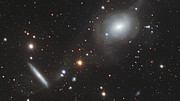
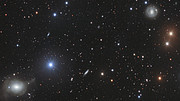
A glittering host of galaxies populate this rich image taken with ESO’s VLT Survey Telescope, a state-of-the-art 2.6-m telescope designed for surveying the sky in visible light. The features of the multitude of galaxies strewn across the image allow astronomers to uncover the most delicate details of galactic structure.

Whereas ESO’s Very Large Telescope (VLT) can observe very faint astronomical objects in great detail, when astronomers want to understand how the huge variety of galaxies come into being they must turn to a different sort of telescope with a much bigger field of view. The VLT Survey Telescope (VST) is such a telescope. It was designed to explore vast swathes of the pristine Chilean night skies, offering astronomers detailed astronomical surveys of the southern hemisphere.

The powerful surveying properties of the VST led an international team of astronomers to conduct the VST Early-type GAlaxy Survey (VEGAS) [1] to examine a collection of elliptical galaxies in the southern hemisphere [2]. Using the sensitive OmegaCAM detector at the heart of the VST [3], a team led by Marilena Spavone from INAF-Astronomical Observatory of Capodimonte in Naples, Italy, captured images of a wide variety of such galaxies in different environments.

One of these galaxies is NGC 5018, the milky-white galaxy near the centre of this image. It lies in the constellation of Virgo (The Virgin) and may at first resemble nothing but a diffuse blob. But, on closer inspection, a tenuous stream of stars and gas — a tidal tail — can be seen stretching outwards from this elliptical galaxy. Delicate galactic features such as tidal tails and stellar streams are hallmarks of galactic interactions, and provide vital clues to the structure and dynamics of galaxies.

As well as the many elliptical (and a few spiral) galaxies in this remarkable 400-megapixel image, a colourful variety of bright foreground stars in our own Milky Way Galaxy also pepper the image. These stellar interlopers, such as the vividly blue HD 114746 near the centre of the image, are not the intended subjects of this astronomical portrait, but happen to lie between the Earth and the distant galaxies under study. Less prominent, but no less fascinating, are the faint tracks left by asteroids in our own Solar System. Just below NGC 5018, the faint streak left by the asteroid 2001 TJ21 (110423) — captured over several successive observations — can be seen stretching across the image. Further to the right, another asteroid  — 2000 WU69 (98603) — left its trace in this spectacular image.

While astronomers set out to investigate the delicate features of distant galaxies millions of light-years from Earth, in the process they also captured images of nearby stars hundreds of light-years away, and even the faint trails of asteroids only light-minutes away in our own Solar System. Even when studying the furthest reaches of the cosmos, the sensitivity of ESO telescopes and dark Chilean skies can offer entrancing observations much closer to home.


Notes

[1] VEGAS is a deep multi-band imaging survey of early-type galaxies carried out with the VLT Survey Telescope (VST), led by Enrichetta Iodice from INAF-Astronomical Observatory of Capodimonte in Naples, Italy.

[2] Elliptical galaxies are also known as early-type galaxies, not because of their age, but because they were once thought to evolve into the more familiar spiral galaxies, an idea now known to be false. Early-type galaxies are characterised by a smooth ellipsoidal shape and usually a lack of gas and active star formation. The bewildering diversity of shapes and types of galaxy is classified into the Hubble Sequence.

[3] OmegaCAM is an exquisitely sensitive detector formed of 32 individual charge coupled devices, and it creates images with 256 million pixels, 16 times greater than the ESA/NASA Hubble Space Telescope’s Advanced Camera for Surveys (ACS). OmegaCAM was designed and built by a consortium including institutes in the Netherlands, Germany and Italy with major contributions from ESO.


More Information

This research was presented in the paper “VEGAS: A VST Early-type GAlaxy Survey. III. Mapping the galaxy structure, interactions and intragroup light in the NGC 5018 group” by Marilena Spavone et al., to appear in the Astrophysical Journal.

The team is composed of Marilena Spavone (INAF-Astronomical Observatory of Capodimonte, Naples, Italy), Enrichetta Iodice (INAF-Astronomical Observatory of Capodimonte, Naples, Italy), Massimo Capaccioli (University of Naples, Naples, Italy), Daniela Bettoni (INAF-Astronomical Observatory of Padova, Italy), Roberto Rampazzo (INAF-Astronomical Observatory of Padova, Italy), Noah Brosch (The Wise Observatory and School of Physics and Astronomy Tel Aviv University, Israel), Michele Cantiello (INAF-Astronomical Observatory of Teramo, Italy), Nicola R. Napolitano (INAF-Astronomical Observatory of Capodimonte, Naples, Italy), Luca Limatola (INAF-Astronomical Observatory of Capodimonte, Naples, Italy), Aniello Grado (INAF-Astronomical Observatory of Capodimonte, Naples, Italy), Pietro Schipani (INAF-Astronomical Observatory of Capodimonte, Naples, Italy).

ESO is the foremost intergovernmental astronomy organisation in Europe and the world’s most productive ground-based astronomical observatory by far. It has 15 Member States: Austria, Belgium, the Czech Republic, Denmark, France, Finland, Germany, Italy, the Netherlands, Poland, Portugal, Spain, Sweden, Switzerland and the United Kingdom, along with the host state of Chile and with Australia as a strategic partner. ESO carries out an ambitious programme focused on the design, construction and operation of powerful ground-based observing facilities enabling astronomers to make important scientific discoveries. ESO also plays a leading role in promoting and organising cooperation in astronomical research. ESO operates three unique world-class observing sites in Chile: La Silla, Paranal and Chajnantor. At Paranal, ESO operates the Very Large Telescope and its world-leading Very Large Telescope Interferometer as well as two survey telescopes, VISTA working in the infrared and the visible-light VLT Survey Telescope. ESO is also a major partner in two facilities on Chajnantor, APEX and ALMA, the largest astronomical project in existence. And on Cerro Armazones, close to Paranal, ESO is building the 39-metre Extremely Large Telescope, the ELT, which will become “the world’s biggest eye on the sky”.


Links


Contacts

Marilena Spavone
INAF – Osservatorio Astronomico di Capodimonte
Napoli, Italy
Tel: +39 081 5575602

Email: marilena.spavone@oacn.inaf.it

Mariya Lyubenova
ESO Outreach Astronomer
Garching bei München, Germany
Tel: +49 89 3200 6188
Email:
mlyubeno@eso.org

Calum Turner
ESO Public Information Officer
Garching bei München, Germany
Tel: +49 89 3200 6670
Email:
pio@eso.org

Source: ESO/News


Friday, May 11, 2018

Massive Cluster Galaxies Move in Unexpected Ways

Figure 1. MS0440+02 galaxy cluster. The central galaxy is a multi-component BCG formed by six bright elliptical spheroids, all at the same redshift. This is a color composite GMOS South image (g, r, i) of the clusters. The size of the image is 2.6 x 2.6 arcmin2 (N up, E left). Credit: R. Carrasco (Gemini Observatory/AURA) and Tomás Verdugo (UNAM).  Full resolution TIFF

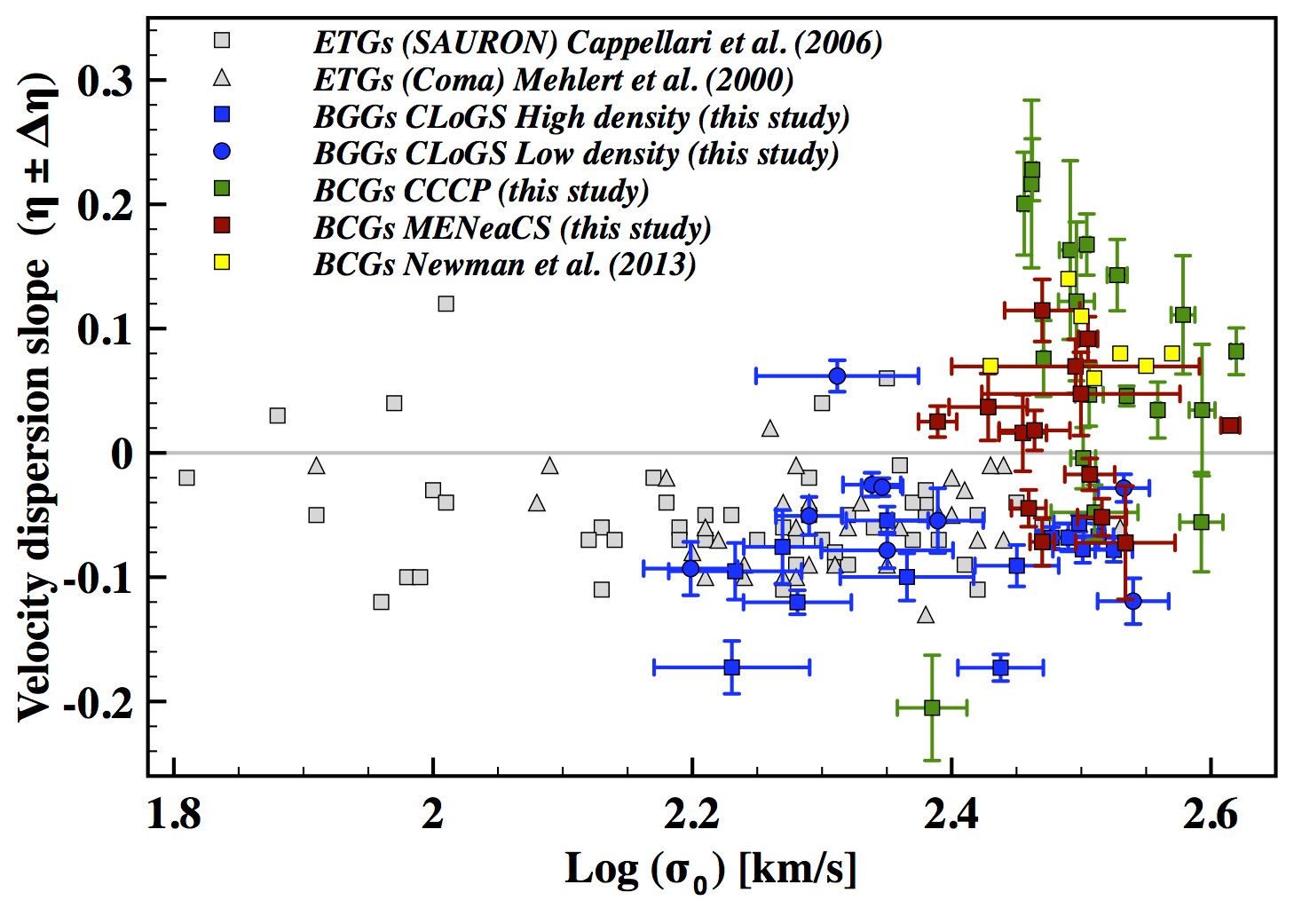
Figure 2. The slope η of the velocity dispersion profile is plotted against the central velocity dispersion σ0 for galaxies in multiple different samples. The blue points represent brightest galaxies in groups (BGGs) of high (square) and low (circles) density, while the green, red, and yellow points represent brightest cluster galaxies (BCGs) in various samples of galaxy clusters. The grey points indicate generic “early-type galaxies” (ETGs). The slope η is negative if the velocity dispersion decreases with radius and positive if it rises. Thus, massive BCGs tend to have rising profiles, with the stellar velocities responding to the cluster potential at larger radii. [Reproduced from Loubser et al. 2018, MNRAS, in press.]  Full resolution JPEG


Astronomers using data from both of the Gemini Multi-Object Spectrographs (GMOS - North and South) measured the motions of stars within a sample of 32 massive elliptical cluster galaxies and found the stellar motions inconsistent with these galaxies’ solitary cousins. 

The galaxies chosen are known as brightest cluster galaxies (BCGs) because they are the brightest members of large galaxy clusters. The international team of astronomers obtained Gemini spectra to find the relative velocities of stars within each galaxy and then determine the central stellar velocity dispersions and radial dispersion profiles for each galaxy. “This is similar to what we see in our own Solar System with the different velocities of the planets around the Sun,” said John Blakeslee, Gemini Observatory's Head of Science. “We use the planets’ velocities to determine our Solar System’s mass distribution and it is also how we know the Sun’s mass accurately.”

The researchers discovered a surprising variety in the shapes of the velocity dispersion profiles for the BCGs, with a large fraction showing rising dispersion profiles (Figure 2). A rising velocity dispersion profile means that the stars within these galaxies are moving faster as you look further from the galaxy’s core in response to an increasing gravitational force. In comparison, rising velocity dispersion profiles are much rarer in other massive ellipticals that are not BCGs, including many brightest galaxies in groups (BGGs).

“You would naively think that massive elliptical galaxies are a homogeneous, well-behaved class of objects, but the most massive beasts, those in the centers of groups and clusters, continue to surprise us,” said Ilani Loubser, an astronomer at North-West University in South Africa and the lead author of the study, which has been accepted for publication in Monthly Notices of the Royal Astronomical Society. She also noted, “The quality, and the wealth of information we can measure from the GMOS spectra (even in poor weather), is remarkable!”

BCGs tend to reside near the centers of their respective clusters, and are therefore generally embedded within extended distributions of both light and dark matter. The sample of BCGs in this study included some of the most massive known galaxies in the Universe out to a distance of about 3.2 billion light years (z ~ 0.3).

The study also found that the slopes of the velocity dispersion profiles correlate with the galaxy luminosity, in the sense that the increase in the speed of the stars is greater in brighter BCGs, as well as BGGs. Whether the full diversity in the observed velocity dispersion profiles is consistent with standard models for the growth of massive galaxies is not yet clear. More detailed comparisons with velocity dispersion profiles in cosmological simulations are needed.


Source:
Gemini Observatory