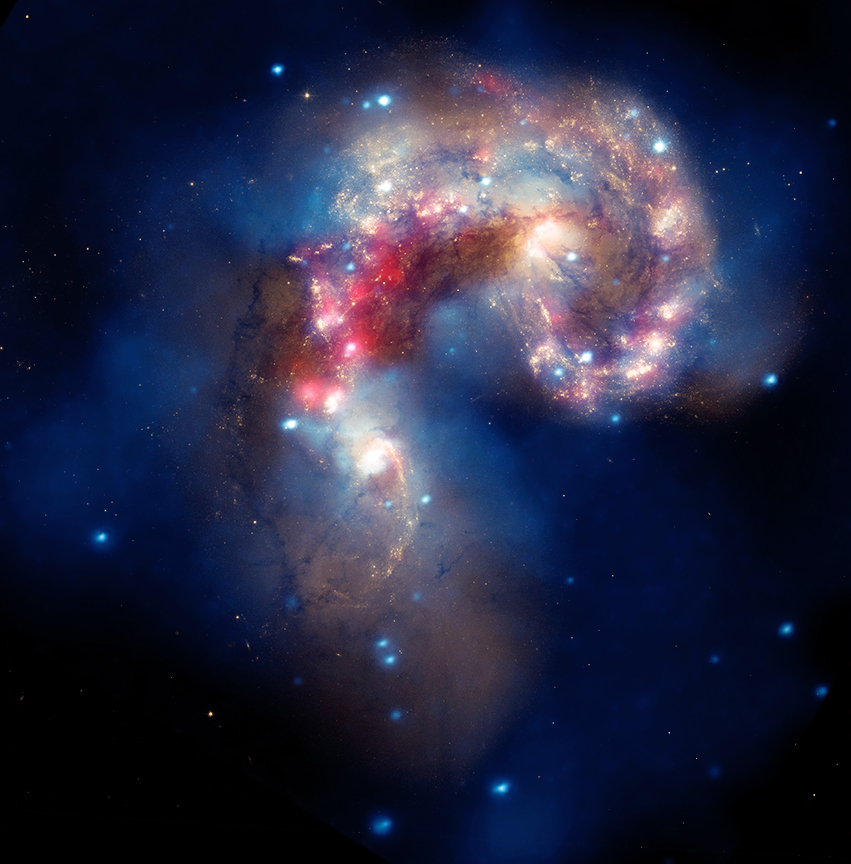
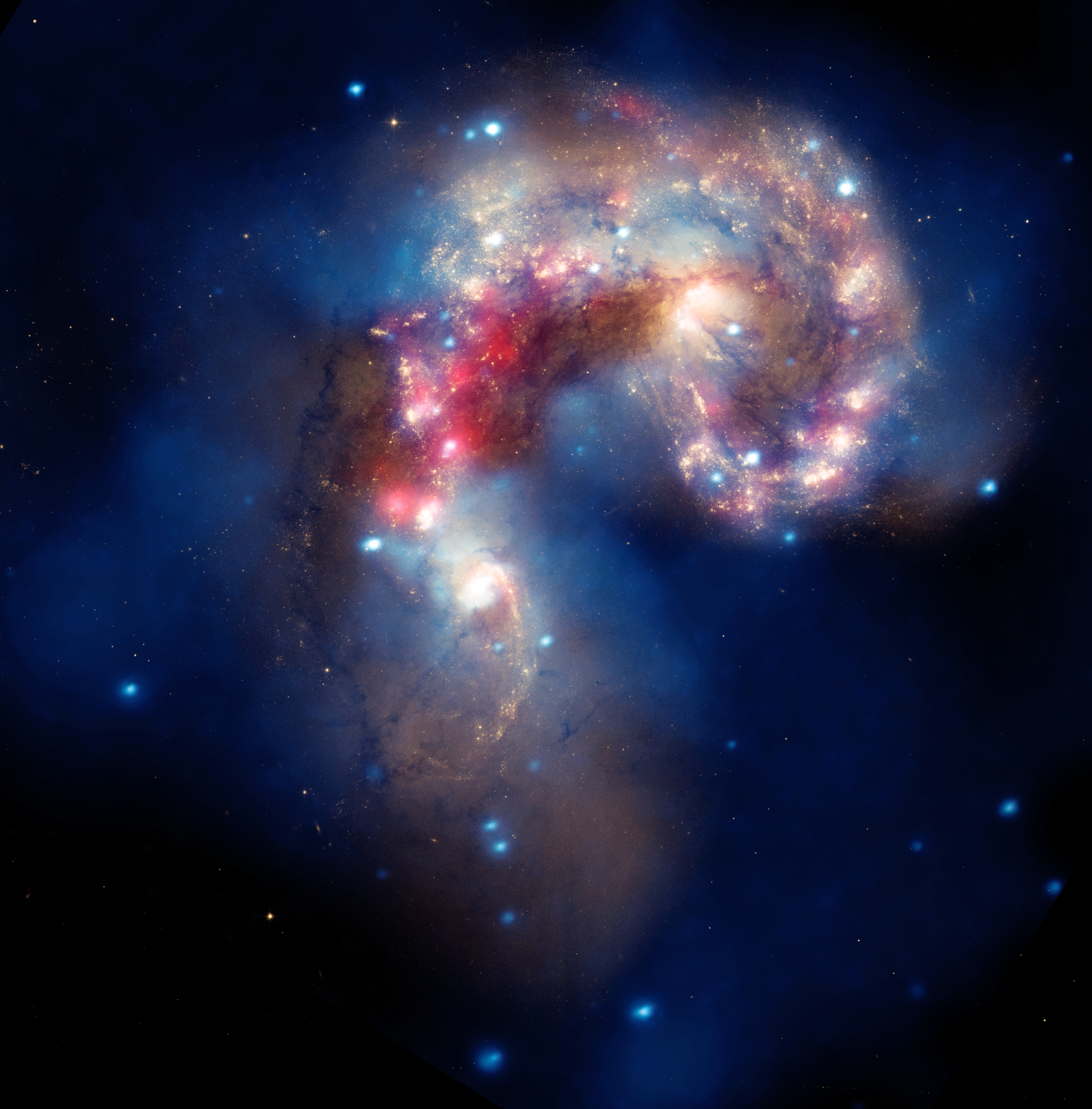
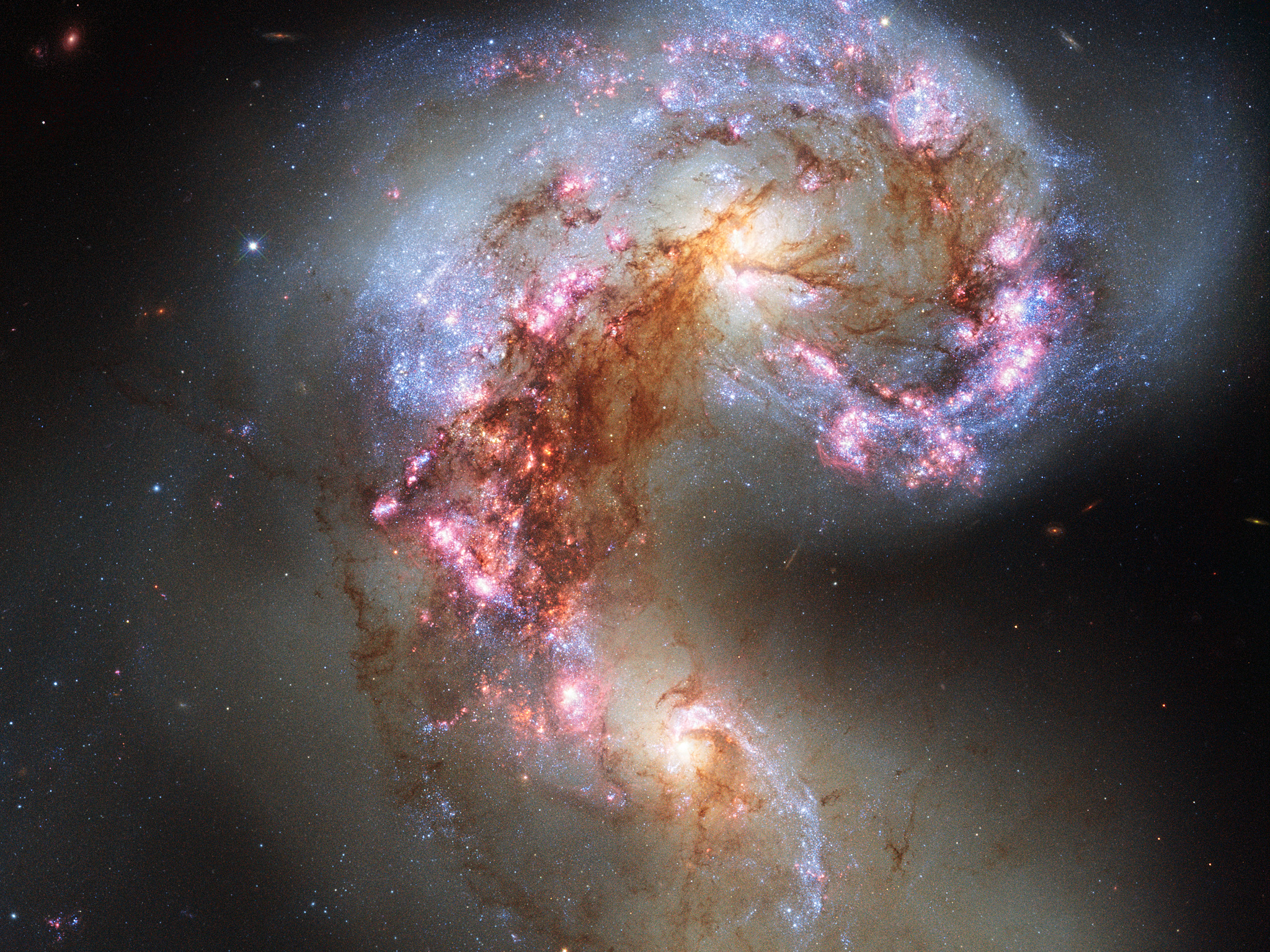
Animation of ALMA data depicting dense cores of molecular gas in the Antennae galaxies. The yellow object at the center may be the first prenatal example of a globular cluster ever identified. Credit: K. Johnson, U.Va.; ALMA (NRAO/ESO/NAOJ)
Globular clusters – dazzling agglomerations of up to a million ancient
stars – are among the oldest objects in the universe. Though plentiful
in and around many galaxies, newborn examples are vanishingly rare and
the conditions necessary to create new ones have never been detected,
until now.
Astronomers using the
Atacama Large Millimeter/submillimeter Array
(ALMA) have discovered what may be the first known example of a
globular cluster about to be born: an incredibly massive, extremely
dense, yet star-free cloud of molecular gas.
“We may be
witnessing one of the most ancient and extreme modes of star formation
in the universe,” said Kelsey Johnson, an astronomer at the University
of Virginia in Charlottesville and lead author on a paper accepted for
publication in the Astrophysical Journal. “This remarkable
object looks like it was plucked straight out of the very early
universe. To discover something that has all the characteristics of a
globular cluster, yet has not begun making stars, is like finding a
dinosaur egg that’s about to hatch.”
This object, which the
astronomers playfully refer to as the "Firecracker,” is located
approximately 50 million light-years away from Earth nestled inside a
famous pair of interacting galaxies (NGC 4038 and NGC 4039), which are
collectively known as the
Antennae galaxies.
The tidal forces generated by their ongoing merger are triggering star
formation on a colossal scale, much of it occurring inside dense
clusters.
What makes the Firecracker unique, however, is its extraordinary mass, comparatively small size, and apparent lack of stars.
All
other globular cluster analogues astronomers have observed to date are
already brimming with stars. The heat and radiation from these stars
have therefore altered the surrounding environment considerably, erasing
any evidence of its colder, quieter beginnings.
With ALMA, the
astronomers were able to find and study in detail a pristine example of
such an object before stars forever change its unique characteristics.
This afforded astronomers a first-ever glimpse of the conditions that
may have led to the formation of many, if not all globular clusters.
“Until
now, clouds with this potential have only been seen as teenagers, after
star formation had begun,” said Johnson. “That meant that the nursery
had already been disturbed. To understand how a globular cluster forms,
you need to see its true beginnings.”
Most globular clusters
formed during a veritable “baby boom” around 12 billion years ago, at a
time when galaxies first assembled. Each contains as many as a million
densely packed “second generation” stars -- stars with conspicuously low
concentrations of heavy metals, indicating they formed very early in
the history of the universe. Our own Milky Way is known to have at least
150 such clusters, though it may have many more.
Throughout the
universe, star clusters of various sizes are still forming to this day.
It’s possible, though increasingly rare, that the largest and densest
of these will go on to become globular clusters.
“The survival
rate for a massive young star cluster to remain intact is very low –
around one percent,” said Johnson. “Various external and internal forces
pull these objects apart, either forming open clusters like the
Pleiades or completely disintegrating to become part of a galaxy’s
halo.”
The astronomers believe, however, that the object they
observed with ALMA, which contains 50 million times the mass of the Sun
in molecular gas, is sufficiently dense that it has a good chance of
being one of the lucky ones.
Globular clusters evolve out of
their embryonic, star-free stage very rapidly -- in as little as one
million years. This means the object discovered by ALMA is undergoing a
very special phase of its life, offering astronomers a unique
opportunity to study a major component of the early universe.
The
ALMA data also indicate that the Firecracker cloud is under extreme
pressure – approximately 10,000 times greater than typical interstellar
pressures. This supports previous theories that high pressures are
required to form globular clusters.
In exploring the Antennae,
Johnson and her colleagues observed the faint emission from carbon
monoxide molecules, which allowed them to image and characterize
individual clouds of dust and gas. The lack of any appreciable thermal
emission – the telltale signal given off by gas heated by nearby stars –
confirms that this newly discovered object is still in its pristine,
unaltered state.
Further studies with ALMA may reveal additional
examples of proto super star clusters in the Antennae galaxies and other
interacting galaxies, shedding light on the origins of these ancient
objects and the role they play in galactic evolution.
The
National Radio Astronomy Observatory is a facility of the National
Science Foundation, operated under cooperative agreement by Associated
Universities, Inc.
Reference:
“The Physical Conditions in a Pre
Super Star Cluster Molecular Cloud in the Antennae Galaxies,” K. E.
Johnson et al., 2015, to appear in the Astrophysical Journal [http://apj.aas.org, preprint: http://arxiv.org/abs/1503.06477].
Contact:
Charles Blue
NRAO Public Information Officer
Charlottesville, Virginia
Tel: (434) 296-0314
Email: cblue@nrao.edu
The
Atacama Large Millimeter/submillimeter Array (ALMA), an international
astronomy facility, is a partnership of ESO, the US National Science
Foundation (NSF) and the National Institutes of Natural Sciences (NINS)
of Japan in cooperation with the Republic of Chile. ALMA is funded by
ESO on behalf of its Member States, by NSF in cooperation with the
National Research Council of Canada (NRC) and the National Science
Council of Taiwan (NSC) and by NINS in cooperation with the Academia
Sinica (AS) in Taiwan and the Korea Astronomy and Space Science
Institute (KASI).