Showing posts with label Antennae. Show all posts

Saturday, July 04, 2020

Antennae: A Galactic Spectacle

Antennae
Credit: X-ray: NASA/CXC/SAO/J.DePasquale; IR: NASA/JPL-Caltech; Optical: NASA/STScI


Tour of Antennae - More Animations


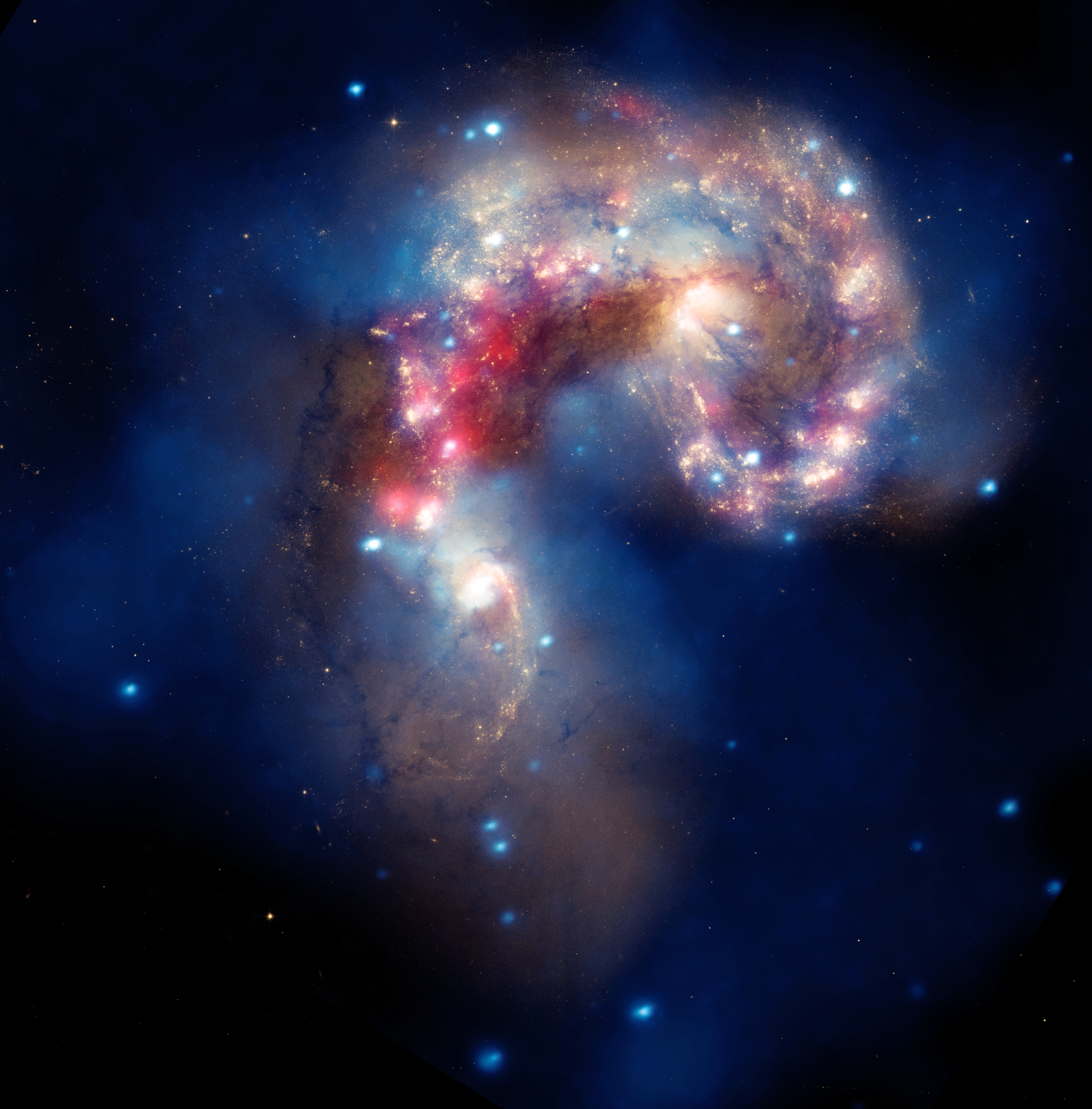
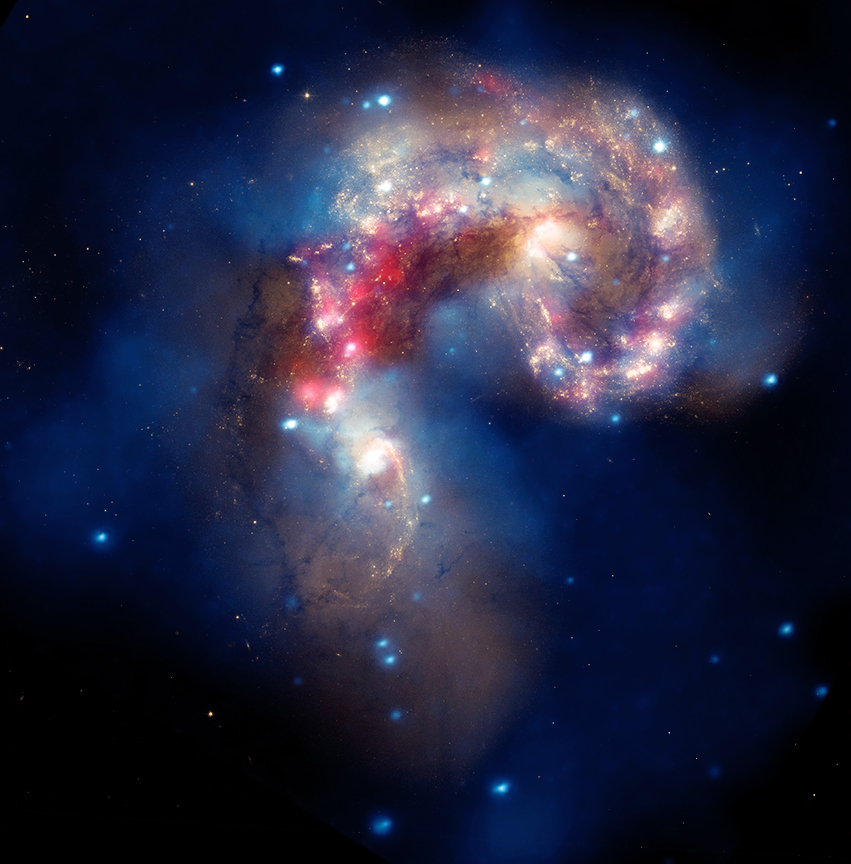
A beautiful new image of two colliding galaxies has been released by NASA's Great Observatories. The Antennae galaxies, located about 62 million light years from Earth, are shown in this composite image from the Chandra X-ray Observatory (blue), the Hubble Space Telescope (gold and brown), and the Spitzer Space Telescope (red). The Antennae galaxies take their name from the long antenna-like "arms," seen in wide-angle views of the system. These features were produced by tidal forces generated in the collision.

Credit: Digitized Sky Survey)

The collision, which began more than 100 million years ago and is still occurring, has triggered the formation of millions of stars in clouds of dusts and gas in the galaxies. The most massive of these young stars have already sped through their evolution in a few million years and exploded as supernovas.

The X-ray image from Chandra shows huge clouds of hot, interstellar gas that have been injected with rich deposits of elements from supernova explosions. This enriched gas, which includes elements such as oxygen, iron, magnesium and silicon, will be incorporated into new generations of stars and planets. The bright, point-like sources in the image are produced by material falling onto black holes and neutron stars that are remnants of the massive stars. Some of these black holes may have masses that are almost one hundred times that of the Sun.

The Spitzer data show infrared light from warm dust clouds that have been heated by newborn stars, with the brightest clouds lying in the overlap region between the two galaxies. The Hubble data reveal old stars and star-forming regions in gold and white while filaments of dust appear in brown. Many of the fainter objects in the optical image are clusters containing thousands of stars.


Fast Facts for Antennae:

Scale: Image is 3.4 arcmin across, (about 61,000 light years)
Category:Normal Galaxies & Starburst Galaxies
Coordinates (J2000): RA 12h 01m 53.70s | Dec -18° 52´ 35.5"
Constellation:Corvus
Observation Date: Dec 1, 1999; Dec 29, 2001; Nov 22, May 31, Apr 18, Jul 10 & Jul 13, 2002
Observation Time: 117 hours (4 days 21 hours)
Obs. ID: 315, 3040-44, 3718
Instrument:ACIS
Also Known As: NGC 4038, NGC 4039
Color Code: Optical (Yellow), X-ray (Blue), Infrared (Red)
Distance Estimate: About 60 million light years


Friday, November 15, 2013

Antennae Galaxies reloaded

Credit: ESA/Hubble & NASA

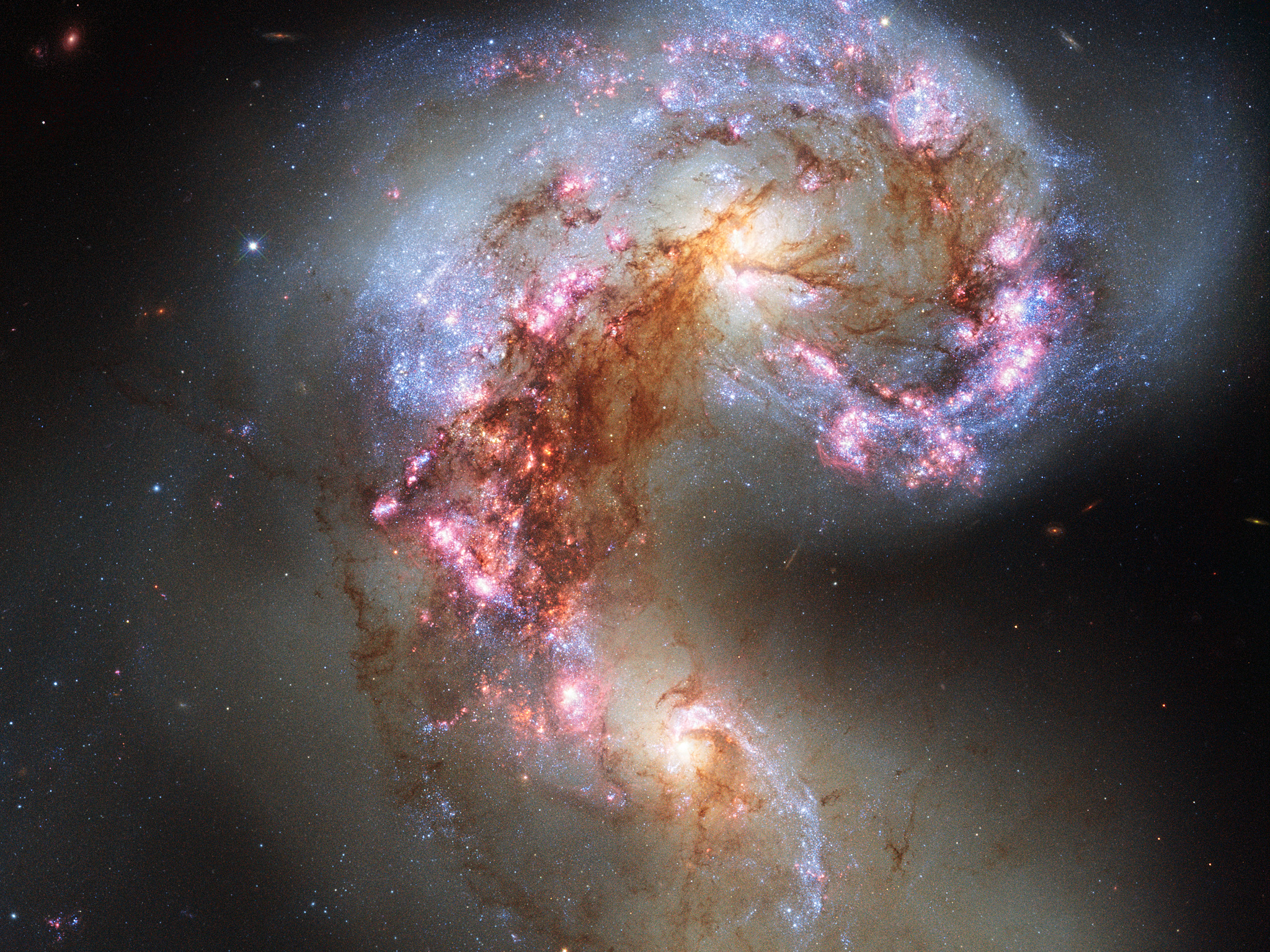
The NASA/ESA Hubble Space Telescope has snapped the best ever image of the Antennae Galaxies. Hubble has released images of these stunning galaxies twice before, once using observations from its Wide Field and Planetary Camera 2 (WFPC2) in 1997, and again in 2006 from the Advanced Camera for Surveys (ACS). Each of Hubble’s images of the Antennae Galaxies has been better than the last, due to upgrades made during the famous servicing missions, the last of which took place in 2009.

The galaxies — also known as NGC 4038 and NGC 4039 — are locked in a deadly embrace. Once normal, sedate spiral galaxies like the Milky Way, the pair have spent the past few hundred million years sparring with one another. This clash is so violent that stars have been ripped from their host galaxies to form a streaming arc between the two. In wide-field images of the pair the reason for their name becomes clear — far-flung stars and streamers of gas stretch out into space, creating long tidal tails reminiscent of antennae.

This new image of the Antennae Galaxies shows obvious signs of chaos. Clouds of gas are seen in bright pink and red, surrounding the bright flashes of blue star-forming regions — some of which are partially obscured by dark patches of dust. The rate of star formation is so high that the Antennae Galaxies are said to be in a state of starburst, a period in which all of the gas within the galaxies is being used to form stars. This cannot last forever and neither can the separate galaxies; eventually the nuclei will coalesce, and the galaxies will begin their retirement together as one large elliptical galaxy.

This image uses visible and near-infrared observations from Hubble’s Wide Field Camera 3 (WFC3), along with some of the previously-released observations from Hubble’s Advanced Camera for Surveys (ACS).