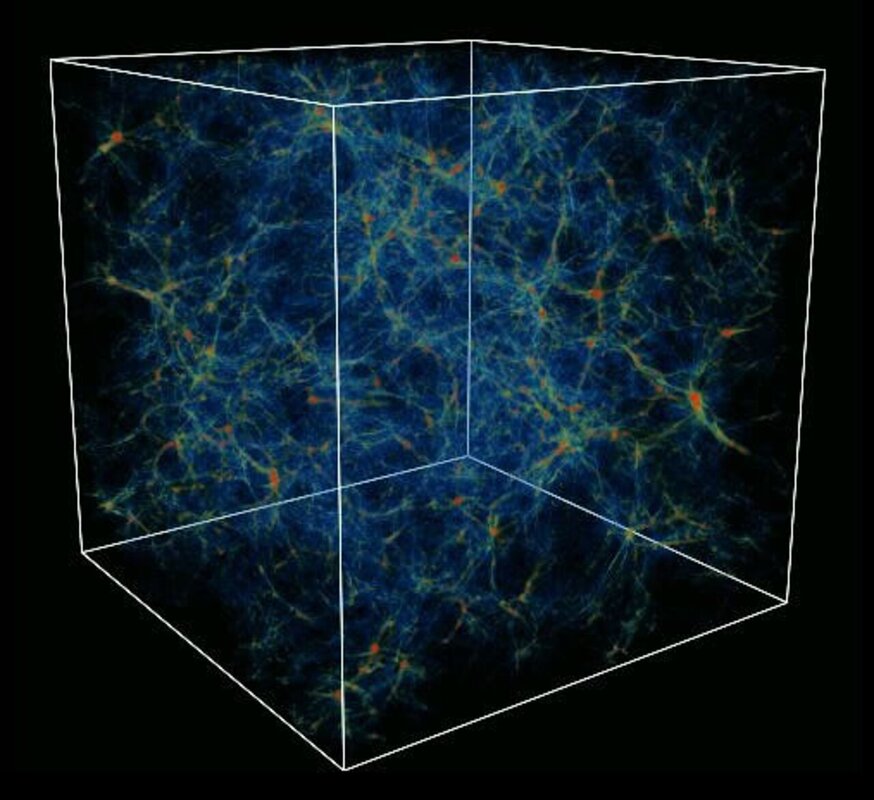
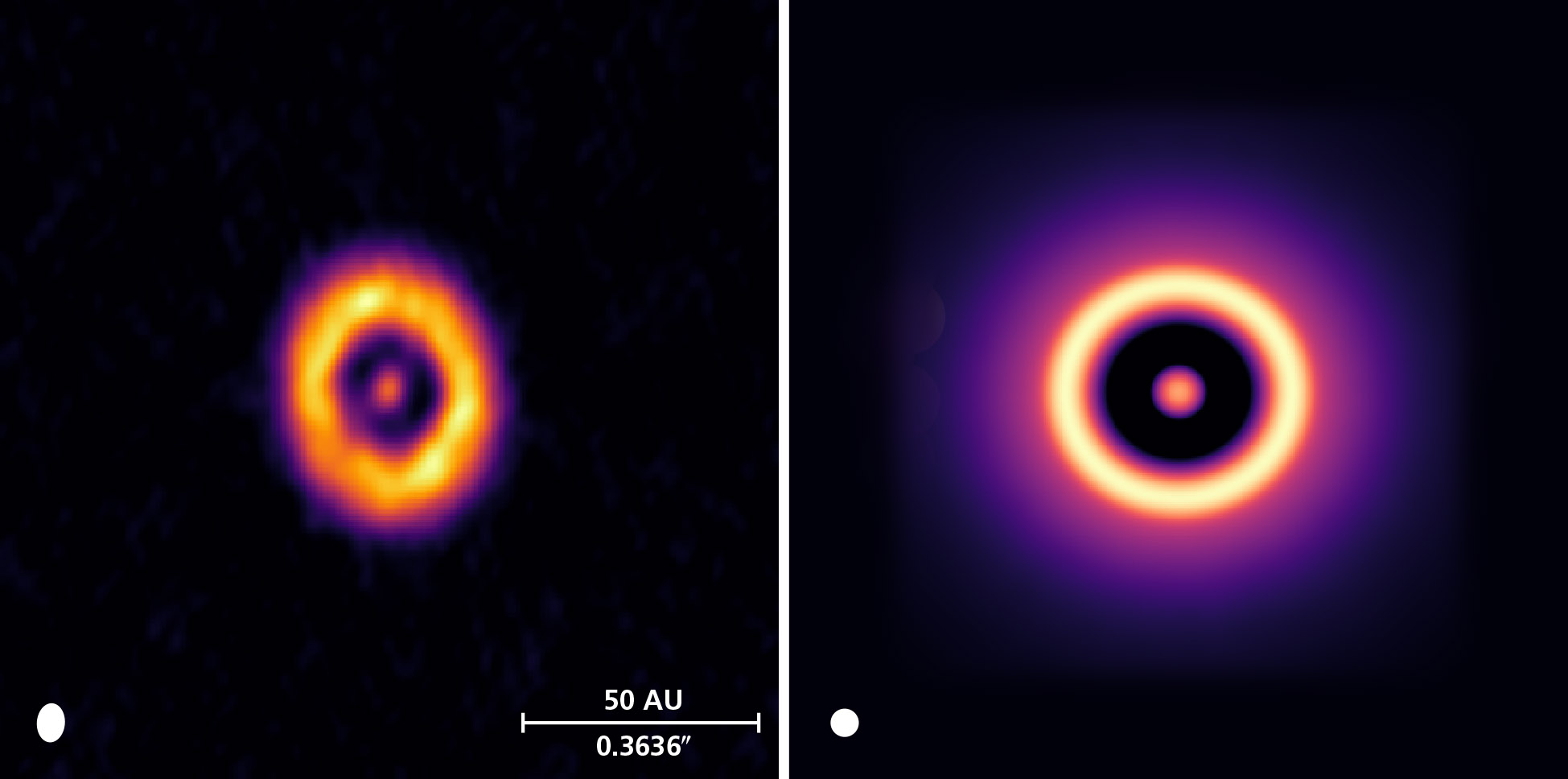
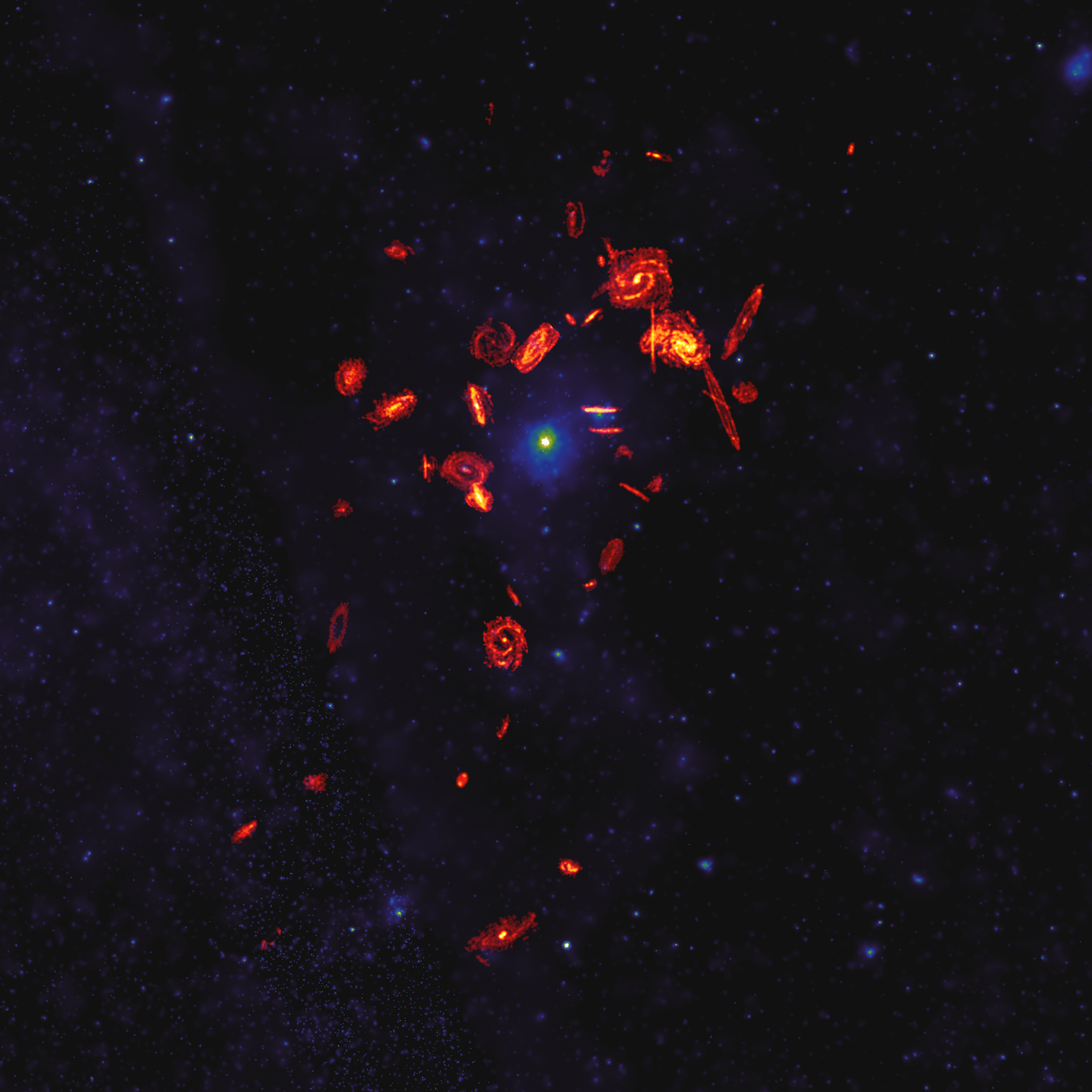

Artist’s impression of the galaxy NGP–190387
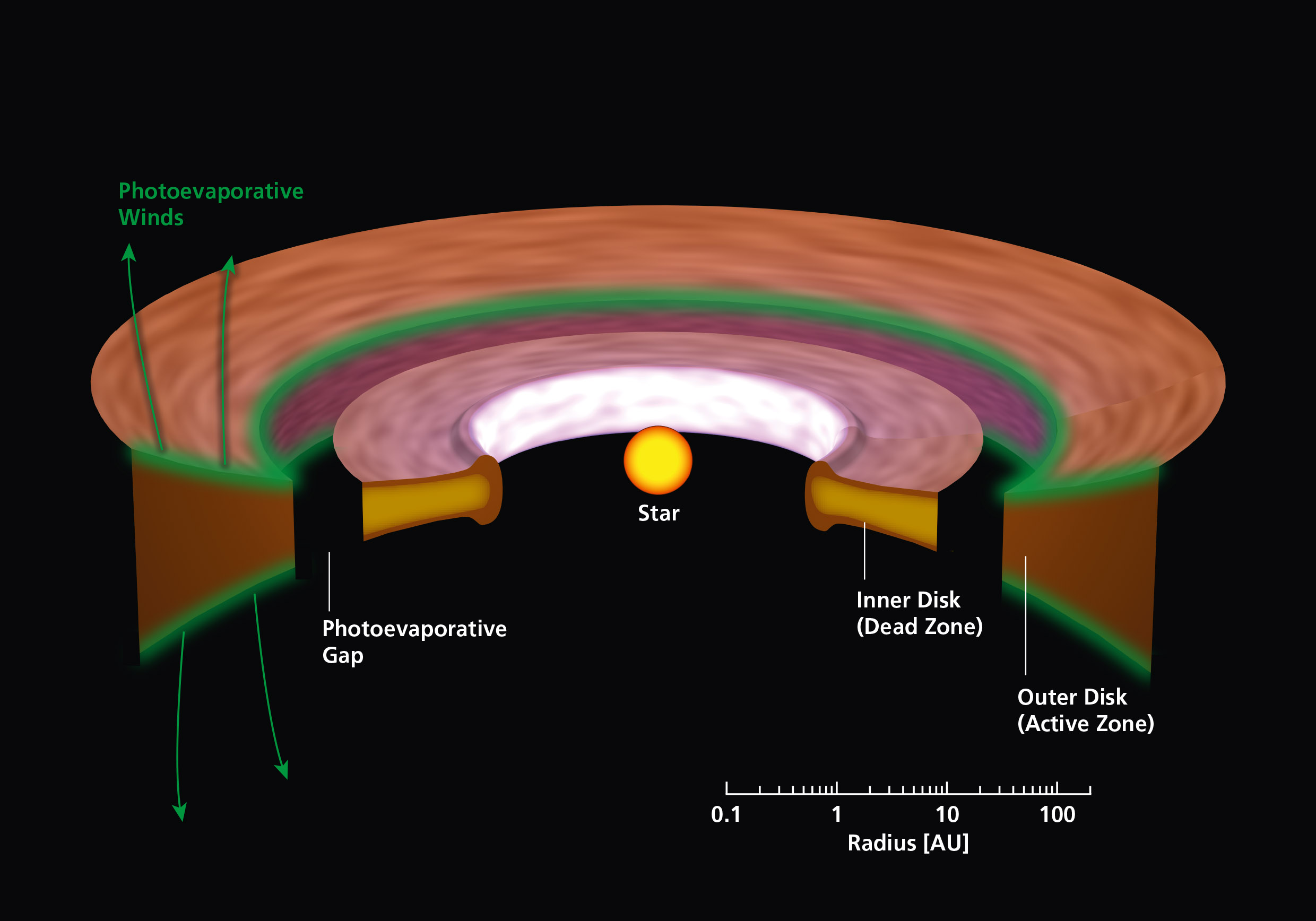
Artist’s impression of a Wolf–Rayet star
Wide-field view of the sky around the galaxy NGP–190387
Videos
Finding the stars that help with our dental health (ESOcast 244 Light)
Zooming in on a Wolf–Rayet star in the remote NGP–190387 galaxy
Artist's animation of the galaxy NGP–190387
A new discovery is shedding light on how
fluorine — an element found in our bones and teeth as fluoride — is
forged in the Universe. Using the Atacama Large Millimeter/submillimeter
Array (ALMA), in which the European Southern Observatory (ESO) is a
partner, a team of astronomers have detected this element in a galaxy
that is so far away its light has taken over 12 billion years to reach
us. This is the first time fluorine has been spotted in such a distant
star-forming galaxy.
“We all know about fluorine because the toothpaste we use every day contains it in the form of fluoride,” says Maximilien Franco from the University of Hertfordshire in the UK, who led the new study, published today in Nature Astronomy.
Like most elements around us, fluorine is created inside stars but,
until now, we did not know exactly how this element was produced. “We did not even know which type of stars produced the majority of fluorine in the Universe!”
Franco and his collaborators spotted fluorine (in the form
of hydrogen fluoride) in the large clouds of gas of the distant galaxy
NGP–190387, which we see as it was when the Universe was only 1.4
billion years old, about 10% of its current age. Since stars expel the
elements they form in their cores as they reach the end of their lives,
this detection implies that the stars that created fluorine must have
lived and died quickly.
The team believes that Wolf–Rayet stars,
very massive stars that live only a few million years, a blink of the
eye in the Universe’s history, are the most likely production sites of
fluorine. They are needed to explain the amounts of hydrogen fluoride
the team spotted, they say. Wolf–Rayet stars had been suggested as
possible sources of cosmic fluorine before, but astronomers did not know
until now how important they were in producing this element in the
early Universe.
“We have shown that Wolf–Rayet stars, which are among
the most massive stars known and can explode violently as they reach the
end of their lives, help us, in a way, to maintain good dental health!” jokes Franco.
Besides these stars, other scenarios for how fluorine is
produced and expelled have been put forward in the past. An example
includes pulsations of giant, evolved stars with masses up to few times
that of our Sun, called asymptotic giant branch
stars. But the team believes these scenarios, some of which take
billions of years to occur, might not fully explain the amount of
fluorine in NGP–190387.
“For this galaxy, it took just tens or hundreds of
millions of years to have fluorine levels comparable to those found in
stars in the Milky Way, which is 13.5 billion years old. This was a
totally unexpected result,” says Chiaki Kobayashi, a professor at the University of Hertfordshire. “Our measurement adds a completely new constraint on the origin of fluorine, which has been studied for two decades.”
The discovery in NGP–190387 marks one of the first
detections of fluorine beyond the Milky Way and its neighbouring
galaxies. Astronomers have previously spotted this element in distant
quasars, bright objects powered by supermassive black holes at the
centre of some galaxies. But never before had this element been observed
in a star-forming galaxy so early in the history of the Universe.
The team’s detection of fluorine was a chance discovery
made possible thanks to the use of space and ground-based observatories.
NGP–190387, originally discovered with the European Space Agency’s
Herschel Space Observatory and later observed with the Chile-based ALMA,
is extraordinarily bright for its distance. The ALMA data confirmed
that the exceptional luminosity of NGP–190387 was partly caused by
another known massive galaxy, located between NGP–190387 and the Earth,
very close to the line of sight. This massive galaxy amplified the light
observed by Franco and his collaborators, enabling them to spot the
faint radiation emitted billions of years ago by the fluorine in
NGP–190387.
Future studies of NGP–190387 with the Extremely Large Telescope (ELT)
— ESO’s new flagship project, under construction in Chile and set to
start operations later this decade — could reveal further secrets about
this galaxy. “ALMA is sensitive to radiation emitted by cold interstellar gas and dust,” says Chentao Yang, an ESO Fellow in Chile. “With the ELT, we will be able to observe NGP–190387 through the direct light of stars, gaining crucial information on the stellar content of this galaxy.”
More Information
This research was presented in the paper "The ramp-up of interstellar medium enrichment at z > 4" to appear in Nature Astronomy (https://doi.org/10.1038/s41550-021-01515-9).
The team is composed of M. Franco (Centre for Astrophysics Research,
University of Hertfordshire, UK [CAR]), K. E. K. Coppin (CAR), J. E.
Geach (CAR), C. Kobayashi (CAR), S. C. Chapman (Department of Physics
and Atmospheric Science, Dalhousie University, Canada and National
Research Council, Herzberg Astronomy and Astrophysics, Canada), C. Yang
(European Southern Observatory, Chile), E. González-Alfonso (Universidad
de Alcalá, Departamento de Física y Matematicas, Spain), J. S. Spilker
(Department of Astronomy, University of Texas at Austin, USA), A. Cooray
(Department of Physics and Astronomy, University of California, Irvine,
USA), M. J. Michałowski (Astronomical Observatory Institute, Faculty of
Physics, Poland)
The European Southern Observatory (ESO) enables scientists worldwide
to discover the secrets of the Universe for the benefit of all. We
design, build and operate world-class observatories on the ground —
which astronomers use to tackle exciting questions and spread the
fascination of astronomy — and promote international collaboration in
astronomy. Established as an intergovernmental organisation in 1962,
today ESO is supported by 16 Member States (Austria, Belgium, the Czech
Republic, Denmark, France, Finland, Germany, Ireland, Italy, the
Netherlands, Poland, Portugal, Spain, Sweden, Switzerland and the United
Kingdom), along with the host state of Chile and with Australia as a
Strategic Partner. ESO’s headquarters and its visitor centre and
planetarium, the ESO Supernova, are located close to Munich in Germany,
while the Chilean Atacama Desert, a marvellous place with unique
conditions to observe the sky, hosts our telescopes. ESO operates three
observing sites: La Silla, Paranal and Chajnantor. At Paranal, ESO
operates the Very Large Telescope and its Very Large Telescope
Interferometer, as well as two survey telescopes, VISTA working in the
infrared and the visible-light VLT Survey Telescope. Also at Paranal ESO
will host and operate the Cherenkov Telescope Array South, the world’s
largest and most sensitive gamma-ray observatory. Together with
international partners, ESO operates APEX and ALMA on Chajnantor, two
facilities that observe the skies in
the millimetre and submillimetre range. At Cerro Armazones, near
Paranal, we are building “the world’s biggest eye on the sky” — ESO’s
Extremely Large Telescope. From our offices in Santiago, Chile we
support our operations in the country and engage with Chilean partners
and society.
The Atacama Large Millimeter/submillimeter Array (ALMA), an
international astronomy facility, is a partnership of ESO, the U.S.
National Science Foundation (NSF) and the National Institutes of Natural
Sciences (NINS) of Japan in cooperation with the Republic of Chile.
ALMA is funded by ESO on behalf of its Member States, by NSF in
cooperation with the National Research Council of Canada (NRC) and
the Ministry of Science and Technology (MOST) and by NINS in cooperation
with the Academia Sinica (AS) in Taiwan and the Korea Astronomy and
Space Science Institute (KASI). ALMA construction and operations are led
by ESO on behalf of its Member States; by the National Radio Astronomy
Observatory (NRAO), managed by Associated Universities, Inc. (AUI), on
behalf of North America; and by the National Astronomical Observatory of
Japan (NAOJ) on behalf of East Asia. The Joint ALMA Observatory (JAO)
provides the unified leadership and management of the construction,
commissioning and operation of ALMA.
The University of Hertfordshire brings the transformational
impact of higher education to all. Its students, staff and businesses
consistently reach their full potential. Through high quality teaching,
550 degree programmes, cutting-edge research projects and powerful
business partnerships, they think bigger, stand out and positively
impact local, national and international communities.
Links
Contacts:
Maximilien Franco
Centre for Astrophysics Research, University of Hertfordshire
Hatfield, Hertfordshire, United Kingdom
Tel: +33-649956665
Email: m.franco@herts.ac.uk
Chiaki Kobayashi
Centre for Astrophysics Research, University of Hertfordshire
Hatfield, Hertfordshire, United Kingdom
Tel: +44-7757116615
Email: c.kobayashi@herts.ac.uk
Chentao Yang
European Southern Observatory
Santiago, Chile
Tel: +56 2 2463 3053
Email: cyang@eso.org
Bárbara Ferreira
ESO Media Manager
Garching bei München, Germany
Tel: +49 89 3200 6670
Cell: +49 151 241 664 00
Email: press@eso.org
Press Office
University of Hertfordshire
Hatfield, UK
Tel: +441707 285770
Email: news@herts.ac.uk
Source: ESO/News