Wednesday, December 08, 2010

Keck Observatory Pictures Show Fourth Planet in Giant Solar System

Infrared image of the HR8799 planetary system. This image shows planet HR8799b (5 times the mass of Jupiter), planets HR8799c and HR8799d (7 times the mass of Jupiter) and the new planet HR8799e. (The star itself is referred to as HR8799A.) Credit: NRC-HIA, Christian Marois, and the W.M. Keck Observator

Schematic representation of the HR8799 system compared to our own solar system, showing the 4 HR8799 planets and Jupiter, Saturn, Uranus and Neptune in our solar system. Infrared observations made by space telescopes have shown that the HR8799 system has massive, dusty asteroid belt, thousands of times more dense than our own, that is gravitationally shaped by HR8799e the same way Jupiter shapes our asteroid belt, and an outer belt of cometary debris similar to but much more massive than our own Kuiper belt.

Kamuela, HI, Dec. 8, 2010 - Astronomers have discovered a fourth giant planet joining three others that, in 2008, were the subject of the first-ever pictures of a planetary system orbiting another star other than our sun. In 2008, astronomers announced the first-ever pictures of a planetary family, showing three planets orbiting around a dusty young star named HR8799, which is 129 light years away. Credit: NRC-HIA, Christian Marois, and the W.M. Keck Observatory

Now, a research team from Lawrence Livermore National Laboratory (LLNL), National Research Council of Canada (NRC), the University of California Los Angeles, and Lowell Observatory has discovered a fourth planet that is about 7 times the mass of Jupiter – similar to the other three. Using high-contrast, near infrared adaptive optics on the Keck II telescope in Hawaii, the astronomers imaged the fourth planet (dubbed HR8799e) in 2009 and confirmed its existence and orbit in 2010. The research appears in the Dec. 8 edition of the journal, Nature.

“The images of this new inner planet in the system is the culmination of 10 years worth of innovations, making steady progress to optimize every observation and analysis step to allow the detection of planets located ever closer to their stars,” said Christian Marois, a former LLNL postdoc now at NRC, and first author of the new paper.

If this newly discovered planet was located in orbit around our sun, it would lie between Saturn and Uranus. This giant version of our solar system is young at about 30 million years old compared to our system, which is about 4.6 billion years old.

Though the system is very much like our own, in other ways, it is much more extreme than our own – the combined mass of the four giant planets may be 20 times higher, and the asteroid and comet belts are dense and turbulent. In fact, the massive planets’ pull on each other gravitationally, and the system may be on the verge of falling apart.

This team of scientists simulated millions of years of evolution of the system, and showed that to have survived this long, the three inner planets may have to orbit like clockwork, with the new planet going around the star exactly four times while the second planet finishes two orbits in the time it takes the outer planet to complete one. This behavior was first seen in the moons of Jupiter but has never before been seen on this scale.

Studying the planet’s orbits also will help estimate their masses. “Our simulations show that if the objects were not planets, but supermassive ‘brown dwarfs’, the system would have fallen apart already,” said Quinn Konopacky, a postdoctoral researcher at LLNL’s Institute of Geophysics and Planetary Physics and a key author of the paper. “The implication is that we have truly found a unique new system of planets.” (Brown dwarfs are “failed stars”, too low in mass to sustain stable hydrogen fusion but larger than planets.) “We don’t yet know if the system will last for billions of years, or fall apart in a few million more. As astronomers carefully follow the HR 8799 planets during the coming decades, the question of just how stable their orbits are could become much clearer.”

The origin of these four giant planets remains a puzzle. It neither follows the “core accretion” model, in which planets form gradually close to stars where the dust and gas are thick or the “disk fragmentation” model in which a turbulent planet-forming disk rapidly cools and collapses out at its edges. Bruce Macintosh, a senior scientist at LLNL and the principal investigator for the Keck Observatory program, said: “There’s no simple model that can make all four planets at their current location. It’s a challenge for our theoretical colleagues.”
Previous observations had shown evidence for a dusty asteroid belt orbiting closer to the star – the new planet’s gravity helps account for the location of those asteroids, confining their orbits just like Jupiter does in our solar system. “Besides having four giant planets, both systems contain also two so-called “debris belts” composed of small rocky and/or icy objects along with lots of tiny dust particles, similar to the asteroid and Kuiper comet belts of our solar system”, noted co-author Ben Zuckerman, a professor of physics and astronomy at UCLA.
“Images like these bring the exoplanet field into the era of characterization. Astronomers can now directly examine the atmospheric properties of four giant planets orbiting another star that are all the same young age and that formed from the same building materials.” said Travis Barman, a Lowell Observatory exoplanet theorist and co-author of the current paper.
“I think there’s a very high probability that there are more planets in the system that we can’t detect yet,” Macintosh said. “One of the things that distinguishes this system from most of the extrasolar planets that are already known is that HR8799 has its giant planets in the outer parts - like our solar system does - and so has ‘room’ for smaller terrestrial planets – far beyond our current ability to see – in the inner parts.”

“It’s amazing how far we’ve come in a few years,” Macintosh said. “In 2007, when we first saw the system, we could barely see two planets out past the equivalent of Pluto’s orbit. Now we’re imaging a fourth planet almost where Saturn is on our solar system. It’s another step to the ultimate goal – still more than a decade away – of a picture showing another planet like Earth.”

The W. M. Keck Observatory operates two 10-meter optical/infrared telescopes on the summit of Mauna Kea. The twin telescopes feature a suite of advanced instrumentation including imagers, multi-object spectrographs, high-resolution spectrographs, integral-field spectroscopy and a world-leading laser guide star adaptive optics system. The Observatory is a private 501(c) 3 organization and a scientific partnership of the California Institute of Technology, the University of California and NASA.

NASA's Spitzer Reveals First Carbon-Rich Planet

Hot, Carbon-Rich Planet
Credit: NASA/JPL-Caltech/R. Hurt (SSC)

Exoplanet WASP-12b
Credit: NASA/JPL-Caltech/R. Hurt (SSC)

This plot of data from NASA's Spitzer Space Telescope indicates the presence of molecules in the planet WASP-12b -- a super-hot gas giant that orbits tightly around its star. Spitzer measurements suggest this planet's atmosphere has carbon monoxide, excess methane, and not much water vapor. The results demonstrate that WASP-12b is the first known carbon-rich planet.

Spitzer made these measurements as the planet circled behind the star, in an event called the secondary eclipse. The telescope collected the infrared light from the star and the planet, then just the star as the planet disappeared behind the star. This allowed astronomers to calculate the amount of infrared light coming solely from the planet. The observations were performed at four different wavelengths of infrared light. These data were then combined with previously reported measurements taken by the Canada-France-Hawaii Telescope atop Mauna Kea, Hawaii, at shorter infrared wavelengths to create this plot.

The yellow dots show the data, along with the observational uncertainties. The blue curve is a model of the planet's light, or spectrum, showing the fingerprints of chemicals in the atmosphere. The blue dots represent the blue model curve averaged to cover the same wavelengths as the data, as shown by the gray lines at the bottom of the plot.

PASADENA, Calif. -- Astronomers have discovered that a huge, searing-hot planet orbiting another star is loaded with an unusual amount of carbon. The planet, a gas giant named WASP-12b, is the first carbon-rich world ever observed. The discovery was made using NASA's Spitzer Space Telescope, along with previously published ground-based observations.

"This planet reveals the astounding diversity of worlds out there," said Nikku Madhusudhan of the Massachusetts Institute of Technology, Cambridge, lead author of a report in the Dec. 9 issue of the journal Nature. "Carbon-rich planets would be exotic in every way -- formation, interiors and atmospheres."

It's possible that WASP-12b might harbor graphite, diamond, or even a more exotic form of carbon in its interior, beneath its gaseous layers. Astronomers don't currently have the technology to observe the cores of exoplanets, or planets orbiting stars beyond our sun, but their theories hint at these intriguing possibilities.

The research also supports theories that carbon-rich rocky planets much less massive than WASP-12b could exist around other stars. Our Earth has rocks like quartz and feldspar, which are made of silicon and oxygen plus other elements. A carbon-rich rocky planet could be a very different place.

"A carbon-dominated terrestrial world could have lots of pure carbon rocks, like diamond or graphite, as well as carbon compounds like tar," said Joseph Harrington of the University of Central Florida, in Orlando, who is the principal investigator of the research.

Carbon is a common component of planetary systems and a key ingredient of life on Earth. Astronomers often measure carbon-to-oxygen ratios to get an idea of a star's chemistry. Our sun has a carbon-to-oxygen ratio of about one to two, which means it has about half as much carbon as oxygen. None of the planets in our solar system is known to have more carbon than oxygen, or a ratio of one or greater. However, this ratio is unknown for Jupiter, Saturn, Uranus, and Neptune. Unlike WASP-12b, these planets harbor water -- the main oxygen carrier -- deep inside their atmospheres, making it hard to detect.

WASP-12b is the first planet ever to have its carbon-to-oxygen ratio measured at greater than one (the actual ratio is most likely between one and two). This means the planet has excess carbon, some of which is in the form of atmospheric methane.

"When the relative amount of carbon gets that high, it's as though you flip a switch, and everything changes," said Marc Kuchner, an astronomer at NASA Goddard Space Flight Center, Greenbelt, Md., who helped develop the theory of carbon-rich rocky planets but is not associated with the study. "If something like this had happened on Earth, your expensive engagement ring would be made of glass, which would be rare, and the mountains would all be made of diamonds."

Madhusudhan, Harrington and colleagues used Spitzer to observe WASP-12b as it slipped behind its star, in a technique known as secondary eclipse, which was pioneered for exoplanets by Spitzer. These data were combined with previously published observations taken from the ground with the Canada-France-Hawaii Telescope at Mauna Kea, Hawaii. Madhusudhan used the data to conduct a detailed atmospheric analysis, revealing chemicals such as methane and carbon monoxide in the planet's atmosphere.

WASP-12b derives its name from the consortium that found it, the Wide Angle Search for Planets. It is 1.4 times as massive as Jupiter and located roughly 1,200 light-years away from Earth. This blistering world whips around its star in a little over a day, with one side always facing the star. It is so close to its star that the star's gravity stretches the planet into an egg-like shape. What's more, the star's gravity is siphoning mass off the planet into a thin disk that orbits around with it.

The Spitzer data also reveal more information about WASP-12b's temperature. The world was already known to be one of the hottest exoplanets found so far; the new observations indicate that the side that faces the star is 2,600 Kelvin, or 4,200 degrees Fahrenheit. That's more than hot enough to melt steel.

Other authors of the paper are Kevin Stevenson, Sarah Nymeyer, Christopher Campo, Jasmina Blecic, Ryan Hardy, Nate Lust, Christopher Britt and William Bowman of University of Central Florida, Orlando; Peter Wheatley of the University of Warwick, United Kingdom; Drake Deming of NASA Goddard Space Flight Center, Greenbelt, Md.; David Anderson, Coel Hellier and Pierre Maxted of Keele University, United Kingdom; Andrew Collier-Cameron of the University of St. Andrews, United Kingdom; Leslie Hebb of Vanderbilt University, Nashville, Tenn.; Don Pollacco of Queen's University, United Kingdom; and Richard West of the University of Leicester, United Kingdom.

Whitney Clavin 818-354-4673
Jet Propulsion Laboratory, Pasadena, Calif.
whitney.clavin@jpl.nasa.gov

NGC 5813: An Intergalactic Weather Map

X-ray, Optical and Temperature Map Images of NGC 5813
Credit: X-ray: NASA/CXC/SAO/S.Randall et al., Optical: SDSS

JPEG (674.6 kb) - Tiff (14.5 MB) - PS (14.8 MB) - More Images

Zoom-In (flash)

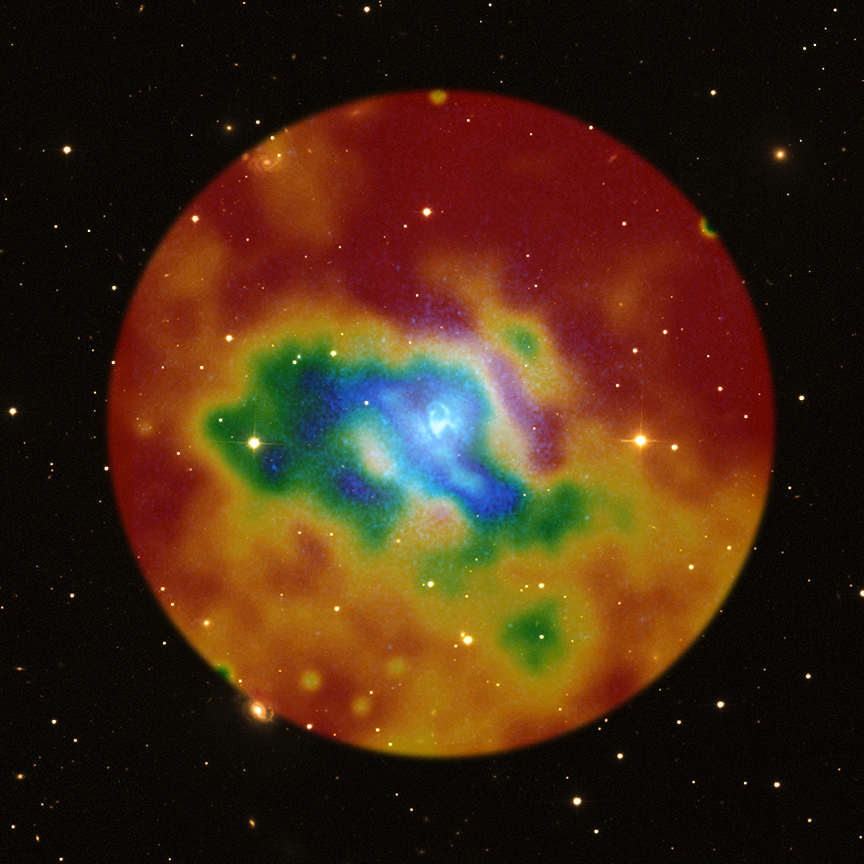
This composite image shows an intergalactic "weather map" around the elliptical galaxy NGC 5813, the dominant central galaxy in a galaxy group located about 105 million light years away from Earth.
Just like a weather map for a local forecast on Earth, the colored circle depicts variations in temperature across a region. This particular map presents the range of temperature in a region of space as observed by NASA's Chandra X-ray Observatory, with the hotter temperatures shown in red and decreasingly cooler temperatures shown in orange, yellow, green, and blue. The numbers displayed when rolling your mouse over the image give the gas temperature in millions of degrees.

A notable feature of this image is the relatively small variation in temperature across the weather map, with a range of only about 30% across several hundred thousand light years. Without any sources of heat, the densest gas near the center of the map should cool to much lower temperatures as energy is lost because of radiation. However, regular outbursts generated by the supermassive black hole at the center of NGC 5813 provide heat, preventing the gas near the center of the galaxy from cooling to such low temperatures. This decreases the amount of cool gas available to form new stars. This process is analogous to the Sun providing heat for Earth's atmosphere and preventing water and water vapor from cooling and freezing.

How do outbursts generated by the black hole provide heat? Powerful jets produced as gas swirls toward the black hole push cavities into the hot gas and drive shock waves -- like sonic booms -- outwards, heating the gas. The shocks from the most recent outburst, which occurred about 3 million years ago in Earth's time frame, show up as a "figure eight" structure at the center of the image. This is the first system where the observed heating from shocks alone is sufficient to keep the gas from cooling indefinitely. These shocks allow the relatively tiny black hole to heat the huge area surrounding it, as shown here.

This Chandra image shows hot gas within and around the large elliptical galaxy NGC 5813. Cavities in the gas have been produced by powerful jets formed near the central supermassive black hole, located in the center of the image. These cavities drive shock waves - like sonic booms - outwards, heating the gas. (Credit: NASA/CXC/SAO/S.Randall et al.)

The gas around NGC 5813 shows evidence for three distinct outbursts from the black hole, which occurred 3 million, 20 million and 90 million years ago, in Earth's time frame. The average power of the two most recent outbursts differ by about a factor of six, showing that the power delivered by the jets can vary significantly over timescales of about 10 million years.

A paper describing these results has been accepted for publication in the Astrophysical Journal. The first author of the paper is Scott Randall from the Harvard-Smithsonian Center for Astrophysics (CfA) and the co-authors are Bill Forman from CfA; Simona Giacintucci from CfA and National Institute for Astrophysics (INAF) in Bologna, Italy; Paul Nulsen from CfA; Ming Sun from the University of Virginia; Christine Jones from CfA; Eugene Churazov from the Max Planck Institute for Astrophysics in Garching, Germany and the Space Research Institute in Moscow, Russia; Larry David and Ralph Kraft from CfA; Megan Donahue from Michigan State University; Elizabeth Blanton from Boston University; and Aurora Simionescu and Norbert Werner from Stanford University.

Fast Facts for NGC 5813:

Scale: Image is 12 arcmin on a side (367,000 light years)
Category: Groups & Clusters of Galaxies
Coordinates: (J2000) RA 15h 01m 11.3s | Dec +01° 42' 07.1''
Constellation: Virgo
Observation Date: Apr 2, 2005 & Jun 5, 2008
Observation Time: 41 hours 20 min
Obs. ID: 5907, 9517
Color Code: X-ray (Blue); Optical (Yellow); Temperature Map (Pseudocolor: Red, Orange, Yellow, Green, Blue)
Instrument: ACIS
References: Randall, S, et al. 2010, ApJ (in press); arXiv:1006.4379
Distance Estimate: 105 million light years

A Swarm of Ancient Stars

PR Image eso1048a
The globular star cluster Messier 107

The globular star cluster Messier 107 in the constellation of Ophiuchus

PR Video eso1048a
Zooming in on the globular star cluster Messier 107

We know of about 150 of the rich collections of old stars called globular clusters that orbit our galaxy, the Milky Way. This sharp new image of Messier 107, captured by the Wide Field Imager on the 2.2-metre telescope at ESO’s La Silla Observatory in Chile, displays the structure of one such globular cluster in exquisite detail. Studying these stellar swarms has revealed much about the history of our galaxy and how stars evolve.

The globular cluster Messier 107, also known as NGC 6171, is a compact and ancient family of stars that lies about 21 000 light-years away. Messier 107 is a bustling metropolis: thousands of stars in globular clusters like this one are concentrated into a space that is only about twenty times the distance between our Sun and its nearest stellar neighbour, Alpha Centauri, across. A significant number of these stars have already evolved into red giants, one of the last stages of a star’s life, and have a yellowish colour in this image.

Globular clusters are among the oldest objects in the Universe. And since the stars within a globular cluster formed from the same cloud of interstellar matter at roughly the same time — typically over 10 billion years ago — they are all low-mass stars, as lightweights burn their hydrogen fuel supply much more slowly than stellar behemoths. Globular clusters formed during the earliest stages in the formation of their host galaxies and therefore studying these objects can give significant insights into how galaxies, and their component stars, evolve.

Messier 107 has undergone intensive observations, being one of the 160 stellar fields that was selected for the Pre-FLAMES Survey — a preliminary survey conducted between 1999 and 2002 using the 2.2-metre telescope at ESO’s La Silla Observatory in Chile, to find suitable stars for follow-up observations with the VLT’s spectroscopic instrument FLAMES [1]. Using FLAMES, it is possible to observe up to 130 targets at the same time, making it particularly well suited to the spectroscopic study of densely populated stellar fields, such as globular clusters.

M107 is not visible to the naked eye, but, with an apparent magnitude of about eight, it can easily be observed from a dark site with binoculars or a small telescope. The globular cluster is about 13 arcminutes across, which corresponds to about 80 light-years at its distance, and it is found in the constellation of Ophiuchus, north of the pincers of Scorpius. Roughly half of the Milky Way’s known globular clusters are actually found in the constellations of Sagittarius, Scorpius and Ophiuchus, in the general direction of the centre of the Milky Way. This is because they are all in elongated orbits around the central region and are on average most likely to be seen in this direction.

Messier 107 was discovered by Pierre Méchain in April 1782 and it was added to the list of seven Additional Messier Objects that were originally not included in the final version of Messier’s catalogue, which was published the previous year. On 12 May 1793, it was independently rediscovered by William Herschel, who was able to resolve this globular cluster into stars for the first time. But it was not until 1947 that this globular cluster finally took its place in Messier’s catalogue as M107, making it the most recent star cluster to be added to this famous list.

This image is composed from exposures taken through the blue, green and near-infrared filters by the Wide Field Camera (WFI) on the MPG/ESO 2.2-metre telescope at the La Silla Observatory in Chile.

Notes

[1] Fibre Large Array Multi-Element Spectrograph

More information

ESO, the European Southern Observatory, is the foremost intergovernmental astronomy organisation in Europe and the world’s most productive astronomical observatory. It is supported by 14 countries: Austria, Belgium, the Czech Republic, Denmark, France, Finland, Germany, Italy, the Netherlands, Portugal, Spain, Sweden, Switzerland and the United Kingdom. ESO carries out an ambitious programme focused on the design, construction and operation of powerful ground-based observing facilities enabling astronomers to make important scientific discoveries. ESO also plays a leading role in promoting and organising cooperation in astronomical research. ESO operates three unique world-class observing sites in Chile: La Silla, Paranal and Chajnantor. At Paranal, ESO operates the Very Large Telescope, the world’s most advanced visible-light astronomical observatory and VISTA, the world’s largest survey telescope. ESO is the European partner of a revolutionary astronomical telescope ALMA, the largest astronomical project in existence. ESO is currently planning a 42-metre European Extremely Large optical/near-infrared Telescope, the E-ELT, which will become “the world’s biggest eye on the sky”.

Links

Photo of MPG/ESO 2.2-metre telescope

Contacts

Richard Hook
ESO, La Silla, Paranal, E-ELT and Survey Telescopes Public Information Officer
Garching, Germany
Tel: +49 89 3200 6655
Cell: +49 151 1537 3591
Email: rhook@eso.org

Tuesday, December 07, 2010

Sneak Attacks from the Sun

This image combines all of STEREO's wavelengths into one three-dimensional photograph (visible with 3D anaglyph glasses). Credit: NASA

Cambridge, MA - Our Sun can be a menace when it sends out powerful solar blasts of radiation towards the Earth. Astronomers keenly watch the Sun to learn more about what powers these solar eruptions, in hopes of being able to predict them. New research shows that one-third of the Sun's blasts are "sneak attacks" that may occur without warning.

"If space weather forecasters rely on some of the traditional danger signs, they'll miss a significant fraction of solar eruptions," said Suli Ma of the Harvard-Smithsonian Center for Astrophysics (CfA).

To reach their conclusion, Ma and her colleagues studied 34 solar eruptions over 8 months using the STEREO spacecraft. STEREO allows us to study the Sun from two different angles simultaneously. It consists of two spacecraft, one ahead of Earth in its orbit and the other trailing behind. The researchers used it to ensure that the events leaving the Sun were definitely on the side facing the Earth.

STEREO is ideal for studying coronal mass ejections, or CMEs. A CME is a huge eruption from the Sun that blasts a billion tons of highly charged particles into space at speeds greater than a million miles per hour. When those charged particles reach Earth, they interact with our planet's magnetic field, potentially creating a geomagnetic storm. Such a storm can interfere with satellite communications, disrupt power grids, or even short out orbiting satellites.

Previous to STEREO, astronomers thought that all Earth-facing CMEs were accompanied by warning signals like flares (smaller explosions accompanied by high-energy radiation), coronal dimmings (darkening of the corona caused by discharge of matter in the CME) or filament eruptions (long ribbons of plasma arching violently out from the solar surface). Therefore, by watching for those signals, we could potentially predict an impending eruption.

This new research found that 11 of the 34 CMEs observed by STEREO were "stealthy," showing none of the usual signals. As a result, any system designed to watch for such warning signs could miss one-third of all solar blasts.

"Meteorologists can give days of warning for a hurricane, but only minutes for a tornado," explained Smithsonian astronomer Leon Golub. "Currently, space weather forecasting is more like tornado warnings. We might know an eruption is imminent, but we can't say exactly when it will happen. And sometimes, they catch us by surprise."

The team plans to continue looking for subtle clues that might allow us to predict an impending "stealth" CME. They caution that their study occurred during a prolonged minimum of solar activity; conditions may change as solar activity increases over the next few years.

"The Sun is entering its stormy season, ramping up toward its next period of maximum activity in 2013 and 2014," said Ma. "The more we learn and understand about it now, the better."

The paper discussing their findings appeared in the Oct. 10, 2010 issue of The Astrophysical Journal. It was authored by Suli Ma, G. Attrill, and Leon Golub (CfA); and J. Lin (Chinese Academy of Sciences). Headquartered in Cambridge, Mass., the Harvard-Smithsonian Center for Astrophysics (CfA) is a joint collaboration between the Smithsonian Astrophysical Observatory and the Harvard College Observatory. CfA scientists, organized into six research divisions, study the origin, evolution and ultimate fate of the universe.

For more information, contact:

David A. Aguilar
Director of Public Affairs
Harvard-Smithsonian Center for Astrophysics
617-495-7462
daguilar@cfa.harvard.edu

Christine Pulliam
Public Affairs Specialist
Harvard-Smithsonian Center for Astrophysics
617-495-7463
cpulliam@cfa.harvard.edu

Monday, December 06, 2010

"Crazy Diamond" breaks record with AGILE

New record for AGILE as it detects the highest gamma radiation emission per quasar 3C 454.3

The AGILE satellite has detected a new super gamma flare coming from a galaxy billions of light-years away, called "Crazy Diamond" because of the unpredictable variability of its emissions. This time we have an even greater flow of energy than in previous cases. "This is the most intense gamma source ever detected since having the instruments to measure such emissions," explains Marco Tavani from the INAF-IASF in Rome, scientific manager for AGILE. "To give an analogy, the energy necessary to produce such a strong emission in a few fractions of a minute is equivalent to the energy obtained in the same time by converting the mass of several planet Earths into kinetic energy." Even if we define the source as the entire object, in reality the emission is produced in its central regions as an effect of the acceleration of matter revolving in a vortex around the gigantic black hole at the centre of the galaxy. The intensity of the gamma radiation thus depends on the quantity of matter that enters the rotation, and this is why the source alternates between periods of tranquillity and periods of enormous activity.

"Theoretically there could be thousands of active galaxies with black holes at their centre, but until now this is the only one with an activity so intense and above all so prolonged," continues Marco Tavani. "There must be some process that makes it different from the other cases but we still do not understand with any certainty what it could be."

The data collected continues to be studied while AGILE is ready to detect new and sudden super gamma flares coming from unpredictable sources. "The ability of the Agile satellite to detect intense gamma emissions in the sky and to indicate the sudden variations in the sources that are already known, has allowed Italy to attain a leading role within the astrophysics of high energies," underlined Barbara Negri head of Exploration and Observation of the Universe at ASI, she continued "this is confirmed by the fact that the Fermi satellite is following the route traced by our Agile." "Agile continues to surprise us with new discoveries despite having long exceeded the operational life for which it was planned. This unquestionably confirms the quality of the project and its innovative technology. As already happened with the observation of the variability of the gamma emission from the Crab, I expect that other satellites will now also start to observe this source," adds Enrico Famini, Chief Scientist of the Agency. The AGILE satellite is a mission conducted by the Italian Space Agency (ASI) in collaboration with the National Institute for Astrophysics (INAF) and the National Institute of Nuclear Physics (INFN).

So You Think You Can Solve a Cosmology Puzzle?

This map shows the distribution of dark matter in a portion of our universe. It was created with the help of "weak gravitational lensing" - a natural phenomenon that occurs when light from distant galaxies is slightly warped by the mass of galaxies and clumps of dark matter in the foreground. Image credit: NASA/ESA/Caltech. Full image and caption

Cosmologists have come up with a new way to solve their problems. They are inviting scientists, including those from totally unrelated fields, to participate in a grand competition. The idea is to spur outside interest in one of cosmology's trickiest problems -- measuring the invisible dark matter and dark energy that permeate our universe.

The results will help in the development of new space missions, designed to answer fundamental questions about the history and fate of our universe.

"We're hoping to get more computer scientists interested in our work," said cosmologist Jason Rhodes of NASA's Jet Propulsion Laboratory in Pasadena, Calif., who is helping to organize the challenge, which begins on Dec. 3, 2010. "Some of the mathematical problems in our field are the same as those in machine-learning applications -- for example facial-recognition software."

JPL and several European Universities, including The University of Edinburgh and University College London in the United Kingdom, are helping to support the event, which is funded by a European Union group called Pattern Analysis, Statistical Modelling and Computation Learning. The principal investigator is Thomas Kitching of the University of Edinburgh.

This year, the competition, which has operated since 2008, is called GREAT 2010, after GRavitational lEnsing Accuracy Testing. The challenge is to solve a series of puzzles involving distorted images of galaxies. Occasionally in nature, a galaxy is situated behind a clump of matter that is causing the light from the galaxy to bend. The result is a magnified and skewed image of the galaxy. In the most extreme cases, the warping results in multiple images and even a perfect ring, called an Einstein Ring after Albert Einstein, who predicted the effect. But most of the time, the results are more subtle and a galaxy image is distorted just a tiny bit -- not even enough to be perceived by eye. This is called weak gravitational lensing, or just weak lensing for short.

Weak lensing is a powerful tool for unlocking the fabric of our universe. Only four percent of our universe consists of the stuff that makes up people, stars and anything with atoms. Twenty-four percent is dark matter -- a mysterious substance that we can't see but which tugs on the regular matter we can see. Most of our universe, 72 percent, consists of dark energy, which is even more baffling than dark matter. Dark energy is gravity's nemesis -- where gravity pulls, dark energy pushes. By studying lensed, or distorted, galaxies, scientists can create better maps of dark matter -- and by studying how dark matter changes over time, they can better understand dark energy.

Weak lensing is a promising method for tackling these questions. The 2010 U.S. National Research Council Decadal Survey on astronomy and astrophysics has ranked mission proposals using this method as high priorities.

The GREAT 2010 challenge is designed to improve weak-lensing know-how. Participants will start with fuzzy pictures of galaxies that have been distorted ever so slightly by invisible dark matter parked in front of them. The effect is so small that you can't see it with your eyes. The problem is even trickier because the telescopes are also distorting the galaxy images to an even greater degree than the dark matter. It takes complex techniques -- mathematical models and image-analysis algorithms -- to tease apart these various influences and ultimately discover how dark matter is warping a galaxy's shape.

"This is an image-analysis challenge. You don't need to be an astronomer or cosmologist to help measure the weak-lensing effect," said Kitching. "This challenge is meant to encourage a multidisciplinary approach to the problem."

Participants will have nine months to solve a series of thousands of puzzles. The winners will be announced at a closing ceremony and workshop held at JPL. Prize-winners can expect some kind of cool gadget -- as well as the satisfaction of having brought the world one step closer to understanding what makes our universe tick.

To participate in the venture, in-depth technical information is available online at: http://www.greatchallenges.info .

JPL is managed by the California Institute of Technology in Pasadena, for NASA.

Whitney Clavin 818-354-4673
Jet Propulsion Laboratory, Pasadena, Calif.
Whitney.clavin@jpl.nasa.gov

Thursday, December 02, 2010

SOHO space mission celebrates 15 years of revealing the Sun's secrets

SOHO composite image
Credit: SOHO (ESA & NASA)


Today (2nd Dec 2010) marks the 15th anniversary of the launch of SOHO – the world’s largest and most successful solar space mission.

The Solar and Heliospheric Observatory (SOHO) mission, a joint programme between the European Space Agency (ESA) and NASA, studies the Sun’s interior, the Sun’s atmosphere and the solar wind.

SOHO moves in a halo orbit around the L1 Lagrange point, 1.5 million kilometres from the Earth. This location allows uninterrupted observation of the sun, with all SOHO instruments observing continuously, 24-hours a day.

Over 3,700 papers using SOHO data have been published in refereed journals since the launch, representing the work of over 3,000 individual scientists. Virtually every living solar physicist has had access to SOHO data.

The UK has very strong involvement in SOHO, primarily through the Coronal Diagnostic Spectrometer (CDS) which was built at the Rutherford Appleton Laboratory, including contributions from the UCL Mullard Space Science Laboratory and several foreign partners.

The CDS instrument is managed from the operations centre at RAL Space. The CDS team, led by the Principal Investigator, Dr Andre Fludra, receive and process observing requests from the world-wide research community, prepare daily science plans and send them to their instrument operators at NASA for uploading to the spacecraft. Over the 15 years, the RAL team have worked closely with UK research groups at 15 universities across the country, and also collaborated with 60 groups world-wide.

Dr Fludra who has been involved in the SOHO CDS project for 16 years, including eight years at NASA Goddard Space Flight Center, said, “One of many things I enjoy in my PI role, is the opportunity to meet and interact with hundreds of users of the CDS instrument which include a significant fraction of the world-wide solar physics community. For many years, many of them were involved hands-on in preparing the observing plans for the instrument. A few years ago we streamlined the process and our project staff now does all the science planning.”

Additional Information

Recently, both NASA and ESA approved a further 2-year extension of SOHO operations. SOHO will continue to play a lead role in the early warning system for space weather, detecting mass ejections leaving the Sun’s corona and heading towards the Earth

The UK instrument, CDS, remains as versatile as ever and continues observing all areas on the sun, often focusing on regions of concentrated magnetic field emerging on the Sun’s surface, which contain hot plasma emitting strong EUV radiation, and are seats of violent flares. The numbers of these ‘active regions’ are finally picking up after a mysteriously prolonged solar minimum that lasted a year longer than expected. The almost unbroken 15-year record of CDS observations will help unravel this mystery if extended for a little longer and aid understanding of the solar activity cycle. Two or three more years of observations are needed to catch the moment when the Sun’s magnetic fields will reverse their polarity again (this happens every 11 years) and the magnetic field in the entire heliosphere will respond accordingly. This response is seen in such unusual ways as, for example, modulated numbers of galactic cosmic rays reaching the Earth.

What is CDS?

The Coronal Diagnostic Spectrometer records emission from the solar corona which is the hottest part of the solar atmosphere. CDS is sensitive to very short wavelengths of light, called extreme ultraviolet. A spectrometer separates individual wavelengths and measures intensities and profiles of spectral emission lines.

What is a spectrometer?

The principle of observing the ultraviolet spectrum is similar to that when a prism separates white light into a rainbow of distinct colours. However, the extreme ultraviolet radiation is dispersed using reflective gratings instead of a prism. It is invisible to the human eye and can’t penetrate the Earth's atmosphere. It has to be observed from space. By analyzing ultraviolet emission, recorded by the CDS spectrometer, we can learn a huge amount of detail about the Sun’s atmosphere and derive the temperature, density, chemical composition, and motion of plasma in the various atmospheric layers.

Cassini Returns Images of Bright Jets at Enceladus

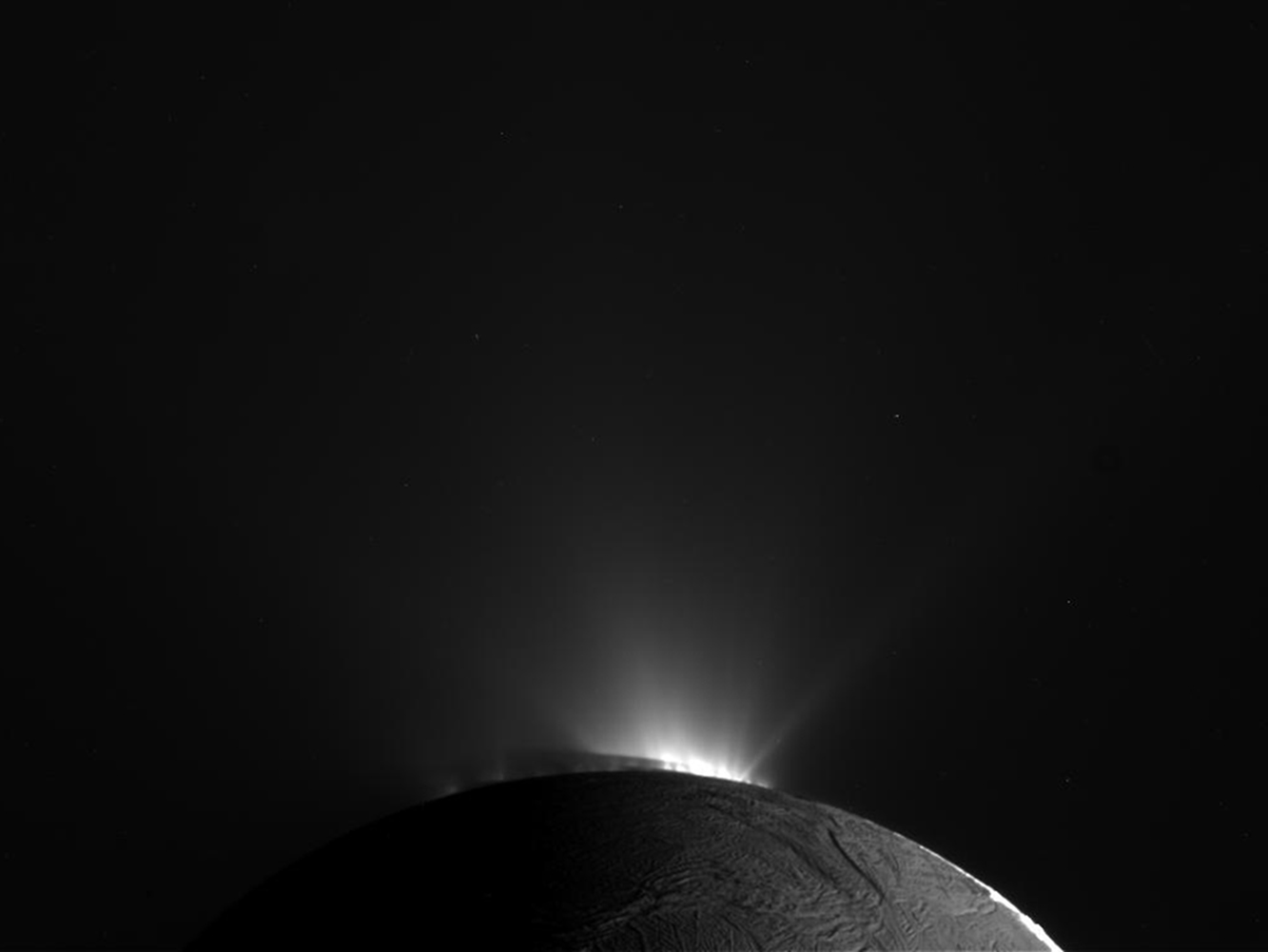
NASA's Cassini spacecraft obtained this raw image of the south polar region of Saturn's moon Enceladus on Nov. 30, 2010. The spacecraft was about 89,000 kilometers (55,000 miles) away from the moon's surface. Image Credit: NASA/JPL/SSI. Larger image

NASA's Cassini spacecraft successfully dipped near the surface of Saturn's moon Enceladus on Nov. 30. Though Cassini's closest approach took it to within about 48 kilometers (30 miles) of the moon's northern hemisphere, the spacecraft also captured shadowy images of the tortured south polar terrain and the brilliant jets that spray out from it.

Many of the raw images feature darkened terrain because winter has descended upon the southern hemisphere of Enceladus. But sunlight behind the moon backlights the jets of water vapor and icy particles. In some images, the jets line up in rows, forming curtains of spray.

The new raw images can be seen at http://saturn.jpl.nasa.gov/photos/raw/ .

The Enceladus flyby was the 12th of Cassini's mission, with the spacecraft swooping down around 61 degrees north latitude. This encounter and its twin three weeks later at the same altitude and latitude, are the closest Cassini will come to the northern hemisphere surface of Enceladus during the extended Solstice mission. (Cassini's closest-ever approach to Enceladus occurred in October 2008, when the spacecraft dipped to an altitude of 25 kilometers, or 16 miles.)

Among the observations Cassini made during this Enceladus flyby, the radio science subsystem collected gravity measurements to understand the moon's interior structure, and the fields and particles instruments sampled the charged particle environment around the moon.

About two days before the Enceladus flyby, Cassini also passed the sponge-like moon Hyperion, beaming back intriguing images of the craters on its surface. The flyby, at 72,000 kilometers (45,000 miles) in altitude, was one of the closest approaches to Hyperion that Cassini has made.

Scientists are still working to analyze the data and images collected during the flybys.

The Cassini-Huygens mission is a cooperative project of NASA, the European Space Agency and the Italian Space Agency. The Jet Propulsion Laboratory manages the project for NASA's Science Mission Directorate in Washington. The Cassini orbiter was designed, developed and assembled at JPL. The imaging operations center is based at the Space Science Institute in Boulder, Colo.

More Cassini information is available, at: http://www.nasa.gov/cassini and http://saturn.jpl.nasa.gov .

Jia-Rui Cook 818-354-0850
Jet Propulsion Laboratory, Pasadena, Calif.
jccook@jpl.nasa.gov

Wednesday, December 01, 2010

First Super-Earth Atmosphere Analysed

PR Image eso1047a
Artist’s impression of GJ 1214b

PR Image eso1047b
Artist’s impression of GJ 1214b in transit

The super-Earth exoplanet GJ 1214b

PR Video eso1047b
Zooming in on GJ 1214

The atmosphere around a super-Earth exoplanet has been analysed for the first time by an international team of astronomers using ESO’s Very Large Telescope. The planet, which is known as GJ 1214b, was studied as it passed in front of its parent star and some of the starlight passed through the planet’s atmosphere. We now know that the atmosphere is either mostly water in the form of steam or is dominated by thick clouds or hazes. The results will appear in the 2 December 2010 issue of the journal Nature.

The planet GJ 1214b was discovered in 2009 using the HARPS instrument on ESO’s 3.6-metre telescope in Chile (eso0950) [1]. Initial findings suggested that this planet had an atmosphere, which has now been confirmed and studied in detail by an international team of astronomers, led by Jacob Bean (Harvard–Smithsonian Center for Astrophysics), using the FORS instrument on ESO’s Very Large Telescope.

“This is the first super-Earth to have its atmosphere analysed. We’ve reached a real milestone on the road toward characterising these worlds,” said Bean.

GJ 1214b has a radius of about 2.6 times that of the Earth and is about 6.5 times as massive, putting it squarely into the class of exoplanets known as super-Earths. Its host star lies about 40 light-years from Earth in the constellation of Ophiuchus (the Serpent Bearer). It is a faint star [2], but it is also small, which means that the size of the planet is large compared to the stellar disc, making it relatively easy to study [3]. The planet travels across the disc of its parent star once every 38 hours as it orbits at a distance of only two million kilometres: about seventy times closer than the Earth orbits the Sun.

To study the atmosphere, the team observed the light coming from the star as the planet passed in front of it [4]. During these transits, some of the starlight passes through the planet’s atmosphere and, depending on the chemical composition and weather on the planet, specific wavelengths of light are absorbed. The team then compared these precise new measurements with what they would expect to see for several possible atmospheric compositions.

Before the new observations, astronomers had suggested three possible atmospheres for GJ 1214b. The first was the intriguing possibility that the planet was shrouded by water, which, given the close proximity to the star, would be in the form of steam. The second possibility was that this is a rocky world with an atmosphere consisting mostly of hydrogen, but with high clouds or hazes obscuring the view. The third option was that this exoplanet was like a mini-Neptune, with a small rocky core and a deep hydrogen-rich atmosphere.

The new measurements do not show the telltale signs of hydrogen and hence rule out the third option. Therefore, the atmosphere is either rich in steam, or it is blanketed by clouds or hazes, similar to those seen in the atmospheres of Venus and Titan in our Solar System, which hide the signature of hydrogen..

“Although we can’t yet say exactly what that atmosphere is made of, it is an exciting step forward to be able to narrow down the options for such a distant world to either steamy or hazy,” says Bean. “Follow-up observations in longer wavelength infrared light are now needed to determine which of these atmospheres exists on GJ 1214b.”
Notes

[1] The number of confirmed exoplanets reached 500 on 19 November 2010. Since then, more exoplanets have been confirmed. For the latest count, please visit: http://exoplanet.eu/catalog.php

[2] If GJ 1214 were seen at the same distance from us as our Sun, it would appear 300 times fainter.

[3] Because the star GJ1214 itself is quite faint — more than 100 times fainter in visible light than the host stars of the two most widely studied hot Jupiter exoplanets — the large collecting area of the Very Large Telescope was critical for acquiring enough signal for these measurements.

[4] GJ 1214b’s atmospheric composition was studied using the FORS instrument on the Very Large Telescope, which can perform very sensitive spectroscopy of multiple objects in the near-infrared part of the spectrum. FORS was one of the first instruments installed on the Very Large Telescope.

More information

This research is presented in a paper to appear in Nature on 2 December 2010.

The team is composed of Jacob Bean (Harvard–Smithsonian Center for Astrophysics, USA), Eliza Miller-Ricci Kempton (University of California, Santa Cruz, USA) and Derek Homeier (Institute for Astrophysics, Göttingen, Germany).

ESO, the European Southern Observatory, is the foremost intergovernmental astronomy organisation in Europe and the world’s most productive astronomical observatory. It is supported by 14 countries: Austria, Belgium, the Czech Republic, Denmark, France, Finland, Germany, Italy, the Netherlands, Portugal, Spain, Sweden, Switzerland and the United Kingdom. ESO carries out an ambitious programme focused on the design, construction and operation of powerful ground-based observing facilities enabling astronomers to make important scientific discoveries. ESO also plays a leading role in promoting and organising cooperation in astronomical research. ESO operates three unique world-class observing sites in Chile: La Silla, Paranal and Chajnantor. At Paranal, ESO operates the Very Large Telescope, the world’s most advanced visible-light astronomical observatory and VISTA, the world’s largest survey telescope. ESO is the European partner of a revolutionary astronomical telescope ALMA, the largest astronomical project in existence. ESO is currently planning a 42-metre European Extremely Large optical/near-infrared Telescope, the E-ELT, which will become “the world’s biggest eye on the sky”.


Contacts

Jacob Bean
Harvard–Smithsonian Center for Astrophysics
Cambridge, USA
Tel: +1 617 495 7747
Cell: +1 857 225 3818
Email: jbean@cfa.harvard.edu

Richard Hook
ESO, La Silla, Paranal, E-ELT and Survey Telescopes Public Information Officer
Garching bei München, Germany
Tel: +49 89 3200 6655
Cell: +49 151 1537 3591
Email: rhook@eso.org

The Universe Does Think Small

The biggest galaxies in the universe are elliptical galaxies like the one in this artist's conception. The largest of these hold over one trillion stars according to astronomical census takers, compared to 400 billion in our Milky Way. However, new research shows that elliptical galaxies actually hold five to ten times as many stars as previously believed. Credit: David A. Aguilar (CfA)

Cambridge, MA - The biggest galaxies in the universe are elliptical galaxies. The largest of these hold over one trillion stars according to astronomical census takers, compared to 400 billion in our Milky Way. However, new research shows that elliptical galaxies actually hold five to ten times as many stars as previously believed. This means that the total number of stars in the universe is likely three times bigger than realized.

The hidden stars are known as red dwarfs for their color and small size. Because red dwarfs are small and dim compared to stars like the Sun, astronomers hadn't been able to detect them in galaxies beyond the Milky Way before now. As such, they didn't know how many stars in the universe were red dwarfs.

Scientists used powerful instruments on the Keck Observatory in Hawaii to detect the faint signature of red dwarfs in the cores of eight elliptical galaxies, which are located between about 50 million and 300 million light-years away. They discovered that the red dwarfs, which are only between 10 and 30 percent as massive as the Sun, were much more bountiful than expected.

"As it turns out, the universe thinks small, at least when it comes to star size," said Harvard astronomer Charlie Conroy. "Our stellar inventory has changed dramatically."

"No one knew how many of these stars there were," said Pieter van Dokkum, a Yale University astronomer who led the research. "Different theoretical models predicted a wide range of possibilities, so this answers a long-standing question about just how abundant these stars are."

Their results imply that stellar population counts depend on what type of galaxy astronomers examine, just as a census of the city of New York and the town of Derby, Kansas will find very different population numbers.

"We usually assume other galaxies look like our own. But this suggests other conditions are possible in other galaxies," Conroy stated. "This discovery could have a major impact on our understanding of galaxy formation and evolution."

In particular, galaxies might contain less dark matter - a mysterious substance only detectable due to its gravitational effects - than previous measurements of their masses indicated. Instead, the abundant red dwarfs might contribute more mass than previously calculated.

Their findings appear in the Dec. 1st online issue of the journal Nature. Headquartered in Cambridge, Mass., the Harvard-Smithsonian Center for Astrophysics (CfA) is a joint collaboration between the Smithsonian Astrophysical Observatory and the Harvard College Observatory. CfA scientists, organized into six research divisions, study the origin, evolution and ultimate fate of the universe.

For more information, contact:

David A. Aguilar
Director of Public Affairs
Harvard-Smithsonian Center for Astrophysics
617-495-7462
daguilar@cfa.harvard.edu

Christine Pulliam
Public Affairs Specialist
Harvard-Smithsonian Center for Astrophysics
617-495-7463
cpulliam@cfa.harvard.edu

Discovery Triples Total Number of Stars in Universe

Filtering out the light from brighter stars, astronomers detected the faint signature of small, dim red dwarf stars in nearby elliptical galaxies (right), and found these are much more numerous than in our own Milky Way (left). This finding suggests that the total number of stars in the universe could be up to three times higher than previously thought. Credit: Yale University

Kamuela, HI Dec. 1, 2010 - Astronomers have discovered that small, dim stars known as red dwarfs are much more prolific than previously thought—so much so that the total number of stars in the universe is likely three times bigger than realized.

Because red dwarfs are relatively small and dim compared to stars like our Sun, astronomers hadn’t been able to detect them in galaxies other than our own Milky Way and its nearest neighbors before now. As such, they did not know how much of the total stellar population of the universe is made up of red dwarfs.

Now astronomers have used powerful instruments on the W. M. Keck Observatory in Hawaii to detect the faint signature of red dwarfs in eight massive, relatively nearby galaxies called elliptical galaxies, which are located between about 50 million and 300 million light years away. They discovered that the red dwarfs, which are only between 10 and 20 percent as massive as the Sun, were much more bountiful than expected.

“This important study, which uses information at the red end of the optical spectrum, was aided by advances in detector technology that have been implemented at Keck,” said Keck Observatory Director Taft Armandroff.

“No one knew how many of these stars there were,” said Pieter van Dokkum, a Yale University astronomer who led the research, which is described in Nature’s Dec.1 Advanced Online Publication. “Different theoretical models predicted a wide range of possibilities, so this answers a longstanding question about just how abundant these stars are.”

The team discovered that there are about 20 times more red dwarfs in elliptical galaxies than in the Milky Way, said Charlie Conroy of the Harvard-Smithsonian Center for Astrophysics, who was also involved in the research.

We usually assume other galaxies look like our own. But this suggests other conditions are possible in other galaxies,” Conroy said. “So this discovery could have a major impact on our understanding of galaxy formation and evolution.”

For instance, Conroy said, galaxies might contain less dark matter—a mysterious substance that has mass but cannot be directly observed—than previous measurements of their masses might have indicated. Instead, the abundant red dwarfs could contribute more mass than realized.

In addition to boosting the total number of stars in the universe, the discovery also increases the number of planets orbiting those stars, which in turn elevates the number of planets that might harbor life, van Dokkum said. In fact, a recently discovered exoplanet that astronomers believe could potentially support life orbits a red dwarf star, called Gliese 581.

“There are possibly trillions of Earths orbiting these stars,” van Dokkum said, adding that the red dwarfs they discovered, which are typically more than 10 billion years old, have been around long enough for complex life to evolve. “It’s one reason why people are interested in this type of star.”

The W. M. Keck Observatory operates two 10-meter optical/infrared telescopes on the summit of Mauna Kea. The twin telescopes feature a suite of advanced instrumentation including imagers, multi-object spectrographs, high-resolution spectrographs, integral-field spectroscopy and a world-leading laser guide star adaptive optics system. The Observatory is a private 501(c) 3 organization and a scientific partnership of the California Institute of Technology, the University of California and NASA.

Friday, November 26, 2010

INTEGRAL helps unravel the tumultuous recent history of the solar neighbourhood

Just like archaeologists, who rely on radioactive carbon to date the organic remains from past epochs, astronomers have exploited the radioactive decay of an isotope of aluminium to estimate the age of stars in the nearby Scorpius-Centaurus association, the closest group of young and massive stars to the Sun. The new observations, performed in gamma rays by ESA's INTEGRAL observatory, provide evidence for recent ejections of matter from massive stars that took place only a few million years ago in our cosmic neighbourhood.

A common technique used in archaeology to establish the age of fossils and other organic samples from the past consists of measuring how much of a particular isotope of carbon, namely carbon-14 (14C), they contain. This radioactive isotope decays into the element nitrogen on a time scale of a few thousand years, hence the amount of it remaining in these ancient fossils is a strong indicator of the epoch from which they date. An analogous method, based on the radioactive decay of an unstable isotope of aluminium, has been recently exploited by astronomers to probe and assess the age of the Scorpius-Centaurus association, the closest group of very young and massive stars. Stellar age estimates can be then used to investigate how nearby massive stars have shaped our local region of the Milky Way.

The radioactive decay process of 26Al. Credit: ESA

This dating procedure is possible because aluminium is one of the elements synthesised by massive stars during their late evolutionary stages, and its abundance in a stellar complex such as the Scorpius-Centaurus association varies strongly with time. One isotope of this element, namely aluminium-26 (26Al), is radioactive and decays with an exponential lifetime of about one million years. The decay process results in a stable isotope of the element magnesium (26Mg) and a number of by-products, including an extremely energetic photon observable in gamma rays at an energy of about 1.8 MeV.

“Conveniently for astronomers, the decay of 26Al involves a similar time scale to that spanned by the life time of massive stars, which is of the order of a few million years,” explains Roland Diehl from the Max-Planck Institute for Extraterrestrial Physics in Germany, who led a recent study targeting the gamma-ray emission from this isotope in the Scorpius-Centaurus association. “As its decay time is 'just right', measuring the abundance of 26Al is an excellent tool to trace the presence of young and massive stars, and it allows us to directly estimate their age,” he adds.

COMPTEL all-sky image of 26Al gamma rays.
Image courtesy of Plüschke et al. 2001.

Earlier observations, conducted in the 1990s with the COMPTEL instrument on NASA's Compton Gamma-Ray Observatory, revealed for the first time the emission of 26Al across the entire sky. Subsequent data collected by ESA's INTEGRAL mission confirmed these results, probing the global properties of this isotope throughout the plane of the Milky Way thanks to INTEGRAL's improved spectral resolution.

“At the characteristic energy of the 26Al line, INTEGRAL has a spectral resolution over 60 times better than COMPTEL's, enabling us to study the intensity and shape of this line across the Galaxy in much greater detail,” comments Chris Winkler, INTEGRAL Project Scientist. “The data, gathered over five years, are so deep that it is now possible to isolate the contribution due to an individual, nearby stellar complex from the overall galactic 26Al emission,” adds Winkler.

The evolution of the abundance of 26Al in a stellar group.
Image courtesy of R. Voss.

The data analysed by Diehl's team focussed on the Scorpius-Centaurus association, which is located at a distance of about 100–150 parsec from the Sun, and revealed robust evidence for recent massive star formation therein. “The gamma-ray data show that the stars in the Upper Scorpius subgroup of the Scorpius-Centaurus association are only about 5 million years old,” notes co-author Thomas Preibisch from the University Observatory Munich, also in Germany. “This is a direct estimate, in contrast to other procedures used to evaluate the ages of stars, which rely heavily on stellar evolution models. The very good agreement between these independent dating methods is an extremely reassuring result,” adds Preibisch.

Via stellar winds and supernova explosions, the stars in the Scorpius-Centaurus association are currently enriching the surrounding interstellar medium with heavy elements, including aluminium, and from the shape of the emission line of 26Al it is possible to constrain the kinematics of such ejecta. “By investigating the details of these outflows of radioactive gas, streaming at velocities of about 100 km/s towards the Sun, we are starting to unravel the recent history of massive star formation in the Solar System's vicinity and its implications on our own cosmic environment,” comments Diehl.

The new INTEGRAL data also allowed the astronomers to refine the estimate of the total content of 26Al in the Milky Way, which is lower by about 20 per cent than previous estimates. This is a critical step that is required to validate our understanding of the star formation and nucleosynthesis processes in our Galaxy and to predict the expected rate of supernova explosions.

Notes for editors:

The study is based on observations performed with the gamma-ray spectrometer, SPI, on board INTEGRAL. The data have been gathered in the energy range between 1785–1826 keV, which embraces the 26 line energy at 1808.63 keV, in bins of 0.5 keV. At this energy, the spectral resolution of SPI is 3 keV; the line positioning precision of 0.5 keV corresponds to a velocity resolution of about 75 km/s.

The data have been collected during about five years of INTEGRAL observations, between February 2003 and November 2007, with a total exposure of 61 million seconds, corresponding to almost 17,000 hours.

The half-life of a radioactive substance is the time required for half the nuclei to decay; for 26Al this quantity is ~700,000 years. Another quantity used to measure the time scale of radioactive decay is the exponential lifetime, or the time required for the number of nuclei to decrease by a factor of e (Euler's number); the exponential lifetime of 26Al is ~1 million years. As a comparison, the half-life of 14C , used for archaeological dating, is ~5700 years, and the exponential lifetime is ~8200 years.

Contacts

Roland Diehl
Max-Planck Institute for Extraterrestrial Physics
Garching, Germany
Phone: +49-89-30000-3850
Email: rod@mpe.mpg.de

Thomas Preibisch
University Observatory Munich, Germany
Phone: +49-89-2180-6016
Email: preibisch@usm.uni-muenchen.de

Chris Winkler
INTEGRAL Project Scientist
Research and Scientific Support Department
Directorate of Science and Robotic Exploration
ESA, The Netherlands
Phone: +31-71-565-3591
Email: cwinkler@rssd.esa.int

Wednesday, November 24, 2010

Stripes Are Back in Season on Jupiter

This image is a composite of three color images taken on Nov. 18, 2010, by the Gemini North telescope in Hawaii. The composite image shows a belt that had previously vanished in Jupiter's atmosphere is now reappearing. Image credit: NASA/JPL/UH/NIRI/Gemini. Larger image

A false-color composite image of Jupiter and its South Equatorial Belt shows an unusually bright spot, or outbreak, where winds are lofting particles to high altitudes in this image made from data obtained by the W.M. Keck telescope on Nov. 11, 2010. Image credit: NASA/JPL-Caltech/W. M. Keck Observatory.

This image of Jupiter is a composite of three color images taken on Nov. 16, 2010, by NASA's Infrared Telescope Facility. The particles lofted by the initial outbreak are easily identified in green as high altitude particles at the upper right, with a second outbreak to the lower left. Image credit: NASA/JPL-Caltech/IRTF.

PASADENA, Calif. - New NASA images support findings that one of Jupiter's stripes that "disappeared" last spring is now showing signs of a comeback. These new observations will help scientists better understand the interaction between Jupiter's winds and cloud chemistry.

Earlier this year, amateur astronomers noticed that a longstanding dark-brown stripe, known as the South Equatorial Belt, just south of Jupiter's equator, had turned white. In early November, amateur astronomer Christopher Go of Cebu City, Philippines, saw an unusually bright spot in the white area that was once the dark stripe. This phenomenon piqued the interest of scientists at NASA's Jet Propulsion Laboratory, Pasadena, Calif., and elsewhere.

After follow-up observations in Hawaii with NASA's Infrared Telescope Facility, the W.M. Keck Observatory and the Gemini Observatory telescope, scientists now believe the vanished dark stripe is making a comeback.

First-glimpse images of the re-appearing stripe are online at: http://www.nasa.gov/topics/solarsystem/features/jupiter20101124-i.html.

"The reason Jupiter seemed to 'lose' this band - camouflaging itself among the surrounding white bands - is that the usual downwelling winds that are dry and keep the region clear of clouds died down," said Glenn Orton, a research scientist at JPL. "One of the things we were looking for in the infrared was evidence that the darker material emerging to the west of the bright spot was actually the start of clearing in the cloud deck, and that is precisely what we saw."

This white cloud deck is made up of white ammonia ice. When the white clouds float at a higher altitude, they obscure the missing brown material, which floats at a lower altitude. Every few decades or so, the South Equatorial Belt turns completely white for perhaps one to three years, an event that has puzzled scientists for decades. This extreme change in appearance has only been seen with the South Equatorial Belt, making it unique to Jupiter and the entire solar system.

The white band wasn't the only change on the big, gaseous planet. At the same time, Jupiter's Great Red Spot became a darker red color. Orton said the color of the spot - a giant storm on Jupiter that is three times the size of Earth and a century or more old - will likely brighten a bit again as the South Equatorial Belt makes its comeback.

The South Equatorial Belt underwent a slight brightening, known as a "fade," just as NASA's New Horizons spacecraft was flying by on its way to Pluto in 2007. Then there was a rapid "revival" of its usual dark color three to four months later. The last full fade and revival was a double-header event, starting with a fade in 1989, revival in 1990, then another fade and revival in 1993. Similar fades and revivals have been captured visually and photographically back to the early 20th century, and they are likely to be a long-term phenomenon in Jupiter's atmosphere.

Scientists are particularly interested in observing this latest event because it's the first time they've been able to use modern instruments to determine the details of the chemical and dynamical changes of this phenomenon. Observing this event carefully may help to refine the scientific questions to be posed by NASA's Juno spacecraft, due to arrive at Jupiter in 2016, and a larger, proposed mission to orbit Jupiter and explore its satellite Europa after 2020.

The event also signifies another close collaboration between professional and amateur astronomers. The amateurs, located worldwide, are often well equipped with instrumentation and are able to track the rapid developments of planets in the solar system. These amateurs are collaborating with professionals to pursue further studies of the changes that are of great value to scientists and researchers everywhere.

"I was fortunate to catch the outburst," said Christopher Go, referring to the first signs that the band was coming back. "I had a meeting that evening and it went late. I caught the outburst just in time as it was rising. Had I imaged earlier, I would not have caught it," he said. Go, who also conducts in the physics department at the University of San Carlos, Cebu City, Philippines, witnessed the disappearance of the stripe earlier this year, and in 2007 he was the first to catch the stripe's return. "I was able to catch it early this time around because I knew exactly what to look for."

NASA's Exoplanet Science Institute at the California Institute of Technology in Pasadena manages time allocation on the Keck telescope for NASA. Caltech manages JPL for NASA.

For more information about NASA and agency programs, visit: http://www.nasa.gov/home

Priscilla Vega/Jia-Rui Cook 818-354-1357/354-0850
Jet Propulsion Laboratory, Pasadena, Calif.
priscilla.r.vega@jpl.nasa.gov / Jia-Rui.C.Cook@jpl.nasa.gov