Ultralight Planet Found Next Door (ESOcast 250 Light)
A team of astronomers using the European
Southern Observatory’s Very Large Telescope (ESO’s VLT) in Chile have
found evidence of another planet orbiting Proxima Centauri, the closest
star to our Solar System. This candidate planet is the third detected in
the system and the lightest yet discovered orbiting this star. At just a
quarter of Earth’s mass, the planet is also one of the lightest
exoplanets ever found.
“The discovery shows that our closest stellar neighbour
seems to be packed with interesting new worlds, within reach of further
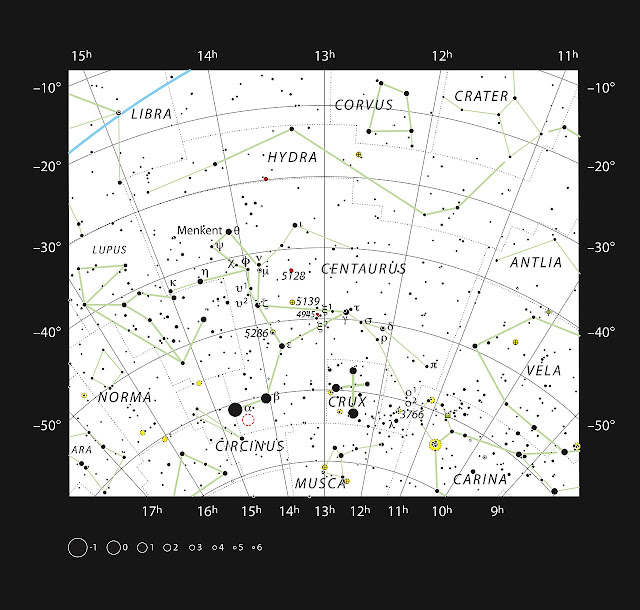
study and future exploration,” explains João Faria, a researcher at the Instituto de Astrofísica e Ciências do Espaço, Portugal and lead author of the study published today in Astronomy & Astrophysics. Proxima Centauri is the closest star to the Sun, lying just over four light-years away.
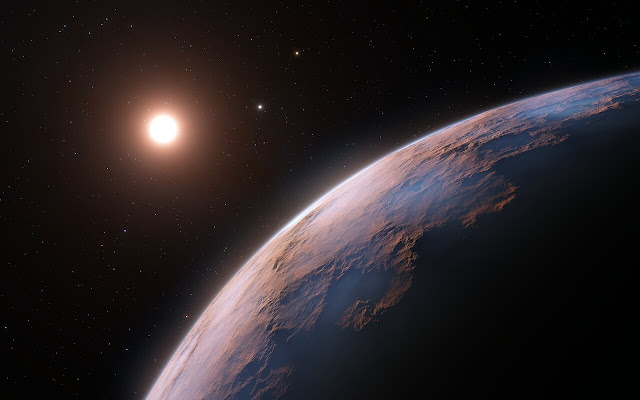
The newly discovered planet, named Proxima d, orbits
Proxima Centauri at a distance of about four million kilometres, less
than a tenth of Mercury’s distance from the Sun. It orbits between the
star and the habitable zone — the area around a star where liquid water
can exist at the surface of a planet — and takes just five days to
complete one orbit around Proxima Centauri.
The star is already known to host two other planets:
Proxima b, a planet with a mass comparable to that of Earth that orbits
the star every 11 days and is within the habitable zone, and candidate
Proxima c, which is on a longer five-year orbit around the star.
Proxima b was discovered a few years ago using the HARPS instrument on ESO’s 3.6-metre telescope. The discovery was confirmed in 2020 when scientists observed the Proxima system with a new instrument on ESO’s VLT that had greater precision, the Echelle SPectrograph for Rocky Exoplanets and Stable Spectroscopic Observations (ESPRESSO).
It was during these more recent VLT observations that astronomers
spotted the first hints of a signal corresponding to an object with a
five-day orbit. As the signal was so weak, the team had to conduct
follow-up observations with ESPRESSO to confirm that it was due to a
planet, and not simply a result of changes in the star itself.
“After obtaining new observations, we were able to confirm this signal as a new planet candidate,” Faria says. “I was excited by the challenge of detecting such a small signal and, by doing so, discovering an exoplanet so close to Earth.”
At just a quarter of the mass of Earth, Proxima d is the lightest exoplanet ever measured using the radial velocity technique, surpassing a planet recently discovered in the L 98-59 planetary system.
The technique works by picking up tiny wobbles in the motion of a star
created by an orbiting planet’s gravitational pull. The effect of
Proxima d’s gravity is so small that it only causes Proxima Centauri to
move back and forth at around 40 centimetres per second (1.44 kilometres
per hour).
“This achievement is extremely important,” says Pedro Figueira, ESPRESSO instrument scientist at ESO in Chile. “It
shows that the radial velocity technique has the potential to unveil a
population of light planets, like our own, that are expected to be the
most abundant in our galaxy and that can potentially host life as we
know it.”
“This result clearly shows what ESPRESSO is capable of and makes me wonder about what it will be able to find in the future,” Faria adds.
ESPRESSO’s search for other worlds will be complemented by ESO’s Extremely Large Telescope (ELT),
currently under construction in the Atacama Desert, which will be
crucial to discovering and studying many more planets around nearby
stars.
More Information
This research was presented in the paper “A candidate short-period sub-Earth orbiting Proxima Centauri” (doi:10.1051/0004-6361/202142337) to appear in Astronomy & Astrophysics.
The team is composed of J. P. Faria (Instituto de
Astrofísica e Ciências do Espaço, Universidade do Porto, Portugal
[IA/UPorto], Centro de Astrofísica da Universidade do Porto, Portugal
[CAUP] and Departamento de Física e Astronomia, Faculdade de Ciências,
Universidade do Porto, Portugal [FCUP]), A. Suárez Mascareño (Instituto
de Astrofísica de Canarias, Tenerife, Spain [IAC], Departamento de
Astrofísica, Universidad de La Laguna, Tenerife, Spain [IAC-ULL]), P.
Figueira (European Southern Observatory, Santiago, Chile [ESO-Chile],
IA-Porto), A. M. Silva (IA-Porto, FCUP) M. Damasso (Osservatorio
Astrofisico di Torino, Italy [INAF-Turin]), O. Demangeon (IA-Porto,
FCUP), F. Pepe (Département d’astronomie de l’Université de Genève,
Switzerland [UNIGE]), N. C. Santos (IA-Porto, FCUP), R. Rebolo (Consejo
Superior de Investigaciones Científicas, Madrid, Spain [CSIC], IAC-ULL,
IAC), S. Cristiani (INAF - Osservatorio Astronomico di Trieste, Italy
[OATS]), V. Adibekyan (IA-Porto), Y. Alibert (Physics Institute of
University of Bern, Switzerland), R. Allart (Department of Physics, and
Institute for Research on Exoplanets, Université de Montréal,Canada,
UNIGE), S. C. C. Barros (IA-Porto, FCUP), A. Cabral (Instituto de
Astrofísica e Ciências do Espaço, Faculdade de Ciências da Universidade
de Lisboa, Portugal [IA-Lisboa], Faculdade de Ciências da Universidade
de Lisboa, Portugal [FCUL]), V. D’Odorico (OATS, Institute for
Fundamental Physics of the Universe, Trieste, Italy [IFPU], Scuola
Normale Superiore, Pisa, Italy) P. Di Marcantonio (OATS), X. Dumusque
(UNIGE), D. Ehrenreich (UNIGE), J. I. González Hernández (IAC-ULL, IAC),
N. Hara (UNIGE), J. Lillo-Box (Centro de Astrobiología (CAB,
CSIC-INTA), Depto. de Astrofísica, Madrid, Spain), G. Lo Curto (European
Southern Observatory, Garching bei München, Germany [ESO], ESO-Chile)
C. Lovis (UNIGE), C. J. A. P. Martins (IA-Porto, Centro de Astrofísica
da Universidade do Porto, Portugal), D. Mégevand (UNIGE), A. Mehner
(ESO-Chile), G. Micela (INAF - Osservatorio Astronomico di Palermo,
Italy), P. Molaro (OATS), IFPU), N. J. Nunes (IA-Lisboa), E. Pallé (IAC,
IAC-ULL), E. Poretti (INAF - Osservatorio Astronomico di Brera, Merate,
Italy ), S. G. Sousa (IA-Porto, FCUP), A. Sozzetti (INAF-Turin), H.
Tabernero (Centro de Astrobiología, Madrid, Spain [CSIC-INTA]), S. Udry
(UNIGE), and M. R. Zapatero Osorio (CSIC-INTA).
The European Southern Observatory (ESO) enables scientists
worldwide to discover the secrets of the Universe for the benefit of
all. We design, build and operate world-class observatories on the
ground — which astronomers use to tackle exciting questions and spread
the fascination of astronomy — and promote international collaboration
in astronomy. Established as an intergovernmental organisation in 1962,
today ESO is supported by 16 Member States (Austria, Belgium, the Czech
Republic, Denmark, France, Finland, Germany, Ireland, Italy, the
Netherlands, Poland, Portugal, Spain, Sweden, Switzerland and the United
Kingdom), along with the host state of Chile and with Australia as a
Strategic Partner. ESO’s headquarters and its visitor centre and
planetarium, the ESO Supernova, are located close to Munich in Germany,
while the Chilean Atacama Desert, a marvellous place with unique
conditions to observe the sky, hosts our telescopes. ESO operates three
observing sites: La Silla, Paranal and Chajnantor. At Paranal, ESO
operates the Very Large Telescope and its Very Large Telescope
Interferometer, as well as two survey telescopes, VISTA working in the
infrared and the visible-light VLT Survey Telescope. Also at Paranal ESO
will host and operate the Cherenkov Telescope Array South, the world’s
largest and most sensitive gamma-ray observatory. Together with
international partners, ESO operates APEX and ALMA on Chajnantor, two
facilities that observe the skies in the millimetre and submillimetre
range. At Cerro Armazones, near Paranal, we are building “the world’s
biggest eye on the sky” — ESO’s Extremely Large Telescope. From our
offices in Santiago, Chile we support our operations in the country and
engage with Chilean partners and society.
Links
Contacts:
João Faria
Instituto de Astrofisica e Ciências do Espaço, Faculdade de Ciências, Universidade do Porto
Porto, Portugal
Tel: +351 226 089 855
Email: joao.faria@astro.up.pt
Pedro Figueira
ESO and Instituto de Astrofísica e Ciências do Espaço
Santiago, Chile
Tel: +56 2 2463 3074
Email: pedro.figueira@eso.org
Nuno Santos
Instituto de Astrofisica e Ciências do Espaço, Faculdade de Ciências, Universidade do Porto
Porto, Portugal
Email: nuno.santos@astro.up.pt
Mario Damasso
INAF – Osservatorio Astrofisico di Torino
Turin, Italy
Tel: +39 339 1816786
Email: mario.damasso@inaf.it
Alejandro Suárez Mascareño
Instituto de Astrofísica de Canarias
Tenerife, Spain
Tel: +34 658 778 954
Email: asm@iac.es
Baptiste Lavie
Département d’astronomie de l’Université de Genève
Genève, Switzerland
Tel: +41 22 379 24 88
Email: baptiste.lavie@unige.ch
Bárbara Ferreira
ESO Media Manager
Garching bei München, Germany
Tel: +49 89 3200 6670
Cell: +49 151 241 664 00
Email: press@eso.org
Source: ESO/News