
Thursday, November 11, 2021
ALMA Scientists Detect Signs of Water in a Galaxy Far, Far Away
This artist’s conception shows the dust continuum and molecular lines of
carbon monoxide and water seen in the pair of galaxies known as
SPT0311-58. ALMA data reveals abundant CO and H2O in the
larger of the two galaxies, indicating that the molecular Universe was
going strong shortly after the elements were initially forged. Credit:
ALMA (ESO/NAOJ/NRAO)/S. Dagnello (NRAO)

These science images show the molecular lines and dust continuum seen in
ALMA observations of the pair of early massive galaxies known as
SPT0311-58. On left: A composite image combining the dust continuum with
molecular lines for H2O and CO. On right: The dust continuum seen in red (top), molecular line for H2O
shown in blue (2nd from top), molecular line transitions for carbon
monoxide, CO(6-5) shown in purple (middle), CO(7-6) shown in magenta
(second from bottom), and CO(10-9) shown in pinks and deep blue
(bottom). Credit: ALMA (ESO/NAOJ/NRAO)/S. Dagnello (NRAO)

This animated gif moves through the dust continuum and molecular lines
for water and carbon monoxide seen in ALMA observations of the pair of
early massive galaxies known as SPT0311-58. This gif begins with a
composite combining the dust continuum with molecular lines for H2O and CO. It is followed by the dust continuum seen in red, molecular lines for H2O
seen in blue, molecular lines for carbon monoxide, CO(10-9) shown in
pinks and deep blue, CO(7-6) shown in magenta, and CO(6-5) shown in
purple. Credit: ALMA (ESO/NAOJ/NRAO)/S. Dagnello (NRAO)
Water has been detected in the most massive galaxy in the early Universe, according to new observations from the Atacama Large Millimeter/submillimeter Array (ALMA). Scientists studying SPT0311-58 found H2O , along with carbon monoxide in the galaxy, which is located nearly 12.88 billion light years from Earth. Detection of these two molecules in abundance suggests that the molecular Universe was going strong shortly after the elements were forged in early stars. The new research comprises the most detailed study of molecular gas content of a galaxy in the early Universe to date and the most distant detection of H2O in a regular star-forming galaxy. The research is published in The Astrophysical Journal.
SPT0311-58 is actually made up of two galaxies, and was first seen by ALMA scientists in 2017 at its location, or time, in the Epoch of Reionization. This epoch occurred at a time when the Universe was just 780 million years old—roughly 5-percent of its current age—and the first stars and galaxies were being born. Scientists believe that the two galaxies may be merging, and that their rapid star formation is not only using up their gas, or star-forming fuel, but that it may eventually evolve the pair into massive elliptical galaxies like those seen in the Local Universe.
“Using high-resolution ALMA observations of molecular gas in the pair of galaxies known collectively as SPT0311-58 we detected both water and carbon monoxide molecules in the larger of the two galaxies. Oxygen and carbon, in particular, are first-generation elements, and in the molecular forms of carbon monoxide and water, they are critical to life as we know it,” said Sreevani Jarugula, an astronomer at the University of Illinois and the principal investigator on the new research. “This galaxy is the most massive galaxy currently known at high redshift, or the time when the Universe was still very young. It has more gas and dust compared to other galaxies in the early Universe, which gives us plenty of potential opportunities to observe abundant molecules and to better understand how these life-creating elements impacted the development of the early Universe.”
Water, in particular, is the third most abundant molecule in the Universe after molecular hydrogen and carbon monoxide. Previous studies of galaxies in the local and early Universe have correlated water emission and the far-infrared emission from dust. “The dust absorbs the ultraviolet radiation from the stars in the galaxy and re-emits it as far-infrared photons,” said Jarugula. “This further excites the water molecules, giving rise to the water emission that scientists are able to observe. In this case, it helped us to detect water emission in this massive galaxy. This correlation could be used to develop water as a tracer of star formation, which could then be applied to galaxies on a cosmological scale.”
Studying the first galaxies to form in the Universe helps scientists to better understand the birth, growth, and evolution of the Universe, and everything in it, including the Solar System and Earth. “Early galaxies are forming stars at a rate thousands of times that of the Milky Way, said Jarugula. “Studying the gas and dust content of these early galaxies informs us of their properties, such as how many stars are being formed, the rate at which gas is converted into stars, how galaxies interact with each other and with the interstellar medium, and more.”
According to Jarugula, there’s plenty left to learn about SPT0311-58 and the galaxies of the early Universe. “This study not only provides answers about where, and how far away, water can exist in the Universe, but also has given rise to a big question: How has so much gas and dust assembled to form stars and galaxies so early in the Universe? The answer requires further study of these and similar star-forming galaxies to get a better understanding of the structural formation and evolution of the early Universe.”
“This exciting result, which shows the power of ALMA, adds to a
growing collection of observations of the early Universe,” said Joe
Pesce, astrophysicist and ALMA Program Director at the National Science
Foundation. “These molecules, important to life on Earth, are forming as
soon as they can, and their observation is giving us insight into the
fundamental processes of a Universe very much different from today’s.”
Additional Information
The original press release was published by the National Radio Astronomy Observatory (NRAO), an ALMA partner on behalf of North America.
The Atacama Large Millimeter/submillimeter Array (ALMA), an international astronomy facility, is a partnership of the European Organisation for Astronomical Research in the Southern Hemisphere (ESO), the U.S. National Science Foundation (NSF) and the National Institutes of Natural Sciences (NINS) of Japan in cooperation with the Republic of Chile. ALMA is funded by ESO on behalf of its Member States, by NSF in cooperation with the National Research Council of Canada (NRC) and the Ministry of Science and Technology (MOST) and by NINS in cooperation with the Academia Sinica (AS) in Taiwan and the Korea Astronomy and Space Science Institute (KASI).
ALMA construction and operations are led by ESO on behalf of its Member States; by the National Radio Astronomy Observatory (NRAO), managed by Associated Universities, Inc. (AUI), on behalf of North America; and by the National Astronomical Observatory of Japan (NAOJ) on behalf of East Asia. The Joint ALMA Observatory (JAO) provides the unified leadership and management of the construction, commissioning and operation of ALMA.
Contacts:
-
Valeria Foncea
Education and Public Outreach Manager
Joint ALMA Observatory Santiago - Chile
Phone: +56 2 2467 6258
Cell phone: +56 9 7587 1963
Email: valeria.foncea@alma.cl
-
Amy C. Oliver
Public Information & News Manager
National Radio Astronomical Observatory (NRAO), USA
Phone: +1 434 242 9584
Email: aoliver@nrao.edu
-
Masaaki Hiramatsu
Education and Public Outreach Officer, NAOJ Chile
Observatory, Tokyo - Japan
Phone: +81 422 34 3630
Email:
- hiramatsu.masaaki@nao.ac.jp
ESO Public Information Officer
Garching bei München, Germany
Phone: +49 89 3200 6670
Email: pio@eso.org
Source: Atacama Large Millimeter/submillimeter Array (ALMA)/News


Wednesday, November 10, 2021
Hubble Surveys A Snowman Sculpted from Gas and Dust

The Snowman Nebula is an emission nebula that resides in the constellation Puppis in the southern sky, about 6,000 light-years away from Earth. Emission nebulae are diffuse clouds of gas that have become so charged by the energy of nearby massive stars that they glow with their own light. The radiation from these massive stars strips electrons from the nebula’s hydrogen atoms in a process called ionization. As the energized electrons revert from their higher-energy state to a lower-energy state, they emit energy in the form of light, causing the nebula’s gas to glow.
From a telescope on Earth, the Snowman looks a bit like a dual-lobed ball of gas, but this Hubble Space Telescope image captures the details of sweeping curves of bright gas and dark knots of dust in a small section of the nebula. The Snowman is also known as Sharpless 2-302, one of the objects in a catalog of mostly emission nebulae that was compiled by astronomer Stewart Sharpless as he sought to identify areas of interstellar ionized hydrogen, or HII regions.
This image was captured as part of a survey of massive- and
intermediate-size “protostars,” or newly forming stars. Astronomers used
the infrared sensitivity of Hubble’s Wide Field Camera 3 to look for
hydrogen ionized by ultraviolet light from the protostars, jets from the
stars, and other features.

The Hubble Space Telescope captured just a small segment of the larger Snowman Nebula. Credits: NASA, ESA, J. Tan (Chalmers University of Technology), and DSS; Processing; Gladys Kober (NASA/Catholic University of America)
Main Image credit: NASA, ESA, and J. Tan (Chalmers University of Technology); Processing; Gladys Kober (NASA/Catholic University of America)
Media Contact:
Claire Andreoli
NASA's Goddard Space Flight Center
301-286-1940
Tuesday, November 09, 2021
Hubble Spots Dark Star-Hatching frEGGs

This image shows knots of cold, dense interstellar gas where new stars are forming. These Free-floating Evaporating Gaseous Globules (frEGGs) were first seen in Hubble’s famous 1995 image of the Eagle Nebula. Because these lumps of gas are dark, they are rarely seen by telescopes. They can be observed when the newly forming stars ignite, their intense ultraviolet radiation eroding the surrounding gas away and letting the denser, more resistant frEGGs remain. These frEGGs are located in the Northern Coalsack Nebula in the direction of Cygnus, the Swan.
This Hubble image also features two giant stars. The left star is a rare, giant O-type star, very bright, blue-white stars known to be the hottest in the universe. These massive stars are 10,000 to a million times the brightness of the Sun and burn themselves out quickly, in a few million years. The right star is an even more massive supergiant B-type star. Supergiant stars also burn through their fuel quickly, anywhere between a few hundred thousand years to tens of millions of years, and die in titanic supernova explosions.

This Digitized Sky Survey image shows the location of the cold, dark frEGGs imaged by Hubble. Credits: NASA, ESA, R. Sahai (Jet Propulsion Laboratory), and DSS; Processing: Gladys Kober (NASA/Catholic University of America)
Main Image Credit: NASA, ESA, and R. Sahai (Jet
Propulsion Laboratory); Processing: Gladys Kober (NASA/Catholic
University of America)
Media Contact:
Claire Andreoli
NASA's Goddard Space Flight Center
301-286-1940
Editor: Andrea Gianopoulos
Source: NASA/Hubble
Monday, November 08, 2021
Tidying up planetary nurseries Additional Information

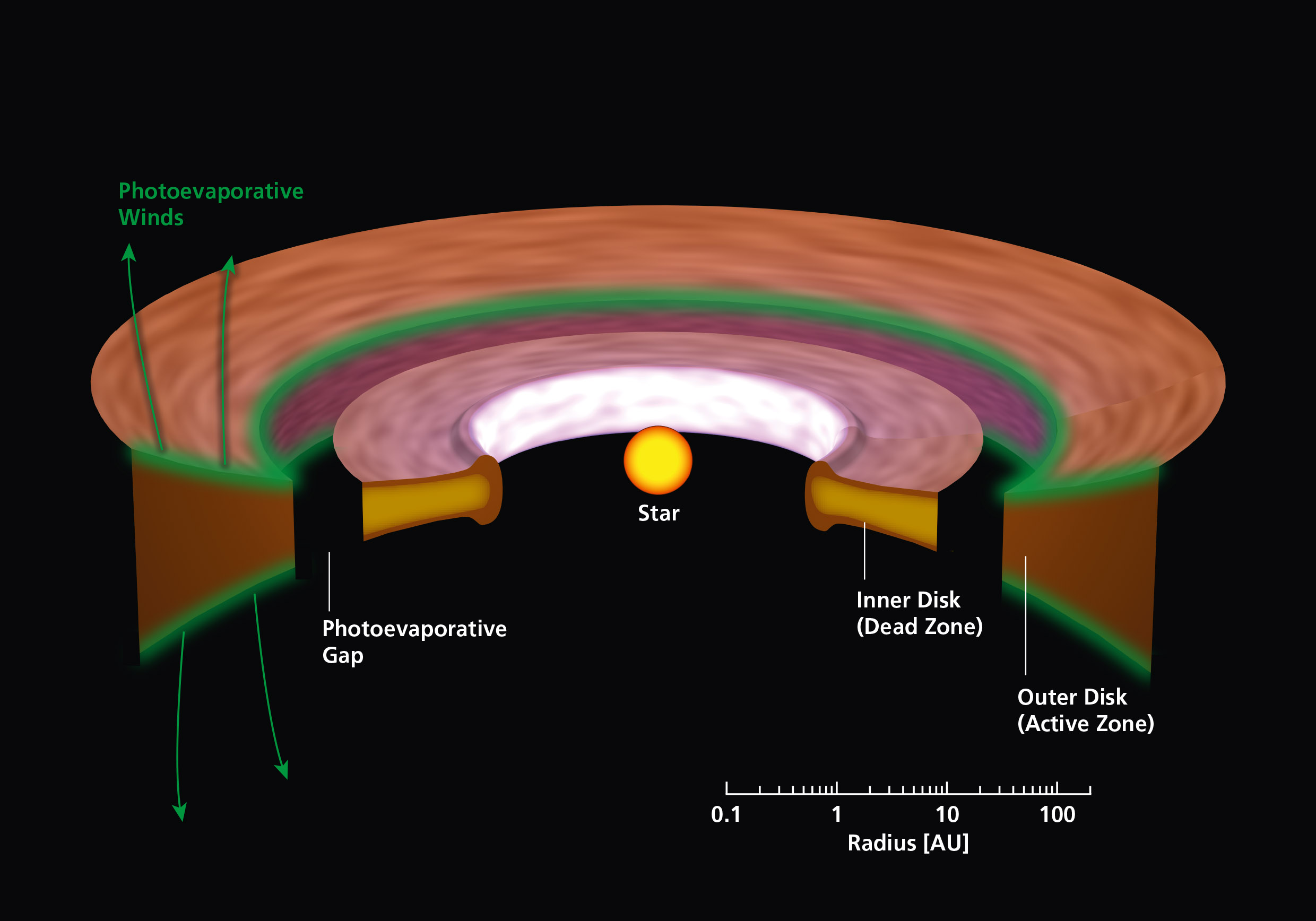
Schematic
view of a transition disk around a solar-type star. X-ray emission from
the central star illuminates the disk. The irradiation ionises the gas
in the disk. It gives rise to winds through photoevaporation, which
expels the gas into outer space. Eventually, a gap opens and detaches
the inner disk from the outer reservoir of gas and dust. A dead zone
inside the inner disk prevents the material from rapidly accreting onto
the star. This process extends the lifetime of the inner disk and
prolongs its accretion activity. Image: MPIA

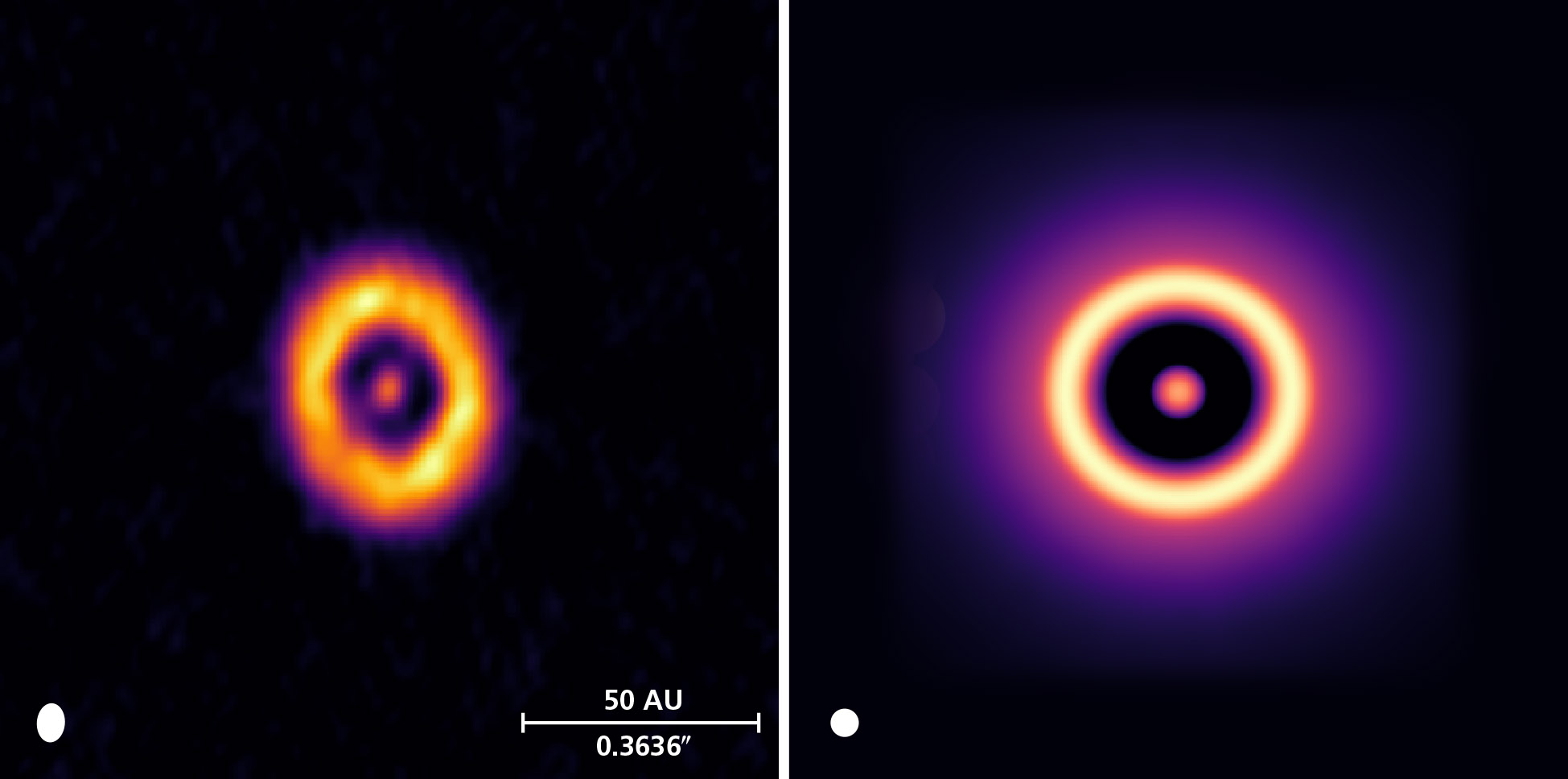
Comparison
between observed and simulated dust distributions in transition disks.
Left: Image of the disk around the object CIDA1 at a wavelength of 0.9
mm obtained with the ALMA interferometer as published in Pinilla et al.,
A&A 649, A122 (2021), DOI: 10.1051/0004-6361/202140371. The disk is
slightly tilted with respect to the image plane. Right: Synthetic image
of the dust distribution from the simulations performed by Matías
Gárate and collaborators. Image: Pinilla et al./Gárate et al./MPIA
Progress in understanding the dispersal mechanisms of planet-forming disks
A group of astronomers, led by scientists from the Max Planck Institute for Astronomy, propose and have tested a mechanism that explains most of the properties observed in dispersing planet-forming disks around newborn stars for the first time. The key ingredients to this new physical concept are X-ray emissions from the central star and a calm inner disk, well shielded from the incident radiation. This approach explains the seemingly contradicting features observed in those dwindling transition disks that previous models have been unable to reconcile. This result, published in the journal “Astronomy & Astrophysics” today, is a big step to understanding the evolution from dusty disks to clean planetary systems like the Solar System
Planets form inside disks made of gas and dust. Each of those disks already gave birth to a new star, or, for that matter, to a predecessor that still has to ignite its nuclear fusion fire, called a protostar. When we look at the Solar System, we recognise that most of that material has long since disappeared. In recent years, research has reached a basic understanding of how these circumstellar disks lose their remnant gas and dust. With the advent of powerful telescopes, astronomers have even identified and studied those dissolving disks coined transition disks.
However, identifying the detailed physical processes remained unsuccessful. The theoretical concepts scientists have explored so far only reproduced a few of the observed properties at a time. Now, a research group led by astronomers from the Max Planck Institute for Astronomy (MPIA) in Heidelberg, Germany, proposes a new scheme that overcomes most of the disadvantages of previous approaches. “Earlier models failed to reproduce more than only a few of the observational results of transition disks,” says Matías Gárate, lead author of the underlying scientific article and scientist at MPIA. “However, we are now able to explain most of the properties that seem to contradict each other: a wide gap in the disk and a sustained accretion of gas and dust from a long-lived inner disk onto the central star.”
Properties of transition disks seem contradictory
Intuitively, it is hard to understand why almost all observed transition disks with a wide gap show signs of accretion. Accretion is the process that feeds the central star with gas and dust from the circumstellar disk. Before the gap opens, material from the thicker outer disk replenishes the inner sectors, sustaining the subsequent transport towards the central star. However, the reservoir is limited, which, in time, reduces the matter flow.
At the same time, X-ray emission from the star hits and heats the disk surface. The radiation gives rise to a wind that expels the then ionised gas into open space. This process is called photoevaporation. As soon as it is more efficient than the outside-in matter flow in the disk, a gap begins to open and disconnects the inner disk from the outer reservoir. At this point, the inner disk should empty very quickly via accretion and disappear rapidly. Accretion onto the star comes to a halt.
A dead zone can keep the disk alive
“We realised that to extend the lifetime of the inner disk and prolong accretion activity, we had to find a mechanism that reduces the inward drift of the gas and the dust,” Paola Pinilla points out, who is the “Genesis of Planets” research group leader at MPIA and a co-author of the paper. “One way of doing this is to include a generally accepted component of circumstellar disks, a so-called dead zone,” Timmy Delage adds, who is a PhD student at MPIA and another co-author of the research article.
A dead zone is a relatively calm annular region of a circumstellar disk where the random gas motion is reduced compared to other disk components. Consequently, friction between individual particles becomes almost negligible, making it difficult to reduce their orbital velocities, stabilising their orbits. Dead zones may manifest themselves when gas is insufficiently ionised and only poorly affected by magnetic fields. They can occur, for example, when the gas is dense enough to protect the deeper disk layers from ionisation by radiation hitting the disk.
Simulating the influence of dead zones
To verify if such a dead zone can explain the observational findings of accreting transition disks with wide gaps, Matías Gárate and his colleagues simulated their evolution in time. They constructed a physical disk model while varying the initial conditions for the dead zone and including X-ray irradiation to facilitate photoevaporation. “We were thrilled when we saw the results. A large majority of the simulated transition disks with a wide range of gap sizes retained a detectable accretion flow to the central solar-type star,” Gárate reports. This result demonstrates that dead zones can produce accreting transition disks with wide gaps in large numbers.
Although the result is a big leap in understanding what astronomers find with telescopes when looking at actual transition disks, it still falls short of reproducing the exact numbers. While observations appear to find approximately 3% of the transition disks to be non-accreting, the simulations produce more than ten times this fraction. Indeed, since computing power is limited, the model used in this study only reflects a simplified version of the real world and does not include all possible mechanisms suspected to occur in such disks. Some of them may even increase the longevity of the inner disk. On the other hand, it is well possible astronomers have to revisit some of their conclusions drawn from observations, and there may actually be more non-accreting disks than previously thought.
Visualising simulated transition disks
During their study, the MPIA-led team explored the accretion activity by focussing on the gas. Still, the dust can behave quite differently. When astronomers take images of such planet-forming disks, it is often the distribution of the dust they see radiating at millimetre wavelengths, frequently shaped in the form of concentric rings. Therefore, the MPIA astronomers investigated if their simulations also treat the dust realistically.
“To compare our calculations with highly resolved images of real transitions disks we had obtained with the ALMA interferometer, we produced a synthetic picture of one of the simulated dust disks,” says co-author Jochen Stadler, a master student at MPIA and Heidelberg University. The result is a stunning confirmation. The image of the computer-generated dust distribution shows the elements typical of transition disks: a small inner disk and an outer ring, both separated by a wide gap.
As often, the devil is in the details. While the structures appear to be a good match, the brightnesses disagree. The dust emission of the simulated transition disks is considerably fainter than one would expect from observations. Hence, the synthetic disks probably possess less dust than the real ones. However, the authors have a reasonable solution for this discrepancy. “We think this is a consequence of planet formation we have not included in our models,” Gárate points out. Studies frequently show that newly formed planets carve gaps along their orbits through the disk. Such rifts function like barriers for the dust drifting radially. Gárate adds: “It is well possible the planetary gaps escape detection by observation due to insufficient spatial resolution. If planets form in the inner disk, that may help prevent dust from accreting onto the central star. We will extend our models accordingly and explore if we can also solve this puzzle.”
Additional Information
The team consists of Matías Gárate (Max Planck Institute for Astronomy,
Heidelberg, Germany [MPIA] and University Observatory, Faculty of
Physics, Ludwig Maximilians University Munich, Germany [LMU]), Timmy N.
Delage (MPIA), Jochen Stadler (MPIA), Paola Pinilla (MPIA and Mullard
Space Science Laboratory, University College London, Dorking, United
Kingdom), Til Birnstiel (LMU and Exzellencluster ORIGINS, Garching,
Germany), Sebastian Markus Stammler (LMU), Giovanni Picogna (LMU),
Barbara Ercolano (LMU), Raphael Franz (LMU), and Christian Lenz (MPIA).
Contact:
Dr. Markus Nielbock
Press and public relations officer
tel:+49 6221 528-134
Max Planck Institute for Astronomy, Heidelberg
Dr. Matías Gárate
tel:+49 6221 528-428
Max Planck Institute for Astronomy, Heidelberg
Dr. Paola Pinilla
Research group leader
tel:+49 6221 528-263
Max Planck Institute for Astronomy, Heidelberg
Contact:
Dr. Markus Nielbock
Press and public relations officer
tel:+49 6221 528-134
Max Planck Institute for Astronomy, Heidelberg
Dr. Matías Gárate
tel:+49 6221 528-428
Max Planck Institute for Astronomy, Heidelberg
Dr. Paola Pinilla
Research group leader
tel:+49 6221 528-263
Max Planck Institute for Astronomy, Heidelberg
Sunday, November 07, 2021
Hubble Images Colorful Planetary Nebula Ringed by Hazy Halo

Credit: NASA, ESA, K. Knoll (NASA Goddard), and S. Öttl
(Leopold Franzens Universität Innsbruck), et. al.; Processing: Gladys
Kober (NASA/Catholic University of America)

NGC 2438 is a planetary nebula, formed after the death of a Sun-like star. The medium-sized star would have expelled its outer layers of gas into space as it died, leaving behind a white-dwarf core. A halo of glowing gas over 4.5 light-years across surrounds the nebula's brighter inner ring. Many round or nearly round planetary nebulae display these halo structures, and astronomers have been investigating how they evolve. NGC 2438 was one of the nebulae studied, and researchers found that the nebula’s halo glows due to the ionizing radiation of the central white dwarf.
In this color-filled image, blue represents oxygen (O III), green is hydrogen (H-alpha), orange is nitrogen (N II), and red is sulfur (S II).
This Hubble Space Telescope image was captured by Hubble’s Wide Field
and Planetary Camera 2, which gave it its distinctive stair-shape. One
of the camera’s four detectors provided a magnified view, which would be
shrunk down in the final image to match the other three, creating the
unique shape. For more information on the Wide Field and Planetary
Camera 2 image shape, visit: https://www.nasa.gov/content/about-facts-hubble-faqs.

The colorful planetary nebula, NGC 2438, appears to
lie on the outskirts of the open star cluster, M46 (NGC 2437). The
nebula is actually in the foreground between us and the star cluster. Credits: NASA, ESA, K. Knoll (NASA Goddard), S. Öttl (Leopold Franzens
Universität Innsbruck), et. al., and DSS; Processing: Gladys Kober
(NASA/Catholic University of America)
Media Contact:
Saturday, November 06, 2021
Mysterious “Superbubble” Hollows Out Nebula in New Hubble Image

Image credit: NASA, ESA, V. Ksoll and D. Gouliermis (Universität Heidelberg), et al.;
Processing: Gladys Kober (NASA/Catholic University of America)
N44 is a complex nebula filled with glowing hydrogen gas, dark lanes of dust, massive stars, and many populations of stars of different ages. One of its most distinctive features, however, is the dark, starry gap called a “superbubble,” visible in this Hubble Space Telescope image in the upper central region.
The hole is about 250 light-years wide and its presence is still something of a mystery. Stellar winds expelled by massive stars in the bubble's interior may have driven away the gas, but this is inconsistent with measured wind velocities in the bubble. Another possibility, since the nebula is filled with massive stars that would expire in titanic explosions, is that the expanding shells of old supernovae sculpted the cosmic cavern..
Astronomers have found one supernova remnant in the vicinity of the superbubble and identified an approximately 5 million year difference in age between stars within and at the rim of the superbubble, indicating multiple, chain-reaction star-forming events. The deep blue area at about 5 o’clock around the superbubble is one of the hottest regions of the nebula and the area of the most intense star formation..
N44 is an emission nebula, which means its gas has been energized, or ionized, by the radiation of nearby stars. As the ionized gas begins to cool from its higher-energy state to a lower-energy state, it emits energy in the form of light, causing the nebula to glow. Located in the Large Magellanic Cloud, N44 spans about 1,000 light-years and is about 170,000 light-years away from Earth..
The hole is about 250 light-years wide and its presence is still something of a mystery. Stellar winds expelled by massive stars in the bubble's interior may have driven away the gas, but this is inconsistent with measured wind velocities in the bubble. Another possibility, since the nebula is filled with massive stars that would expire in titanic explosions, is that the expanding shells of old supernovae sculpted the cosmic cavern..
Astronomers have found one supernova remnant in the vicinity of the superbubble and identified an approximately 5 million year difference in age between stars within and at the rim of the superbubble, indicating multiple, chain-reaction star-forming events. The deep blue area at about 5 o’clock around the superbubble is one of the hottest regions of the nebula and the area of the most intense star formation..
N44 is an emission nebula, which means its gas has been energized, or ionized, by the radiation of nearby stars. As the ionized gas begins to cool from its higher-energy state to a lower-energy state, it emits energy in the form of light, causing the nebula to glow. Located in the Large Magellanic Cloud, N44 spans about 1,000 light-years and is about 170,000 light-years away from Earth..
Media Contact:
Claire Andreoli
NASA's Goddard Space Flight Center
301-286-1940
Friday, November 05, 2021
Astronomers make most distant detection yet of fluorine in star-forming galaxy

Artist’s impression of the galaxy NGP–190387

Artist’s impression of a Wolf–Rayet star

Wide-field view of the sky around the galaxy NGP–190387
Videos
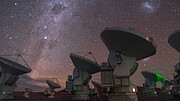




A new discovery is shedding light on how
fluorine — an element found in our bones and teeth as fluoride — is
forged in the Universe. Using the Atacama Large Millimeter/submillimeter
Array (ALMA), in which the European Southern Observatory (ESO) is a
partner, a team of astronomers have detected this element in a galaxy
that is so far away its light has taken over 12 billion years to reach
us. This is the first time fluorine has been spotted in such a distant
star-forming galaxy.
“We all know about fluorine because the toothpaste we use every day contains it in the form of fluoride,” says Maximilien Franco from the University of Hertfordshire in the UK, who led the new study, published today in Nature Astronomy. Like most elements around us, fluorine is created inside stars but, until now, we did not know exactly how this element was produced. “We did not even know which type of stars produced the majority of fluorine in the Universe!”
Franco and his collaborators spotted fluorine (in the form of hydrogen fluoride) in the large clouds of gas of the distant galaxy NGP–190387, which we see as it was when the Universe was only 1.4 billion years old, about 10% of its current age. Since stars expel the elements they form in their cores as they reach the end of their lives, this detection implies that the stars that created fluorine must have lived and died quickly.
The team believes that Wolf–Rayet stars, very massive stars that live only a few million years, a blink of the eye in the Universe’s history, are the most likely production sites of fluorine. They are needed to explain the amounts of hydrogen fluoride the team spotted, they say. Wolf–Rayet stars had been suggested as possible sources of cosmic fluorine before, but astronomers did not know until now how important they were in producing this element in the early Universe.
“We have shown that Wolf–Rayet stars, which are among the most massive stars known and can explode violently as they reach the end of their lives, help us, in a way, to maintain good dental health!” jokes Franco.
Besides these stars, other scenarios for how fluorine is produced and expelled have been put forward in the past. An example includes pulsations of giant, evolved stars with masses up to few times that of our Sun, called asymptotic giant branch stars. But the team believes these scenarios, some of which take billions of years to occur, might not fully explain the amount of fluorine in NGP–190387.
“For this galaxy, it took just tens or hundreds of millions of years to have fluorine levels comparable to those found in stars in the Milky Way, which is 13.5 billion years old. This was a totally unexpected result,” says Chiaki Kobayashi, a professor at the University of Hertfordshire. “Our measurement adds a completely new constraint on the origin of fluorine, which has been studied for two decades.”
The discovery in NGP–190387 marks one of the first detections of fluorine beyond the Milky Way and its neighbouring galaxies. Astronomers have previously spotted this element in distant quasars, bright objects powered by supermassive black holes at the centre of some galaxies. But never before had this element been observed in a star-forming galaxy so early in the history of the Universe.
The team’s detection of fluorine was a chance discovery made possible thanks to the use of space and ground-based observatories. NGP–190387, originally discovered with the European Space Agency’s Herschel Space Observatory and later observed with the Chile-based ALMA, is extraordinarily bright for its distance. The ALMA data confirmed that the exceptional luminosity of NGP–190387 was partly caused by another known massive galaxy, located between NGP–190387 and the Earth, very close to the line of sight. This massive galaxy amplified the light observed by Franco and his collaborators, enabling them to spot the faint radiation emitted billions of years ago by the fluorine in NGP–190387.
Future studies of NGP–190387 with the Extremely Large Telescope (ELT)
— ESO’s new flagship project, under construction in Chile and set to
start operations later this decade — could reveal further secrets about
this galaxy. “ALMA is sensitive to radiation emitted by cold interstellar gas and dust,” says Chentao Yang, an ESO Fellow in Chile. “With the ELT, we will be able to observe NGP–190387 through the direct light of stars, gaining crucial information on the stellar content of this galaxy.”
More Information
This research was presented in the paper "The ramp-up of interstellar medium enrichment at z > 4" to appear in Nature Astronomy (https://doi.org/10.1038/s41550-021-01515-9).
The team is composed of M. Franco (Centre for Astrophysics Research, University of Hertfordshire, UK [CAR]), K. E. K. Coppin (CAR), J. E. Geach (CAR), C. Kobayashi (CAR), S. C. Chapman (Department of Physics and Atmospheric Science, Dalhousie University, Canada and National Research Council, Herzberg Astronomy and Astrophysics, Canada), C. Yang (European Southern Observatory, Chile), E. González-Alfonso (Universidad de Alcalá, Departamento de Física y Matematicas, Spain), J. S. Spilker (Department of Astronomy, University of Texas at Austin, USA), A. Cooray (Department of Physics and Astronomy, University of California, Irvine, USA), M. J. Michałowski (Astronomical Observatory Institute, Faculty of Physics, Poland)
The European Southern Observatory (ESO) enables scientists worldwide to discover the secrets of the Universe for the benefit of all. We design, build and operate world-class observatories on the ground — which astronomers use to tackle exciting questions and spread the fascination of astronomy — and promote international collaboration in astronomy. Established as an intergovernmental organisation in 1962, today ESO is supported by 16 Member States (Austria, Belgium, the Czech Republic, Denmark, France, Finland, Germany, Ireland, Italy, the Netherlands, Poland, Portugal, Spain, Sweden, Switzerland and the United Kingdom), along with the host state of Chile and with Australia as a Strategic Partner. ESO’s headquarters and its visitor centre and planetarium, the ESO Supernova, are located close to Munich in Germany, while the Chilean Atacama Desert, a marvellous place with unique conditions to observe the sky, hosts our telescopes. ESO operates three observing sites: La Silla, Paranal and Chajnantor. At Paranal, ESO operates the Very Large Telescope and its Very Large Telescope Interferometer, as well as two survey telescopes, VISTA working in the infrared and the visible-light VLT Survey Telescope. Also at Paranal ESO will host and operate the Cherenkov Telescope Array South, the world’s largest and most sensitive gamma-ray observatory. Together with international partners, ESO operates APEX and ALMA on Chajnantor, two facilities that observe the skies in the millimetre and submillimetre range. At Cerro Armazones, near Paranal, we are building “the world’s biggest eye on the sky” — ESO’s Extremely Large Telescope. From our offices in Santiago, Chile we support our operations in the country and engage with Chilean partners and society.
The Atacama Large Millimeter/submillimeter Array (ALMA), an international astronomy facility, is a partnership of ESO, the U.S. National Science Foundation (NSF) and the National Institutes of Natural Sciences (NINS) of Japan in cooperation with the Republic of Chile. ALMA is funded by ESO on behalf of its Member States, by NSF in cooperation with the National Research Council of Canada (NRC) and the Ministry of Science and Technology (MOST) and by NINS in cooperation with the Academia Sinica (AS) in Taiwan and the Korea Astronomy and Space Science Institute (KASI). ALMA construction and operations are led by ESO on behalf of its Member States; by the National Radio Astronomy Observatory (NRAO), managed by Associated Universities, Inc. (AUI), on behalf of North America; and by the National Astronomical Observatory of Japan (NAOJ) on behalf of East Asia. The Joint ALMA Observatory (JAO) provides the unified leadership and management of the construction, commissioning and operation of ALMA.
The University of Hertfordshire brings the transformational
impact of higher education to all. Its students, staff and businesses
consistently reach their full potential. Through high quality teaching,
550 degree programmes, cutting-edge research projects and powerful
business partnerships, they think bigger, stand out and positively
impact local, national and international communities.
Links
- Research paper
- Images of ALMA
- Videos of ALMA
- University of Hertfordshire press release
- Find out more about ESO's Extremely Large Telescope
- For journalists: subscribe to receive our releases under embargo in your language
- For scientists: got a story? Pitch your research
Contacts:
Maximilien Franco
Centre for Astrophysics Research, University of Hertfordshire
Hatfield, Hertfordshire, United Kingdom
Tel: +33-649956665
Email: m.franco@herts.ac.uk
Chiaki Kobayashi
Centre for Astrophysics Research, University of Hertfordshire
Hatfield, Hertfordshire, United Kingdom
Tel: +44-7757116615
Email: c.kobayashi@herts.ac.uk
Chentao Yang
European Southern Observatory
Santiago, Chile
Tel: +56 2 2463 3053
Email: cyang@eso.org
Bárbara Ferreira
ESO Media Manager
Garching bei München, Germany
Tel: +49 89 3200 6670
Cell: +49 151 241 664 00
Email: press@eso.org
Press Office
University of Hertfordshire
Hatfield, UK
Tel: +441707 285770
Email: news@herts.ac.uk
Source: ESO/News
Thursday, November 04, 2021
A New Astrogeology Study Suggests That Most Nearby Rocky Exoplanets Are Quite Unlike Anything in Our Solar System

Rock debris, the pieces ofa a former rocky planet that has broken up, spiral inward toward a white dwarf in this illustration. Studying the atmospheres of white dwarfs that have been "polluted" by such debrir, a NOIRLab Astronomer and a Geologist have identified exotic rock types that do not exist in our Solar System. The results suggests that nearby rocky exoplanets must be even stranger and more diverse than previously thought. Credit: NOIRLab/NSF/AURA/J. da Silva
A New Astrogeology Study Suggests That Most Nearby Rocky Exoplanets Are Quite Unlike Anything in Our Solar System
Maunakea, Hawaiʻi – Astronomers have discovered thousands of planets orbiting stars in our galaxy – known as exoplanets. However, it’s difficult to know what exactly these planets are made of, or whether any resemble Earth. To try to find out, astronomer Siyi Xu of NSF’s NOIRLab partnered with geologist Keith Putirka of California State University, Fresno, to study the atmospheres of what are known as polluted white dwarfs.
These are the dense, collapsed cores of once-normal stars like the Sun that contain foreign material from planets, asteroids, or other rocky bodies that once orbited the star but eventually fell into the white dwarf and “contaminated” its atmosphere. By looking for elements that wouldn’t naturally exist in a white dwarf’s atmosphere (anything other than hydrogen and helium), scientists can figure out what the rocky planetary objects that fell into the star were made of.
Putirka and Xu looked at 23 polluted white dwarfs, all within about 650 light-years of the Sun, where calcium, silicon, magnesium, and iron had been measured with precision using W. M. Keck Observatory’s High-Resolution Echelle Spectrometer (HIRES) on Maunakea in Hawai‘i, the Hubble Space Telescope, and other observatories. The scientists then used the measured abundances of those elements to reconstruct the minerals and rocks that would form from them.
“Combining the high sensitivity of Keck’s HIRES instrument and Hubble’s Cosmic Origins Spectrograph is the best way to measure the chemical compositions of extrasolar planetary materials accreted onto polluted white dwarfs,” said Xu.
Putirka and Xu’s results are published in today’s issue of Nature Communications.
They found that these white dwarfs have a much wider range of compositions than any of the inner planets in our solar system, suggesting their planets had a wider variety of rock types. In fact, some of the compositions are so unusual that Putirka and Xu had to create new names (such as “quartz pyroxenites” and “periclase dunites”) to classify the novel rock types that must have existed on those planets.
“While some exoplanets that once orbited polluted white dwarfs appear similar to Earth, most have rock types that are exotic to our solar system,” said Xu. “They have no direct counterparts in the solar system.”
Putirka describes what these new rock types might mean for the rocky worlds they belong to.
“Some of the rock types that we see from the white dwarf data would dissolve more water than rocks on Earth and might impact how oceans are developed,” he explained. “Some rock types might melt at much lower temperatures and produce thicker crust than Earth rocks, and some rock types might be weaker, which might facilitate the development of plate tectonics.”
Earlier studies of polluted white dwarfs had found elements from rocky bodies, including calcium, aluminum, and lithium. However, Putirka and Xu explain that those are minor elements (which typically make up a small part of an Earth rock) and measurements of major elements (which make up a large part of an Earth rock), especially silicon, are needed to truly know what kind of rock types would have existed on those planets.
In addition, Putirka and Xu state that the high levels of magnesium and low levels of silicon measured in the white dwarfs’ atmospheres suggest that the rocky debris detected likely came from the interiors of the planets – from the mantle, not their crust.
Some previous studies of polluted white dwarfs reported signs that continental crust existed on the rocky planets that once orbited those stars, but Putirka and Xu found no evidence of crustal rocks. However, the observations do not completely rule out that the planets had continental crust or other crust types.
“We believe that if crustal rock exists, we are unable to see it, probably because it occurs in too small a fraction compared to the mass of other planetary components, like the core and mantle, to be measured,” Putirka stated.
According to Xu, the pairing of an astronomer and a geologist was the key to unlocking the secrets hidden in the atmospheres of the polluted white dwarfs.
“I met Keith Putirka at a conference and was excited that he could help me understand the systems that I was observing. He taught me geology and I taught him astronomy, and we figured out how to make sense of these mysterious exoplanetary systems.”
These are the dense, collapsed cores of once-normal stars like the Sun that contain foreign material from planets, asteroids, or other rocky bodies that once orbited the star but eventually fell into the white dwarf and “contaminated” its atmosphere. By looking for elements that wouldn’t naturally exist in a white dwarf’s atmosphere (anything other than hydrogen and helium), scientists can figure out what the rocky planetary objects that fell into the star were made of.
Putirka and Xu looked at 23 polluted white dwarfs, all within about 650 light-years of the Sun, where calcium, silicon, magnesium, and iron had been measured with precision using W. M. Keck Observatory’s High-Resolution Echelle Spectrometer (HIRES) on Maunakea in Hawai‘i, the Hubble Space Telescope, and other observatories. The scientists then used the measured abundances of those elements to reconstruct the minerals and rocks that would form from them.
“Combining the high sensitivity of Keck’s HIRES instrument and Hubble’s Cosmic Origins Spectrograph is the best way to measure the chemical compositions of extrasolar planetary materials accreted onto polluted white dwarfs,” said Xu.
Putirka and Xu’s results are published in today’s issue of Nature Communications.
They found that these white dwarfs have a much wider range of compositions than any of the inner planets in our solar system, suggesting their planets had a wider variety of rock types. In fact, some of the compositions are so unusual that Putirka and Xu had to create new names (such as “quartz pyroxenites” and “periclase dunites”) to classify the novel rock types that must have existed on those planets.
“While some exoplanets that once orbited polluted white dwarfs appear similar to Earth, most have rock types that are exotic to our solar system,” said Xu. “They have no direct counterparts in the solar system.”
Putirka describes what these new rock types might mean for the rocky worlds they belong to.
“Some of the rock types that we see from the white dwarf data would dissolve more water than rocks on Earth and might impact how oceans are developed,” he explained. “Some rock types might melt at much lower temperatures and produce thicker crust than Earth rocks, and some rock types might be weaker, which might facilitate the development of plate tectonics.”
Earlier studies of polluted white dwarfs had found elements from rocky bodies, including calcium, aluminum, and lithium. However, Putirka and Xu explain that those are minor elements (which typically make up a small part of an Earth rock) and measurements of major elements (which make up a large part of an Earth rock), especially silicon, are needed to truly know what kind of rock types would have existed on those planets.
In addition, Putirka and Xu state that the high levels of magnesium and low levels of silicon measured in the white dwarfs’ atmospheres suggest that the rocky debris detected likely came from the interiors of the planets – from the mantle, not their crust.
Some previous studies of polluted white dwarfs reported signs that continental crust existed on the rocky planets that once orbited those stars, but Putirka and Xu found no evidence of crustal rocks. However, the observations do not completely rule out that the planets had continental crust or other crust types.
“We believe that if crustal rock exists, we are unable to see it, probably because it occurs in too small a fraction compared to the mass of other planetary components, like the core and mantle, to be measured,” Putirka stated.
According to Xu, the pairing of an astronomer and a geologist was the key to unlocking the secrets hidden in the atmospheres of the polluted white dwarfs.
“I met Keith Putirka at a conference and was excited that he could help me understand the systems that I was observing. He taught me geology and I taught him astronomy, and we figured out how to make sense of these mysterious exoplanetary systems.”
Source: W.M.Keck Observatory
About HIRES
The High-Resolution Echelle Spectrometer (HIRES) produces spectra of single objects at very high spectral resolution, yet covering a wide wavelength range. It does this by separating the light into many “stripes” of spectra stacked across a mosaic of three large CCD detectors. HIRES is famous for finding exoplanets. Astronomers also use HIRES to study important astrophysical phenomena like distant galaxies and quasars, and find cosmological clues about the structure of the early universe, just after the Big Bang.
About W.M.Keck Observatory
The W. M. Keck Observatory telescopes are among the most scientifically productive on Earth. The two 10-meter optical/infrared telescopes atop Maunakea on the Island of Hawaiʻi feature a suite of advanced instruments including imagers, multi-object spectrographs, high-resolution spectrographs, integral-field spectrometers, and world-leading laser guide star adaptive optics systems. Some of the data presented herein were obtained at Keck Observatory, which is a private 501(c) 3 non-profit organization operated as a scientific partnership among the California Institute of Technology, the University of California, and the National Aeronautics and Space Administration. The Observatory was made possible by the generous financial support of the W. M. Keck Foundation. The authors wish to recognize and acknowledge the very significant cultural role and reverence that the summit of Maunakea has always had within the Native Hawaiian community. We are most fortunate to have the opportunity to conduct observations from this mountain.
Wednesday, November 03, 2021
A Cosmic Whodunit: ALMA Study Confirms What’s Robbing Galaxies of Their Star-Forming Gas

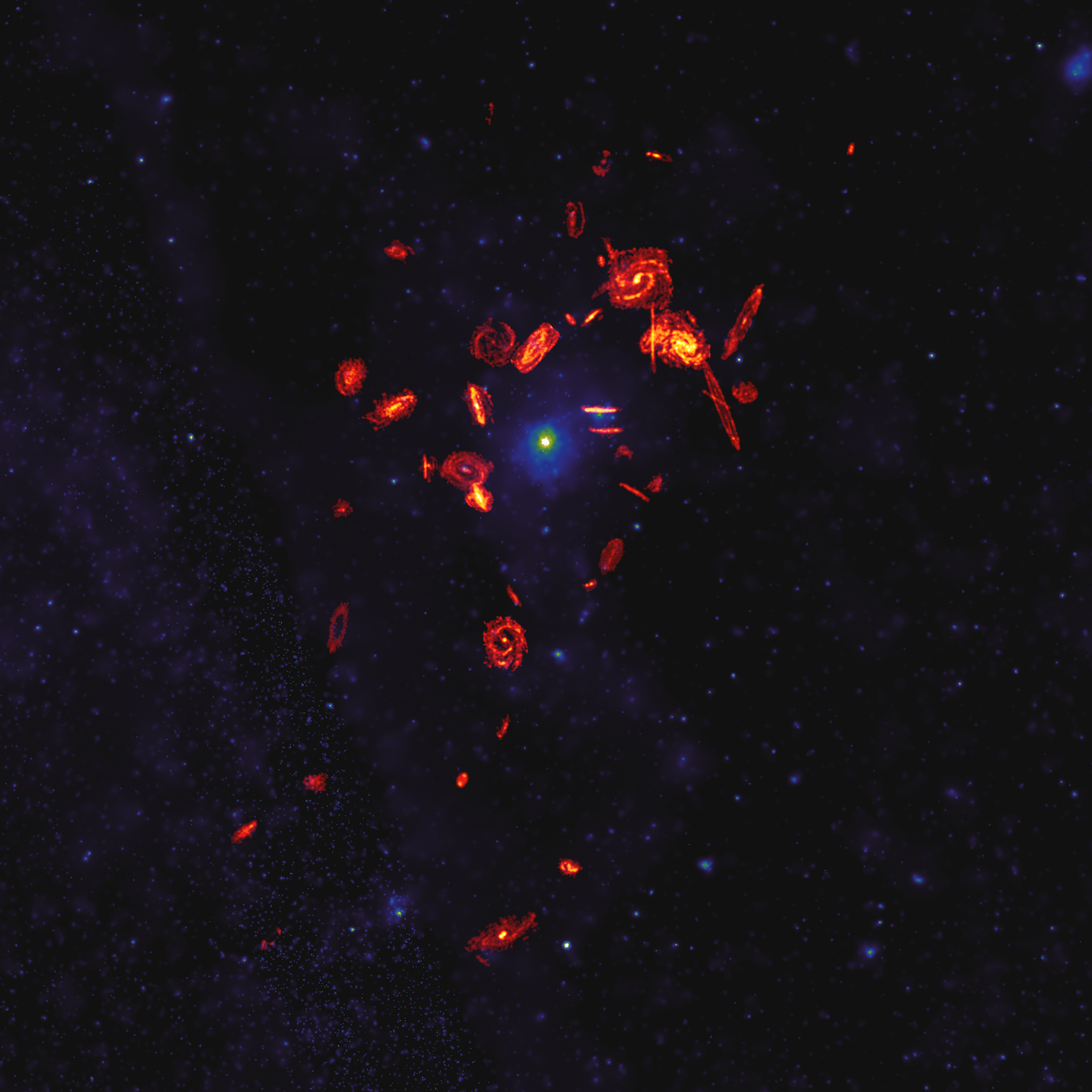
The VERTICO—Virgo Environment Traced in Carbon Monoxide—Survey observed the gas reservoirs in 51 galaxies in the nearby Virgo Cluster and found that the extreme environment in the cluster was killing galaxies by robbing them of their star-forming fuel. In this composite image, ALMA’s radio wavelength observations of the VERTICO galaxies’ molecular gas disks are magnified by a factor of 20. They are overlaid on the X-ray image of the hot plasma within the Virgo Cluster. Hi-Res File


NGC 4567 and NGC 4568 are two of the thousands of galaxies in the Virgo Cluster, located roughly 65 million light-years from Earth. Observed by the VERTICO—Virgo Environment Traced in Carbon Monoxide—Survey, the two galaxies are among those in the galaxy cluster impacted by extreme physical processes that can lead to the death of galaxies. The galaxies are shown here in composite radio data from ALMA with molecular gas in red/orange and optical data from Hubble Space Telescope with stars in white/blue. Credit: ALMA (ESO/NAOJ/NRAO)/S. Dagnello (NRAO). Hi-Res File


Spiral galaxy NGC 4254 is among the thousands of galaxies living and dying by the extreme physical processes in the Virgo Cluster. The galaxy is seen here in radio from ALMA with molecular gas in red/orange and optical from Hubble Space Telescope with stars in white/blue. Credit: ALMA (ESO/NAOJ/NRAO)/S. Dagnello (NRAO). Hi-Res File
VERTICO Survey unmasks violent environments as culprit in mass galaxy quenching mystery
Astronomers examining the nearby Universe with the help of the Atacama Large Millimeter/submillimeter Array (ALMA) have just completed the largest high-resolution survey of star-forming fuel ever conducted in galaxy clusters. But more importantly, they’re tackling a long-standing mystery in astrophysics: what’s killing galaxies? The research, which provides the clearest evidence to date that extreme environments in space have severe impacts on the galaxies within them, will be published in an upcoming edition of The Astrophysical Journal Supplement Series.
The Virgo Environment Traced in Carbon Monoxide Survey—VERTICO—set out to better understand star formation and the role of galaxies in the Universe. “We know that galaxies are being killed by their environments, and we want to know why,” said Toby Brown, Plaskett Fellow at the National Research Council of Canada and lead author on the paper. “What VERTICO reveals better than ever before is which physical processes affect molecular gas and how they dictate the life and death of the galaxy.”
Galaxies are large collections of stars, and their births, evolutions, and deaths are influenced by where they live in the Universe and how they interact with their surroundings. Galaxy clusters, in particular, are some of the most extreme environments in the Universe, making them of particular interest to scientists studying the evolution of galaxies.
Home to thousands of galaxies the Virgo Cluster is the nearest massive cluster of galaxies to the Local Group, where the Milky Way resides. The extreme size and proximity make the cluster easy to study, but it also has other features that make it ripe for observation. “The Virgo Cluster is a bit unusual in that it has a relatively large population of galaxies that are still forming stars,” said Christine Wilson, Distinguished University Professor at McMaster University and co-principal investigator on the VERTICO project. “Many galaxy clusters in the Universe are dominated by red galaxies with little gas and star formation.”
The VERTICO project observed the gas reservoirs of 51 galaxies in the Virgo Cluster in high-resolution, revealing an environment so extreme and inhospitable that it can stop entire galaxies from forming stars in a process known as galaxy quenching. “The Virgo Cluster is the most extreme region of the local Universe, filled with million-degree plasma, extreme galaxy speeds, violent interactions between galaxies and their surroundings, a galaxy retirement village, and accordingly, a galaxy graveyard,” said Brown, adding that the project revealed how gas stripping can stunt, or shut down, one of the most important physical processes in the Universe: star formation. “Gas stripping is one of the most spectacular and violent external mechanisms that can shut down star formation in galaxies,” said Brown. “Gas stripping occurs when galaxies are moving so fast through hot plasma in the cluster that vast quantities of cold molecular gas are stripped away from the galaxy, as though the gas is being swept away by a huge cosmic broom. The exquisite quality of VERTICO’s observations allows us to better see and understand such mechanisms.”
The project was aided by ALMA’s Band 6 receiver—developed at the National Radio Astronomy Observatory’s Central Development Laboratory (CDL)—which provides high sensitivity and high resolution while minimizing required observing time. That, in turn, led to the collection of a significant amount of data, which may contain the clues needed to solve the remaining mysteries of how environments impact galaxies, and accordingly, how galaxies die. Wilson said, “There have been a lot of questions over the years on whether and how the cluster environment affects the molecular gas in galaxies, and how exactly those environments may contribute to their deaths. We still have work to do, but I’m confident VERTICO will allow us to answer these questions once and for all.”
The Virgo Environment Traced in Carbon Monoxide Survey—VERTICO—set out to better understand star formation and the role of galaxies in the Universe. “We know that galaxies are being killed by their environments, and we want to know why,” said Toby Brown, Plaskett Fellow at the National Research Council of Canada and lead author on the paper. “What VERTICO reveals better than ever before is which physical processes affect molecular gas and how they dictate the life and death of the galaxy.”
Galaxies are large collections of stars, and their births, evolutions, and deaths are influenced by where they live in the Universe and how they interact with their surroundings. Galaxy clusters, in particular, are some of the most extreme environments in the Universe, making them of particular interest to scientists studying the evolution of galaxies.
Home to thousands of galaxies the Virgo Cluster is the nearest massive cluster of galaxies to the Local Group, where the Milky Way resides. The extreme size and proximity make the cluster easy to study, but it also has other features that make it ripe for observation. “The Virgo Cluster is a bit unusual in that it has a relatively large population of galaxies that are still forming stars,” said Christine Wilson, Distinguished University Professor at McMaster University and co-principal investigator on the VERTICO project. “Many galaxy clusters in the Universe are dominated by red galaxies with little gas and star formation.”
The VERTICO project observed the gas reservoirs of 51 galaxies in the Virgo Cluster in high-resolution, revealing an environment so extreme and inhospitable that it can stop entire galaxies from forming stars in a process known as galaxy quenching. “The Virgo Cluster is the most extreme region of the local Universe, filled with million-degree plasma, extreme galaxy speeds, violent interactions between galaxies and their surroundings, a galaxy retirement village, and accordingly, a galaxy graveyard,” said Brown, adding that the project revealed how gas stripping can stunt, or shut down, one of the most important physical processes in the Universe: star formation. “Gas stripping is one of the most spectacular and violent external mechanisms that can shut down star formation in galaxies,” said Brown. “Gas stripping occurs when galaxies are moving so fast through hot plasma in the cluster that vast quantities of cold molecular gas are stripped away from the galaxy, as though the gas is being swept away by a huge cosmic broom. The exquisite quality of VERTICO’s observations allows us to better see and understand such mechanisms.”
The project was aided by ALMA’s Band 6 receiver—developed at the National Radio Astronomy Observatory’s Central Development Laboratory (CDL)—which provides high sensitivity and high resolution while minimizing required observing time. That, in turn, led to the collection of a significant amount of data, which may contain the clues needed to solve the remaining mysteries of how environments impact galaxies, and accordingly, how galaxies die. Wilson said, “There have been a lot of questions over the years on whether and how the cluster environment affects the molecular gas in galaxies, and how exactly those environments may contribute to their deaths. We still have work to do, but I’m confident VERTICO will allow us to answer these questions once and for all.”
The new paper is the first from VERTICO, with additional research expected to publish in the near future.
Resources
“VERTICO: The Virgo Environment Traced In CO Survey,” Brown et. al. (2021), The Astrophysical Journal Supplement Series, preprint: https://arxiv.org/abs/2111.00937
About ALMA
Media Contact:
About ALMA
The Atacama Large Millimeter/submillimeter Array (ALMA), an international astronomy facility, is a partnership of the European Organisation for Astronomical Research in the Southern Hemisphere (ESO), the U.S. National Science Foundation (NSF) and the National Institutes of Natural Sciences (NINS) of Japan in cooperation with the Republic of Chile. ALMA is funded by ESO on behalf of its Member States, by NSF in cooperation with the National Research Council of Canada (NRC) and the Ministry of Science and Technology (MOST) and by NINS in cooperation with the Academia Sinica (AS) in Taiwan and the Korea Astronomy and Space Science Institute (KASI).
ALMA construction and operations are led by ESO on behalf of its Member States; by the National Radio Astronomy Observatory (NRAO), managed by Associated Universities, Inc. (AUI), on behalf of North America; and by the National Astronomical Observatory of Japan (NAOJ) on behalf of East Asia. The Joint ALMA Observatory (JAO) provides the unified leadership and management of the construction, commissioning and operation of ALMA.
ALMA construction and operations are led by ESO on behalf of its Member States; by the National Radio Astronomy Observatory (NRAO), managed by Associated Universities, Inc. (AUI), on behalf of North America; and by the National Astronomical Observatory of Japan (NAOJ) on behalf of East Asia. The Joint ALMA Observatory (JAO) provides the unified leadership and management of the construction, commissioning and operation of ALMA.
Media Contact:
Amy C. Oliver
Public Information Officer, ALMA
Public Information & News Manager, NRAO
+1 434 242 9584
aoliver@nrao.edu
Public Information Officer, ALMA
Public Information & News Manager, NRAO
+1 434 242 9584
aoliver@nrao.edu
Tuesday, November 02, 2021
NASA selects SwRI-LED CubeSat to assess the origins of hot plasma in the Sun's corona

Simulations of what the CubIXSS imaging spectrometer will see during one minute of a solar flare (top) and over one hour from an active region. At the top of the detector, four images of the Sun are taken through different filters that block different X-ray wavelengths (“colors”). At the bottom of the detector, the entire X-ray spectrum from each point on the Sun spreads out sideways, allowing a detailed measurement of the temperature and composition of plasma at each point in the corona. (The solar images are rotated so the solar north pole points to the right.) Credit: Courtesy of SwRI

This diagram shows the layout of the SwRI-designed CubeSat Imaging X-Ray Solar Spectrometer (CubIXSS), which has been selected by NASA as an upcoming space mission. CubIXSS will measure the abundances of elements in the Sun’s corona to determine the origins of hot plasma in solar flares and active regions. Credit: Courtesy of SwRI
NASA has selected the CubeSat Imaging X-Ray Solar Spectrometer (CubIXSS), led by Southwest Research Institute, to measure the elemental composition of hot, multimillion-degree plasmas in the Sun’s corona – its outermost atmosphere. The nanosatellite is expected to be launched in 2024 as a secondary payload on another satellite launch. CubIXSS will determine the origins of hot plasma – highly ionized gas – in solar flares and active regions.
Concentrations of strong and complicated magnetic fields at the surface of the Sun are called “active regions.” These regions frequently spawn strong solar activity including explosive “solar storms” such as solar flares and coronal mass ejections (CMEs).
“A solar flare happens because the magnetic field in that active region has become so twisted and tangled that it basically ‘snaps’ back into a less tangled shape,” said SwRI Principal Scientist Dr. Amir Caspi, the mission’s leader. “That snap releases a lot of energy, which we see as a solar flare.”
The solar flare heats the Sun’s plasma in that region to heat up to tens of millions of degrees Celsius. That is considerably hotter than the rest of the Sun’s corona, which typically ranges from 1 to a few million degrees, and much hotter than the Sun’s surface, which is only about 6000 degrees.
“One of the interesting things we don’t really know is how much plasma in solar flares is heated directly in the corona, and how much is heated in the Sun’s lower atmosphere and then transported up to the corona,” Caspi said. “CubIXSS will measure the X-rays that come from these phenomena, to allow us to unravel this mystery.”
A standard CubeSat is a 10-centimeter cube with a one-liter volume, referred to as “1U.” CubIXSS takes up six of these units, or 6U, about the size of a shoebox or two loaves of bread. It will carry multiple spectrometers to measure different wavelengths, or “colors,” of X-rays from the Sun, including a new kind of X-ray imaging spectrometer to determine the amounts of certain key elements in the Sun’s corona, which will in turn allow Caspi to identify where that plasma was heated.
“Some elemental species – certain ions – can only exist in a specific range of temperatures, so seeing which elements are more prevalent helps us to create a temperature map,” Caspi said. “Previous observations have shown a higher proportion of certain elements in the corona than other regions of the Sun. By measuring the abundances of these elements at each temperature, we’ll be able to tell where the heated plasma came from.”
CubIXSS will be the first device of its kind to routinely measure certain wavelengths of solar X-ray emissions, which not only help to determine the abundances of solar elements but also have a direct impact on the Earth. X-rays from the Sun can contribute to expansion of Earth’s upper atmosphere, which can cause increased drag on satellites in low orbits and alter their trajectories. They also cause changes in Earth’s ionosphere, a charged region in the upper atmosphere, that can affect radio communications. “Even though it might seem like what we’re doing is very academic, studying the Sun is very important for people living on Earth. It drives almost everything that happens on our planet,” Caspi said. “CMEs and solar flares can impact satellites and radio frequencies, disrupting communications both on Earth and to satellites in space. Understanding how these things happen is very important to understanding why they happen, which will help us predict these ‘space weather’ events and mitigate their effects.”
Work is set to begin on CubIXSS in late 2021, with a projected launch date of late 2024. CubIXSS includes major instrument contributions from NASA's Goddard Space Flight Center and the Laboratory for Atmospheric and Space Physics at the University of Colorado Boulder. SwRI is also partnering with the Naval Research Laboratory, Lockheed Martin Solar and Astrophysics Laboratory, the Polish Academy of Sciences Space Research Centre, and the MIT Lincoln Laboratory for critical science support.
Concentrations of strong and complicated magnetic fields at the surface of the Sun are called “active regions.” These regions frequently spawn strong solar activity including explosive “solar storms” such as solar flares and coronal mass ejections (CMEs).
“A solar flare happens because the magnetic field in that active region has become so twisted and tangled that it basically ‘snaps’ back into a less tangled shape,” said SwRI Principal Scientist Dr. Amir Caspi, the mission’s leader. “That snap releases a lot of energy, which we see as a solar flare.”
The solar flare heats the Sun’s plasma in that region to heat up to tens of millions of degrees Celsius. That is considerably hotter than the rest of the Sun’s corona, which typically ranges from 1 to a few million degrees, and much hotter than the Sun’s surface, which is only about 6000 degrees.
“One of the interesting things we don’t really know is how much plasma in solar flares is heated directly in the corona, and how much is heated in the Sun’s lower atmosphere and then transported up to the corona,” Caspi said. “CubIXSS will measure the X-rays that come from these phenomena, to allow us to unravel this mystery.”
A standard CubeSat is a 10-centimeter cube with a one-liter volume, referred to as “1U.” CubIXSS takes up six of these units, or 6U, about the size of a shoebox or two loaves of bread. It will carry multiple spectrometers to measure different wavelengths, or “colors,” of X-rays from the Sun, including a new kind of X-ray imaging spectrometer to determine the amounts of certain key elements in the Sun’s corona, which will in turn allow Caspi to identify where that plasma was heated.
“Some elemental species – certain ions – can only exist in a specific range of temperatures, so seeing which elements are more prevalent helps us to create a temperature map,” Caspi said. “Previous observations have shown a higher proportion of certain elements in the corona than other regions of the Sun. By measuring the abundances of these elements at each temperature, we’ll be able to tell where the heated plasma came from.”
CubIXSS will be the first device of its kind to routinely measure certain wavelengths of solar X-ray emissions, which not only help to determine the abundances of solar elements but also have a direct impact on the Earth. X-rays from the Sun can contribute to expansion of Earth’s upper atmosphere, which can cause increased drag on satellites in low orbits and alter their trajectories. They also cause changes in Earth’s ionosphere, a charged region in the upper atmosphere, that can affect radio communications. “Even though it might seem like what we’re doing is very academic, studying the Sun is very important for people living on Earth. It drives almost everything that happens on our planet,” Caspi said. “CMEs and solar flares can impact satellites and radio frequencies, disrupting communications both on Earth and to satellites in space. Understanding how these things happen is very important to understanding why they happen, which will help us predict these ‘space weather’ events and mitigate their effects.”
Work is set to begin on CubIXSS in late 2021, with a projected launch date of late 2024. CubIXSS includes major instrument contributions from NASA's Goddard Space Flight Center and the Laboratory for Atmospheric and Space Physics at the University of Colorado Boulder. SwRI is also partnering with the Naval Research Laboratory, Lockheed Martin Solar and Astrophysics Laboratory, the Polish Academy of Sciences Space Research Centre, and the MIT Lincoln Laboratory for critical science support.
For more information, visit Heliophysics or contact Joanna Carver, tel:+1 210 522 2073, Communications Department, Southwest Research Institute, 6220 Culebra Road, San Antonio, TX 78238-5166.
Monday, November 01, 2021
Astronomers Discover a Massive Galaxy 'Shipyard' in the Distant Universe

Several instruments joined forces to produce this image of the G237 protocluster, identifying its galaxies in different colors representing different wavelengths of observations. The image on the right zooms in on the central region of this massive galaxy “shipyard.” Credits: ESA/Herschel and XMM-Newton; NASA/Spitzer; NAOJ/Subaru; Large Binocular Telescope; ESO/VISTA. Polletta, M. et al. 2021; Koyama, Y. et al. 2021. Credits: ESA/Herschel and XMM-Newton; NASA/Spitzer; NAOJ/Subaru; Large Binocular Telescope; ESO/VISTA
Several instruments joined forces to produce this image of the G237 protocluster, identifying its galaxies in different colors representing different wavelengths of observations. The image on the right zooms in on the central region of this massive galaxy “shipyard.” Credits: ESA/Herschel and XMM-Newton; NASA/Spitzer; NAOJ/Subaru; Large Binocular Telescope; ESO/VISTA. Polletta, M. et al. 2021; Koyama, Y. et al. 2021. Credits: ESA/Herschel and XMM-Newton; NASA/Spitzer; NAOJ/Subaru; Large Binocular Telescope; ESO/VISTA
Even galaxies don't like to be alone. While astronomers have known for a while that galaxies tend to congregate in groups and in clusters, the process of going from formation to friend groups has remained an open question in cosmology.
In a paper published in the Astronomy & Astrophysics Journal, an international team of astronomers reports the discovery of objects that appear to be an emerging accumulation of galaxies in the making – known as a protocluster.
"This discovery is an important step toward reaching our ultimate goal: understanding the assembly of galaxy clusters, the most massive structures that exist in the universe," said Brenda Frye, an associate professor of astronomy at the University of Arizona's Steward Observatory and a co-author of the study.
To cite a local analog, the Milky Way, the galaxy that is home to our solar system, belongs to a galaxy cluster known as the Local Group, which in turn is a part of the Virgo supercluster. But what did a supercluster such as Virgo look like 11 billion years ago?
“We still know very little about protoclusters, in part because they are so faint, too faint to be detected by optical light,” Frye said. At the same time, they are known to radiate brightly in other wavelengths such as the sub-millimeter.”
Initially discovered by the European Space Agency’s Planck telescope as part of an all-sky survey, this protocluster showed up prominently in the far-infrared region of the electromagnetic spectrum. Sifting through a sample of more than 2000 candidate objects – structures that could be in the process of becoming clusters – the researchers came across a protocluster designated as PHz G237.01+42.50, or G237 for short. The observations looked promising, but to confirm its identity required follow-up observations with other telescopes.
Led by Mari Polletta at the National Institute for Astrophysics, or INAF in Milan, Italy, the team conducted the observations using the combined power of the Large Binocular Telescope in Arizona, which is managed by UArizona, and the Subaru Telescope in Japan. As a result of this combined study, the team identified 63 galaxies belonging to the G237 protocluster. The original discovery was published in a paper (https://ui.adsabs.harvard.edu/abs/2021MNRAS.503L...1K/abstract), and follow-up observations were also obtained using archival data, the Herschel Space Observatory, and the Spitzer Space Telescope.
"You can think of galaxy protoclusters such as G237 as a galaxy shipyard in which massive galaxies are being assembled, only this structure existed at a time when the universe was 3 billion years old," Frye said. "At the same time, the genealogy may be closer than you think. Because the universe is homogeneous and the same in all directions, we think that the Milky Way may have docked at a protocluster node similar to G237 when it was very young.”
At first, the observations of G237 implied a total star formation rate that was unrealistically high, and the team struggled to make sense of the data. The G237 protocluster seemed to be forming stars at a rate of 10,000 times that of the Milky Way, the authors note. At that rate, the protocluster is expected to rapidly use up its stellar fuel and subsequently settle down into a complex system similar to the Virgo supercluster.
"Each of the 63 galaxies discovered so far in G237 was like a star factory in overdrive," Frye said. "It's as if the galaxies were working on overtime to the assemble stars. The rate of production was unsustainable. As such a pace, the supply chains are expected to break in the near future, and in a way that permanently shuts down the galaxy shipyard.”
Such high yields can only be maintained by a continuous injection of fuel, which for stars is hydrogen gas. Frye said the result required an efficient and unbroken supply chain that drew in unreasonably-large amounts of fresh gas to fuel the star-forming factories.
In a paper published in the Astronomy & Astrophysics Journal, an international team of astronomers reports the discovery of objects that appear to be an emerging accumulation of galaxies in the making – known as a protocluster.
"This discovery is an important step toward reaching our ultimate goal: understanding the assembly of galaxy clusters, the most massive structures that exist in the universe," said Brenda Frye, an associate professor of astronomy at the University of Arizona's Steward Observatory and a co-author of the study.
To cite a local analog, the Milky Way, the galaxy that is home to our solar system, belongs to a galaxy cluster known as the Local Group, which in turn is a part of the Virgo supercluster. But what did a supercluster such as Virgo look like 11 billion years ago?
“We still know very little about protoclusters, in part because they are so faint, too faint to be detected by optical light,” Frye said. At the same time, they are known to radiate brightly in other wavelengths such as the sub-millimeter.”
Initially discovered by the European Space Agency’s Planck telescope as part of an all-sky survey, this protocluster showed up prominently in the far-infrared region of the electromagnetic spectrum. Sifting through a sample of more than 2000 candidate objects – structures that could be in the process of becoming clusters – the researchers came across a protocluster designated as PHz G237.01+42.50, or G237 for short. The observations looked promising, but to confirm its identity required follow-up observations with other telescopes.
Led by Mari Polletta at the National Institute for Astrophysics, or INAF in Milan, Italy, the team conducted the observations using the combined power of the Large Binocular Telescope in Arizona, which is managed by UArizona, and the Subaru Telescope in Japan. As a result of this combined study, the team identified 63 galaxies belonging to the G237 protocluster. The original discovery was published in a paper (https://ui.adsabs.harvard.edu/abs/2021MNRAS.503L...1K/abstract), and follow-up observations were also obtained using archival data, the Herschel Space Observatory, and the Spitzer Space Telescope.
"You can think of galaxy protoclusters such as G237 as a galaxy shipyard in which massive galaxies are being assembled, only this structure existed at a time when the universe was 3 billion years old," Frye said. "At the same time, the genealogy may be closer than you think. Because the universe is homogeneous and the same in all directions, we think that the Milky Way may have docked at a protocluster node similar to G237 when it was very young.”
At first, the observations of G237 implied a total star formation rate that was unrealistically high, and the team struggled to make sense of the data. The G237 protocluster seemed to be forming stars at a rate of 10,000 times that of the Milky Way, the authors note. At that rate, the protocluster is expected to rapidly use up its stellar fuel and subsequently settle down into a complex system similar to the Virgo supercluster.
"Each of the 63 galaxies discovered so far in G237 was like a star factory in overdrive," Frye said. "It's as if the galaxies were working on overtime to the assemble stars. The rate of production was unsustainable. As such a pace, the supply chains are expected to break in the near future, and in a way that permanently shuts down the galaxy shipyard.”
Such high yields can only be maintained by a continuous injection of fuel, which for stars is hydrogen gas. Frye said the result required an efficient and unbroken supply chain that drew in unreasonably-large amounts of fresh gas to fuel the star-forming factories.
"We don't know where that gas was coming from," she said.
Later, the team discovered that some of the light was coming from galaxies unrelated to the protocluster, but even after the irrelevant light was removed, the total star formation rate remained high, at least a thousand solar masses per year, according to Poletta. For comparison, the Milky Way produces about one solar mass each year.
“The picture we have pieced together now is that of a successful galaxy shipyard which is working at high efficiency to assemble galaxies and the stars within them and and has an energy supply that is more sustainable,” Frye said.
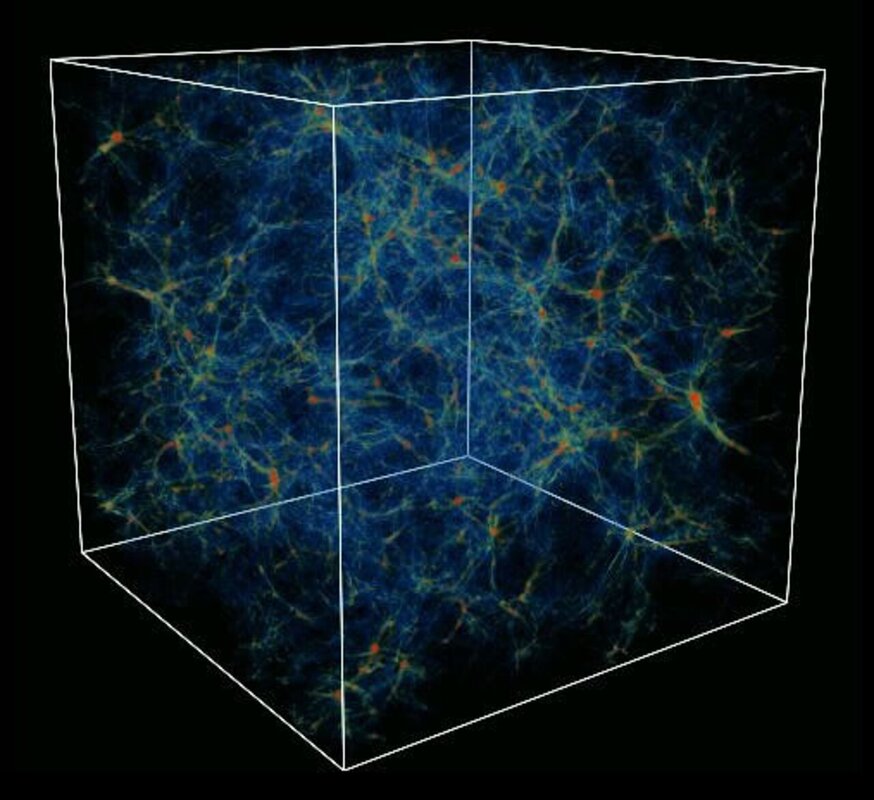
All galaxies in the universe are part of a giant structure that resembles a three-dimensional spider web shape called the cosmic web. The filaments of the cosmic web intersect at the nodes, which equate to the galaxy shipyards in the analogy used here.
“We believe that the filaments mediate the transfer of hydrogen gas from the diffuse medium of intergalactic space onto these hungry, newly forming protocluster structures in the nodes,” Frye said.
Pointing to future research, Polletta said: “We are in the process of analyzing more observations on this and other Planck protoclusters with the goal of tracing the gas that gives birth to these newly-forming stars and feeds the supermassive black holes, to determine its origin and explain the observed extraordinary activity.”
Frye said she is looking forward to combining data from the Large Binocular Telescope with planned observations using the James Webb Space Telescope, to be launched in December.
“Protoclusters offer an opportunity to investigate key questions in astronomy that only this new observatory can answer,” she said, “such as what mechanisms drive the prodigious star formation, and when will the hydrogen supply run out, forcing this galaxy shipyard to close its doors and turn into a supercluster similar to the one our Milky Way is in?”
The two research papers are:
“A Planck-selected dusty protocluster at z=2.16 associated with a strong over-density of massive Hα emitting galaxies”, authored by Yusei Koyama, Maria del Carmen Polletta, Ichi Tanaka, Tadayuki Kodama, Hervé Dole, Geneviève Soucail, Brenda Frye, Matt Lehnert, Marco Scodeggio, 2021, MNRAS, 501, L1, Abstract here and publication here.
"Spectroscopic observations of PHz G237.01+42.50 : a galaxy protocluster at z=2.16 in the Cosmos field”, authored by M. Polletta, G. Soucail, H. Dole, M. D. Lehnert, E. Pointecouteau, G. Vietri, M. Scodeggio, L. Montier, Y. Koyama, G. Lagache, B. L. Frye, F. Cusano, and M. Fumana, 2021, A&A, Volume 654, A121.
The work reported here used different facilities around the world and in space:
“The picture we have pieced together now is that of a successful galaxy shipyard which is working at high efficiency to assemble galaxies and the stars within them and and has an energy supply that is more sustainable,” Frye said.
All galaxies in the universe are part of a giant structure that resembles a three-dimensional spider web shape called the cosmic web. The filaments of the cosmic web intersect at the nodes, which equate to the galaxy shipyards in the analogy used here.
“We believe that the filaments mediate the transfer of hydrogen gas from the diffuse medium of intergalactic space onto these hungry, newly forming protocluster structures in the nodes,” Frye said.
Pointing to future research, Polletta said: “We are in the process of analyzing more observations on this and other Planck protoclusters with the goal of tracing the gas that gives birth to these newly-forming stars and feeds the supermassive black holes, to determine its origin and explain the observed extraordinary activity.”
Frye said she is looking forward to combining data from the Large Binocular Telescope with planned observations using the James Webb Space Telescope, to be launched in December.
“Protoclusters offer an opportunity to investigate key questions in astronomy that only this new observatory can answer,” she said, “such as what mechanisms drive the prodigious star formation, and when will the hydrogen supply run out, forcing this galaxy shipyard to close its doors and turn into a supercluster similar to the one our Milky Way is in?”
The two research papers are:
“A Planck-selected dusty protocluster at z=2.16 associated with a strong over-density of massive Hα emitting galaxies”, authored by Yusei Koyama, Maria del Carmen Polletta, Ichi Tanaka, Tadayuki Kodama, Hervé Dole, Geneviève Soucail, Brenda Frye, Matt Lehnert, Marco Scodeggio, 2021, MNRAS, 501, L1, Abstract here and publication here.
"Spectroscopic observations of PHz G237.01+42.50 : a galaxy protocluster at z=2.16 in the Cosmos field”, authored by M. Polletta, G. Soucail, H. Dole, M. D. Lehnert, E. Pointecouteau, G. Vietri, M. Scodeggio, L. Montier, Y. Koyama, G. Lagache, B. L. Frye, F. Cusano, and M. Fumana, 2021, A&A, Volume 654, A121.
The work reported here used different facilities around the world and in space:
- Subaru Telescope in Hawaii. MOIRCS: Multi-Object Infrared Camera and Spectrograph.
- Large Binocular Telescope in Arizona. Operated by different universities and research institutions in the USA, Germany, Italy. LUCI spectrograph — Large Binocular Telescope Near-infrared Spectroscopic Utility with Camera and Integral Field Unit for Extragalactic Research.
- Planck, an ESA mission dedicated to cosmology and the cosmic microwave background, observing the whole sky in the radio and sub-millimeter light
- Herschel, an ESA observatory dedicated to the cold and far-away universe, observing the far-infrared and sub-millimeter light
- Spitzer, a NASA great observatory observing in the infrared.
Other links:
UA/LBTO pdf version of this PR here
UA News Release here
INAF Press Release (Italian) here
CNRS Press Release (French) here
Subaru Press Release (Japanese - English)
About LBT
The largest optical telescope in operation, the Large Binocular Telescope uses two 8.4-meter primary meters which offer the light gathering power of an 11.7m mirror and, when used in interferometric mode, the resolving power of an 22.7m telescope. A sophisticated Adaptive Optics System correcting for atmospheric disturbances enables LBT to generate crisp and clear images of the universe. Operated by the University of Arizona (UA) in Tucson, Arizona, USA, the LBT is an international collaboration of the UA, Italy (INAF: Istituto Nazionale di Astrofisica), Germany (LBTB: LBT Beteiligungsgesellschaft), and The Ohio State University (OSU) representing OSU, the University of Minnesota, the University of Virginia, and the University of Notre Dame.
Subscribe to:
Posts (Atom)