Wednesday, January 27, 2010

Black Hole Hunters Set New Distance Record

The black hole inside NGC 300 X-1 (artist’s impression)

NGC 300 X-1 in the spiral galaxy NGC 300

NGC 300 X-1 in the spiral galaxy NGC 300

The surroundings of NGC 300

Artist’s impression

Zoom in onto the stellar black hole NGC 300 X-1

Artist’s impression

Astronomers using ESO’s Very Large Telescope have detected, in another galaxy, a stellar-mass black hole much farther away than any other previously known. With a mass above fifteen times that of the Sun, this is also the second most massive stellar-mass black hole ever found. It is entwined with a star that will soon become a black hole itself.

The stellar-mass black holes [1] found in the Milky Way weigh up to ten times the mass of the Sun and are certainly not be taken lightly, but, outside our own galaxy, they may just be minor-league players, since astronomers have found another black hole with a mass over fifteen times the mass of the Sun. This is one of only three such objects found so far.

The newly announced black hole lies in a spiral galaxy called NGC 300, six million light-years from Earth. “This is the most distant stellar-mass black hole ever weighed, and it’s the first one we’ve seen outside our own galactic neighbourhood, the Local Group,” says Paul Crowther, Professor of Astrophysics at the University of Sheffield and lead author of the paper reporting the study. The black hole’s curious partner is a Wolf–Rayet star, which also has a mass of about twenty times as much as the Sun. Wolf–Rayet stars are near the end of their lives and expel most of their outer layers into their surroundings before exploding as supernovae, with their cores imploding to form black holes.

In 2007, an X-ray instrument aboard NASA’s Swift observatory scrutinised the surroundings of the brightest X-ray source in NGC 300 discovered earlier with the European Space Agency’s XMM-Newton X-ray observatory. “We recorded periodic, extremely intense X-ray emission, a clue that a black hole might be lurking in the area,” explains team member Stefania Carpano from ESA.

Thanks to new observations performed with the FORS2 instrument mounted on ESO’s Very Large Telescope, astronomers have confirmed their earlier hunch. The new data show that the black hole and the Wolf–Rayet star dance around each other in a diabolic waltz, with a period of about 32 hours. The astronomers also found that the black hole is stripping matter away from the star as they orbit each other.

“This is indeed a very ‘intimate’ couple,” notes collaborator Robin Barnard. “How such a tightly bound system has been formed is still a mystery.”

Only one other system of this type has previously been seen, but other systems comprising a black hole and a companion star are not unknown to astronomers. Based on these systems, the astronomers see a connection between black hole mass and galactic chemistry. “We have noticed that the most massive black holes tend to be found in smaller galaxies that contain less ‘heavy’ chemical elements,” says Crowther [2]. “Bigger galaxies that are richer in heavy elements, such as the Milky Way, only succeed in producing black holes with smaller masses.” Astronomers believe that a higher concentration of heavy chemical elements influences how a massive star evolves, increasing how much matter it sheds, resulting in a smaller black hole when the remnant finally collapses.

In less than a million years, it will be the Wolf–Rayet star’s turn to go supernova and become a black hole. “If the system survives this second explosion, the two black holes will merge, emitting copious amounts of energy in the form of gravitational waves as they combine [3],” concludes Crowther. However, it will take some few billion years until the actual merger, far longer than human timescales. “Our study does however show that such systems might exist, and those that have already evolved into a binary black hole might be detected by probes of gravitational waves, such as LIGO or Virgo [4].”
Notes

[1] Stellar-mass black holes are the extremely dense, final remnants of the collapse of very massive stars. These black holes have masses up to around twenty times the mass of the Sun, as opposed to supermassive black holes, found in the centre of most galaxies, which can weigh a million to a billion times as much as the Sun. So far, around 20 stellar-mass black holes have been found.

[2] In astronomy, heavy chemical elements, or “metals”, are any chemical elements heavier than helium.

[3] Predicted by Einstein’s theory of general relativity, gravitational waves are ripples in the fabric of space and time. Significant gravitational waves are generated whenever there are extreme variations of strong gravitational fields with time, such as during the merger of two black holes. The detection of gravitational waves, never directly observed to date, is one of the major challenges for the next few decades.

[4] The LIGO and Virgo experiments have the goal of detecting gravitational waves using sensitive interferometers in Italy and the United States.

More information

This research was presented in a letter to appear in the Monthly Notices of the Royal Astronomical Society (NGC 300 X-1 is a Wolf–Rayet/Black Hole binary, P.A. Crowther et al.).

The team is composed of Paul Crowther and Vik Dhillon (University of Sheffield, UK), Robin Barnard and Simon Clark (The Open University, UK), and Stefania Carpano and Andy Pollock (ESAC, Madrid, Spain).

ESO, the European Southern Observatory, is the foremost intergovernmental astronomy organisation in Europe and the world’s most productive astronomical observatory. It is supported by 14 countries: Austria, Belgium, the Czech Republic, Denmark, France, Finland, Germany, Italy, the Netherlands, Portugal, Spain, Sweden, Switzerland and the United Kingdom. ESO carries out an ambitious programme focused on the design, construction and operation of powerful ground-based observing facilities enabling astronomers to make important scientific discoveries. ESO also plays a leading role in promoting and organising cooperation in astronomical research. ESO operates three unique world-class observing sites in Chile: La Silla, Paranal and Chajnantor. At Paranal, ESO operates the Very Large Telescope, the world’s most advanced visible-light astronomical observatory, and VISTA, the largest survey telescope in the world. ESO is the European partner of a revolutionary astronomical telescope ALMA, the largest astronomical project in existence. ESO is currently planning a 42-metre European Extremely Large optical/near-infrared Telescope, the E-ELT, which will become “the world’s biggest eye on the sky”.

Links
Research paper

Contacts

Paul Crowther
University of Sheffield, UK
Tel: +44-114 222 4291
Email:
Paul.Crowther@sheffield.ac.uk

Stefania Carpano
ESTEC, ESA
The Netherlands
Tel: +31-71-5654827
Email:
scarpano@rssd.esa.int

Caught in the act: a merging binary QSO

The NOAO i band image of the binary quasar on the right, with the Chandra X-ray image on the left. The X-ray image is contoured and those contours overlaid on the i-band image.

It has been assumed for some time that binary supermassive black holes (SMBH) should be common in the universe, given that galaxies regularly interact and merge and that most, if not all, galaxies contain a SMBH. Such a SMBH will only be detected as a quasar when it is accreting matter. And galaxy merging is a leading proposal to trigger such accretion. Now the first luminous, spatially resolved binary quasar that clearly inhabits an interacting/merging galaxy pair has been reported. ( SDSS J1254+0846: A Binary Quasar Caught in the Act of Merging, Green et. al., Ap. J accepted Jan. 2010 ). The unique properties of this system allow detailed numerical simulations to create plausible scenarios for the histories of both the host galaxies and the SMBH that inhabit them.

The first spectrum confirming this binary QSO was taken by A. Myers at the KPNO Mayall 4-meter using R-C Spectrograph on Feb 12, 2008. Subsequent Chandra/NOAO observations (P. Green, P.I.) with the MOSAIC imager on the Mayall 4m image obtained March 18, 2009 (Barkhouse, Myers observing) revealed the existence of the tidal arms in the host galaxy,seen in the figure above. Additional deeper imaging and spectroscopy with Magellan/IMACS were used by the authors to determine the properties and history of this merger.

Sunday, January 24, 2010

The First of Many Asteroid Finds for WISE

The red dot at the center of this image is the first near-Earth asteroid discovered by NASA's Wide-Field Infrared Survey Explorer, or WISE. Image credit: NASA/JPL-Caltech/UCLA

NASA's Wide-field Infrared Survey Explorer, or WISE, has spotted its first never-before-seen near-Earth asteroid, the first of hundreds it is expected to find during its mission to map the whole sky in infrared light.

The near-Earth object, designated 2010 AB78, was discovered by WISE Jan. 12. After the mission's sophisticated software picked out the moving object against a background of stationary stars, researchers followed up and confirmed the discovery with the University of Hawaii's 2.2-meter (88-inch) visible-light telescope near the summit of Mauna Kea.

The asteroid is currently about 158 million kilometers (98 million miles) from Earth. It is estimated to be roughly 1 kilometer (0.6 miles) in diameter and circles the sun in an elliptical orbit tilted to the plane of our solar system. The object comes as close to the sun as Earth, but because of its tilted orbit, it is not thought to pass near our planet. This asteroid does not pose any foreseeable impact threat to Earth, but scientists will continue to monitor it.

WISE, which began its all-sky survey on Jan. 14, is expected to find about 100-thousand previously undiscovered asteroids in the Main Belt between Mars and Jupiter, and hundreds of new near-Earth asteroids. It will also spot millions of new stars and galaxies.

NASA's Jet Propulsion Laboratory in Pasadena, Calif., manages the WISE for NASA's Science Mission Directorate, Washington. The principal investigator, Edward Wright, is at UCLA. The mission was competitively selected under NASA's Explorers Program managed by the Goddard Space Flight Center, Greenbelt, Md. The science instrument was built by the Space Dynamics Laboratory, Logan, Utah, and the spacecraft was built by Ball Aerospace & Technologies Corp., Boulder, Colo. Science operations and data processing take place at the Infrared Processing and Analysis Center at the California Institute of Technology in Pasadena. Caltech manages JPL for NASA. The ground-based observations are partly supported by the National Science Foundation.


Whitney Clavin 818-354-4673
Jet Propulsion Laboratory, Pasadena, Calif.

whitney.clavin@jpl.nasa.gov

Friday, January 22, 2010

West Virginia Student Discovers New Pulsar

Pulsar
Credit: NASA

Shay Bloxton
CREDIT: NRAO/AUI/NSF

A West Virginia high-school student has discovered a new pulsar, using data from the giant Robert C. Byrd Green Bank Telescope (GBT).

Shay Bloxton, 15, a participant in a project in which students analyze data from the radio telescope, spotted evidence of the pulsar on October 15. Bloxton, along with NRAO astronomers observed the object again one month later. The new observation confirmed that the object is a pulsar, a rotating, superdense neutron star. Bloxton is a sophomore at Nicholas County High School in Summersville, West Virginia.

"I was very excited when I found out I had actually made a discovery," Bloxton said. She went to Green Bank in November to participate in the follow-up observation. She termed that visit "a great experience."

"It also helped me learn a lot about how observations with the GBT are actually done," she added.

The project in which she participated, called the Pulsar Search Collaboratory (PSC), is a joint project of the National Radio Astronomy Observatory (NRAO) and West Virginia University, funded by a grant from the National Science Foundation.

Pulsars are known for their lighthouse-like beams of radio waves that sweep through space as the neutron star rotates, creating a pulse as the beam sweeps by the Earth. First discovered in 1967, pulsars serve as valuable natural "laboratories" for physicists studying exotic states of matter, quantum mechanics and General Relativity. The GBT, dedicated in 2000, has become one of the world's leading tools for discovering and studying pulsars.

The PSC, led by NRAO Education Officer Sue Ann Heatherly and Project Director Rachel Rosen, includes training for teachers and student leaders, and provides parcels of data from the GBT to student teams. The project involves teachers and students in helping astronomers analyze data from 1500 hours of observing with the GBT. The 120 terabytes of data were produced by 70,000 individual pointings of the giant, 17-million-pound telescope. Some 300 hours of the observing data were reserved for analysis by student teams.

The student teams use analysis software to reveal evidence of pulsars. Each portion of the data is analyzed by multiple teams. In addition to learning to use the analysis software, the student teams also must learn to recognize man-made radio interference that contaminates the data. The project will continue through 2011. Teachers interested in participating in the program can learn more at this link.

For Bloxton, the pulsar discovery may be only her first in a scientific career. "Participating in the PSC has definitely encouraged me to pursue my dream of being an astrophysicist," she said, adding that she hopes to attend West Virginia University to study astrophysics.

Late last year, another West Virginia student, from South Harrison High School, Lucas Bolyard, discovered a pulsar-like object called a rotating radio transient. His discovery also came through participation in the PSC.

The National Radio Astronomy Observatory is a facility of the National Science Foundation, operated under cooperative agreement by Associated Universities, Inc.

Contact:

Dr. Rachel Rosen, PSC Project Director
(304) 456-2385

rrosen@nrao.edu

Thursday, January 21, 2010

ESO 137-001: Two Tails to Tell

Credit X-ray: NASA/CXC/UVa/M. Sun, et al;
H-alpha/Optical: SOAR (UVa/NOAO /UNC/CNPq-Brazil)/M.Sun et al.


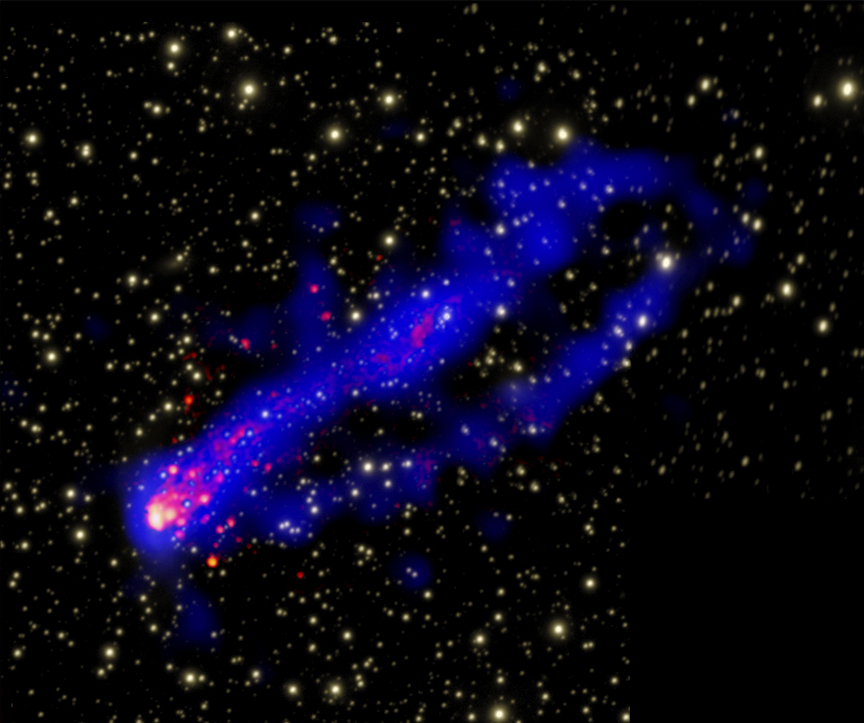
Two spectacular tails of X-ray emission have been seen trailing behind a galaxy using the Chandra X-ray Observatory. A composite image of the galaxy cluster Abell 3627 shows X-rays from Chandra in blue, optical emission in yellow and emission from hydrogen light -- known to astronomers as "H-alpha" -- in red. The optical and H-alpha data were obtained with the Southern Astrophysical Research (SOAR) Telescope in Chile.

At the front of the tail is the galaxy ESO 137-001. The brighter of the two tails has been seen before and extends for about 260,000 light years. The detection of the second, fainter tail, however, was a surprise to the scientists.

The X-ray tails were created when cool gas from ESO 137-001 (with a temperature of about ten degrees above absolute zero) was stripped by hot gas (about 100 million degrees) as it travels towards the center of the galaxy cluster Abell 3627. What astronomers observe with Chandra is essentially the evaporation of the cold gas, which glows at a temperature of about 10 million degrees. Evidence of gas with temperatures between 100 and 1,000 degrees Kelvin in the tail was also found with the Spitzer Space Telescope.

Galaxy clusters are collections of hundreds or even thousands of galaxies held together by gravity that are enveloped in hot gas. The two-pronged tail in this system may have formed because gas has been stripped from the two major spiral arms in ESO 137-001. The stripping of gas is thought to have a significant effect on galaxy evolution, removing cold gas from the galaxy, shutting down the formation of new stars in the galaxy, and changing the appearance of inner spiral arms and bulges because of the effects of star formation.

The H-alpha data shows evidence for star formation in the tails -- the first unambiguous evidence that star formation can occur when cold gas is stripped out of galaxies as they fall through clusters. The Chandra data also reveal an excess of luminous X-ray point sources around the X-ray tails. Some of them are considered to be young massive binary stars associated with nearby young star clusters, giving more evidence of star formation in the tails. The implication is that a large portion of stars between cluster galaxies can be formed in situ.

The X-ray data also reveal that there is little change in temperature of the hot gas in the tails, and also little change in width of the tails with distance from ESO 137-001. Both of these features present challenges to scientists doing simulations of the galaxy tails.

Fast Facts for ESO 137-001:

Scale: Image is 5 arcmin across
Category: Groups & Clusters of Galaxies
Coordinates: (J2000) RA 16h 13m 25.59s | Dec -60° 45' 43.10
Constellation: Norma
Observation Date: 6/12/2008
Observation Time: 39 hours
Obs. ID: 9518
Color Code: X-ray (Blue); Optical (Yellow); H-alpha (Red)
Instrument: ACIS
References: Sun, M., et al, 2010, ApJ 708 946
Distance Estimate: About 230 million light years

Wednesday, January 20, 2010

On the Trail of a Cosmic Cat

The Cat's Paw Nebula

Around the Cat's Paw Nebula

Zooming into the Cat's Paw Nebula

Panning across the Cat’s Paw Nebula

ESO has just released a stunning new image of the vast cloud known as the Cat’s Paw Nebula or NGC 6334. This complex region of gas and dust, where numerous massive stars are born, lies near the heart of the Milky Way galaxy, and is heavily obscured by intervening dust clouds.

Few objects in the sky have been as well named as the Cat’s Paw Nebula, a glowing gas cloud resembling the gigantic pawprint of a celestial cat out on an errand across the Universe. British astronomer John Herschel first recorded NGC 6334 in 1837 during his stay in South Africa. Despite using one of the largest telescopes in the world at the time, Herschel seems to have only noted the brightest part of the cloud, seen here towards the lower left.

NGC 6334 lies about 5500 light-years away in the direction of the constellation Scorpius (the Scorpion) and covers an area on the sky slightly larger than the full Moon. The whole gas cloud is about 50 light-years across. The nebula appears red because its blue and green light are scattered and absorbed more efficiently by material between the nebula and Earth. The red light comes predominantly from hydrogen gas glowing under the intense glare of hot young stars.

NGC 6334 is one of the most active nurseries of massive stars in our galaxy and has been extensively studied by astronomers. The nebula conceals freshly minted brilliant blue stars — each nearly ten times the mass of our Sun and born in the last few million years. The region is also home to many baby stars that are buried deep in the dust, making them difficult to study. In total, the Cat’s Paw Nebula could contain several tens of thousands of stars.

Particularly striking is the red, intricate bubble in the lower right part of the image. This is most likely either a star expelling large amount of matter at high speed as it nears the end of its life or the remnant of a star that already has exploded.

This new portrait of the Cat’s Paw Nebula was created from images taken with the Wide Field Imager (WFI) instrument at the 2.2-metre MPG/ESO telescope at the La Silla Observatory in Chile, combining images taken through blue, green and red filters, as well as a special filter designed to let through the light of glowing hydrogen.

More information

ESO, the European Southern Observatory, is the foremost intergovernmental astronomy organisation in Europe and the world’s most productive astronomical observatory. It is supported by 14 countries: Austria, Belgium, the Czech Republic, Denmark, France, Finland, Germany, Italy, the Netherlands, Portugal, Spain, Sweden, Switzerland and the United Kingdom. ESO carries out an ambitious programme focused on the design, construction and operation of powerful ground-based observing facilities enabling astronomers to make important scientific discoveries. ESO also plays a leading role in promoting and organising cooperation in astronomical research. ESO operates three unique world-class observing sites in Chile: La Silla, Paranal and Chajnantor. At Paranal, ESO operates the Very Large Telescope, the world’s most advanced visible-light astronomical observatory and VISTA, the world’s largest survey telescope. ESO is the European partner of a revolutionary astronomical telescope ALMA, the largest astronomical project in existence. ESO is currently planning a 42-metre European Extremely Large optical/near-infrared Telescope, the E-ELT, which will become “the world’s biggest eye on the sky”.

Contacts

Henri Boffin
ESO La Silla-Paranal/E-ELT Press Officer
Garching, Germany
Tel: +49 89 3200 6222
Email:
hboffin@eso.org

Tuesday, January 19, 2010

Weak Lensing Gains Strength

Visible-light images from the Hubble Space Telescope populate this tiny section of the full two-square-degree Cosmic Evolution Survey (COSMOS), which combines data in many wavelengths from space and ground-based telescopes around the world. COSMOS was the basis of a new extension of the mass-luminosity relation for weak lensing studies.

Berkeley, CA — Weak gravitational lensing is a uniquely promising way to learn how much dark matter there is in the Universe and how its distribution has evolved since the distant past. New work by a team led by a cosmologist from the U.S. Department of Energy’s Lawrence Berkeley National Laboratory has made major progress in extending the use of gravitational lensing to the study of much older and smaller structures than was previously possible.

Until recently, weak lensing had been limited to calculating the total mass of relatively nearby groups and clusters of galaxies. Their total mass includes both ordinary, visible matter like stars and dust – what astronomers call “baryonic” matter – plus the much more massive invisible concentrations of dark matter that form groups and clusters by pulling galaxies together.

Astronomers were able to establish an important scaling relationship for nearby clusters between their total masses, determined by gravitational lensing, and the brightness of their x-ray emissions, an indication of the mass of the ordinary matter alone. A new study in the Astrophysical Journal (ApJ) now continues this important relationship to distant objects.

“We’ve been able to extend measurements of mass to much smaller structures, which existed much earlier in the history of the Universe,” says Alexie Leauthaud, a Chamberlain Fellow in Berkeley Lab’s Physics Division and first author of the ApJ study. “This helps us gain a better understanding of the relationship between the normal matter in dense structures, which are seen through the x-ray luminosity, and the total dark-matter mass of these structures, as measured by the weak lensing.” Leauthaud is a member of the Berkeley Center for Cosmological Physics (BCCP) at UC Berkeley and Berkeley Lab.

Mass as a lens

Gravitational lensing occurs because mass curves the space around it, bending the paths along which rays of light travel: the more mass (and the closer to the center of mass), the more space bends, and the more the image of a distant object is displaced and distorted. Thus measuring distortion, or “shear,” is key to measuring the mass of the lensing object.

At least this is so for “strong” lensing. A very massive object or collection of objects, like a nearby galaxy cluster and the invisible dark matter that encloses it, distorts the apparent shape and position of bright objects beyond it so much that the distant images are bent and may even be smeared into rings around the foreground cluster. The visible distortion is a direct measure of the mass of the lens and points to its center.

A spectacular example of strong gravitational lensing is the nearby galaxy cluster Abell 2218 (top), in which the visible distortion of individual background galaxies can be used to measure the mass of the lensing structure. The weak lensing of fainter and more distant structures must be detected by statistical averaging (bottom). (Abell 2218 image by NASA, weak lensing simulation by Bhuvnesh Jain, Uroš Seljak, and Simon White)

Weak lensing works the same way, except that the shear is too subtle to be seen directly. Most of the apparent shear isn’t distortion at all – a galaxy has its own distinct shape, and we often see it from an angle that makes it look elongated. Apparent shear may also be due to the telescope, the detector, or the atmosphere.

Nevertheless, faint additional distortions in a collection of distant galaxies can be calculated statistically, and the average shear due to the lensing of some massive object in front of them can be computed. Yet to calculate the lens’s mass from average shear, one needs to know its center.

“The problem with low-mass, high-redshift clusters is that it is difficult to determine which exact galaxy lies at the center of the cluster,” says Leauthaud. “That’s where x-rays help. The x-ray luminosity from a galaxy cluster can be used to find its center very accurately.”

The hot intracluster medium of gas or plasma that fills almost all galaxy clusters emits x-rays, making x-ray emission a convenient way to find distant galaxy structures in the night sky. But how does this emission help find the center of mass in a galaxy cluster? For the same reason that dark matter is dark.

Why dark matter is dark

Except through gravitation, dark matter does not interact (or interacts only very weakly) with itself or with ordinary matter. Indeed, that’s why it’s dark: to emit light it would have to interact via the electromagnetic force.

With ordinary matter, electromagnetism affects everything from chemistry to luminosity to electric and magnetic fields and even the pressure of stellar winds; thus electromagnetism plays an important role in determining the arrangement of ordinary matter, which is often irregular.

Because electromagnetism plays no role in the distribution of dark matter, however, dark matter forms large, smooth, spherical clumps, usually filled by ordinary galaxies plus hot gas or plasma, which it has trapped and retained solely through gravitation.

“Gas density follows the dark matter density, and because x-ray emission scales as the square of the gas density, the x-ray light shines very strongly in the core of the structure,” Leauthaud explains. “So x-rays are an excellent way to determine the center of even a distant, fuzzy galaxy cluster.”

“Basically the more mass, the more heat,” says Jean-Paul Kneib, a lead author of the ApJ paper from the Laboratory of Astrophysics of Marseilles (LAM) and France’s National Center for Scientific Research (CNRS). “But the plasma is baryonic matter, which is only a small part of the total mass of the cluster. While the x-radiation tells you something about the total mass, you need to get the scaling just right.”

Visible matter follows an underlying dark matter scaffolding. At left, blue indicates the mass of stars in galaxies in a given area, yellow the number of galaxies, and red the sources of brightest x-ray emission. Contours at right are the distribution of dark matter, from gravitational lensing. (Richard Massey et al, Nature 2007.

To pin down the scaling relation between x-ray brightness and total mass, Leauthaud and her colleagues first used x-ray luminosity to identify the center of mass of 206 galaxy groups and clusters, including numerous faint, distant clusters listed in the Hubble Space Telescope’s Cosmic Evolution Survey (COSMOS), which is curated by Nick Scoville of the California Institute of Technology, an author of the ApJ paper.

X-ray imaging came from the European Space Agency’s XMM-Newton satellite and from NASA’s Chandra satellite, whose principal investigator is Martin Elvis of the Harvard-Smithsonian Center for Astrophysics, an author of the ApJ paper. Elvis says, “I never thought our Chandra data would enable such a great measurement. In fact I was astonished when Alexie first showed me the results. It’s quite a tour de force of analysis, and really convincing.”

The X-ray analysis itself was performed by Alexis Finoguenov of the Max Planck Institute for Extraterrestrial Physics and the University of Maryland, one of the paper’s lead authors. Knowing the centers of mass from analysis of x-ray emission, the researchers could now use weak lensing to estimate the total mass of the distant groups and clusters with greater accuracy than ever before.

Finally they calculated the mass-luminosity relation for the new collections of groups and clusters and found that it was consistent with previous relations established by surveys of much closer structures – including some studied with strong gravitational lensing. Within calculable uncertainty, the relation follows the same straight slope from nearby galaxy clusters to distant ones; a simple, consistent scaling factor relates a group or cluster’s total mass to its x-ray brightness, or “baryonic tracer.”

“By confirming the mass-luminosity relation and extending it to high redshifts,” Leauthaud says, “we have taken a small step in the right direction toward using weak lensing as a powerful tool to measure the evolution of structure.”

In the beginning

The origin of galaxies can be traced back to slight differences in the density of the hot, liquid-like early universe; traces of these differences can still be seen as minute temperature differences in the cosmic microwave background (CMB).

“The variations we observe in the ancient microwave sky represent the imprints that developed over time into the cosmic dark-matter scaffolding for the galaxies we see today,” says BCCP director and UC Berkeley physics professor George Smoot of Berkeley Lab’s Physics Division, who shared the 2006 Nobel Prize in Physics for measuring anisotropies in the CMB and is one of the authors of the ApJ paper. “It is very exciting that we can actually measure with gravitational lensing how the dark matter has collapsed and evolved since the beginning.”

Dark matter shapes visible matter in a way that reflects the nature of dark energy. How galaxies are distributed in a Universe with no dark energy (left) would differ measurably from one in which dark energy is significant (right).

One goal in studying the evolution of structure is to understand dark matter itself, and how it interacts with the ordinary matter we can see. Another goal is to learn more about dark energy, the mysterious something that is pushing matter apart and causing the Universe to expand at an accelerating rate. Is dark energy constant, or is it dynamic? Or is it unreal, merely an illusion caused by a limitation in Einstein’s General Theory of Relativity?

The tools provided by the extended mass-luminosity relationship will do much to answer these questions about the opposing roles of gravity and dark energy in the once and future shape of the Universe.

“A Weak Lensing Study of X-Ray Groups in the COSMOS Survey: Form and Evolution of the Mass-Luminosity Relation,” by Alexie Leauthaud, Alexis Finoguenov, Jean-Paul Kneib, James E. Taylor, Richard Massey, Jason Rhodes, Olivier Ilbert, Kevin Bundy, Jeremy Tinker, Matthew R. George, Peter Capak, Anton M. Koekemoer, David E. Johnston, Yu-Ying Zhang, Nico Cappelluti, Richard S. Ellis, Martin Elvis, Catherine Heymans, Oliver Le Fèvre, Simon Lilly, Henry J. McCracken, Yannick Mellier, Alexandre Réfrégier, Mara Salvato, Nick Scoville, George Smoot, Masayuki Tanaka, Ludovic Van Waerbeke, and Melody Wolk, appears in the Astrophysical Journal and is available online to subscribers.

Berkeley Lab is a U.S. Department of Energy national laboratory located in Berkeley, California. It conducts unclassified scientific research for DOE’s Office of Science and is managed by the University of California. Visit our website at http://www.lbl.gov.

Additional Information

More about
weak gravitational lensing

More about the COSMOS survey

Alexie Leauthaud demonstrates how dark matter causes gravitational lensing

Scientific contact: Alexie Leauthaud

First Direct Imaging of a Young Binary System

Figure 1: Observed and simulated images of the young binary star SR24 (distance: 520 light years).
A. Infrared image of SR24 and associated disks. The regions gravitationally bound to each star (Roche Lobes) are indicated by dotted lines (for the inner regions) and dashed lines (for the outer regions). (©The graduate University for Advanced Studies & the National Astronomical Observatory of Japan)

B. Snapshot of the buildup of materials onto the binary system SR24 based on two-dimensional numerical simulations. The colors designate the distribution of surface densities and the arrows, the distribution of velocity. (© Chiba University)

Figure 2: Three-dimensional numerical simulation image of young binary star system. (© Hosei University)

Figure 3: Diagram of the birth of a binary (© Hosei University)
The team observed the young binary SR24 in its formative stage and detected three disks for the first time. These are portrayed in the figure. Arrows denote the velocity distribution of materials in this figure.

In a binary system, the brighter star is called the primary star and the fainter star, the secondary star. While a single star has only one circumstellar disk, a binary has three types of disks. In a binary system, both the primary and secondary stars orbit each other and have circumprimary and cirumsecondary disks respectively. The entire system can be surrounded by a circumbinary disk. Numerical simulation leads to the assumption that there is a stage when a young binary is associated with all three disks.

Figure 4: Left panel: Wide-field three-color composite image of the environment around the constellation Ophiuchus, where SR24 is located. (Obtained with the 1.4 m telescope IRSF [Infrared Survey Facility] at the South African Astronomical Observatory [SAAO]) (© The Graduate University for Advanced Studies)

Right panel: Image of the young binary system SR24. Obtained with the 8.2m Subaru Telescope. (© The Graduate University for Advanced Studies)

A team of astronomers from The Graduate University for Advanced Studies, the National Astronomical Observatory of Japan, and other universities have captured the first direct image of a young binary star system (Figure 1A, Figure 4). Using the Coronagraphic Imager with Adaptive Optics (CIAO) mounted on the Subaru Telescope, the team observed the young binary star SR24, which is located in the constellation Ophiuchus, 520 light years away. The data from the team’s observations provide the first solid basis for testing and refining theoretical models of star and planet formation in binary systems.

Our understanding of the creation and development of stars and planets has advanced substantially in the past two decades. Research has confirmed that new stars are often surrounded by disks of dense gas (“protoplanetary disks”) from which planets are believed to form; the radii of these disks can extend distances up to several hundreds times farther than the distance between the Sun and the Earth. Scientists have intensively studied the structure of protoplanetary disks at various electromagnetic wavelengths, and our knowledge of the mechanisms of single star formation has increased considerably. Nevertheless, most stars form in binary or multiple (more than two stars) systems, and many unanswered questions remain about how they are born and develop (see Figure 2 for a numerical simulation of binary formation and Figure 3 and the movie for the birth of a binary system). Consequently, studies of protoplanetary disks in binary and multiple systems are essential for making generalizations about the processes of star and planet formation.

In a binary system, two stars orbit around a common center of mass. The brighter or more massive star is referred to as the primary star and the fainter or less massive one is called the secondary star. A disk of gas and dust surrounds the primary star (“circumprimary disk”); another disk encircles the secondary star (circumsecondary disk). A third disk (“circumbinary disk”) may ring the primary and secondary stars and supply mass to the stars’ disks through a stream of gas. Spiral arms of gas and dust may extend from the stars’ disks to feed them with material from the circumbinary disk, thus contributing to the development of their circumstellar disks. However, such disks and spiral arms in binary or multiple systems have rarely been directly imaged or resolved—until now.

The July 2006 observations of the young binary star SR24 by astronomers Dr. Satoshi Mayama (The Graduate University for Advanced Studies or SOKENDAI), Dr. Motohide Tamura (National Astronomical Observatory of Japan or NAOJ and SOKENDAI), Dr. Masahiko Hayashi (NAOJ and SOKENDAI) and colleagues have corrected this deficit and provided data that can be used to test theories about binary system formation. The team captured a high-resolution, near-infrared image of the circumprimary and circumsecondary disks of SR24, the first such image of twin protoplanetary disks around a young stellar object (Figure 1A, Figure 4). They also discovered a long spiral arm extending out from the circumprimary disk, another first in observations of young stars. The image shows a bridge of gas connecting the two disks. The observations provide the first data that can be used to test theoretical models of mass accretion in binary systems.

Astronomers Dr. Tomoyuki Hanawa (Chiba University) and Dr. Tomoaki Matsumoto (Hosei University) analyzed the young binary star and collected information about its attributes. Using a supercomputer, they performed two-dimensional numerical simulations of accretion from a circumbinary disk and were able to generate stellar structures (Figure 1B) that shared common features with the observed image. The agreement between the observations and the simulation suggests that fresh material streams along the spiral arm, replenishing the circumprimary disk with a reservoir of gas contained in a circumbinary disk. As reported in this article, the 0.1 arcsecond image shows the supporting structures of twin protoplanetary disks, which are fed with planet-building materials. Such an image cannot be reproduced by spectroscopic observations or studies of models of spectral energy distribution. The simulations also confirm that the bridge between the twin disks corresponds to gas flow and a shock wave caused by the collision of gas rotating around the primary and secondary stars. The comparison of the simulations with the observation demonstrates a mechanism for how protoplanetary disks interact in young binary systems.

These findings are a testament to the significance of this first direct observation of a binary system that is in the process of forming. They lead to a better understanding of the process of star and planet formation in a binary system by clarifying the role of supporting structures in maintaining the binary system.

Notes

These findings were published in the November 19, 2009 edition of Science Express in an article entitled “Direct Imaging of Bridged Twin Protoplanetary Disks in a Young Multiple Star” by S. Mayama et al. and will be subsequently published in Science.

A movie of the formation of binary stars is available for real time viewing in broadband by clicking on "Movie Link" below, then click on "movies" and select "Formation of Binary Stars."


The complete list of authors, their affiliations and positions are as follows:

Satoshi Mayama (The Graduate University for Advanced Studies (SOKENDAI) Assistant Professor)
Motohide Tamura (National Astronomical Observatory of Japan, Associate Professor)
Tomoyuki Hanawa (Chiba University, Professor)
Tomoaki Matsumoto (Hosei University, Associate Professor)
Miki Ishii (Subaru Telescope/National Astronomical Observatory of Japan, Subaru support astronomer)
Tae-Soo Pyo (Subaru Telescope/National Astronomical Observatory of Japan, Subaru support astronomer)
Hiroshi Suto (National Astronomical Observatory of Japan, Assistant Professor)
Takahiro Naoi (National Astronomical Observatory of Japan, research expert)
Tomoyuki Kudo (National Astronomical Observatory of Japan, postdoctoral fellow)
Jun Hashimoto (The Graduate University for Advanced Studies (SOKENDAI), graduate student)
Shogo Nishiyama (Kyoto University, JSPS fellow)
Masayuki Kuzuhara (University of Tokyo, graduate student)
Masahiko Hayashi(Subaru Telescope/National Astronomical Observatory of Japan, Professor)

Source: Subaru Telescope - Release December 11, 2009

Saturday, January 16, 2010

Solar System Shield

An artist's rendering of a planet-forming disk in which molecules may be protected by a layer of water vapor. Credit: NASA/JPL-Caltech

Water vapor in planet-forming disks may block ultraviolet radiation from destroying water and other important molecules for life, according to new calculations.

The early solar system was tough on molecules. There were few places then to hide from the harsh ultraviolet radiation from the young Sun. However, new theoretical models show that water vapor provided a kind of shield - like the ozone layer in Earth's atmosphere - that protected molecules inside the planet-forming disk.

This water shield may have helped the disk hold onto water that later seeded the Earth's oceans. It could have also provided a safe haven for some of the biological building blocks known to form in space.

"Water is basically capable of sacrificing itself to protect the chemistry below it," says Ted Bergin of the University of Michigan in Ann Arbor.

Bergin and colleague Thomas Bethell calculated the survival rate of water vapor in the inner regions of young planetary systems. Somewhat unexpectedly, they found that several thousand oceans-worth of water can escape UV destruction.

The results, reported in a recent issue of the journal Science, may explain recent observations of water vapor around young stars, as well as help scientists trying to model how planets form.

Cross-section of a planet-forming disk surrounding a young star. Similar to the ozone layer that protects life on Earth, the "shielding layer" of water vapor (red) protects the planet-forming zone (blue) from molecule-destroying ultraviolet radiation. Credit: Science/AAAS

Star light, star bright

When a star is born out of a dense cloud of dust and gas, some of the cloud material ends up in a flat disk circling the central star.

Initially, the gas in the cloud contains some simple molecules, but once the star "turns on" these molecules are at risk from the stellar radiation.

"Molecules are fragile," Bergin says. "The ultraviolet light can easily break them apart."

Ultraviolet photons striking the molecule H2O, for example, will strip off one hydrogen and then the other, leaving a single oxygen atom.

Water and other molecules are provided some protection by dust in the disk. But as the grains grow bigger on their way to forming planets, they no longer block UV radiation.

The general consensus was that there should be a limited number of molecules around million-year-old stars when grains have grown, and yet recent observations have detected large quantities of water and OH vapor floating in the inner disk regions of several such stars.

To explain these observations, some scientists suggested that comets from cold outer regions fly in towards their host star, releasing frozen water through evaporation. However, this hypothesis doesn't seem to account for the OH data in the disk, Bergin says.

Sun screen for the solar system

Bergin had a hunch that the water vapor in the inner disk was dense enough that it could chemically reassemble itself just as fast as the UV was destroying it. He and Bethell ran models for various star luminosities and disk temperatures and found that in most cases a thin layer of water surrounding the disk could absorb the incoming radiation.

"What Bethell and Bergin have showed is that if water is present, it can protect itself from destruction as the water begins to reform on quick timescales, preventing the light from destroying all of it," says Fred Ciesla of the University of Chicago.

The authors predict that the amount of "space mist" surrounding a young star should be equivalent to many thousands of oceans. They show that this is consistent with three previous water detections in planet-forming disks.

The water shield not only protects other water molecules, but it also would keep radiation from destroying other molecules in the inner disk region.

"Water in the disk provides this nice umbrella," Bergin says.

Under this umbrella, organic chemistry could operate, perhaps leading to some of the biological building blocks that have been detected in very old meteorites and the innermost regions near young stars.

Water vapor was detected by the Spitzer telescope around the young stellar system called NGC 1333-IRAS 4B. Credit: NASA/JPL-Caltech/Harvard-Smithsonian CfA

Follow the water

One nagging question is what happens to all the oceans of water in the inner disk as the star gets older and its planets grow up. Bergin believes the water vapor within about 1 AU (the Earth-Sun distance) eventually gets destroyed. "Over time, radiation will win," he says.

But out at 3 AU (where our solar system's asteroid belt is located) the lower temperature may have allowed water vapor to condense onto the solid material forming in the disk. As it so happens, astronomers have recently detected icy asteroids that have comet-like compositions but appear to originate from inside the asteroid belt.

There has been some speculation that icy asteroids may have delivered water to the early Earth. The idea stems from the fact that our planet's oceans have a high ratio of deuterium to hydrogen, signifying that the water formed in a colder part of space than where Earth formed.

This could mean that some of the water vapor from the early days of our inner solar system wound up in our drinking supply.

Ciesla is somewhat skeptical. He thinks the situation that the authors are considering occurred too late in the evolution of the solar system to explain Earth's water. By the time the water-shielding mechanism becomes important, the solid material would have developed into clumps of rock, resulting in less overall surface area onto which water could condense.

However, Ciesla does believe these new results will help scientists peel away some of the uncertainty about the planet formation supposedly going on inside the thick dusty disks around young stars.

Source: Astrobio.net

Thursday, January 14, 2010

Hubble Catches End of Star-Making Party in Nearby Dwarf Galaxy

Credit: NASA, ESA, and J. Dalcanton and B. Williams (University of Washington, Seattle)


Galaxies throughout the universe are ablaze with star birth. But for a nearby, small spiral galaxy, the star-making party is almost over.

Astronomers were surprised to find that star-formation activities in the outer regions of NGC 2976 have been virtually asleep because they shut down millions of years ago. The celebration is confined to a few die-hard partygoers huddled in the galaxy's inner region.

The explanation, astronomers say, is that a raucous interaction with a neighboring group of hefty galaxies ignited star birth in NGC 2976. Now the star-making fun is beginning to end. Images from NASA's Hubble Space Telescope show that star formation in the galaxy began fizzling out in its outskirts as some of the gas was stripped away and the rest collapsed toward the center. With no gas left to fuel the party, more and more regions of the galaxy are taking a much-needed nap.

"Astronomers thought that grazing encounters between galaxies can cause the funneling of gas into a galaxy's core, but these Hubble observations provide the clearest view of this phenomenon," explains astronomer Benjamin Williams of the University of Washington in Seattle, who directed the Hubble study, which is part of the ACS Nearby Galaxy Survey Treasury (ANGST) program. "We are catching this galaxy at a very interesting time. Another 500 million years and the party will be over."

NGC 2976 does not look like a typical spiral galaxy. It has a star-forming disk, but no obvious spiral pattern. Its gas is centrally concentrated, but it does not have a central bulge of stars. The galaxy resides on the fringe of the M81 group of galaxies, located about 12 million light-years away in the constellation Ursa Major.

"The galaxy looks weird because an interaction with the M81 group about a billion years ago stripped some gas from the outer parts of the galaxy, forcing the rest of the gas to rush toward the galaxy's center, where it is has little organized spiral structure," Williams says.

The tsunami of gas racing toward the center has fueled rapid star birth for at least the past 500 million years in the relatively armless disk. At the same time, star birth ended in the galaxy's outer regions because the gas ran out. Now, the inner disk is running out of gas as new stars burst to life, shrinking the star-birth zone to a 5,000-light-year-wide area around the core.

"At one point during this process, the density of gas in the inner regions of this galaxy was very high, about five times higher than it is today," explains Julianne Dalcanton of the University of Washington, and leader of the ANGST team. "The gas vanished incredibly fast, and the galaxy now appears to be settling down."

Astronomers pieced together this star-formation story with the help of Hubble's sharp vision. The galaxy's relatively close distance to Earth allowed Hubble's Advanced Camera for Surveys (ACS) to resolve hundreds of thousands of individual stars. By studying those stars, the astronomers determined their color and brightness, which provided information about when the stars formed. The astronomers combined the Hubble results with a map, made from radio observations, showing the current distribution of hydrogen across the galaxy. The map is part of The HI Nearby Galaxy Survey by the National Radio Astronomy Observatory's Very Large Array in New Mexico. By analyzing the combined data, Williams and the team then reconstructed the star-making history for large areas of the galaxy.

"This type of observation is unique to Hubble," Williams says. "If we had not been able to pick out individual stars, we would have known that the galaxy is weird, but we would not have dug up evidence for a significant gas rearrangement in the galaxy, which caused the stellar birth zone to shrink toward the galaxy's center."

Simulations predict that the same "gas-funneling" mechanism may trigger starbursts in the central regions of other dwarf galaxies that interact with larger neighbors. The trick to studying the effects of this process in detail, Williams says, is being able to resolve many individual stars in galaxies to create an accurate picture of their evolution.

Williams' results will appear in the January 20, 2010 issue of The Astrophysical Journal.

Contact

Donna Weaver / Ray Villard
Space Telescope Science Institute, Baltimore, Md.
410-338-4493 / 410-338-4514

dweaver@stsci.edu / villard@stsci.edu

Benjamin Williams
University of Washington, Seattle, WA
206-543-9849

ben@astro.washington.edu

Wednesday, January 13, 2010

New research resolves conflict in theory of how galaxies form

These images depict various stages of galaxy formation under the cold dark matter theory using new computer simulations that account for the effects of supernova explosions. - Credit: Katy Brooks

For more than two decades, the cold dark matter theory has been used by cosmologists to explain how the smooth universe born in the big bang more than 13 billion years ago evolved into the filamentary, galaxy-rich cosmic web that we see today.

There's been just one problem: the theory suggested most galaxies should have far more stars and dark matter at their cores than they actually do. The problem is most pronounced for dwarf galaxies, the most common galaxies in our own celestial neighborhood. Each contains less than 1 percent of the stars found in large galaxies such as the Milky Way.

Now an international research team, led by a University of Washington astronomer, reports Jan. 14 in Nature that it resolved the problem using millions of hours on supercomputers to run simulations of galaxy formation (1 million hours is more than 100 years). The simulations produced dwarf galaxies very much like those observed today by satellites and large telescopes around the world.

"Most previous work included only a simple description of how and where stars formed within galaxies, or neglected star formation altogether," said Fabio Governato, a UW research associate professor of astronomy and lead author of the Nature paper.

"Instead we performed new computer simulations, run over several national supercomputing facilities, and included a better description of where and how star formation happens in galaxies."

The simulations showed that as the most massive new stars exploded as supernovas, the blasts generated enormous winds that swept huge amounts of gas away from the center of what would become dwarf galaxies, preventing millions of new stars from forming.

With so much mass suddenly removed from the center of the galaxy, the pull of gravity on the dark matter there is diminished and the dark matter drifts away, Governato said. It is similar to what would happen if our sun suddenly disappeared and the loss of its gravitational pull allowed the Earth to drift off into space.

The cosmic explosions proved to be the missing piece of the puzzle, and adding them to the simulations generated formation of galaxies with substantially lower densities at their cores, closely matching the observed properties of dwarf galaxies.

"The cold dark matter theory works amazingly well at telling where, when and how many galaxies should form," Governato said. "What we did was find a better description of processes that we know happen in the real universe, resulting in more accurate simulations."

The theory of cold dark matter, first advanced in the mid 1980s, holds that the vast majority of the matter in the universe -- as much as 75 percent -- is made up of "dark" material that does not interact with electrons and protons and so cannot be observed from electromagnetic radiation. The term "cold" means that immediately following the big bang these dark matter particles have speeds far lower than the speed of light.

In the cold dark matter theory, smaller structures form first, then they merge with each other to form more massive halos, and finally galaxies form within the halos.

Coauthors of the Nature paper are Chris Brook of the Jeremiah Horrocks Institute in the United Kingdom; Lucio Mayer of the Institut für Astronomie and the Institute for Theoretical Physics in Switzerland; Alyson Brooks of the California Institute of Technology; George Rhee of the University of Nevada; James Wadsley and Gregory Stinson of McMaster University in Canada; Patrik Jonsson and Piero Madau of the University of California, Santa Cruz; Beth Willman of Haverford College in Pennsylvania and Thomas R. Quinn of the UW.

The research was funded by NASA and the National Science Foundation, and was conducted using facilities of NASA's Advanced Supercomputing Division, the University of Washington Computing Center, the Arctic Region Supercomputing Center in Alaska and the TeraGrid supercomputer coordinated through the Grid Infrastructure Group at the University of Chicago.


###

For more information:

Contact Governato at 206-250-0472 or fabio@astro.washington.edu

See a movie depicting galaxy formation based on supercomputer simulations using a refined understanding of the cold dark matter theory: http://www.astro.washington.edu/users/fabio/movies/dwarfCDM2.mov

Giant Magnetic Loop Sweeps Through Space Between Stellar Pair

Artist's conception of Algol star system
with radio image superimposed on grid.
CREDIT: Peterson et al., NRAO/AUI/NSF

Astronomers have found a giant magnetic loop stretched outward from one of the stars making up the famous double-star system Algol. The scientists used an international collection of radio telescopes to discover the feature, which may help explain details of previous observations of the stellar system.
"This is the first time we've seen a feature like this in the magnetic field of any star other than the Sun," said William Peterson, of the University of Iowa.

The pair, 93 light-years from Earth, includes a star about 3 times more massive than the Sun and a less-massive companion, orbiting it at a distance of 5.8 million miles, only about six percent of the distance between Earth and the Sun. The newly-discovered magnetic loop emerges from the poles of the less-massive star and stretches outward in the direction of the primary star. As the secondary star orbits its companion, one side -- the side with the magnetic loop -- constantly faces the more-massive star, just as the same side of our Moon always faces the Earth.

The scientists detected the magnetic loop by making extremely detailed images of the system using an intercontinental set of radio telescopes, including the National Science Foundation's Very Long Baseline Array, Very Large Array, and Robert C. Byrd Green Bank Telescope, along with the Effelsberg radio telescope in Germany. These radio telescopes were used as a single observing system that offered both great detail, or resolving power, and high sensitivity to detect very faint radio waves. When working together, these telescopes are known as the High Sensitivity Array.

Algol, in the constellation Perseus, is visible to the naked eye and well-known to amateur astronomers. As seen from Earth, the two stars regularly pass in front of each other, causing a notable change in brightness. The pair completes a cycle of such eclipses in less than three days, making it a popular object for amateur observers. The variability in brightness was discovered by an Italian astronomer in 1667, and the eclipsing-binary explanation was confirmed in 1889.

The newly-discovered magnetic loop helps explain phenomena seen in earlier observations of the Algol system at X-ray and radio wavelengths, the scientists said. In addition, they now believe there may be similar magnetic features in other double-star systems.

Peterson worked with Robert Mutel, also of the University of Iowa, Manuel Gudel of the Swiss Federal Institute of Technology, and Miller Goss of the National Radio Astronomy Observatory. The scientists reported their findings in the 14 January edition of the scientific journal Nature.

The National Radio Astronomy Observatory is a facility of the National Science Foundation, operated under cooperative agreement by Associated Universities, Inc.