Monday, June 08, 2009

Texas-Sized Computer Finds Most Massive Black Hole in Galaxy M87

The illustration shows the relationship between the mass of a galaxy’s central black hole and the mass of its central bulge. The new higher mass Gebhardt and Thomas computer modeled for M87’s black hole, 6.4 billion solar masses, could change this relationship. They used a more complete computer model than previous work. This may mean that the black holes in all nearby massive galaxies are more massive than we think, signaling a change in our understanding of the relationship between a black hole and its surrounding galaxy. Credit: Tim Jones/UT-Austin after K. Cordes & S. Brown (STScI)

Karl Gebhardt is a professor in the Department of Astronomy at The University of Texas at Austin. Photo credit: McDonald Obs./UT-Austin

The Lonestar supercomputer is a resource of the Texas Advanced Computing Center (TACC) at The University of Texas at Austin. It is a Dell Linux cluster with 5,840 processing cores, and a peak performance of 62 teraflops (62 trillion floating-point operations per second). Since its launch in 2006, Lonestar has provided more than 85 million computing hours to approximately 1,100 researchers across the nation. Credit: TACC/UT-Austin

Indicates Accepted Masses for Black Holes in Nearby Galaxies Too Low


Astronomers Karl Gebhardt (The University of Texas at Austin) and Jens Thomas (Max Planck Institute for Extraterrestrial Physics) have used new computer modeling techniques to discover that the black hole at the heart of M87, one the largest nearby giant galaxies, is two to three times more massive than previously thought. Weighing in at 6.4 billion times the Sun’s mass, it is the most massive black hole yet measured with a robust technique, and suggests that the accepted black hole masses in nearby large galaxies may be off by similar amounts. This has consequences for theories of how galaxies form and grow, and might even solve a long-standing astronomical paradox.

Gebhardt will detail these results in a press conference June 8 at 12 Noon PDT at the 214th meeting of the American Astronomical Society in Pasadena, Calif. They will be published later this summer in The Astrophysical Journal, in a paper by Gebhardt and Thomas.

To try to understand how galaxies form and grow, astronomers need to start with basic census information about today’s galaxies. What are they made of? How big are they? How much do they weigh? Astronomers measure this last category, galaxy mass, by clocking the speed of stars orbiting within the galaxy.

Studies of the total mass are important, Thomas said, but “the crucial point is to determine whether the mass is in the black hole, the stars, or the dark halo. You have to run a sophisticated model to be able to discover which is which. The more components you have, the more complicated the model is.”

To model M87, Gebhardt and Thomas used one of the world’s most powerful supercomputers, the Lonestar system at The University of Texas at Austin’s Texas Advanced Computing Center. Lonestar is a Dell Linux cluster with 5,840 processing cores and can perform 62 trillion floating-point operations per second. (Today’s top-of-the-line laptop computer has two cores and can perform up to 10 billion floating-point operations per second.)

Gebhardt and Jens’ model of M87 was more complicated than previous models of the galaxy, because in addition to modeling its stars and black hole, it takes into account the galaxy’s “dark halo,” a spherical region surrounding a galaxy that extends beyond its main visible structure, containing the galaxy’s mysterious “dark matter.”

“In the past, we have always considered the dark halo to be significant, but we did not have the computing resources to explore it as well,” Gebhardt said. “We were only able to use stars and black holes before. Toss in the dark halo, it becomes too computationally expensive, you have to go to supercomputers.”

The Lonestar result was a mass for M87’s black hole several times what previous models have found. “We did not expect it at all,” Gebhardt said. He and Jens simply wanted to test their model on “the most important galaxy out there,” he said.

Extremely massive and conveniently nearby (in astronomical terms), M87 was one of the first galaxies suggested to harbor a central black hole nearly three decades ago. It also has an active jet shooting light out the galaxy’s core as matter swirls closer to the black hole, allowing astronomers to study the process by which black holes attract matter. All of these factors make M87 the “the anchor for supermassive black hole studies,” Gebhardt said.

These new results for M87, together with hints from other recent studies and his own recent telescope observations (publications in preparation), lead him to suspect that all black hole masses for the most massive galaxies are underestimated.

That conclusion “is important for how black holes relate to galaxies,” Thomas said. “If you change the mass of the black hole, you change how the black hole relates to the galaxy.” There is a tight relation between the galaxy and its black hole which had allowed researchers to probe the physics of how galaxies grow over cosmic time. Increasing the black hole masses in the most massive galaxies will cause this relation to be re-evaluated.

Higher masses for black holes in nearby galaxies also could solve a paradox concerning the masses of quasars — active black holes at the centers of extremely distant galaxies, seen at a much earlier cosmic epoch. Quasars shine brightly as the material spiraling in, giving off copious radiation before crossing the event horizon (the region beyond which nothing — not even light — can escape).

“There is a long-standing problem in that quasar black hole masses were very large — 10 billion solar masses,” Gebhardt said. “But in local galaxies, we never saw black holes that massive, not nearly. The suspicion was before that the quasar masses were wrong,” he said. But “if we increase the mass of M87 two or three times, the problem almost goes away.”

Today’s conclusions are model-based, but Gebhardt also has made new telescope observations of M87 and other galaxies using new powerful instruments on the Gemini North Telescope and the European Southern Observatory’s Very Large Telescope. He said these data, which will be submitted for publication soon, support the current model-based conclusions about black hole mass.

For future telescope observations of galactic dark haloes, Gebhardt notes that a relatively new instrument at The University of Texas at Austin’s McDonald Observatory is perfect. “If you need to study the halo to get the black hole mass, there’s no better instrument than VIRUS-P,” he said. The instrument is a spectrograph. It separates the light from astronomical objects into its component wavelengths, creating a signature that can be read to find out an object’s distance, speed, motion, temperature, and more.

VIRUS-P is good for halo studies because it can take spectra over a very large area of sky, allowing astronomers to reach the very low light levels at large distances from the galaxy center where the dark halo is dominant. It is a prototype, built to test technology going into the larger VIRUS spectrograph for the forthcoming Hobby-Eberly Telescope Dark Energy Experiment (HETDEX).

Contacts:

Dr. Karl Gebhardt, The University of Texas at Austin (mobile 512-590-5206). More information about Dr. Gebhardt is available in our Experts Guide.

Dr. Jens Thomas, Max Planck Institute For Extraterrestrial Physics, Germany) (+49-89-30000-3714)

Rebecca Johnson, Press Officer, UT-Austin Astronomy Program (512-475-6763)

Faith Singer-Villalobos, Press Officer, UT-Austin Texas Advanced Computing Center (512-232-5771)

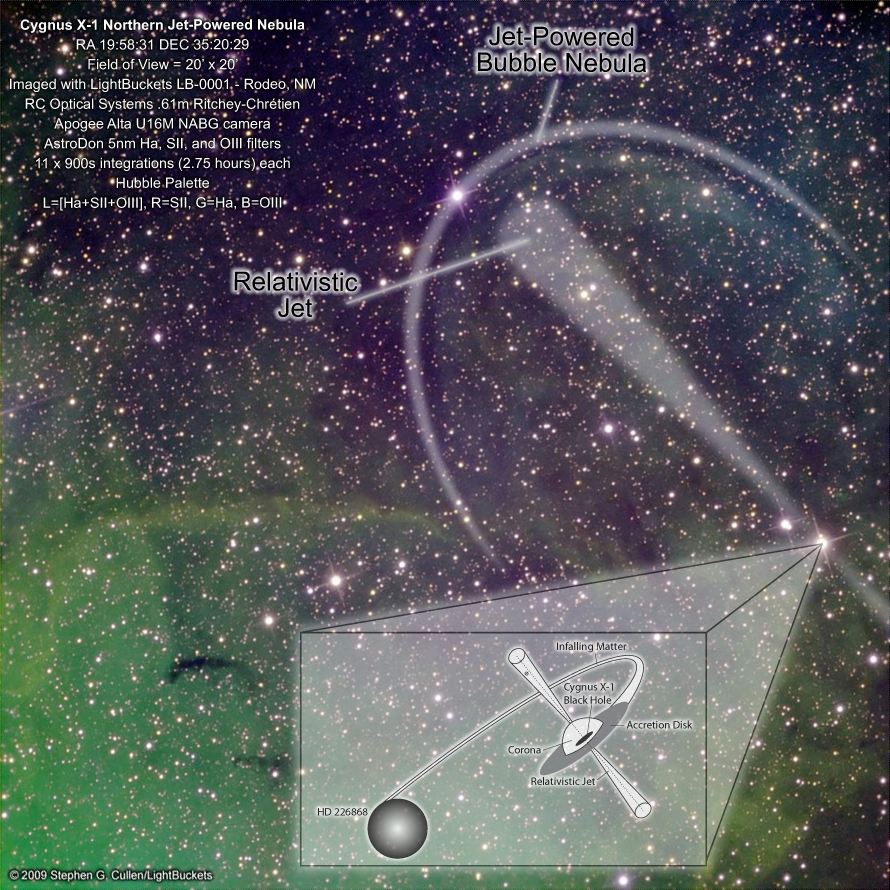
Possible Jet Blown Shells Near Microquasar Cygnus X-1


Explanation: What happens to matter that falls toward an energetic black hole? In the case of Cygnus X-1, perhaps little of that matter actually makes it in. Infalling gas may first collide not only with itself but with an accretion disk of swirling material surrounding the black hole.

The result may be a microquasar that glows across the electromagnetic spectrum and produces powerful jets that expel much of the infalling matter back into the cosmos at near light speed before it can even approach the black hole's event horizon. Confirmation that black hole jets may create expanding shells has come recently from the discovery of shells surrounding Cygnus X-1.

Pictured above on the upper right is one such shell quite possibly created by the jet of microquasar and black hole candidate Cygnus X-1. Rolling your cursor over the image will bring up an annotated version. The physical processes that create the black hole jets is a topic that continues to be researched.

Thursday, June 04, 2009

Stellar family in crowded, violent neighbourhood proves to be surprisingly normal

ESO PR Photo 21a/09
The Arches Cluster
This image of the Arches Cluster of young, massive stars was obtained with NACO on ESO’s Very Large Telescope. The field of view is 28 arcseconds. North is up and east is to the left. This image is a composite of infrared images obtained through J, H and K filters. The stars appear as bright cores surrounded by faint diffuse halos. This is typical of images obtained by adaptive optics instruments. The halo corresponds to light that was not fully corrected for the blurring effects of the Earth’s atmosphere.

ESO PR Photo 21b/09
The Centre of the Milky Way
This image from the Digitized Sky Survey 2 shows the heart of our Galaxy, the Milky Way. The Arches Cluster is located in the centre of the image, but its stars are hidden behind large amount of dust. The bright star at the top of the image is 3 Sagittarii, while the cluster of stars seen at the bottom left is NGC 6451. This image in full reslution (380 MB) is available on this link.

ESO PR Video 21a/09
A voyage to the heart of the Milky Way

Using ESO’s Very Large Telescope, astronomers have obtained one of the sharpest views ever of the Arches Cluster — an extraordinary dense cluster of young stars near the supermassive black hole at the heart of the Milky Way. Despite the extreme conditions astronomers were surprised to find the same proportions of low- and high-mass young stars in the cluster as are found in more tranquil locations in our Milky Way.

The massive Arches Cluster is a rather peculiar star cluster. It is located 25 000 light-years away towards the constellation of Sagittarius (the Archer), and contains about a thousand young, massive stars, less than 2.5 million years old [1]. It is an ideal laboratory to study how massive stars are born in extreme conditions as it is close to the centre of our Milky Way, where it experiences huge opposing forces from the stars, gas and the supermassive black hole that reside there. The Arches Cluster is ten times heavier than typical young star clusters scattered throughout our Milky Way and is enriched with chemical elements heavier than helium.

Using the NACO adaptive optics instrument on ESO’s Very Large Telescope, located in Chile, astronomers scrutinised the cluster in detail. Thanks to adaptive optics, astronomers can remove most of the blurring effect of the atmosphere, and so the new NACO images of the Arches Cluster are even crisper than those obtained with telescopes in space. Observing the Arches Cluster is very challenging because of the huge quantities of absorbing dust between Earth and the Galactic Centre, which visible light cannot penetrate. This is why NACO was used to observe the region in near-infrared light.

The new study confirms the Arches Cluster to be the densest cluster of massive young stars known. It is about three light-years across with more than a thousand stars packed into each cubic light-year — an extreme density a million times greater than in the Sun’s neighbourhood.

Astronomers studying clusters of stars have found that higher mass stars are rarer than their less massive brethren, and their relative numbers are the same everywhere, following a universal law. For many years, the Arches Cluster seemed to be a striking exception.

“With the extreme conditions in the Arches Cluster, one might indeed imagine that stars won’t form in the same way as in our quiet solar neighbourhood,” says Pablo Espinoza, the lead author of the paper reporting the new results. “However, our new observations showed that the masses of stars in this cluster actually do follow the same universal law”.

In this image the astronomers could also study the brightest stars in the cluster. “The most massive star we found has a mass of about 120 times that of the Sun,” says co-author Fernando Selman. “We conclude from this that if stars more massive than 130 solar masses exist, they must live for less than 2.5 million years and end their lives without exploding as supernovae, as massive stars usually do.”

The total mass of the cluster seems to be about 30 000 times that of the Sun, much more than was previously thought. “That we can see so much more is due to the exquisite NACO images,” says co-author Jorge Melnick.

Note
[1] The name “Arches” does not come from the constellation the cluster is located in (Sagittarius, i.e., the Archer), but because it is located next to arched filaments detected in radio maps of the centre of the Milky Way.

More Information

This research was presented in a paper to appear in Astronomy and Astrophysics (The massive star Initial Mass Function of the Arches Cluster, by P. Espinoza et al.).
The team is composed of Pablo Espinoza (Steward Observatory, University of Arizona, USA), Fernando Selman and Jorge Melnick (ESO). P. Espinoza was working on this as an undergraduate student at the Pontificia Universidad Católica de Chile.

ESO, the European Southern Observatory, is the foremost intergovernmental astronomy organisation in Europe. It is supported by 14 countries: Austria, Belgium, the Czech Republic, Denmark, France, Finland, Germany, Italy, the Netherlands, Portugal, Spain, Sweden, Switzerland and the United Kingdom. ESO carries out an ambitious programme focused on the design, construction and operation of powerful ground-based observing facilities enabling astronomers to make important scientific discoveries. ESO also plays a leading role in promoting and organising cooperation in astronomical research. ESO operates three unique world-class observing sites in the Atacama Desert region of Chile: La Silla, Paranal and Chajnantor.

Links: Science paper

Contacts:
Fernando Selman and Jorge Melnick
ESO
Phone: +56 55 43 5311, +56 2 463 3168, +49 89 3200 6297
E-mail: fselman@eso.org, jmelnick@eso.org

Pablo Espinoza
Steward Observatory, University of Arizona, USA
Phone: +56 9 84192504
E-mail: pespinoza@as.arizona.edu


ESO La Silla - Paranal - ELT Press Officer: Dr. Henri Boffin - +49 89 3200 6222 - hboffin@eso.org
ESO Press Officer in Chile: Valeria Foncea - +56 2 463 3123 - vfoncea@eso.org

National contacts for the media: http://www.eso.org/public/outreach/eson/

Magnetic Tornadoes Could Liberate Mercury's Tenuous Atmosphere

This is a diagram of the October 6, 2008, MESSENGER flyby that revealed magnetic tornadoes forming in Mercury's magnetic field. The tornadoes are corkscrew-shaped bundles of twisted magnetic fields and plasma. The pink area represents the boundary of Mercury's magnetic field, called the magnetopause. The tornadoes are technically known as "flux transfer events" (twisted lines) when they form at the magnetopause and "plasmoids" (yellow areas) when they form in the long magnetic "tail" extending from the night-side of Mercury. The large magnetic field leakage through the magnetopause and the flux transfer events acts as open channels through which the solar wind can flow down to the surface of the planet and sputter neutral atoms into Mercury’s atmosphere.
Credit:
Image produced by NASA/Goddard Space Flight Center/Johns Hopkins University Applied Physics Laboratory/Carnegie Institution of Washington. Image reproduced courtesy of Science/AAAS. Print-resolution copy

As the closest planet to the sun, Mercury is scorching hot, with daytime temperatures of more than 800 degrees Fahrenheit (approximately 450 degrees Celsius). It is also the smallest rocky planet, so its gravity is weak, only about 38 percent of Earth's. These conditions make it hard for the planet to hold on to its atmosphere, which is extremely thin, and invisible to the human eye. However, it can be seen by special instruments attached to telescopes and spacecraft like MESSENGER (MErcury Surface, Space ENvironment, GEochemistry, and Ranging).

"Mercury's atmosphere is so thin, it would have vanished long ago unless something was replenishing it," says Dr. James A. Slavin of NASA's Goddard Space Flight Center, Greenbelt, Md., a co-investigator on NASA's MESSENGER mission to Mercury. That something could be the solar wind, a thin gas of electrically charged particles, called a plasma, which blows constantly from the surface of the sun. The solar wind moves quickly, usually around 250 to 370 miles per second (about 400 to 600 kilometers/second); fast enough to blast atoms off the surface of Mercury. Through a process called "sputtering," solar wind particles that crash into Mercury’s surface transfer sufficient energy to launch some atoms into ballistic trajectories high above the surface and replenish Mercury's atmosphere, according to Slavin.

However, there's a problem – Mercury's magnetic field gets in the way. MESSENGER's first flyby on January 14, 2008, confirmed that the planet has a global magnetic field, as first discovered by the Mariner 10 spacecraft during its flybys of the planet in 1974 and 1975.

The ions and electrons that make up the solar wind are electrically charged and "feel" magnetic forces, so a global magnetic field usually deflects the solar wind. However, global magnetic fields are leaky shields and, under the right conditions, they are known to develop holes through which the solar wind can flow.

During its second flyby of the planet on October 6, 2008, MESSENGER discovered that Mercury’s magnetic field can be extremely leaky indeed. The spacecraft encountered magnetic "tornadoes" – twisted bundles of magnetic fields connecting the planetary magnetic field to interplanetary space – that were up to 500 miles wide or a third of the radius of the planet.

"These 'tornadoes' form when magnetic fields carried by the solar wind connect to Mercury's magnetic field," said Slavin. "As the solar wind blows past Mercury's field, these joined magnetic fields are carried with it and twist up into vortex-like structures. These twisted magnetic flux tubes, technically known as flux transfer events, form open windows in the planet's magnetic shield through which the solar wind may enter and directly impact Mercury's surface."

Venus, Earth, and even Mars have thick atmospheres compared to Mercury, so the solar wind never makes it to the surface of these planets, even if there is no global magnetic field in the way, as is the case for Venus and Mars. Instead, it hits the upper atmosphere of these worlds, where it has the opposite effect to that on Mercury, gradually stripping away atmospheric gas as it blows by.

Venus has a thick atmosphere that may be replenished by volcanoes, so losses to the solar wind are insignificant. Mars is a different story. Mars lost its global magnetic field billions of years ago. With little apparent volcanic activity since then, the solar wind could have eroded a significant portion of the Red Planet's atmosphere.

Features on Mars resembling dry riverbeds, and the discovery of minerals that form in the presence of water, indicate that Mars once had a thicker atmosphere that kept it warm enough for liquid water to flow on the surface. However, somehow that much thicker ancient atmosphere got lost, because it appears Mars has been cold and dry for billions of years.

In 2013, NASA plans to launch a mission to Mars called MAVEN (Mars Atmosphere and Volatile Evolution Mission). It will explore the various ways Mars loses its atmosphere to space, including how much may have been stripped away by the solar wind.

The process of linking interplanetary and planetary magnetic fields, called magnetic reconnection, is common throughout the cosmos. It occurs in Earth's magnetic field, where it generates magnetic tornadoes as well. However, the MESSENGER observations show the reconnection rate is ten times higher at Mercury.

"Mercury's proximity to the sun only accounts for about a third of the reconnection rate we see," said Slavin. "It will be exciting to see what's special about Mercury to explain the rest. We'll get more clues from MESSENGER's third flyby on September 29, 2009, and when we get into orbit in March 2011."

Slavin's MESSENGER research was funded by NASA and is the subject of a paper that appeared in the journal Science on May 1, 2009.

MESSENGER is a NASA-sponsored scientific investigation of the planet Mercury and the first space mission designed to orbit the planet closest to the Sun. The MESSENGER spacecraft launched on August 3, 2004, and after flybys of Earth, Venus, and Mercury will start a yearlong study of its target planet in March 2011. Dr. Sean C. Solomon, of the Carnegie Institution of Washington, leads the mission as Principal Investigator. The Johns Hopkins University Applied Physics Laboratory, Laurel, Md., built and operates the MESSENGER spacecraft and manages this Discovery-class mission for NASA.


Bill Steigerwald
NASA Goddard Space Flight Center

Wednesday, June 03, 2009

Cassini Finds Titan's Clouds Hang on to Summerv

This infrared image of Saturn’s moon Titan shows a large burst of clouds in the moon’s south polar region. Image credit: NASA/JPL/University of Arizona/University of Nantes
Full image and caption

Lots of clouds are visible in this infrared image of Saturn's moon Titan.
Image credit: NASA/JPL/University of Arizona/University of Nantes

Full image and caption

Cloud chasers studying Saturn's moon Titan say its clouds form and move much like those on Earth, but in a much slower, more lingering fashion.

Their forecast for Titan's early autumn -- warm and wetter.

Scientists with NASA's Cassini mission have monitored Titan's atmosphere for three-and-a-half years, between July 2004 and December 2007, and observed more than 200 clouds. They found that the way these clouds are distributed around Titan matches scientists' global circulation models. The only exception is timing -- clouds are still noticeable in the southern hemisphere while fall is approaching.

"Titan's clouds don't move with the seasons exactly as we expected," said Sebastien Rodriguez of the University of Paris Diderot, in collaboration with Cassini visual and infrared mapping spectrometer team members at the University of Nantes, France. "We see lots of clouds during the summer in the southern hemisphere, and this summer weather seems to last into the early fall. It looks like Indian summer on Earth, even if the mechanisms are radically different on Titan from those on Earth. Titan may then experience a warmer and wetter early autumn than forecasted by the models."

On Earth, abnormally warm, dry weather periods in late autumn occur when low-pressure systems are blocked in the winter hemisphere. By contrast, scientists think the sluggishness of temperature changes at the surface and low atmosphere on Titan may be responsible for its unexpected warm and wet, hence cloudy, late summer.

The new infrared images showing the global cloud pattern are now available at: http://saturn.jpl.nasa.gov and http://www.nasa.gov/cassini .

As summer changes to fall at the equinox in August 2009, Titan's clouds are expected to disappear altogether. But, circulation models of Titan's weather and climate predict that clouds at the southern latitudes don't wait for the equinox and should have already faded out since 2005. However, Cassini was still able to see clouds at these places late in 2007, and some of them are particularly active at mid-latitudes and the equator.

Titan is the only moon in our solar system with a substantial atmosphere, and its climate shares Earth-like characteristics. Titan's dense, nitrogen-methane atmosphere responds much more slowly than Earth's atmosphere, as it receives about 100 times less sunlight because it is 10 times farther from the sun. Seasons on Titan last more than seven Earth years.

Scientists will continue to observe the long-term changes during Cassini's extended mission, which runs until the fall of 2010. Cassini is set to fly by Titan on May 6.

The Cassini-Huygens mission is a cooperative project of NASA, the European Space Agency and the Italian Space Agency. NASA's Jet Propulsion Laboratory, Pasadena, Calif., manages the Cassini-Huygens mission for NASA's Science Mission Directorate. The Cassini orbiter was designed, developed and assembled at JPL. The visual and infrared mapping spectrometer team is based at the University of Arizona.

Media contact:
DC Agle 818-393-9011
Jet Propulsion Laboratory, Pasadena, Calif.
agle@jpl.nasa.gov

NASA's Fermi Finds Gamma-ray Galaxy Surprises

This artist's concept shows the core of an active galaxy, where a feeding supermassive black hole drives oppositely directed particle jets. Credit: ESA/NASA/AVO/Paolo Padovani

Gamma rays from the narrow-line Seyfert 1 galaxy PMN J0948+0022 (center) show that its central black hole drives a fast-moving particle beam. The object lies 5.5 billion light-years away in the constellation Sextans. Brighter colors indicate higher numbers of gamma rays at energies above 200 million electron volts. For comparison, the energy of visible light is between two and three electron volts. Credit: NASA/DOE/Fermi LAT Collaboration

NASA's Fermi Gamma-ray Space Telescope sees NGC 1275 (center), the core member of the Perseus cluster of galaxies, as a source of high-energy gamma rays, but the earlier Compton mission did not. The beam from this galaxy's central black hole strengthened in the years between the two missions. Brighter colors indicate higher numbers of gamma rays at energies above 200 million electron volts. Credit: NASA/DOE/Fermi LAT Collaboration

Back in June 1991, just before the launch of NASA's Compton Gamma-Ray Observatory, astronomers knew of gamma rays from exactly one galaxy beyond our own. To their surprise and delight, the satellite captured similar emissions from dozens of other galaxies. Now its successor, the Fermi Gamma-ray Space Telescope, is filling in the picture with new finds of its own.

"Compton showed us that two classes of active galaxies emitted gamma rays -- blazars and radio galaxies," said Luigi Foschini at Brera Observatory of the National Institute for Astrophysics in Merate, Italy. "With Fermi, we've found a third -- and opened a new window in the field."

In the Beam

Active galaxies are those with unusually bright centers that show evidence of particle acceleration to speeds approaching that of light itself. In 1943, astronomer Carl Seyfert described the first two types of active galaxy based on the width of spectral lines, a tell-tale sign of rapid gas motion in their cores. Today, astronomers recognize many additional classes, but they now believe these types represent the same essential phenomenon seen at different viewing angles.

At the center of each active galaxy sits a feeding black hole weighing upwards of a million times the sun's mass. Through processes not yet understood, some of the matter headed for the black hole blasts outward in fast, oppositely directed particle jets. For the most luminous active-galaxy classes -- blazars -- astronomers are looking right down the particle beam.

Using Fermi's Large Area Telescope (LAT), Foschini and his colleagues detected gamma rays from a Seyfert 1 galaxy cataloged as PMN J0948+0022, which lies 5.5 billion light-years away in the constellation Sextans. Splitting the light from this source into its component colors shows a spectrum with narrow lines, which indicates slower gas motions and argues against the presence of particle jet.

"But, unlike ninety percent of narrow-line Seyfert 1 galaxies, PMN J0948 also produces strong and variable radio emission," said Gino Tosti, who leads the Fermi LAT science group studying active galaxies at the University and National Institute of Nuclear Physics in Perugia, Italy. "This suggested the galaxy was indeed producing such a jet."

"The gamma rays seen by Fermi's LAT seal the deal," said team member Gabriele Ghisellini, a theorist at Brera Observatory. "They confirm the existence of particle acceleration near the speed of light in these types of galaxies." The findings will appear in the July 10 issue of The Astrophysical Journal.

"We are sifting through Fermi LAT data for gamma rays from more sources of this type," Foschini said. "And we've begun a multiwavelength campaign to monitor PMN J0948 across the spectrum, from radio to gamma rays."

Flare Up

Another case where Fermi sees something new involves NGC 1275, a massive Seyfert galaxy much closer to home. Also known as Perseus A, one of the sky's loudest radio sources, NGC 1275 lies at the center of the Perseus cluster of galaxies about 225 million light-years away.

The Compton observatory's high-energy EGRET instrument never detected gamma rays from NGC 1275, although it was detected by another instrument sensitive to lower-energy gamma rays. But Fermi's LAT clearly shows the galaxy to be a gamma-ray source at the higher energies for which EGRET was designed. "Fermi sees this galaxy shining with gamma rays at a flux about seven times higher than the upper limit of EGRET," said Jun Kataoka at Waseda University in Tokyo. "If NGC 1275 had been this bright when EGRET was operating, it would have been seen."

This change in the galaxy's output suggests that its particle beam was either inactive or much weaker a decade ago. Such changes clue astronomers into the size of the emitting region. "The gamma rays in NGC 1275 must arise from a source no more than two light-years across," said Teddy Cheung at NASA's Goddard Space Flight Center in Greenbelt, Md. "That means we're seeing radiation from the heart of the galaxy -- near its black hole -- as opposed to emission by hot gas throughout the cluster."

The Fermi team plans to monitor the galaxy to watch for further changes. The results of the study will appear in the July 1 issue of The Astrophysical Journal.

NASA's Fermi Gamma-ray Space Telescope is an astrophysics and particle physics partnership mission, developed in collaboration with the U.S. Department of Energy and important contributions from academic institutions and partners in France, Germany, Italy, Japan, Sweden, and the U.S.

Related Links:

> Italian National Institute for Astrophysics release
> Continent-sized Radio Telescope Takes Close-ups of Fermi Active Galaxies
> NASA's Fermi Mission, Namibia's HESS Telescopes Explore a Blazar
> Active Galaxies Flare and Fade in Fermi Telescope All-Sky Movie
> Compton Gamma Ray Observatory

Francis Reddy
NASA's Goddard Space Flight Center

Source: Fermi Gamma-ray Space Telescope/NASA

Tuesday, June 02, 2009

Stellar Explosion Displays Massive Carbon Footprint

Credit: NASA, ESA, and K. Barbary (University of California, Berkeley/Lawrence Berkeley National Lab, Supernova Cosmology Project)

While humans are still struggling to get rid of unwanted carbon it appears that the heavens are really rather good at it. New research by astrophysicists at the University of Warwick has discovered that a mystery stellar explosion recorded in 2006 may have marked the unusual death of an equally unusually carbon-rich star.

The strange object known as SCP 06F6 was first noted in 2006 by supernovae researchers in the US taking images with the Hubble Space Telescope, seeing it appearing out of nowhere, and fading again into oblivion, over the course of 120 days. The US team published their observations in September 2008, drawing a blank on the nature of SCP 06F6, in particular it was unclear if this event happened in our cosmic backyard, or at the other end of the universe.

Now a team of astrophysicists and astronomers at the University of Warwick in the UK believe they have come up with an answer. According to their research, the observations of SCP 06F6 bear remarkable resemblance to a group of stars containing extremely large proportions of carbon, hence dubbed carbon stars. However, to achieve the close match, SCP 06F6 must be at a distance of around 2 billion light years, causing a considerable redshift in its appearance. Given the large distance, the sudden appearance of SCP 06F6 is most likely related to the sudden death of a carbon-rich star, and the Warwick team believes that this object may be a new type of a totally new class of supernova.

It would be an unusual type of supernovae in several aspects: SCP 06F6 is located in a blank part of the sky, with no known visible host galaxy. If the star did explode as a normal type II supernova why then did it take up to four times as long to brighten and diminish as other such supernova and why did emit up to 100 times more X-rays energy than expected? The X-ray energy might lead one to speculate that the star was ripped apart by a black hole rather than exploding on its own, but the lead researcher of University of Warwick team Boris Gänsicke says that idea is not without its problems as:

“The lack of any obvious host galaxy for SCP 06F6 would imply either a very low black hole mass (if black holes do exist at the centres of dwarf irregular galaxies) or that the black hole has somehow been ejected from its host galaxy. While neither is impossible this does make the case for disruption by a black hole somewhat contrived”

“Several new telescopes are now being designed and built that will continuously monitor the entire sky for short guest appearances of new stars, and there is no doubt that SCP 06F6 will not remain alone in puzzling astronomers over the coming years. “

Note for editors

The research is published in the June 1 issue of the Astrophysical Journal Letters as “SCP06F6: A carbon-rich extragalactic transient at redshift z~0.14?” by Dr Boris Gaensicke, Dr Andrew Levan, Professor Thomas Marsh, and Dr Peter Wheatley all from the Department of Physics at the University of Warwick.

For further information please contact:

Dr Boris Gänsicke, Department of Physics
University of Warwick 02476 574741
Boris.Gaensicke@warwick.ac.uk

Or

Peter Dunn, Press and Media Relations Manager
University of Warwick 02476 523708 or mobile 07767 655860
p.j.dunn@warwick.ac.uk

twitter: @peterjdunn

Friday, May 29, 2009

Suzaku Snaps First Complete X-ray View of a Galaxy Cluster


This Suzaku image shows X-ray emission from hot gas throughout the galaxy cluster PKS 0745-191. Brighter colors indicate greater X-ray emission. The circle is 11.2 million light-years across and marks the region where cold gas is now entering the cluster. Inset: A Hubble optical image of the cluster's central galaxies is shown at the correct scale. Credit: NASA/ISAS/Suzaku/M. George, et al.

The massive radio galaxy PKS 0745-191, for which the cluster is named, appears at the center of this Hubble Space Telescope image. The picture forms the inset in the Suzaku image above. Credit: NASA/STScI/Fabian, et al.

The joint Japan-U.S. Suzaku mission is providing new insight into how assemblages of thousands of galaxies pull themselves together. For the first time, Suzaku has detected X-ray-emitting gas at a cluster's outskirts, where a billion-year plunge to the center begins.

"These Suzaku observations are exciting because we can finally see how these structures, the largest bound objects in the universe, grow even more massive," said Matt George, the study's lead author at the University of California, Berkeley.

The team trained Suzaku's X-ray telescopes on the cluster PKS 0745-191, which lies 1.3 billion light-years away in the southern constellation Puppis. Between May 11 and 14, 2007, Suzaku Justificaracquired five images of the million-degree gas that permeates the cluster.

By looking at a cluster in X-rays, astronomers can measure the temperature and density of the gas, which provides clues about the gas pressure and total mass of the cluster. Astronomers expect that the gas in the inner part of a galaxy cluster has settled into a "relaxed" state in equilibrium with the cluster's gravity. This means that the hottest, densest gas lies near the cluster's center, and temperatures and densities steadily decline at greater distances.

In the cluster's outer regions, though, the gas is no longer in an orderly state because matter is still falling inward. "Clusters are the most massive, relaxed objects in the universe, and they are continuing to form now," said team member Andy Fabian at the Cambridge Institute of Astronomy in the UK. The distance where order turns to chaos is referred to as the cluster's "virial radius."

For the first time, this study shows the X-ray emission and gas density and temperature out to -- and even beyond -- the virial radius, where the cluster continues to form. "It gives us the first complete X-ray view of a cluster of galaxies," Fabian said.

In PKS 0745-191, the gas temperature peaks at 164 million degrees Fahrenheit (91 million C) about 1.1 million light-years from the cluster's center. Then, the temperature declines smoothly with distance, dropping to 45 million F (25 million C) more than 5.6 million light-years from the center. The findings appear in the May 11 issue of Monthly Notices of the Royal Astronomical Society.

To discern the cluster's outermost X-ray emission requires detectors with exceptionally low background noise. Suzaku's advanced X-ray detectors, coupled with a low-altitude orbit, give the observatory much lower background noise than other X-ray satellites. The low orbit means that Suzaku is largely protected by Earth's magnetic field, which deflects energetic particles from the sun and beyond.

"With more Suzaku observations in the outskirts of other galaxy clusters, we'll get a better picture of how these massive structures evolve," added George.

Suzaku ("red bird of the south") was launched on July 10, 2005. The observatory was developed at the Japanese Institute of Space and Astronautical Science (ISAS), which is part of the Japan Aerospace Exploration Agency (JAXA), in collaboration with NASA and other Japanese and U.S. institutions.

Francis Reddy
NASA's Goddard Space Flight Center

Thursday, May 28, 2009

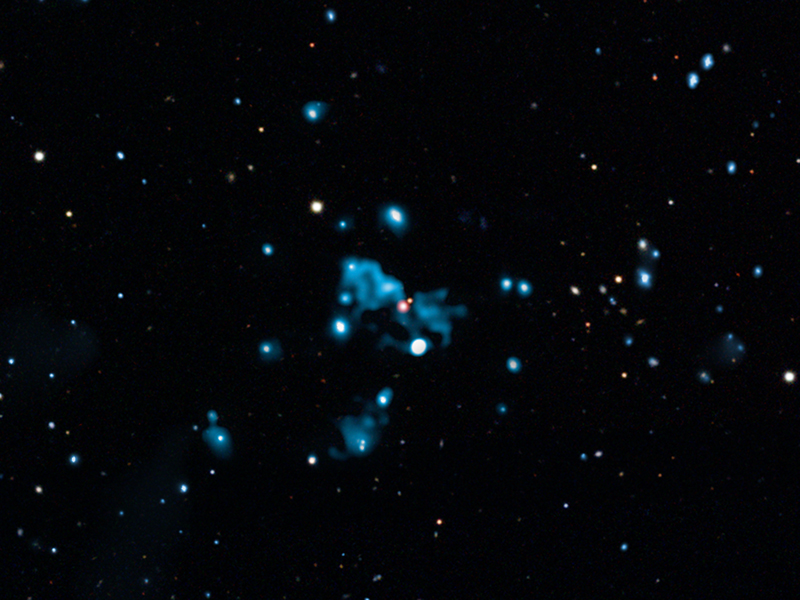
HDF 130 - Ghost Remains After Black Hole Eruption

Credit: X-ray (NASA/CXC/IoA/A.Fabian et al.);
Optical (SDSS), Radio (STFC/JBO/MERLIN)

Download image:
JPEG (410.3 kb)
Tiff (4.5 MB)
PS (4.2 MB)
Powerpoint and PDFS

More Information:
Press Room: HDF 130
Blog: Ghost Remains After Black Hole Eruption
Handout: html | pdf
Zoom-In (flash)

This is a composite image showing a small region of the Chandra Deep Field North. Shown in blue is a deep image from the Chandra X-ray Observatory and in red is an image from the Multi-Element Radio Linked Interferometer Network (MERLIN) an array of radio telescopes based in Great Britain. An optical image from the Sloan Digital Sky Survey (SDSS) is shown in white, yellow and orange.

The diffuse blue object near the center of the image is believed to be a cosmic "ghost" generated by a huge eruption from a v in a distant galaxy. This X-ray ghost, a.k.a. HDF 130, remains after powerful radio waves from particles traveling away from the black hole at almost the speed of light, have died off. As the electrons radiate away their energy they produce X-rays by interacting with the pervasive sea of photons remaining from the Big Bang - the cosmic background radiation. Collisions between these electrons and the background photons can impart enough energy to the photons to boost them into the X-ray energy band. The cigar-like shape of HDF 130 and its length of about 2.2 million light years are consistent with the properties of radio jets.

HDF 130 is over 10 billion light years away and existed at a time 3 billion years after the Big Bang, when galaxies and black holes were forming at a high rate. Near the center of the X-ray ghost is a radio point source indicating the presence of a growing supermassive black hole. This source corresponds to the location of a massive elliptical galaxy visible in very deep optical images (not shown here). The nearby red object in the SDSS image located immediately above and to the right of the radio source is another, unrelated galaxy located closer to the Earth.

Fast Facts for HDF 130:

Scale: Image is 8.2 arcmin across
Category: Cosmology/Deep Fields/X-ray Background, Groups & Clusters of Galaxies
Coordinates: (J2000) RA 12h 36m 17.6s | Dec +62° 15' 44.5"
Constellation: Ursa Major
Observation Date: 11/20/2000-02/22/2002
Observation Time: 514
Obs. ID: 167, 238, 234, 957, 2232-2234, 2421, 2423, 3294, 3388-3391, 3408-3409
Color Code: X-ray (Blue); Optical (White, Yellow, Orange); Radio (Red)
Instrument: ACIS
References: Fabian et al. 2009, MNRAS, 395, L67
Distance Estimate: About 10 billion light years

Media contacts:

Janet Anderson
NASA Marshall Space Flight Center, Ala.
256-544-6162
janet.l.anderson@nasa.gov

Megan Watzke
Chandra X-ray Center, Cambridge, Mass.
617-496-7998
mwatzke@cfa.harvard.edu

More information, including images and other multimedia, can be found at:
http://chandra.harvard.edu/ and http://chandra.nasa.gov

Press Release: http://chandra.harvard.edu/press/09_releases/press_052809.html

Planet-Hunting Method Succeeds at Last

This artist's concept shows the smallest star known to host a planet. The planet, called VB 10b, was discovered using astrometry, a method in which the wobble induced by a planet on its star is measured precisely on the sky.

The dim, red star, called VB 10, is a so-called M-dwarf, located 20 light-years away in the constellation Aquila. It has only one-twelfth the mass, and one-tenth the size, of our sun. The planet is a gas giant similar in size to Jupiter but with six times the mass. Though the planet is less massive than its star, the two orbs would have a similar diameter.

VB 10b orbits its star about every 9 months at a distance of 50 million kilometers (30 million miles). Image credit: NASA/JPL-Caltech

This artist's diagram compares our solar system (below) to the VB 10 star system. Astronomers successfully used the astrometry planet-hunting method for the first time to discover a gas planet, called VB 10b, around a very tiny star, VB 10. All of the bodies in this diagram are shown in circular insets at the same relative scales.

The VB 10 star is one of the smallest known -- and holds the record for the smallest known to host a planet. It's a dim, red M-dwarf with only one-tenth the size, and one-twelfth the mass, of our sun. Its planet, on the other hand, is quite hefty, with six times the mass of Jupiter. Though the planet is less massive than the star, the two orbs would be about the same size.


The VB 10 system is essentially a shrunken version of our solar system. Even though its planet is at a similar distance from its star as Mercury is from our sun, it wouldn't receive as much heat and would be classified as a "cold Jupiter" similar to our own. If any rocky planets do orbit in the VB 10 system, they would be located even closer in than VB 10b, and could lie within the star's habitable zone -- a region where temperatures are right for water to be liquid.


Astrometry involves measuring the wobble of a star on the sky, caused by an unseen planet yanking it back and forth. Because the VB 10b planet is so big relative to its star, it really tugs the star around. The red circle seen at the center of the VB 10 system shows just how big this wobble is. Because our sun is more massive than VB 10, its planets do not cause it to wobble nearly as much.
Image credit: NASA/JPL-Caltech


This movie shows the star VB 10 moving across the sky over a period of nine years. Image credit: NASA/JPL-Caltech/Palomar


A long-proposed tool for hunting planets has netted its first catch -- a Jupiter-like planet orbiting one of the smallest stars known.

The technique, called astrometry, was first attempted 50 years ago to search for planets outside our solar system, called exoplanets. It involves measuring the precise motions of a star on the sky as an unseen planet tugs the star back and forth. But the method requires very precise measurements over long periods of time, and until now, has failed to turn up any exoplanets.

A team of two astronomers from NASA's Jet Propulsion Laboratory, Pasadena, Calif., has, for the past 12 years, been mounting an astrometry instrument to a telescope at the Palomar Observatory near San Diego. After careful, intermittent observations of 30 stars, the team has identified a new exoplanet around one of them -- the first ever to be discovered around a star using astrometry.

"This method is optimal for finding solar-system configurations like ours that might harbor other Earths," said astronomer Steven Pravdo of JPL, lead author of a study about the results to be published in the Astrophysical Journal. "We found a Jupiter-like planet at around the same relative place as our Jupiter, only around a much smaller star. It's possible this star also has inner rocky planets. And since more than seven out of 10 stars are small like this one, this could mean planets are more common than we thought."

The finding confirms that astrometry could be a powerful planet-hunting technique for both ground- and space-based telescopes. For example, a similar technique would be used by SIM Lite, a NASA concept for a space-based mission that is currently being explored.

The newfound exoplanet, called VB 10b, is about 20 light-years away in the constellation Aquila. It is a gas giant, with a mass six times that of Jupiter's, and an orbit far enough away from its star to be labeled a "cold Jupiter" similar to our own. In reality, the planet's own internal heat would give it an Earth-like temperature.

The planet's star, called VB 10, is tiny. It is what's known as an M-dwarf and is only one-twelfth the mass of our sun, just barely big enough to fuse atoms at its core and shine with starlight. For years, VB 10 was the smallest star known -- now it has a new title: the smallest star known to host a planet. In fact, though the star is more massive than the newfound planet, the two bodies would have a similar girth.

Because the star is so small, its planetary system would be a miniature, scaled-down version of our own. For example, VB 10b, though considered a cold Jupiter, is located about as far from its star as Mercury is from the sun. Any rocky Earth-size planets that might happen to be in the neighborhood would lie even closer in.

"Some other exoplanets around larger M-dwarf stars are also similar to our Jupiter, making the stars fertile ground for future Earth searches," said Stuart Shaklan, Pravdo's co-author and the SIM Lite instrument scientist at JPL. "Astrometry is best suited to find cold Jupiters around all kinds of stars, and thus to find more planetary systems arranged like our home."

Two to six times a year, for the past 12 years, Pravdo and Shaklan have bolted their Stellar Planet Survey instrument onto Palomar's five-meter Hale telescope to search for planets. The instrument, which has a 16-megapixel charge-coupled device, or CCD, can detect very minute changes in the positions of stars. The VB 10b planet, for instance, causes its star to wobble a small fraction of a degree. Detecting this wobble is equivalent to measuring the width of a human hair from about three kilometers away.

Other ground-based planet-hunting techniques in wide use include radial velocity and the transit method. Like astrometry, radial velocity detects the wobble of a star, but it measures Doppler shifts in the star's light caused by motion toward and away from us. The transit method looks for dips in a star's brightness as orbiting planets pass by and block the light. NASA's space-based Kepler mission, which began searching for planets on May 12, will use the transit method to look for Earth-like worlds around stars similar to the sun.

"This is an exciting discovery because it shows that planets can be found around extremely light-weight stars," said Wesley Traub, the chief scientist for NASA's Exoplanet Exploration Program at JPL. "This is a hint that nature likes to form planets, even around stars very different from the sun."

JPL is a partner with the California Institute of Technology in Pasadena in the Palomar Observatory. Caltech manages JPL for NASA. More information about exoplanets and NASA's planet-finding program is at http://planetquest.jpl.nasa.gov . More information about the Palomar Observatory is at http://www.astro.caltech.edu/palomar/

Whitney Clavin 818-354-4673
Jet Propulsion Laboratory, Pasadena, Calif.
whitney.clavin@jpl.nasa.gov

J.D. Harrington 202-358-5241
NASA Headquarters, Washington
jharring@nasa.gov

Wednesday, May 27, 2009

XMM-Newton takes astronomers to a black hole’s edge

Illustration of a supermassive black hole at the centre of a galaxy. Using new data from ESA’s XMM-Newton spaceborne observatory, astronomers have probed closer than ever to a supermassive black hole lying deep at the core of a distant active galaxy. The black hole at the centre of the galaxy – known as 1H0707-495 – was thought to be partially obscured from view by intervening clouds of gas and dust, but the current observations have revealed the innermost depths of the galaxy. Credits: ESA (Image by C. Carreau)

Using new data from ESA’s XMM-Newton spaceborne observatory, astronomers have probed closer than ever to a supermassive black hole lying deep at the core of a distant active galaxy.

The galaxy – known as 1H0707-495 – was observed during four 48-hr-long orbits of XMM-Newton around Earth, starting in January 2008. The black hole at its centre was thought to be partially obscured from view by intervening clouds of gas and dust, but these current observations have revealed the innermost depths of the galaxy.

“We can now start to map out the region immediately around the black hole,” says Andrew Fabian, at the University of Cambridge, who headed the observations and analysis.

X-rays are produced as matter swirls into a supermassive black hole. The X-rays illuminate and are reflected from the matter before its eventual accretion. Iron atoms in the flow imprint characteristic iron lines on the reflected light. The iron lines are distorted in a number of characteristic ways: they are affected by the speed of the orbiting iron atoms, the energy required for the X-rays to escape the black hole’s gravitational field, and the spin of the black hole. All these features show that the astronomers are tracking matter to within twice the radius of the black hole itself.

XMM-Newton detected two bright features of iron emission in the reflected X-rays that had never been seen together in an active galaxy. These bright features are known as the iron L and K lines, and they can be so bright only if there is a high abundance of iron. Seeing both in this galaxy suggests that the core is much richer in iron than the rest of the galaxy.

The direct X-ray emission varies in brightness with time. During the observation, the iron L line was bright enough for its variations to be followed.

A painstaking statistical analysis of the data revealed a time lag of 30 seconds between changes in the X-ray light observed directly, and those seen in its reflection from the disc. This delay in the echo enabled the size of the reflecting region to be measured, which leads to an estimate of the mass of the black hole at about 3 to 5 million solar masses.

The observations of the iron lines also reveal that the black hole is spinning very rapidly and eating matter so quickly that it verges on the theoretical limit of its eating ability, swallowing the equivalent of two Earths per hour.

The team are continuing to track the galaxy using their new technique. There is a lot for them to study. Far from being a steady process, like water slipping down a plughole, a feeding black hole is a messy eater. “Accretion is a very messy process because of the magnetic fields that are involved,” says Fabian.

Their new technique will enable the astronomers to map out the process in all its glorious complexity, taking them to previously unseen regions at the very edges of this and other supermassive black holes.

Notes for editors:

'The detection of Broad Iron K and L line emission in the Narrow-Line Seyfert 1 Galaxy 1H0707-495 using XMM-Newton', by A. Fabian et al. will be published in Nature tomorrow.

An exploding star in an "exploding" galaxy

Discovery of radio supernova SN 2008iz in the nearby starburst galaxy M82

An international team of radio astronomers have discovered the secret explosion of a massive star, a new supernova, in the nearby galaxy M82. Despite being the closest supernovae discovered in the last five years, the explosion is exclusively detectable at radio wavelengths since the dense gas and dust surrounding the exploding star leave it invisible in other wavebands. Without the obscuration, this explosion would have been visible even with amateur telescopes. The results are published in this week's release of Astronomy & Astrophysics Letters.

Figure 1: Zooming into the center of the galaxy M82, one of the nearest starburst galaxies at a distance of only 12 Million light years. The left image, taken with the Hubble Space Telescope (HST), shows the body of the galaxy in blue and hydrogen gas breaking out from the central starburst in red. The VLA image (top left) clearly shows the supernova (SN 2008iz), taken in May 2008. The high-resolution VLBI images (lower right) shows an expanding shell at the scale of a few light days and proves the transient source as the result of a supernova explosion in M82.
Graphics: Milde Science Communication, HST Image: /NASA, ESA, and The Hubble Heritage Team (STScI/AURA); Radio Images: A. Brunthaler, MPIfR. (Click image for higher resolution).

M82 is an irregular galaxy in a nearby galaxy group located 12 million lightyears from Earth. Despite being smaller than the Milky Way, it harbors a vigorous central starburst in the inner few hundred lightyears. In this stellar factory more stars are presently born than in the entire Milky Way. M82 is often called an 'exploding galaxy', because it looks as if being torn apart in optical and infrared images as the result of numerous supernova explosions from massive stars (see Fig. 1, left). Many remnants from previous supernovae are seen on radio images of M82 and a new supernova explosion was long overdue. For a quarter of century astronomers have tried to catch this cosmic catastrophe in the act and have started to wonder why the galaxy has been so silent in recent years.
The new discovery was first made in April 2009 when the MPIfR's Dr. Andreas Brunthaler examined data just taken (on April 8) with the Very Large Array (VLA) of the National Radio Astronomy Observatory, an interferometer of 27 identical 25 meter telescopes in New Mexico, USA. "I then looked back into older data we had from March and May last year, and there it was as well, outshining the entire galaxy!", he says (see Fig 1, top). Observations taken before 2008 showed neither pronounced radio nor X-ray emission at the position of this supernova.

On the other hand, observations of M82 taken last year with optical telescopes to search for new supernovae showed no signs of this explosion. Furthermore, the supernova is hidden on ultraviolet and X-ray images. The supernova exploded close to the center of the galaxy in a very dense interstellar environment. This could also reveal the mystery about the long silence of M82: many of these events may actually be something like "underground explosions", where the bright flash of light is covered under huge clouds of gas and dust and only radio waves can penetrate this dense material. "This cosmic catastrophe shows that using our radio telescopes we have a front-row seat to observe the otherwise hidden universe", Prof. Heino Falcke from Radboud University/Nijmegen & ASTRON explains. If not obscured, the explosion could have been visible even in a medium-sized amateur telescope.

Radio emission can be detected only from core collapse supernovae, where the core of a massive star collapses and produces a black hole or a neutron star. It is produced when the shock wave of the explosion propagates into dense material surrounding the star, usually material that was shed from the massive progenitor star before it exploded.

By combining data from the ten telescopes of the Very Long Baseline Array (VLBA), the VLA, the Green Bank Telescope in the USA, and the Effelsberg 100m telescope in Germany, using the technique of Very Long Baseline Interferometry (VLBI), the team was able to produce images that show a ring-like structure expanding at more than 40 million km/h or 4% of the speed of light, typical for supernovae. "By extrapolating this expansion back in time, we can estimate the explosion date. Our current data indicate that the star exploded in late January or early February 2008.", explains Dr. Andreas Brunthaler.

Only three months after the explosion, the ring was already 650 times larger than Earth's orbit around the Sun. It takes the extremely sharp view of VLBI observations to resolve this structure which is as large as a 1 Euro coin seen from a distance of 13.000 km.

The asymmetric appearance of the supernova on the VLBI images indicates also that either the explosion was highly asymmetric or the surrounding material unevenly distributed. "Using the super sharp vision of VLBI we can follow the supernova expanding into the dense interstellar medium of M82 over the coming years and gain more insight on it and the explosion itself.", says Prof. Karl Menten, director at the MPIfR.

Discoveries like this supernova will be routine with the next generation of radio telescopes, such as the Low Frequency Array (LOFAR) which is currently under construction in Europe, the Allen Telescope Array (ATA) in the USA, or the planned Square Kilometer Array (SKA). These will have the capability to observe large parts of the sky continously.

Team members were Andreas Brunthaler, Karl M. Menten, Christian Henkel from the MPIfR, Mark J. Reid from the CfA, Geoffrey C. Bower from Berkeley, and Heino Falcke from the University of Nijmegen/ASTRON.

Figure 2: The Very Large Array (left) in New Mexico/USA was used for the initial discovery of the new supernova 2008iz in the galaxy M82. This telescope, together with the Effelsberg 100m telescope (center) and the Green Bank Telescope (right) in West Virginia/USA, complemented the high-resolution VLBA array for the observations of the expanding shell of the supernova.
Images: NRAO, MPIfR Bonn (Click for higher resolution).

Original Publication:


Discovery of a bright radio transient in M82: a new radio supernova?, A. Brunthaler, K.M. Menten, M.J. Reid, C. Henkel, G.C. Bower, H. Falcke, Astronomy & Astrophysics, 2009, Vol. 499, L17 (May 28 issue).


Further Information:

Additional Images


Harvard-Smithsonian Center for Astrophysics (CfA)

Berkeley Astronomy Department University of California

Astrophysics Department
, Radboud University Nijmegen & ASTRON

Very Large Array (VLA)

Very Long Baseline Array (VLBA)

Effelsberg 100m telescope

Green Bank Telescope (GBT, Robert C. Byrd Telescope)

Contact:

Dr. Andreas Brunthaler,
Max-Planck-Institut für Radioastronomie, Bonn.
Fon: +49-228-525-377
E-mail: brunthal@mpifr.de

Prof. Dr. Karl Menten,
Max-Planck-Institut für Radioastronomie, Bonn.
Fon: +49-228-525-297
E-mail: kmenten@mpifr.de

Dr. Norbert Junkes,
Public Outreach,
Max-Planck-Institut für Radioastronomie, Bonn.
Fon: +49-228-525-399
E-mail: njunkes@mpifr.de

Monday, May 25, 2009

Most Efficient Spectrograph to Shoot the Southern Skies

ESO PR Photo 20a/09
An X-shooter spectrum

ESO PR Photo 20b/09
The X-shooter instrument

ESO PR Photo 20c/09
First Light of X-shooter

ESO’s Very Large Telescope — Europe’s flagship facility for ground-based astronomy — has been equipped with the first of its second generation instruments: X-shooter. It can record the entire spectrum of a celestial object in one shot — from the ultraviolet to the near-infrared — with high sensitivity. This unique new instrument will be particularly useful for the study of distant exploding objects called gamma-ray bursts.

“X-shooter offers a capability that is unique among astronomical instruments installed at large telescopes,” says Sandro D’Odorico, who coordinated the Europe-wide consortium of scientists and engineers that built this remarkable instrument. “Until now, different instruments at different telescopes and multiple observations were needed to cover this kind of wavelength range, making it very difficult to compare data, which, even though from the same object, could have been taken at different times and under different sky conditions.”

X-shooter collects the full spectrum from the ultraviolet (300 nm) to the near-infrared (2400 nm) in parallel, capturing up to half of all the light from an object that passes through the atmosphere and the various elements of the telescope. “All in all, X-shooter can save us a factor of three or more in terms of precious telescope time and opens a new window of opportunity for the study of many, still poorly understood, celestial sources,” says D’Odorico.

The name of the 2.5-ton instrument was chosen to stress its capacity to capture data highly efficiently from a source whose nature and energy distribution are not known in advance of the observation. This property is particularly crucial in the study of gamma-ray bursts, the most energetic explosions known to occur in the Universe (ESO 17/09). Until now, a rough estimate of the distance of the target was needed, so as to know which instrument to use for a detailed study. Thanks to X-shooter, astronomers won’t have to go through this first observing step. This is particularly relevant for gamma-ray bursts, which fade away very quickly and where being fast is the key to understanding the nature of these elusive cosmic sources.

“I am very confident that X-shooter will discover the most distant gamma-ray bursts in the Universe, or in other words, the first objects that formed in the young Universe,” says François Hammer, who leads the French efforts in X-shooter.

X-shooter was built by a consortium of 11 institutes in Denmark, France, Italy and the Netherlands, together with ESO. In total 68 person-years of work by engineers, technicians and astronomers and a global budget of six million Euros were required. The development time was remarkably fast for a project of this complexity, which was completed in just over five years, starting from the kick-off meeting held in December 2003.

“The success of X-shooter and its relatively short completion time are a tribute to the quality and dedication of the many people involved in the project,” says Alan Moorwood, ESO Director of Programmes.

The instrument was installed at the telescope at the end of 2008 and the first observations in its full configuration were made on 14 March 2009, demonstrating that the instrument works efficiently over the full spectral range with unprecedented resolution and quality. X-shooter has already proved its full capability by obtaining the complete spectra of low metallicity stars, of X-ray binaries, of distant quasars and galaxies, of the nebulae associated with Eta Carinae and the supernova 1987A, as well as with the observation of a distant gamma-ray burst that coincidently exploded at the time of the commissioning run.

X-shooter will be offered to the astronomical community from 1 October 2009. The instrument is clearly answering a need in the scientific community as about 150 proposals were received for the first runs of X-shooter, for a total of 350 observing nights, making it the second most requested instrument at the Very Large Telescope in this period.

More information

ESO’s Very Large Telescope (VLT) is the world’s most advanced optical instrument. It is an ensemble of four 8.2-metre telescopes located at the Paranal Observatory on an isolated mountain peak in the Atacama Desert in North Chile. The four 8.2-metre telescopes have a total of 12 focal stations where different instruments for imaging and spectroscopic observations are installed and a special station where the light of the four telescopes is combined for interferometric observations.

The first VLT instrument was installed in 1998 and has been followed by 12 more in the last 10 years, distributed at the different focal stations. X-shooter is the first of the second generation of VLT instruments and replaces the workhorse-instrument FORS1, which has been successfully used for more than ten years by hundreds of astronomers. X-shooter operates at the Cassegrain focus of the Kueyen telescope (UT2).

In response to an ESO Call for Proposals for second generation VLT instrumentation, ESO received three proposals for an intermediate resolution, high efficiency spectrograph. These were eventually merged into a single proposal around the present concept of X-shooter, which was approved for construction in November 2003. The Final Design Review, at which the instrument design is finalised and declared ready for construction, took place in April 2006. The first observations with the instrument at the telescope in its full configuration were on 14 March 2009.

X-shooter is a joint project by Denmark, France, Italy, the Netherlands and ESO. The collaborating institutes in Denmark are the Niels Bohr and the DARK Institutes of the University of Copenhagen and the National Space Institute (Technical University of Denmark); in France GEPI at the Observatoire de Paris and APC at the Université D. Diderot, with contributions from the CEA and the CNRS; in Italy the Osservatorio di Brera, Trieste, Palermo and Catania; and in the Netherlands, the University of Amsterdam, the University of Nijmegen and ASTRON. Beside the participating institutes and ESO, the project was supported by the National Agencies of Italy (INAF), the Italian Ministry for Education, University and Research (MIUR), the Netherlands (NOVA and NWO) and by the Carlsberg Foundation in Denmark. The project was also supported in Denmark and the Netherlands with funds from the EU Descartes prize, the highest European prize for science, awarded in 2002 to the European collaboration on gamma-ray burst research headed by Professor Ed van den Heuvel.

ESO, the European Southern Observatory, is the foremost intergovernmental astronomy organisation in Europe. It is supported by 14 countries: Austria, Belgium, the Czech Republic, Denmark, France, Finland, Germany, Italy, the Netherlands, Portugal, Spain, Sweden, Switzerland and the United Kingdom. ESO carries out an ambitious programme focused on the design, construction and operation of powerful ground-based observing facilities enabling astronomers to make important scientific discoveries. ESO also plays a leading role in promoting and organising cooperation in astronomical research. ESO operates three unique world-class observing sites in the Atacama Desert region of Chile: La Silla, Paranal and Chajnantor.

Contacts
Sandro D’Odorico
ESO
Phone: +49 89 32 00 62 39
E-mail: sdodoric@eso.org

François Hammer
Paris Observatory
Phone: +33 1 45 07 74 08
E-mail: francois.hammer@obspm.fr

Per Kjærgaard Rasmussen
Niels Bohr Institute, Copenhagen University, Denmark
Phone: +45 353 259 87
E-mail: per@astro.ku.dk

Sofia Randich
INAF-Osservatorio di Arcetri
Phone: +39 055 27 52 251
E-mail: randich@arcetri.astro.it

Lex Kaper
Astronomical Institute "Anton Pannekoek"
Amsterdam, The Netherlands
Phone: +31 20 52 57 474
E-mail: L.Kaper@uva.nl

ESO La Silla - Paranal - ELT Press Officer: Dr. Henri Boffin - +49 89 3200 6222 - hboffin@eso.org
ESO Press Officer in Chile: Valeria Foncea - +56 2 463 3123 - vfoncea@eso.org

National contacts for the media: http://www.eso.org/public/outreach/eson/