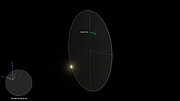
Astronomers have discovered 21 stars like our Sun in orbit around neutron
stars—heavy, compact remains of massive stars that previously exploded.
The hidden neutron stars were discovered through their gravitational
effects alone. Though the neutron stars are heavier than Sun-like stars,
the two objects mutually orbit one another around a common center of
mass. As the neutron stars orbit around, they tug on the Sun-like stars,
causing them to wobble. The European Space Agency's Gaia mission
detected this wobble by observing the orbits of the Sun-like stars
(yellow dots) over a period of three years. The Sun-like stars are green
in this animation, and the neutron stars (and their orbits) are purple. Credit: Caltech/Kareem El-Badry

This illustration depicts a
binary star system consisting of a dense neutron star and a normal
Sun-like star (upper left). Using data from the European Space Agency's
Gaia mission, astronomers found several systems like this one, in which
the two bodies are widely separated. Because the bodies in these systems
are far apart, with separations on average 300 times the size of a
Sun-like star, the neutron star is dormant—it is not actively stealing
mass from its companion and is thus very faint. To find these hidden
neutron stars, the scientists used Gaia observations to look for a
wobble in the Sun-like stars caused by a tugging action of the orbiting
neutron stars. These are the first neutron stars discovered purely due
to their gravitational effects. As depicted in this illustration, the
intense gravity of the compact neutron star—which is about 100,000 times
smaller than the Sun-like star yet heavier—warps our view of the sky
around it, producing a distorted mirrored view of the nearby star.
Credit: Caltech/R. Hurt (IPAC)
Most stars in our universe come in pairs. While our own Sun is a loner, many stars like our Sun orbit
similar stars, while a host of other exotic pairings between stars and
cosmic orbs pepper the universe. Black holes, for example, are often
found orbiting each other. One pairing that has proved to be quite rare
is that between a Sun-like star and a type of dead star called a neutron
star.
Now, astronomers led by Caltech's Kareem El-Badry have uncovered what appear to be 21 neutron stars orbiting in binary systems with stars like our Sun. Neutron stars are dense burned-out cores of massive stars that exploded. On their own, they are extremely faint and usually cannot be detected directly. They are heavier than Sun-like stars, but the two objects mutually orbit each other around a common center of mass. As the neutron stars orbit, they tug on the Sun-like stars, causing their companions to shift back and forth in the sky. Using the European Space Agency's Gaia mission, the astronomers were able to catch these telltale wobbles to reveal a new population of dark neutron stars.
"Gaia is continuously scanning the sky and measuring the wobbles of more than a billion stars, so the odds are good for finding even very rare objects," says El-Badry, an assistant professor of astronomy at Caltech and an adjunct scientist at the Max Planck Institute for Astronomy in Germany.
Now, astronomers led by Caltech's Kareem El-Badry have uncovered what appear to be 21 neutron stars orbiting in binary systems with stars like our Sun. Neutron stars are dense burned-out cores of massive stars that exploded. On their own, they are extremely faint and usually cannot be detected directly. They are heavier than Sun-like stars, but the two objects mutually orbit each other around a common center of mass. As the neutron stars orbit, they tug on the Sun-like stars, causing their companions to shift back and forth in the sky. Using the European Space Agency's Gaia mission, the astronomers were able to catch these telltale wobbles to reveal a new population of dark neutron stars.
"Gaia is continuously scanning the sky and measuring the wobbles of more than a billion stars, so the odds are good for finding even very rare objects," says El-Badry, an assistant professor of astronomy at Caltech and an adjunct scientist at the Max Planck Institute for Astronomy in Germany.
This animation depicts a binary star system in which a massive compact
neutron star is orbiting a larger Sun-like star. The intense gravity of
this high-density neutron star produces significant warping effects that
distort the view of the sky around it, not unlike what occurs around
more compact black holes. Animation credit: Caltech/R. Hurt (IPAC)
The new study, which includes a team of co-authors from around the world, was published in The Open Journal for Astrophysics. Data from several ground-based telescopes, including the W. M. Keck Observatory
on Maunakea, Hawai‘i; La Silla Observatory in Chile; and the Whipple
Observatory in Arizona, were used to follow up the Gaia observations and
learn more about the masses and orbits of the hidden neutron stars.
While neutron stars have previously been detected in orbit around stars like our Sun, those systems have all been more compact. With little distance separating the two bodies, a neutron star (which is heavier than a Sun-like star) can steal mass away from its partner. This mass transfer process makes the neutron star shine brightly at X-ray or radio wavelengths. In contrast, the neutron stars in the new study are much farther from their partners—on the order of one to three times the distance between Earth and the Sun.
That means the newfound stellar corpses are too far from their partners to be stealing material from them. They are instead quiescent and dark. "These are the first neutron stars discovered purely due to their gravitational effects," El-Badry says.
The discovery comes as somewhat of a surprise because it is not clear how an exploded star winds up next to a star like our Sun.
"We still do not have a complete model for how these binaries form," explains El-Badry. "In principle, the progenitor to the neutron star should have become huge and interacted with the solar-type star during its late-stage evolution." The huge star would have knocked the little star around, likely temporarily engulfing it. Later, the neutron star progenitor would have exploded in a supernova, which, according to models, should have unbound the binary systems, sending the neutron stars and Sun-like stars careening in opposite directions.
"The discovery of these new systems shows that at least some binaries survive these cataclysmic processes even though models cannot yet fully explain how," he says.
Gaia was able to find the unlikely companions due to their wide orbits and long periods (the Sun-like stars orbit around the neutron stars with periods of six months to three years). "If the bodies are too close, the wobble will be too small to detect," El-Badry says. "With Gaia, we are more sensitive to the wider orbits." Gaia is also most sensitive to binaries that are relatively nearby. Most of the newly discovered systems are located within 3,000 light-years of Earth—a relatively small distance compared, for example, to the 100,000 light-year-diameter of the Milky Way Galaxy.
The new observations also suggest just how rare the pairings are. "We estimate that about one in a million solar-type stars is orbiting a neutron star in a wide orbit," he said
El-Badry also has an interest in finding unseen dormant black holes in orbit with Sun-like stars. Using Gaia data, he has found two of these quiet black holes hidden in our galaxy. One, called Gaia BH1, is the closest known black hole to Earth at 1,600 light-years away.
"We don't know for sure how these black hole binaries formed either," El-Badry says. "There are clearly gaps in our models for the evolution of binary stars. Finding more of these dark companions and comparing their population statistics to predictions of different models will help us piece together how they form."
The paper titled "A population of neutron star candidates in wide orbits from Gaia astrometry" was funded by the National Science Foundation, the European Research Council, and the Gordon and Betty Moore Foundation. Other Caltech authors include graduate student Natsuko Yamaguchi and Professor of Astronomy Andrew Howard. Additional authors include Hans-Walter Rix and René Andrae of the Max-Planck Institute for Astronomy, David Latham and Allyson Bieryla of the Center for Astrophysics/Harvard & Smithsonian, Sahar Shahaf of the Weizmann Institute for Science, Tsevi Mazeh of Tel Aviv University; Lars Buchhave of the Technical University of Denmark, Howard Isaacson of UC Berkeley and University of Southern Queensland; Alessandro Savino of UC Berkeley, and Ilya Ilyin of Leibniz Institute for Astrophysics Potsdam.
While neutron stars have previously been detected in orbit around stars like our Sun, those systems have all been more compact. With little distance separating the two bodies, a neutron star (which is heavier than a Sun-like star) can steal mass away from its partner. This mass transfer process makes the neutron star shine brightly at X-ray or radio wavelengths. In contrast, the neutron stars in the new study are much farther from their partners—on the order of one to three times the distance between Earth and the Sun.
That means the newfound stellar corpses are too far from their partners to be stealing material from them. They are instead quiescent and dark. "These are the first neutron stars discovered purely due to their gravitational effects," El-Badry says.
The discovery comes as somewhat of a surprise because it is not clear how an exploded star winds up next to a star like our Sun.
"We still do not have a complete model for how these binaries form," explains El-Badry. "In principle, the progenitor to the neutron star should have become huge and interacted with the solar-type star during its late-stage evolution." The huge star would have knocked the little star around, likely temporarily engulfing it. Later, the neutron star progenitor would have exploded in a supernova, which, according to models, should have unbound the binary systems, sending the neutron stars and Sun-like stars careening in opposite directions.
"The discovery of these new systems shows that at least some binaries survive these cataclysmic processes even though models cannot yet fully explain how," he says.
Gaia was able to find the unlikely companions due to their wide orbits and long periods (the Sun-like stars orbit around the neutron stars with periods of six months to three years). "If the bodies are too close, the wobble will be too small to detect," El-Badry says. "With Gaia, we are more sensitive to the wider orbits." Gaia is also most sensitive to binaries that are relatively nearby. Most of the newly discovered systems are located within 3,000 light-years of Earth—a relatively small distance compared, for example, to the 100,000 light-year-diameter of the Milky Way Galaxy.
The new observations also suggest just how rare the pairings are. "We estimate that about one in a million solar-type stars is orbiting a neutron star in a wide orbit," he said
El-Badry also has an interest in finding unseen dormant black holes in orbit with Sun-like stars. Using Gaia data, he has found two of these quiet black holes hidden in our galaxy. One, called Gaia BH1, is the closest known black hole to Earth at 1,600 light-years away.
"We don't know for sure how these black hole binaries formed either," El-Badry says. "There are clearly gaps in our models for the evolution of binary stars. Finding more of these dark companions and comparing their population statistics to predictions of different models will help us piece together how they form."
The paper titled "A population of neutron star candidates in wide orbits from Gaia astrometry" was funded by the National Science Foundation, the European Research Council, and the Gordon and Betty Moore Foundation. Other Caltech authors include graduate student Natsuko Yamaguchi and Professor of Astronomy Andrew Howard. Additional authors include Hans-Walter Rix and René Andrae of the Max-Planck Institute for Astronomy, David Latham and Allyson Bieryla of the Center for Astrophysics/Harvard & Smithsonian, Sahar Shahaf of the Weizmann Institute for Science, Tsevi Mazeh of Tel Aviv University; Lars Buchhave of the Technical University of Denmark, Howard Isaacson of UC Berkeley and University of Southern Queensland; Alessandro Savino of UC Berkeley, and Ilya Ilyin of Leibniz Institute for Astrophysics Potsdam.
Written by Whitney Clavin
Contact:
Whitney Clavin
(626) 395‑1944
wclavin@caltech.edu
Source: Caltech/News