Videos
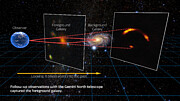
PR Video noirlab2615a
Gravitational lensing animation
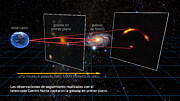
PR Video noirlab2615b
Gravitational lensing animation (Spanish)
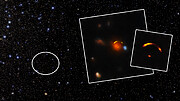
PR Video noirlab2615d
Zooming into “Shadow Blaster” galaxy
PR Video noirlab2615a
Gravitational lensing animation
PR Video noirlab2615b
Gravitational lensing animation (Spanish)
PR Video noirlab2615d
Zooming into “Shadow Blaster” galaxy
Gemini North telescope on Maunakea helps uncover strongest evidence yet that distant star-forming galaxies contribute to the production of one of the Universe’s most mysterious ghost particles
A team of astronomers has identified a remarkably bright, gravitationally-lensed, star-forming galaxy as the likely source of the high-energy neutrino event IC 210922A, detected by the IceCube Neutrino Observatory in 2021. The galaxy, nicknamed “Shadow Blaster,” is located about 11 billion light-years away, providing the most concrete observational evidence yet that populations of distant star-forming galaxies play a significant role in producing high-energy cosmic neutrinos.
Neutrinos are one of the fundamental particles of the Universe. They live a ghostly existence with no electric charge, very little mass, and extremely few interactions with matter. They are also the most abundant particles with mass in the Universe, and can be created through a variety of processes, such as the decay of heavy particles, nuclear reactions in the Sun, and the explosions of stars.
Instruments on Earth have detected high-energy neutrinos arriving from space since the 1960s, and identifying their origin has been a long-standing challenge in astronomy. While scientists have identified a small number of nearby neutrino sources [1], they cannot account for the total amount of neutrinos our instruments measure arriving from across the Universe, referred to as the cosmic neutrino background. Astronomers, therefore, suspect that other major source populations exist but remain hidden.
In a study published today in Nature Astronomy, a team led by Yuji Urata of MITOS Science Co., LTD. in Taiwan presents the analysis of a new neutrino source candidate — an extremely bright galaxy, JCMT0402−0424, nicknamed “Shadow Blaster.” This galaxy is located about 11 billion light-years away, has trillions of times the luminosity of the Sun in the infrared, and may provide the long-sought link between high-energy neutrino production and distant star-forming galaxies.
The discovery was made in part using observations from the International Gemini Observatory, partly funded by the U.S. National Science Foundation (NSF) and operated by NSF NOIRLab. The study also utilized observations from the James Clerk Maxwell Telescope (JCMT), operated by the East Asian Observatory, and the Submillimeter Array (SMA), a joint operation between the Center for Astrophysics | Harvard & Smithsonian and the Academia Sinica Institute of Astronomy and Astrophysics. All three of these telescopes are located on the summit of Maunakea in Hawai‘i.
In 2021, the NSF IceCube Neutrino Observatory in Antarctica alerted the scientific community to a high-energy neutrino event, dubbed IC 210922A, coming from a region of space in the direction of the constellation Eridanus. This alert triggered rapid follow-up observations across the electromagnetic spectrum to search for a counterpart signal that, if detected, could help identify the neutrino’s source.
Multiple teams of scientists conducted follow-up observations using a variety of telescopes and instruments. However, they all reported no convincing gamma-ray, X-ray, or optical counterpart, nor any gamma-ray burst, supernova, or tidal disruption event that could be associated with the alert [2].
Then, a couple of days after the initial alert, Urata and his team initiated observations with JCMT and SMA and discovered Shadow Blaster, whose location and brightness made it a promising candidate for the source of the signal. To investigate this galaxy further, the team organized follow-up observations with the Atacama Large Millimeter/submillimeter Array (ALMA), managed for North America by the NSF National Radio Astronomy Observatory, and they discovered that Shadow Blaster is located behind a strong gravitational lens[3].
Thanks to this lensing effect, the team would be able to study the internal structure of Shadow Blaster, which would otherwise be too distant and too faint to resolve in such detail. However, to use the lensing effect correctly and to understand how much the lens amplified the neutrino signal, they first needed to know the distance, nature, and mass distribution of the foreground galaxy. To decipher these details, they used two powerful instruments on Gemini North: the Gemini Multi-Object Spectrograph (GMOS) and the Gemini Near-InfraRed Spectrograph (GNIRS).
“The combined GMOS and GNIRS data helped us measure the distance to the lensing galaxy and determine that it is a massive elliptical galaxy. This information was crucial for estimating the lens mass distribution and constructing a model of the gravitational lens,” says Urata.
Combining the lens model with the ALMA imaging data revealed that the central region of Shadow Blaster contains an extremely compact core that is densely packed with gas and dust and forming new stars at an intense rate. Theoretical models predict that such an extreme environment can act as a natural particle accelerator, where energetic particles repeatedly collide with gas and produce neutrinos. Additionally, Shadow Blaster does not display any characteristics of possessing an active black hole. This strongly suggests that high-energy neutrinos can be produced not only by spectacular black-hole jets as scientists have observed in nearby galaxies, but also by the intense, densely packed star formation that is common in very distant galaxies.
“This breakthrough shows how particle detectors and telescopes become far more impactful when they work together, opening a powerful 'multi-messenger' window on the Universe,” says Martin Still, Program Director, NSF Office of Research Infrastructure. “By combining signals from particles and light, scientists can explore distant cosmic environments and events in unprecedented detail — revealing phenomena that were once only theoretical.”sts have observed in nearby galaxies, but also by the intense, densely packed star formation that is common in very distant galaxies.
Around 10 billion years ago, the Universe was populated with galaxies like Shadow Blaster that were actively forming stars. During this epoch, galaxies were theoretically producing large numbers of cosmic rays, which are high-energy streams of particles that can generate neutrinos. Yet obtaining observational evidence that links an individual neutrino event to such a distant galaxy has been extremely difficult since these galaxies are very far away and often deeply hidden behind thick layers of dust. Shadow Blaster's serendipitous location behind a gravitational lens makes finding this observational evidence much easier.
“Shadow Blaster possesses the kind of dense, gas-rich environment that theoretical models have long suggested could efficiently produce high-energy neutrinos,” says Urata. Combined with the absence of any more compelling counterpart despite extensive follow-up searches, Shadow Blaster is the most plausible candidate for the source of IC 210922A. “If confirmed, Shadow Blaster would be the first-ever individual dusty star-forming galaxy directly linked to a high-energy neutrino event.”
Compact star-forming galaxies like Shadow Blaster may be numerous throughout the Universe. As a population, they may therefore contribute a significant fraction of the high-energy neutrino background that fills the cosmos. “Our analysis suggests that this population could contribute up to roughly 20% of the observed diffuse neutrino background measured by IceCube,” says Urata.
A team of astronomers has identified a remarkably bright, gravitationally-lensed, star-forming galaxy as the likely source of the high-energy neutrino event IC 210922A, detected by the IceCube Neutrino Observatory in 2021. The galaxy, nicknamed “Shadow Blaster,” is located about 11 billion light-years away, providing the most concrete observational evidence yet that populations of distant star-forming galaxies play a significant role in producing high-energy cosmic neutrinos.
Neutrinos are one of the fundamental particles of the Universe. They live a ghostly existence with no electric charge, very little mass, and extremely few interactions with matter. They are also the most abundant particles with mass in the Universe, and can be created through a variety of processes, such as the decay of heavy particles, nuclear reactions in the Sun, and the explosions of stars.
Instruments on Earth have detected high-energy neutrinos arriving from space since the 1960s, and identifying their origin has been a long-standing challenge in astronomy. While scientists have identified a small number of nearby neutrino sources [1], they cannot account for the total amount of neutrinos our instruments measure arriving from across the Universe, referred to as the cosmic neutrino background. Astronomers, therefore, suspect that other major source populations exist but remain hidden.
In a study published today in Nature Astronomy, a team led by Yuji Urata of MITOS Science Co., LTD. in Taiwan presents the analysis of a new neutrino source candidate — an extremely bright galaxy, JCMT0402−0424, nicknamed “Shadow Blaster.” This galaxy is located about 11 billion light-years away, has trillions of times the luminosity of the Sun in the infrared, and may provide the long-sought link between high-energy neutrino production and distant star-forming galaxies.
The discovery was made in part using observations from the International Gemini Observatory, partly funded by the U.S. National Science Foundation (NSF) and operated by NSF NOIRLab. The study also utilized observations from the James Clerk Maxwell Telescope (JCMT), operated by the East Asian Observatory, and the Submillimeter Array (SMA), a joint operation between the Center for Astrophysics | Harvard & Smithsonian and the Academia Sinica Institute of Astronomy and Astrophysics. All three of these telescopes are located on the summit of Maunakea in Hawai‘i.
In 2021, the NSF IceCube Neutrino Observatory in Antarctica alerted the scientific community to a high-energy neutrino event, dubbed IC 210922A, coming from a region of space in the direction of the constellation Eridanus. This alert triggered rapid follow-up observations across the electromagnetic spectrum to search for a counterpart signal that, if detected, could help identify the neutrino’s source.
Multiple teams of scientists conducted follow-up observations using a variety of telescopes and instruments. However, they all reported no convincing gamma-ray, X-ray, or optical counterpart, nor any gamma-ray burst, supernova, or tidal disruption event that could be associated with the alert [2].
Then, a couple of days after the initial alert, Urata and his team initiated observations with JCMT and SMA and discovered Shadow Blaster, whose location and brightness made it a promising candidate for the source of the signal. To investigate this galaxy further, the team organized follow-up observations with the Atacama Large Millimeter/submillimeter Array (ALMA), managed for North America by the NSF National Radio Astronomy Observatory, and they discovered that Shadow Blaster is located behind a strong gravitational lens[3].
Thanks to this lensing effect, the team would be able to study the internal structure of Shadow Blaster, which would otherwise be too distant and too faint to resolve in such detail. However, to use the lensing effect correctly and to understand how much the lens amplified the neutrino signal, they first needed to know the distance, nature, and mass distribution of the foreground galaxy. To decipher these details, they used two powerful instruments on Gemini North: the Gemini Multi-Object Spectrograph (GMOS) and the Gemini Near-InfraRed Spectrograph (GNIRS).
“The combined GMOS and GNIRS data helped us measure the distance to the lensing galaxy and determine that it is a massive elliptical galaxy. This information was crucial for estimating the lens mass distribution and constructing a model of the gravitational lens,” says Urata.
Combining the lens model with the ALMA imaging data revealed that the central region of Shadow Blaster contains an extremely compact core that is densely packed with gas and dust and forming new stars at an intense rate. Theoretical models predict that such an extreme environment can act as a natural particle accelerator, where energetic particles repeatedly collide with gas and produce neutrinos. Additionally, Shadow Blaster does not display any characteristics of possessing an active black hole. This strongly suggests that high-energy neutrinos can be produced not only by spectacular black-hole jets as scientists have observed in nearby galaxies, but also by the intense, densely packed star formation that is common in very distant galaxies.
“This breakthrough shows how particle detectors and telescopes become far more impactful when they work together, opening a powerful 'multi-messenger' window on the Universe,” says Martin Still, Program Director, NSF Office of Research Infrastructure. “By combining signals from particles and light, scientists can explore distant cosmic environments and events in unprecedented detail — revealing phenomena that were once only theoretical.”sts have observed in nearby galaxies, but also by the intense, densely packed star formation that is common in very distant galaxies.
Around 10 billion years ago, the Universe was populated with galaxies like Shadow Blaster that were actively forming stars. During this epoch, galaxies were theoretically producing large numbers of cosmic rays, which are high-energy streams of particles that can generate neutrinos. Yet obtaining observational evidence that links an individual neutrino event to such a distant galaxy has been extremely difficult since these galaxies are very far away and often deeply hidden behind thick layers of dust. Shadow Blaster's serendipitous location behind a gravitational lens makes finding this observational evidence much easier.
“Shadow Blaster possesses the kind of dense, gas-rich environment that theoretical models have long suggested could efficiently produce high-energy neutrinos,” says Urata. Combined with the absence of any more compelling counterpart despite extensive follow-up searches, Shadow Blaster is the most plausible candidate for the source of IC 210922A. “If confirmed, Shadow Blaster would be the first-ever individual dusty star-forming galaxy directly linked to a high-energy neutrino event.”
Compact star-forming galaxies like Shadow Blaster may be numerous throughout the Universe. As a population, they may therefore contribute a significant fraction of the high-energy neutrino background that fills the cosmos. “Our analysis suggests that this population could contribute up to roughly 20% of the observed diffuse neutrino background measured by IceCube,” says Urata.
Notes
[1] Astrophysical neutrino sources, or candidate source associations, that have been identified include the Sun and Supernova 1987A at lower energies, and, at high energies, the blazar TXS 0506+056, the active galaxy Messier 77, the active galaxy PKS 1424+240, and diffuse emission from the plane of the Milky Way. Candidate high-energy associations have also been reported with tidal disruption events such as AT2019dsg and AT2019fdr.
[2] Facilities used for follow-up observations: NASA's Fermi Gamma-ray Space Telescope, ANTARES neutrino telescope, NASA's Neil Gehrels Swift Observatory, Zwicky Transient Facility, High-Altitude Water Cherenkov Observatory, and the Department of Energy-funded DESI Transients Survey. In particular, DESI “spare fibers” — fibers that can’t be matched to targets from the main DESI program on a given pointing — obtained spectra for 249 galaxies within the IceCube localization region.
[3] Gravitational lensing occurs when a very massive foreground galaxy bends spacetime, acting as a cosmic magnifying glass that enlarges and distorts the image of a more distant galaxy behind it. In this case, the gravitational lens amplified the brightness of Shadow Blaster from 2.7 trillion to 33 trillion times the luminosity of the Sun in infrared light.
[2] Facilities used for follow-up observations: NASA's Fermi Gamma-ray Space Telescope, ANTARES neutrino telescope, NASA's Neil Gehrels Swift Observatory, Zwicky Transient Facility, High-Altitude Water Cherenkov Observatory, and the Department of Energy-funded DESI Transients Survey. In particular, DESI “spare fibers” — fibers that can’t be matched to targets from the main DESI program on a given pointing — obtained spectra for 249 galaxies within the IceCube localization region.
[3] Gravitational lensing occurs when a very massive foreground galaxy bends spacetime, acting as a cosmic magnifying glass that enlarges and distorts the image of a more distant galaxy behind it. In this case, the gravitational lens amplified the brightness of Shadow Blaster from 2.7 trillion to 33 trillion times the luminosity of the Sun in infrared light.
More information
This research is presented in a paper titled “Compact dusty starbursts at cosmic noon linked to high-energy neutrinos,” appearing in Nature Astronomy. DOI: 10.1038/s41550-026-02884-9.
The team is composed of Y. Urata (MITOS Science Co., LTD/National Central University, Taiwan), K. Huang (Chung Yuan Christian University, Taiwan), B. Hatsukade (National Astronomical Observatory of Japan/The Graduate University for Advanced Studies/The University of Tokyo, Japan), M. Kasliwal (California Institute of Technology, USA), S. S. Kimura (Tohoku University, Japan), Y. Matsuda (National Astronomical Observatory of Japan/Ministry of Education, Culture, Sports, Science and Technology, Japan), Y. Miyamoto (Fukui University of Technology, Japan), H. Nagai (National Astronomical Observatory of Japan/The Graduate University for Advanced Studies, Japan), K. Nakanishi (National Astronomical Observatory of Japan/The Graduate University for Advanced Studies, Japan), and R. Stein (University of Maryland/NASA Goddard Space Flight Center, USA).
NSF NOIRLab, the U.S. National Science Foundation center for ground-based optical-infrared astronomy, operates the International Gemini Observatory (a facility of NSF, NRC–Canada, ANID–Chile, MCTIC–Brazil, MINCyT–Argentina, and KASI–Republic of Korea), NSF Kitt Peak National Observatory (KPNO), NSF Cerro Tololo Inter-American Observatory (CTIO), the Community Science and Data Center (CSDC), and NSF–DOE Vera C. Rubin Observatory (in cooperation with DOE’s SLAC National Accelerator Laboratory). It is managed by the Association of Universities for Research in Astronomy (AURA) under a cooperative agreement with NSF and is headquartered in Tucson, Arizona.
The scientific community is honored to have the opportunity to conduct astronomical research on I’oligam Du’ag (Kitt Peak) in Arizona, on Maunakea in Hawai‘i, and on Cerro Tololo and Cerro Pachón in Chile. We recognize and acknowledge the very significant cultural role and reverence of I’oligam Du’ag to the Tohono O’odham Nation, and Maunakea to the Kanaka Maoli (Native Hawaiians) community. The James Clerk Maxwell Telescope is operated by the East Asian Observatory, which is funded by the Academia Sinica Institute of Astronomy and Astrophysics (ASIAA, Taiwan), the National Astronomical Research Institute of Thailand (NARIT), the Science and Technology Facilities Council (STFC, United Kingdom), and other partners.
The team is composed of Y. Urata (MITOS Science Co., LTD/National Central University, Taiwan), K. Huang (Chung Yuan Christian University, Taiwan), B. Hatsukade (National Astronomical Observatory of Japan/The Graduate University for Advanced Studies/The University of Tokyo, Japan), M. Kasliwal (California Institute of Technology, USA), S. S. Kimura (Tohoku University, Japan), Y. Matsuda (National Astronomical Observatory of Japan/Ministry of Education, Culture, Sports, Science and Technology, Japan), Y. Miyamoto (Fukui University of Technology, Japan), H. Nagai (National Astronomical Observatory of Japan/The Graduate University for Advanced Studies, Japan), K. Nakanishi (National Astronomical Observatory of Japan/The Graduate University for Advanced Studies, Japan), and R. Stein (University of Maryland/NASA Goddard Space Flight Center, USA).
NSF NOIRLab, the U.S. National Science Foundation center for ground-based optical-infrared astronomy, operates the International Gemini Observatory (a facility of NSF, NRC–Canada, ANID–Chile, MCTIC–Brazil, MINCyT–Argentina, and KASI–Republic of Korea), NSF Kitt Peak National Observatory (KPNO), NSF Cerro Tololo Inter-American Observatory (CTIO), the Community Science and Data Center (CSDC), and NSF–DOE Vera C. Rubin Observatory (in cooperation with DOE’s SLAC National Accelerator Laboratory). It is managed by the Association of Universities for Research in Astronomy (AURA) under a cooperative agreement with NSF and is headquartered in Tucson, Arizona.
The scientific community is honored to have the opportunity to conduct astronomical research on I’oligam Du’ag (Kitt Peak) in Arizona, on Maunakea in Hawai‘i, and on Cerro Tololo and Cerro Pachón in Chile. We recognize and acknowledge the very significant cultural role and reverence of I’oligam Du’ag to the Tohono O’odham Nation, and Maunakea to the Kanaka Maoli (Native Hawaiians) community. The James Clerk Maxwell Telescope is operated by the East Asian Observatory, which is funded by the Academia Sinica Institute of Astronomy and Astrophysics (ASIAA, Taiwan), the National Astronomical Research Institute of Thailand (NARIT), the Science and Technology Facilities Council (STFC, United Kingdom), and other partners.
Links
- Read the paper: Compact dusty starbursts at cosmic noon linked to high-energy neutrinos
- Press release from ALMA
- Press release from MITOS Science
- Photos of the Gemini North telescope
- Videos of the Gemini North telescope
- Check out other NOIRLab Science Releases
- For journalists: subscribe to receive our releases under embargo
- For scientists: got a story? Pitch your research
Contacts:
Yuji Urata
MITOS Science Co., Ltd
National Central University
Email: yjurata@gmail.com
Josie Fenske
Public Information Officer
NSF NOIRLab
Email: josie.fenske@noirlab.edu