Kepler's Supernova Remnant
Credit: X-ray: NASA/CXC/SAO; Optical: Pan-STARRS
Credit: X-ray: NASA/CXC/SAO; Optical: Pan-STARRS
JPEG (226.7 kb)-Large JPEG (4.3 MB) - Tiff (109 MB) - More Images
A Tour of MSH 15-52 - More Videos
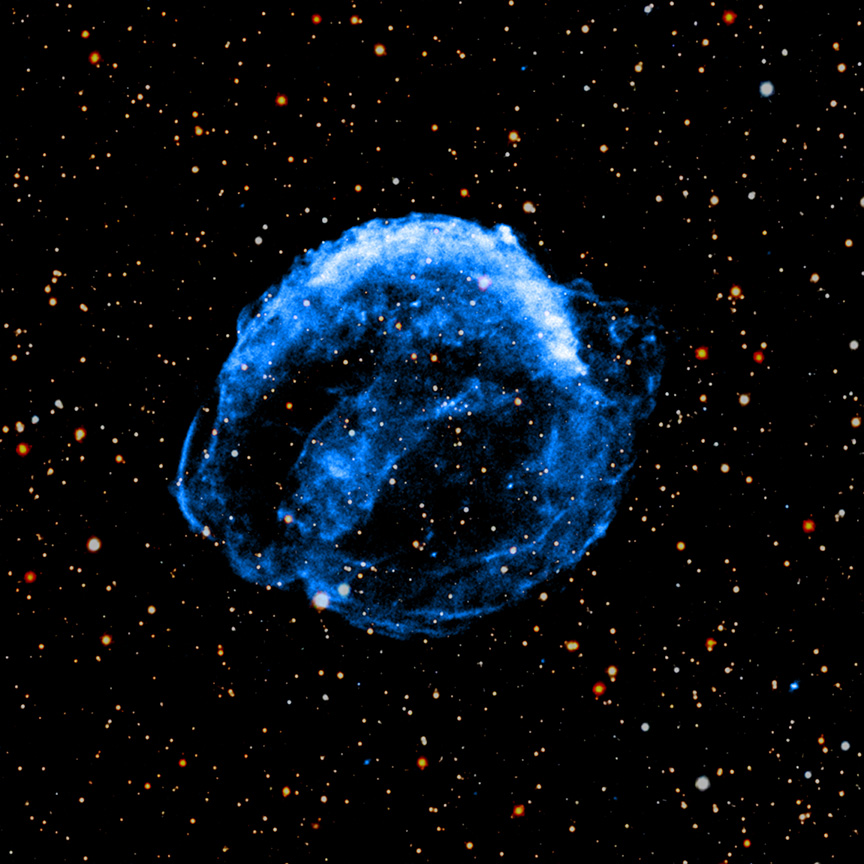

A new video shows changes in Kepler’s Supernova Remnant using data from NASA’s Chandra X-ray Observatory captured over more than two and a half decades with observations taken in 2000, 2004, 2006, 2014, and 2025. In this video, which is the longest-spanning one ever released by Chandra, X-rays (blue) from the telescope have been combined with an optical image (red, green, and blue) from Pan-STARRS.
Kepler’s Supernova Remnant, named after the German astronomer Johannes Kepler, was first spotted in the night sky in 1604. Today, astronomers know that a white dwarf star exploded when it exceeded a critical mass, after pulling material from a companion star, or merging with another white dwarf. This kind of supernova is known as a Type Ia and scientists use it to measure the expansion of the Universe.
Supernova remnants, the debris fields left behind after a stellar explosion, often glow strongly in X-ray light because the material has been heated to millions of degrees from the blast. Kepler’s Supernova Remnant is located in the Milky Way galaxy about 17,000 light-years from Earth. Although this is relatively close in cosmic terms, only Chandra, with its sharp X-ray images and longevity, can see changes like those seen here.
The video allows astronomers to watch as the remains from this shattered star expand and crash into material already thrown out into space. The researchers found that the fastest parts of the remnant are traveling at about 13.8 million miles per hour — or about 2% of the speed of light — moving towards the bottom of the image. Meanwhile, the slowest parts are traveling towards the top at about 4 million miles per hour. This is a large difference in speed, and astronomers think it comes from the fact that the gas that the remnant is plowing into towards the top of the image is denser than the gas towards the bottom. This gives scientists information about the environments into which this star exploded.
Supernova explosions and the elements they hurl into space are the lifeblood of new stars and planets. Understanding exactly how they behave is crucial to knowing our cosmic history.
Jessye Gassel (George Mason University) presented the new Chandra video and the associated research at the 247th meeting of the American Astronomical Society (AAS) meeting in Phoenix, AZ. Quotes from Gassel and co-author Brian Williams from NASA’s Goddard Space Flight Center are provided in our press release.
NASA's Marshall Space Flight Center in Huntsville, Alabama, manages the Chandra program. The Smithsonian Astrophysical Observatory's Chandra X-ray Center controls science operations from Cambridge, Massachusetts, and flight operations from Burlington, Massachusetts
Kepler’s Supernova Remnant, named after the German astronomer Johannes Kepler, was first spotted in the night sky in 1604. Today, astronomers know that a white dwarf star exploded when it exceeded a critical mass, after pulling material from a companion star, or merging with another white dwarf. This kind of supernova is known as a Type Ia and scientists use it to measure the expansion of the Universe.
Supernova remnants, the debris fields left behind after a stellar explosion, often glow strongly in X-ray light because the material has been heated to millions of degrees from the blast. Kepler’s Supernova Remnant is located in the Milky Way galaxy about 17,000 light-years from Earth. Although this is relatively close in cosmic terms, only Chandra, with its sharp X-ray images and longevity, can see changes like those seen here.
The video allows astronomers to watch as the remains from this shattered star expand and crash into material already thrown out into space. The researchers found that the fastest parts of the remnant are traveling at about 13.8 million miles per hour — or about 2% of the speed of light — moving towards the bottom of the image. Meanwhile, the slowest parts are traveling towards the top at about 4 million miles per hour. This is a large difference in speed, and astronomers think it comes from the fact that the gas that the remnant is plowing into towards the top of the image is denser than the gas towards the bottom. This gives scientists information about the environments into which this star exploded.
Supernova explosions and the elements they hurl into space are the lifeblood of new stars and planets. Understanding exactly how they behave is crucial to knowing our cosmic history.
Jessye Gassel (George Mason University) presented the new Chandra video and the associated research at the 247th meeting of the American Astronomical Society (AAS) meeting in Phoenix, AZ. Quotes from Gassel and co-author Brian Williams from NASA’s Goddard Space Flight Center are provided in our press release.
NASA's Marshall Space Flight Center in Huntsville, Alabama, manages the Chandra program. The Smithsonian Astrophysical Observatory's Chandra X-ray Center controls science operations from Cambridge, Massachusetts, and flight operations from Burlington, Massachusetts
Source: NASA’s Chandra X-ray Observatory
Visual Description:
This release features a ten second silent video of Kepler's expanding Supernova Remnant, located in our own galaxy, about 17,000 light-years from Earth. The video was created using X-ray data gathered in 2000, 2004, 2006, 2014, and 2025. Those distinct datasets were turned into highly-detailed visuals, creating a 25-year timelapse-style video of the growing remnant.
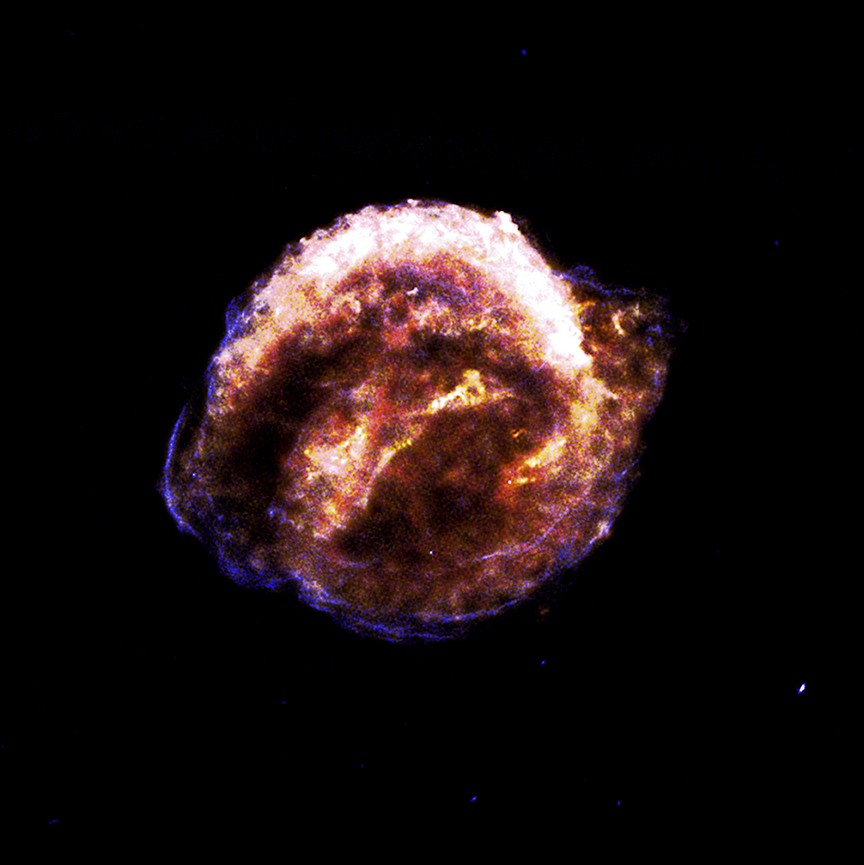
Kepler's Supernova Remnant was once a white dwarf star that exploded when it exceeded its critical mass. Here, in X-ray light, the remnant resembles a cloudy neon blue ring with a diagonal cross line stretching from our upper right down to our lower left. The ring appears thinner and wispier at the bottom, with a band of white arching across the top.
As the video plays, cycling through the 5 datasets, the ring subtly, but clearly, expands, like a slowly inflating balloon. In the video, this sequence is replayed several times with dates included at our lower right, to give sighted learners time to absorb the visual information. Upon close inspection, researchers have determined that the bottom of the remnant is expanding fastest; about 13.8 million miles per hour, or 2% of the speed of light. The top of the ring appears to be expanding the slowest; about 4 million miles per hour, or 0.5% of the speed of light. The large difference in speed is because the gas that the remnant is plowing into towards the top of the image is denser than the gas towards the bottom.
Collecting and interpreting this data over decades has provided information about the environment into which the white dwarf star exploded, and has helped scientists understand how remnants change with time.
Kepler's Supernova Remnant was once a white dwarf star that exploded when it exceeded its critical mass. Here, in X-ray light, the remnant resembles a cloudy neon blue ring with a diagonal cross line stretching from our upper right down to our lower left. The ring appears thinner and wispier at the bottom, with a band of white arching across the top.
As the video plays, cycling through the 5 datasets, the ring subtly, but clearly, expands, like a slowly inflating balloon. In the video, this sequence is replayed several times with dates included at our lower right, to give sighted learners time to absorb the visual information. Upon close inspection, researchers have determined that the bottom of the remnant is expanding fastest; about 13.8 million miles per hour, or 2% of the speed of light. The top of the ring appears to be expanding the slowest; about 4 million miles per hour, or 0.5% of the speed of light. The large difference in speed is because the gas that the remnant is plowing into towards the top of the image is denser than the gas towards the bottom.
Collecting and interpreting this data over decades has provided information about the environment into which the white dwarf star exploded, and has helped scientists understand how remnants change with time.
Fast Facts for Kepler's Supernova Remnant:
Release Date: January 6, 2026
Scale: Image is about 7.2 arcmin (36 light-years) across.
Category: Supernovas & Supernova Remnants
Coordinates (J2000): RA 17h 30m 40.80s | Dec -21° 29´ 11.00"
Constellation: Ophiuchus
Observation Dates: 18 pointings between June 2000 and July 2025
Observation Time: 298 hours 21.5 minutes (12 days 10 hours 21.5 minutes)
Obs. ID: 116,4650,6714-6718, 7366, 16004, 16614, 29846, 30138, 30140, 30950-30951, 30969-30970, 30986
Instrument: ACIS
Also Known As: SN 1604, G004.5+06.8, V 843 Ophiuchi
References: J. Gassel et al., 2026, 247th AAS meeting
Color Code: X-ray: blue; Optical: red, green, and blue
Distance Estimate: About 17,000 light-years from Earth