Wednesday, May 14, 2025

Capturing candyfloss clouds

A part of a nebula in space. It is made of layers of gas and dust clouds in different colours, from blue and green shades to pink, red and black, indicating light emitted by different molecules. The background cloud layers are thicker and puffier, though still translucent, and the upper layers are thin and bright at the edges. Behind the clouds are very many small, mostly orange and some blue, stars. Credit: ESA/Hubble & NASA, C. Murray

Today’s NASA/ESA Hubble Space Telescope Picture of the Week features a sparkling cloudscape from one of the Milky Way’s galactic neighbours, a dwarf galaxy called the Large Magellanic Cloud. Located 160 000 light-years away in the constellations Dorado and Mensa, the Large Magellanic Cloud is the largest of the Milky Way’s many small satellite galaxies.

This view of dusty gas clouds in the Large Magellanic Cloud is possible thanks to Hubble’s cameras, such as the Wide Field Camera 3 (WFC3) that was used to collect the observations for this image. WFC3 is equipped with a variety of filters, each of which lets through only specific wavelengths, or colours, of light. This image combines observations made with five different filters, including some that capture ultraviolet and infrared light that the human eye cannot see.

The wispy gas clouds in this image resemble brightly coloured candyfloss. When viewing such a vividly coloured cosmic scene, it is natural to wonder whether the colours are ‘real’. After all, Hubble, with its 2.4 metre-wide mirror and advanced scientific instruments, doesn’t bear resemblance to a typical camera! When image-processing specialists combine raw filtered data into a multi-coloured image like this one, they assign a colour to each filter. Visible-light observations are typically matched to the colour that the filter allows through. Shorter wavelengths of light such as ultraviolet are usually coloured blue or purple, while longer wavelengths like infrared are typically coloured red.

This colour scheme closely represents reality while adding new information from the portions of the electromagnetic spectrum that humans cannot see. However, there are endless possible colour combinations that can be employed to achieve an especially aesthetically pleasing or scientifically insightful image.


Tuesday, May 13, 2025

NASA's Webb Reveals New Details, Mysteries in Jupiter's Aurora

Close-up Observations of Auroras on Jupiter
Credits/Image: NASA, ESA, CSA, Jonathan Nichols (University of Leicester), Mahdi Zamani (ESA/Webb)

Credits/Image: NASA, ESA, CSA, STScI, Ricardo Hueso (UPV), Imke de Pater (UC Berkeley), Thierry Fouchet (Observatory of Paris), Leigh Fletcher (University of Leicester), Michael H. Wong (UC Berkeley), Joseph DePasquale (STScI), Jonathan Nichols (University of Leicester), Mahdi Zamani (ESA/Webb)


Videos

Credits/Video: NASA, ESA, CSA, STScI, Ricardo Hueso (UPV), Imke de Pater (UC Berkeley), Thierry Fouchet (Observatory of Paris), Leigh Fletcher (University of Leicester), Michael H. Wong (UC Berkeley), Joseph DePasquale (STScI), Jonathan Nichols (University of Leicester), Mahdi Zamani (ESA/Webb)

Closeup Observations of Auroras on Jupiter
Credits/Video: NASA, ESA, CSA, Jonathan Nichols (University of Leicester), Mahdi Zamani (ESA/Webb)


NASA’s James Webb Space Telescope has captured new details of the auroras on our solar system’s largest planet. The dancing lights observed on Jupiter are hundreds of times brighter than those seen on Earth. With Webb’s advanced sensitivity, astronomers have studied the phenomena to better understand Jupiter’s magnetosphere.

Auroras are created when high-energy particles enter a planet’s atmosphere near its magnetic poles and collide with atoms or molecules of gas. On Earth these are known as the Northern and Southern Lights. Not only are the auroras on Jupiter huge in size, they are also hundreds of times more energetic than those in Earth’s atmosphere. Earth’s auroras are caused by solar storms — when charged particles from the Sun rain down on the upper atmosphere, energize gases, and cause them to glow in shades of red, green and purple.

Jupiter has an additional source for its auroras: The strong magnetic field of the gas giant grabs charged particles from its surroundings. This includes not only the charged particles within the solar win but also the particles thrown into space by its orbiting moon Io, known for its numerous and large volcanoes. Io’s volcanoes spew particles that escape the moon’s gravity and orbit Jupiter. A barrage of charged particles unleashed by the Sun also reaches the planet. Jupiter’s large and powerful magnetic field captures all of the charged particles and accelerates them to tremendous speeds. These speedy particles slam into the planet’s atmosphere at high energies, which excites the gas and causes it to glow.

Now, Webb’s unique capabilities are providing new insights into the auroras on Jupiter. The telescope’s sensitivity allows astronomers to capture fast-varying auroral features. New data was captured with Webb’s NIRCam (Near-Infrared Camera) Dec. 25, 2023, by a team of scientists led by Jonathan Nichols from the University of Leicester in the United Kingdom.

“What a Christmas present it was – it just blew me away!” shared Nichols. “We wanted to see how quickly the auroras change, expecting them to fade in and out ponderously, perhaps over a quarter of an hour or so. Instead, we observed the whole auroral region fizzing and popping with light, sometimes varying by the second.”

In particular, the team studied emission from the trihydrogen cation (H3+), which can be created in auroras. They found that this emission is far more variable than previously believed. The observations will help develop scientists’ understanding of how Jupiter’s upper atmosphere is heated and cooled.

The team also uncovered some unexplained observations in their data.

“What made these observations even more special is that we also took pictures simultaneously in the ultraviolet with NASA’s Hubble Space Telescope,” added Nichols. “Bizarrely, the brightest light observed by Webb had no real counterpart in Hubble’s pictures. This has left us scratching our heads. In order to cause the combination of brightness seen by both Webb and Hubble, we need to have a combination of high quantities of very low-energy particles hitting the atmosphere, which was previously thought to be impossible. We still don’t understand how this happens.”

The team now plans to study this discrepancy between the Hubble and Webb data and to explore the wider implications for Jupiter’s atmosphere and space environment. They also intend to follow up this research with more Webb observations, which they can compare with data from NASA’s Juno spacecraft to better explore the cause of the enigmatic bright emission.

These results were published today in the journal Nature Communications.

The James Webb Space Telescope is the world’s premier space science observatory. Webb is solving mysteries in our solar system, looking beyond to distant worlds around other stars, and probing the mysterious structures and origins of our universe and our place in it. Webb is an international program led by NASA with its partners, ESA (European Space Agency) and CSA (Canadian Space Agency).

To learn more about Webb, visit: https://science.nasa.gov/webb


Aboout This Release

Credits:

Media Contact:

Bethany Downer
ESA/Webb, Baltimore

Christine Pulliam
Space Telescope Science Institute, Baltimore

Permissions: Content Use Policy

Contact Us: Direct inquiries to the News Team.

Related Links and Documents


Monday, May 12, 2025

NASA's Hubble Pinpoints Roaming Massive Black Hole

This six-panel illustration of a tidal disruption event around a supermassive black hole shows the following: 1) A supermassive black hole is adrift inside a galaxy, its presence only detectable by gravitational lensing; 2) A wayward star gets swept up in the black hole's intense gravitational pull; 3) The star is stretched or "spaghettified" by gravitational tidal effects; 4) The star's remnants form a disk around the black hole; 5) There is a period of black hole accretion, pouring out radiation across the electromagnetic spectrum, from X-rays to radio wavelengths; and 6) The host galaxy, seen from afar, contains a bright flash of energy that is offset from the galaxy's nucleus, where an even more massive black hole dwells. Artwork: NASA, ESA, STScI, Ralf Crawford (STScI)

Like a scene out of a sci-fi movie, astronomers using NASA telescopes have found “Space Jaws.”

Lurking 600 million light-years away, within the inky black depths between stars, there is an invisible monster gulping down any wayward star that plummets toward it. The sneaky black hole betrayed its presence in a newly identified tidal disruption event (TDE) where a hapless star was ripped apart and swallowed in a spectacular burst of radiation. These disruption events are powerful probes of black hole physics, revealing the conditions necessary for launching jets and winds when a black hole is in the midst of consuming a star, and are seen as bright objects by telescopes.

The new TDE, called AT2024tvd, allowed astronomers to pinpoint a wandering supermassive black hole using NASA’s Hubble Space Telescope, with similar supporting observations from NASA’s Chandra X-Ray Observatory and the NRAO Very Large Array telescope that also showed that the black hole is offset from the center of the galaxy.

The paper will be published in an upcoming issue of The Astrophysical Journal Letters.

Surprisingly, this one million-solar-mass black hole doesn’t reside exactly in the center of the host galaxy, where supermassive black holes are typically found, and actively gobble up surrounding material. Out of approximately 100 TDE events recorded by optical sky surveys so far, this is the first time an offset TDE has been identified. The rest are associated with the central black holes of galaxies.

In fact, at the center of the host galaxy there is a different supermassive black hole weighing 100 million times the mass of the Sun. Hubble’s optical precision shows the TDE was only 2,600 light-years from the more massive black hole at the galaxy’s center. That’s just one-tenth the distance between our Sun and the Milky Way’s central supermassive black hole.

This bigger black hole spews out energy as it accretes infalling gas, and it is categorized as an active galactic nucleus. Strangely, the two supermassive black holes co-exist in the same galaxy, but are not gravitationally bound to each other as a binary pair. The smaller black hole may eventually spiral into the galaxy’s center to merge with the bigger black hole. But for now, it is too far separated to be gravitationally bound.

A TDE happens when an infalling star is stretched or “spaghettified” by a black hole’s immense gravitational tidal forces. The shredded stellar remnants are pulled into a circular orbit around the black hole. This generates shocks and outflows with high temperatures that can be seen in ultraviolet and visible light.

“AT2024tvd is the first offset TDE captured by optical sky surveys, and it opens up the entire possibility of uncovering this elusive population of wandering black holes with future sky surveys,” said lead study author Yuhan Yao of the University of California at Berkeley. “Right now, theorists haven't given much attention to offset TDEs. “I think this discovery will motivate scientists to look for more examples of this type of event.”

This is a Hubble Space Telescope image of galaxy located 600 million light-years away that is host to the telltale signature of a roaming supermassive black hole. Visible in the Hubble image is a tidal disruption event (TDE), an intense flash of radiation caused by the supermassive black hole eating a star. The TDE appears as an isolated blue point source of ultraviolet light, while the galaxy is colored orange in visible light. The source is one of the first examples of a TDE significantly offset from the host galaxy's core by 2,600 light-years – where an even more massive active black resides. Hubble's precise angular resolution clearly shows this offset and confirms independent observations made with NASA's Chandra X-ray observatory. The photo taken on January 16, 2025 with Hubble's WFC3 detector in UV and visible light wavelengths. Science: NASA, ESA, STScI, Yuhan Yao (UC Berkeley); Image Processing: Joseph DePasquale (STScI)

A Flash in the Night

The star-snacking black hole gave itself away when several ground-based sky survey telescopes observed a flare as bright as a supernova. But unlike a supernova, astronomers know that this came from a black hole snacking on a star because the flare was very hot, and showed broad emission lines of hydrogen, helium, carbon, nitrogen, and silicon. The Zwicky Transient Facility at Caltech’s Palomar Observatory, with its 1.2-meter telescope that surveys the entire northern sky every two days, first observed the event.

“Tidal disruption events hold great promise for illuminating the presence of massive black holes that we would otherwise not be able to detect,” said Ryan Chornock, associate adjunct professor at UC Berkeley and a member of the ZTF team. “Theorists have predicted that a population of massive black holes located away from the centers of galaxies must exist, but now we can use TDEs to find them.”

The flare was seemingly offset from the center of a bright massive galaxy as cataloged by Pan-STARRS (Panoramic Survey Telescope and Rapid Response System), the Sloan Digital Sky Survey, and the DESI Legacy Imaging Survey. To better determine that it was not at the galactic center, Yao’s team used NASA’s Chandra X-ray Observatory to confirm that X-rays from the flare site were also offset.

It took the resolving power of Hubble to settle any uncertainties. Hubble’s sensitivity to ultraviolet light also allows it to pinpoint the location of the TDE, which is much bluer than the rest of the galaxy.

This is a combined Hubble Space Telescope/Chandra X-Ray Observatory image of galaxy located 600 million light-years away that is host to the telltale signature of a roaming supermassive black hole. Visible in the Hubble image is a tidbr> ultraviolet light, while the galaxy is colored orange in visible light. In addition, X-ray light is captured by Chandra as a blue haze that surrounds the TDE. Both Hub.ble and Chandra observations were combined to pinpoint the TDE's location, which is offset from the center of the galaxy, which appears as a bright orange-white blob.

Origin Unknown

The black hole responsible for the TDE is prowling inside the bulge of the massive galaxy. The black hole only becomes apparent every few tens of thousands of years when it “burps” from capturing a star, and then it goes quiet again until its next meal comes along.

How did the black hole get off-center? Previous theoretical studies have shown that black holes can be ejected out of the centers of galaxies because of three-body interactions, where the lowest-mass member gets kicked out. This may be the case here, given the stealthy black hole’s close proximity to the central black hole. “If the black hole went through a triple interaction with two other black holes in the galaxy’s core, it can still remain bound to the galaxy, orbiting around the central region,“ said Yao.

An alternative explanation is that the black hole is the surviving remnant of a smaller galaxy that merged with the host galaxy more than 1 billion years ago. If that is the case, the black hole might eventually spiral in to merge with the central active black hole sometime in the very far future. So at present, astronomers don’t know if it’s coming or going.

Erica Hammerstein, another UC Berkeley postdoctoral researcher, scrutinized the Hubble images as part of the study, but did not find any evidence of a past galaxy merger. But she explained, “There is already good evidence that galaxy mergers enhance TDE rates, but the presence of a second black hole in AT2024tvd’s host galaxy means that at some point in this galaxy’s past, a merger must have happened.”

Specialized for different kinds of light, observatories like Hubble and Chandra work together to pinpoint and better understand fleeting events like these. Future telescopes that will also be optimized for capturing transient events like this one include the National Science Foundation’s Vera C. Rubin Observatory and NASA’s upcoming Nancy Grace Roman Space Telescope. They will provide more opportunities for follow-up Hubble observations to zero in on a transient’s exact location.


Explore More:


The Hubble Space Telescope has been operating for over three decades and continues to make ground-breaking discoveries that shape our fundamental understanding of the universe. Hubble is a project of international cooperation between NASA and ESA (European Space Agency). NASA’s Goddard Space Flight Center in Greenbelt, Maryland, manages the telescope and mission operations. Lockheed Martin Space, based in Denver, also supports mission operations at Goddard. The Space Telescope Science Institute in Baltimore, which is operated by the Association of Universities for Research in Astronomy, conducts Hubble science operations for NASA.

ZTF is a public-private partnership, with equal support from the ZTF Partnership and from the U.S. National Science Foundation.


Sunday, May 11, 2025

Astronomers Tune Into the Music of a Nearby Star Unlocking a Surprising Discovery

HD219134 system


By analyzing subtle stellar vibrations, researchers using the Keck Planet Finder uncovered hidden interior structures that challenge long-standing models

Maunakea, Hawaiʻi – Astronomers using W. M. Keck Observatory on Maunakea, Hawaiʻi Island have listened to the music of a nearby star, uncovering surprises that shake our understanding of how stars work.

The study used Keck Observatory’s latest cutting-edge instrument, the Keck Planet Finder (KFP), to detect oscillations rippling through a star. The findings, published today in the The Astrophysical Journal, open a new window into the interiors of stars that were once thought too quiet to probe.

A Stellar Symphony

Although we cannot directly hear them with our own ears, stars are not silent. Like musical instruments, stars resonate with natural frequencies that astronomers can “hear” with the right tools. This field of research — known as asteroseismology — allows scientists to use these frequencies to probe the interiors of stars, just as earthquakes help scientists learn about Earth’s interior.

“The vibrations of a star are like its unique song,” said Yaguang Li, lead author and researcher at the University of Hawaiʻi at Mānoa. “By listening to those oscillations, we can precisely determine how massive a star is, how large it is, and how old it is.”

Until now, “stellar songs” had mostly been recorded from stars hotter than the Sun, using NASA space telescopes like Kepler and TESS. But the oscillations of HD 219134 — a cooler, orange-colored star just 21 light-years away — are too subtle to pick up using brightness variations that are probed by space-based telescopes.

Keck Observatory’s KPF instrument precisely measures the motion of the stellar surface towards and away from the observer. Over four consecutive nights, the team used KPF to collect over 2,000 ultra-precise velocity measurements of the star — enabling them to catch the star’s vibrations in action. This is the first asteroseismic inference of the age and radius for a cool star using KPF.

“KPF’s fast readout mode makes it perfectly suited for detecting oscillations in cool stars,” added Li, “and it is the only spectrograph on Mauna Kea currently capable of making this type of discovery.”

Artist’s concept of the HD219134 system. Sound waves propagating through the stellar interior were used to measure its age and size, and characterize the planets orbiting the star. Credit: openAI, based on original artwork from Gabriel Perez Diaz/Instituto de Astrofísica de Canarias. The 10-second audio clip transforms the oscillations of HD219134 measured using the Keck Planet Finder into audible sound. The star pulses roughly every four minutes. When sped up by a factor of ~250,000, its internal vibrations shift into the range of human hearing. By “listening” to starlight in this way, astronomers can explore the hidden structure and dynamics beneath the star’s surface.

A 10-Billion-Year-Old Time Capsule

Using the oscillations detected in HD 219134, the team determined its age to be 10.2 billion years, more than twice the age of our Sun. This makes it one of the oldest main-sequence stars with an age determined using asteroseismology.

This measurement is more than just a curiosity—it has major implications for how we understand stellar aging. Astronomers use a method called gyrochronology to estimate stellar ages based on how quickly they spin. Young stars rotate rapidly, but they gradually slow down as they lose angular momentum over time—much like spinning tops that wind down.

But something curious happens with stars like HD 219134: their spin-down seems to stall at older ages. The new asteroseismic age allows scientists to anchor models at the old end of the stellar timeline, helping to refine how we estimate the ages of countless other stars.

“This is like finding a long-lost tuning fork for stellar clocks,” said Dr. Yaguang Li. “It gives us a reference point to calibrate how stars spin down over billions of years.”

A Puzzle in the Star’s Size

Surprisingly, the team also discovered that HD 219134 appears smaller than expected. While other measurements using interferometry — a technique that measures a star’s size by observing it with multiple telescopes — gave a radius about 4% larger, the asteroseismic measurement suggests a more compact star.

This difference is puzzling and challenges assumptions in stellar modeling—especially for cooler stars like HD 219134. Whether the discrepancy is due to unrecognized atmospheric effects, magnetic fields, or deeper modeling issues remains an open question.

The star HD 219134 is not alone — it hosts a family of at least five planets, including two rocky, super-Earth-sized worlds that transit across the star’s face. With a more precise measurement of the star’s size, the team was able to refine the sizes and densities of these planets. Their updated values confirm that these worlds likely have Earth-like compositions, with solid, rocky surfaces.

Stellar Sounds and the Search for Life

Instruments like the Keck Planet Finder will enable measurements for other stars like HD 219134, which will become the focus for searching for life on other planets in the coming decades using future NASA Missions such as the Habitable Worlds Observatory.

“When we find life on another planet, we will want to know how old that life is.” said Dr. Daniel Huber, a co-author on the study. “Listening to the sounds of its star will tell us the answer.”

Paper DOI: 10.3847/1538-4357/adc737


Media Contact

Meagan O’Shea

moshea@keck.hawaii.edu


About KPF

The Keck Planet Finder (KPF) is a high-resolution optical spectrometer designed to study exoplanets identified through the behavior of their host stars using the Doppler Technique – a method that can detect stars moving back and forth at a rate of less than 30 centimeters per second. KPF has the ability to study smaller, Earth-like planets orbiting nearby bright stars and the ability to characterize transiting planets from missions such as TESS, Kepler, and PLATO, measuring their masses and orbital properties. Support for KPF was provided by the National Science Foundation, the Heising-Simons Foundation, W. M. Keck Foundation, Simons Foundation, Mt. Cuba Astronomical Foundation, the Jet Propulsion Laboratory, which is managed by Caltech for NASA, private donors, and W. M. Keck Observatory, Caltech, University of California, and University of Hawaiʻi.

ABOUT W.M. Keck Observatory

The W. M. Keck Observatory telescopes are among the most scientifically productive on Earth. The two 10-meter optical/infrared telescopes atop Maunakea on the Island of Hawaii feature a suite of advanced instruments including imagers, multi-object spectrographs, high-resolution spectrographs, integral-field spectrometers, and world-leading laser guide star adaptive optics systems. Some of the data presented herein were obtained at Keck Observatory, which is a private 501(c) 3 non-profit organization operated as a scientific partnership among the California Institute of Technology, the University of California, and the National Aeronautics and Space Administration. The Observatory was made possible by the generous financial support of the W. M. Keck Foundation. The authors wish to recognize and acknowledge the very significant cultural role and reverence that the summit of Maunakea has always had within the Native Hawaiian community. We are most fortunate to have the opportunity to conduct observations from this mountain. For more information, visit: www.keckobservatory.org


Saturday, May 10, 2025

New Visualization From NASA's Webb Telescope Explores Cosmic Cliffs

Carina Nebula Complex

Exploring the Cosmic Cliffs in 3D
Credits/Producer: Greg Bacon (STScI), Frank Summers (STScI), NASA's Universe of Learning
Visualization: Greg Bacon (STScI), Ralf Crawford (STScI), Joseph DePasquale (STScI), Leah Hustak (STScI), Danielle Kirshenblat (STScI), Christian Nieves (STScI), Joseph Olmsted (STScI), Alyssa Pagan (STScI), Frank Summers (STScI)

Star Formation from the Carina Nebula to the Cosmic Cliffs
Credits/Producer: Greg Bacon (STScI), Frank Summers (STScI), NASA's Universe of Learning
Visualization: Greg Bacon (STScI), Ralf Crawford (STScI), Joseph DePasquale (STScI), Leah Hustak (STScI), Danielle Kirshenblat (STScI), Christian Nieves (STScI), Joseph Olmsted (STScI), Alyssa Pagan (STScI), Frank Summers (STScI), Robert L. Hurt (Caltech/IPAC). Script Writer: Frank Summers (STScI) | Narration: Frank Summers (STScI) | Audio Description: Ann Jenkins (STScI)

Flight to the Carina Nebula Complex
Credits/Producer: NASA's Universe of Learning
Visualization: Christian Nieves (STScI), Joseph Olmsted (STScI), Frank Summers (STScI)
Music: Christian Nieves (STScI)


In July 2022, NASA’s James Webb Space Telescope made its public debut with a series of breathtaking images. Among them was an ethereal landscape nicknamed the Cosmic Cliffs. This glittering realm of star birth is the subject of a new 3D visualization derived from the Webb data. The visualization, created by NASA’s Universe of Learning and titled “Exploring the Cosmic Cliffs in 3D,” breathes new life into an iconic Webb image.

It is being presented today at a special event hosted by the International Planetarium Society to commemorate the 100th anniversary of the first public planetarium in Munich, Germany.

The landscape of “mountains” and “valleys” known as the Cosmic Cliffs is actually a portion of the nebula Gum 31, which contains a young star cluster called NGC 3324. Both Gum 31 and NGC 3324 are part of a vast star-forming region known as the Carina Nebula Complex.

Ultraviolet light and stellar winds from the stars of NGC 3324 have carved a cavernous area within Gum 31. A portion of this giant bubble is seen above the Cosmic Cliffs. (The star cluster itself is outside this field of view.)

The Cliffs display a misty appearance, with “steam” that seems to rise from the celestial mountains. In actuality, the wisps are hot, ionized gas and dust streaming away from the nebula under an onslaught of relentless ultraviolet radiation.

Eagle-eyed viewers may also spot particularly bright, yellow streaks and arcs that represent outflows from young, still-forming stars embedded within the Cosmic Cliffs. The latter part of the visualization sequence swoops past a prominent protostellar jet in the upper right of the image.

Produced for NASA by the Space Telescope Science Institute (STScI) with partners at Caltech/IPAC, and developed by the AstroViz Project of NASA’s Universe of Learning, this visualization is part of a longer, narrated video that provides broad audiences, including youth, families, and lifelong learners, with a direct connection to the science and scientists of NASA’s Astrophysics missions. That video enables viewers to explore fundamental questions in science, experience how science is done, and discover the universe for themselves.

“Bringing this amazing Webb image to life helps the public to comprehend the three-dimensional structure inherent in the 2D image, and to develop a better mental model of the universe,” said STScI’s Frank Summers, principal visualization scientist and leader of the AstroViz Project.

More visualizations and connections between the science of nebulas and learners can be explored through other products produced by NASA’s Universe of Learning including a Carina Nebula Complex resource page and ViewSpace, a video exhibit that is currently running at almost 200 museums and planetariums across the United States. Visitors can go beyond video to explore the images produced by space telescopes with interactive tools now available for museums and planetariums.

NASA’s Universe of Learning materials are based upon work supported by NASA under award number NNX16AC65A to the Space Telescope Science Institute, working in partnership with Caltech/IPAC, Center for Astrophysics | Harvard & Smithsonian, and NASA’s Jet Propulsion Laboratory.

The James Webb Space Telescope is the world’s premier space science observatory. Webb is solving mysteries in our solar system, looking beyond to distant worlds around other stars, and probing the mysterious structures and origins of our universe and our place in it. Webb is an international program led by NASA with its partners, ESA (European Space Agency) and CSA (Canadian Space Agency).

NASA’s Universe of Learning is part of the NASA Science Activation program, from the Science Mission Directorate at NASA Headquarters. The Science Activation program connects NASA science experts, real content and experiences, and community leaders in a way that activates minds and promotes deeper understanding of our world and beyond. Using its direct connection to the science and the experts behind the science, NASA’s Universe of Learning provides resources and experiences that enable youth, families, and lifelong learners to explore fundamental questions in science, experience how science is done, and discover the universe for themselves.

To learn more about Webb, visit: https://science.nasa.gov/webb


About This Release

Credits:

Media Contact

Christine Pulliam
Space Telescope Science Institute, Baltimore

Permissions: Content Use Policy

Contact Us: Direct inquiries to the News Team.


Friday, May 09, 2025

Unveiling the Birth Secrets of Massive Stars with the NSF NRAO Very Large Array

Ammonia Gas Infalling Into Accretion Disk Feeding Cepheus A HW2
Credit: NSF/AUI/NSF NRAO/B. Saxton


Astronomers Solve Long Standing Mystery of Massive Star Formation Using Interstellar Ammonia

Using the U.S. National Science Foundation National Radio Astronomy Observatory’s (NSF NRAO) U.S. National Science Foundation Very Large Array (NSF VLA), astronomers have revealed for the first time the huge flow of gas near a massive star in the making which allows its rapid growth. By observing the young star HW2 in Cepheus A, located 2300 light years from Earth, researchers have resolved the structure and dynamics of an accretion disk feeding material to this massive star. This finding sheds light on a central question in astrophysics: how do massive stars, which often end their lives as supernovae, accumulate their immense mass?

Cepheus A is the second closest site of massive star formation to Earth, making it an ideal laboratory for studying these challenging processes. The research team used ammonia (NH3), a molecule commonly found in interstellar gas clouds and widely used industrially on Earth, as a tracer to map the gas dynamics around the star. Observations revealed a dense ring of hot ammonia gas spanning radii of 200 to 700 astronomical units (AU) around HW2. This structure was identified as part of an accretion disk—a key feature in star formation theories.

The study found that gas within this disk is both collapsing inward and rotating around the young star. Remarkably, the infall rate of material onto HW2 was measured at two thousandths of a solar mass per year—one of the highest rates ever observed for a forming massive star. These findings confirm that accretion disks can sustain such extreme mass transfer rates even when the central star has already grown to 16 times the mass of our Sun.

“Our observations provide direct evidence that massive stars can form through disk-mediated accretion up to tens of solar masses,” said Dr. Alberto Sanna, lead author of the study. “The NSF VLA’s unparalleled radio sensitivity allowed us to resolve features on scales on the order of 100 AU only, offering unprecedented insights into this process.”

The team also compared their observations with state-of-the-art simulations of massive star formation. “The results aligned closely with theoretical predictions, showing that ammonia gas near HW2 is collapsing almost at free-fall speeds while rotating at sub-Keplerian velocities—a balance dictated by gravity and centrifugal forces,” said Prof. André Oliva, who performed the detailed simulations.

Interestingly, the study uncovered asymmetries in the disk’s structure and turbulence, suggesting that external streams of gas—known as “streamers”—may be delivering fresh material to one side of the disk. Such streamers have been observed in other star-forming regions and may play a crucial role in replenishing accretion disks around massive stars. This discovery resolves decades of debate over whether HW2, and protostars alike, can form accretion disks able to sustain their rapid growth. It also reinforces the idea that similar physical mechanisms govern star formation across a wide range of stellar masses.

“HW2 has been known for more than 40 years by now and still inspires new generations of astronomers,” said Prof. José María Torrelles, who conducted some pivotal observations of HW2 in the late ‘90s. The findings were made possible by high-sensitivity NSF VLA observations conducted at centimeter wavelengths in 2019. The researchers targeted specific ammonia transitions that are excited at temperatures above 100 Kelvin, enabling them to trace dense and warm gas near HW2.

“These results highlight the power of radio interferometry to probe the hidden processes behind the formation of the most influential objects in our Galaxy,” said Dr. Todd Hunter of the NRAO, “and, in ten years, the next upgraded version of the VLA will make it possible to study circum-stellar ammonia at scales of our Solar system.”

This work not only advances our understanding of how massive stars form but also has implications for broader questions about galaxy evolution and chemical enrichment in the universe. Massive stars play pivotal roles as cosmic engines, driving winds and explosions that seed galaxies with heavy elements.

The research has been accepted for publication in Astronomy & Astrophysics, and you can access it HERE (https://ui.adsabs.harvard.edu/abs/2025arXiv250215070S/abstract).


About NRAO:

The National Radio Astronomy Observatory (NRAO) is a facility of the U.S. National Science Foundation, operated under cooperative agreement by Associated Universities, Inc.


Thursday, May 08, 2025

ALMA Inspires New Models for the Evolution of Planet-Forming Disks

This image shows the 15 brightest protoplanetary disks in Ophiuchus (observed by the ODISEA project and DSHARP), in which one can observe the presence of rings and grooves of different sizes that indicate the presence of bodies in formation. Credit: Orcajo, S. et al. (2025)

The top panel shows the models of each evolutionary stage of planet-driven substructures proposed by Cieza et al. (2021). The bottom panels show authentic ALMA images of disks representing each stage. Credit: Orcajo, S. et al. (2025)

This table presents the 15 protoplanetary disks considered by the ODISEA project (ten disks in the Ophiuchus system observed by ODISEA, and five observations from the DSHARP survey) and their corresponding classifications (in the top row) according to the evolutionary sequence proposed by Cieza et al. (2021). Credit: Orcajo, S. et al. (2025)

This video showcases the comparison between the structure of the protoplanetary disks predicted in the simulations and the disks observed in ODISEA. Credit: Orcajo, S. et al. (2025)


By combining ALMA observations and simulations, the ODISEA team traces how planets may form and reshape their disks

Ever since ALMA captured the striking image of HL Tau in 2014, revealing intricate rings and gaps in a disk around a newborn star, astronomers have sought to understand how such complex structures could emerge so early. The surprise deepened in 2018 when the DSHARP survey showed these features were common across many protoplanetary disks, sparking debate over whether planets were behind them.

Now, using data from the Atacama Large Millimeter/submillimeter Array (ALMA) and advanced simulations, a research team led by Santiago Orcajo from the Instituto de Astrofísica de La Plata in Argentina (CONICET and Universidad Nacional de La Plata) in collaboration with researchers from the YEMS Millennium Nucleus (Chile) has presented a new model that traces the evolution of these disks through five distinct stages. The results strongly support a planet-driven origin of these substructures and offer new insights into how planets interact with the disks in which they form.

Protoplanetary disks are the birthplaces of planetary systems, and understanding their evolution is crucial for comprehending planet formation processes. The surprising image of HL Tau captured by ALMA in 2014 prompted astronomers to ask: How could a young protostar system already show such well-defined rings and gaps?

In 2018, the Disk Substructures at High Angular Resolution Project (DSHARP) showed that rings and gaps are widespread in most protoplanetary disks. These findings further challenged our understanding of the planet formation process and generated significant skepticism about their planetary origin.

By using ALMA observational data and PlanetaLP and Radmc-3D simulations, an international scientific team led by Orcajo has now been able to reproduce each one of the stages of the evolutionary sequence proposed by the Ophiuchus Disk Survey Employing ALMA (ODISEA) project in 2021, providing strong evidence in support of the planet formation scenario. This could also confirm the mechanisms by which giant planets affect dust dynamics and the formation of substructures such as gaps and rings.

"In science, we look for patterns and similarities and search for the simplest explanation that might account for many observations. We realized that the disks could be organized in several groups, and each group showed distinct properties that may be linked to distinct stages of a single underlying process: planet formation," said Lucas Cieza about the evolutionary sequence proposed in 2021.

The ODISEA sequence proposes categorizing protoplanetary disks into five distinct stages, each characterized by specific features related to planet formation. Observations indicate that young disks (Stage I1) exhibit minimal substructure. At the same time, as protoplanets grow, they begin to carve gaps and create rings (Stages II2 and III3) due to their gravitational interactions with the surrounding material. These gaps indicate the presence of giant planets, which can form within approximately 1 million years or less at significant distances from their host stars. Large central dust cavities become clear as the disks evolve (Stages IV4 and V5), marking advanced evolution due to the interactions between the disk and forming planets.

Giant planets significantly influence dust dynamics within protoplanetary disks by creating gaps and pressure bumps that alter the distribution of gas and dust. As a giant planet forms, it generates a deep gap in the disk, redistributing gas density and accumulating millimeter-sized dust at the edges of these gaps. This process drives the evolution of dust within the disk and facilitates the formation of ring-like structures. Simulations using models like PlanetaLP have demonstrated how these gravitational effects lead to observable features in the disk, which can be directly compared with high-resolution ALMA observations.

"Working on this study, we found that the PlanetaLP evolution simulation code allows us to find possible configurations of planets (of different masses and orbits) that form disks with gap and ring structures after thousands of years of evolution, like those we see with ALMA observations. In several tests, we noticed that planets' existence extends the inner disk's lifetime. While the possibilities are endless, planets affect the disk morphology. The first motivation was to recreate the Elias 2-24 disk from simulations. Still, we then realized that our code could reproduce the entire evolutionary sequence," concluded the main author, Santiago Orcajo.

The implications of this work are significant, especially for interpreting the original HL Tau image. "This kind of study is deeply relevant to ALMA because it supports one of the array's most iconic discoveries," said Antonio Hales, an ALMA astronomer and co-author of the study. "By showing that these structures are likely caused by forming planets, we're not just observing disks—we're watching the process of planet formation unfold in real-time. ALMA becomes not just a disk imager, but a powerful tool for planet detection."

The findings also highlight current challenges in explaining how massive planets can form so quickly and far from their host stars. As research continues, detecting minor, rocky planets in fainter disks remains a promising and ambitious goal to understand the origins of planetary systems like our own.


Additional Information

The results of the study are published in the Astrophysical Journal Letters in the following scientific article by Orcajo et al.: "The Ophiuchus DIsk Survey Employing ALMA (ODISEA): A Unified Evolutionary Sequence of Planet-Driven Substructures Explaining the Diversity of Disk Morphologies."

The research team is composed of young researchers from the Institute of Astrophysics of La Plata (CONICET and National University of La Plata, Argentina) and the Millennium Nucleus for the Study of Young Exoplanets and their Moons (YEMS, Chile), a research center funded by the National Agency for Research and Development of Chile (ANID) through its Millennium Scientific Initiative program, and housed at the Diego Portales University, the University of Santiago de Chile, the Pontifical Catholic University of Chile and the University of Concepción.

The Atacama Large Millimeter/submillimeter Array (ALMA), an international astronomy facility, is a partnership of the European Southern Observatory (ESO), the U.S. National Science Foundation (NSF), and the National Institutes of Natural Sciences (NINS) of Japan in cooperation with the Republic of Chile. ALMA is funded by ESO on behalf of its Member States, by NSF in cooperation with the National Research Council of Canada (NRC) and the National Science and Technology Council (NSTC) in Taiwan, and by NINS in cooperation with the Academia Sinica (AS) in Taiwan and the Korea Astronomy and Space Science Institute (KASI).

ALMA construction and operations are led by ESO on behalf of its Member States; by the National Radio Astronomy Observatory (NRAO), managed by Associated Universities, Inc. (AUI), on behalf of North America; and by the National Astronomical Observatory of Japan (NAOJ) on behalf of East Asia. The Joint ALMA Observatory (JAO) provides the unified leadership and management of ALMA's construction, commissioning, and operation.


Foot Notes

  1. Stage I: Very young disks with shallow or no obvious substructures, corresponding to an epoch in which protoplanets are not massive enough to carve noticeable gaps in the disks. ↩︎
  2. Stage II: Disks with relatively narrow, but clear gaps and rings, indicating the growth of protoplanets ↩︎
  3. Stage III: A rapid widening of the gaps due to the sudden growth in the mass of some planets when they acquire their gaseous envelopes. This stage includes the rapid accumulation of dust at the outer edges of the gaps (the inner rims of the outer disks) due to the strong “pressure bumps” caused by the giant planets that recently formed, which stops the inward drift of dust. ↩︎
  4. Stage IV: Dust filtration at the edges of the cavities, resulting in dust-depleted inner disks. The millimeter dust from the outer disks efficiently drifts in and accumulates at the edges of the gaps. ↩︎
  5. Stage V: Eventually, the dusty inner disks drain completely onto the stars, and the outer disks become narrow rings (or collections of narrow rings). ↩︎


Contacts:

Nicolás Lira
Education and Public Outreach Coordinator
Joint ALMA Observatory, Santiago - Chile
Phone:
+56 2 2467 6519
Cel: +56 9 9445 7726
Email: nicolas.lira@alma.cl

Bárbara Ferreira
ESO Media Manager
Garching bei München, Germany
Phone:
+49 89 3200 6670
Email: press@eso.org

Jill Malusky
Public Information Officer
NRAO
Phone:
+1 304-456-2236
Email: jmalusky@nrao.edu

Yuichi Matsuda
ALMA EA-ARC Staff Member
NAOJ
Email:
yuichi.matsuda@nao.ac.jp


Wednesday, May 07, 2025

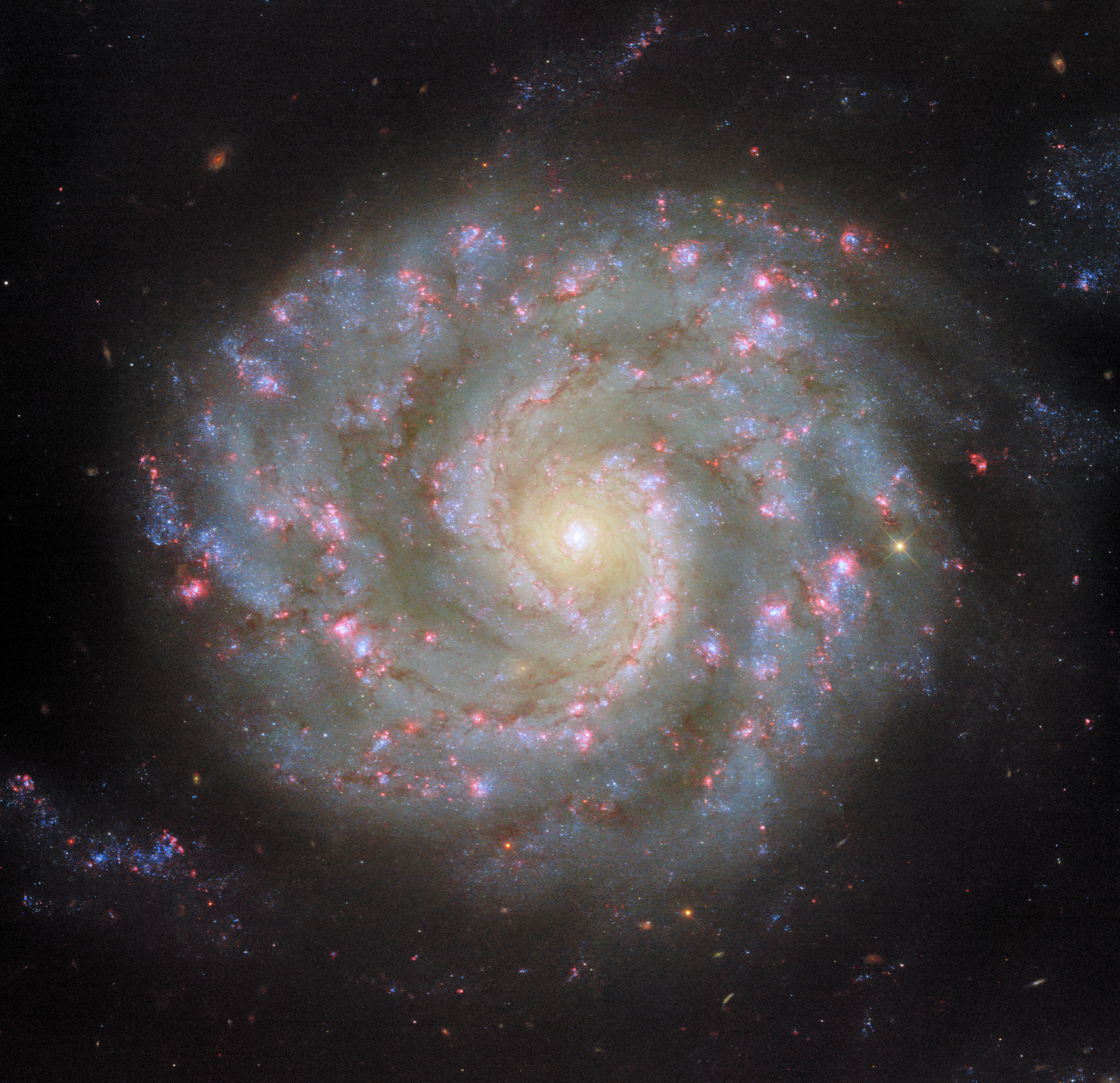
Face to face with a spiral’s arms

A spiral galaxy viewed face-on, with a slightly oval-shaped disc. The centre is a bright white spot surrounded by a golden glow. Two spiral arms extend out from the centre, wrapping around the galaxy and broadening out to form the thick outer edge of the disc. Thin reddish strands of dust and bright pink spots follow the arms through the disc.

The spiral galaxy NGC 3596 is on display in this NASA/ESA Hubble Space Telescope Picture of the Week, which incorporates six different wavelengths of light. NGC 3596 is situated 90 million light-years from Earth in the constellation Leo. The galaxy was discovered in 1784 by astronomer William Herschel, the namesake of ESA’s Herschel Space Observatory.

NGC 3596 appears almost perfectly face-on when viewed from Earth, showcasing the galaxy’s neatly wound spiral arms. The bright arms mark where the galaxy’s stars, gas and dust are concentrated. Star formation is also most active in a galaxy’s spiral arms, as shown by the brilliant pink star-forming regions and young blue stars tracing NGC 3596’s arms in this image.

What causes these spiral arms to form? It’s a surprisingly difficult question to answer, partly because of the remarkable diversity of spiral galaxies. Some have clear spiral arms, while others have patchy, feathery arms. Some have prominent bars across their centres, while others have compact, circular nuclei. Some have close neighbours, while others are isolated.NGC 3596

Early ideas of how spiral arms formed were stumped by what’s called the ‘winding problem’. If a galaxy’s spiral arms are coherent structures, the arms would be wound tighter and tighter as the galaxy spins, until the arms are no longer visible. Now, researchers believe that spiral arms represent a pattern of high-density and low-density areas rather than a physical structure. As stars, gas and dust orbit within a galaxy’s disc, they pass in and out of the spiral arms. Much like cars moving through a traffic jam, these materials slow down and bunch up as they enter a spiral arm, before emerging and continuing their journey through the galaxy.


Tuesday, May 06, 2025

NASA's Webb Lifts Veil on Common but Mysterious Type of Exoplanet

Hot Sub-Neptune Exoplanet Illustration
Credits/Illustration: NASA, ESA, CSA, Dani Player (STScI)

Hot Sub-Neptune Spectrum
Credits/Illustration: NASA, ESA, CSA, Joseph Olmsted (STScI)


Though they don’t orbit around our Sun, sub-Neptunes are the most common type of exoplanet, or planet outside our solar system, that have been observed in our galaxy. These small, gassy planets are shrouded in mystery…and often, a lot of haze. Now, by observing exoplanet TOI-421 b, NASA’s James Webb Space Telescope is helping scientists understand sub-Neptunes in a way that was not possible prior to the telescope’s launch.

“I had been waiting my entire career for Webb so that we could meaningfully characterize the atmospheres of these smaller planets,” said principal investigator Eliza Kempton of the University of Maryland, College Park. “By studying their atmospheres, we’re getting a better understanding of how sub-Neptunes formed and evolved, and part of that is understanding why they don't exist in our solar system.”

Small, Cool, Shrouded in Haze

The existence of sub-Neptunes was unexpected before they were discovered by NASA’s retired Kepler space telescope in the last decade. Now, astronomers are trying to understand where these planets came from and why are they so common.

Before Webb, scientists had very little information on them. While sub-Neptunes are a few times larger than Earth, they are still much smaller than gas-giant planets and typically cooler than hot Jupiters, making them much more challenging to observe than their gas-giant counterparts.

A key finding prior to Webb was that most sub-Neptune atmospheres had flat or featureless transmission spectra. This means that when scientists observed the spectrum of the planet as it passed in front of its host star, instead of seeing spectral features – the chemical fingerprints that would reveal the composition of the atmosphere – they saw only a flat-line spectrum. Astronomers concluded from all of those flat-line spectra that at least certain sub-Neptunes were probably very highly obscured by either clouds or hazes.

A Different Kind of Sub-Neptune?

“Why did we observe this planet, TOI-421 b? It's because we thought that maybe it wouldn't have hazes,” said Kempton. “And the reason is that there were some previous data that implied that maybe planets over a certain temperature range were less enshrouded by haze or clouds than others.”

That temperature threshold is about 1,070 degrees Fahrenheit. Below that, scientists hypothesized that a complex set of photochemical reactions would occur between sunlight and methane gas, and that would trigger the haze. But hotter planets shouldn't have methane and therefore perhaps shouldn't have haze.

The temperature of TOI-421 b is about 1,340 degrees Fahrenheit, well above the presumed threshold. Without haze or clouds, researchers expected to see a clear atmosphere – and they did!

A Surprising Finding

“We saw spectral features that we attribute to various gases, and that allowed us to determine the composition of the atmosphere,” said the University of Maryland’s Brian Davenport, a third-year Ph.D. student who conducted the primary data analysis. “Whereas with many of the other sub-Neptunes that had been previously observed, we know their atmospheres are made of something, but they're being blocked by haze.”

The team found water vapor in the planet’s atmosphere, as well as tentative signatures of carbon monoxide and sulfur dioxide. Then there are molecules they didn’t detect, such as methane and carbon dioxide. From the data, they can also infer that a large amount of hydrogen is in TOI-421 b’s atmosphere.

The lightweight hydrogen atmosphere was the big surprise to the researchers. “We had recently wrapped our mind around the idea that those first few sub-Neptunes observed by Webb had heavy-molecule atmospheres, so that had become our expectation, and then we found the opposite,” said Kempton. This suggests TOI-421 b may have formed and evolved differently from the cooler sub-Neptunes observed previously.

Is TOI-421 b Unique?

The hydrogen-dominated atmosphere is also interesting because it mimics the composition of TOI-421 b's host star. “If you just took the same gas that made the host star, plopped it on top of a planet's atmosphere, and put it at the much cooler temperature of this planet, you would get the same combination of gases. That process is more in line with the giant planets in our solar system, and it is different from other sub-Neptunes that have been observed with Webb so far,” said Kempton.

Aside from being hotter than other sub-Neptunes previously observed with Webb, TOI-421 b orbits a Sun-like star. Most of the other sub-Neptunes that have been observed so far orbit smaller, cooler stars called red dwarfs.

Is TOI-421b emblematic of hot sub-Neptunes orbiting Sun-like stars, or is it just that exoplanets are very diverse? To find out, the researchers would like to observe more hot sub-Neptunes to determine if this is a unique case or a broader trend. They hope to gain insights into the formation and evolution of these common exoplanets.

“We've unlocked a new way to look at these sub-Neptunes,” said Davenport. “These high-temperature planets are amenable to characterization. So by looking at sub-Neptunes of this temperature, we're perhaps more likely to accelerate our ability to learn about these planets.”

The team’s findings appear May 5 in The Astrophysical Journal Letters.

The James Webb Space Telescope is the world’s premier space science observatory. Webb is solving mysteries in our solar system, looking beyond to distant worlds around other stars, and probing the mysterious structures and origins of our universe and our place in it. Webb is an international program led by NASA with its partners, ESA (European Space Agency) and CSA (Canadian Space Agency).

To learn more about Webb, visit:  https://science.nasa.gov/webb


About This Release

Credits:

Media Contact:

Ann Jenkins
Space Telescope Science Institute, Baltimore

Hannah Braun
Space Telescope Science Institute, Baltimore

Permissions: Content Use Policy

Contact Us: Direct inquiries to the News Team.


Monday, May 05, 2025

A Universe made of Black Holes?

Fig. 3: Overall intensity of the gravitational-wave background generated by merging primordial black holes in the simulation, plotted as a function of time via the cosmological scale factor. LIGO/Virgo/Kagra limits today (scale factor 1 or redshift 0) are at the level of 10−7, about a factor 30 below the lower limit of the plot. © MPA

Video 1: Snapshot through the simulated region at different times during its evolution, showing the dark matter density. The left panel shows the case of particle dark matter, while the right panel shows the primordial-black-hole scenario. The middle panel illustrates the result if one were to approximate the evolution of primordial black holes by neglecting the small-scale binary interactions.

The nature of dark matter is still very much unknown; viable candidates range from microsopic elementary particles to black holes with masses many times that of the Sun. Researchers at MPA, Carnegie Observatories, and the University of Sussex have recently made concrete and reliable predictions for how the Universe would look if dark matter consists entirely of massive black holes: they performed the first self-consistent study of how structure would form in such a Universe, and how many of these black holes merge and emit observable gravitational waves.

Astronomers and cosmologists have collected a wide range of evidence for the existence of dark matter, a clustering matter component that has so far only been observed via its gravitational effects. Many dark matter candidates have been proposed, from microsopic elementary particles all the way to black holes with masses several times that of the Sun. Black holes comprising the dark matter would have to have formed in the early Universe, and hence are known as primordial black holes (PBH); astrophysically formed black holes (e.g., from stellar collapse) could not explain the evidence for dark matter seen in early-Universe probes, such as the cosmic microwave background, and would not be abundant enough. One possibility is that the PBHs were generated toward the end of the epoch of inflation in the early Universe.

A wide range of observations, including gamma-ray and X-ray backgrounds, gravitational lensing, the large-scale structure of the Universe, and the cosmic microwave background, have placed various constraints on the allowed PBH masses. Nevertheless, at least a fraction of dark matter might still consist of PBHs in several potential “mass windows”.

Researchers at MPA, Carnegie Observatories, and the University of Sussex have recently performed the first self-consistent study of how structure would form in a Universe with primordial-black-hole dark matter (of mass about 16 solar masses), by investigating the evolution of a region in the Universe with slightly above-average density. They carefully treated the evolution throughout the primordial Universe, and then continued the calculation with the state-of-the-art N-body code BIFROST. BIFROST calculates all gravitational forces between each black hole in the simulation without any small-scale resolution limit. It also includes relativistic effects responsible for libration and precession of binary PBH orbits, reminiscent of Einstein’s famous explanation for the periapsis advance of Mercury’s orbit. Most importantly, gravitational-wave radiation reaction effects are also modelled, allowing PBH binaries to merge in the simulations. This pilot study assumed that 100% of dark matter consists of PBHs. Mixed models with various dark matter components including collisional PBHs are numerically far more challenging to simulate, but might become feasible in the next few years.

The right column of Video 1 shows the evolution of the dark matter density in this scenario. For comparison, the team also performed simulations of the same region within a scenario where dark matter is made of microscopic particles (left column). The distribution of particle dark matter is much more smooth, while the discrete massive bodies are visible in the PBH simulation. The middle column shows the result of an approximate PBH simulation, where small-scale gravitational interactions are neglected; the clearly visible differences with the right column illustrate the importance of an accurate code like BIFROST for this study.

The dynamics of the system of black holes is highly complex. Close encounters between multiple black holes can lead to slingshot effects where one black hole is “kicked” with high velocity (the energy for this kick comes from the deep potential wells of the black holes). This is illustrated in Video 2, which shows the motions of individual black holes in the simulation over a short period of time (essentially, a dynamic, zoomed-in version of Video 1). Capturing these dynamics accurately while also being able to follow the system over the Universe’s history (or at least a substantial fraction of it) is very challenging, and this study presents the first such calculation ever performed.


Video 2: Motion of primordial black holes within a zoomed-in region over a short period of time. Multiple strong (“collisional”) dynamical effects are visible. Note that the PBH motion is interpolated for this video from the simulation output.


Given the dramatic differences between the primordial-black-hole and particle-dark-matter scenarios in Video 1, one would expect that astronomers could easily tell which scenario corresponds to the real Universe. However, we cannot observe either particle dark matter or black holes directly; moreover, the scales shown here are very small and difficult to probe. Thus, a bit of creativity is required to come up with observational routes to probe primordial black holes. For example, the “grainy” mass distribution in the primordial-black-hole case can affect (“heat”) the distribution of stars in galaxies.

One of the cleanest, and probably the most exciting probe of this scenario however are the gravitational waves emitted by the black hole population, in particular when two black holes merge, which happens when they get sufficiently close to each other. This is the subject of ongoing followup work by the team. A first result was already published in the study reported on here, however: the total intensity of all gravitational waves generated by mergers, as a function of time (Fig. 3). This signal is already several orders of magnitude larger than that observed in today’s Universe by the LIGO/Virgo/Kagra experiments, and is expected to put tough constraints on primordial black holes.

Moreover, the simulations predict that mergers of primordial black holes should already happen in the very young Universe (redshifts 𝑧>100), at a time before any stars have formed. Such a merger could not be explained by astrophysical black holes, and it would be a smoking-gun signal of primordial black holes. Future experiments such as the Einstein Telescope will actually be able to detect such mergers, if primordial black holes in the solar-mass range exist.


Antti Rantala
Postdoc
Tel:
2253
anttiran@mpa-garching.mpg.de

Fabian Schmidt
Scientific Staff
Member of the works council, Representative of the Scientific Coworkers

Tel: 2274
fschmidt@mpa-garching.mpg.de

Sten Delos
Carnegie Observatories
Research website

Sam Young
University of Sussex


Original publication

M. Sten Delos, Antti Rantala, Sam Young, Fabian Schmidt
Structure formation with primordial black holes: collisional dynamics, binaries, and gravitational waves
JCAP12 (2024) 005

Source | DOI


Sunday, May 04, 2025

ALMA Discovers Oxygen in Most Distant Known Galaxy Press Releases ALMA Discovers Oxygen in Most Distant Known Galaxy

This image shows the location in the night sky of the galaxy JADES-GS-z14-0, an extremely tiny dot in the Fornax constellation. As of today, this is the most distant confirmed galaxy we know of. Its light took 13.4 billion years to reach us and shows the universe's conditions when it was only 300 million years old. The inset of the image shows a close-up of this primordial galaxy as seen with the Atacama Large Millimeter/submillimeter Array (ALMA).

The inset is overlaid on an image taken with the NASA/ESA/CSA James Webb Space Telescope. The two spectra shown here result from an independent analysis of ALMA data by two teams of astronomers. Both found an emission line of oxygen, making this the most distant detection of oxygen when the universe was only 300 million years old. ALMA (ESO/NAOJ/NRAO)/S. Carniani et al./S. Schouws et al./JWST: NASA, ESA, CSA, STScI, Brant Robertson (UC Santa Cruz), Ben Johnson (CfA), Sandro Tacchella (Cambridge), Phill Cargile (CfA).

This is an artist’s impression of JADES-GS-z14-0, which as of today is the most distant confirmed galaxy. Galaxies in the early Universe tend to be clumpy and irregular. Supernova explosions in this galaxy would have spread heavy elements forged inside stars, like oxygen, which has been now detected with the Atacama Large Millimeter/submillimeter Array (ALMA).

This artist’s animation shows JADES-GS-z14-0, the most-distant galaxy confirmed to date. We see this galaxy as it was when the Universe was less than 300 million years old, about 2% of its present age. Such galaxies were thought to be too young to be ripe with heavy elements, but the discovery of oxygen by two teams of astronomers suggest this is not the case. Instead, as this recreation shows, JADES-GS-z14-0 must have had multiple generations of stars being born and dying as supernovae, producing and leaving behind heavy elements like oxygen. This element has now been detected thanks to the extreme sensitivity of the Atacama Large Millimeter/submillimeter Array (ALMA). Credits: ESO/M. Kornmesser.


Two different scientific teams have detected oxygen in JADES-GS-z14-0. The breakthrough, reported in two separate studies, was made possible thanks to the Atacama Large Millimeter/submillimeter Array (ALMA). This record-breaking detection makes astronomers rethink how quickly galaxies formed in the early universe.

Discovered in 2024, JADES-GS-z14-0 is the most distant confirmed galaxy ever found. Its light took 13.4 billion years to reach us, meaning we see it as when the universe was less than 300 million (about 2% of its present age). The new oxygen detection with ALMA suggests the galaxy is more chemically mature than expected.

"It is like finding an adolescent where you would only expect babies," says Sander Schouws, a PhD candidate at Leiden Observatory, Netherlands, and first author of the Dutch-led study. "The results show the galaxy has formed and matured very rapidly, adding to a growing body of evidence that the formation of galaxies happens much faster than expected."

Galaxies usually start their lives with plenty of young stars, which are made mostly of light elements like hydrogen and helium. As stars evolve, they create heavier elements like oxygen, which get dispersed through their host galaxy after they die. Researchers thought that, at 300 million years old, the universe was still too young to have galaxies ripe with heavy elements. However, the two ALMA studies indicate that JADES-GS-z14-0 has about 10 times more heavy elements than expected.

"I was astonished by the unexpected results because they opened a new view on the first phases of galaxy evolution," says Stefano Carniani of the Scuola Normale Superiore of Pisa, Italy, and lead author on the second paper. "The evidence that a galaxy is already mature in the infant Universe raises questions about when and how galaxies formed."

The oxygen detection has also allowed astronomers to make their distance measurements to JADES-GS-z14-0 much more accurate. "The ALMA detection offers an extraordinarily precise measurement of the galaxy's distance down to an uncertainty of just 0.005%. This level of precision — analogous to being accurate within 5 cm over 1 km — helps refine our understanding of distant galaxy properties", adds Eleonora Parlanti, a PhD student at the Scuola Normale Superiore of Pisa.

"While the galaxy was originally discovered with the James Webb Space Telescope (JWST), it took ALMA to confirm and precisely determine its enormous distance," says Associate Professor Rychard Bouwens, a team member at Leiden Observatory.". This shows the amazing synergy between ALMA and JWST to reveal the formation and evolution of the first galaxies."

Gergö Popping, an European Southern Observatory (ESO) astronomer at the European ALMA Regional Centre who did not participate in the studies, says: "I was really surprised by this clear detection of oxygen in JADES-GS-z14-0. It suggests galaxies can form more rapidly after the Big Bang than previously thought. This result showcases the important role ALMA plays in unraveling the conditions under which the first galaxies in our universe formed."


< Additional information

The results of the studies are published in the following papers:


The European Southern Observatory (ESO), an ALMA partner on behalf of Europe, published the original press release.

The Atacama Large Millimeter/submillimeter Array (ALMA), an international astronomy facility, is a partnership of the European Southern Observatory (ESO), the U.S. National Science Foundation (NSF), and the National Institutes of Natural Sciences (NINS) of Japan in cooperation with the Republic of Chile. ALMA is funded by ESO on behalf of its Member Sta
tes, by NSF in cooperation with the National Research Council of Canada (NRC) and the National Science and Technology Council (NSTC) in Taiwan, and by NINS in cooperation with the Academia Sinica (AS) in Taiwan and the Korea Astronomy and Space Science Institute (KASI).

ALMA construction and operations are led by ESO on behalf of its Member States; by the National Radio Astronomy Observatory (NRAO), managed by Associated Universities, Inc. (AUI), on behalf of North America; and by the National Astronomical Observatory of Japan (NAOJ) on behalf of East Asia. The Joint ALMA Observatory (JAO) provides the unified leadership and management of ALMA's construction, commissioning, and operation.


Contacts:

Nicolás Lira
Education and Public Outreach Coordinator
Joint ALMA Observatory, Santiago - Chile
Phone:
+56 2 2467 6519
Cel: +56 9 9445 7726
Email: nicolas.lira@alma.cl

Bárbara Ferreira
ESO Media Manager
Garching bei München, Germany
Phone:
+49 89 3200 6670
Email: press@eso.org

Jill Malusky
Public Information Officer
NRAO
Phone:
+1 304-456-2236
Email: jmalusky@nrao.edu

Yuichi Matsuda
ALMA EA-ARC Staff Member
NAOJ
Email:
yuichi.matsuda@nao.ac.jp