Tuesday, October 13, 2020

Death by Spaghettification: ESO Telescopes Record Last Moments of Star Devoured by a Black Hole

Artist’s impression of star being tidally disrupted by a supermassive black hole
 
Location of AT2019qiz in the constellation of Eridanus
 
The sky around AT2019qiz


Videos

ESOcast 231 Light: Death by Spaghettification
 
Death by spaghettification: artistic animation of star being tidally disrupted by a black hole
Death by spaghettification: artistic animation of star being tidally disrupted by a black hole 
 
Zooming in on AT2019qiz


Using telescopes from the European Southern Observatory (ESO) and other organisations around the world, astronomers have spotted a rare blast of light from a star being ripped apart by a supermassive black hole. The phenomenon, known as a tidal disruption event, is the closest such flare recorded to date at just over 215 million light-years from Earth, and has been studied in unprecedented detail. The research is published today in Monthly Notices of the Royal Astronomical Society.

The idea of a black hole ‘sucking in’ a nearby star sounds like science fiction. But this is exactly what happens in a tidal disruption event,” says Matt Nicholl, a lecturer and Royal Astronomical Society research fellow at the University of Birmingham, UK, and the lead author of the new study. But these tidal disruption events, where a star experiences what’s known as spaghettification as it’s sucked in by a black hole, are rare and not always easy to study. The team of researchers pointed ESO’s Very Large Telescope (VLT) and ESO’s New Technology Telescope (NTT) at a new flash of light that occurred last year close to a supermassive black hole, to investigate in detail what happens when a star is devoured by such a monster.

Astronomers know what should happen in theory. “When an unlucky star wanders too close to a supermassive black hole in the centre of a galaxy, the extreme gravitational pull of the black hole shreds the star into thin streams of material,” explains study author Thomas Wevers, an ESO Fellow in Santiago, Chile, who was at the Institute of Astronomy, University of Cambridge, UK, when he conducted the work. As some of the thin strands of stellar material fall into the black hole during this spaghettification process, a bright flare of energy is released, which astronomers can detect.

Although powerful and bright, up to now astronomers have had trouble investigating this burst of light, which is often obscured by a curtain of dust and debris. Only now have astronomers been able to shed light on the origin of this curtain.

We found that, when a black hole devours a star, it can launch a powerful blast of material outwards that obstructs our view,” explains Samantha Oates, also at the University of Birmingham. This happens because the energy released as the black hole eats up stellar material propels the star’s debris outwards.

The discovery was possible because the tidal disruption event the team studied, AT2019qiz, was found just a short time after the star was ripped apart. “Because we caught it early, we could actually see the curtain of dust and debris being drawn up as the black hole launched a powerful outflow of material with velocities up to 10 000 km/s,” says Kate Alexander, NASA Einstein Fellow at Northwestern University in the US. “This unique ‘peek behind the curtain' provided the first opportunity to pinpoint the origin of the obscuring material and follow in real time how it engulfs the black hole.

The team carried out observations of AT2019qiz, located in a spiral galaxy in the constellation of Eridanus, over a 6-month period as the flare grew in luminosity and then faded away. “Several sky surveys discovered emission from the new tidal disruption event very quickly after the star was ripped apart,” says Wevers. “We immediately pointed a suite of ground-based and space telescopes in that direction to see how the light was produced.”

Multiple observations of the event were taken over the following months with facilities that included X-shooter and EFOSC2, powerful instruments on ESO’s VLT and ESO’s NTT, which are situated in Chile. The prompt and extensive observations in ultraviolet, optical, X-ray and radio light revealed, for the first time, a direct connection between the material flowing out from the star and the bright flare emitted as it is devoured by the black hole. “The observations showed that the star had roughly the same mass as our own Sun, and that it lost about half of that to the monster black hole, which is over a million times more massive,” says Nicholl, who is also a visiting researcher at the University of Edinburgh.

The research helps us better understand supermassive black holes and how matter behaves in the extreme gravity environments around them. The team say AT2019qiz could even act as a ‘Rosetta stone’ for interpreting future observations of tidal disruption events. ESO’s Extremely Large Telescope (ELT), planned to start operating this decade, will enable researchers to detect increasingly fainter and faster evolving tidal disruption events, to solve further mysteries of black hole physics.


More information

This research was presented in the paper “An outflow powers the optical rise of the nearby, fast-evolving tidal disruption event AT2019qiz” to appear in Monthly Notices of the Royal Astronomical Society (doi: 10.1093/mnras/staa2824). The team is composed of M. Nicholl (Birmingham Institute for Gravitational Wave Astronomy and School of Physics and Astronomy, University of Birmingham, UK [Birmingham] and Institute for Astronomy, University of Edinburgh, Royal Observatory, UK [IfA]), T. Wevers (Institute of Astronomy, University of Cambridge, UK), S. R. Oates (Birmingham), K. D. Alexander (Center for Interdisciplinary Exploration and Research in Astrophysics and Department of Physics and Astronomy, Northwestern University, USA [Northwestern]), G. Leloudas (DTU Space, National Space Institute, Technical University of Denmark, Denmark [DTU]), F. Onori (Istituto di Astrofisica e Planetologia Spaziali (INAF), Roma, Italy), A. Jerkstrand (Max-Planck-Institut für Astrophysik, Garching, Germany and Department of Astronomy, Stockholm University, Sweden [Stockholm]), S. Gomez (Center for Astrophysics | Harvard & Smithsonian, Cambridge, USA [CfA]), S. Campana (INAF–Osservatorio Astronomico di Brera, Italy), I. Arcavi (The School of Physics and Astronomy, Tel Aviv University, Israel and CIFAR Azrieli Global Scholars program, CIFAR, Toronto, Canada), P. Charalampopoulos (DTU), M. Gromadzki (Astronomical Observatory, University of Warsaw, Poland [Warsaw]), N. Ihanec (Warsaw), P. G. Jonker (Department of Astrophysics/IMAPP, Radboud University, the Netherlands [Radboud] and SRON, Netherlands Institute for Space Research, the Netherlands [SRON]), A. Lawrence (IfA), I. Mandel (Monash Centre for Astrophysics, School of Physics and Astronomy, Monash University, Australia and The ARC Center of Excellence for Gravitational Wave Discovery – OzGrav, Australia and Birmingham), S. Schulze (Department of Particle Physics and Astrophysics, Weizmann Institute of Science, Israel [Weizmann]) P. Short (IfA), J. Burke (Las Cumbres Observatory, Goleta, USA [LCO] and Department of Physics, University of California, Santa Barbara, USA [UCSB]), C. McCully (LCO and UCSB) D. Hiramatsu (LCO and UCSB), D. A. Howell (LCO and UCSB), C. Pellegrino (LCO and UCSB), H. Abbot (The Research School of Astronomy and Astrophysics, Australian National University, Australia [ANU]), J. P. Anderson (European Southern Observatory, Santiago, Chile), E. Berger (CfA), P. K. Blanchard (Northwestern), G. Cannizzaro (Radboud and SRON), T.-W. Chen (Stockholm), M. Dennefeld (Institute of Astrophysics Paris (IAP), and Sorbonne University, Paris), L. Galbany (Departamento de Física Teórica y del Cosmos, Universidad de Granada, Spain), S. González-Gaitán (CENTRA-Centro de Astrofísica e Gravitação and Departamento de Física, Instituto Superior Técnico, Universidade de Lisboa, Portugal), G. Hosseinzadeh (CfA), C. Inserra (School of Physics & Astronomy, Cardiff University, UK), I. Irani (Weizmann), P. Kuin (Mullard Space Science Laboratory, University College London, UK), T. Muller-Bravo (School of Physics and Astronomy, University of Southampton, UK), J. Pineda (Departamento de Ciencias Fisicas, Universidad Andrés Bello, Santiago, Chile), N. P. Ross (IfA), R. Roy (The Inter-University Centre for Astronomy and Astrophysics, Ganeshkhind, India), S. J. Smartt (Astrophysics Research Centre, School of Mathematics and Physics, Queen’s University Belfast, UK [QUB]), K. W. Smith (QUB), B. Tucker (ANU), Ł. Wyrzykowski (Warsaw), D. R. Young (QUB).

ESO is the foremost intergovernmental astronomy organisation in Europe and the world’s most productive ground-based astronomical observatory by far. It has 16 Member States: Austria, Belgium, the Czech Republic, Denmark, France, Finland, Germany, Ireland, Italy, the Netherlands, Poland, Portugal, Spain, Sweden, Switzerland and the United Kingdom, along with the host state of Chile and with Australia as a Strategic Partner. ESO carries out an ambitious programme focused on the design, construction and operation of powerful ground-based observing facilities enabling astronomers to make important scientific discoveries. ESO also plays a leading role in promoting and organising cooperation in astronomical research. ESO operates three unique world-class observing sites in Chile: La Silla, Paranal and Chajnantor. At Paranal, ESO operates the Very Large Telescope and its world-leading Very Large Telescope Interferometer as well as two survey telescopes, VISTA working in the infrared and the visible-light VLT Survey Telescope. Also at Paranal ESO will host and operate the Cherenkov Telescope Array South, the world’s largest and most sensitive gamma-ray observatory. ESO is also a major partner in two facilities on Chajnantor, APEX and ALMA, the largest astronomical project in existence. And on Cerro Armazones, close to Paranal, ESO is building the 39-metre Extremely Large Telescope, the ELT, which will become “the world’s biggest eye on the sky”.


Links


Contacts

Matt Nicholl
School of Physics and Astronomy and Institute of Gravitational Wave Astronomy, University of Birmingham
Birmingham, UK
Email:
m.nicholl.1@bham.ac.uk

Thomas Wevers
European Southern Observatory
Santiago, Chile
Email:
Thomas.Wevers@eso.org

Samantha Oates
Institute of Gravitational Wave Astronomy, University of Birmingham
Birmingham, UK
Email:
sroates@star.sr.bham.ac.uk

Kate Alexander
Center for Interdisciplinary Exploration and Research in Astrophysics and Department of Physics and Astronomy, Northwestern University
Evanston, USA
Email:
kate.alexander@northwestern.edu

Bárbara Ferreira
ESO Public Information Officer
Garching bei München, Germany
Tel: +49 89 3200 6670
Cell: +49 151 241 664 00
Email:
pio@eso.org


Source: ESO/News
 

Monday, October 12, 2020

Massive Stars Are Factories for Ingredients to Life

llustration of a dusty disc rotating around a massive newborn star that’s about 40 times the size of the Sun. SOFIA, the Stratospheric Observatory for Infrared Astronomy, found the inner regions of two of these kinds of discs are filled with organic molecules that are important for life as we know it. These include water, ammonia, methane, and acetylene — which is a chemical building block to larger and more complex organic molecules — illustrated in the call out.   Credits: NASA/SOFIA. Video

NASA’s telescope on an airplane, the Stratospheric Observatory for Infrared Astronomy, has provided a new glimpse of the chemistry in the inner region surrounding massive young stars where future planets could begin to form. It found massive quantities of water and organic molecules in these swirling, disk-shaped clouds, offering new insights into how some of the key ingredients of life get incorporated into planets during the earliest stages of formation.

A similar process likely happened during the formation of the Sun and the inner rocky planets of our solar system, including Earth. The results are published in the Astrophysical Journal.

“We’re seeing many more molecular signatures than were ever seen before at these wavelengths,” said Andrew Barr, the lead author of the study and a doctoral candidate at Leiden University in the Netherlands. “It turns out that these stars are like chemical factories churning out molecules important for life as we know it and we just needed the right kind of observations to see them.”

SOFIA’s infrared observations offer an unparalleled view of star chemistry. When visible light is spread into its component colors, a rainbow appears. When infrared light is broken into its components, it reveals a series of bright lines, called spectra. Each element creates a unique line, so the lines act as chemical fingerprints. Scientists use them to identify which substances are in and around stars. SOFIA’s instruments can detect small details in the chemical fingerprints from the cores of massive young stars, similar to how high-resolution images reveal tiny features. This information about massive stars, more than 40 times the mass of our Sun, can be a reference for NASA’s James Webb Space Telescope, which will study the formation of Sun-sized stars, among other types of targets.

“This study is very exciting as it demonstrates the power of infrared observatories to sense the presence of simple organic compounds that were important for the origin of life on Earth, and possibly other planets,” said Klaus Pontoppidan, project scientist for the Webb telescope at the Space Telescope Science Institute. “One of the most important goals of both Webb and SOFIA is to understand the origins of stars and planets — and ultimately ourselves.”

Stars form when celestial clouds collapse, feeding a rotating disc of gas and dust into a central core. SOFIA looked at this process happening around two massive stars, AFGL 2591 and AFGL 2136, each about 3,000 light years away in the constellation Cygnus and the Juggler Nebula respectively. The observatory found the inner regions of these discs are heated from the inside out, transforming the gas surrounding the core into an entirely different composition. Within the same areas of the disc where planets would form were a chemical soup of organic molecules, including water, ammonia, methane, and acetylene — which is a chemical building block of larger and more complex organic molecules.

 Further studies of other massive young stars by SOFIA will deepen our understanding of the processes creating organic molecules. As SOFIA’s observations indicate that massive star formation is a scaled-up version of what is occurring in smaller, Sun-sized stars, these new studies can be of benefit to Webb. While Webb’s extremely sensitive telescope will be able to detect some of the weakest signals from molecules present around Sun-like stars, SOFIA can unambiguously identify the chemical compositions of molecules glowing brightly around more massive stars. This will help scientists using Webb interpret the weaker signals.

SOFIA is a Boeing 747SP jetliner modified to carry a 106-inch diameter telescope. It is a joint project of NASA and the German Aerospace Center, DLR. NASA’s Ames Research Center in California’s Silicon Valley manages the SOFIA program, science, and mission operations in cooperation with the Universities Space Research Association headquartered in Columbia, Maryland, and the German SOFIA Institute (DSI) at the University of Stuttgart. The aircraft is maintained and operated from NASA’s Armstrong Flight Research Center Hangar 703 in Palmdale, California.

Members of the news media interested in covering this topic should reach out to the NASA Ames newsroom.

Felicia Chou
NASA Headquarters, Washington 
202-358-0257

felicia.chou@nasa.gov

Alison Hawkes 
Ames Research Center, Silicon Valley, Calif.
650-604-4789

alison.hawkes@nasa.gov

Editor: Kassandra Bell

 Source: NASA/Stars


Friday, October 09, 2020

The origin of Type Ia supernovae revealed by manganese abundances

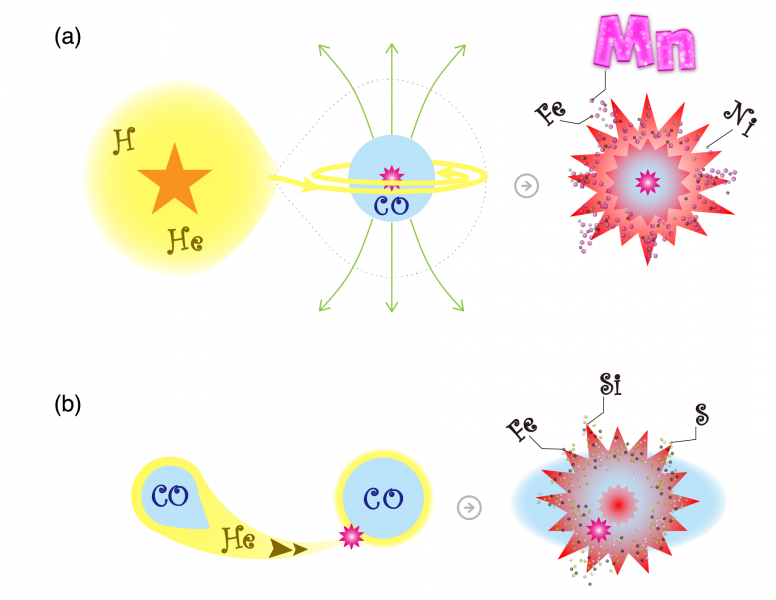
Image caption 1: (a) Near-Chandrasekhar mass explosions: In a binary system of one white dwarf that is made of carbon and oxygen, mass accretion from the companion star (a main se-quence star or red giant) causes winds of material from the white dwarf, which regu-lates the mass accretion onto the white dwarf, and increases the white dwarf mass. Subsonic waves from the explosion at the centre of near-Chandrasekhar mass white dwarf trigger a detonation in the outskirts. This explosion can produce a lot of manga-nese (Mn) and nickel (Ni) as well as iron (Fe). (b) An example of sub-Chandrasekhar mass explosions: In a binary system of two white dwarfs (at least one white dwarf consists of carbon and oxygen), the smaller one is dis-rupted by tidal forces and merges with the larger one. A detonation in a thin helium enve-lope around the white dwarf triggers a carbon detonation at the centre. This explosion can produce more silicon (Si) and sulphur (S), as well as iron (Fe), and unburnt carbon and oxygen.


Image caption 2: Evolution of oxygen (left) and manganese (right) in the solar neighborhood of the Milky Way Galaxy. The x-axis shows the metallicity (iron abundance relative to hydrogen), which is a proxy of time increasing from the left to right. The y-axis shows the oxygen and manganese abundances, relative to iron. The points are for the elemental abundances observed in nearby stars with high-resolution spectroscopy. From the comparison, it is found that at least 75 percent of Type Ia supernovae are near-Chandrasekhar mass ex-plosions.

A research team at the Kavli Institute for the Physics and Mathematics of the Universe (Kavli IPMU) consisting of Visiting Scientist Chiaki Kobayashi, Project Researcher at the time Shing-Chi Leung (currently at the California Institute of Technology), and Senior Scientist Ken’ichi Nomoto have used computer simulations to follow the explosion, nuclear reaction, production of elements, and evolution of elemental abundances in galaxies. As a result, they placed stringent constraints on the origin of Type Ia supernovae. 

A Type Ia supernova is a type of supernova that is not related to the death of a massive star. Instead, a Type Ia supernova is a luminous explosion of a star that occurs in a binary system, where two relatively low-mass stars are evolving together. Because of their relatively constant luminosity, Type Ia supernovae have been used as a standard “candle” to measure the expansion of the universe, a result for which the 2011 Nobel Prize in Physics was awarded. However, the progenitor star of a Type Ia supernova is unknown, and has been the topic of debate for around a half century. 

“As usual for normal supernovae, Type Ia supernovae produce “metals”—or, in astronomical terms, chemical elements heavier than hydrogen and helium, the latter pair tracing their origin to the Big Bang—but Type Ia supernovae produce different elements, such as manganese (Mn), nickel (Ni), and iron (Fe). These elemental abundances can be measured in spectral features of nearby stars, which keep a “record” of supernovae from the past, like fossils do in archaeology,’’ Kobayashi, who is also an associate professor at the University of Hertfordshire in the United Kingdom, said. Therefore, the evolution of elemental abundances in galaxies can provide a stringent constraint on the true origin of Type Ia supernovae.

The progenitor stars of Type Ia supernovae are a type of white dwarf that are made of carbon and oxygen. White dwarfs form after the deaths of intermediate-mass stars, where electron degeneracy pressure supports the star against collapsing under its own gravity. However, if a white dwarf exceeds its upper mass limit—also called the Chandrasekhar mass limit (named after physicist Subrahmanyan Chandrasekhar)—this leads to nuclear reactions that cause it to explode.

Therefore, in a binary system containing a near-Chandrasekhar-mass white dwarf, mass accretion from a companion star can cause an explosion, which is one of the two proposed scenarios (the “single degenerate scenario”) for Type Ia supernovae (Figure 1a). In the other scenario, two white dwarfs are formed in a binary system (the “double degenerate scenario”), which merge together to cause an explosion—namely, a sub-Chandrasekhar-mass explosion (Figure 1b).  

Click here for Figure 1 (with a white background).

 To investigate both cases, the research team run detailed calculations (2-dimensional hydrodynamical simulations and nucleosynthesis) of both near-Chandrasekhar-mass and sub-Chandrasekhar-mass explosions, and calculated the evolution of the Milky Way Galaxy, something that had not been done in previous research. 

“Between these two cases, we find a critical difference in the evolution of elemental abundances, in particular for the element manganese,’’ Kobayashi explained. In the first simulation, the explosion provided high-temperature and high-density matter where a lot of manganese was produced, while in the second simulation, there was no such matter and hence not enough manganese was produced.

The research team then incorporated the production amount of each chemical element into their galaxy model to predict the evolution of elements in the Milky Way. Compared to observational data, namely, elemental abundances measured in nearby stars with high-resolution spectroscopy, they found that at least 75 percent of Type Ia supernovae are near-Chandrasekhar mass explosions (Figure 2). In both cases, the research found, the produced iron mass is roughly the same—that is, 60 percent of the mass of the Sun—which is about 10 times larger than in normal supernovae from massive stars.

“The chemical evolution of galaxies is powerful for solving long-standing problems in nuclear astrophysics. Not only manganese but also nickel abundances are updated in our calculations with the latest nuclear reactions. Nickel was overproduced in previous calculations, but now the predicted abundance is consistent with observations,’’ Kobayashi added. As a result of their findings, the nickel overproduction problem is finally solved, after two decades of studies.

More interestingly, the research team also showed that a larger contribution from sub-Chandrasekhar-mass explosions is preferred to near-Chandrasekhar-mass explosions  from the available observations in different galaxies—dwarf spheroidal galaxies around the Milky Way, for example. 

Kobayashi and her team noted that the elemental abundances of millions of stars will be obtained with ongoing and future international projects, such as APOGEE (Apache Point Observatory Galactic Evolution Experiment), HERMES-GALAH (GALactic Archeology with HERMES), WEAVE (WHT Enhanced Area Velocity Explorer), 4MOST (4-metre Multi-Object Spectroscopic Telescope), MSE (The Maunakea Spectroscopic Explorer), in the new research area of “Galactic Archaeology,” or the study of the history of the Milky Way Galaxy, and their findings will be tested further in future research.

Paper details:

Journal: The Astrophysical Journal

Title: New Type Ia Supernova Yields and the Manganese and Nickel Problems in the Milky Way and Dwarf Spheroidal Galaxies

Authors: Chiaki Kobayashi (1,2), Shing-Chi Leung (2,3), Ken'ichi Nomoto (2)

Author affiliation:

1. Center for Astrophysics Research, Department of Physics, Astronomy and Mathemat-ics, University of Hertfordshire, College Lane, Hatfield AL10 9AB, UK
2. Kavli Institute for the Physics and Mathematics of the Universe (WPI), The University of Tokyo Institutes for Advanced Study, The University of Tokyo, Kashiwa, Chiba 277-8583, Japan
3. TAPIR, Walter Burke Institute for Theoretical Physics, Mailcode 350-17, Caltech, Pasa-dena, CA 91125, USA

DOI: https://doi.org/10.3847/1538-4357/ab8e44 (Posted on June 4, 2020)

Paper abstract: (Astrophysical Journal page): https://iopscience.iop.org/article/10.3847/1538-4357/ab8e44 

Preprint (arXiv.org page): https://arxiv.org/abs/1906.09980 

Research contact: 

Ken’ichi Nomoto 
Senior Scientist
Kavli Institute for the Physics and Mathematics of the Universe, University of Tokyo
E-mail:
nomoto@astron.s.u-tokyo.ac.jp
TEL: +81-4-7136-5940

Chiaki Kobayashi
Associate Professor
University of Hertfordshire
Visiting Scientist
Kavli Institute for the Physics and Mathematics of the Universe, University of Tokyo
E-mail:
c.kobayashi@herts.ac.uk

Media contact:

John Amari
Press officer 
Kavli Institute for the Physics and Mathematics of the Universe, The University of Tokyo
E-mail:
press@ipmu.jp
TEL: 080-4056-2767 

Related links:

Gold in the cosmos is an astronomical mystery (University of Hertfordshire press release, English)*
https://www.herts.ac.uk/about-us/media-centre/news/2020/gold-in-the-cosmos-is-an-astronomical-mystery 


*Contents related to the research results, by Kavli IPMU Visiting Scientist Chiaki Koba-yashi, published in the Astrophysical Journal on September 16, 2020


Thursday, October 08, 2020

Growing up Stardust: Scientists Discover That Stars and Planets May Be Siblings

This ALMA image shows the young planetforming dust rings surrounding the IRS 63 protostar, which is younger than 500,000 years old. Credit: MPE/D. Segura-Cox Data credit: ALMA (ESO/NAOJ/NRAO). High Resolution (jpg) - Low Resolution (jpg)

The rings and gaps in the IRS 63 dust disk are shown next to a sketch of the Solar System orbits drawn at the same size scale and orientation of the IRS 63 disk. The locations of the rings are similar to the locations of objects in our own Solar System, with the inner ring about the size of Neptune's orbit and the outer ring a little larger than Pluto's orbit. Credit: MPE/D. Segura-Cox Data credit: ALMA (ESO/NAOJ/NRAO).High Resolution (jpg)-Low Resolution (jpg)

The dense L1709 region of the Ophiuchus Molecular Cloud mapped by the Herschel Space Telescope, which surrounds and feeds material to the much smaller IRS 63 protostar and planet-forming disk (location marked by the black x). Credit: MPE/D. Segura-Cox Data credit: ESA/Herschel/SPIRE/PACS/D. Arzoumanian.High Resolution (jpg)-Low Resolution (jpg)

Rings of dust have previously been detected in great numbers in systems older than one million years, and prior to the study, scientists believed that stars are well into adulthood before planets to begin to form. Observations of IRS 63—a young protostar located 470 light years from Earth, deep within the dense LI709 interstellar cloud in the constellation Ophiuchus—revealed that this may not be the case after all. At less than half the age of other young stars with dust rings—and younger than 500,000 years old—IRS 63 has a long way to go in gathering mass, and yet, planets have already begun to form.

"We observed the young protoplanetary disk called IRS 63 and found gaps and rings within the disk, which is indicative of planet formation," said Ian Stephens, astronomer, Center for Astrophysics | Harvard & Smithsonian (CfA). "Traditionally it was thought that a star does most of its formation before the planets form, but our observations showed that they form simultaneously." Dominique Segura-Cox, a scientist at the Max Planck Institute for Extraterrestrial Physics (MPE) in Germany and the lead author on the study added, "The rings in the disk around IRS 63 are so young. We used to have this idea that stars entered adulthood first and were the mothers of planets that came afterwards, but now we see that protostars and planets grow and evolve together from early times like siblings."

Observations also revealed implications for understanding the formation of our own solar system. It takes at least 10 Earth masses of solid material to form a planet core capable of accreting enough gas to form a gas giant. While researching IRS 63 scientists found that the young disk contains roughly 150 Earth masses of dust and material. Paired with the rings and gaps present in the disk, scientists are learning a lot about the early formation of planets, including those in our own solar system. "These rings and gaps suggest that we are seeing the earliest evidence of planet formation, and that planets certainly start to form within the first half million years, and probably within the first 150,000 years," said Stephens. "Planets, especially planets like Jupiter, started their own formation at one of the earliest stages of the star formation process."

There is growing evidence that Jupiter may have formed beyond Neptune's orbit in our own solar system, and then migrated over time to its present-day position. Observations of IRS 63 indicate that the amount of material in the disk and the young age of the system could create conditions similar to those in our solar system, allowing for similar formation of planets. “The size of the disk is very similar to our own solar system,” said Segura-Cox. "Even the mass of the protostar is just a little smaller than the mass of our Sun. Studying such young planet-forming disks around protostars can give us important insights into our own origins."

"Four annular structures in a protostellar disk less than 500,000 years old," D. M. Segura-Cox et al., Nature.

MPE: https://www.mpe.mpg.de/7508431/news20201007

About Center for Astrophysics | Harvard & Smithsonian

Headquartered in Cambridge, Mass., the Center for Astrophysics | Harvard & Smithsonian (CfA) is a collaboration between the Smithsonian Astrophysical Observatory and the Harvard College Observatory. CfA scientists, organized into six research divisions, study the origin, evolution and ultimate fate of the universe.

For more information, contact:

Amy Oliver
Public Affairs
Center for Astrophysics | Harvard & Smithsonian
Fred Lawrence Whipple Observatory
520-879-4406

amy.oliver@cfa.harvard.edu


Source: Harvard-Smithsonian Center for Astrophysics (CfA)


Wednesday, October 07, 2020

2020 Nobel Prize in Physics awarded for research with ESO telescopes on Milky Way's supermassive black hole

The centre of the Milky Way* 
 
Professor Reinhard Genzel at the Paranal Observatory 
 
A laser beam towards the Milky Way's centre* 

Orbits of stars around black hole at the heart of the Milky Way 
 
Orbit diagram of S2 around black hole at centre of the Milky Way


Videos

Testing general relativity at the Galactic Centre — compilation


Reinhard Genzel and Andrea Ghez have jointly been awarded the 2020 Nobel Prize in Physics for their work on the supermassive black hole, Sagittarius A*, at the centre of our galaxy. Genzel, Director at the Max Planck Institute for Extraterrestrial Physics in Germany, and his team have conducted observations of Sagittarius A* for nearly 30 years using a fleet of instruments on European Southern Observatory (ESO) telescopes.

Genzel shares half of the prize with Ghez, a professor at the University of California, Los Angeles in the US, "for the discovery of a supermassive compact object at the centre of our galaxy", with the other half awarded to Roger Penrose, professor at the University of Oxford in the UK, "for the discovery that black hole formation is a robust prediction of the general theory of relativity.

"Congratulations to all three Nobel laureates! We are delighted that the research on the supermassive black hole at the centre of our galaxy has been recognised with the 2020 Nobel Prize in Physics. We are proud that the telescopes ESO builds and operates at its observatories in Chile played a key role in this discovery," says ESO's Director General Xavier Barcons. “The work done by Reinhard Genzel with ESO telescopes and by Andrea Ghez with the Keck telescopes in Hawaii has enabled unprecedented insight into Sagittarius A*, which confirmed predictions of Einstein’s general relativity."

ESO has worked in very close collaboration with Genzel and his group for around 30 years. Since the early 1990s, Genzel and his team, in cooperation with ESO, have developed instruments designed to track the orbits of stars in the Sagittarius A* region at the centre of the Milky Way. 

They started their campaign in 1992 using the SHARP instrument on ESO’s New Technology Telescope (NTT) at the La Silla Observatory in Chile. The team later used extremely sensitive instruments on ESO’s Very Large Telescope (VLT) and the Very Large Telescope Interferometer at the Paranal Observatory, namely NACO, SINFONI and later GRAVITY, to continue their study of Sagittarius A*. 

In 2008, after 16 years of tracking stars orbiting Sagittarius A*, the team delivered the best empirical evidence that a supermassive black hole exists at the centre of our galaxy. Both Genzel's and Ghez's groups accurately traced the orbit of one star in particular, S2, which reached the closest distance to Sagittarius A* in May 2018. ESO undertook a number of developments and infrastructure upgrades in Paranal to enable accurate measurements of the position and velocity of S2. The team led by Genzel found the light emitted by the star close to the supermassive black hole was stretched to longer wavelengths, an effect known as gravitational redshift, confirming for the first time Einstein’s general relativity near a supermassive black hole. Earlier this year, the team announced they had seen S2 ‘dance’ around the supermassive black hole, showing its orbit is shaped like a rosette, an effect called Schwarzschild precession that was predicted by Einstein.

Genzel and his team are also involved in the development of instruments that will be installed on ESO’s Extremely Large Telescope, currently under construction in Chile’s Atacama Desert, which will enable them to probe the environment even closer to the supermassive black hole.


More Information

ESO is the foremost intergovernmental astronomy organisation in Europe and the world’s most productive ground-based astronomical observatory by far. It has 16 Member States: Austria, Belgium, the Czech Republic, Denmark, France, Finland, Germany, Ireland, Italy, the Netherlands, Poland, Portugal, Spain, Sweden, Switzerland and the United Kingdom, along with the host state of Chile and with Australia as a Strategic Partner. ESO carries out an ambitious programme focused on the design, construction and operation of powerful ground-based observing facilities enabling astronomers to make important scientific discoveries. ESO also plays a leading role in promoting and organising cooperation in astronomical research. ESO operates three unique world-class observing sites in Chile: La Silla, Paranal and Chajnantor. At Paranal, ESO operates the Very Large Telescope and its world-leading Very Large Telescope Interferometer as well as two survey telescopes, VISTA working in the infrared and the visible-light VLT Survey Telescope. Also at Paranal ESO will host and operate the Cherenkov Telescope Array South, the world’s largest and most sensitive gamma-ray observatory. ESO is also a major partner in two facilities on Chajnantor, APEX and ALMA, the largest astronomical project in existence. And on Cerro Armazones, close to Paranal, ESO is building the 39-metre Extremely Large Telescope, the ELT, which will become “the world’s biggest eye on the sky”.
 
Bárbara Ferreira
ESO Public Information Officer
Garching bei München, Germany
Tel: +49 89 3200 6670
Email:
pio@eso.org
 
Source: ESO/News


Tuesday, October 06, 2020

Sharp: Most Detailed Image Yet of Famous Stellar Nursery

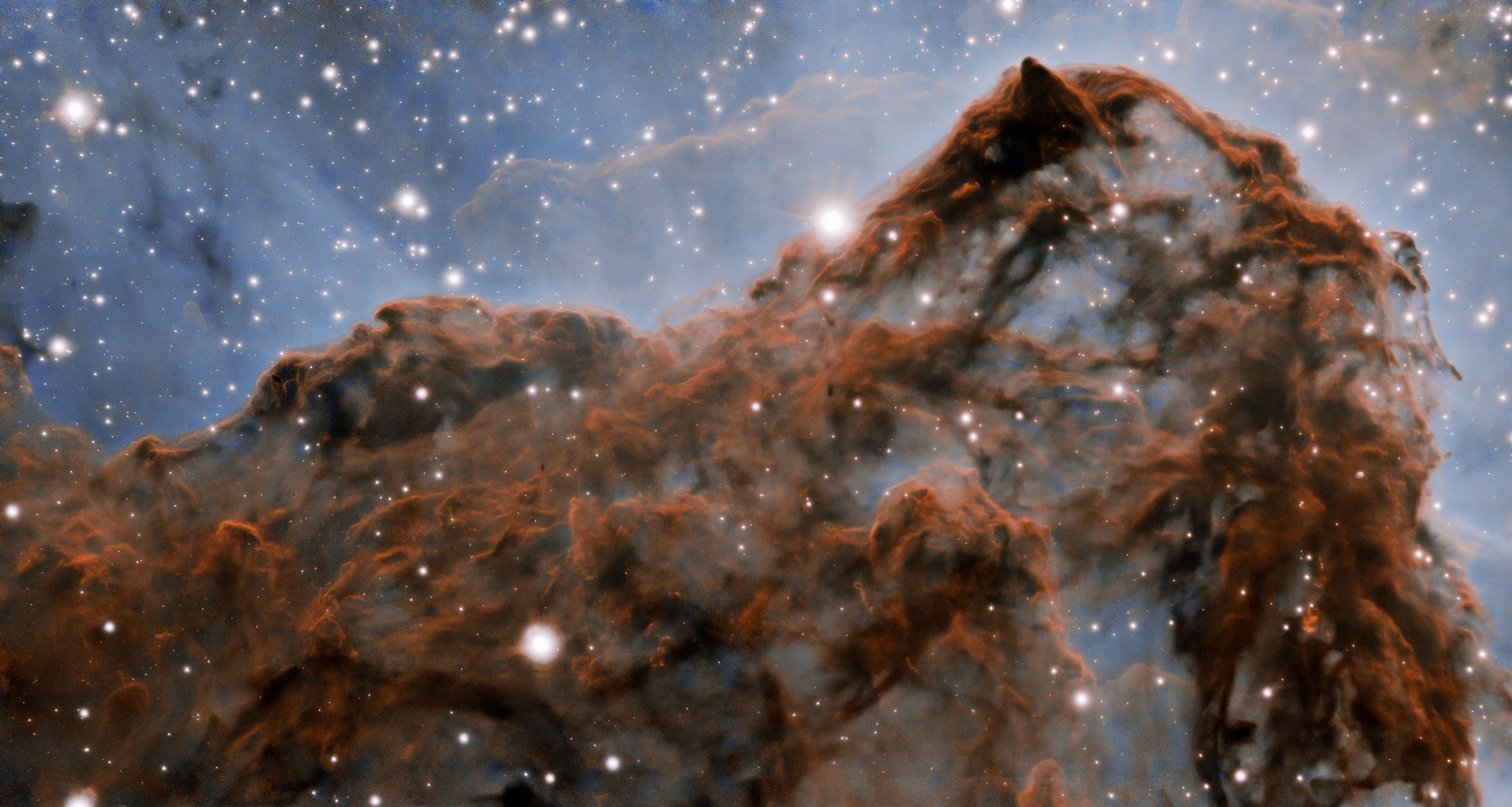
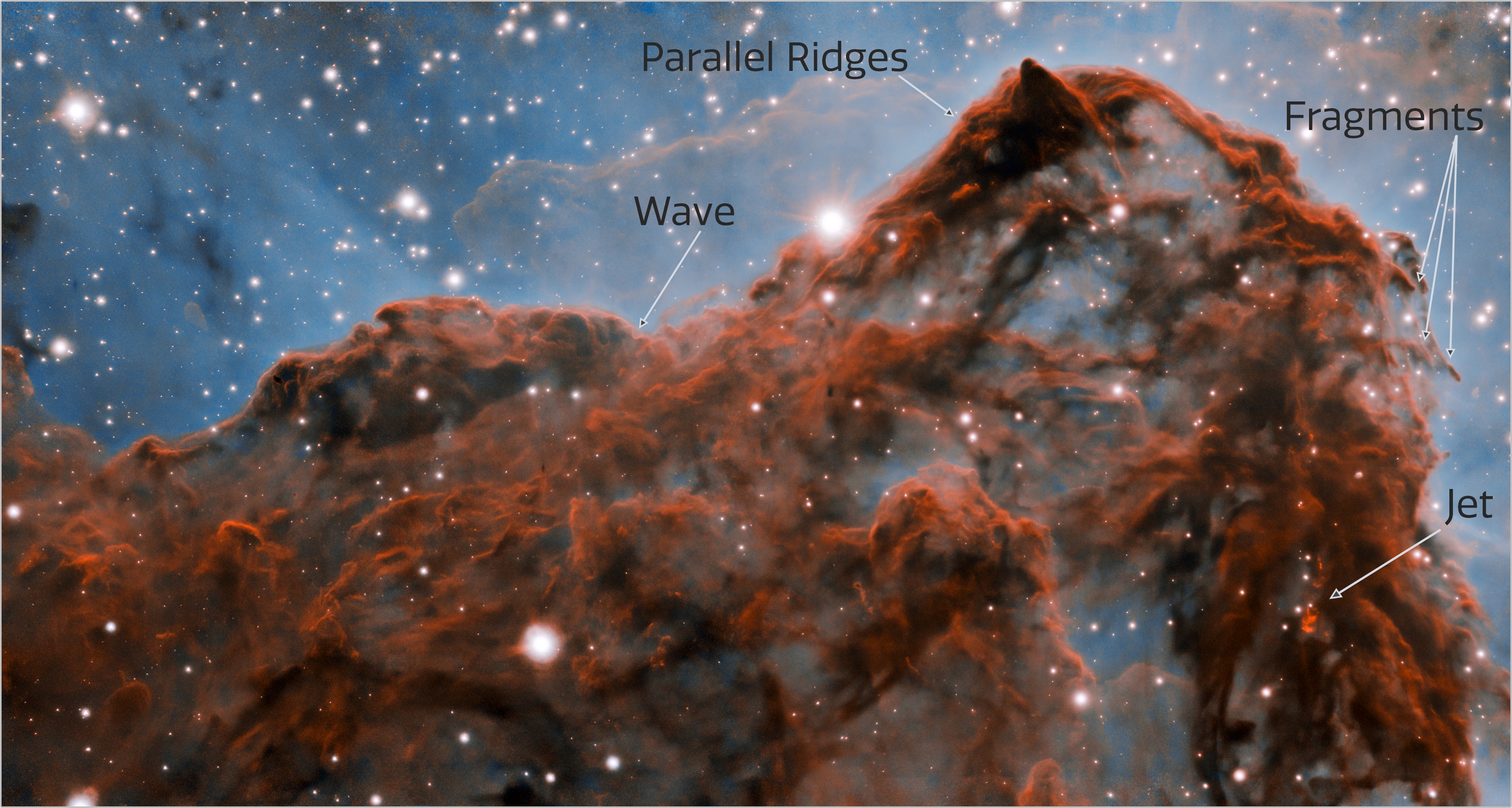
Carina Nebula western wall (with adaptive optics). A 50-trillion-km (33-trillion-mile, or 5 light-year) long section of the western wall in the Carina Nebula, as observed with adaptive optics on the Gemini South telescope. This mountainous section of the nebula reveals a number of unusual structures including a long series of parallel ridges that could be produced by a magnetic field, a remarkable almost perfectly smooth wave, and fragments that appear to be in the process of being sheared off the cloud by a strong wind. There is also evidence for a jet of material ejected from a newly-formed star. The exquisite detail seen in the image is in part due to a technology known as adaptive optics, which resulted in a ten-fold improvement in the resolution of the research team’s observations. Credit: International Gemini Observatory/NOIRLab/NSF/AURA. Acknowledgment: PI: Patrick Hartigan (Rice University). Image processing: Patrick Hartigan (Rice University), Travis Rector (University of Alaska Anchorage), Mahdi Zamani & Davide de Martin.  download TIFF | JPEG

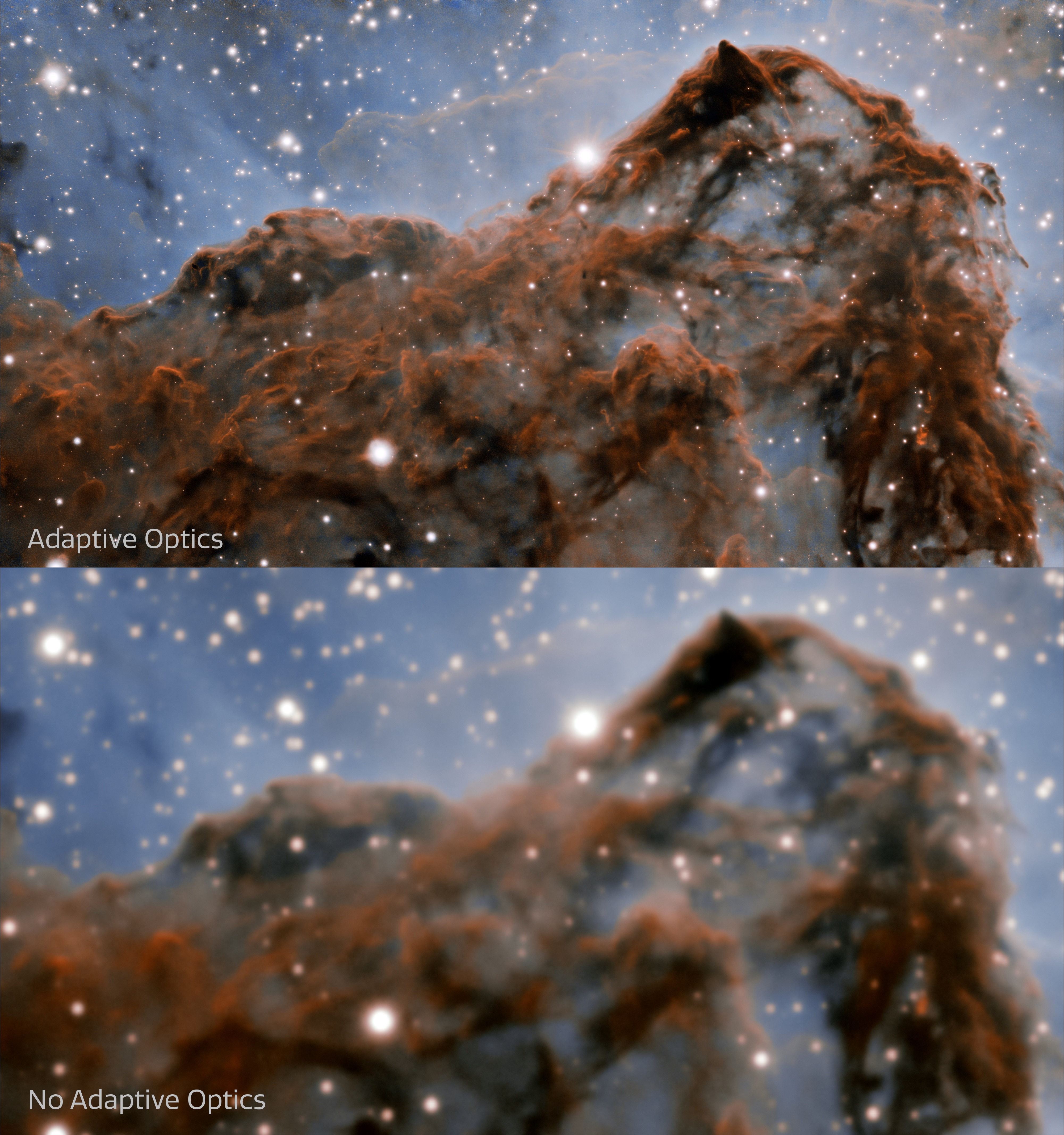
Comparison of images with and without Adaptive Optics (labeled). This image shows a comparison of the new image (top) of the western wall of the Carina Nebula taken by the international Gemini Observatory, a Program of NSF’s NOIRLab, and an image of the same region without Adaptive Optics (bottom). The top image was taken with the Gemini South telescope with the GSAOI instrument using the GeMS adaptive optics system, and the bottom image was taken at the Cerro Tololo Inter-American Observatory with the Víctor M. Blanco 4-meter Telescope using the NEWFIRM instrument. Credit: International Gemini Observatory/NOIRLab/NSF/AURA. Acknowledgment: PI: Patrick Hartigan (Rice University). Image processing: Patrick Hartigan (Rice University), Travis Rector (University of Alaska Anchorage), Mahdi Zamani & Davide de Martin. download TIFF  JPEG

Carina Nebula Western Wall (labeled) A 50-trillion-km (33-trillion-mile, or 5 light-year) long section of the western wall in the Carina Nebula, as observed with adaptive optics on the Gemini South telescope. This mountainous section of the nebula reveals a number of unusual structures including a long series of parallel ridges that could be produced by a magnetic field, a remarkable almost perfectly smooth wave, and fragments that appear to be in the process of being sheared off the cloud by a strong wind. There is also evidence for a jet of material ejected from a newly-formed star. The exquisite detail seen in the image is in part due to a technology known as adaptive optics, which resulted in a ten-fold improvement in the resolution of the research team’s observations. Credit: International Gemini Observatory/NOIRLab/NSF/AURA. Acknowledgment: PI: Patrick Hartigan (Rice University). Image processing: Patrick Hartigan (Rice University), Travis Rector (University of Alaska Anchorage), Mahdi Zamani & Davide de Martin.  download TIFF | JPEG

Looking Sharp: Most Detailed Image Yet of Famous Stellar Nursery.
Credit: Images and Videos: International Gemini Observatory/NOIRLab/NSF/AURA, NASA, D. Stover/ESO/S. Brunier/Digitized Sky Survey 2. Image Processing: Patrick Hartigan (Rice University), Travis Rector (University of Alaska Anchorage), Mahdi Zamani & Davide de Martin. Music: Tomaz Vital - Auroras pt.2 (www.trilhavital.com). Video

The Carina Nebula observed in unprecedented detail with adaptive optics.

Astronomers using the international Gemini Observatory, a Program of NSF’s NOIRLab, have captured the western wall of the Carina Nebula in unprecedented detail in a compelling image released today. The image reveals a number of unusual structures in the nebula. The exquisite detail revealed in the image is in part due to a technology known as adaptive optics, which resulted in a ten-fold improvement in the sharpness of the research team’s observations.

There is no better location to investigate the birth of stars than nebulae — regions of gas and dust where stars coalesce, heat up and start to glow. The brilliant Carina Nebula, located in the southern hemisphere sky, is 500 times larger in actual area than the better-known Orion Nebula, making it an ideal candidate for investigating star formation.

The team used adaptive optics on the 8.1-meter Gemini South telescope in Chile to significantly improve upon previous observations of the Carina Nebula’s western wall, the well-defined edge of the nebula. Adaptive optics compensates for the effects of turbulence in the Earth’s atmosphere to produce pin-sharp images, comparable to those from a space telescope. Indeed, this image is reminiscent of the famous Hubble Pillars of Creation in the Eagle Nebula.

Star-forming regions are shrouded in dust but it is possible to see through the shroud of dust by observing in infrared light. The team, led by Patrick Hartigan of Rice University, utilized the Gemini South Adaptive Optics Imager (GSAOI), a near-infrared adaptive optics camera, to peer through the outer layers of dust to reveal a huge wall of dust and gas glowing with the intense ultraviolet light from nearby massive young stars. This region is a great example of such a wall and this image provides a very clear view of a star-forming region in the near-infrared [1].

With a resolution ten times higher than it would be without adaptive optics from the ground [2], the image reveals a wealth of detail never observed before. This mountainous section of the nebula reveals a number of unusual structures. There is a long series of parallel ridges that could be produced by a magnetic field, a remarkable almost perfectly smooth wave, and fragments that appear to be in the process of being sheared off the cloud by a strong wind. There is also evidence for a jet of material ejected from a newly-formed star.

The image provides the sharpest view to date of how massive young stars affect their surroundings and influence how star and planet formation proceeds. “It is possible that the Sun formed in such an environment,” said Hartigan. “If so, radiation and winds from any nearby massive stars would have affected the masses and atmospheres of the Solar System’s outer planets.” Astronomers are just beginning to model how such stars affect the evolution of planetary systems.

This spectacular image is a wonderful demonstration of the effectiveness of adaptive optics. It is also the first time that this region has been observed using this technique, so every new detail is a fascinating first glimpse for astronomers and the general public alike, and gives a taste of what could be possible with the upcoming James Webb Space Telescope.

Notes

[1] The region was examined at the infrared wavelength of molecular hydrogen (2120 nm). Molecular hydrogen is the best way to trace the structures because they would otherwise be rendered invisible by dust blocking them at optical and ultraviolet wavelengths (where the Hubble Space Telescope operates).

[2] The images are about twice as sharp as those from the Hubble Space Telescope at this wavelength.

More information

This research was presented in a paper published today in the Astrophysical Journal Letters.

The team is composed of Patrick Hartigan (Rice University), Turlough Downes (Dublin City University), Andrea Isella (Rice University).

Links

Contacts:

Amanda Kocz
Press and Internal Communications Officer
NSF’s NOIRLab
Cell: +1 626 524 5884
Email:
amanda.kocz@noirlab.edu

Source: Gemini Observatory


Monday, October 05, 2020

Hubble Observes Spectacular Supernova Time-Lapse

Hubble Captures Supernova in NGC 2525 
 
Galaxy NGC 2525 
 
Wide-Field View of NGC 2525


Videos

Time-Lapse of Supernova in NGC 2525
Time-Lapse of Supernova in NGC 2525 
 
Zooming Into NGC 2525


The NASA/ESA’s Hubble Space Telescope has tracked the fading light of a supernova in the spiral galaxy NGC 2525, located 70 million light years away. Supernovae like this one can be used as cosmic tape measures, allowing astronomers to calculate the distance to their galaxies. Hubble captured these images as part of one of its major investigations, measuring the expansion rate of the Universe, which can help answer fundamental questions about our Universe’s very nature. 

The supernova, formally known as SN2018gv, was first spotted in mid-January 2018. The NASA/ESA’s Hubble Space Telescope began observing the brilliant brightness of the supernova in February 2018 as part of the research program led by lead researcher and Nobel Laureate Adam Riess of the Space Telescope Science Institute (STScI) and Johns Hopkins University, in Baltimore, USA. The Hubble images center on the barred spiral galaxy NGC 2525, which is located in the constellation of Puppis in the Southern Hemisphere. 

The supernova is captured by Hubble in exquisite detail within this galaxy in the left portion of the image. It appears as a very bright star located on the outer edge of one of its beautiful swirling spiral arms. This new and unique time-lapse of Hubble images created by the ESA/Hubble team shows the once bright supernova initially outshining the brightest stars in the galaxy, before fading into obscurity during the year of observations. This time-lapse consists of observations taken over the course of one year, from February 2018 to February 2019.

"No Earthly fireworks display can compete with this supernova, captured in its fading glory by the Hubble Space Telescope," shared Riess of this new time-lapse of the supernova explosion in NGC 2525.

Supernovae are powerful explosions which mark the end of a star’s life. The type of supernova seen in these images, known as a Type Ia supernova, originate from a white dwarf in a close binary system accreting material from its companion star. If the white dwarf reaches a critical mass (1.44 times the mass of our Sun), its core becomes hot enough to ignite carbon fusion, triggering a thermonuclear runaway process that fuses large amounts of oxygen and carbon together in a matter of seconds. The energy released tears the star apart in a violent explosion, ejecting matter at speeds up to 6% the speed of light and emitting huge amounts of radiation. Type Ia supernovae consistently reach a peak brightness of 5 billion times brighter than our Sun before fading over time.

Because supernovae of this type produce this fixed brightness, they are useful tools for astronomers, known as ‘standard candles’, which act as cosmic tape measures. Knowing the actual brightness of the supernova and observing its apparent brightness in the sky, astronomers can calculate the distance to these grand spectacles and therefore their galaxies. Riess and his team combined the distance measurements from the supernovae with distances calculated using variable stars known as Cepheid variables. Cepheid variables pulsate in size, causing periodic changes in brightness. As this period is directly related to the star’s brightness, astronomers can calculate the distance to them: allowing them to act as another standard candle in the cosmic distance ladder. 

Riess and his team are interested in accurately measuring the distance to these galaxies since it helps them better constrain the expansion rate of the Universe, known as the Hubble constant. This value accounts for how fast the Universe is expanding depending on its distance from us, with more distant galaxies moving faster away from us. Since it launched, NASA/ESA’s Hubble Space Telescope has helped dramatically improve the precision of the Hubble constant. Results from the same observing program led by Riess have now reduced the uncertainty of their measurement of the Hubble constant to an unprecedented 1.9% [1]. Further measurements of NGC 2525 will contribute to their goal of reducing the uncertainty down to 1%, pinpointing how fast the Universe is expanding. A more accurate Hubble constant may uncover clues about the invisible dark matter and mysterious dark energy, responsible for accelerating the Universe’s rate of expansion. Together this information can help us understand the history and future fate of our Universe.

A supermassive black hole is also known to be lurking at the centre of NGC 2525. Nearly every galaxy contains a supermassive black hole, which can range in mass from hundreds of thousands to billions of times the mass of the Sun.


Notes

[1] This finding is detailed in this ESA/Hubble release from 2019.


More Information

The Hubble Space Telescope is a project of international cooperation between ESA and NASA.

These observations were conducted under Hubble observation programme 15145 (PI: A. Riess).

Image credit: NASA, ESA, A. Riess and the SH0ES team
Acknowledgement: Mahdi Zamani


Links

Adam Riess
Space Telescope Science Institute
Baltimore, USA
Email:
ariess@stsci.edu

Bethany Downer
ESA/Hubble, Public Information Officer
Garching, Germany
Email:
bethany.downer@partner.eso.org

 Source: ESA/Hubble/News


Friday, October 02, 2020

ESO telescope spots galaxies trapped in the web of a supermassive black hole

Artist’s impression of the web of the supermassive black hole 
 
Location of the supermassive black hole’s web in the constellation of Sextans
 
Wide-field view of the sky around the supermassive black hole’s web


 Videos

Animation of the web of the supermassive black hole
Animation of the web of the supermassive black hole 
 
Zooming in on the web of the supermassive black hole


With the help of ESO’s Very Large Telescope (VLT), astronomers have found six galaxies lying around a supermassive black hole when the Universe was less than a billion years old. This is the first time such a close grouping has been seen so soon after the Big Bang and the finding helps us better understand how supermassive black holes, one of which exists at the centre of our Milky Way, formed and grew to their enormous sizes so quickly. It supports the theory that black holes can grow rapidly within large, web-like structures which contain plenty of gas to fuel them.

This research was mainly driven by the desire to understand some of the most challenging astronomical objects — supermassive black holes in the early Universe. These are extreme systems and to date we have had no good explanation for their existence,” said Marco Mignoli, an astronomer at the National Institute for Astrophysics (INAF) in Bologna, Italy, and lead author of the new research published today in Astronomy & Astrophysics.  

The new observations with ESO’s VLT revealed several galaxies surrounding a supermassive black hole, all lying in a cosmic “spider’s web” of gas extending to over 300 times the size of the Milky Way. “The cosmic web filaments are like spider’s web threads, explains Mignoli. “The galaxies stand and grow where the filaments cross, and streams of gas — available to fuel both the galaxies and the central supermassive black hole — can flow along the filaments.

The light from this large web-like structure, with its black hole of one billion solar masses, has travelled to us from a time when the Universe was only 0.9 billion years old. “Our work has placed an important piece in the largely incomplete puzzle that is the formation and growth of such extreme, yet relatively abundant, objects so quickly after the Big Bang,” says co-author Roberto Gilli, also an astronomer at INAF in Bologna, referring to supermassive black holes. 

The very first black holes, thought to have formed from the collapse of the first stars, must have grown very fast to reach masses of a billion suns within the first 0.9 billion years of the Universe’s life. But astronomers have struggled to explain how sufficiently large amounts of “black hole fuel” could have been available to enable these objects to grow to such enormous sizes in such a short time. The new-found structure offers a likely explanation: the “spider’s web” and the galaxies within it contain enough gas to provide the fuel that the central black hole needs to quickly become a supermassive giant.

But how did such large web-like structures form in the first place? Astronomers think giant halos of mysterious dark matter are key. These large regions of invisible matter are thought to attract huge amounts of gas in the early Universe; together, the gas and the invisible dark matter form the web-like structures where galaxies and black holes can evolve.

Our finding lends support to the idea that the most distant and massive black holes form and grow within massive dark matter halos in large-scale structures, and that the absence of earlier detections of such structures was likely due to observational limitations,” says Colin Norman of Johns Hopkins University in Baltimore, US, also a co-author on the study.

The galaxies now detected are some of the faintest that current telescopes can observe. This discovery required observations over several hours using the largest optical telescopes available, including ESO’s VLT. Using the MUSE and FORS2 instruments on the VLT at ESO’s Paranal Observatory in the Chilean Atacama Desert, the team confirmed the link between four of the six galaxies and the black hole. “We believe we have just seen the tip of the iceberg, and that the few galaxies discovered so far around this supermassive black hole are only the brightest ones,” said co-author Barbara Balmaverde, an astronomer at INAF in Torino, Italy.

These results contribute to our understanding of how supermassive black holes and large cosmic structures formed and evolved. ESO’s Extremely Large Telescope, currently under construction in Chile, will be able to build on this research by observing many more fainter galaxies around massive black holes in the early Universe using its powerful instruments.


More Informataion

This research was presented in the paper “Web of the giant: Spectroscopic confirmation of a large-scale structure around the z = 6.31 quasar SDSS J1030+0524” to appear in Astronomy & Astrophysics (doi: 10.1051/0004-6361/202039045).

The team is composed of M. Mignoli (INAF, Bologna, Italy), R. Gilli (INAF, Bologna, Italy), R. Decarli (INAF, Bologna, Italy), E. Vanzella (INAF, Bologna, Italy), B. Balmaverde (INAF, Pino Torinese, Italy), N. Cappelluti (Department of Physics, University of Miami, Florida, USA), L. Cassarà (INAF, Milano, Italy), A. Comastri (INAF, Bologna, Italy), F. Cusano (INAF, Bologna, Italy), K. Iwasawa (ICCUB, Universitat de Barcelona & ICREA, Barcelona, Spain), S. Marchesi (INAF, Bologna, Italy), I. Prandoni (INAF, Istituto di Radioastronomia, Bologna, Italy), C. Vignali (Dipartimento di Fisica e Astronomia, Università degli Studi di Bologna, Italy & INAF, Bologna, Italy), F. Vito (Scuola Normale Superiore, Pisa, Italy), G. Zamorani (INAF, Bologna, Italy), M. Chiaberge (Space Telescope Science Institute, Maryland, USA), C. Norman (Space Telescope Science Institute & Johns Hopkins University, Maryland, USA).

ESO is the foremost intergovernmental astronomy organisation in Europe and the world’s most productive ground-based astronomical observatory by far. It has 16 Member States: Austria, Belgium, the Czech Republic, Denmark, France, Finland, Germany, Ireland, Italy, the Netherlands, Poland, Portugal, Spain, Sweden, Switzerland and the United Kingdom, along with the host state of Chile and with Australia as a Strategic Partner. ESO carries out an ambitious programme focused on the design, construction and operation of powerful ground-based observing facilities enabling astronomers to make important scientific discoveries. ESO also plays a leading role in promoting and organising cooperation in astronomical research. ESO operates three unique world-class observing sites in Chile: La Silla, Paranal and Chajnantor. At Paranal, ESO operates the Very Large Telescope and its world-leading Very Large Telescope Interferometer as well as two survey telescopes, VISTA working in the infrared and the visible-light VLT Survey Telescope. Also at Paranal ESO will host and operate the Cherenkov Telescope Array South, the world’s largest and most sensitive gamma-ray observatory. ESO is also a major partner in two facilities on Chajnantor, APEX and ALMA, the largest astronomical project in existence. And on Cerro Armazones, close to Paranal, ESO is building the 39-metre Extremely Large Telescope, the ELT, which will become “the world’s biggest eye on the sky”.


Links


Contacts

Marco Mignoli
INAF Bologna
Bologna, Italy
Tel: +39 051 6357 382
Email:
marco.mignoli@inaf.it

Roberto Gilli
INAF Bologna
Bologna, Italy
Tel: +39 051 6357 383
Email:
roberto.gilli@inaf.it

Barbara Balmaverde
INAF Torino
Pino Torinese, Italy
Email:
barbara.balmaverde@inaf.it

Colin Norman
Johns Hopkins University
Baltimore, USA
Email:
norman@stsci.edu

Bárbara Ferreira
ESO Public Information Officer
Garching bei München, Germany
Tel: +49 89 3200 6670
Cell: +49 151 241 664 00
Email:
pio@eso.org

 Source: ESO/News


Thursday, October 01, 2020

Blob Ejection May Cause Magnetar Bursts

How could a magnetar — a powerfully magnetized neutron star — produce the brief flashes of radio emission and X-rays we’ve recently spotted from SGR 1935+2154, the first equivalent of a fast radio burst in our own galaxy? Magnetars have crusts that can suddenly crack and shear, shaking the magnetic fields of the star in what’s known as a magnetar quake. Using numerical simulations, a team of scientists led by Yajie Yuan (CCA, Flatiron Institute) has shown that waves from a magnetar quake can propagate to the star’s magnetosphere, converting into blobs of magnetized plasma. These plasmoids accelerate outward from the star, driving blast waves into the surrounding magnetar wind that generate simultaneous X-ray and radio bursts.
A zoom-in of ejecta propagating through the magnetosphere surrounding a magnetized neutron star. [Adapted from Yuan et al. 2020]

The simulation frame above spans roughly 15 x 108 cm by 30 x 108 cm. It provides a large-scale view of the magnetar and its magnetosphere 50 milliseconds into the authors’ simulation, as the ejected plasmoid blobs reach the outer regions of the magnetosphere. The image to the right is from just 10 milliseconds into the simulation, showing a detailed view of the ejecta early on. Both images are adapted from the original figures; to see the originals and to learn more about the authors’ results, check out the original article below.

Citation

“Plasmoid Ejection by Alfvén Waves and the Fast Radio Bursts from SGR 1935+2154,” Yajie Yuan et al 2020 ApJL 900 L21. doi:10.3847/2041-8213/abafa8


Source: American Astronomical Society (AAS) NOVA