Monday, October 22, 2012

Astronomers Uncover a Surprising Trend in Galaxy Evolution


A study of 544 star-forming galaxies observed by the Keck and Hubble telescopes shows that disk galaxies like our own Milky Way unexpectedly reached their current state long after much of the universe’s star formation had ceased. Over the past 8 billion years, the galaxies lose chaotic motions and spin faster as they develop into settled disk galaxies. Credit: NASA’s Goddard Space Flight Center

A comprehensive study of hundreds of galaxies observed by the Keck telescopes in Hawaii and NASA’s Hubble Space Telescope has revealed an unexpected pattern of change that extends back 8 billion years, or more than half the age of the universe.

“Astronomers thought disk galaxies in the nearby universe had settled into their present form by about 8 billion years ago, with little additional development since,” said Susan Kassin, an astronomer at NASA’s Goddard Space Flight Center in Greenbelt, Md., and the study’s lead researcher. “The trend we’ve observed instead shows the opposite, that galaxies were steadily changing over this time period.”

Today, star-forming galaxies take the form of orderly disk-shaped systems, such as the Andromeda Galaxy or the Milky Way, where rotation dominates over other internal motions. The most distant blue galaxies in the study tend to be very different, exhibiting disorganized motions in multiple directions. There is a steady shift toward greater organization to the present time as the disorganized motions dissipate and rotation speeds increase. These galaxies are gradually settling into well-behaved disks.

This plot shows the fractions of settled disk galaxies in four time spans, each about 3 billion years long. There is a steady shift toward higher percentages of settled galaxies closer to the present time. At any given time, the most massive galaxies are the most settled. More distant and less massive galaxies on average exhibit more disorganized internal motions, with gas moving in multiple directions, and slower rotation speeds. Credit: NASA’s Goddard Space Flight Center

Blue galaxies — their color indicates stars are forming within them — show less disorganized motions and ever-faster rotation speeds the closer they are observed to the present. This trend holds true for galaxies of all masses, but the most massive systems always show the highest level of organization.

Researchers say the distant blue galaxies they studied are gradually transforming into rotating disk galaxies like our own Milky Way.

“Previous studies removed galaxies that did not look like the well-ordered rotating disks now common in the universe today,” said co-author Benjamin Weiner, an astronomer at the University of Arizona in Tucson. “By neglecting them, these studies examined only those rare galaxies in the distant universe that are well-behaved and concluded that galaxies didn’t change.”

Rather than limit their sample to certain galaxy types, the researchers instead looked at all galaxies with emission lines bright enough to be used for determining internal motions. Emission lines are the discrete wavelengths of radiation characteristically emitted by the gas within a galaxy. They are revealed when a galaxy’s light is separated into its component colors. These emission lines also carry information about the galaxy’s internal motions and distance.


This cosmological simulation follows the development of a single disk galaxy over about 13.5 billion years, from shortly after the Big Bang to the present time. Colors indicate old stars (red), young stars (white and bright blue) and the distribution of gas density (pale blue); the view is 300,000 light-years across. The simulation ran on the Pleiades supercomputer at NASA’s Ames Research Center in Moffett Field, Calif., and required about 1 million CPU hours. It assumes a universe dominated by dark energy and dark matter. Credit: F. Governato and T. Quinn (Univ. of Washington), A. Brooks (Univ. of Wisconsin, Madison), and J. Wadsley (McMaster Univ.).

The team studied a sample of 544 blue galaxies from the Deep Extragalactic Evolutionary Probe 2 (DEEP2) Redshift Survey, a project that employs Hubble and the twin 10-meter telescopes at the W. M. Keck Observatory in Hawaii. Located between 2 billion and 8 billion light-years away, the galaxies have stellar masses ranging from about 0.3 percent to 100 percent of the mass of our home galaxy.

A paper describing these findings will be published Oct. 20 in The Astrophysical Journal.

The Milky Way galaxy must have gone through the same rough-and-tumble evolution as the galaxies in the DEEP2 sample, and gradually settled into its present state as the sun and solar system were being formed.

In the past 8 billion years, the number of mergers between galaxies large and small has decreased sharply. So has the overall rate of star formation and disruptions of supernova explosions associated with star formation. Scientists speculate these factors may play a role in creating the evolutionary trend they observe.

Now that astronomers see this pattern, they can adjust computer simulations of galaxy evolution until these models are able to replicate the observed trend. This will guide scientists to the physical processes most responsible for it.

The DEEP2 survey is led by Lick Observatory at the University of California at Santa Cruz in collaboration with the University of California at Berkeley, the University of Hawaii at Manoa, Johns Hopkins University in Baltimore, Md., the University of Chicago and the California Institute of Technology in Pasadena.

The Hubble Space Telescope is a project of international cooperation between NASA and the European Space Agency. NASA’s Goddard Space Flight Center in Greenbelt, Md., manages the telescope. The Space Telescope Science Institute (STScI) in Baltimore, Md., conducts Hubble science operations. STScI is operated by the Association of Universities for Research in Astronomy, Inc. in Washington.

Posted by: Soderman/NLSI Staff
Source: NASA

Astronomers study two million light year ‘extragalactic afterburner’

The jet known as ‘PKS 0637-752’ as seen by the Australia Telescope Compact Array (ATCA) in New South Wales, Australia clearly showing the shock diamond-like shapes in the two million light year long structure. Image Credit: Dr Leith Godfrey, ICRAR and Dr Jim Lovell, UTas. Click here to enlarge.

A video showing a close up view of shock diamonds created in a rocket exhaust. From http://www.youtube.com/watch?v=KeGidtk6t2Y&feature=endscreen&NR=1

Blasting over two million lights years from the centre of a distant galaxy is a supersonic jet of material that looks strikingly similar to the afterburner flow of a fighter jet, except in this case the jet engine is a supermassive black hole and the jet material is moving at nearly the speed of light.

Research published over the weekend in the Astrophysical Journal Letters shows the galaxy-scale jet to have bright and dark regions, similar to the phenomenon in an afterburner exhaust called ‘shock diamonds.’

A new image of the previously studied jet reveals regularly spaced areas that are brighter than the rest of the jet in a pattern that echoes the way the afterburner from a jet engine has brighter diamond-shaped areas in its general glow.

“One intriguing possibility is that the pattern we see in this cosmic jet is produced in the same way as the pattern in the exhaust from fighter jet engines,” said Dr Leith Godfrey, from the Curtin University node of The International Centre for Radio Astronomy Research.

Dr Godfrey said the jets are produced when material falls onto a supermassive black hole at the centre of a galaxy, but many details beyond that remain unknown.

“Massive jets like this one have been studied for decades, since the beginning of radio astronomy, but we still don’t understand exactly how they are produced or what they’re made of,” he said.

“If the brighter patches are caused by the same process in astronomical jets as they are in earthly jet engines, then the distance between them can give us important information about the power of the jet and the density of the surrounding space.”

Dr Godfrey said that jets like the one he studied are the largest objects in the Universe, about 100 times larger than the Milky Way.

“If we want to understand how galaxies form and grow, we need to understand these jets. They are extremely powerful and are believed to stop stars forming in their parent galaxy, limiting how big the galaxies can grow and effecting how the Universe looks today,” he said.

“This new image of the jet shows detail we’ve never seen before and the pattern we revealed provides a clue to how jets like this one work,” said Dr Jim Lovell, a co-author from the University of Tasmania.

“This particular jet emits a lot of X-rays, which is hard to explain with our current models. Our new find is a step forward in understanding how these giant objects emit so much X-Ray radiation, and indirectly, will help us understand how the jet came to be.”

Dr Lovell said that the image had been taken using the CSIRO Australia Telescope Compact Array radio telescope in New South Wales.

ICRAR is a joint venture between Curtin University and The University of Western Australia providing research excellence in the field of radio astronomy.
Original Publication:

Leith Godfrey et al. “Periodic Structure in the megaparsec-scale jet of PKS 0637-752” Published in The Astrophysical Journal Letters, Vol 758 Number 2.


Contacts: 
Further Information:

Dr Leith Godfrey
CRAR, Curtin University
Ph: +61 8 9266 9102 M: + 61 417 308 212

Dr Jim Lovell
University of Tasmania
Ph: +61 3 6226 2410 M: +61 429 587 613 

Media Contacts:

Kirsten Gottschalk
Media Contact, ICRAR
Ph: +61 8 6488 7771 M: +61 438 361 876 

Megan Meates
Media Contact, Curtin University
Ph: +61 8 9266 4241 M: +61 401 103 755 

Cherie Cooper
Media Contact, University of Tasmania
Ph: +61 3 6226 2691 M: +61 447 537 375 

Adaptive Optics allows Earth-based monitoring of Io’s Fiery show


Quiescent activity of Io observed in 2010 and 2011 showing several quasi-permanent eruptions at 3.8 microns [bottom] and the absence of bright, hotter outbursts at 2.1 microns. 

Kamuela, Hawaii – Watching active volcanic eruptions should be done from a safe distance, and a group of California researchers has figured out how to do it from, ironically, Mauna Kea – one of Earth’s tallest volcanoes – using the W. M. Keck Observatory. Employing an ingenious combination of telescopic surveys and archival data, they have gathered nearly 40 distinct snapshots of effusive (slow) volcanic eruptions and high temperature outbursts on Jupiter’s tiny moon, Io, showing details as small as 100 km (60 miles) on the moon’s surface. 

While space-based telescopes were once required for viewing surface details on Io – similar in size to our Moon, but more than 1,600 times distant – adaptive optics (AO), pioneered at Keck, allows teams like that led by Franck Marchis, a researcher at the Carl Sagan Center of the SETI Institute, to collect fascinating data on the wild show from Earth. Marchis presented results from ground-based telescopic monitoring of Io’s volcanic activity over the past decade this week, at the 2012 Division of Planetary Sciences Meeting of the American Astronomical Society.

Erupting volcanoes on Io cannot be seen well from beneath the Earth’s atmosphere using classical astronomical techniques. Io is a relatively small satellite with a 3,600 km diameter, more than 630 million kilometers away. In 1979, Voyager 1 visited the Jovian system, revealing Io’s dynamic volcanic activity from the first close-up pictures of its surface, capturing bizarre volcanic terrains, active plumes and hot spots. The Galileo spacecraft remained in orbit in the Jovian system from 1995 to 2003 and observed more than 160 active volcanoes and a broad range of eruption styles. Several outstanding questions remained in the post-Galileo era, and the origin and long-term evolution of Io’s volcanic activity is still not fully understood. 

In the meantime, astronomers designed instruments to break the “seeing barrier” and improve the image quality of ground-based telescopes. The blurring (“seeing”) introduced by the constant motion of the Earth’s atmosphere can be measured and corrected in real time using adaptive optics (AO), providing an image with a resolution close to the theoretical “diffraction limit” of the telescope. The W. M. Keck Observatory has used adaptive optics since 1999. 

“Since our first observation of Io in 2001 using the Keck II 10-meter telescope and its AO system from Mauna Kea in Hawaii, our group became very excited about the technology.  We also began using AO at the Very Large Telescope in Chile, and at the Gemini North telescope in Hawaii.  The technology has improved over the years, and the image quality and usefulness of these AO systems have made them part of the essential instrument suite for large telescopes,” said Marchis.

Since 2003, combining their own observing programs with archival data, the team led by Marchis has gathered approximately 40 epochs of observations of Io in the near-infrared. These images show details as small as 100 km (60 miles) on the surface of the satellite. 

Their observations have revealed young and energetic eruptions called outbursts.  These are easily detectable from their immense thermal emission at shorter wavelengths, implying a high eruption temperature. The team observed the awakening of the volcano Tvashtar simultaneously with the New Horizons spacecraft, which flew past Jupiter on its way to Pluto. From a combined survey based on three large telescopes, they reported that the eruption was detectable from April 2006 to September 2007. Older observations from the Galileo spacecraft and the W. M. Keck Observatory show that this volcano previously displayed a similar “fire fountain” eruption which started in November 1999 and lasted for 15 months. Similarly, Pillan, an energetic eruption detected with the Galileo spacecraft from 1996 to 1999, had sporadic activity again in August 2007 that was reported by the team using the Keck II telescope.

“The episodicity of these volcanoes points to a regular recharge of magma storage chambers” said Ashley Davies a volcanologist at the Jet Propulsion Laboratory, California Institute of Technology, and a member of the study.  “This will allow us to model the eruption process and understand how heat is removed from Io’s deep interior by this particular style of volcanic activity.”

Four additional young eruptions were detected during this survey including an extremely active volcano located at a region that had never shown activity in the past. The new activity was seen in May 2004 and had a total output of 10% the average Io thermal output. This was more energetic than Tvashtar in 2001, implying a fire fountain style eruption. Interestingly, the team did not observe any “mega-outburst” during this survey, with an energetic output similar to the eruption on Surt in 2001, the most energetic eruption ever witnessed in the Solar System. They conclude that such outbursts are rare and short-lived, typically lasting only a few days.

The team and several others groups continued to monitor Io’s volcanic activity. They noticed that since September 2010, Io’s volcanic activity has been globally quiescent. A dozen permanent, low temperature eruptions, which represent less dramatic “effusive” activity, are still detected across the surface of Io, but recent observations of the satellite show an absence of young bright eruptions.

“Spacecraft have only been able to capture fleeting glimpses of Io’s volcanoes, Voyager for a few months, Galileo a few years, and New Horizons a few days.  Ground-based observations, on the other hand, can continue to monitor Io’s volcanoes over long time-scales. The more telescopes looking at Io, the better time coverage we can obtain,” said Julie Rathbun from Redlands University, a planetary scientist not directly involved in this study but who has monitored Io for more than 15 years.. “AO observations from 8- to 10-meter class telescopes are a dramatic improvement in spatial resolution over previous ground-based observations.  Soon they will not only be our only way to monitor Io’s volcanoes, but the best way.  We should be making these observations more often.”

The monitoring of Io’s volcanism will continue to build a timeline of activity and thermal emission variability, which will be further complemented by data obtained by other missions to the Jupiter system (such as the ESA mission JUICE, or a future dedicated Europa or Io mission). Until these missions, however, the large, AO-enabled ground-based telescopes will shoulder the task of monitoring Io’s volcanic activity.

The next generation of AO systems will provide even better image quality and open the visible wavelength range to planetary astronomers. These systems are currently under development and will have their first light in the coming years. Colorful surface changes due to volcanic activity, such as plume deposits or lava flow fields, will be detectable from the ground.

 “The understanding and characterization of volcanoes on Io is one of the many very exciting applications of the current Keck AO systems,” said Peter Wizinowich, Optical Systems Manager at W. M Keck Observatory. “Marchis’ simulations of what Keck’s proposed Next Generation AO system (NGAO) could do for the field of solar system astronomy remind us that there is a lot more breakthrough science awaiting the delivery of NGAO.” 

The W. M. Keck Observatory operates two, 10-meter optical/infrared telescopes on the summit of Mauna Kea on the Island of Hawaii. The twin telescopes feature a suite of advanced instruments including imagers, multi-object spectrographs, high-resolution spectrographs, integral-field spectroscopy and a world-leading laser guide star adaptive optics system. The Observatory is a private 501(c) 3 non-profit organization and a scientific partnership of the California Institute of Technology, the University of California and NASA.

Saturday, October 20, 2012

Hubble Sees Galaxy in a spin

NGC 3344
Credit: ESA/Hubble & NASA

NGC 3344 is a glorious spiral galaxy around half the size of the Milky Way, which lies 25 million light-years distant. We are fortunate enough to see NGC 3344 face-on, allowing us to study its structure in detail.

 The galaxy features an outer ring swirling around an inner ring with a subtle bar structure in the center. A bar is an elongated distribution of stars and gas in the center of a spiral galaxy. The central regions of the galaxy are predominately populated by young stars, with the galactic fringes also featuring areas of active star formation.

 Central bars are found in around two thirds of spiral galaxies. NGC 3344’s is clearly visible here, although it is not as dramatic as in some galaxies.

 The high density of stars in galaxies’ central regions gives them enough gravitational influence to affect the movement of other stars in their galaxy. However, NGC 3344’s outer stars are moving in an unusual manner, although the presence of the bar cannot entirely account for this, leaving astronomers puzzled. It is possible that in its past NGC 3344 passed close by another galaxy and acquired stars from it, but more research is needed to state this with confidence.

 The image is a combination of exposures taken in visible and near-infrared light, using Hubble’s Advanced Camera for Surveys. The field of view is around 3.4 by 3.4 arcminutes, or around a tenth of the diameter of the full moon.

Friday, October 19, 2012

A cosmic garden sprinkler

 Hen 3-1475
 Credit:  ESA/Hubble & NASA

The Universe is filled with mysterious objects. Many of them are as strange as they are beautiful. Among these, planetary nebulae are probably one of the most fascinating objects to behold in the night sky. No other type of object has such a large variety of shapes and structures. The NASA/ESA Hubble Space Telescope provides us this week with a striking image of Hen 3-1475, a planetary nebula in the making.

Planetary nebulae — the name arises because most of these objects resembled a planet when they were first discovered through early telescopes — are expanding, glowing shells of gas coming from Sun-like stars at the ends of their lives. They glow brightly because of the radiation that comes from a hot, compact core, which remains after the outer envelope is ejected, and is powerful enough to make these gossamer shells shine.

Each planetary nebula is complex and unique. Hen 3-1475 is a great example of a planetary nebula in the making, a phase which is known to astronomers as a protoplanetary or preplanetary nebula.

Since the central star has not yet blown away its complete shell, the star is not hot enough to ionise the shell of gas and so the nebula does not shine. Rather, we see the expelled gas thanks to light reflected off it. When the star’s envelope is fully ejected, it will begin to glow and become a planetary nebula.

Hen 3-1475 is located in the constellation of Sagittarius around 18 000 light-years away from us. The central star is more than 12 000 times as luminous as our Sun. Its most characteristic feature is a thick torus of dust around the central star and two S-shaped jets that are emerging from the pole regions of the central star. These jets are long outflows of fast-moving gas travelling at hundreds of kilometres per second.

The formation of these bipolar jets has puzzled astronomers for a long time. How can a spherical star form these complex structures? Recent studies suggest that the object’s characteristic shape and the large velocity outflow is created by a central source that ejects streams of gas in opposite directions and precesses once every thousand years. It is like an enormous, slowly rotating garden sprinkler in the middle of the sky. No wonder astronomers also have nicknamed this object the “Garden-sprinkler Nebula”.

This picture was taken with Hubble’s Wide Field Camera 3, which provides significantly higher resolution than previous observations made with the Wide Field and Planetary Camera 2 (heic0308).

Links
Hubblecast 52: The Death of Stars explains how Sun-like stars end their lives as planetary nebulae

Source:  ESA/Hubble - Space Telescope


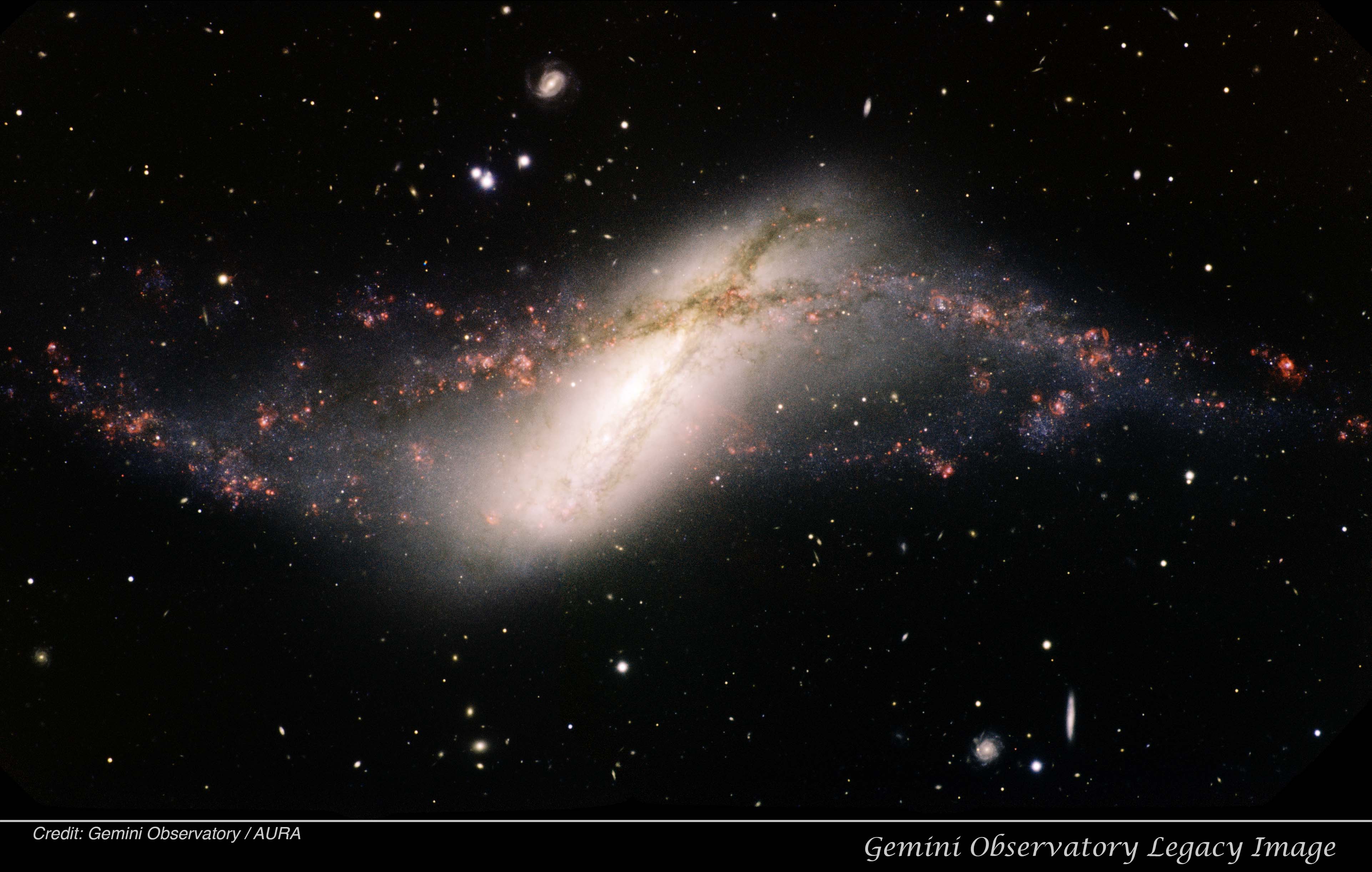
Poetry in Motion: Rare Polar Ring Galaxy Captured in New Image


This image of the ring galaxy NGC 660, captured with the Gemini Multi-Object Spectrograph on the Fredrick C. Gillett Gemini North telescope on Mauna Kea in Hawai‘i, was obtained in August of 2012. The optical image, made using g, r, I, and hydrogen alpha filters, were assigned the colors of blue, green, orange and red respectively. The field of view is 9.3x5.6 arcminutes and is oriented 8 degrees clockwise from north at right and east up. The total exposure (integration) time was 1,620 seconds cumulative for all filters.

Color composite produced by Travis Rector, University of Alaska Anchorage.  Credit: Gemini Observatory/AURA

Medium Resolution JPEG (643KB) | Full Resolution JPEG (11.6MB) | TIFF (53.5MB) 

These words, which open Shelley’s poem "When the Lamp is Shattered," employ visions of nature to symbolize life in decay and rebirth. It's as if he had somehow foreseen the creation of this new Gemini Legacy image, and penned a caption for it. What Gemini has captured is nothing short of poetry in motion: the colorful and dramatic tale of a life-and-death struggle between two galaxies interacting. All the action appears in a single frame, with the stunning polar-ring galaxy NGC 660 as the focus of attention. 

Polar-ring galaxies are peculiar objects. Astronomers have found only a handful of them, so not much is known about their origins. Most have an early-type spiral system, called a lenticular galaxy, as the central showpiece. But NGC 660, which lies about 40 million light-years distant toward the direction of Pisces the Fishes, is the only polar-ring galaxy known with what is called a late-type lenticular galaxy as its host. All, however, display a ring of stars, dust, and gas that extends tens of thousands of light-years across space along an orbit nearly perpendicular to the main disk. 

Models of how polar-ring galaxies form offer two general formation scenarios: 1) a piercing merger between two galaxies aligned roughly at right angles, or 2) when the host galaxy tidally strips material from a passing gas-rich spiral and strews it into a ring. 

What you see in this new Gemini Legacy image, then, is not a single dynamic body but either the “bloody” aftermath of one galaxy piercing the heart of another or the remains of a furious tidal struggle between two galaxies that shattered one galaxy’s "lamp," scattered its dust and gas, and formed a colorful, 40,000-light-year-long ring of visual glory. 

Born of Violence

Brian Svoboda of the University of Arizona, who recently studied the chemical and temperature environment of NGC 660, believes that unique morphology arises from a previous interaction with a gas-rich galaxy. The geometry of NGC 660 –– an enormous edge-on polar ring (some 40,000 light-years across) –– contains more gas (and associated star formation) than its host, which strongly suggests a violent formation. "One of the main characteristics of NGC 660 is that the ring is not truly polar, but is inclined ~45 degrees from the plane of the disk,” Svoboda points out. “The simulations for the piercing mergers cannot reproduce these low inclination polar rings; however, the tidal accretion scenario can." 

NGC 660’s polar ring resolves into hundreds of objects, a considerable part of which are blue and red supergiant stars. The youngest detected stars in the ring formed only about 7 million years ago, indicating a long, ongoing process. 

"Gemini's incredible definition of the active star forming regions strewn through the polar ring in NGC 660, juxtaposed against the exquisite crossing dust lanes, is simply beautiful. It really is the most incredible picture I've seen of the galaxy," Svoboda exclaims. "None of the other images I've seen, including those from the Hubble Space Telescope, show the star forming regions with such clarity." 

Weighing the Evidence

If NGC represents a merging of two galaxies, astronomer would expect to find a collapsed core and a burst of star formation, which they do see. But the monkey wrench is the uniquely high gas content of both NGC 660’s disk component and its polar ring. 

"A tidal accretion event will place gas in the polar ring without strongly interacting with the original gas rich host," Svoboda explains. "Tidal interaction is consistent with an influx of gas into the nuclear region creating the starburst that we observe now." Further evidence, he says, is NGC 660's lack of a double nucleus (i.e. two super-massive black holes), which one would expect from a merger. 

Astronomers have not detected any "tails" extending from NGC 660, a key signature of many tidal interactions. Usually, when galaxy passes close to another, tidal forces eject stars, gas, and dust into a graceful tail of extragalactic debris and stretched them far into space. But both polar-ring models have produced systems without tidal tails while creating active star formation in the polar ring. 

 While it can’t be proven with a great deal of confidence, in the case of NGC 660, Svoboda says, "I think that there is good evidence to suggest that the origin of the polar ring lies in the tidal accretion event scenario." Particularly he notes that the ring may be about 1 billion years old, so the stripped galaxy could have moved out of the field by the time of our observations now.

Life from Death?

Unseen to the eye, but bright at radio wavelengths, is a compact source (less than 32 light-years in extent) at the host’s core. Believed to be a super cluster of stars in a dense cloud of dust and gas, this powerful radio emitter contains perhaps a few thousand hot, blue youthful stars. 

Galaxies usually have a majority of old red stars at their cores, but one of the violent scenarios that created NGC 660 has triggered a furious burst of star formation at the galaxy’s core. Either way, the gravitational interaction between the two galaxies created shock waves that plowed into giant clouds of gas, causing them to collapse into behemoth blue stars, many likely containing more than 100 times the mass of our Sun. These monstrous, short-lived, stars exploded shortly thereafter as supernovae, which generated more shock waves, creating a domino effect that has ever since perpetuated the creation of youthful stars at NGC 660’s core. NGC 660, then, is not only a polar-ring galaxy but also a starburst galaxy. These systems are among the most dense and intense star-forming environments known. 

Probing Dark Matter

The ring in a polar-ring galaxy rotates at a speed comparable to that of its host galaxy. By determining how fast a polar ring rotates at different distances from the center of the system, astronomers can search for evidence of elusive and mysterious dark matter in NGC 660’s halo. Radio observations have shown that while the ring’s velocity close to NGC 660’s core is normal, the velocity in the ring’s outer parts remains consistent; theoretically the rotational velocity should have dropped off significantly due to the region’s gas-poor environment. This finding points to the existence of huge amounts of dark matter in NGC 660. 

Astronomers believe dark matter influences the dynamics of all galaxies. Yet understanding dark matter remains one of the astronomy’s greatest challenges. Further observations of the enigmatic environment of NGC 660 may shed more light on this … well … dark matter.

Gemini's mission is to advance our knowledge of the Universe by providing the international Gemini Community with forefront access to the entire sky.


The Gemini Observatory is an international collaboration with two identical 8-meter telescopes. The Frederick C. Gillett Gemini Telescope is located on Mauna Kea, Hawai'i (Gemini North) and the other telescope on Cerro Pachón in central Chile (Gemini South); together the twin telescopes provide full coverage over both hemispheres of the sky. The telescopes incorporate technologies that allow large, relatively thin mirrors, under active control, to collect and focus both visible and infrared radiation from space. 

The Gemini Observatory provides the astronomical communities in seven partner countries with state-of-the-art astronomical facilities that allocate observing time in proportion to each country's contribution. In addition to financial support, each country also contributes significant scientific and technical resources. The national research agencies that form the Gemini partnership include: the US National Science Foundation (NSF), the UK Science and Technology Facilities Council (STFC), the Canadian National Research Council (NRC), the Chilean Comisión Nacional de Investigación Cientifica y Tecnológica (CONICYT), the Australian Research Council (ARC), the Argentinean Ministerio de Ciencia, Tecnología e Innovación Productiva, and the Brazilian Ministério da Ciência, Tecnologia e Inovação. The observatory is managed by the Association of Universities for Research in Astronomy, Inc. (AURA) under a cooperative agreement with the NSF. The NSF also serves as the executive agency for the international partnership.

Press Contact:

Peter Michaud
Gemini Observatory
Hilo, HI 96720
Office: +1 (808) 974-2510
Cell: +1 (808) 936-6643
pmichaud@gemini.edu

Thursday, October 18, 2012

Heliophysics Nugget: Gradient Sun


Heliophysics nuggets are a collection of early science results, research techniques and instrument updates that further our attempt to understand the sun and the dynamic space weather system that surrounds Earth.

The image on the left shows the sun on Feb. 24, 2011 as observed by NASA's Solar Dynamics Observatory. The image shows light emitted by million degree plasma, a temperature that is particularly good at highlighting fine arcs in the sun's atmosphere called coronal loops. The image on the right shows the same image after being processed with a gradient filter that enhances the loops even more for research purposes. Credit: NASA/A. Young.


 Watching a particularly beautiful movie of the sun helps show how the lines between science and art can sometimes blur. But there is more to the connection between the two disciplines: science and art techniques are often quite similar, indeed one may inform the other or be improved based on lessons from the other arena. One such case is a technique known as a "gradient filter" – recognizable to many people as an option available on a photo-editing program. Gradients are, in fact, a mathematical description that highlights the places of greatest physical change in space. A gradient filter, in turn, enhances places of contrast, making them all the more obviously different, a useful tool when adjusting photos.

Scientists, too, use gradient filters to enhance contrast, using them to accentuate fine structures that might otherwise be lost in the background noise. On the sun, for example, scientists wish to study a phenomenon known as coronal loops, which are giant arcs of solar material constrained to travel along that particular path by the magnetic fields in the sun's atmosphere. These loops can vary in complexity over the sun's 11-year activity cycle, becoming more or less intertwined and inter-connected. Observations of this phenomena can help researchers understand what's happening with the sun's complicated magnetic fields that can also power great eruptions on the sun such as the solar flares or coronal mass ejections. The images above show an unfiltered image from the sun next to one that has been processed using a gradient filter. Note how the coronal loops are sharp and defined, making them all the more easy to study.


Using a gradient filter on imagery captured by NASA's Solar Dynamics Observatory (SDO) helped create this stunning display of sharply defined coronal loops on the sun next to fuzzier, cooler areas that are sometimes referred to as "moss" due to their moss-like appearance. Credit: NASA/Goddard Space Flight Center . Download video

Figuring out how to best process scientific imagery takes experts of all types working together to devise the new and improved methods. For example, experts in statistics, computer recognition and image processing have all come together regularly for the last nine years at Solar Information Processing workshops to focus on sharing state-of-the-art imaging techniques that can best further scientific research.

And, of course, gradients also make great art. Through careful adjustment of gradient algorithms on this movie from NASA's Solar Dynamics Observatory, sharp loops of solar material on the sun pop out visually next to more fuzzy areas in the sun's atmosphere, providing a dazzling show.

Karen C. Fox
NASA Goddard Space Flight Center, Greenbelt, MD

Jupiter: Turmoil from Below, Battering from Above


Images in the visible-light and infrared parts of the spectrum highlight the massive changes roiling the atmosphere of Jupiter. Image credit: NASA/IRTF/JPL-Caltech/NAOJ/A. Wesley/A. Kazemoto/C. Go . Full image and caption

Jupiter has been suffering more impacts over the last four years than ever previously observed, including this meteoroid impact on Sept. 10, 2012. Image credit: NASA/IRTF/JPL-Caltech/G. Hall/University of the Basque Country .   Full image and caption - enlarge image

Jupiter, the mythical god of sky and thunder, would certainly be pleased at all the changes afoot at his namesake planet. As the planet gets peppered continually with small space rocks, wide belts of the atmosphere are changing color, hotspots are vanishing and reappearing, and clouds are gathering over one part of Jupiter, while dissipating over another. The results were presented today by Glenn Orton, a senior research scientist at NASA's Jet Propulsion Laboratory, Pasadena, Calif., at the American Astronomical Society's Division for Planetary Sciences Meeting in Reno, Nev.

 "The changes we're seeing in Jupiter are global in scale," Orton said. "We've seen some of these before, but never with modern instrumentation to clue us in on what's going on. Other changes haven't been seen in decades, and some regions have never been in the state they're appearing in now. At the same time, we've never seen so many things striking Jupiter. Right now, we're trying to figure out why this is all happening."

 Orton and colleagues Leigh Fletcher of the University of Oxford, England; Padma Yanamandra-Fisher of the Space Science Institute, Boulder, Colo.; Thomas Greathouse of Southwest Research Institute, San Antonio; and Takuyo Fujiyoshi of the Subaru Telescope, National Astronomical Observatory of Japan, Hilo, Hawaii, have been taking images and maps of Jupiter at infrared wavelengths from 2009 to 2012 and comparing them with high-quality visible images from the increasingly active amateur astronomy community. Following the fading and return of a prominent brown-colored belt just south of the equator, called the South Equatorial Belt, from 2009 to 2011, the team studied a similar fading and darkening that occurred at a band just north of the equator, known as the North Equatorial Belt. This belt grew whiter in 2011 to an extent not seen in more than a century. In March of this year, that northern band started to darken again.

 The team obtained new data from NASA's Infrared Telescope Facility and the Subaru Telescope on Mauna Kea that matched up that activity with infrared observations. Those data showed a simultaneous thickening of the deeper cloud decks, but not necessarily the upper cloud deck, unlike the South Equatorial Belt, where both levels of clouds thickened and then cleared up. The infrared data also resolved brown, elongated features in the whitened area called "brown barges" as distinct features and revealed them to be regions clearer of clouds and probably characterized by downwelling, dry air.

The team was also looking out for a series of blue-gray features along the southern edge of the North Equatorial Belt. Those features appear to be the clearest and driest regions on the planet and show up as apparent hotspots in the infrared view, because they reveal the radiation emerging from a very deep layer of Jupiter's atmosphere. (NASA's Galileo spacecraft sent a probe into one of these hotspots in 1995.) Those hotspots disappeared from 2010 to 2011, but had reestablished themselves by June of this year, coincident with the whitening and re-darkening of the North Equatorial Belt.

While Jupiter's own atmosphere has been churning through change, a number of objects have hurtled into Jupiter's atmosphere, creating fireballs visible to amateur Jupiter watchers on Earth. Three of these objects - probably less than 45 feet (15 meters) in diameter - have been observed since 2010. The latest of these hit Jupiter on Sept. 10, 2012, although Orton and colleagues' infrared investigations of these events showed this one did not cause lasting changes in the atmosphere, unlike those in 1994 or 2009.

"It does appear that Jupiter is taking an unusual beating over the last few years, but we expect that this apparent increase has more to do with an increasing cadre of skilled amateur astronomers training their telescopes on Jupiter and helping scientists keep a closer eye on our biggest planet," Orton said. "It is precisely this coordination between the amateur-astronomy community that we want to foster."

The California Institute of Technology, Pasadena, operates the Jet Propulsion Laboratory for NASA.

Jia-Rui Cook 818-354-0850
Jet Propulsion Laboratory, Pasadena, Calif.
jccook@jpl.nasa.gov


Wednesday, October 17, 2012

INTEGRAL finds titanium in supernova remnant 1987A

INTEGRAL view of supernova remnant 1987A (on the right) and two adjacent high-energy sources. Credit: ESA/INTEGRAL/IBIS-ISGRI/S. Grebenev et al .  Hi-Res [jpg]

INTEGRAL observations of SNR 1987A in three hard X-ray energy bands: the signal from the supernova remnant, detected only in the central band (65-82 keV), is produced by the decay of titanium-44.  Credit: ESA/INTEGRAL/IBIS-ISGRI/S. Grebenev et al .  High-Res

 Hubble image of SNR 1987A at optical wavelengths.
Credit: ESA/Hubble & NASA .
Wallpaper [jpg]

Astronomers using INTEGRAL have detected the first direct signature of titanium-44 in the remnant of the nearby supernova 1987A. The discovery reveals a large amount of this key isotope in the remnant, equivalent to 0.03 per cent the mass of the Sun. This value is close to upper bounds from theoretical predictions and exceeds the amount of titanium-44 observed in Cassiopeia A - the only other supernova remnant where this isotope has been found. The amount of titanium-44 found in SNR 1987A demonstrates that its radioactive decay has been powering the source for the past 22 years.

Stars are the tireless furnaces of the Universe. They spend most of their lives burning hydrogen into helium in their cores. However, towards the end of their lives, the most massive stars reach such high temperatures that nuclear fusion of heavier elements becomes possible. This causes the star's core to collapse and eventually leads to a supernova explosion. During these powerful explosions, the nuclei of many heavy elements that we find on Earth are synthesised: titanium, iron, cobalt, and nickel. Supernovae and their remnants represent a unique laboratory for astronomers to study how nucleosynthesis occurs in some of the most extreme cosmic environments.

When a star explodes as a supernova, it releases an amount of energy equivalent to the radiation output of an entire galaxy. Such a sudden boost in luminosity makes supernovae easy to spot, even in very distant galaxies. After the explosion, the brightness of a supernova remnant starts declining: the source is no longer powered by the initial energy of the explosion, but by the radioactive decay of some of the atomic nuclei produced during the supernova phase.

Just after the peak of its brightness, the power of a supernova remnant derives mainly from the decay of an isotope of nickel (nickel-56, or 56Ni) and, later, of cobalt (cobalt-56, or 56Co). Both of these isotopes have a rather short half-life and start decaying on timescales of a few to several hundreds of days. In the long run, however, astronomers believe that the source of power is the decay of an isotope of titanium (titanium-44, or 44Ti). With a half-life of about 60 years, titanium-44 is able to keep supernova remnants shining from about three years after the explosion until the ejected material begins to interact with the circumstellar matter.

The remnant of the famous supernova 1987A (SNR 1987A), first detected in February 1987, is an ideal test bed to monitor how the brightness of a supernova changes over a period of several years. It is located relatively close by, in the Large Magellanic Cloud, one of the Milky Way's satellite galaxies – at a distance of only about 166,000 light-years. For the past 25 years, it has been providing astronomers with plenty of data to test theoretical predictions about supernovae and their aftermath in great detail.

"We have now detected, for the first time, the direct signature of titanium-44 in SNR 1987A," comments Sergei Grebenev from the Space Research Institute at the Russian Academy of Science in Moscow, Russia. Grebenev is the first author of a paper reporting on the results, which is being published in the 18 October 2012 issue of Nature. "The discovery is based on over 1500 hours of observations performed at hard X-ray energies with ESA's INTEGRAL mission. Such a long exposure was crucial to achieve a clear detection," he adds.

The data analysed by Grebenev and his collaborators show a clear signal, corresponding to the position in the sky of this supernova remnant, in the spectral range between 65 and 82 keV, which brackets two emission lines produced during the decay of titanium-44, namely at 67.9 and 78.4 keV. In addition, the astronomers observed the same patch of the sky at slightly higher and at slightly lower energies, but did not detect any signal.

 "This demonstrates that the signal detected by INTEGRAL at 65–82 keV does arise from line emission," notes Chris Winkler, INTEGRAL Project Scientist at ESA and co-author of the Nature paper. Previous indications of the presence of titanium-44 in SNR 1987A were only indirect and had been inferred by combining observations in other portions of the electromagnetic spectrum with complex numerical modelling.

"Titanium-44 is synthesised, during the first instants of a supernova explosion, via the nuclear burning of silicon," explains Grebenev. From analysis of the INTEGRAL data, the astronomers have estimated the total mass of this isotope that must have been produced right after the collapse of the stellar core of the supernova's progenitor. It amounts to about 0.03 per cent of the mass of the Sun. Such a large amount of titanium-44 demonstrates that the radioactive decay of this isotope has been powering the supernova remnant at ultraviolet, visible and infrared wavelengths for the past 22 years. However, the interaction between the ejecta from the supernova and the surrounding material, which started several years after the explosion, represents an additional mechanism to power the remnant and produce emission at soft X-ray energies.

The amount of titanium-44 detected in SNR 1987A with INTEGRAL is very close to the highest values predicted from numerical simulations of nucleosynthesis in supernova explosions. Astronomers believe that the production of unusually large amounts of this isotope is possible in some particular configurations of the explosion – in particular, in supernova explosions with a complex and asymmetric geometry, such as SN1987A.

 Before now, titanium-44 had only been seen in one other supernova remnant – Cassiopeia A, which is about 400 years older than SNR 1987A. That discovery, made in 1994 with NASA's Compton Gamma Ray Observatory, was later confirmed using the Italian/Dutch BeppoSAX satellite and INTEGRAL. The amounts of titanium-44 found in these two remnants are comparable, although SNR 1987A seems to contain more than Cassiopeia A.
"The discovery of large amounts of titanium-44 in SN1987A confirms our previous suspicions that this supernova might have produced a significant quantity of this isotope," notes Winkler. Astronomers expect to find titanium-44 in more supernova remnants by analysing more data already collected with INTEGRAL.   
"These observations are broadening our understanding of the nucleosynthesis reactions that take place during the final stages of a massive star's life."

Notes for editors

The study presented here is based on data gathered with the IBIS/ISGRI hard X-ray telescope on board ESA's INTEGRAL observatory in 2010 and 2011. The total exposure time amounts to about 6 million seconds, equivalent to about 1650 hours.

Observations were performed in three narrow energy bands: 48-65, 65-82 and 82-99 keV. A signal corresponding to the position in the sky of the supernova remnant SNR 1987A was detected only in the 65-82 keV band, which encompasses two of the emission lines produced during the radioactive decay of the isotope titanium-44, at 67.9 and 78.4 keV, respectively.
The signal detected at 65-82 keV can be translated into the initial amount of titanium-44 that has been synthesised during the supernova explosion: M44 ~ (3.5±0.8) × 10-4 MSun. This value is close to the upper bounds of predictions from numerical simulations, suggesting that either nucleosynthesis in this supernova did not proceed in the canonical way to produce such a large amount of titanium-44 or that the accuracy of the simulations must be improved.
The results presented here are reported in the paper "Hard X-ray emission lines from the decay of 44Ti in the remnant of Supernova 1987A" by S. A. Grebenev, et al., to be published in the 18 October 2012 issue of the journal Nature.

INTEGRAL is an ESA project with instruments and science data centre funded by ESA Member States (especially the Principal Investigator countries: Denmark, France, Germany, Italy, Spain, Switzerland) and Poland, and with the participation of Russia and the USA.

 Contacts

Sergei A. Grebenev
 Space Research Institute
 Russian Academy of Science
 Moscow, Russia.
 Email:
sergei@hea.iki.rssi.ru
 Phone: +7-495-3332222

Chris Winkler
 INTEGRAL Project Scientist
 Research and Scientific Support Department
 Directorate of Science and Robotic Exploration
 ESA, The Netherlands
 Email:
cwinkler@rssd.esa.int
 Phone: +31-71-5653591

What's Baking on Titan?

 
NASA's Cassini spacecraft obtained this image of a feature shaped like a hot cross bun in the northern region of Titan (left) that bears a striking resemblance to a similar feature on Venus (right). Image Credit: NASA/JPL-Caltech/ASI . Full image and caption -  View unlabeled image

This image from NASA's Cassini spacecraft shows an ancient southern sea that used to sprawl out near the south pole of Saturn's moon Titan. Image Credit: NASA/JPL-Caltech/ASI/Proxemy Research.
 
These images obtained by NASA's Cassini spacecraft show Titan's stable northern lake district. Image Credit: NASA/JPL-Caltech/ASI .  Full image and caption  -  enlarge image

Radar images from NASA's Cassini spacecraft reveal some new curiosities on the surface of Saturn's mysterious moon Titan, including a nearly circular feature that resembles a giant hot cross bun and shorelines of ancient seas. The results were presented today at the American Astronomical Society's Division of Planetary Sciences conference in Reno, Nev. 

Steam from baking often causes the top of bread to lift and crack. Scientists think some similar process involving heat may be at play on Titan. The image showing the bun-like mound was obtained on May 22, 2012, by Cassini's radar instrument. Scientists have seen similar terrain on Venus, where a dome-shaped region about 20 miles (30 kilometers) across has been seen at the summit of a large volcano called Kunapipi Mons. They theorize that the Titan cross, which is about 40 miles (70 kilometers) long, is also the result of fractures caused by uplift from below, possibly the result of rising magma.
"The 'hot cross bun' is a type of feature we have not seen before on Titan, showing that Titan keeps surprising us even after eight years of observations from Cassini," said Rosaly Lopes, a Cassini radar team scientist based at NASA's Jet Propulsion Laboratory, Pasadena, Calif. "The 'bun' may be the result of what is known on Earth as a laccolith, an intrusion formed by magma pushing up from below. The Henry Mountains of Utah are well-known examples of this geologic phenomenon."
Another group of Cassini scientists, led by Ellen Stofan, who is based at Proxemy Research, Rectortown, Va., has been scrutinizing radar images of Titan's southern hemisphere. Titan is the only place other than Earth that has stable liquid on its surface, though the liquids on Titan are hydrocarbon rather than water. So far, vast seas have only been seen in Titan's northern hemisphere.
A new analysis of Cassini images collected from 2008 to 2011 suggests there were once vast, shallow seas at Titan's south pole as well. Stofan and colleagues have found two good candidates for dry or mostly dry seas. One of these dry seas appears to be about 300 by 170 miles (475 by 280 kilometers) across, and perhaps a few hundred feet (meters) deep. Ontario Lacus, the largest current lake in the south, sits inside of the dry shorelines, like a shrunken version of a once-mighty sea.
Scientists led by Oded Aharonson, another radar team member based at the California Institute of Technology in Pasadena, think that cycles analogous to Earth's Croll-Milankovich cycles, which explain climate changes in terms of the way Earth orbits around the sun, are at play on Titan, too. Such cycles on Titan would cause long-term transfer of liquid hydrocarbons from pole to pole. By this model, the south pole could have been covered with extensive seas less than 50,000 years ago.
"The seas on Titan are temporary hosts for experiments in prebiotic chemistry, and we know they are cycling from one hemisphere to the other over 100,000 years," said Stofan. "I'd love to get a closer look at the seas of the north or these dry seabeds to examine the extent to which this prebiotic chemistry has developed."
The Cassini team has confirmed some of the stability of Titan's northern seas by looking at radar images from Cassini taken about one Titan season (in this case, six Earth years) apart. The newer images, from May 22, 2012, on the same flyby as the hot cross bun images, show the shorelines stayed about the same, indicating the northern lakes are not transient weather events, in contrast to the temporary darkening of parts of the equator after a rainstorm in 2010.
The Cassini-Huygens mission is a cooperative project of NASA, the European Space Agency and ASI, the Italian Space Agency. NASA's Jet Propulsion Laboratory, a division of the California Institute of Technology in Pasadena, manages the mission for NASA's Science Mission Directorate, Washington. The Cassini orbiter was designed, developed and assembled at JPL. The RADAR instrument was built by JPL and the Italian Space Agency, working with team members from the US and several European countries. JPL is a division of the California Institute of Technology in Pasadena.

Jia-Rui C. Cook 818-354-0850
Jet Propulsion Laboratory, Pasadena, Calif.
jia-rui.c.cook@jpl.nasa.gov

Tuesday, October 16, 2012

Planet Found in Nearest Star System to Earth

Artist’s impression of the planet around Alpha Centauri B

 PR Image eso1241b
Artist’s impression of the planet around Alpha Centauri B (Annotated)

 PR Image eso1241d
Alpha Centauri in the constellation of Centaurus (The Centaur)
 
 PR Image eso1241e
The bright star Alpha Centauri and its surroundings 

Videos

A journey to Alpha Centauri

A fly-through of the Alpha Centauri system

ESO’s HARPS instrument finds Earth-mass exoplanet orbiting Alpha Centauri B 

European astronomers have discovered a planet with about the mass of the Earth orbiting a star in the Alpha Centauri system — the nearest to Earth. It is also the lightest exoplanet ever discovered around a star like the Sun. The planet was detected using the HARPS instrument on the 3.6-metre telescope at ESO’s La Silla Observatory in Chile. The results will appear online in the journal Nature on 17 October 2012.

Alpha Centauri is one of the brightest stars in the southern skies and is the nearest stellar system to our Solar System — only 4.3 light-years away. It is actually a triple star — a system consisting of two stars similar to the Sun orbiting close to each other, designated Alpha Centauri A and B, and a more distant and faint red component known as Proxima Centauri [1]. Since the nineteenth century astronomers have speculated about planets orbiting these bodies, the closest possible abodes for life beyond the Solar System, but searches of increasing precision had revealed nothing. Until now.

“Our observations extended over more than four years using the HARPS instrument and have revealed a tiny, but real, signal from a planet orbiting Alpha Centauri B every 3.2 days,” says Xavier Dumusque (Geneva Observatory, Switzerland and Centro de Astrofisica da Universidade do Porto, Portugal), lead author of the paper. “It’s an extraordinary discovery and it has pushed our technique to the limit!”

The European team detected the planet by picking up the tiny wobbles in the motion of the star Alpha Centauri B created by the gravitational pull of the orbiting planet [2]. The effect is minute — it causes the star to move back and forth by no more than 51 centimetres per second (1.8 km/hour), about the speed of a baby crawling. This is the highest precision ever achieved using this method.

Alpha Centauri B is very similar to the Sun but slightly smaller and less bright. The newly discovered planet, with a mass of a little more than that of the Earth [3], is orbiting about six million kilometres away from the star, much closer than Mercury is to the Sun in the Solar System. The orbit of the other bright component of the double star, Alpha Centauri A, keeps it hundreds of times further away, but it would still be a very brilliant object in the planet’s skies.

The first exoplanet around a Sun-like star was found by the same team back in 1995 and since then there have been more than 800 confirmed discoveries, but most are much bigger than the Earth, and many are as big as Jupiter [4]. The challenge astronomers now face is to detect and characterise a planet of mass comparable to the Earth that is orbiting in the habitable zone [5] around another star. The first step has now been taken [6].

“This is the first planet with a mass similar to Earth ever found around a star like the Sun. Its orbit is very close to its star and it must be much too hot for life as we know it,” adds Stéphane Udry (Geneva Observatory), a co-author of the paper and member of the team, “but it may well be just one planet in a system of several. Our other HARPS results, and new findings from Kepler, both show clearly that the majority of low-mass planets are found in such systems.”

“This result represents a major step towards the detection of a twin Earth in the immediate vicinity of the Sun. We live in exciting times!” concludes Xavier Dumusque.
ESO will hold an online press conference offering journalists the opportunity to discuss the result and its impact with the scientists. To participate please read our media advisory.

Notes

[1] The components of a multiple star are named by adding uppercase letters to the name of the star. Alpha Centauri A is the brightest component, Alpha Centauri B is the slightly fainter second star and Alpha Centauri C is the much fainter Proxima Centauri. Proxima Centauri is slightly closer to Earth than A or B and hence is formally the closest star.

[2] HARPS measures the radial velocity of a star — its speed towards or away from the Earth — with extraordinary precision. A planet in orbit around a star causes the star to regularly move towards and away from a distant observer on Earth. Due to the Doppler effect, this radial velocity change induces a shift of the star’s spectrum towards longer wavelengths as it moves away (called a redshift) and a blueshift (towards shorter wavelengths) as it approaches. This tiny shift of the star’s spectrum can be measured with a high-precision spectrograph such as HARPS and used to infer the presence of a planet.

[3] Using the radial velocity method, astronomers can only estimate a minimum mass for a planet as the mass estimate also depends on the tilt of the orbital plane relative to the line of sight, which is unknown. But, from a statistical point of view, this minimum mass is often close to the real mass of the planet.

[4] NASA’s Kepler mission has found 2300 candidate planets using an alternative method — searching for the slight drop in the brightness of a star as a planet passes in front of it (transits) and blocks some of the light. The majority of planet candidates detected by this transit method are very distant from us. But, in contrast, the planets found by HARPS are around stars close to the Sun — with the new discovery being the closest yet. This makes them better targets for many kinds of additional follow-up observations such as characterising the planet’s atmosphere.

[5] The habitable zone is a narrow annular region around a star in which water may be present in liquid form if conditions are right.

[6] ESPRESSO, the Echelle SPectrograph for Rocky Exoplanet and Stable Spectroscopic Observations, is to be installed on the ESO Very Large Telescope. Currently undergoing final design, it is scheduled to start operating in late-2016 or early-2017. ESPRESSO will feature radial velocity precision of 0.35 km/hour or less. For comparison, Earth induces a 0.32 km/hour radial velocity on the Sun. This resolution should thus enable ESPRESSO to discover Earth-mass planets in the habitable zone. The ESPRESSO consortium is led by team members responsible for the current discovery.

More information

This research was presented in a paper “An Earth mass planet orbiting Alpha Centauri B”, to appear online in the journal Nature on 17 October 2012.

The team is composed of Xavier Dumusque (Observatoire de Genève, Switzerland; Centro de Astrofisica da Universidade do Porto, Portugal), Francesco Pepe (Observatoire de Genève), Christophe Lovis (Observatoire de Genève), Damien Ségransan (Observatoire de Genève), Johannes Sahlmann (Observatoire de Genève), Willy Benz (Universität Bern, Switzerland), François Bouchy (Observatoire de Genève; Institut d’Astrophysique de Paris, France), Michel Mayor (Observatoire de Genève), Didier Queloz (Observatoire de Genève), Nuno Santos (Centro de Astrofisica da Universidade do Porto) and Stéphane Udry (Observatoire de Genève).

The year 2012 marks the 50th anniversary of the founding of the European Southern Observatory (ESO). ESO is the foremost intergovernmental astronomy organisation in Europe and the world’s most productive ground-based astronomical observatory by far. It is supported by 15 countries: Austria, Belgium, Brazil, the Czech Republic, Denmark, France, Finland, Germany, Italy, the Netherlands, Portugal, Spain, Sweden, Switzerland and the United Kingdom. ESO carries out an ambitious programme focused on the design, construction and operation of powerful ground-based observing facilities enabling astronomers to make important scientific discoveries. ESO also plays a leading role in promoting and organising cooperation in astronomical research. ESO operates three unique world-class observing sites in Chile: La Silla, Paranal and Chajnantor. At Paranal, ESO operates the Very Large Telescope, the world’s most advanced visible-light astronomical observatory and two survey telescopes. VISTA works in the infrared and is the world’s largest survey telescope and the VLT Survey Telescope is the largest telescope designed to exclusively survey the skies in visible light. ESO is the European partner of a revolutionary astronomical telescope ALMA, the largest astronomical project in existence. ESO is currently planning the 39-metre European Extremely Large optical/near-infrared Telescope, the E-ELT, which will become “the world’s biggest eye on the sky”.

Links

Contacts

Xavier Dumusque
Observatoire de l’Université de Genève
Switzerland
Tel: +41 22 379 22 64
Email: xavier.dumusque@unige.ch

Stéphane Udry
Observatoire de l’Université de Genève
Switzerland
Tel: +41 22 379 24 67
Email: stephane.udry@unige.ch

Willy Benz
Center for Space and Habitability
Bern, Switzerland
Email: willy.benz@space.unibe.ch

Francesco Pepe
Observatoire de l’Université de Genève
Switzerland
Tel: +41 223 792 396
Cell: +41 79 302 47 40
Email: francesco.pepe@unige.ch

Damien Ségransan
Observatoire de l’Université de Genève
Switzerland
Tel: +41 223 792 479
Email: damien.segransan@unige.ch

Nuno Santos
Centro de Astrofisica da Universidade do Porto
Porto, Portugal
Tel: +351 226 089 893
Email: Nuno.Santos@astro.up.pt

Richard Hook
ESO, La Silla, Paranal, E-ELT and Survey Telescopes Public Information Officer
Garching bei München, Germany
Tel: +49 89 3200 6655
Cell: +49 151 1537 3591
Email: rhook@eso.org