Tuesday, December 06, 2011

A Tale of Tails

RSCG 42 group
A visible light image of the RSCG 42 group of galaxies (CGCG 097−026, CGCG 097−027 and Mrk 0182) in Abell 1367. This is based on a composite of images taken from the Sloan Digital Sky Survey through three colour filters. The white contours show the neutral hydrogen distribution, with the highest contour coinciding with the spiral galaxy GCGC 97-026 and a huge gas tail emanating from this galaxy in a north-easterly direction. Four other galaxies in the RSCG 42 group have associated neutral hydrogen here marked by contour lines. http://amiga.iaa.es/files/97026_ugr300-2.jpg

FGC 1287 group
A visible light image of the FGC 1287 group of galaxies in Abell 1367. This is based on a composite of images taken from the Sloan Digital Sky Survey through three colour filters. The white contours show the neutral hydrogen distribution. The huge gas tail emanates from the edge on spiral galaxy FGC 1287. Two other members of the group have associated neutral hydrogen here marked by contour lines. http://amiga.iaa.es/files/fgc1287_ugr300-1.jpg

Wide angle view of Abell 1367
Image showing a wide angle view of Abell 1367 and the positions of the RSCG 42 and FGC 1287 groups. The cyan contours trace the X-ray emission from the hot intra-cluster gas at the centre of the cluster and the white contours show the cold neutral hydrogen gas detected in the two groups. http://amiga.iaa.es/files/figPR.jpg

Clusters of galaxies are the biggest structures in the Universe that are held together by gravity. They are like a huge metropolis populated by galaxies that interact with one another and with their environment, the hot gas trapped within the cluster's gravitational field. In the last few decades, astronomers have revealed that, in order to enjoy life in these big cities, galaxies have to pay an entrance fee: they are stripped of their cold hydrogen gas when they enter.

Without this gas, the fuel for future star formation, they age much more quickly than their counterparts who shun the big conurbations. Scientists believe that this is why clusters of galaxies have a significantly larger fraction of passive, quiescent objects where stars are no longer forming than is found in lower density environments. The research by Scott and his team might change this view, showing that galaxies can be robbed of their gas reservoir well before reaching the outskirts of the metropolis.

The astronomers made their discovery after using the Expanded Very Large Array (EVLA) of the National Radio Astronomy Observatory (NRAO) in the USA to study Abell 1367 in detail. "When we looked at the data, we were amazed to see these tail structures" says Tom Scott.

'The projected lengths of the gaseous tails are 9 to 10 times that of the size of the parent galaxies, i.e., 520,000 and 815,000 light years respectively. In both cases the amount of cold hydrogen gas in the tails is approximately the same as that remaining in the galaxy's disk. In other words, these galaxies have already left behind half of their fuel for star formation before entering the sphere of influence of the cluster."

The commonly accepted scenario invoked to explain the loss of gas in galaxies is based on the idea that when galaxies enter a big cluster, they lose their gas interacting with the hot intra-cluster medium. Like a meteor entering the Earth's atmosphere, the atomic hydrogen is stripped by the pressure that builds up from moving through the dense, hot gas that pervades the cluster, the stripped gas being dispersed within the intergalactic medium. Scientists call this mechanism ram-pressure stripping.

However, in this case, the perturbed galaxies are still well outside the sphere of influence of this cluster medium and it is not clear which mechanism is responsible for these unique gas tails.

"We considered the various physical processes proposed by theorists in the past to describe gas removal from galaxies, but no one seems to be able to explain our observations" says Luca Cortese, researcher at ESO-Garching, Germany, and co-author of this work. "Whereas in the case of CGCG97-026, the gravitational interaction between the various members of the group could explain what we see, FGC1287 is completely different from any case we have seen before."

Indeed, ram pressure stripping does not seem to be a viable explanation in this case. As this galaxy is located in the outskirts of the cluster, it lies beyond what is thought to be the sphere of influence of the hot and diffuse gas in Abell 1367. To make things even more complicated, gravitational interactions are apparently unable to explain the extraordinary length of the tail and the lack of any sign of disturbance in the stellar body of the galaxy.

The origin of these extraordinary tails still remains a puzzle for scientists, and they perhaps require some physical mechanism that has not been considered before.

"Although the mechanism responsible for this extraordinary gas tail remains to be determined, our discovery highlights how much there still is to learn about environmental effects in galaxy groups" says team member Elias Brinks, a scientist at the University of Hertfordshire. "This discovery might open a new chapter in our understanding of environmental effects on galaxy evolution."


SCIENCE CONTACTS

T. C. Scott
Instituto de Astrofísica de Andalucía (CSIC)
Granada
Spain
Tel: +34 958 121 311
Email: tom@iaa.es

L. Cortese
European Southern Observatory
Germany
Tel: +49 (0)89 3200 6610
Email: lcortese@eso.org

E. Brinks
Centre for Astrophysics Research
University of Hertfordshire
UK
Tel: +44 (0)1707 286072
Email: e.brinks@herts.ac.uk


MEDIA CONTACTS

Robert Massey
Royal Astronomical Society
Tel: +44 (0)20 7734 3307 x214
Mob: +44 (0)794 124 8035
Email: rm@ras.org.uk


FURTHER INFORMATION

The new research appears in "Two long tails in the outskirts of Abell 1367", Scott T., Cortese L., Brinks E., Bravo-Alfaro H., Auld R. and Minchin R., Monthly Notices of the Royal Astronomical Society, in press. A preprint of the paper can be seen at http://arxiv.org/abs/1111.7144


NOTES FOR EDITORS

The National Radio Astronomy Observatory is a facility of the National Science Foundation operated under cooperative agreement by Associated Universities, Inc.


The Royal Astronomical Society (RAS, www.ras.org.uk), founded in 1820, encourages and promotes the study of astronomy, solar-system science, geophysics and closely related branches of science. The RAS organizes scientific meetings, publishes international research and review journals, recognizes outstanding achievements by the award of medals and prizes, maintains an extensive library, supports education through grants and outreach activities and represents UK astronomy nationally and internationally. Its more than 3500 members (Fellows), a third based overseas, include scientific researchers in universities, observatories and laboratories as well as historians of astronomy and others.

Follow the RAS on Twitter via @royalastrosoc

Monday, December 05, 2011

NASA's Voyager Hits New Region at Solar System Edge

Artist concept of Voyager 1 encountering a stagnation region
Full image and caption

PASADENA, Calif. -- NASA's Voyager 1 spacecraft has entered a new region between our solar system and interstellar space. Data obtained from Voyager over the last year reveal this new region to be a kind of cosmic purgatory. In it, the wind of charged particles streaming out from our sun has calmed, our solar system's magnetic field is piled up, and higher-energy particles from inside our solar system appear to be leaking out into interstellar space.

"Voyager tells us now that we're in a stagnation region in the outermost layer of the bubble around our solar system," said Ed Stone, Voyager project scientist at the California Institute of Technology in Pasadena. "Voyager is showing that what is outside is pushing back. We shouldn't have long to wait to find out what the space between stars is really like."

Although Voyager 1 is about 11 billion miles (18 billion kilometers) from the sun, it is not yet in interstellar space. In the latest data, the direction of the magnetic field lines has not changed, indicating Voyager is still within the heliosphere, the bubble of charged particles the sun blows around itself. The data do not reveal exactly when Voyager 1 will make it past the edge of the solar atmosphere into interstellar space, but suggest it will be in a few months to a few years.

The latest findings, described today at the American Geophysical Union's fall meeting in San Francisco, come from Voyager's Low Energy Charged Particle instrument, Cosmic Ray Subsystem and Magnetometer.

Scientists previously reported the outward speed of the solar wind had diminished to zero in April 2010, marking the start of the new region. Mission managers rolled the spacecraft several times this spring and summer to help scientists discern whether the solar wind was blowing strongly in another direction. It was not. Voyager 1 is plying the celestial seas in a region similar to Earth's doldrums, where there is very little wind.

During this past year, Voyager's magnetometer also detected a doubling in the intensity of the magnetic field in the stagnation region. Like cars piling up at a clogged freeway off-ramp, the increased intensity of the magnetic field shows that inward pressure from interstellar space is compacting it.

Voyager has been measuring energetic particles that originate from inside and outside our solar system. Until mid-2010, the intensity of particles originating from inside our solar system had been holding steady. But during the past year, the intensity of these energetic particles has been declining, as though they are leaking out into interstellar space. The particles are now half as abundant as they were during the previous five years.

At the same time, Voyager has detected a 100-fold increase in the intensity of high-energy electrons from elsewhere in the galaxy diffusing into our solar system from outside, which is another indication of the approaching boundary.

"We've been using the flow of energetic charged particles at Voyager 1 as a kind of wind sock to estimate the solar wind velocity," said Rob Decker, a Voyager Low-Energy Charged Particle Instrument co-investigator at the Johns Hopkins University Applied Physics Laboratory in Laurel, Md. "We've found that the wind speeds are low in this region and gust erratically. For the first time, the wind even blows back at us. We are evidently traveling in completely new territory. Scientists had suggested previously that there might be a stagnation layer, but we weren't sure it existed until now."

Launched in 1977, Voyager 1 and 2 are in good health. Voyager 2 is 9 billion miles (15 billion kilometers) away from the sun.

The Voyager spacecraft were built by NASA's Jet Propulsion Laboratory in Pasadena, Calif., which continues to operate both. JPL is a division of the California Institute of Technology. The Voyager missions are a part of the NASA Heliophysics System Observatory, sponsored by the Heliophysics Division of the Science Mission Directorate in Washington. For more information about the Voyager spacecraft, visit: http://www.nasa.gov/voyager .

For more information about NASA media events at the American Geophysical Union meeting, visit: http://www.nasa.gov/agu .

Jia-Rui C. Cook/Alan Buis 818-354-0850/818-653-8339
Jet Propulsion Laboratory, Pasadena, Calif.
jccook@jpl.nasa.gov/alan.d.buis@jpl.nasa.gov

Steve Cole 202-358-0918
NASA Headquarters, Washington
stephen.e.cole@nasa.gov

NASA's Kepler Mission Confirms Its First Planet in Habitable Zone of Sun-like Star

This artist's conception illustrates Kepler-22b, a planet known to comfortably circle in the habitable zone of a sun-like star. Image credit: NASA/Ames/JPL-Caltech. Click here for multiple resolutions.

This diagram compares our own solar system to Kepler-22, a star system containing the first "habitable zone" planet discovered by NASA's Kepler mission. Image credit: NASA/Ames/JPL-Caltech. Click here for multiple resolutions.

NASA's Kepler mission has confirmed its first planet in the "habitable zone," the region where liquid water could exist on a planet’s surface. Kepler also has discovered more than 1,000 new planet candidates, nearly doubling its previously known count. Ten of these candidates are near-Earth-size and orbit in the habitable zone of their host star. Candidates require follow-up observations to verify they are actual planets.

The newly confirmed planet, Kepler-22b, is the smallest yet found to orbit in the middle of the habitable zone of a star similar to our sun. The planet is about 2.4 times the radius of Earth. Scientists don't yet know if Kepler-22b has a predominantly rocky, gaseous or liquid composition, but its discovery is a step closer to finding Earth-like planets.

Previous research hinted at the existence of near-Earth-size planets in habitable zones, but clear confirmation proved elusive. Two other small planets orbiting stars smaller and cooler than our sun recently were confirmed on the very edges of the habitable zone, with orbits more closely resembling those of Venus and Mars.

"This is a major milestone on the road to finding Earth's twin," said Douglas Hudgins, Kepler program scientist at NASA Headquarters in Washington. "Kepler's results continue to demonstrate the importance of NASA's science missions, which aim to answer some of the biggest questions about our place in the universe."

Kepler discovers planets and planet candidates by measuring dips in the brightness of more than 150,000 stars to search for planets that cross in front, or "transit," the stars. Kepler requires at least three transits to verify a signal as a planet.

"Fortune smiled upon us with the detection of this planet," said William Borucki, Kepler principal investigator at NASA Ames Research Center at Moffett Field, Calif., who led the team that discovered Kepler-22b. "The first transit was captured just three days after we declared the spacecraft operationally ready. We witnessed the defining third transit over the 2010 holiday season."

The Kepler science team uses ground-based telescopes and the Spitzer Space Telescope to review observations on planet candidates the spacecraft finds. The star field that Kepler observes in the constellations Cygnus and Lyra can only be seen from ground-based observatories in spring through early fall. The data from these other observations help determine which candidates can be validated as planets.

Kepler-22b is located 600 light-years away. While the planet is larger than Earth, its orbit of 290 days around a sun-like star resembles that of our world. The planet's host star belongs to the same class as our sun, called G-type, although it is slightly smaller and cooler.

Of the 54 habitable zone planet candidates reported in February 2011, Kepler-22b is the first to be confirmed. This milestone will be published in The Astrophysical Journal.

The Kepler team is hosting its inaugural science conference at Ames Dec. 5-9, announcing 1,094 new planet candidate discoveries. Since the last catalog was released in February, the number of planet candidates identified by Kepler has increased by 89 percent and now totals 2,326. Of these, 207 are approximately Earth-size, 680 are super Earth-size, 1,181 are Neptune-size, 203 are Jupiter-size and 55 are larger than Jupiter.

The findings, based on observations conducted May 2009 to September 2010, show a dramatic increase in the numbers of smaller-size planet candidates.

Kepler observed many large planets in small orbits early in its mission, which were reflected in the February data release. Having had more time to observe three transits of planets with longer orbital periods, the new data suggest that planets one to four times the size of Earth may be abundant in the galaxy.

The number of Earth-size and super Earth-size candidates has increased by more than 200 and 140 percent since February, respectively.

There are 48 planet candidates in their star's habitable zone. While this is a decrease from the 54 reported in February, the Kepler team has applied a stricter definition of what constitutes a habitable zone in the new catalog, to account for the warming effect of atmospheres, which would move the zone away from the star, out to longer orbital periods.

"The tremendous growth in the number of Earth-size candidates tells us that we're honing in on the planets Kepler was designed to detect: those that are not only Earth-size, but also are potentially habitable," said Natalie Batalha, Kepler deputy science team lead at San Jose State University in San Jose, Calif. "The more data we collect, the keener our eye for finding the smallest planets out at longer orbital periods."

NASA's Ames Research Center manages Kepler's ground system development, mission operations and science data analysis. NASA's Jet Propulsion Laboratory in Pasadena, Calif., managed Kepler mission development.

Ball Aerospace and Technologies Corp. in Boulder, Colo., developed the Kepler flight system and supports mission operations with the Laboratory for Atmospheric and Space Physics at the University of Colorado in Boulder.

The Space Telescope Science Institute in Baltimore archives, hosts and distributes the Kepler science data. Kepler is NASA's 10th Discovery Mission and is funded by NASA's Science Mission Directorate at the agency's headquarters.

Related links:
- NASA’s Kepler Mission
- Kepler Science Conference News Briefing Press Kit
- NASA’s Ames Research Center


Michele Johnson, 650-604-4789
NASA Ames Research Center
michele.johnson@nasa.gov

VLT Finds Fastest Rotating Star

PR Image eso1147a
VFTS 102: the fastest rotating star

PR Image eso1147b
Artist’s impression of the fastest rotating star

VFTS 102: the fastest rotating massive star (unannotated)

Wide-field view of the sky around VFTS 102: the fastest rotating massive star

ESO's Very Large Telescope has picked up the fastest rotating star found so far. This massive bright young star lies in our neighbouring galaxy, the Large Magellanic Cloud, about 160 000 light-years from Earth. Astronomers think that it may have had a violent past and has been ejected from a double star system by its exploding companion.

An international team of astronomers has been using ESO’s Very Large Telescope at the Paranal Observatory in Chile, to make a survey of the heaviest and brightest stars in the Tarantula Nebula (eso1117), in the Large Magellanic Cloud. Among the many brilliant stars in this stellar nursery the team has spotted one, called VFTS 102 [1], that is rotating at more than two million kilometres per hour — more than three hundred times faster than the Sun [2] and very close to the point at which it would be torn apart due to centrifugal forces. VFTS 102 is the fastest rotating star known to date [3].

The astronomers also found that the star, which is around 25 times the mass of the Sun and about one hundred thousand times brighter, was moving through space at a significantly different speed from its neighbours [4].

“The remarkable rotation speed and the unusual motion compared to the surrounding stars led us to wonder if this star had had an unusual early life. We were suspicious.” explains Philip Dufton (Queen’s University Belfast, Northern Ireland, UK), lead author of the paper presenting the results.

This difference in speed could imply that VFTS 102 is a runaway star — a star that has been ejected from a double star system after its companion exploded as a supernova. This idea is supported by two further clues: a pulsar and an associated supernova remnant in its vicinity [5].

The team has developed a possible back story for this very unusual star. It could have started life as one component of a binary star system. If the two stars were close, gas from the companion could have streamed over and in the process the star would have spun faster and faster. This would explain one unusual fact — why it is rotating so fast. After a short lifetime of about ten million years, the massive companion would have exploded as a supernova — which could explain the characteristic gas cloud known as a supernova remnant found nearby. The explosion would also have led to the ejection of the star and could explain the third anomaly — the difference between its speed and that of other stars in the region. As it collapsed, the massive companion would have turned into the pulsar that is observed today, and which completes the solution to the puzzle.

Although the astronomers cannot yet be sure that this is exactly what happened, Dufton concludes “This is a compelling story because it explains each of the unusual features that we’ve seen. This star is certainly showing us unexpected sides of the short, but dramatic lives of the heaviest stars.”

Notes

[1] The name VFTS102 refers to the VLT-FLAMES Tarantula Survey made using the Fibre Large Array Multi Element Spectrograph (FLAMES) on ESO’s Very Large Telescope.

[2] An aircraft travelling at this speed would take about one minute to circle the Earth at the equator.

[3] Some stars end their lives as compact objects such as pulsars (see note [5]), which may spin much more rapidly than VFTS 102, but they are also very much smaller and denser and do not shine by thermonuclear reactions like normal stars.

[4] VFTS 102 is moving at roughly 228 kilometres per second, which is slower than other similar stars in the region by about 40 kilometres per second.

[5] Pulsars are the result of supernovae. The core of the star collapses to a very small size creating a neutron star which spins very rapidly and emits powerful jets of radiation. These jets create a regular “pulse” as seen from Earth as the star rotates around its axis. The associated supernova remnant is a characteristic cloud of gas blown away by the shock wave resulting from the collapse of the star into a neutron star.
More information

This research was presented in a paper in the Astrophysical Journal Letters, “The VLT-FLAMES Tarantula Survey: The fastest rotating O-type star and shortest period LMC pulsar — remnants of a supernova disrupted binary?”, by Philip L. Dufton et al.

The team is composed of P.L. Dufton (Astrophysics Research Centre, Queen’s University Belfast (ARC/QUB), UK), P.R. Dunstall (ARC/QUB, UK), C.J. Evans (UK Astronomy Technology Centre, Royal Observatory Edinburgh (ROE), UK), I. Brott (University of Vienna, Department of Astronomy, Austria), M. Cantiello (Argelander Institut fur Astronomie der Universitat Bonn, Germany, Kavli Institute for Theoretical Physics, University of California, USA), A. de Koter (Astronomical Institute ‘Anton Pannekoek’, University of Amsterdam, The Netherlands), S.E. de Mink (Space Telescope Science Institute, USA), M. Fraser (ARC/QUB, UK), V. Henault-Brunet (Scottish Universities Physics Alliance (SUPA), Institute for Astronomy, University of Edinburgh, ROE, UK), I.D. Howarth (Department of Physics & Astronomy, University College London, UK), N. Langer (Argelander Institut fur Astronomie der Universitat Bonn, Germany), D.J. Lennon (ESA, Space Telescope Science Institute, USA), N. Markova (Institute of Astronomy with NAO, Bulgaria), H. Sana (Astronomical Institute ‘Anton Pannekoek’, University of Amsterdam, The Netherlands), W.D. Taylor (SUPA, Institute for Astronomy, University of Edinburgh, ROE, UK).

ESO, the European Southern Observatory, is the foremost intergovernmental astronomy organisation in Europe and the world’s most productive astronomical observatory. It is supported by 15 countries: Austria, Belgium, Brazil, the Czech Republic, Denmark, France, Finland, Germany, Italy, the Netherlands, Portugal, Spain, Sweden, Switzerland and the United Kingdom. ESO carries out an ambitious programme focused on the design, construction and operation of powerful ground-based observing facilities enabling astronomers to make important scientific discoveries. ESO also plays a leading role in promoting and organising cooperation in astronomical research. ESO operates three unique world-class observing sites in Chile: La Silla, Paranal and Chajnantor. At Paranal, ESO operates the Very Large Telescope, the world’s most advanced visible-light astronomical observatory and two survey telescopes. VISTA works in the infrared and is the world’s largest survey telescope and the VLT Survey Telescope is the largest telescope designed to exclusively survey the skies in visible light. ESO is the European partner of a revolutionary astronomical telescope ALMA, the largest astronomical project in existence. ESO is currently planning a 40-metre-class European Extremely Large optical/near-infrared Telescope, the E-ELT, which will become “the world’s biggest eye on the sky”.

Links
Published paper in ApJL
Photos of ESO’s Very Large Telescope

Contacts

Philip Dufton
Queen's University of Belfast
Belfast, UK
Tel: +44 028 9097 3552
Email: P.Dufton@qub.ac.uk

Richard Hook
ESO, La Silla, Paranal, E-ELT & Survey Telescopes Press Officer
Garching bei München, Germany
Tel: +49 89 3200 6655
Cell: +49 151 1537 3591
Email: rhook@eso.org

A Beast With Four Tails

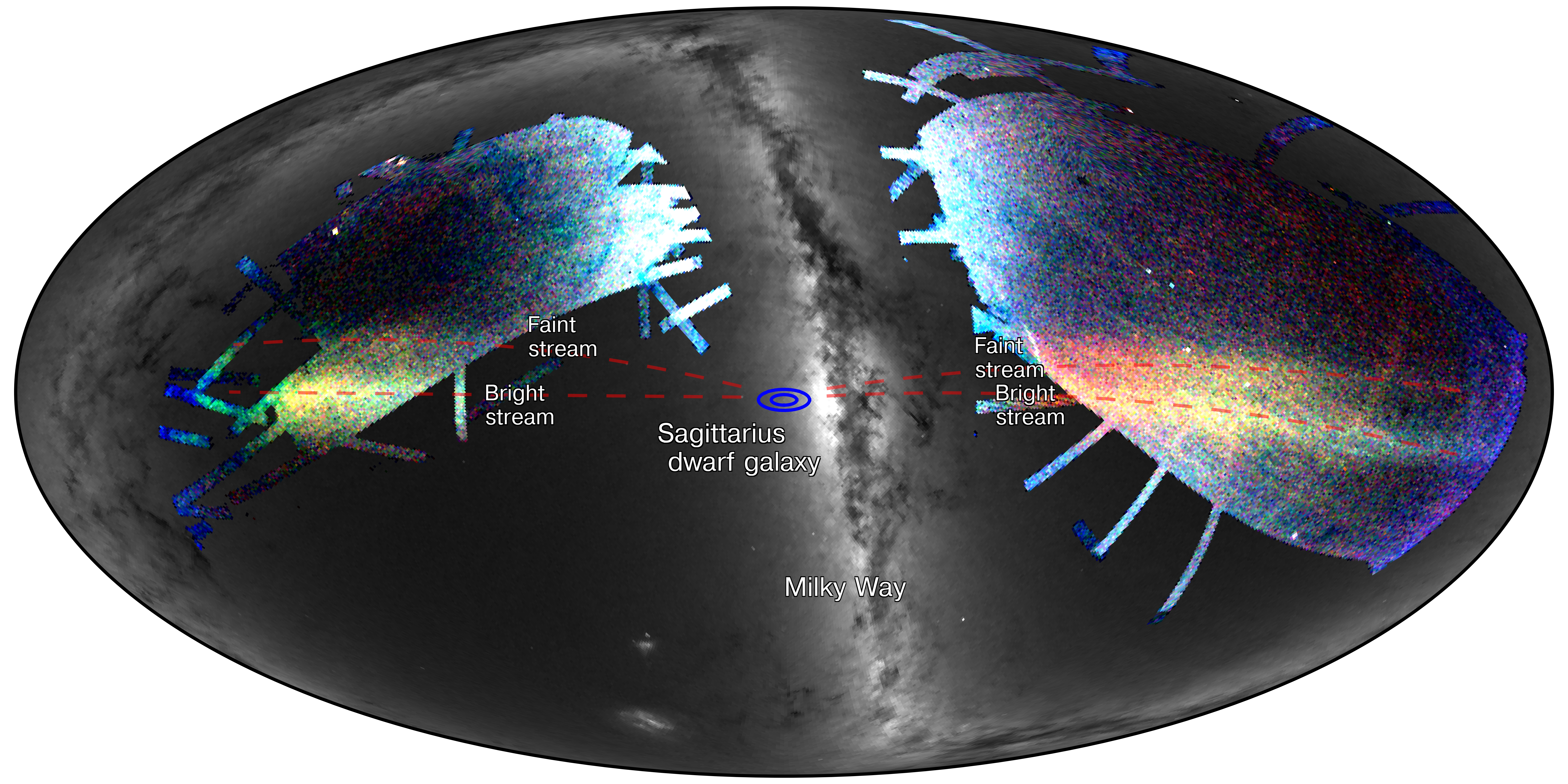
A map of the sky showing the numbers of stars counted in the Sagittarius streams. The colors indicate the distances to the stars identified in the study - stars located in red areas are further away, while stars in the blue areas are closer. The dotted red lines trace out the Sagittarius streams, and the blue ellipses in the center show the current location of the Sagittarius Dwarf Galaxy. Figure credit: S. Koposov and the SDSS-III collaboration. Click here for a larger (300 DPI) version.

The Milky Way galaxy continues to devour its small neighboring dwarf galaxies and the evidence is spread out across the sky.

A team of astronomers led by Sergey Koposov and Vasily Belokurov of the University of Cambridge recently discovered two streams of stars in the Southern Galactic hemisphere that were torn off the Sagittarius dwarf galaxy. This discovery came from analyzing data from the latest Sloan Digital Sky Survey (SDSS-III) and was announced in a paper released December 1, 2011 (arXiv paper #1111.7042) that connects these new streams with two previously known streams in the Northern Galactic hemisphere.

"We have long known that when small dwarf galaxies fall into bigger galaxies, elongated streams, or tails, of stars are pulled out of the dwarf by the enormous tidal field," said Sergey Koposov.

The Sagittarius dwarf galaxy used to be one of the brightest of the Milky Way satellites. Its disrupted remnant now lies on the other side of the Galaxy, breaking up as it is crushed and stretched by huge tidal forces. It is so small that it has lost half of its stars and all its gas over the last billion years.

Before SDSS-III, Sagittarius was known to have two tails, one in front of and one behind the remnant. Previous SDSS imaging had already found the Sagittarius tidal tail in the Northern Galactic sky in 2006 and revealed that one of the tails was forked into two.

"That was an amazing discovery," said Vasily Belokurov, "but the remaining piece of the puzzle, the structure in the South, was missing until now."

Sergey Koposov and colleagues analyzed density maps of over 13 million stars in the latest release of Sloan Digital Sky Survey data, including the crucial coverage of the Southern Galactic sky. The new data show that the Sagittarius stream in the South is also split into two, a fatter and brighter stream alongside a thinner and fainter stream. This brighter stream is more enriched with iron and other metals than its dimmer companion. Because each generation of stars makes and distributes more metals into the next generation, the Cambridge astronomers concluded that the brighter stream is younger than the older fainter one.

"Sagittarius is like a beast with four tails," observed Wyn Evans, from the Institute of Astronomy, University of Cambridge.

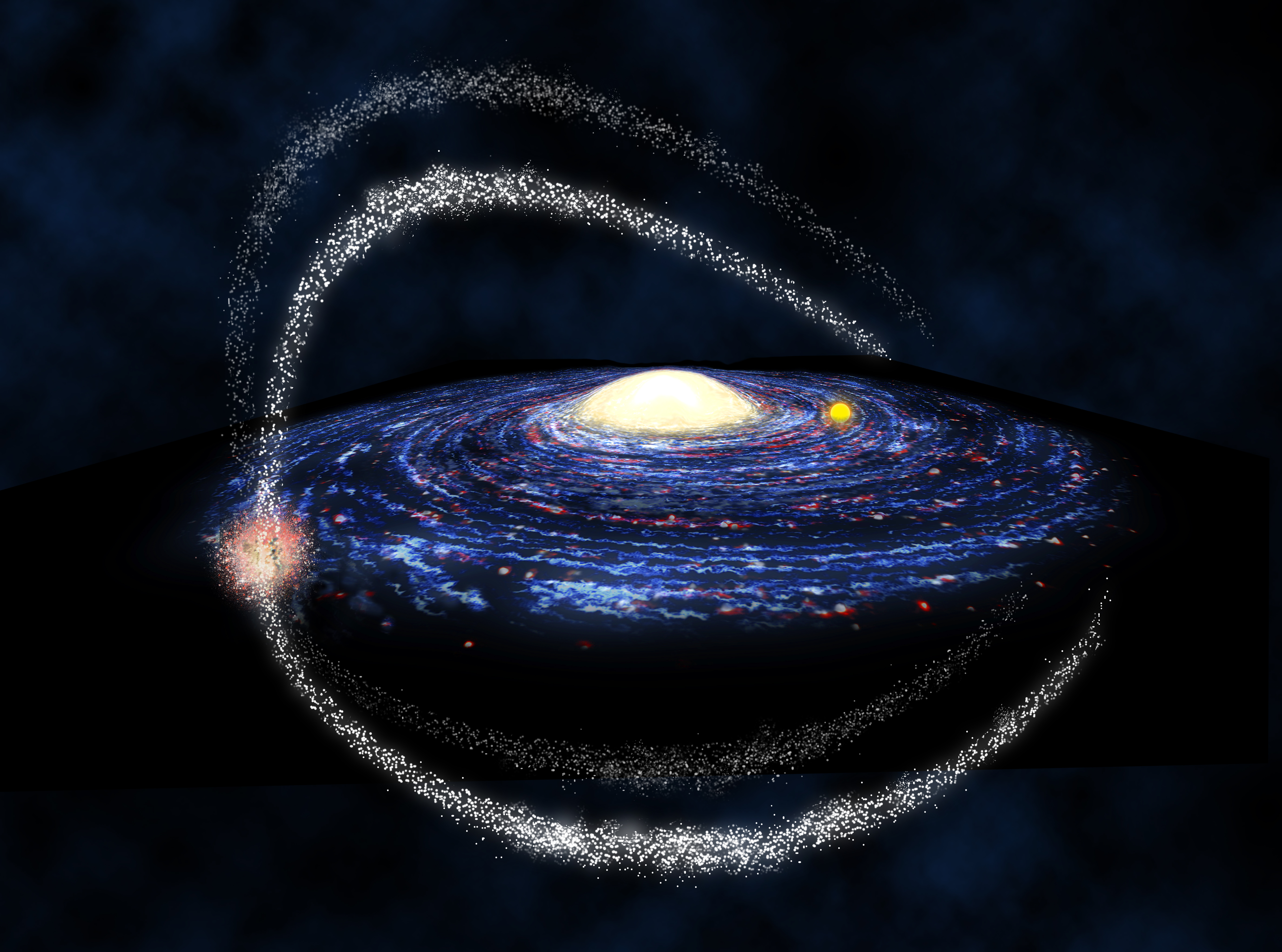
An artist's impression of the four tails of the Sagittarius Dwarf Galaxy (the orange clump on the left of the image) orbiting the Milky Way. The bright yellow circle to the right of the galaxy's center is our Sun (not to scale). Figure credit: Amanda Smith, Institute of Astronomy, University of Cambridge

The Sagittarius dwarf galaxy is on the other side of the galaxy from us, but we can see its tidal tails of stars (white in this image) stretching across the sky as they wrap around our galaxy. Click here for a larger (300 DPI) version.

No one knows the mechanism that caused the splitting of the tidal tails. However, scientists believe that perhaps the Sagittarius dwarf galaxy was once a part of a binary galactic system, similar to the present day Large and Small Magellanic Clouds. Each of these could have produced a leading and trailing tail on falling into the Milky Way Galaxy, yielding four in all.

But co-author Geraint Lewis of Sydney University has another idea. He says, "Perhaps the Sagittarius dwarf galaxy has suffered an encounter with an object in the game of Galactic billiards. Maybe a collision with a massive clump of dark matter, or even another satellite galaxy, has split each of the streams into two."

A final theory suggests that, just as meteors have spread into different streams through evolution in the Solar system, debris from Sagittarius may have spread into different streams at different points in time. Different epochs may suffer different amounts of precession in the Galaxy, causing the split streams. "I have been running hundreds of simulations of the disruption of the Sagittarius dwarf and this idea looks very plausible," commented Jorge Penarrubia of the IAA, Granada, who was also involved in the study.

Whatever the explanation, SDSS-III has provided a wealth of new information on the engorgement of the Sagittarius galaxy. The disruption of smaller galaxies has occurred many times in the history of the Milky Way and other galaxies like ours throughout the Universe.

The wagging of the four tails of Sagittarius will shed new light on both the structure and formation of the Milky Way.

Additional Resources

The paper is available from the arXiv Preprint Server (paper number 1111.7042)

The following YouTube video is an illustration of the streams produced by the Sagittarius dwarf galaxy wrapping around the Milky Way.


This YouTube movie shows an illustration of multiple streams produced by the disruption of the Sagittarius dwarf galaxy in the Milky Way halo. The orange sphere shows the location of the Sun in the Galaxy. The Sagittarius dwarf galaxy itself is located in the middle of the stream. The size of the area shown in the movie is approximately 600 thousands light years (200 kiloparsecs). Figure credit: S. Koposov and the SDSS-III collaboration

About SDSS-III

Funding for SDSS-III has been provided by the Alfred P. Sloan Foundation, the Participating Institutions, the National Science Foundation, and the U.S. Department of Energy. The SDSS-III web site is http://www.sdss3.org/.

SDSS-III is managed by the Astrophysical Research Consortium for the Participating Institutions of the SDSS-III Collaboration including the University of Arizona, the Brazilian Participation Group, Brookhaven National Laboratory, University of Cambridge, University of Florida, the French Participation Group, the German Participation Group, the Instituto de Astrofisica de Canarias, the Michigan State/Notre Dame/JINA Participation Group, Johns Hopkins University, Lawrence Berkeley National Laboratory, Max Planck Institute for Astrophysics, New Mexico State University, New York University, Ohio State University, Pennsylvania State University, University of Portsmouth, Princeton University, the Spanish Participation Group, University of Tokyo, University of Utah, Vanderbilt University, University of Virginia, University of Washington, and Yale University.

Contacts:

Sergey Koposov,
University of Cambridge,

koposov@ast.cam.ac.uk, +44 01223 337551

Vasily Belokurov,
University of Cambridge,

vasily@ast.cam.ac.uk, +44 01223 337515

Wyn Evans, University of Cambridge,
nwe@ast.cam.ac.uk, +44 01223 765847

Michael Wood-Vasey,
SDSS-III Spokesperson,
University of Pittsburgh,
wmwv@pitt.edu, +1 412-624-2751

Jordan Raddick,
SDSS Public Information Officer,

raddick@jhu.edu, +1 410-516-8889

Copyright © 2010 SDSS-III

Saturday, December 03, 2011

Keck Telescopes Find 18 New Exoplanets


Artist's conception of an exoplanet and its moons
Credit: NASA/JPL

KAMUELA, Hawaii—A whopping 18 new, bona fide exoplanets have been discovered and confirmed by a team of Caltech astronomers using the Keck Telescopes and two other ground-based observatories.

“It’s the largest single announcement of planets in orbit around stars more massive than the sun, aside from the discoveries made by the Kepler mission,” says John Johnson, assistant professor of astronomy at Caltech and the first author on the team’s paper, which was published in the December issue of The Astrophysical Journal Supplement Series. The Kepler mission is a space telescope that has so far identified more than 1,200 possible planets, though the majority of those have not yet been confirmed.

Using the Keck Observatory—with follow-up observations using the McDonald and Fairborn Observatories in Texas and Arizona, respectively—the researchers surveyed about 300 stars. They focused on those dubbed “retired” A-type stars that are more than one and a half times more massive than the sun. These stars are just past the main stage of their life—hence, “retired”—and are now puffing up into what’s called a subgiant star.

To look for planets, the astronomers searched for stars of this type that wobble, which could be caused by the gravitational tug of an orbiting planet. The wobble is given away by the fact that the light of those stars have a periodic lengthening and contracting of wavelengths due to the stars’ motion away from and toward the observer—better known as a Doppler shift. Using this, the team found 18 planets with masses similar to Jupiter’s.

This new bounty marks a 50 percent increase in the number of known planets orbiting massive stars and, according to Johnson, provides an invaluable population of planetary systems for understanding how planets—and our own solar system—might form. The researchers say that the findings also lend further support to the theory that planets grow from seed particles that accumulate gas and dust in a disk surrounding a newborn star.

According to this theory, tiny particles start to clump together, eventually snowballing into a planet. If this is the true sequence of events, the characteristics of the resulting planetary system—such as the number and size of the planets, or their orbital shapes—will depend on the mass of the star. For instance, a more massive star would mean a bigger disk, which in turn would mean more material to produce a greater number of giant planets.

In another theory, planets form when large amounts of gas and dust in the disk spontaneously collapse into big, dense clumps that then become planets. But in this picture, it turns out that the mass of the star doesn’t affect the kinds of planets that are produced.

So far, as the number of discovered planets has grown, astronomers are finding that stellar mass does seem to be important in determining the prevalence of giant planets. The newly discovered planets further support this pattern—and are therefore consistent with the first theory, the one stating that planets are born from seed particles.

“It’s nice to see all these converging lines of evidence pointing toward one class of formation mechanisms,” Johnson says.

The new batch of planets have yet another interesting pattern: their orbits are mainly circular, while planets around sunlike stars span a wide range of circular to elliptical paths. Johnson says he’s now trying to find an explanation.

For Johnson, these discoveries have been a long time coming. This latest find, for instance, comes from an astronomical survey that he started while a graduate student; because these planets have wide orbits, they can take a couple of years to make a single revolution, meaning that it can also take quite a few years before their stars’ periodic wobbles become apparent to an observer.

“I liken it to a garden—you plant the seeds and put a lot of work into it,” he says. “Then, a decade in, your garden is big and flourishing. That’s where I am right now. My garden is full of these big, bright, juicy tomatoes—these Jupiter-sized planets.”

The other authors on the The Astrophysical Journal Supplement Series paper, “Retired A stars and their companions VII. Eighteen new Jovian planets,” include former Caltech undergraduate Christian Clanton, who graduated in 2010; Caltech postdoctoral scholar Justin Crepp; and nine others from the Institute for Astronomy at the University of Hawaii; the University of California, Berkeley; the Center of Excellence in Information Systems at Tennessee State University; the McDonald Observatory at the University of Texas, Austin; and the Pennsylvania State University. The research was supported by the National Science Foundation and NASA.

The W. M. Keck Observatory operates two 10-meter optical/infrared telescopes on the summit of Mauna Kea on the Big Island of Hawaii. The twin telescopes feature a suite of advanced instruments including imagers, multi-object spectrographs, high-resolution spectrographs, integral-field spectroscopy and a world-leading laser guide star adaptive optics system which cancels out much of the interference caused by Earth’s turbulent atmosphere. The Observatory is a private 501(c) 3 non-profit organization and a scientific partnership of the California Institute of Technology, the University of California and NASA.

***

Adapted from a Caltech press release by Marcus Woo

Friday, December 02, 2011

IN A STAR’S FINAL DAYS, ASTRONOMERS HUNT “SIGNAL OF IMPENDING DOOM”

A Large Binocular Telescope image which shows the supernova in M51 is available here for the media.

COLUMBUS, Ohio – An otherwise nondescript binary star system in the Whirlpool Galaxy has brought astronomers tantalizingly close to their goal of observing a star just before it goes supernova.

The study, submitted in a paper to the Astrophysical Journal, provides the latest result from an Ohio State University galaxy survey underway with the Large Binocular Telescope, located in Arizona.

In the first survey of its kind, the researchers have been scanning 25 nearby galaxies for stars that brighten and dim in unusual ways, in order to catch a few that are about to meet their end. In the three years since the study began, this particular unnamed binary system in the Whirlpool Galaxy was the first among the stars they’ve cataloged to produce a supernova.

The astronomers were trying to find out if there are patterns of brightening or dimming that herald the end of a star’s life. Instead, they saw one star in this binary system dim noticeably before the other one exploded in a supernova during the summer of 2011.

Though they’re still sorting through the data, it’s likely that they didn’t get any direct observations of the star that exploded – only its much brighter partner.

Yet, principal investigator Christopher Kochanek, professor of astronomy at Ohio State and the Ohio Eminent Scholar in Observational Cosmology, does not regard this first result as a disappointment. Rather, it’s a proof of concept.

“Our underlying goal is to look for any kind of signature behavior that will enable us to identify stars before they explode,” he said. “It’s a speculative goal at this point, but at least now we know that it’s possible.”

“Maybe stars give off a clear signal of impending doom, maybe they don’t,” said study co-author Krzystof Stanek, professor of astronomy at Ohio State, “But we’ll learn something new about dying stars no matter the outcome.”

Postdoctoral researcher Dorota Szczygiel, who led the study of this supernova, explained why the galaxy survey is important.

“The odds are extremely low that we would just happen to be observing a star for several years before it went supernova. We would have to be extremely lucky,” she said.

“With this galaxy survey, we’re making our own luck. We’re studying all the variable stars in 25 galaxies, so that when one of them happens go supernova, we’ve already compiled data on it.”
The supernova, labeled 2011dh, was first detected on May 31 and is still visible in telescopes. It originated from a binary star system in the Whirlpool Galaxy – also known as M51, one of the galaxies that the Ohio State astronomers have been observing for three years.

The system is believed to have contained one very bright blue star and one even brighter red star. From what the astronomers can tell, it’s likely that the red star is the one that dimmed over the three years, before the blue star initiated the supernova.

When the Ohio State researchers reviewed the Large Binocular Telescope data as well as Hubble Space Telescope images of M51, they saw that the red star had dimmed by about 10 percent over three years, at a pace of three percent per year.

Szczygiel believes that the red star likely survived its partner’s supernova.

“After the light from the explosion fades away, we should be able to see the companion that did not explode,” she said.

As astronomers gather data from more supernovae – Kochanek speculates that as many as one per year could emerge from their data set – they could assemble a kind of litmus test to predict whether a particular star is near death. Whether it’s going to spawn a supernova or shrink into a black hole, there may be particular signals visible on the surface, and this study has shown that those signals are detectable.

The team won’t be watching our sun for any changes, however. At less than 10 percent of the mass of the star in supernova 2011dh, our star will most likely meet a very boring end.

“There’ll be no supernova for our sun – it’ll just fizzle out,” Kochanek said. “But that’s okay – you don’t want to live around an exciting star.”

This research was supported by the National Science Foundation.

The Large Binocular Telescope is an international collaboration among institutions in the United Sates, Italy, and Germany. The LBT Corporation partners are: the University of Arizona on behalf of the Arizona University System; the Instituto nazionale di Astrofisica, Italy; the LBT Beteiligungsesellschaft, Germany, representing the Max Planck Society, the Astrophysical Institute of Potsdam, and Heidelberg University; the Ohio State University; and the Research Corporation, on behalf of the University of Notre Dame, University of Minnesota, and University of Virginia.

***

Contact:

Christopher Kochanek, (614) 292-5954;
Kochanek.1@osu.edu
Dorota Szczygiel, (614) 688-7426; Szczygiel.3@osu.edu

Written by Pam Frost Gorder, (614) 292-9475; Gorder.1@osu.edu

Thursday, December 01, 2011

Strange New "Species" of Ultra-Red Galaxy Discovered

This artist's conception portrays four extremely red galaxies that lie almost 13 billion light-years from Earth. Discovered using the Spitzer Space Telescope, these galaxies appear to be physically associated and may be interacting. One galaxy shows signs of an active galactic nucleus, shown here as twin jets streaming out from a central black hole. Credit: David A. Aguilar (CfA). Low Resolution Image (jpg)

Cambridge, MA - In the distant reaches of the universe, almost 13 billion light-years from Earth, a strange species of galaxy lay hidden. Cloaked in dust and dimmed by the intervening distance, even the Hubble Space Telescope couldn't spy it. It took the revealing power of NASA's Spitzer Space Telescope to uncover not one, but four remarkably red galaxies. And while astronomers can describe the members of this new "species," they can't explain what makes them so ruddy.

"We've had to go to extremes to get the models to match our observations," said Jiasheng Huang of the Harvard-Smithsonian Center for Astrophysics (CfA). Huang is lead author on the paper announcing the find, which was published online by the Astrophysical Journal.

Spitzer succeeded where Hubble failed because Spitzer is sensitive to infrared light - light so red that it lies beyond the visible part of the spectrum. The newfound galaxies are more than 60 times brighter in the infrared than they are at the reddest colors Hubble can detect.

Galaxies can be very red for several reasons. They might be very dusty. They might contain many old, red stars. Or they might be very distant, in which case the expansion of the universe stretches their light to longer wavelengths and hence redder colors (a process known as redshifting). All three reasons seem to apply to the newfound galaxies.

All four galaxies are grouped near each other and appear to be physically associated, rather than being a chance line-up. Due to their great distance, we see them as they were only a billion years after the Big Bang - an era when the first galaxies formed.

"Hubble has shown us some of the first protogalaxies that formed, but nothing that looks like this. In a sense, these galaxies might be a 'missing link' in galactic evolution" said co-author Giovanni Fazio of the CfA.

Next, researchers hope to measure an accurate redshift for the galaxies, which will require more powerful instruments like the Large Millimeter Telescope or Atacama Large Millimeter Array. They also plan to search for more examples of this new "species" of extremely red galaxies.

"There's evidence for others in other regions of the sky. We'll analyze more Spitzer and Hubble observations to track them down," said Fazio.

NASA's Jet Propulsion Laboratory, Pasadena, Calif., manages the Spitzer mission for NASA's Science Mission Directorate. Science operations are conducted at the Spitzer Science Center at the California Institute of Technology in Pasadena. NASA's Goddard Space Flight Center built Spitzer's Infrared Array Camera, which took the observations. The instrument's principal investigator is Giovanni Fazio of CfA.

Headquartered in Cambridge, Mass., the Harvard-Smithsonian Center for Astrophysics (CfA) is a joint collaboration between the Smithsonian Astrophysical Observatory and the Harvard College Observatory. CfA scientists, organized into six research divisions, study the origin, evolution and ultimate fate of the universe.

For more information, contact:

David A. Aguilar
Director of Public Affairs
Harvard-Smithsonian Center for Astrophysics
617-495-7462
daguilar@cfa.harvard.edu

Christine Pulliam
Public Affairs Specialist
Harvard-Smithsonian Center for Astrophysics
617-495-7463
cpulliam@cfa.harvard.edu

4,000-Year-Old Supernova Fireballs Observed in the Jellyfish Nebula

IC 443 - Jellyfish Nebula

Studies of two supernova remnants using the Japan-U.S. Suzaku observatory revealed never-before-seen embers of the high-temperature fireballs that immediately followed the explosions. Even after thousands of years, gas within these stellar wrecks retain the imprint of temperatures 10,000 times hotter than the sun's surface. "Suzaku sees the Jellyfish's hot heart," said Midori Ozawa of Koyoto University.

"This is the first evidence of a new type of supernova remnant -- one that was heated right after the explosion," said Hiroya Yamaguchi at the Institute of Physical and Chemical Research in Japan.

A supernova remnant usually cools quickly due to rapid expansion following the explosion. Then, as it sweeps up tenuous interstellar gas over thousands of years, the remnant gradually heats up again.

Capitalizing on the sensitivity of the Suzaku satellite, a team led by Yamaguchi and Midori Ozawa, of Kyoto University, detected unusual features in the X-ray spectrum of IC 443, better known to amateur astronomers as the Jellyfish Nebula.

The remnant, which lies some 5,000 light-years away in the constellation Gemini, formed about 4,000 years ago. The X-ray emission forms a roughly circular patch in the northern part of the visible nebulosity.

Suzaku's X-ray Imaging Spectrometers (XISs) separate X-rays by energy in much the same way as a prism separates light into a rainbow of colors. This allows astronomers to tease out the types of processes responsible for the radiation.

Some of the X-ray emission in the Jellyfish Nebula arises as fast-moving free electrons sweep near the nuclei of atoms. Their mutual attraction deflects the electrons, which then emit X-rays as they change course. The electrons have energies corresponding to a temperature of about 12 million degrees Fahrenheit (7 million degrees Celsius).

Several bumps in the Suzaku spectrum were more puzzling. "These structures indicate the presence of a large amount of silicon and sulfur atoms from which all electrons have been stripped away," Yamaguchi said. These "naked" nuclei produce X-rays as they recapture their lost electrons.

But removing all electrons from a silicon atom requires temperatures higher than about 30 million degrees F (17 million C); hotter still for sulfur atoms. "These ions cannot form in the present-day remnant," Yamaguchi explained. "Instead, we're seeing ions created by the enormous temperatures that immediately followed the supernova."

The team suggests that the supernova occurred in a relatively dense environment, perhaps in a cocoon of the star's own making. As a massive star ages, it sheds material in the form of an outflow called a stellar wind and creates a cocoon of gas and dust. When the star explodes, the blast wave traverses the dense cocoon and heats it to temperatures as high as 100 million degrees F (55 million C), or 10,000 times hotter than the sun's surface.

Eventually, the shock wave breaks out into true interstellar space, where the gas density can be as low as a single atom per cubic centimeter -- about the volume of a sugar cube. Once in this low-density environment, the young supernova remnant rapidly expands.

The expansion cools the electrons, but it also thins the remnant's gas so much that collisions between particles become rare events. Because an atom may take thousands of years to recapture an electron, the Jellyfish Nebula's hottest ions remain even today, the astronomers reported in the Nov. 1 issue of The Astrophysical Journal.

The team has already identified another fossil fireball in the supernova remnant known as W49B, which lies 35,000 light-years away in the constellation Aquila. In the Nov. 20 edition of The Astrophysical Journal, Ozawa, Yamaguchi and colleagues report X-ray emission from iron atoms that are almost completely stripped of electrons. Forming these ions requires temperatures in excess of 55 million degrees F (30 million C)-- nearly twice the observed temperature of the remnant's electrons.

Launched on July 10, 2005, Suzaku was developed at the Japanese Institute of Space and Astronautical Science (ISAS), which is part of the Japan Aerospace Exploration Agency (JAXA), in collaboration with NASA and other Japanese and U.S. institutions.

The Daily Galaxy via NASA's Goddard Space Flight Center

NASA's Swift Finds a Gamma-Ray Burst With a Dual Personality

This animation illustrates two wildly different explanations for GRB 101225A, better known as the "Christmas burst." First, a solitary neutron star in our own galaxy shreds and accretes an approaching comet-like body. In the second, a neutron star is engulfed by, spirals into and merges with an evolved giant star in a distant galaxy. (Credit: NASA/Goddard Space Flight Center) . Download this video and related content from NASA Goddard's Scientific Visualization Studio

WASHINGTON -- A peculiar cosmic explosion first detected by NASA's Swift observatory on Christmas Day 2010 was caused either by a novel type of supernova located billions of light-years away or an unusual collision much closer to home, within our own galaxy. Papers describing both interpretations appear in the Dec. 1 issue of the journal Nature.

Gamma-ray bursts (GRBs) are the universe's most luminous explosions, emitting more energy in a few seconds than our sun will during its entire energy-producing lifetime. What astronomers are calling the "Christmas burst" is so unusual that it can be modeled in such radically different ways.

"What the Christmas burst seems to be telling us is that the family of gamma-ray bursts is more diverse than we fully appreciate,” said Christina Thoene, the supernova study's lead author, at the Institute of Astrophysics of Andalusia in Granada, Spain. It's only by rapidly detecting hundreds of them, as Swift is doing, that we can catch some of the more eccentric siblings."

Common to both scenarios is the presence of a neutron star, the crushed core that forms when a star many times the sun's mass explodes. When the star's fuel is exhausted, it collapses under its own weight, compressing its core so much that about a half-million times Earth's mass is squeezed into a sphere no larger than a city.

The Christmas burst, also known as GRB 101225A, was discovered in the constellation Andromeda by Swift's Burst Alert Telescope at 1:38 p.m. EST on Dec. 25, 2010. The gamma-ray emission lasted at least 28 minutes, which is unusually long. Follow-up observations of the burst's afterglow by the Hubble Space Telescope and ground-based observatories were unable to determine the object's distance.

Thoene's team proposes that the burst occurred in an exotic binary system where a neutron star orbited a normal star that had just entered its red giant phase, enormously expanding its outer atmosphere. This expansion engulfed the neutron star, resulting in both the ejection of the giant's atmosphere and rapid tightening of the neutron star's orbit.

Once the two stars became wrapped in a common envelope of gas, the neutron star may have merged with the giant's core after just five orbits, or about 18 months. The end result of the merger was the birth of a black hole and the production of oppositely directed jets of particles moving at nearly the speed of light, followed by a weak supernova.

The particle jets produced gamma rays. Jet interactions with gas ejected before the merger explain many of the burst's signature oddities. Based on this interpretation, the event took place about 5.5 billion light-years away, and the team has detected what may be a faint galaxy at the right location.

"Deep exposures using Hubble may settle the nature of this object," said Sergio Campana, who led the collision study at Brera Observatory in Merate, Italy.

If it is indeed a galaxy, that would be evidence for the binary model. On the other hand, if NASA's Chandra X-ray Observatory finds an X-ray point source or if radio telescopes detect a pulsar, that goes against it.

Campana's team supports an alternative model that involves the tidal disruption of a large comet-like object and the ensuing crash of debris onto a neutron star located only about 10,000 light-years away. The scenario requires the break-up of an object with about half the mass of the dwarf planet Ceres. While rare in the asteroid belt, such objects are thought to be common in the icy Kuiper belt beyond Neptune. Similar objects located far away from the neutron star may have survived the supernova that formed it.

Gamma-ray emission occurred when debris fell onto the neutron star. Clumps of cometary material likely made a few orbits, with different clumps following different paths before settling into a disk around the neutron star. X-ray variations detected by Swift's X-Ray Telescope that lasted several hours may have resulted from late-arriving clumps that struck the neutron star as the disk formed.

In the early years of studying GRBs, astronomers had very few events to study in detail and dozens of theories to explain them. In the Swift era, astronomers have settled into two basic scenarios, either the collapse of a massive star or the merger of a compact binary system.

"The beauty of the Christmas burst is that we must invoke two exotic scenarios to explain it, but such rare oddballs will help us advance the field,” said Chryssa Kouveliotou, a co-author of the supernova study at NASA's Marshall Space Flight Center in Huntsville, Ala.

NASA's Swift was launched in November 2004 and is managed by Goddard. It is operated in collaboration with several U.S. institutions and partners in the United Kingdom, Italy, Germany and Japan.


Francis Reddy
NASA's Goddard Space Flight Center, Greenbelt, Md.

Wednesday, November 30, 2011

NOAO: New Planet Kepler-21b discovery a partnership of both space and ground-based observations

Figure 1: The Kepler field as seen in the sky over Kitt Peak National Observatory. The approximate position of HD 179070 is indicated by the circle (sky imaged using a diffraction grating to show spectra of brighter stars, credit J. Glaspey; telescopes imaged separately and combined, credit P. Marenfeld)

Figure 2: Kepler light curve of HD 179070 showing the eclipse of Kepler-21b. The data cover 15 months. The figure shows the binned, and phase folded-data based on 164 individual transits over-plotted by the model fit (red line).

The NASA Kepler Mission is designed to survey ahttp://www.blogger.com/img/blank.gif portion of our region of the Milky Way Galaxy to discover Earth-size planets in or near the “habitable zone,” the region in a planetary system where liquid water can exist, and determine how many of the billions of stars in our galaxy have such planets. It now has another planet to add to its growing list. A research team led by Steve Howell, NASA Ames Research Center, has shown that one of the brightest stars in the Kepler star field has a planet with a radius only 1.6 that of the earth’s radius and a mass no greater that 10 earth masses, circling its parent star with a 2.8 day period. With such a short period, and such a bright star, the team of over 65 astronomers (that included David Silva, Ken Mighell and Mark Everett of NOAO) needed multiple telescopes on the ground to support and confirm their Kepler observations. These included the 4 meter Mayall telescope and the WIYN telescope at Kitt Peak National Observatory. The accompanying figure shows the size of the Kepler field, seen over Kitt Peak.

With a period of only 2.8 days, this planet, designated Kepler-21b, is only about 6 million km away from its parent star. By comparison Mercury, the closest planet to the sun, has a period of 88 days and a distance from the sun almost ten times greater, or 57 million km. So Kepler 21b is far hotter than any place humans could venture. The team calculates that the temperature at the surface of the planet is about 1900 K, or 2960 F. While this temperature is nowhere near the habitable zone in which liquid water might be found, the planet’s size is approaching that of the earth.

The parent star, HD 179070, is quite similar to our sun: its mass is 1.3 solar masses, its radius is 1.9 solar radii, and its age, based on stellar models, is 2.84 billion years (or a bit younger than the sun’s 4.6 billion years). HD 179070 is spectral type F6 IV, a little hotter and brighter than the sun. By astronomical standards, HD 179070 is fairly close, at a distance from the sun of 352 light years. While it cannot be seen by the unaided eye, a small telescope can easily pick it out.

Part of the difficulty in detecting this planet is the realization, from the Kepler mission, that many stars show short period brightness oscillations. The effect of these must be removed from the stellar light in order to uncover the regular, but very small, dimming caused by the planet passing in front of the star. The Kepler mission observed this field for over 15 months, and the team combined the observations to enable them to detect this tiny, periodic signal. They also relied on spectroscopic and imaging data from a number of ground based telescopes. The attached figure 2 shows a light curve: a plot of the brightness of HD 179070 over time as the planet passes in front of it. This curve was built up over the many months of observing.

The results of this work have been accepted for publication in the Astrophysical Journal.

NOAO is operated by Association of Universities for Research in Astronomy Inc. (AURA) under a cooperative agreement with the National Science Foundation.

Science Contact

Dr. Steve Howell
NASA Ames Research Center
PO Box 1
M/S 244-30
Moffett Field, CA 94035
steve.b.howell@nasa.gov
650.604.4238

Monday, November 28, 2011

In The Heart Of Cygnus, NASA's Fermi Reveals A Cosmic-ray Cocoon

Tour the Cygnus X star factory. This video opens with wide optical and infrared images of the constellation Cygnus, then zooms into the Cygnus X region using radio, infrared and gamma-ray images. Fermi LAT shows that gamma rays fill cavities in the star-forming clouds. The emission occurs when fast-moving cosmic rays strike hot gas and starlight. Credit: NASA/Goddard Space Flight Center. Download this video and related content from NASA Goddard's Scientific Visualization Studio.

Gamma-ray emission detected by Fermi LAT fills bubbles of hot gas created by the most massive stars in Cygnus X. The turbulence and shock waves produced by these stars make it more difficult for high-energy cosmic rays to traverse the region. When the particles strike gas nuclei or photons of starlight, gamma rays result. Credit: NASA/DOE/Fermi LAT Collaboration/I. A. Grenier and L. Tibaldo . Larger image

Cygnus X hosts many young stellar groupings, including the OB2 and OB9 associations and the cluster NGC 6910. The combined outflows and ultraviolet radiation from the region's numerous massive stars have heated and pushed gas away from the clusters, producing cavities of hot, lower-density gas. In this 8-micron infrared image, ridges of denser gas mark the boundaries of the cavities. Bright spots within these ridges show where stars are forming today. Credit: NASA/IPAC/MSX . Larger Image - Labeled image

The constellation Cygnus, now visible in the western sky as twilight deepens after sunset, hosts one of our galaxy's richest-known stellar construction zones. Astronomers viewing the region at visible wavelengths see only hints of this spectacular activity thanks to a veil of nearby dust clouds forming the Great Rift, a dark lane that splits the Milky Way, a faint band of light marking our galaxy's central plane.

Located in the vicinity of the second-magnitude star Gamma Cygni, the star-forming region was named Cygnus X when it was discovered as a diffuse radio source by surveys in the 1950s. Now, a study using data from NASA's Fermi Gamma-ray Space Telescope finds that the tumult of star birth and death in Cygnus X has managed to corral fast-moving particles called cosmic rays.

Cosmic rays are subatomic particles -- mainly protons -- that move through space at nearly the speed of light. In their journey across the galaxy, the particles are deflected by magnetic fields, which scramble their paths and make it impossible to backtrack the particles to their sources.

Yet when cosmic rays collide with interstellar gas, they produce gamma rays -- the most energetic and penetrating form of light -- that travel to us straight from the source. By tracing gamma-ray signals throughout the galaxy, Fermi's Large Area Telescope (LAT) is helping astronomers understand the sources of cosmic rays and how they're accelerated to such high speeds. In fact, this is one of the mission's key goals.

The galaxy's best candidate sites for cosmic-ray acceleration are the rapidly expanding shells of ionized gas and magnetic field associated with supernova explosions. For stars, mass is destiny, and the most massive ones -- known as types O and B -- live fast and die young.

They're also relatively rare because such extreme stars, with masses more than 40 times that of our sun and surface temperatures eight times hotter, exert tremendous influence on their surroundings. With intense ultraviolet radiation and powerful outflows known as stellar winds, the most massive stars rapidly disperse their natal gas clouds, naturally limiting the number of massive stars in any given region.

Which brings us back to Cygnus X. Located about 4,500 light-years away, this star factory is believed to contain enough raw material to make two million stars like our sun. Within it are many young star clusters and several sprawling groups of related O- and B-type stars, called OB associations. One, called Cygnus OB2, contains 65 O stars -- the most massive, luminous and hottest type -- and nearly 500 B stars.

Astronomers estimate that the association's total stellar mass is 30,000 times that of our sun, making Cygnus OB2 the largest object of its type within 6,500 light-years. And with ages of less than 5 million years, few of its most massive stars have lived long enough to exhaust their fuel and explode as supernovae.

Intense light and outflows from the monster stars in Cygnus OB2 and from several other nearby associations and star clusters have excavated vast amounts of gas from their vicinities. The stars reside within cavities filled with hot, thin gas surrounded by ridges of cool, dense gas where stars are now forming. It's within the hollowed-out zones that Fermi's LAT detects intense gamma-ray emission, according to a paper describing the findings that was published in the Nov. 25 edition of the journal Science.

"We are seeing young cosmic rays, with energies comparable to those produced by the most powerful particle accelerators on Earth. They have just started their galactic voyage, zig-zagging away from their accelerator and producing gamma rays when striking gas or starlight in the cavities," said co-author Luigi Tibaldo, a physicist at Padova University and the Italian National Institute of Nuclear Physics.

The energy of the gamma-ray emission, which is measured up to 100 billion electron volts by the LAT and even higher by ground-based gamma-ray detectors, indicates the extreme nature of the accelerated particles. (For comparison, the energy of visible light is between 2 and 3 electron volts.) The environment holds onto its cosmic rays despite their high energies by entangling them in turbulent magnetic fields created by the combined outflows of the region's numerous high-mass stars.

"These shockwaves stir the gas and twist and tangle the magnetic field in a cosmic-scale jacuzzi so the young cosmic rays, freshly ejected from their accelerators, remain trapped in this turmoil until they can leak into quieter interstellar regions, where they can stream more freely," said co-author Isabelle Grenier, an astrophysicist at Paris Diderot University and the Atomic Energy Commission in Saclay, France.

The well known Gamma Cygni supernova remnant – so named for its proximity to the star -- also lies within this region; astronomers estimate its age at about 7,000 years. The Fermi team considers it possible that the supernova remnant spawned the cosmic rays trapped in the Cygnus X "cocoon," but they also suggest an alternative scenario where the particles became accelerated through repeated interaction with shockwaves produced inside the cocoon by powerful stellar winds.

"Whether the particles further gain or lose energy inside this cocoon needs to be investigated, but its existence shows that cosmic-ray history is much more eventful than a random walk away from their sources," Tibaldo added.

Fermi is providing a never-before-seen glimpse of the early life of cosmic rays, long before they diffuse into the galaxy at large. Astronomers know of a dozen stellar clusters at least as young and rich as Cygnus OB2, including the Arches and Quintuplet clusters near the galaxy's center. Energetic gamma rays are detected in the vicinity of several of them, so perhaps they also corral cosmic rays in their own high-energy cocoons.

NASA's Fermi is an astrophysics and particle physics partnership managed by NASA's Goddard Space Flight Center in Greenbelt, Md., and developed in collaboration with the U.S. Department of Energy, with important contributions from academic institutions and partners in France, Germany, Italy, Japan, Sweden and the United States.

Related Links:

Nursery of Giants Captured in New Spitzer Image
http://www.nasa.gov/vision/universe/starsgalaxies/spitzer-041304.html

NASA's Fermi Telescope Detects Gamma-Rays From 'Star Factories' in Other Galaxies
http://www.nasa.gov/mission_pages/GLAST/news/star_factories.html

What is Cygnus X?
http://www.cfa.harvard.edu/cygnusX/whatis.html


Francis Reddy
NASA's Goddard Space Flight Center, Greenbelt, Md.

A Galaxy Full of Surprises — NGC 3621 is bulgeless but has three central black holes

NGC 3621
Credit: ESO


This image, from ESO’s Very Large Telescope (VLT), shows a truly remarkable galaxy known as NGC 3621. To begin with, it is a pure-disc galaxy. Like other spirals, it has a flat disc permeated by dark lanes of material and with prominent spiral arms where young stars are forming in clusters (the blue dots seen in the image). But while most spiral galaxies have a central bulge — a large group of old stars packed in a compact, spheroidal region — NGC 3621 doesn’t. In this image, it is clear that there is simply a brightening to the centre, but no actual bulge like the one in NGC 6744 (eso1118), for example.

NGC 3621 is also interesting as it is believed to have an active supermassive black hole at its centre that is engulfing matter and producing radiation. This is somewhat unusual because most of these so-called active galactic nuclei exist in galaxies with prominent bulges. In this particular case, the supermassive black hole is thought to have a relatively small mass, of around 20 000 times that of the Sun.

Another interesting feature is that there are also thought to be two smaller black holes, with masses of a few thousand times that of the Sun, near the nucleus of the galaxy. Therefore, NGC 3621 is an extremely interesting object which, despite not having a central bulge, has a system of three black holes in its central region.

This galaxy is located in the constellation of Hydra (The Sea Snake) and can be seen with a moderate-sized telescope. This image, taken using B, V, and I filters with the FORS1 instrument on the powerful VLT, shows striking detail in this odd object and also reveals a multitude of background galaxies. A number of bright foreground stars that belong to our own Milky Way are also visible.