Monday, June 13, 2011

The Very Curious Creation of an Ageing Star

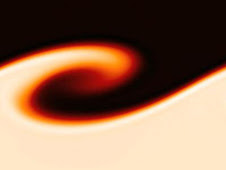
IRAS 22036+5306
Credit: ESA/Hubble & NASA

The NASA/ESA Hubble Space Telescope has made a rare celestial catch. Close to a bright, nearby star in this image, the bizarre, whorl-shaped object known as IRAS 22036+5306 has been captured during a brief tumultuous period late in a star's life.

Inside IRAS 22036+5306 lies an aged star that has coughed off almost all of its outer material, forming a cloud in space. Hidden under this veil, the dense, still-burning, exposed core of the star grows hotter. Encircling the star is a torus consisting partly of castoff material, as well as possibly the grainy remnants of comets and other small, rocky bodies. Twin jets spout from the star’s poles and pierce this dusty waist. The jets contain gobbets of material — typically about ten thousand times the mass of the Earth — hurling outwards at a speed of nearly 800 000 kilometres per hour.

IRAS 22036+5306 is making the transition through the protoplanetary, or preplanetary, nebula phase. Only a few hundred such nebulae have been spotted in our galaxy. For now, light from the central star is merely being reflected off its expelled gaseous shell. Soon, however, the star will become a very hot, white dwarf, and its intense ultraviolet radiation will ionise the blown-off gas, making it glow in rich colours. IRAS 22036+5306 will have then blossomed into a fully-fledged planetary nebula, and this event will serve as a last hurrah before the star starts its very slow final cool-down.

Planetary nebulae are much longer-lived than their precursors, protoplanetary nebulae, and are therefore more commonly spotted. The term planetary nebula is a leftover from observations through small telescopes made by early astronomers to whom some of these objects looked circular and similar in appearance to the outer planets Uranus and Neptune.

IRAS 22036+5306 is found about 6500 light-years away in the constellation of Cepheus (The King). Studying rarities such as IRAS 22036+5306 provides astronomers with a window into the short and poorly understood phase of stellar evolution when bloated red giant stars pare down to small white dwarfs. For example, mysteries remain about how exactly the dusty torus and jets form. The planetary nebula phase is thought to be the fate that awaits most medium-sized stars, including our Sun. But it is not clear that our star will make such a fuss on its way out — the star that generated all the gaseous splendour of IRAS 22036+5306 is reckoned to have been at least four times the mass of the Sun.

The image was obtained with the High Resolution Channel of Hubble’s Advanced Camera for Surveys. The picture has been made from images through a yellow/orange filter (F606W, coloured blue), a near-infrared filter (F814W, coloured orange) and a filter that lets through the red glow of hydrogen (F658N, coloured red). The total exposure times per filter were 1600 s, 3200 s and 5104 s, respectively and the field of view is about 22 arcseconds across.

A New, Distant Arm of the Milky Way Galaxy

The Milky Way's basic structure is believed to involve two main spiral arms emanating from opposite ends of an elongated central bar. But only parts of the arms can be seen - gray segments indicate portions not yet detected. Other known spiral arm segments--including the Sun's own spur--are omitted for clarity. Credit: T. Dame

Our Milky Way galaxy, like other spiral galaxies, has a disk with sweeping arms of stars, gas, and dust that curve around the galaxy like the arms of a huge pinwheel. The Sun, Earth, and solar system are located in a spur of material that lies between two of the spiral arms, collectively orbiting around the galaxy about 25,000 light-years from its center. Because the Milky Way contains copious amounts of dust that blocks our optical views, it is extremely difficult to study the galaxy from our vantage point within the disk. Thus the details of the spiral arms in our own galaxy are much less certain than is the structure of external spirals such as Andromeda, which is a few million light-years away but sits well above the plane of obscuring dust. Radio wavelengths can peer through the dust, however, and molecules like carbon monoxide that emit in the radio and concentrate in the galaxy's spiral arms are particularly good tracers of their structure.

Using a small 1.2-meter radio telescope on the roof of their science building in Cambridge, CfA astronomers Tom Dame and Pat Thaddeus used carbon monoxide emission to search for evidence of spiral arms in the most distant parts of the galaxy, and discovered a large new spiral arm peppered with dense concentrations of molecular gas. The CfA scientists suggest that the new spiral is the far end of the Scutum-Centaurus Arm, one of the two main spiral arms thought to originate from opposite ends of our galaxy's central bar (see figure). If their proposal is confirmed, it will demonstrate that the Milky Way has a striking symmetry, with the new arm being the symmetric counterpart of the nearby Perseus Arm.

Saturday, June 11, 2011

Blowin in the Stellar Wind

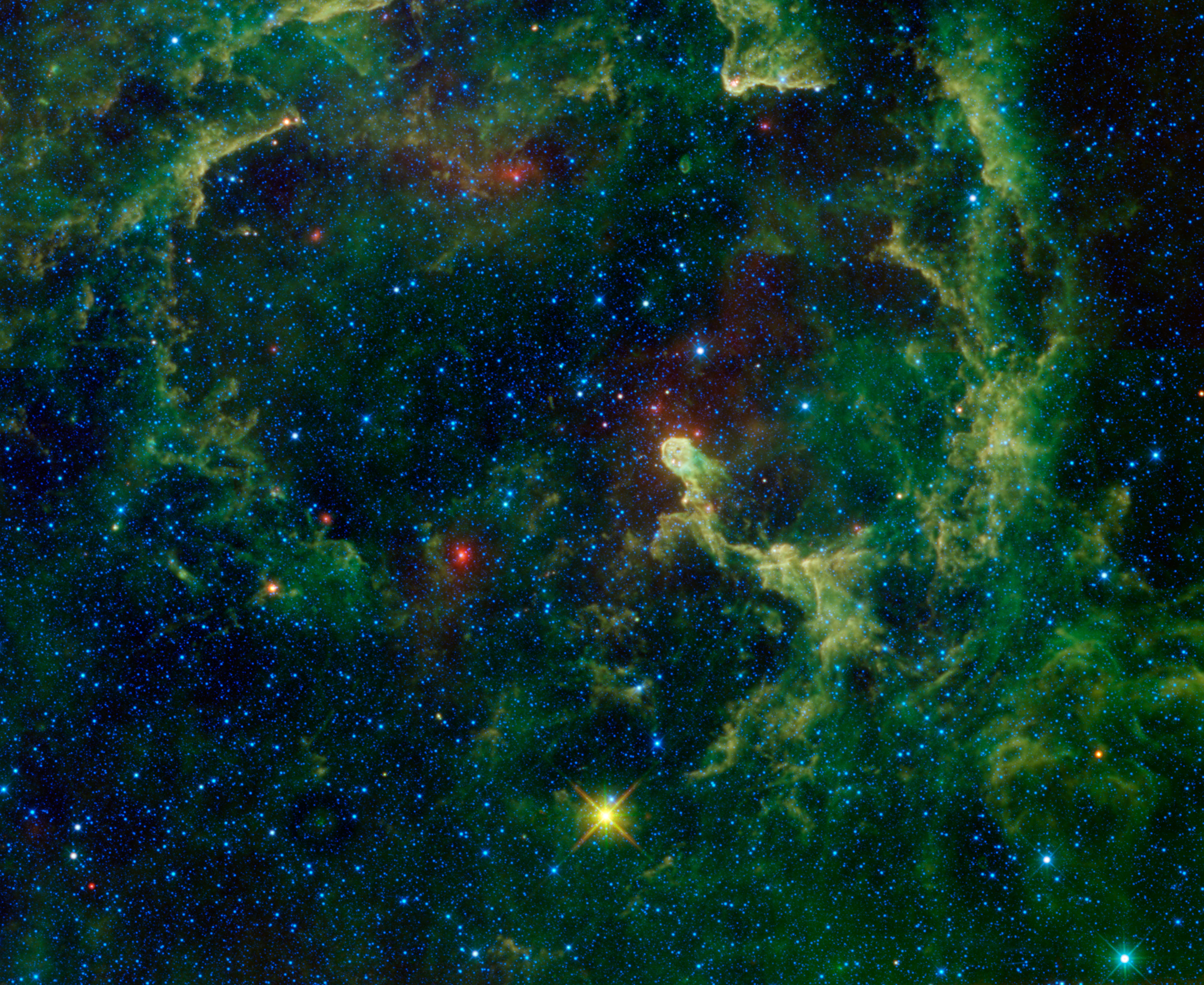
IC 1396
Image Credit: NASA/JPL-Caltech/WISE Team

Download Options

small (113K) 400 x 327 JPEG
medium (465K) 800 x 655 JPEG
large (1.36M) 1600 x 1309 JPEG
extra large (3.36M) 3200 x 2618 JPEG
original (66.5M) 7700 x 6300 TIF

Packaged image (1.89M) 2400 x 3000 JPG
Packaged image (38.7M) 8 x 10 in. PDF

Like dust being blown around by the wind here on Earth, space dust can be blown around by the wind and radiation from stars. This image of the Elephant’s Trunk nebula from NASA’s Wide-field Survey Explorer, or WISE, shows clouds of dust and gas being pushed and eroded by a massive star. The bright ‘trunk’ of the nebula near the center is an especially dense cloud holding up against the star’s powerful radiation and stellar wind, like a windsock standing strong while the rest of the gas and dust gets broken up and swept away.

‘Elephant trunk’ is a term commonly used by astronomers for this type of structure. Similar structures can be found in many other nebulae, however this is the only nebula that uses the term in its moniker. More distant examples of elephant trunks can be seen in previously featured WISE images such as LBN 211.91-01.37 (link to http://wise.ssl.berkeley.edu/gallery_LBN211.91-01.37.html ) and the Soul Nebula (link to http://wise.ssl.berkeley.edu/gallery_Soul_Nebula.html ). They’re all formed in basically the same way – a nearby massive star (or cluster) emitting vast amounts of ultraviolet radiation and stellar winds that clear out all of the gas and dust surrounding it, leaving behind only the most dense parts of the cloud. These dense portions then protect some of the gas ‘downwind’ creating a trunk-like feature.

The culprit star here, HR8281, is located close the center of the image. It’s one of the three bright blue stars near the upper left tip of the trunk that form a triangle about as wide as the glowing tip of the trunk. Of those three, it’s the uppermost one in the center. Its destructive effects on the surrounding nebula can be seen by the dark cavity it’s created, outlined by the brighter dust clouds encircling it. The entire nebula, also known as IC1396A, fills most of the field of view. It’s located only 2,450 light-years away, quite close compared to other similar nebulae. The trunk itself is about 30 light-years long, while the full nebula stretches over 100 light-years across.

If you look closely at the tip of the elephant trunk you can see a small dark area, appearing as a sort of opening. This is a small void in the gas formed by a pair of new baby stars that recently formed in the dense cloud. Their radiation and wind is clearing out the nearby gas and dust, creating a smaller version of the same effect seen on a larger scale in the full image. The reddish stars scattered throughout the image are likely new stars just forming that and are still wrapped inside their dusty cocoons.
The colors used in this image represent specific wavelengths of infrared light. Blue and cyan (blue-green) represent light emitted at wavelengths of 3.4 and 4.6 microns, which is predominantly from stars. Green and red represent light from 12 and 22 microns, respectively, which is mostly emitted by dust.

About the Objects

Names: Elephant Trunk Nebula; IC 1396A; LBN 452

Type: Nebula > Emission > HII Region Distance: 2,450 light years
Size: ~100 light years across

About the Images


Postion of Object (J2000):): RA=21h 38m 57m; Dec=+57° 29’ 20”

Constellation: Cepheus
Orientation: North is 43 degrees right of straight up

Color Mapping: Blue=3.4 microns; Cyan=4.6 microns; Green=12 microns; Red=22 microns

Friday, June 10, 2011

Nearby Galaxy Boasts Two Monster Black Holes, Both Active

A study using NASA's Swift satellite and the Chandra X-ray Observatory has found a second supersized black hole at the heart of an unusual nearby galaxy already known to be sporting one.

The galaxy, which is known as Markarian 739 or NGC 3758, lies 425 million light-years away toward the constellation Leo. Only about 11,000 light-years separate the two cores, each of which contains a black hole gorging on infalling gas.

The study will appear in a forthcoming issue of The Astrophysical Journal Letters.

Zoom into Markarian 739, a nearby galaxy hosting two monster black holes. Using NASA's Swift and Chandra, astronomers have shown that both black holes are producing energy as gas falls into them. The object is only the second-known binary active galactic nucleus within half-a-billion light-years. (No audio. Animation begins with visible light view of Markarian 739 and transitions into an artistic rendering of the two black holes. Credit: NASA's Goddard Space Flight Center)

Viewed in visible light, Markarian 739 resembles a smiling face, with a pair of bright cores underscored by an arcing spiral arm. The object is really a pair of merging galaxies. Data from Swift and Chandra reveal the western core (right) to be a previously unknown AGN; past studies already had identified an AGN in the eastern core. The two supermassive black holes are separated by about 11,000 light-years. The galaxy is 425 million light-years away. Credit: SDSS

"At the hearts of most large galaxies, including our own Milky Way, lies a supermassive black hole weighing millions of times the sun's mass," said Michael Koss, the study's lead author at NASA's Goddard Space Flight Center in Greenbelt, Md., and the University of Maryland in College Park (UMCP). "Some of them radiate billions of times as much energy as the sun."

Astronomers refer to galaxy centers exhibiting such intense emission as active galactic nuclei (AGN). Yet as common as monster black holes are, only about one percent of them are currently powerful AGN. Binary AGN are rarer still: Markarian 739 is only the second identified within half a billion light-years.

Many scientists think that disruptive events like galaxy collisions trigger AGN to switch on by sending large amounts of gas toward the black hole. As the gas spirals inward, it becomes extremely hot and radiates huge amounts of energy.

Since 2004, the Burst Alert Telescope (BAT) aboard Swift has been mapping high-energy X-ray sources all around the sky. The survey is sensitive to AGN up to 650 million light-years away and has uncovered dozens of previously unrecognized systems. Follow-up studies by Koss and colleagues published in 2010 reveal that about a quarter of the Swift BAT AGN were either interacting or in close pairs, with perhaps 60 percent of them poised to merge in another billion years.

"If two galaxies collide and each possesses a supermassive black hole, there should be times when both black holes switch on as AGN," said coauthor Richard Mushotzky, professor of astronomy at UMCP. "We weren't seeing many double AGN, so we turned to Chandra for help."

Swift's BAT instrument is scanning one-tenth of the sky at any given moment, its X-ray survey growing more sensitive every year as its exposure increases. Where Swift's BAT provided a wide-angle view, the X-ray telescope aboard the Chandra X-ray Observatory acted like a zoom lens and resolved details a hundred times smaller.

For decades, astronomers have known that the eastern nucleus of Markarian 739 contains a black hole that is actively accreting matter and generating prodigious energy. The Chandra study shows that its western neighbor is too. This makes the galaxy one of the nearest and clearest cases of a binary AGN.

The distance separating the two black holes is about a third of the distance separating the solar system from the center of our own galaxy. The dual AGN of Markarian 739 is the second-closest known, both in terms of distance from one another and distance from Earth. However, another galaxy known as NGC 6240 holds both records.

How did the second AGN remain hidden for so long? "Markarian 739 West shows no evidence of being an AGN in visible, ultraviolet and radio observations," said coauthor Sylvain Veilleux, a professor of astronomy at UMCP. "This highlights the critical importance of high-resolution observations at high X-ray energies in locating binary AGN."

The research team also includes Ezequiel Treister and David Sanders at the University of Hawaii’s Institute for Astronomy in Honolulu, Kevin Schawinski at Yale University in New Haven, Conn., and Ranjan Vasudevan, Neal Miller and Margaret Trippe at the University of Maryland, College Park.

Swift, launched in November 2004, is managed by Goddard. It was built and is being operated in collaboration with Penn State University, the Los Alamos National Laboratory in New Mexico, and General Dynamics in Falls Church, Va.; the University of Leicester and Mullard Space Sciences Laboratory in the United Kingdom; Brera Observatory and the Italian Space Agency in Italy; plus additional partners in Germany and Japan.

The Marshall Space Flight Center manages the Chandra program for NASA's Science Mission Directorate in Washington. The Smithsonian Astrophysical Observatory controls Chandra's science and flight operations from Cambridge, Mass.

Francis Reddy
NASA's Goddard Space Flight Center, Greenbelt, Md.

Also issued as Goddard Release No. 11-038

Lynn Chandler
NASA's Goddard Space Flight Center, Greenbelt, Md.
301-286-2806
lynn.chandler-1@nasa.gov

Thursday, June 09, 2011

Caltech-led Astronomers Find a New Class of Stellar Explosion

The four supernovae discovered by the Palomar Transient Factory. Left: before explosion. Right: after explosion. From top to bottom, the supernovae are PTF09atu, PTF09cnd, PTF09cwl, and PTF10cwr. Credit: Caltech/Robert Quimby/Nature

The 1.2-meter Samuel Oschin Telescope at Palomar Observatory that was used to discover four supernovae of a new class. Inset: one of the newly discovered supernovae, PTF09cnd. Credit: Caltech/Scott Kardel/Robert Quimby/modified from Nature

PASADENA, Calif.—They're bright and blue—and a bit strange. They're a new type of stellar explosion that was recently discovered by a team of astronomers led by the California Institute of Technology (Caltech). Among the most luminous in the cosmos, these new kinds of supernovae could help researchers better understand star formation, distant galaxies, and what the early universe might have been like.

"We're learning about a whole new class of supernovae that wasn't known before," says Robert Quimby, a Caltech postdoctoral scholar and the lead author on a paper to be published in the June 9 issue of the journal Nature. In addition to finding four explosions of this type, the team also discovered that two previously known supernovae, whose identities had baffled astronomers, also belonged to this new class.

Quimby first made headlines in 2007 when—as a graduate student at the University of Texas, Austin—he discovered what was then the brightest supernova ever found: 100 billion times brighter than the sun and 10 times brighter than most other supernovae. Dubbed 2005ap, it was also a little odd. For one thing, its spectrum—the chemical fingerprint that tells astronomers what the supernova is made of, how far away it is, and what happened when it blew up—was unlike any seen before. It also showed no signs of hydrogen, which is commonly found in most supernovae.

At around the same time, astronomers using the Hubble Space Telescope discovered a mysterious supernova called SCP 06F6. This supernova also had an odd spectrum, though there was nothing that indicated this cosmic blast was similar to 2005ap.

Shri Kulkarni, Caltech's John D. and Catherine T. MacArthur Professor of Astronomy and Planetary Science and a coauthor on the paper, recruited Quimby to become a founding member of the Palomar Transient Factory (PTF). The PTF is a project that scans the skies for flashes of light that weren't there before—flashes that signal objects called transients, many of which are supernovae. As part of the PTF, Quimby and his colleagues used the 1.2-meter Samuel Oschin Telescope at Palomar Observatory to discover four new supernovae. After taking spectra with the 10-meter Keck telescopes in Hawaii, the 5.1-meter telescope at Palomar, and the 4.2-meter William Herschel Telescope in the Canary Islands, the astronomers discovered that all four objects had an unusual spectral signature.

Quimby then realized that if you slightly shifted the spectrum of 2005ap—the supernova he had found a couple of years earlier—it looked a lot like these four new objects. The team then plotted all the spectra together. "Boom—it was a perfect match," he recalls.

The astronomers soon determined that shifting the spectrum of SCP 06F6 similarly aligned it with the others. In the end, it turned out that all six supernovae are of the same type, and that they all have spectra that are very blue—with the brightest wavelengths shining in the ultraviolet.

According to Quimby, the two mysterious supernovae—2005ap and SCP 06F6—had looked different from one another because 2005ap was 3 billion light-years away while SCP 06F6 was 8 billion light-years away. More distant supernovae have a stronger cosmological redshift, a phenomenon in which the expanding universe stretches the wavelength of the emitted light, shifting supernovae spectra toward the red end.

The four new discoveries, which had features similar to 2005ap and SCP 06F6, were at an intermediate distance, providing the missing link that connected the two previously unexplained supernovae. "That's what was most striking about this—that this was all one unified class," says Mansi Kasliwal, a Caltech graduate student and coauthor on the Nature paper.

Even though astronomers now know these supernovae are related, no one knows much else. "We have a whole new class of objects that can't be explained by any of the models we've seen before," Quimby says. What we do know about them is that they are bright and hot—10,000 to 20,000 Kelvin; that they are expanding rapidly at 10,000 kilometers per second; that they lack hydrogen; and that they take about 50 days to fade away—much longer than most supernovae, whose luminosity is often powered by radioactive decay. So there must be some other mechanism that's making them so bright.

One possible model that would create an explosion with these properties involves a pulsating star about 90 to 130 times the mass of the sun. The pulsations blow off hydrogen-free shells, and when the star exhausts its fuel and explodes as a supernova, the blast heats up those shells to the observed temperatures and luminosities.

A second model requires a star that explodes as a supernova but leaves behind what's called a magnetar, a rapidly spinning dense object with a strong magnetic field. The rotating magnetic field slows the magnetar down as it interacts with the sea of charged particles that fills space, releasing energy. The energy heats the material that was previously blown off during the supernova explosion and can naturally explain the brightness of these events.

The newly discovered supernovae live in dim, small collections of a few billion stars called dwarf galaxies. (Our own Milky Way has 200–400 billion stars.) The supernovae, which are almost a hundred times brighter than their host galaxies, illuminate their environments like distant street lamps lighting up dark roads. They work as a kind of backlight, enabling astronomers to measure the spectrum of the interstellar gas that fills the dwarf galaxies in which the supernovae reside, and revealing each galaxy's composition. Once an observed supernova fades a couple of months later, astronomers can directly study the dwarf galaxy—which would have remained undetected if it weren't for the supernova.

These supernovae could also reveal what ancient stars might have been like, since they most likely originate from stars around a hundred times more massive than the sun—stars that would have been very similar to the first stars in the universe.

“It is really amazing how rich the night sky continues to be," Kulkarni says. "In addition to supernovae, the Palomar Transient Factory is making great advances in stellar astronomy as well.”

In addition to Quimby, Kasliwal, and Kulkarni, 24 other authors—11 of whom are from Caltech—contributed to the work described in the Nature paper, "A new class of hydrogen-poor super-luminous stellar explosions." This research was supported by the National Science Foundation, the United States-Israel Binational Science Foundations, the Israeli Science Foundation, the Department of Energy, the Gordon & Betty Moore foundation, Gary and Cynthia Bengier, the Richard and Rhoda Goldman Fund, and the Royal Society. The Palomar Transient Factory is a collaboration between Caltech, Columbia University, Las Cumbres Observatory Global Telescope, Lawrence Berkeley Laboratory, UC Berkeley, University of Oxford, and the Weizmann Institute of Science (Israel).

Written by Marcus Woo

Deborah Williams-Hedges
626-395-3227
debwms@caltech.edu

Caltech Media Relations - mr@caltech.edu
1200 E California Blvd, MC 5-32, Pasadena CA 91125
Tel: 626.395.3226 | Fax: 626.577.0636

Wednesday, June 08, 2011

New Supernova Remnant Lights Up

This HST image of SN 1987A shows the brightening ring of supernova debris. The closest supernova explosion seen in almost 400 years, it is located in the Large Magellanic Cloud. Credit: Pete Challis (CfA). High Resolution Image (jpg)

Cambridge, MA - In 1987, light from an exploding star in a neighboring galaxy, the Large Magellanic Cloud, reached Earth. Named Supernova 1987A, it was the closest supernova explosion witnessed in almost 400 years, allowing astronomers to study it in unprecedented detail as it evolves.

Today a team of astronomers announced that the supernova debris, which has faded over the years, is brightening. This shows that a different power source has begun to light the debris, and marks the transition from a supernova to a supernova remnant.

"Supernova 1987A has become the youngest supernova remnant visible to us," said Robert Kirshner of the Harvard-Smithsonian Center for Astrophysics (CfA).

Kirshner leads a long-term study of SN 1987A with NASA's Hubble Space Telescope. Since its launch in 1990, Hubble has provided a continuous record of the changes in SN 1987A.

As shown in the accompanying image, SN 1987A is surrounded by a ring of material that blew off the progenitor star thousands of years before it exploded. The ring is about one light-year (6 trillion miles) across. Inside that ring, the "guts" of the star are rushing outward in an expanding debris cloud.

Most of a supernova's light comes from radioactive decay of elements created in the explosion. As a result, it fades over time. However, the debris from SN 1987A has begun to brighten, suggesting that a new power source is lighting it.

"It’s only possible to see this brightening because SN 1987A is so close and Hubble has such sharp vision," Kirshner said.

A supernova remnant consists of material ejected from an exploding star, as well as the interstellar material it sweeps up. The debris of SN 1987A is beginning to impact the surrounding ring, creating powerful shock waves that generate X-rays observed with NASA's Chandra X-ray Observatory. Those X-rays are illuminating the supernova debris and shock heating is making it glow. The same process powers well-known supernova remnants in our galaxy like Cassiopeia A.

Because it's so young, the remnant of SN 1987A still shows the history of the last few thousand years of the star's life recorded in the knots and whorls of gas. By studying it further, astronomers may decode that history.

"Young supernova remnants have personality," Kirshner agreed.

Eventually, that history will be lost when the bulk of the expanding stellar debris hits the surrounding ring and shreds it. Until then, SN 1987A continues to offer an unprecedented opportunity to watch a cosmic object change over the course of a human lifetime. Few other objects in the sky evolve on such short time-scales.

This research appears in a paper in the June 9, 2011 issue of Nature. The first author is Josefin Larsson (University of Stockholm).

Headquartered in Cambridge, Mass., the Harvard-Smithsonian Center for Astrophysics (CfA) is a joint collaboration between the Smithsonian Astrophysical Observatory and the Harvard College Observatory. CfA scientists, organized into six research divisions, study the origin, evolution and ultimate fate of the universe.

For more information, contact:

David A. Aguilar
Director of Public Affairs
Harvard-Smithsonian Center for Astrophysics
617-495-7462
daguilar@cfa.harvard.edu

Christine Pulliam
Public Affairs Specialist
Harvard-Smithsonian Center for Astrophysics
617-495-7463
cpulliam@cfa.harvard.edu

First Images from the VLT Survey Telescope

PR Image eso1119a
VST image of the star-forming region Messier 17

PR Image eso1119b
VST image of the giant globular cluster Omega Centauri

PR Image eso1119c
The VLT Survey Telescope: the largest telescope in the world designed
for visible light sky surveys

PR Image eso1119d
OmegaCAM, the monster camera of the VLT Survey Telescope

PR Image eso1119e
Highlights from the VST image of Messier 17

PR Image eso1119f
Highlights from the VST image of Omega Centauri

PR Image eso1119g
The star-forming region Messier 17 in the constellation of Sagittarius

PR Image eso1119h
The globular star cluster Omega Centauri in the constellation of Centaurus

PR Image eso1119i
Comparison of the field of view of VST/OmegaCAM and other telescopes

PR Image eso1119j
The detectors of OmegaCAM

PR Image eso1119k
The VLT Survey Telescope observing on a moonlit night

PR Image eso1119l
The VLT Survey Telescope observing on a moonlit night

_____________________________________________________________

Videos

PR Video eso1119a
ESOcast 30: First Images from the VLT Survey Telescope -- VST and 268 megapixel OmegaCAM start work

PR Video eso1119b
Video News Release 33: First Images from the
VLT Survey Telescope – VST and 268 megapixel OmegaCAM start work (eso1119b)

PR Video eso1119c
Zooming in on the star-forming region Messier 17

PR Video eso1119d
Zooming in on the globular cluster Omega Centauri

PR Video eso1119e
Panning across the VST image of the star-forming region Messier 17

PR Video eso1119f
Panning across the VST image of the globular cluster Omega Centauri

PR Video eso1119g - PR Video eso1119h
PR Video eso1119i - PR Video eso1119j
Timelapse sequences of the VST enclosure at night

The VLT Survey Telescope (VST), the latest addition to ESO’s Paranal Observatory, has made its first release of impressive images of the southern sky. The VST is a state-of-the-art 2.6-metre telescope, with the huge 268-megapixel camera OmegaCAM at its heart, which is designed to map the sky both quickly and with very fine image quality. It is a visible-light telescope that perfectly complements ESO’s VISTA infrared survey telescope. New images of the Omega Nebula and the globular cluster Omega Centauri demonstrate the VST’s power.
A New Telescope and Camera

The VLT Survey Telescope (VST) is the latest telescope to be added to ESO’s Paranal Observatory in the Atacama Desert of northern Chile. It is housed in an enclosure immediately adjacent to the four VLT Unit Telescopes on the summit of Cerro Paranal under the pristine skies of one of the best observing sites on Earth. The VST is a wide-field survey telescope with a field of view twice as broad as the full Moon. It is the largest telescope in the world designed to exclusively survey the sky in visible light. Over the next few years the VST and its camera OmegaCAM will make several very detailed surveys of the southern sky. All survey data will be made public.

“I am very pleased to see the impressive first images from the VST and OmegaCAM. The unique combination of the VST and the VISTA infrared survey telescope will allow many interesting objects to be identified for more detailed follow-up observations with the powerful telescopes of the VLT,” says Tim de Zeeuw, the ESO Director General.

“The VST project has overcome many difficulties but it is now repaying, with its excellent image quality, the expectations of the astronomical community and the efforts of the many people at INAF involved in its construction. I am very pleased to see the VST in operation,” adds Tommaso Maccacaro, the President of the Italian National Institute for Astrophysics (INAF).

The VST programme is a joint venture between the INAF–Osservatorio Astronomico di Capodimonte, Naples, Italy [1] and ESO. INAF has designed and built the telescope with the collaboration of leading Italian industries and ESO is responsible for the enclosure and the civil engineering works at the site. OmegaCAM, the VST’s camera, was designed and built by a consortium including institutes in the Netherlands, Germany and Italy [2] with major contributions from ESO. The new facility will be operated by ESO, which will also archive and distribute data from the telescope.

The VST is a state-of-the-art 2.6-metre aperture telescope with an active optics system to keep the mirrors perfectly positioned at all times. At its core, behind large lenses that ensure the best possible image quality [3], lies the 770 kg OmegaCAM camera, built around 32 CCD detectors [4], sealed in vacuum, that together create 268-megapixel images [5].

The First Images

Both the telescope and the camera have been designed to fully exploit the high quality skies at Paranal.

“The superb images now coming from VST and OmegaCAM are a tribute to the hard work of many groups around Europe over many years. We are now looking forward to a rich harvest of science and unexpected discoveries from the VST surveys,” adds Massimo Capaccioli, principal investigator of the VST project.

The first released image shows the spectacular star-forming region Messier 17, also known as the Omega Nebula or the Swan Nebula, as it has never been seen before. This dramatic region of gas, dust and hot young stars lies in the heart of the Milky Way in the constellation of Sagittarius (The Archer). The VST field of view is so large that the entire nebula, including its fainter outer parts, is captured — and retains its superb sharpness across the entire image.

The second released image may be the best portrait of the globular star cluster Omega Centauri ever made. This is the largest globular cluster in the sky, but the very wide field of view of VST and OmegaCAM can encompass even the faint outer regions of this spectacular object. This view, which includes about 300 000 stars, demonstrates the excellent resolution of VST.

The Surveys

The VST will make three public surveys over the next five years [6]. The KIDS survey will image several regions of the sky away from the Milky Way. It will further the study of dark matter, dark energy and galaxy evolution, and find many new galaxy clusters and high-redshift quasars. The VST ATLAS survey will cover a larger area of sky and focus on understanding dark energy and supporting more detailed studies using the VLT and other telescopes. The third survey, VPHAS+, will image the central plane of the Milky Way to map the structure of the Galactic disc and its star formation history. VPHAS+ will yield a catalogue of around 500 million objects and will discover many new examples of unusual stars at all stages of their evolution.

The data volume produced by OmegaCAM will be large. About 30 terabytes of raw data will be produced per year and will flow back into data centres in Europe for processing [7]. A novel and sophisticated software system has been developed at Groningen and Naples to handle the very large data flow. The end products from the processing will be huge lists of the objects found, as well as images, and these will be made available to astronomers worldwide for scientific analysis.

“The combination of large field of view, excellent image quality, and the very efficient operations scheme of the VST will produce an enormous wealth of information that will advance many fields of astrophysics,” concludes Konrad Kuijken, head of the OmegaCAM consortium.

Notes

[1] The VST has been designed at the Astronomical Observatory of INAF at Capodimonte, Naples. All components apart from the main optics, which were supplied by the Russian firm LZOS, have been built by Italian industries. INAF has managed the construction and secured the assembly at the Paranal Observatory. This work was performed with the contribution of the project manager G. De Paris and the AIV manager D. Fierro, members of the INAF Department of National Projects, Monte Mario, Rome, Italy. The project manager of the current phase of commissioning is P. Schipani from INAF-Capodimonte Observatory. He was the former VST project engineer and leads a team mostly from the Naples and Padua Observatories. The VST-Tube software system to handle the data at Naples was developed by A. Grado.

[2] The OmegaCAM consortium is comprised of institutes in the Netherlands (NOVA, in particular the Kapteyn Institute / OmegaCEN Groningen and Leiden Observatory), Germany (in particular the university observatories of Munich, Göttingen and Bonn) and Italy (INAF, in particular the Padua and Naples Observatories). The ESO Optical Detector Team provides the detector system. OmegaCAM is headed by PI K. Kuijken (Groningen and Leiden University) and co-PI’s R. Bender (Munich USM/MPE) and E. Cappellaro (INAF, Osservatorio Astronomico di Padova), project management is done by B. Muschielok and R. Häfner (University Observatory of the Ludwig-Maximilians University Munich) and the data handling system, Astro-WISE, is developed by OmegaCEN-NOVA led by E.A. Valentijn (Groningen).

[3] The telescope optics also include correction for dispersion by the Earth’s atmosphere.

[4] The camera also contains extra CCDs, which work with the telescope’s systems to help control the guiding and active optics systems.

[5] To measure the colours of objects in the sky, different very large glass filters can be slid automatically in front of the detectors. Each filter is over 30 cm on a side and most have special coatings that ensure that very little light is lost. There is also a very large shutter consisting of two blades that can be used to block the light while the detectors are read out.

[6] More details about the VST public surveys are available at: http://www.eso.org/sci/observing/policies/PublicSurveys/sciencePublicSurveys.html

[7] The VST/OmegaCAM surveys will make use of a new, dedicated fast intercontinental data link between Paranal and Europe that was established with support from the European Union (eso1043).

More information

ESO, the European Southern Observatory, is the foremost intergovernmental astronomy organisation in Europe and the world’s most productive astronomical observatory. It is supported by 15 countries: Austria, Belgium, Brazil, the Czech Republic, Denmark, France, Finland, Germany, Italy, the Netherlands, Portugal, Spain, Sweden, Switzerland and the United Kingdom. ESO carries out an ambitious programme focused on the design, construction and operation of powerful ground-based observing facilities enabling astronomers to make important scientific discoveries. ESO also plays a leading role in promoting and organising cooperation in astronomical research. ESO operates three unique world-class observing sites in Chile: La Silla, Paranal and Chajnantor. At Paranal, ESO operates the Very Large Telescope, the world’s most advanced visible-light astronomical observatory and two survey telescopes. VISTA works in the infrared and is the world’s largest survey telescope and the VLT Survey Telescope is the largest telescope designed to exclusively survey the skies in visible light. ESO is the European partner of a revolutionary astronomical telescope ALMA, the largest astronomical project in existence. ESO is currently planning a 42-metre European Extremely Large optical/near-infrared Telescope, the E-ELT, which will become “the world’s biggest eye on the sky”.
Links
Photos of the VST
Link to the ESO VST public web pages
Press release from the Georg-August Universität Göttingen

Contacts

Prof. Massimo Capaccioli
University of Naples Federico II and INAF-Capodimonte Astronomical Observatory
Naples, Italy
Tel: +39 081 557 5601 Cell: +39 335 677 6940
Email: capaccioli@na.infn.it

Prof. Koen Kuijken
Leiden Observatory
The Netherlands
Tel: +31 71 527 5848
Email: kuijken@strw.leidenuniv.nl

Prof. Edwin A. Valentijn
University of Groningen
The Netherlands
Tel: +31 50 363 4011/4036 (secretary)
Cell: +31 6 482 76416
Email: valentyn@astro.rug.nl

Prof. Ralf Bender
University Observatory of the Ludwig-Maximilians-University Munich, and Max-Planck-Institute for Extraterrestrial Physics
Garching bei München, Germany
Tel: +49 89 2180 5999 Email: bender@usm.lmu.de

Richard Hook
ESO, La Silla, Paranal, E-ELT and Survey Telescopes Public Information Officer
Garching bei München,
Germany
Tel: +49 89 3200 6655
Cell: +49 151 1537 3591

Tuesday, June 07, 2011

NASA’s Solar Dynamics Observatory Catches “Surfer” Waves on the Sun

Cue the surfing music. Scientists have spotted the iconic surfer's wave rolling through the atmosphere of the sun. This makes for more than just a nice photo-op: the waves hold clues as to how energy moves through that atmosphere, known as the corona.

Surfer waves -- initiated in the sun, as they are in the water, by a process called a Kelvin-Helmholtz instability -- have been found in the sun's atmosphere. Credit: NASA/SDO/Astrophysical Journal Letters

Since scientists know how these kinds of waves -- initiated by a Kelvin-Helmholtz instability if you're being technical -- disperse energy in the water, they can use this information to better understand the corona. This in turn, may help solve an enduring mystery of why the corona is thousands of times hotter than originally expected.

"One of the biggest questions about the solar corona is the heating mechanism," says solar physicist Leon Ofman of NASA’s Goddard Space Flight Center, Greenbelt, Md. and Catholic University, Washington. "The corona is a thousand times hotter than the sun's visible surface, but what heats it up is not well-understood. People have suggested that waves like this might cause turbulence which cause heating, but now we have direct evidence of Kelvin-Helmholtz waves."

On April 8, 2010, SDO recorded images of gas erupting through the sun's atmosphere that formed the froth covered, curly waves that look like surfing waves. Look for them rolling around the edges of the expanding dark spots. Credit: NASA/Goddard Space Flight Center


Ofman and his Goddard colleague, Barbara Thompson, spotted these waves in images taken on April 8, 2010. These were some of the first images caught on camera by the Solar Dynamics Observatory (SDO), a solar telescope with outstanding resolution that launched on February 11, 2010 and began capturing data on March 24 of that year. The team's results appeared online in Astrophysical Journal Letters on May 19, 2011 and will be published in the journal on June 10.

That these "surfer" waves exist in the sun at all is not necessarily a surprise, since they do appear in so many places in nature including, for example, clouds on Earth and between the bands of Saturn. But observing the sun from almost 93 million miles away means it's not easy to physically see details like this. That's why the resolution available with SDO gets researchers excited.

"The waves we're seeing in these images are so small," says Thompson who in addition to being a co-author on this paper is the deputy project scientist for SDO. "They're only the size of the United States," she laughs.

Kelvin-Helmholtz instabilities occur when two fluids of different densities or different speeds flow by each other. In the case of ocean waves, that's the dense water and the lighter air. As they flow past each other, slight ripples can be quickly amplified into the giant waves loved by surfers. In the case of the solar atmosphere, which is made of a very hot and electrically charged gas called plasma, the two flows come from an expanse of plasma erupting off the sun's surface as it passes by plasma that is not erupting. The difference in flow speeds and densities across this boundary sparks the instability that builds into the waves.

In order to confirm this description, the team developed a computer model to see what takes place in the region. Their model showed that these conditions could indeed lead to giant surfing waves rolling through the corona.

Ofman says that despite the fact that Kelvin-Helmholtz instabilities have been spotted in other places, there was no guarantee they'd be spotted in the sun's corona, which is permeated with magnetic fields. "I wasn't sure that this instability could evolve on the sun, since magnetic fields can have a stabilizing effect," he says. "Now we know that this instability can appear even though the solar plasma is magnetized."

Seeing the big waves suggests they can cascade down to smaller forms of turbulence too. Scientists believe that the friction created by turbulence – the simple rolling of material over and around itself – could help add heating energy to the corona. The analogy is the way froth at the top of a surfing wave provides friction that will heat up the wave. (Surfers of course don't ever notice this, as any extra heat quickly dissipates into the rest of the water.)

Hammering out the exact mechanism for heating the corona will continue to intrigue researchers for some time but, says Thompson, SDO's ability to capture images of the entire sun every 12 seconds with such precise detail will be a great boon. "SDO is not the first solar observatory with high enough visual resolution to be able to see something like this," she says. "But for some reason Kelvin-Helmholtz features are rare. The fact that we spotted something so interesting in some of the first images really shows the strength of SDO."

View larger
K-H waves in the clouds Credit: Danny Ratcliffe

The iconic surfer wave appears in between the bands of Saturn.
Credit: NASA/Cassini

This computer simulation shows how the conditions of erupting gas flowing by stationary gas in the sun's atmosphere could give rise to Kelvin-Helmholtz instabilities. Credit: Ofman/Thompson/Astrophysical Journal Letters.

Hubble Watches a Celestial Prologue

IRAS 13208-6020
Credit: ESA/Hubble & NASA


The two billowing structures in this NASA/ESA Hubble Space Telescope image of IRAS 13208-6020 are formed from material that is shed by a central star. This is a relatively short-lived phenomenon that gives astronomers an opportunity to watch the early stages of planetary nebula formation, hence the name protoplanetary, or preplanetary nebula. Planetary nebulae are unrelated to planets and the name arose because of the visual similarity between some planetary nebulae and the small discs of the outer planets in the Solar System when viewed through early telescopes.

This object has a very clear bipolar form, with two very similar outflows of material in opposite directions and a dusty ring around the star.

Protoplanetary nebulae do not shine, but are illuminated by light from the central star that is reflected back to us. But as the star continues to evolve, it becomes hot enough to emit strong ultraviolet radiation that can ionise the surrounding gas, making it glow as a spectacular planetary nebula. But before the nebula begins to shine, fierce winds of material ejected from the star will continue to shape the surrounding gas into intricate patterns that can only be truly appreciated later once the nebula begins to glow.

This picture was created from images taken using the High Resolution Channel of Hubble’s Advanced Camera for Surveys. Images taken through an orange filter (F606W, coloured blue) and a near-infrared filter (F814W, coloured red) have been combined to create this picture. The exposure times were 1130 s and 150 s respectively and the field of view is just 22 x 17 arcseconds.

Sunday, June 05, 2011

Supernova Discovered in M51 The Whirlpool Galaxy

M51
Credit: Hubble

A new supernova (exploding star) has been discovered in the famous Whirlpool Galaxy, M51.

M51, The Whirlpool galaxy is a galaxy found in the constellation of Canes Venatici, very near the star Alkaid in the handle of the saucepan asterism of the big dipper. Easily found with binoculars or a small telescope.

The discovery was made on June 2nd by French astronomers and the supernova is reported to be around magnitude 14. More information (In French) can be found here or translated version here.

Supernova in M51
Image by BBC Sky at Night Presenter Pete Lawrence

The supernova will be quite tricky to spot visually and you may need a good sized dobsonian or similar telescope to spot it, but it will be a easy target for those interested in astro imaging.

The whirlpool galaxy was the first galaxy discovered with a spiral structure and is one of the most recognisable and famous objects in the sky.

by Adrian West
Source: Universe Today

Another Nearby Supernova in the Whirlpool Galaxy
Credit & Copyright: Stephane Lamotte Bailey, Marc Deldem,
& Jean-Luc Dauvergne
Source: APOD

Friday, June 03, 2011

A Perfect Spiral with an Explosive Secret

NGC 634
Credit:ESA/Hubble & NASA

The NASA/ESA Hubble Space Telescope is renowned for its breathtaking images and this snapshot of NGC 634 is definitely that — the fine detail and exceptionally perfect spiral structure of the galaxy make it hard to believe that this is a real observation and not an artist’s impression or a screenshot taken straight from Star Wars.

This spiral galaxy was discovered back in the nineteenth century by French astronomer Édouard Jean-Marie Stephan, but in 2008 it became a prime target for observations thanks to the violent demise of a white dwarf star. The type Ia supernova known as SN2008a was spotted in the galaxy and briefly rivalled the brilliance of its entire host galaxy but, despite the energy of the explosion, it can no longer be seen this Hubble image, which was taken around a year and a half later.

White dwarfs are thought to be the endpoint of evolution for stars between 0.07 to 8 solar masses, which equates to 97% of the stars in the Milky Way. However, there are exceptions to the rule; in a binary system it is possible for a white dwarf to accrete material from the companion star and gradually put on weight. Like a person gorging on junk food, the star can eventually grow too full — when it exceeds 1.38 solar masses nuclear reactions ignite that produce enormous amounts of energy and the star explodes as a type Ia supernova.

This picture was created from images taken with the Wide Field Channel of Hubble’s Advanced Camera for Surveys. Images through a yellow filter (F555W, coloured blue) have been combined with images through red (F625W, coloured green) and near-infrared (F775W, coloured red) filters. The total exposure times per filter were 3750 s, 3530 s and 2484 s, respectively and the field of view is 2.5 x 1.5 arcminutes.

Wednesday, June 01, 2011

A Postcard from Extragalactic Space?

PR Image eso1118a
Wide Field Imager view of a Milky Way look-alike, NGC 6744

PR Image eso1118b
The spiral galaxy NGC 6744 in the constellation of Pavo

PR Image eso1118c
Wide-field view of the sky around NGC 6744

Zooming in on the spiral galaxy NGC 6744

ESO astronomers have used the Wide Field Imager on the MPG/ESO 2.2-metre telescope to capture an image of NGC 6744. This impressive spiral galaxy lies about 30 million light-years away in the southern constellation of Pavo (The Peacock). But this view could almost be a picture postcard of our own Milky Way, taken and sent by an extragalactic friend, as this galaxy closely resembles our own.

We see NGC 6744 almost face on, meaning we get a dramatic bird’s eye view of the galaxy’s structure. If we had the technology to escape the Milky Way and could look down on it from intergalactic space, this view is close to the one we would see — striking spiral arms wrapping around a dense, elongated nucleus and a dusty disc. There is even a distorted companion galaxy — NGC 6744A, seen here as a smudge to the lower right of NGC 6744, which is reminiscent of one of the Milky Way’s neighbouring Magellanic Clouds.

One difference between NGC 6744 and the Milky Way is their size. While our galaxy is roughly 100 000 light-years across, the galaxy pictured here extends to almost twice this diameter. Nevertheless, NGC 6744 gives us a tantalising sense of how a distant observer might see our own galactic home.

This dramatic object is one of the largest and nearest spiral galaxies. Although it has a brightness of about 60 billion Suns, its light spreads across a large area in the sky — about two thirds the width of the full Moon, making the galaxy appear as a hazy glow with a bright centre through a small telescope. Still, it is one of the most beautiful objects in the southern sky, and it can be identified by amateur astronomers as an oval shape contrasting with a rich background of stars.

With professional telescopes such as the MPG/ESO 2.2-metre telescope at La Silla, which captured this image, NGC 6744 can be seen in all its glory. The dusty spiral arms are home to many glowing star-forming regions (seen in red) and give this Milky Way look-alike its striking spiral form.

This picture was taken by the Wide Field Imager attached to the MPG/ESO 2.2-metre telescope at ESO’s La Silla Observatory in Chile. The picture was created from exposures taken through four different filters that passed blue, yellow-green and red light and the glow coming from hydrogen gas. These are shown in this picture as blue, green, orange and red, respectively.

More information

ESO, the European Southern Observatory, is the foremost intergovernmental astronomy organisation in Europe and the world’s most productive astronomical observatory. It is supported by 15 countries: Austria, Belgium, Brazil, the Czech Republic, Denmark, France, Finland, Germany, Italy, the Netherlands, Portugal, Spain, Sweden, Switzerland and the United Kingdom. ESO carries out an ambitious programme focused on the design, construction and operation of powerful ground-based observing facilities enabling astronomers to make important scientific discoveries. ESO also plays a leading role in promoting and organising cooperation in astronomical research. ESO operates three unique world-class observing sites in Chile: La Silla, Paranal and Chajnantor. At Paranal, ESO operates the Very Large Telescope, the world’s most advanced visible-light astronomical observatory and VISTA, the world’s largest survey telescope. ESO is the European partner of a revolutionary astronomical telescope ALMA, the largest astronomical project in existence. ESO is currently planning a 42-metre European Extremely Large optical/near-infrared Telescope, the E-ELT, which will become “the world’s biggest eye on the sky”.

Links
Photos of La Silla Observatory
The MPG/ESO 2.2-metre telescope

Contacts

Richard Hook
ESO, La Silla, Paranal, E-ELT and Survey Telescopes Public Information Officer
Garching bei München, Germany
Tel: +49 89 3200 6655
Email: rhook@eso.org

LOFAR makes deeper images of Universe than ever before


An international team led by astronomers at ASTRON and the Kapteyn Institute of the University of Groningen have used the LOFAR telescope, designed and constructed by ASTRON, to make the deepest wide-field images of the sky in the relatively unexplored part of the spectrum around 150 MHz. It reveals faint radio sources never seen before.

The results were presented at an international conference in Zadar, Croatia, last week (May 23-27, and were eagerly awaited by the astronomical community. The Zadar conference (organised by team member dr. V. Jelic, ASTRON), discussed the properties of the foregrounds that trouble our view of the distant Universe. Two projects were central at the conference: Planck observations of the Cosmic Microwave Background and (searches for) redshifted 21cm line observations of an era known as the Epoch of Reionization (EoR). This phase in the Universe is believed to have taken place in the period between about 400 and 800 million years after the Big Bang. The birth of the Universe took place about 13.8 billion years ago. During the EoR the neutral hydrogen was slowly disappearing, probably as a result of the strong 'ionizing' power of the first stars and quasars. Detecting the EoR is one of the hottest projects in astronomy today.

A group of astronomers based at ASTRON and the Kapteyn Institute of the University of Groningen, headed by Prof. Ger de Bruyn, Dr. Michiel Brentjens, Prof. Leon Koopmans and Prof. Saleem Zaroubi, is in the race to first detect these signals. They lead a team of about a dozen members, including astronomers currently working in Germany, USA, Canada and Sweden . The results presented at the conference constitute an important step on the road to detecting the elusive signals. However, there is still a long way to go along this road.

A very small part of the raw LOFAR image of the field centered on the bright quasar 3C196. It shows tens of discrete sources, the faintest having a flux density of only a few mJy at 150 MHz.The image has an angular resolution of 8 arcseconds. The image still needs to be deconvolved. The data was processed by Dr. Panos Labropoulos on the EoR-cluster at the University of Groningen. Click here for a high res image.

Most of the antenna stations of the International LOFAR Telescope have already been rolled out across the Netherlands and Europe. It has been taking data for a large number of astronomers after its official opening by Her Majesty queen Beatrix of the Netherlands last year. The LOFAR data on which the images are based, were obtained in a 6-hour synthesis on the night of 29/30 January 2011 and the evening of 1 April 2011 using 18 core stations and 7 remote stations. Signals were recorded with the High Band Antennas and covered the frequency range from 115 - 163 MHz. After initial processing on the central LOFAR cluster they were transferred and further processed on a cluster dedicated to the processing of data for the LOFAR Epoch-of-Reionization project. This cluster is also located at the Computing Centre of the University of Groningen.

Cutouts from a very small part of the giant images are shown in the associated figures. One of the fields is centered at the celestial North Pole which is special in the sense that night-time observations can be obtained all year round. The second field was centered at the bright compact quasar 3C196 in the constellation of Lynx. The images, which have a resolution of 8" are already comparable to, or even slightly better, than the best published images taken with the Giant Meter Wavelength Radio telescope (GMRT) in India. The images contain a large number (>1000) of both very bright and very faint sources, spanning a so-called dynamic range of more than 200,000:1 in brightness between sources in the 3C196 image.

This is an important record for the time being for LOFAR. The image quality, however, is still not perfect and significant improvements can be expected in the months ahead using improved knowledge of the effects of the LOFAR station beams. Continued efforts are also needed to improve the software to deal with imaging artefacts and the ionosphere. These two fields and several others will be observed for about 100 nights to conclusively detect signals from the EoR.

The results, and their implications, will soon be written up in two papers headed by Dr. Panos Labropoulos (ASTRON) and Dr. Sarod Yatawatta (ASTRON/ RuG) who lead the processing of the datasets for the 3C196 and NCP fields, respectively.


For more information, please contact:

ASTRON:

Prof. Ger de Bruyn, senior astronomer. Phone: +31 521 595 787. E-mail: ger@astron.nl

Dr. Michiel Brentjens, support scientist. Phone: +31 521 595 781. E-mail: brentjens@astron.nl

University of Groningen:

Prof. Leon Koopmans, astronomer. Phone: + 31 50 363 6519. E-mail: Koopmans@astro.rug.nl


Captions by top image:

A tiny part of the LOFAR image of the field centered on the North Celestial Pole. It shows at least 7 discrete sources, some of them double or complex. The faintest source has a flux density of only a few mJy at 150 MHz. The image has an angular resolution of 8 arcseconds but still needs to be deconvolved. The data was processed by Dr. Sarod Yatawatta on the EoR-cluster at the University of Groningen Acknowledgements:

The data were obtained as part of the commissioning of LOFAR and the results obtained thus far are a tribute to the hard work of a large group of people, usually referred to as the LOFAR collaboration.

About LOFAR:

The International LOFAR telescope is a Pan-European collaborative project led by ASTRON Netherlands Institute for Radio Astronomy. Combining thousands of simple dipole receivers with powerful digital signal processing and high-performance computing, LOFAR can rapidly survey wide areas of the sky, looking in multiple directions simultaneously and relatively unexplored low frequencies, opening open up a new window for astronomers.

LOFAR will focus on six areas of research:

1. The Epoch of Reionisation - understanding how the first stars and black holes made the universe hot.
2. Extragalactic surveys - what is the history of star formation and black hole growth over cosmological time?
3. Transients and Pulsars - probing the extreme astrophysical environments that lead to transient bright bursts in the radio sky.
4. Cosmic rays - what is the origin of the most energetic particles in the universe?
5. Solar and space environment - mapping the structure of the solar wind, how it relates to solar bursts, and how it interacts with the Earth.
6. Cosmic Magnetism - what is the origin of the large-scale magnetic fields that pervade the universe?