Showing posts with label interstellar magnetic field (ISMF). Show all posts

Monday, April 22, 2024

Twinkle Twinkle Baby Star, ‘Sneezes’ Tell us How You Are

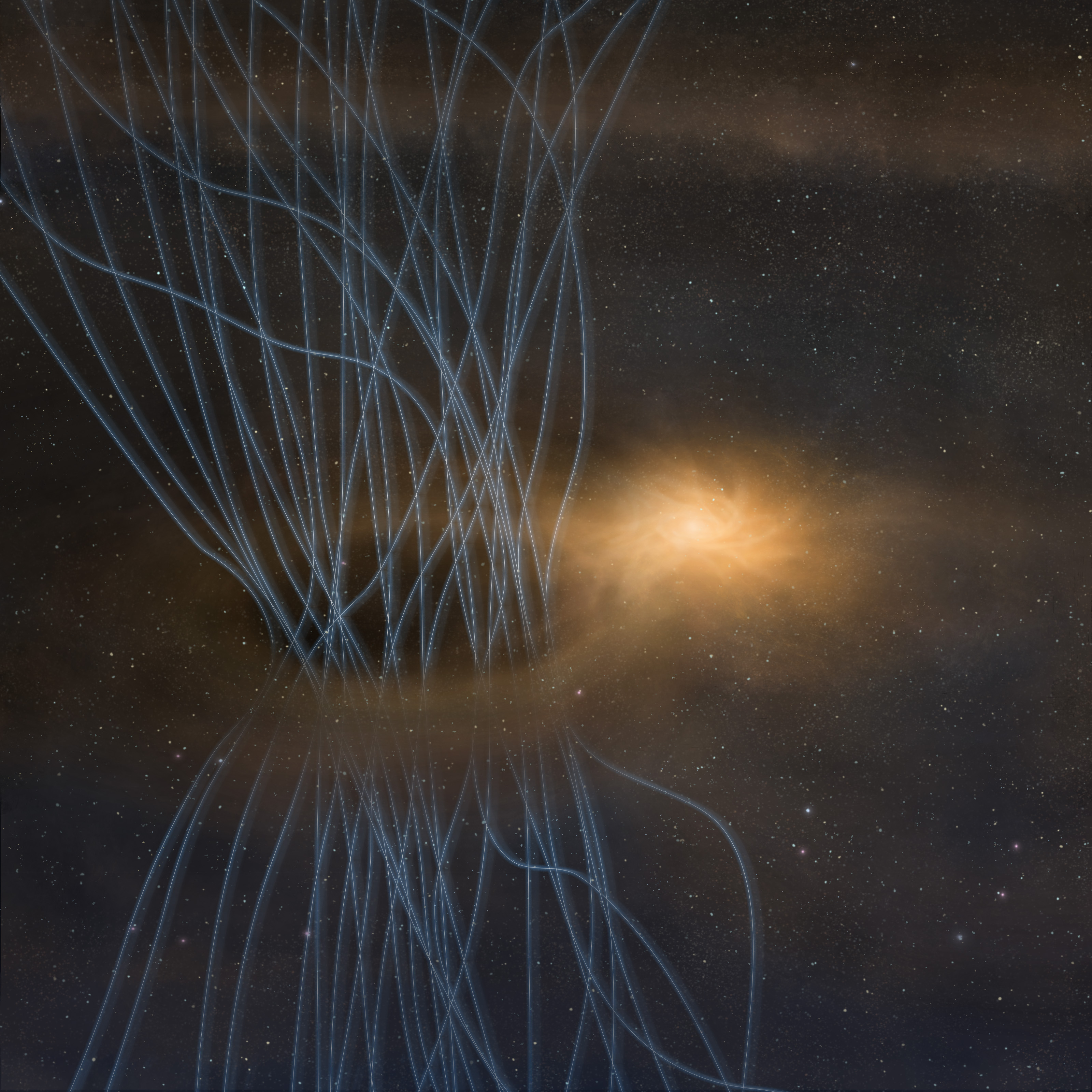
Artist’s conception of a ‘sneeze’ of magnetic field lines, dust, and gas ejected from a baby star.
Credit: ALMA (ESO/NAOJ/NRAO)).
Download image (1.6MB)


Astronomers have discovered the remnants of powerful ‘sneezes’ expelling gas, dust, and electromagnetic energy around stars in the process of forming. The team believes these sneezes help the baby star expel excess magnetic flux, and as such may play a vital role in enabling the star to form.

A star forms from a cloud of gas and dust. Interstellar magnetic field lines pass through these clouds. As the cloud contracts to form the star, the magnetic field lines get pulled along. But observations of young stars show that most of this magnetic energy is lost during the formation process. The question is, where does it go?

Looking for the answer to this question, a team led by Kazuki Tokuda, an astronomer affiliated with NAOJ and Kyushu University, used ALMA (Atacama Large Millimeter/submillimeter Array) to study one of the clouds with a baby star, known as Taurus Dense Core MC 27. This stellar nursery is located approximately 450 light-years from Earth in the direction of the constellation Taurus.

One of the leading theories was that the magnetic field gradually weakened over time as the baby star grew. But as Tokuda explains, “As we analyzed our data, we found something quite unexpected. There were these ‘spike-like’ structures extending a few astronomical units from the protostellar disk. As we dug in deeper, we found that these were spikes of expelled magnetic flux, dust, and gas.”

Tokuda continues, “This is a phenomenon called ‘interchange instability’ where instabilities in the magnetic field react with the different densities of the gases in the protostellar disk, resulting in an outward expelling of magnetic flux. We dubbed this a baby star’s ‘sneeze’ as it reminded us of when we expel dust and air at high speeds.”

Additionally, other spikes were observed several thousands of astronomical units away from the protostellar disk. The team hypothesizes that these were indications of past ‘sneezes.’ And similar spike-like structures have been observed in other young stars, indicating that they may be ubiquitous. These sneezes could help explain how baby stars shed excess magnetic energy and might be a vital part of the star formation process.


Detailed Article(s)


Kyushu University


Release Information

Researcher(s) Involved in this Release

Kazuki Tokuda (Department of Earth and Planetary Science, Faculty of Science, Kyushu University / National Astronomical Observatory of Japan)


Coordinated Release Organization(s)

Kyushu University
National Astronomical Observatory of Japan


Paper(s)

Kazuki Tokuda et al. “Discovery of Asymmetric Spike-like Structures of the 10 au Disk around the Very Low-luminosity Protostar Embedded in the Taurus Dense Core MC 27/L1521F with ALMA”, in The Astrophysical Journal, DOI: 10.3847/1538-4357/ad2f9a


Related Link(s)


Wednesday, April 26, 2017

NASA’s Cassini, Voyager Missions Suggest New Picture of Sun’s Interaction with Galaxy

New data from NASA’s Cassini, Voyager and Interstellar Boundary Explorer missions show that the heliosphere — the bubble of the sun’s magnetic influence that surrounds the inner solar system — may be much more compact and rounded than previously thought. The image on the left shows a compact model of the heliosphere, supported by this latest data, while the image on the right shows an alternate model with an extended tail. The main difference is the new model’s lack of a trailing, comet-like tail on one side of the heliosphere. This tail is shown in the old model in light blue. Credits: Dialynas, et al. (left); NASA (right). Hi-res image

Many other stars show tails that trail behind them like a comet’s tail, supporting the idea that our solar system has one too. However, new evidence from NASA’s Cassini, Voyager and Interstellar Boundary Explorer missions suggest that the trailing end of our solar system may not be stretched out in a long tail. From top left and going counter clockwise, the stars shown are LLOrionis, BZ Cam and Mira. Credits: NASA/HST/R.Casalegno/GALEX. Hi-res image


New data from NASA’s Cassini mission, combined with measurements from the two Voyager spacecraft and NASA’s Interstellar Boundary Explorer, or IBEX, suggests that our sun and planets are surrounded by a giant, rounded system of magnetic field from the sun — calling into question the alternate view of the solar magnetic fields trailing behind the sun in the shape of a long comet tail.

The sun releases a constant outflow of magnetic solar material — called the solar wind — that fills the inner solar system, reaching far past the orbit of Neptune. This solar wind creates a bubble, some 23 billion miles across, called the heliosphere. Our entire solar system, including the heliosphere, moves through interstellar space. The prevalent picture of the heliosphere was one of comet-shaped structure, with a rounded head and an extended tail. But new data covering an entire 11-year solar activity cycle show that may not be the case: the heliosphere may be rounded on both ends, making its shape almost spherical. A paper on these results was published in Nature Astronomy on April 24, 2017.

“Instead of a prolonged, comet-like tail, this rough bubble-shape of the heliosphere is due to the strong interstellar magnetic field — much stronger than what was anticipated in the past — combined with the fact that the ratio between particle pressure and magnetic pressure inside the heliosheath is high,” said Kostas Dialynas, a space scientist at the Academy of Athens in Greece and lead author on the study.

An instrument on Cassini, which has been exploring the Saturn system over a decade, has given scientists crucial new clues about the shape of the heliosphere’s trailing end, often called the heliotail. When charged particles from the inner solar system reach the boundary of the heliosphere, they sometimes undergo a series of charge exchanges with neutral gas atoms from the interstellar medium, dropping and regaining electrons as they travel through this vast boundary region. Some of these particles are pinged back in toward the inner solar system as fast-moving neutral atoms, which can be measured by Cassini.

“The Cassini instrument was designed to image the ions that are trapped in the magnetosphere of Saturn,” said Tom Krimigis, an instrument lead on NASA’s Voyager and Cassini missions based at Johns Hopkins University’s Applied Physics Laboratory in Laurel, Maryland, and an author on the study. “We never thought that we would see what we’re seeing and be able to image the boundaries of the heliosphere.”

Because these particles move at a small fraction of the speed of light, their journeys from the sun to the edge of the heliosphere and back again take years. So when the number of particles coming from the sun changes — usually as a result of its 11-year activity cycle — it takes years before that’s reflected in the amount of neutral atoms shooting back into the solar system.

Cassini’s new measurements of these neutral atoms revealed something unexpected — the particles coming from the tail of the heliosphere reflect the changes in the solar cycle almost exactly as fast as those coming from the nose of the heliosphere.

“If the heliosphere’s ‘tail’ is stretched out like a comet, we’d expect that the patterns of the solar cycle would show up much later in the measured neutral atoms,” said Krimigis.

But because patterns from solar activity show just as quickly in tail particles as those from the nose, that implies the tail is about the same distance from us as the nose. This means that long, comet-like tail that scientists envisioned may not exist at all — instead, the heliosphere may be nearly round and symmetrical.

A rounded heliosphere could come from a combination of factors. Data from Voyager 1 show that the interstellar magnetic field beyond the heliosphere is stronger than scientists previously thought, meaning it could interact with the solar wind at the edges of the heliosphere and compact the heliosphere’s tail.

The structure of the heliosphere plays a big role in how particles from interstellar space — called cosmic rays — reach the inner solar system, where Earth and the other planets are.

“This data that Voyager 1 and 2, Cassini and IBEX provide to the scientific community is a windfall for studying the far reaches of the solar wind,” said Arik Posner, Voyager and IBEX program scientist at NASA Headquarters in Washington, D.C., who was not involved with this study. “As we continue to gather data from the edges of the heliosphere, this data will help us better understand the interstellar boundary that helps shield the Earth environment from harmful cosmic rays.”


By Sarah Frazier
NASA’s Goddard Space Flight Center, Greenbelt, Md. 
Editor: Rob Garner   S

Source: NASA/Sun

Monday, February 29, 2016

NASA’s IBEX Observations Pin Down Interstellar Magnetic Field

(Artist concept) Far beyond the orbit of Neptune, the solar wind and the interstellar medium interact to create a region known as the , bounded on the inside by the termination shock, and on the outside by the heliopause. Credits: NASA/IBEX/Adler Planetarium

This simulation shows the origin of ribbon particles of different energies or speeds outside the heliopause (labeled HP). The IBEX ribbon particles interact with the interstellar magnetic field (labeled ISMF) and travel inwards toward Earth, collectively giving the impression of a ribbon spanning across the sky.Credits: SwRI/Zirnstein

The new paper is based on one particular theory of the origin of the IBEX ribbon, in which the particles streaming in from the ribbon are actually solar material reflected back at us after a long journey to the edges of the sun’s magnetic boundaries. A giant bubble, known as the heliosphere, exists around the sun and is filled with what’s called solar wind, the sun’s constant outflow of ionized gas, known as plasma. When these particles reach the edges of the heliosphere, their motion becomes more complicated.

“The theory says that some solar wind protons are sent flying back towards the sun as neutral atoms after a complex series of charge exchanges, creating the IBEX ribbon,” said Eric Zirnstein, a space scientist at the Southwest Research Institute in San Antonio, Texas, and lead author on the study. “Simulations and IBEX observations pinpoint this process – which takes anywhere from three to six years on average – as the most likely origin of the IBEX ribbon.”

Outside the heliosphere lies the interstellar medium, with plasma that has different speed, density, and temperature than solar wind plasma, as well as neutral gases. These materials interact at the heliosphere’s edge to create a region known as the inner heliosheath, bounded on the inside by the termination shock – which is more than twice as far from us as the orbit of Pluto – and on the outside by the heliopause, the boundary between the solar wind and the comparatively dense interstellar medium.

Some solar wind protons that flow out from the sun to this boundary region will gain an electron, making them neutral and allowing them to cross the heliopause. Once in the interstellar medium, they can lose that electron again, making them gyrate around the interstellar magnetic field. If those particles pick up another electron at the right place and time, they can be fired back into the heliosphere, travel all the way back toward Earth, and collide with IBEX’s detector. The particles carry information about all that interaction with the interstellar magnetic field, and as they  hit the detector they can give us unprecedented insight into the characteristics of that region of space.

“Only Voyager 1 has ever made direct observations of the interstellar magnetic field, and those are close to the heliopause, where it’s distorted,” said Zirnstein. “But this analysis provides a nice determination of its strength and direction farther out.”

The directions of different ribbon particles shooting back toward Earth are determined by the characteristics of the interstellar magnetic field. For instance, simulations show that the most energetic particles come from a different region of space than the least energetic particles, which gives clues as to how the interstellar magnetic field interacts with the heliosphere.

For the recent study, such observations were used to seed simulations of the ribbon’s origin. Not only do these simulations correctly predict the locations of neutral ribbon particles at different energies, but the deduced interstellar magnetic field agrees with Voyager 1 measurements, the deflection of interstellar neutral gases, and observations of distant polarized starlight.

However, some early simulations of the interstellar magnetic field don’t quite line up. Those pre-IBEX estimates were based largely on two data points – the distances at which Voyagers 1 and 2 crossed the termination shock.

“Voyager 1 crossed the termination shock at 94 astronomical units, or AU, from the sun, and Voyager 2 at 84 AU,” said Zirnstein. One AU is equal to about 93 million miles, the average distance between Earth and the sun. “That difference of almost 930 million miles was mostly explained by a strong, very tilted interstellar magnetic field pushing on the heliosphere.”

But that difference may be accounted for by considering a stronger influence from the solar cycle, which can lead to changes in the strength of the solar wind and thus change the distance to the termination shock in the directions of Voyager 1 and 2. The two Voyager spacecraft made their measurements almost three years apart, giving plenty of time for the variable solar wind to change the distance of the termination shock.

“Scientists in the field are developing more sophisticated models of the time-dependent solar wind,” said Zirnstein.

The simulations generally jibe well with the Voyager data.

The IBEX ribbon is a relatively narrow strip of particles flying in towards the sun from outside the heliosphere. A new study corroborates the idea that particles from outside the heliosphere that form the IBEX ribbon actually originate at the sun – and reveals information about the distant interstellar magnetic field. Credits: SwRI

“The new findings can be used to better understand how our space environment interacts with the interstellar environment beyond the heliopause,” said Eric Christian, IBEX program scientist at NASA’s Goddard Space Flight Center in Greenbelt, Maryland, who was not involved in this study. “In turn, understanding that interaction could help explain the mystery of what causes the IBEX ribbon once and for all.”

The Southwest Research Institute leads IBEX with teams of national and international partners. NASA Goddard manages the Explorers Program for the agency’s Heliophysics Division within the Science Mission Directorate in Washington.


Related Link


 Source: NASA/Ibex