Showing posts with label NGC 6752. Show all posts

Thursday, January 31, 2019

Hubble fortuitously discovers a new galaxy in the cosmic neighbourhood

The accidentally discovered galaxy Bedin I

Bedin 1 in NGC 6752

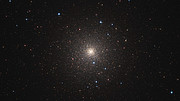
Globular cluster NGC 6752

Wide-field view of NGC 6752 (ground-based view)


Videos 
Zooming in on NGC 6752 and Bedin 1

Flight to Bedin 1
Flight to Bedin 1


Astronomers using the NASA/ESA Hubble Space Telescope to study some of the oldest and faintest stars in the globular cluster NGC 6752 have made an unexpected finding. They discovered a dwarf galaxy in our cosmic backyard, only 30 million light-years away. The finding is reported in the journal Monthly Notices of the Royal Astronomical Society: Letters.

An international team of astronomers recently used the NASA/ESA Hubble Space Telescope to study white dwarf stars within the globular cluster NGC 6752. The aim of their observations was to use these stars to measure the age of the globular cluster, but in the process they made an unexpected discovery.
In the outer fringes of the area observed with Hubble’s Advanced Camera for Surveys a compact collection of stars was visible. After a careful analysis of their brightnesses and temperatures, the astronomers concluded that these stars did not belong to the cluster — which is part of the Milky Way — but rather they are millions of light-years more distant.

Our newly discovered cosmic neighbour, nicknamed Bedin 1 by the astronomers, is a modestly sized, elongated galaxy. It measures only around 3000 light-years at its greatest extent — a fraction of the size of the Milky Way. Not only is it tiny, but it is also incredibly faint. These properties led astronomers to classify it as a dwarf spheroidal galaxy.

Dwarf spheroidal galaxies are defined by their small size, low-luminosity, lack of dust and old stellar populations [1]. 36 galaxies of this type are already known to exist in the Local Group of Galaxies, 22 of which are satellite galaxies of the Milky Way.

While dwarf spheroidal galaxies are not uncommon, Bedin 1 has some notable features. Not only is it one of just a few dwarf spheroidals that have a well established distance but it is also extremely isolated. It lies about 30 million light-years from the Milky Way and 2 million light-years from the nearest plausible large galaxy host, NGC 6744. This makes it possibly the most isolated small dwarf galaxy discovered to date.

From the properties of its stars, astronomers were able to infer that the galaxy is around 13 billion years old — nearly as old as the Universe itself. Because of its isolation — which resulted in hardly any interaction with other galaxies — and its age, Bedin 1 is the astronomical equivalent of a living fossil from the early Universe.

The discovery of Bedin 1 was a truly serendipitous find. Very few Hubble images allow such faint objects to be seen, and they cover only a small area of the sky. Future telescopes with a large field of view, such as the WFIRST telescope, will have cameras covering a much larger area of the sky and may find many more of these galactic neighbours.


Notes

[1] While similar to dwarf elliptical galaxies in appearance and properties, dwarf spheroidal galaxies are in general approximately spherical in shape and have a lower luminosity.


More Information

The Hubble Space Telescope is a project of international cooperation between ESA and NASA.

The results were presented in the letter The HST Large Programme on NGC 6752. I. Serendipitous discovery of a dwarf galaxy in background, published in the journal Monthly Notices of the Royal Astronomical Society: Letters.

The international team of astronomers that carried out this study consists of L. R. Bedin (INAF-Osservatorio Astronomico di Padova, Italy), M. Salaris (Liverpool John Moores University, UK), R. M. Rich (University of California Los Angeles, USA), H. Richer (University of British Columbia), J. Anderson (Space Telescope Science Institute, USA), B. Bettoni (INAF-Osservatorio Astronomico di Padova, Italy), D. Nardiello (Università di Padova, Italy), A. P. Milone (Università di Padova, Italy), A. F. Marino (Università di Padova, Italy), M. Libralato (Space Telescope Science Institute, USA), A. Bellini (Space Telescope Science Institute, USA), A. Dieball (University of Bonn, Germany), P. Bergeron (Université de Montréal, Canada), A. J. Burgasser (University of California San Diego, USA), D. Apai (University of Arizona, USA).

Image credit: NASA, ESA, Bedin et al.


Links


Contact

L. R. Bedin
INAF-Osservatorio Astronomico di Padova
Padua, Italy
Tel: +49 8293 413

Email: luigi.bedin@oapd.inaf.it

Mathias Jäger
ESA/Hubble, Public Information Officer
Garching, Germany
Tel: +49 176 62397500
Email:
mjaeger@partner.eso.org


Wednesday, May 29, 2013

Low Sodium Diet Key to Old Age for Stars

The globular star cluster NGC 6752
The globular star cluster NGC 6752 in the constellation of Pavo 

  Videos

Zooming in on the globular star cluster NGC 6752

A close look at the globular star cluster NGC 6752

New VLT observations create major headache for stellar theories

Astronomers expect that stars like the Sun will blow off much of their atmospheres into space near the ends of their lives. But new observations of a huge star cluster made using ESO’s Very Large Telescope have shown — against all expectations — that a majority of the stars studied simply did not get to this stage in their lives at all. The international team found that the amount of sodium in the stars was a very strong predictor of how they ended their lives.

The way in which stars evolve and end their lives was for many years considered to be well understood. Detailed computer models predicted that stars of a similar mass to the Sun would have a period towards the ends of their lives — called the asymptotic giant branch, or AGB [1] — when they undergo a final burst of nuclear burning and puff off a lot of their mass in the form of gas and dust.

This expelled material [2] goes on to form the next generations of stars and this cycle of mass loss and rebirth is vital to explain the evolving chemistry of the Universe. This process is also what provides the material required for the formation of planets — and indeed even the ingredients for organic life.

But when Australian stellar theory expert Simon Campbell of the Monash University Centre for Astrophysics, Melbourne, scoured old papers he found tantalising suggestions that some stars may somehow not follow the rules and might skip the AGB phase entirely. He takes up the story:

“For a stellar modelling scientist this suggestion was crazy! All stars go through the AGB phase according to our models. I double-checked all the old studies but found that this had not been properly investigated. I decided to investigate myself, despite having little observational experience.”

Campbell and his team used ESO’s Very Large Telescope (VLT) to very carefully study the light coming from stars in the globular star cluster NGC 6752 in the southern constellation of Pavo (The Peacock). This vast ball of ancient stars contains both a first generation of stars and a second that formed somewhat later [3]. The two generations can be distinguished by the amount of sodium they contain — something that the very high-quality VLT data can be used to measure.

“FLAMES, the multi-object high-resolution spectrograph on the VLT, was the only instrument that could allow us to get really high-quality data for 130 stars at a time. And it allowed us to observe a large part of the globular cluster in one go,” adds Campbell.

The results were a surprise — all of the AGB stars in the study were first generation stars with low levels of sodium and none of the higher-sodium second generation stars had become AGB stars at all. As many as 70% of the stars were not undergoing the final nuclear burning and mass-loss phase [4] [5].

“It seems stars need to have a low-sodium “diet” to reach the AGB phase in their old age. This observation is important for several reasons. These stars are the brightest stars in globular clusters — so there will be 70% fewer of the brightest stars than theory predicts. It also means our computer models of stars are incomplete and must be fixed!” concludes Campbell.

The team expects that similar results will be found for other star clusters and further observations are planned.

Notes

[1] AGB stars get their odd name because of their position on the Hertzsprung Russell diagram, a plot of the brightnesses of stars against their colours.

[2] For a short period of time this ejected material is lit up by the strong ultraviolet radiation from the star and creates a planetary nebula (see for instance eso1317).

[3] Although the stars in a globular cluster all formed at about the same time, it is now well established that these systems are not as simple as they once thought to be. They usually contain two or more populations of stars with different amounts of light chemical elements such as carbon, nitrogen and — crucially for this new study — sodium.

[4] It is thought that stars which skip the AGB phase will evolve directly into helium white dwarf stars and gradually cool down over many billions of years.

[5] It is not thought that the sodium itself is the cause of the different behaviour, but must be strongly linked to the underlying cause — which remains mysterious.


More information

This research was presented in a paper entitled “Sodium content as a predictor of the advanced evolution of globular cluster stars” by Simon Campbell et al., to appear online in the journal Nature on 29 May 2013.


The team is composed of Simon W. Campbell (Monash University, Melbourne, Australia), Valentina D’Orazi (Macquarie University, Sydney, Australia; Monash University), David Yong (Australian National University, Canberra, Australia [ANU]), Thomas N. Constantino (Monash University), John C. Lattanzio (Monash University), Richard J. Stancliffe (ANU; Universität Bonn, Germany), George C. Angelou (Monash University), Elizabeth C. Wylie-de Boer (ANU), Frank Grundahl (Aarhus University, Denmark).


ESO is the foremost intergovernmental astronomy organisation in Europe and the world’s most productive ground-based astronomical observatory by far. It is supported by 15 countries: Austria, Belgium, Brazil, the Czech Republic, Denmark, France, Finland, Germany, Italy, the Netherlands, Portugal, Spain, Sweden, Switzerland and the United Kingdom. ESO carries out an ambitious programme focused on the design, construction and operation of powerful ground-based observing facilities enabling astronomers to make important scientific discoveries. ESO also plays a leading role in promoting and organising cooperation in astronomical research. ESO operates three unique world-class observing sites in Chile: La Silla, Paranal and Chajnantor. At Paranal, ESO operates the Very Large Telescope, the world’s most advanced visible-light astronomical observatory and two survey telescopes. VISTA works in the infrared and is the world’s largest survey telescope and the VLT Survey Telescope is the largest telescope designed to exclusively survey the skies in visible light. ESO is the European partner of a revolutionary astronomical telescope ALMA, the largest astronomical project in existence. ESO is currently planning the 39-metre European Extremely Large optical/near-infrared Telescope, the E-ELT, which will become “the world’s biggest eye on the sky”.


Links


Contacts

Simon Campbell
Monash University
Melbourne, Australia
Tel: +61 3 9905 4454
Email:
simon.campbell@monash.edu

John Lattanzio
Monash University
Melbourne, Australia
Tel: +61 3 9905 4428
Email:
john.lattanzio@monash.edu

Richard Hook
ESO Public Information Officer
Garching bei München, Germany
Tel: +49 89 3200 6655
Cell: +49 151 1537 3591
Email:
rhook@eso.org


Tuesday, January 31, 2012

Young Stars at Home in an Ancient Cluster

NGC 6752
Credit: ESA/Hubble & NASA

Looking like a hoard of gems fit for an emperor’s collection, this deep sky object called NGC 6752 is in fact far more worthy of admiration. It is a globular cluster, and at over 10 billion years old is one the most ancient collections of stars known. It has been blazing for well over twice as long long as our Solar System has existed.

NGC 6752 contains a high number of “blue straggler” stars, some of which are visible in this image. These stars display characteristics of stars younger than their neighbours, despite models suggesting that most of the stars within globular clusters should have formed at approximately the same time. Their origin is therefore something of a mystery.

Studies of NGC 6752 may shed light on this situation. It appears that a very high number — up to 38% — of the stars within its core region are binary systems. Collisions between stars in this turbulent area could produce the blue stragglers that are so prevalent.

Lying 13 000 light-years distant, NGC 6752 is far beyond our reach, yet the clarity of Hubble’s images brings it tantalisingly close.

Source: ESA/HUBBLE