Showing posts with label JAXA. Show all posts

Friday, November 01, 2013

Cosmos Seeded with Heavy Elements During Violent Youth


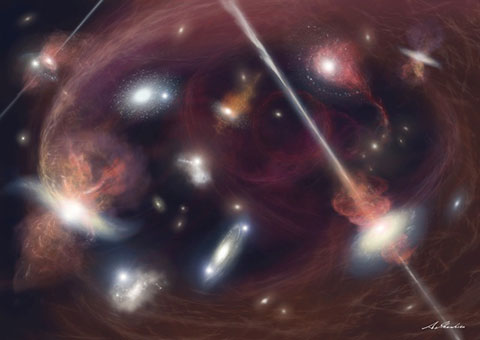
[Fig.1] Ten to twelve billion years ago, the universe was undergoing a turbulent youth. Stars formed at very high rates, but many of the newborn stars died quickly in huge supernova explosions. These explosions produced the chemical elements - the building blocks of other stars, planets, and life.In the same period, black holes in the centers of galaxies were devouring large amounts of the surrounding gas, producing strong jets and outflows. The combined energy of supernovae and black hole activity created powerful galactic winds that blew the iron out of the galaxies, into intergalactic space. [Image Credit: Akihiro Ikeshita]

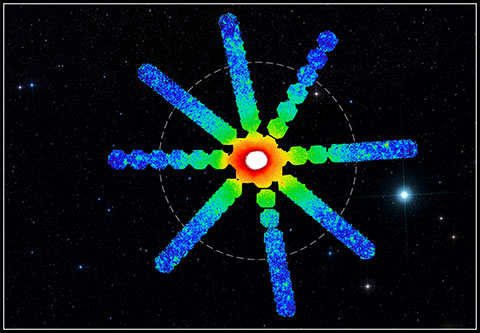
[Fig.2] Suzaku observed the Perseus Cluster along 8 directions for two weeks. Image Credit: "NASA/ISAS/DSS/O.Urban al., MNRAS"

[Fig.3] Young stars, exploding supernovae, and voraciously feeding black holes produced powerful winds 10-12 billion years ago. These winds were the spoon that lifted the iron from the galaxies and mixed it with the intergalactic gas.  [Image Credit: Akihiro Ikeshita/JAXA]

Traces of iron spread smoothly throughout a massive galaxy cluster tell the 10 billion-year-old story of exploding supernovae and fierce outbursts from supermassive black holes sowing heavy elements throughout the early cosmos.

New evidence of heavy elements spread evenly between the galaxies of the giant Perseus cluster supports the theory that the universe underwent a turbulent and violent youth more than 10 billion years ago. That explosive period was responsible for seeding the cosmos with the heavy elements central to life itself.

This discovery, reported today in the journal Nature by a team of researchers from the Kavli Institute for Particle Astrophysics and Cosmology (KIPAC) and the Japan Aerospace Exploration Agency (JAXA), was made possible by almost two weeks of observations of the nearby Perseus cluster of galaxies with the Suzaku satellite. The Suzaku Key Project observations were used to map the spectroscopic signature of iron in the hot, 10 million degree gas that fills the space between galaxies in clusters.

"We saw that iron is spread out between the galaxies remarkably smoothly,"
said Norbert Werner, lead author of the paper. "That means it had to be present in the intergalactic gas before the Perseus cluster formed."

Most of the elements that we are made of were produced inside stars and released by stellar explosions called supernovae. Whether the elements formed by stars stay within the galaxies they are born in, or are spread out into intergalactic space, had long been an open question. If the elements stay within their original host galaxies then we would expect to see an uneven distribution of iron within galaxy clusters, roughly following the distribution of galaxies. But what Werner and his colleagues saw is a remarkably even distribution of iron all the way out to the edge of the Perseus cluster. According to the authors, this can only be explained if the iron had been spread out into the intergalactic medium before the cluster formed, roughly 10 billion years ago, during a time of intense star formation.

At that time, billions of exploding stars created vast quantities of heavy elements in the alchemical furnaces of their own destruction. This was also the epoch when black holes in the hearts of galaxies were at their most energetic.

"The combined energy of these cosmic phenomena must have been strong enough to expel most of the metals from the galaxies at early times, and to enrich and mix the intergalactic gas." said co-author and KIPAC graduate student Ondrej Urban.

"The results suggest that the Perseus cluster is probably not unique, and that iron - along with other heavy elements - is evenly spread throughout all massive galaxy clusters", said Steven Allen, a KIPAC professor and head of the research team.

"You are older than you think - or at least, some of the iron in your blood is older, formed in galaxies millions of lights years away and billions of years ago," concluded co-author Aurora Simionescu, an International Top Young Fellow at the Japanese Space Agency.

The researchers are now looking for iron in other clusters and eagerly awaiting a mission capable of measuring the concentration of chemical elements in the hot gas with a much higher accuracy.

"With measurements like these, the Suzaku satellite is having a profound impact on our understanding of how the largest structures in our universe grow," Allen said. "We're really looking forward to to what further data from Suzaku and the new ASTRO-H satellite will tell us." 

Thursday, March 24, 2011

Suzaku Shows Clearest Picture Yet of Perseus Galaxy Cluster

X-ray observations made by the Suzaku observatory provide the clearest picture to date of the size, mass and chemical content of a nearby cluster of galaxies. The study also provides the first direct evidence that million-degree gas clouds are tightly gathered in the cluster's outskirts.

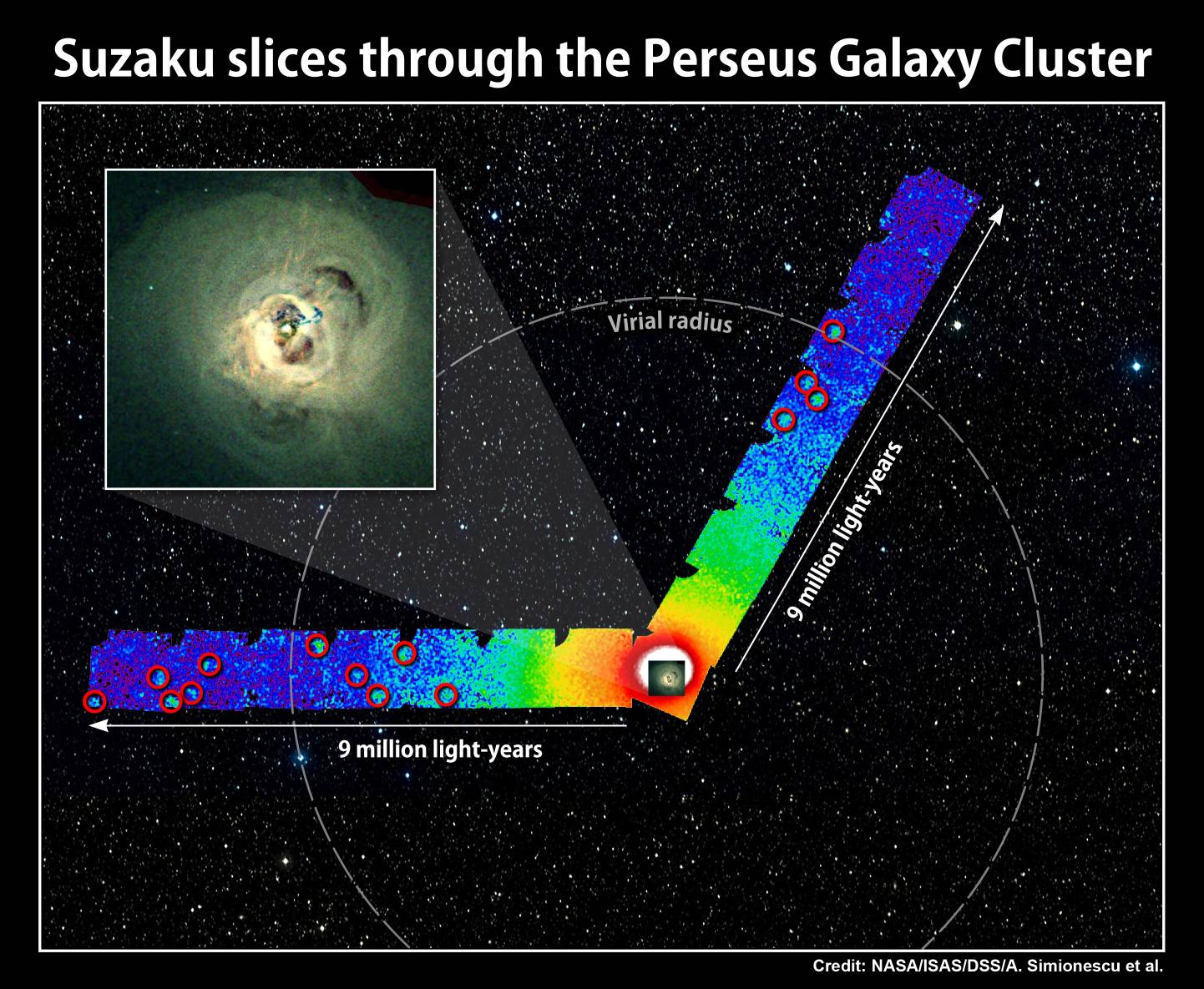
Suzaku explored faint X-ray emission of hot gas across two swaths of the Perseus Galaxy Cluster. The images, which record X-rays with energies between 700 and 7,000 electron volts in a combined exposure of three days, are shown in two false-color strips. Bluer colors indicate less intense X-ray emission. The dashed circle is 11.6 million light-years across and marks the so-called virial radius, where cold gas is now entering the cluster. Red circles indicate X-ray sources not associated with the cluster. Inset: An image of the cluster's bright central region taken by NASA's Chandra X-ray Observatory is shown to scale. (Credits: NASA/ISAS/DSS/A. Simionescu et al.; inset: NASA/CXC/A. Fabian et al.) › Larger image. › Larger image (unlabeled)

Suzaku is sponsored by the Japan Aerospace Exploration Agency (JAXA) with contributions from NASA and participation by the international scientific community. The findings will appear in the March 25 issue of the journal Science.

Galaxy clusters are millions of light-years across, and most of their normal matter comes in the form of hot X-ray-emitting gas that fills the space between the galaxies.

"Understanding the content of normal matter in galaxy clusters is a key element for using these objects to study the evolution of the universe," explained Adam Mantz, a co-author of the paper at NASA's Goddard Space Flight Center in Greenbelt, Md.

Clusters provide independent checks on cosmological values established by other means, such as galaxy surveys, exploding stars and the cosmic microwave background, which is the remnant glow of the Big Bang. The cluster data and the other values didn't agree.

NASA's Wilkinson Microwave Anisotropy Probe (WMAP) explored the cosmic microwave background and established that baryons -- what physicists call normal matter -- make up only about 4.6 percent of the universe. Yet previous studies showed that galaxy clusters seemed to hold even fewer baryons than this amount.

Suzaku images of faint gas at the fringes of a nearby galaxy cluster have allowed astronomers to resolve this discrepancy for the first time.

The satellite's ideal target for this study was the Perseus Galaxy Cluster, which is located about 250 million light-years away and named for the constellation in which it resides. It is the brightest extended X-ray source beyond our own galaxy, and also the brightest and closest cluster in which Suzaku has attempted to map outlying gas.

"Before Suzaku, our knowledge of the properties of this gas was limited to the innermost parts of clusters, where the X-ray emission is brightest, but this left a huge volume essentially unexplored," said Aurora Simionescu, the study's lead researcher at the Kavli Institute for Particle Astrophysics and Cosmology (KIPAC) at Stanford University.

This Hubble Space Telescope image shows NGC 1275, the galaxy located in the center of the Perseus Galaxy Cluster. The red threadlike filaments are composed of cool gas suspended by a magnetic field. (Credit: NASA/ESA/Hubble Heritage (STScI/AURA)-ESA/Hubble Collaboration). › Larger image

In late 2009, Suzaku's X-ray telescopes repeatedly observed the cluster by progressively imaging areas farther east and northwest of the center. Each set of images probed sky regions two degrees across -- equivalent to four times the apparent width of the full moon or about 9 million light-years at the cluster's distance. Staring at the cluster for about three days, the satellite mapped X-rays with energies hundreds of times greater than that of visible light.

From the data, researchers measured the density and temperature of the faint X-ray gas, which let them infer many other important quantities. One is the so-called virial radius, which essentially marks the edge of the cluster. Based on this measurement, the cluster is 11.6 million light-years across and contains more than 660 trillion times the mass of the sun. That's nearly a thousand times the mass of our Milky Way galaxy.

The researchers also determined the ratio of the cluster's gas mass to its total mass, including dark matter -- the mysterious substance that makes up about 23 percent of the universe, according to WMAP. By virtue of their enormous size, galaxy clusters should contain a representative sample of cosmic matter, with normal-to-dark-matter ratios similar to WMAP's. Yet the outer parts of the Perseus cluster seemed to contain too many baryons, the opposite of earlier studies, but still in conflict with WMAP.

To solve the problem, researchers had to understand the distribution of hot gas in the cluster, the researchers say. In the central regions, the gas is repeatedly whipped up and smoothed out by passing galaxies. But computer simulations show that fresh infalling gas at the cluster edge tends to form irregular clumps.

Not accounting for the clumping overestimates the density of the gas. This is what led to the apparent disagreement with the fraction of normal matter found in the cosmic microwave background.

"The distribution of these clumps and the fact that they are not immediately destroyed as they enter the cluster are important clues in understanding the physical processes that take place in these previously unexplored regions," said Steve Allen at KIPAC, the principal investigator of the Suzaku observations.

Goddard supplied Suzaku's X-ray telescopes and data-processing software, and it continues to operate a facility that supports U.S. astronomers who use the spacecraft.

Suzaku ( Japanese for "red bird of the south") is the fifth Japanese X-ray astronomy satellite. It was launched as Astro-E2 on July 10, 2005, and renamed in orbit. The observatory was developed at JAXA's Institute of Space and Astronautical Science in collaboration with NASA and other Japanese and U.S. institutions.

Text issued as NASA Headquarters Release No. 11-087