Showing posts with label Jupiter's moon. Show all posts

Wednesday, April 03, 2024

Simulations of Europa Craters Suggest Thick Ice Crust

Artist’s conception of a basin forming impact occurring on Jupiter’s icy moon Europa.
Credit: Brandon Johnson generated with the assistance of AI.)
Download image (8.6MB)


Sometimes planetary physics is like being in a snowball fight. Most people, if handed an already formed snowball, can use their experience and the feel of the ball to guess what kind of snow it is comprised of: wet and puffy, or dry and packable. Using nearly the same principles, planetary scientists have been able to study the structure of Europa, Jupiter’s icy moon.

Europa is a rocky moon, home to saltwater oceans twice the volume of Earth’s, encased in a shell of ice. Scientists have long thought that Europa may be one of the best places in our Solar System to look for non-terrestrial life. The likelihood and nature of that life, though, heavily depend on the thickness of its icy shell, something astronomers have not yet been able to ascertain.

A team of planetary science experts including Shigeru Wakita, a research scientist in the Department of Earth, Atmospheric, and Planetary Sciences in Purdue University’s College of Science, announced in a new paper published in Science Advances that Europa’s ice shell is at least 20 kilometers thick.

To reach their conclusion, the scientists studied the formation of large craters on Europa, running a variety of simulations to determine what ice shell structure and combination of physical characteristics could have created such a surface structure. These simulations were partially performed using the PC cluster of the National Astronomical Observatory of Japan.

“This is the first work that has been done on this large crater on Europa,” says Wakita. “Previous estimates showed a very thin ice layer over a thick ocean. But our research showed that there needs to be a thick layer – so thick that convection in the ice, which has previously been debated, is likely.”

Using data and images from the spacecraft Galileo which studied Europa in 1998, the research team analyzed the impact craters to decode truths about Europa’s structure. Experts in planetary physics and colossal collisions have studied almost every major planetary body in the Solar System. They have long debated the thickness of Europa’s ice shell; no one has visited to measure it directly, so scientists are creatively using the evidence at hand: the craters on Europa’s icy surface.

Europa is a frozen world, but the ice shelters a rocky core. The icy surface, though, is not stagnant. Plate tectonics and convection currents in the oceans and the ice itself refresh the surface fairly frequently. This means the surface itself is only 50 to 100 million years old – which sounds old to short-lived organisms like humans, but it is young as far as geological periods go.

That smooth, young surface means that craters are clearly defined, easier to analyze, and not very deep. The craters tell scientists more about the icy shell of the moon and the water ocean below, rather than conveying much information about its rocky heart.

A team member, Brandon Johnson, an associate professor in Purdue University, said, “Understanding the thickness of the ice is vital to theorizing about possible life on Europa. The thickness of the ice shell controls what kind of processes are happening within it, and that is important for understanding the exchange of material between the surface and the ocean. Understanding that will help us understand how all kinds of processes happen on Europa – and help us understand the possibility of life.”


Release Information

Researcher(s) Involved in this Release

Shigeru Wakita (Research Scientist @ Department of Earth, Atmospheric, and Planetary Sciences, Purdue University)
Brandon Johnson (Associate Professor @ Department of Earth, Atmospheric, and Planetary Sciences, Purdue University)

Coordinated Release Organization(s)

Purdue University
Massachusetts Institute of Technology
National Astronomical Observatory of Japan

Paper(s)

Wakita et al., “Multiring basin formation constrains Europa’s ice shell thickness”, in Science Advances,
DOI: 10.1126/sciadv.adj8455


Related Link(s)


Saturday, February 18, 2023

12 New Jovian Moons Discovered


Figure 1: Conceptual diagram showing the orbits of Jupiter's satellites. The left and right figures represent Jupiter viewed from the polar and equatorial directions, respectively. The gray (innermost), pink, yellow, blue, light blue, green, and red lines represent the orbits of Amalthea group, Galilean satellites, Themisto, Himalia group, Carpo, Valetudo, and retrogrades, respectively.. Credit: Scott Shepard/Carnegie Institution for Science

Observations using the Subaru Telescope and other telescopes led to the discovery of swarms of potential new moons around Jupiter. Of these, 12 have been confirmed as moons of Jupiter, and many more are awaiting further observations for confirmation.

A team, led by Scott Sheppard at the Carnegie Institute for Science, noticed that Jupiter was near their target field locations while searching for new objects in the outer Solar System beyond Pluto. So the team decided to look for new Jovian moons in the foreground while looking for new outer-Solar-System objects in the background. They performed their observations with the Subaru Telescope in September 2021 and the Blanco 4-meter Telescope with the Dark Energy Camera in August 2022.

The team’s ingenuity was rewarded with many new candidates. Follow-up observations using the 6.5-meter Magellan Telescopes in Chile characterized 12 of those candidates well enough to be declared moons. They will now be given official numbers and names. The team will continue to monitor the additional candidates to see if they can increase the number of known moons even more.

The newly confirmed satellites bring the number of known moons around Jupiter to 92, exceeding the 83 known moons around Saturn. But caution is needed in making direct comparisons. Because Saturn is farther away, it is more difficult to spot small, faint satellites around it. Sheppard comments, "We believe when comparing moons of the same size range, Saturn has more than Jupiter, but both planets have many, many of these small moons."

One motivation to look for new moons around Jupiter is that ESA’s JUICE (JUpiter ICy moons Explorer) and NASA’s Europa Clipper spacecraft are planned to enter the Jovian system in the near future. Sheppard explains, "The hope is that if we find enough moons, one of them will just happen to be close enough to the spacecraft’s trajectory to get close-up flyby images of it while the spacecraft is passing through the outer Jovian system to the inner Jovian system."

These findings were announced in late January by the International Astronomical Union’s Minor Planet Center.

Maunakea, which has cultural, historical, and natural significance in Hawai`i.

Relevant Links

SourceSubaru Telescope


Thursday, October 22, 2020

ALMA Shows Volcanic Impact on Io’s Atmosphere

This video shows images of Jupiter's moon Io in radio (made with ALMA), and optical light (made with Voyager 1 and Galileo missions). The ALMA images were taken when Io passed into Jupiter's shadow in March 2018 (eclipse), and from Jupiter's shadow into sunlight in September 2018. These radio images for the first time show plumes of sulfur dioxide (in yellow) rise up from the volcanoes on Io.Credit: ALMA (ESO/NAOJ/NRAO), I. de Pater et al.; NRAO/AUI NSF, S. Dagnello; NASA
. Download Video
 
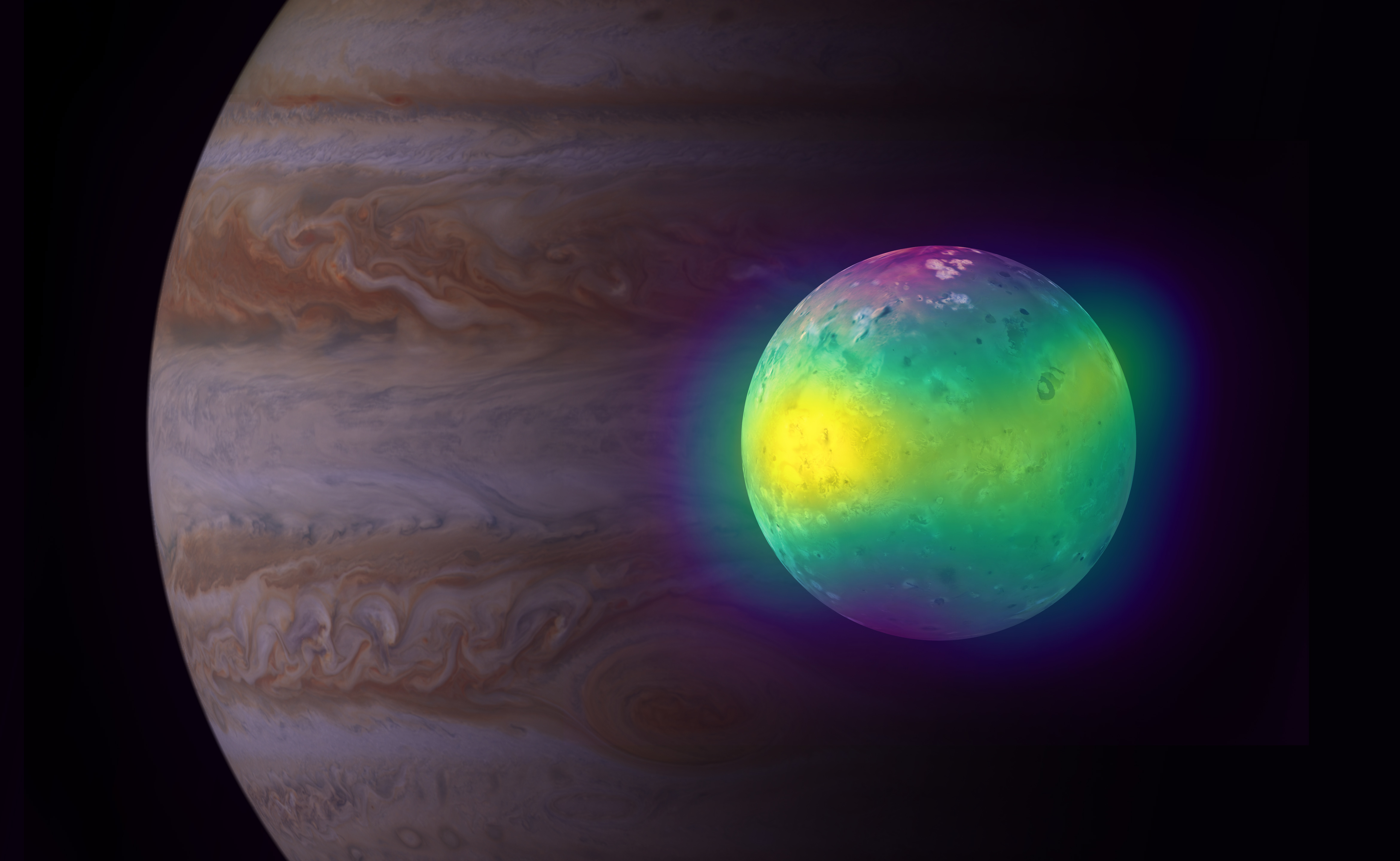
Composite image showing Jupiter's moon Io in radio (ALMA), and optical light (Voyager 1 and Galileo). The ALMA images of Io show for the first time plumes of sulfur dioxide (in yellow) rise up from its volcanoes. Jupiter is visible in the background (Cassini image).Credit: ALMA (ESO/NAOJ/NRAO), I. de Pater et al.; NRAO/AUI NSF, S. Dagnello; NASA/JPL/Space Science Institute.  Hi-Res File 
 
New radio images from the Atacama Large Millimeter/submillimeter Array (ALMA)vf Jupiter’s moon Io.

Io is the most volcanically active moon in our solar system. It hosts more than 400 active volcanoes, spewing out sulfur gases that give Io its yellow-white-orange-red colors when they freeze out on its surface.

Although it is extremely thin – about a billion times thinner than Earth’s atmosphere – Io has an atmosphere that can teach us about Io’s volcanic activity and provide us a window into the exotic moon’s interior and what is happening below its colorful crust.

Previous research has shown that Io’s atmosphere is dominated by sulfur dioxide gas, ultimately sourced from volcanic activity. “However, it is not known which process drives the dynamics in Io’s atmosphere,” said Imke de Pater of the University of California, Berkeley. “Is it volcanic activity, or gas that has sublimated (transitioned from solid to gaseous state) from the icy surface when Io is in sunlight?“

To distinguish between the different processes that give rise to Io’s atmosphere, a team of astronomers used ALMA to make snapshots of the moon when it passed in and out of Jupiter’s shadow (they call this an “eclipse”).

“When Io passes into Jupiter’s shadow, and is out of direct sunlight, it is too cold for sulfur dioxide gas, and it condenses onto Io’s surface. During that time we can only see volcanically-sourced sulfur dioxide. We can therefore see exactly how much of the atmosphere is impacted by volcanic activity,” explained Statia Luszcz-Cook from Columbia University, New York.

Thanks to ALMA’s exquisite resolution and sensitivity, the astronomers could, for the first time, clearly see the plumes of sulfur dioxide (SO2) and sulfur monoxide (SO) rise up from the volcanoes. Based on the snapshots, they calculated that active volcanoes directly produce 30-50 percent of Io’s atmosphere.

The ALMA images also showed a third gas coming out of volcanoes: potassium chloride (KCl). “We see KCl in volcanic regions where we do not see SO2 or SO,” said Luszcz-Cook. “This is strong evidence that the magma reservoirs are different under different volcanoes.”

Io is volcanically active due to a process called tidal heating. Io orbits Jupiter in an orbit that is not quite circular and, like our Moon always faces the same side of Earth, so does the same side of Io always face Jupiter. The gravitational pull of Jupiter’s other moons Europa and Ganymede causes tremendous amounts of internal friction and heat, giving rise to volcanoes such as Loki Patera, which spans more than 200 kilometers (124 miles) across. “By studying Io’s atmosphere and volcanic activity we learn more about not only the volcanoes themselves, but also the tidal heating process and Io’s interior,” added Luszcz-Cook.

A big unknown remains the temperature in Io’s lower atmosphere. In future research, the astronomers hope to measure this with ALMA. “To measure the temperature of Io’s atmosphere, we need to obtain a higher resolution in our observations, which requires that we observe the moon for a longer period of time. We can only do this when Io is in sunlight since it does not spend much time in eclipse,” said de Pater. “During such an observation, Io will rotate by tens of degrees. We will need to apply software that helps us make un-smeared images. We have done this previously with radio images of Jupiter made with ALMA and the Very Large Array (VLA).”

The National Radio Astronomy Observatory is a facility of the National Science Foundation, operated under cooperative agreement by Associated Universities, Inc.

Source: National Radio Astronomy Observatory (NRAO)/News

Media contact:

Iris Nijman
NRAO News and Public Information Manager

inijman@nrao.edu

Imke de Pater and Statia Luszcz-Cook worked with Patricio Rojo of the Universidad de Chile, Erin Redwing of the University of California, Berkeley, Katherine de Kleer of the California Institute of Technology (Caltech), and Arielle Moullet of SOFIA/USRA in California.

This research titled “ALMA Observations of Io Going into and Coming out of Eclipse” has been accepted for publication in The Planetary Science Journal. Preprint: https://arxiv.org/abs/2009.07729

The Atacama Large Millimeter/submillimeter Array (ALMA), an international astronomy facility, is a partnership of the European Organisation for Astronomical Research in the Southern Hemisphere (ESO), the U.S. National Science Foundation (NSF) and the National Institutes of Natural Sciences (NINS) of Japan in cooperation with the Republic of Chile. ALMA is funded by ESO on behalf of its Member States, by NSF in cooperation with the National Research Council of Canada (NRC) and the Ministry of Science and Technology (MOST) and by NINS in cooperation with the Academia Sinica (AS) in Taiwan and the Korea Astronomy and Space Science Institute (KASI).

ALMA construction and operations are led by ESO on behalf of its Member States; by the National Radio Astronomy Observatory (NRAO), managed by Associated Universities, Inc. (AUI), on behalf of North America; and by the National Astronomical Observatory of Japan (NAOJ) on behalf of East Asia. The Joint ALMA Observatory (JAO) provides the unified leadership and management of the construction, commissioning and operation of ALMA.


Friday, September 18, 2020

Hubble’s Crisp New Image of Jupiter and Europa

Hubble’s Crisp New Image of Jupiter and Europa 
 
Hubble’s New Rainbow View of Jupiter
 
Hubble’s New Views of Jupiter


Videos 
 
Hubble’s New Views of Jupiter


This latest image of Jupiter, taken by the NASA/ESA Hubble Space Telescope on 25 August 2020, was captured when the planet was 653 million kilometres from Earth. Hubble’s sharp view is giving researchers an updated weather report on the monster planet’s turbulent atmosphere, including a remarkable new storm brewing, and a cousin of the Great Red Spot changing colour — again. The new image also features Jupiter’s icy moon Europa.

A unique and exciting detail of Hubble’s new snapshot appears at mid-northern latitudes as a bright, white, stretched-out storm moving at 560 kilometres per hour. This single plume erupted on 18 August 2020 and another has since appeared.

While it’s common for storms to pop up in this region, often several at once, this particular disturbance appears to have more structure behind it than observed in previous storms. Trailing behind the plume are small, counterclockwise dark clumps also not witnessed in the past. Researchers speculate this may be the beginning of a longer-lasting northern hemisphere spot, perhaps to rival the legendary Great Red Spot that dominates the southern hemisphere.

Hubble shows that the Great Red Spot, rolling counterclockwise in the planet’s southern hemisphere, is ploughing into the clouds ahead of it, forming a cascade of white and beige ribbons. The Great Red Spot is currently an exceptionally rich red colour, with its core and outermost band appearing deeper red.

Researchers say the Great Red Spot now measures about 15 800 kilometres across, big enough to swallow the Earth. The super-storm is still shrinking, as noted in telescopic observations dating back to 1930, but its rate of shrinkage appears to have slowed. The reason for its dwindling size is a complete mystery.

Researchers are noticing that another feature has changed: the Oval BA, nicknamed by astronomers as Red Spot Jr., which appears just below the Great Red Spot in this image. For the past few years, Red Spot Jr. has been fading in colour to its original shade of white after appearing red in 2006. However, now the core of this storm appears to be darkening to a reddish hue. This could hint that Red Spot Jr. is on its way to reverting to a colour more similar to that of its cousin.

Hubble’s image shows that Jupiter is clearing out its higher-altitude white clouds, especially along the planet’s equator, which is enveloped in an orangish hydrocarbon smog.

Jupiter’s icy moon Europa is visible to the left of the gas giant. Europa is already thought to harbour a liquid ocean beneath its icy crust, making this moon one of the main targets in the search for habitable worlds beyond Earth. In 2013 it was announced that the Hubble Space Telescope discovered water vapour erupting from the frigid surface of Europa, in one or more localised plumes near its south pole. ESA's JUpiter ICy moons Explorer, a mission planned for launch in 2022, aims to explore both Jupiter and three of its largest moons: Ganymede, Callisto, and Europa.

Hubble also captured a new multiwavelength observation in ultraviolet/visible/near-infrared light of Jupiter on 25 August 2020, which is giving researchers an entirely new view of the giant planet. Hubble’s near infrared imaging, combined with ultraviolet views, provides a unique panchromatic look that offers insights into the altitude and distribution of the planet’s haze and particles. This complements Hubble’s visible-light picture that shows the ever-changing cloud patterns.

Source: ESA/Hubble/News


Notes

These new Hubble images form part of yearly maps of the entire planet taken under the Outer Planets Atmospheres Legacy programme, or OPAL. The programme provides yearly Hubble global views of the outer planets to look for changes in their storms, winds, and clouds.


More Information 
 

The Hubble Space Telescope is a project of international cooperation between ESA and NASA.

Image credit: NASA, ESA, A. Simon (Goddard pace Flight Center), and M. H. Wong (University of California, Berkeley) and the OPAL team.


Links
 
Bethany Downer
ESA/Hubble, Public Information Officer
Garching, Germany
Email: Bethany.Downer@partner.eso.org
 

Wednesday, June 12, 2019

Table Salt Compound Spotted on Europa

Tara regio is the yellowish area to left of center, in this nasa galileo image of europa’s surface. this region of geologic chaos is the area researchers identified an abundance of sodium chloride. Credit: NASA/JPL/University of Arizona

Maunakea, Hawaii – A familiar ingredient has been hiding in plain sight on the surface of Jupiter’s moon Europa. Using the Hubble Space Telescope to conduct a visible-light spectral analysis along with data taken from W. M. Keck Observatory on Maunakea in Hawaii, planetary scientists at Caltech and NASA’s Jet Propulsion Laboratory in Pasadena, California, have discovered that the yellow color visible on portions of the surface of Europa is actually sodium chloride, a compound known on Earth as table salt, which is also the principal component of sea salt.

The discovery suggests that the salty subsurface ocean of Europa may chemically resemble Earth’s oceans more than previously thought, challenging decades of supposition about the composition of those waters. The finding was published by Science Advances on June 12.

Flybys from NASA’s Voyager and Galileo spacecraft have led scientists to conclude that Europa is covered by a layer of salty liquid water encased in an icy shell. Galileo carried an infrared spectrometer, an instrument scientists use to examine the composition of a surface they’re studying. Galileo’s spectrometer found water ice and a substance that appeared to be magnesium sulfate salts (like Epsom salts). Since the icy shell is geologically young and features abundant evidence of past geologic activity, it was suspected that whatever salts exist on the surface may derive from the ocean below.

“People have traditionally assumed that all of the interesting spectroscopy is in the infrared on planetary surfaces, because that’s where most of the molecules that scientists are looking for have their fundamental features,” said Mike Brown, the Richard and Barbara Rosenberg Professor of Planetary Astronomy at Caltech and coauthor of the Science Advances paper.

“No one has taken visible-wavelength spectra of Europa before that had this sort of spatial and spectral resolution. The Galileo spacecraft didn’t have a visible spectrometer. It just had a near-infrared spectrometer, and in the near-infrared, chlorides are featureless,” said Caltech graduate student Samantha Trumbo, lead author of the paper.

That all changed when new, higher spectral resolution data taken with Keck Observatory’s upgraded Near-Infrared Spectrograph (NIRSPEC) suggested that the scientists weren’t actually seeing magnesium sulfates on Europa. Most of the sulfate salts considered previously possess distinct absorptions, which serve as fingerprints for compounds, that should have been visible in the higher-quality Keck data. However, the spectra of regions expected to reflect the internal composition lacked any of the characteristic sulfate absorptions.

“We thought that we might be seeing sodium chlorides, but they are essentially featureless in an infrared spectrum,” Brown said.

Meanwhile, JPL scientist Kevin Hand had used sample ocean salts, bombarded by radiation in a laboratory under Europa-like conditions, and found that several new and distinct features arose in sodium chloride after irradiation. He discovered that they changed colors to the point that they could be identified with an analysis of the visible spectrum. Sodium chloride, for example, turned a shade of yellow similar to that visible in a geologically young area of Europa known as “Tara Regio.”

Europa Lab Turns White Salt Yellow
In a laboratory simulating conditions on Jupiter’s moon Europa at NASA’s Jet Propulsion Laboratory in Pasadena, California, plain white table salt (sodium chloride) turned yellow (visible in a small well at the center of this photograph). The color is significant because scientists can now deduce that the yellow color previously observed on portions of the surface of Europa is actually sodium chloride. The JPL lab experiments matched temperature, pressure and electron radiation conditions at Europa’s surface. Credit: NASA/JPL-Caltech

“Sodium chloride is a bit like invisible ink on Europa’s surface. Before irradiation you can’t tell it’s there, but after irradiation the color jumps right out at you,” said Hand.

By taking a close look with the NASA/ESA Hubble Space Telescope, the research team was able to identify a distinct absorption in the visible spectrum at 450 nanometers, which matched the irradiated salt precisely, confirming that the yellow color of Tara Regio reflected the presence of irradiated sodium chloride on the surface.

“We’ve had the capacity to do this analysis with the Hubble Space Telescope for the past 20 years,” Brown said. “It’s just that nobody thought to look.”

While the finding does not guarantee that this sodium chloride is derived from the subsurface ocean (this could, in fact, simply be evidence of different types of materials stratified in the moon’s icy shell), the study’s authors propose that it warrants a reevaluation of the geochemistry of Europa.

“Magnesium sulfate would simply have leached into the ocean from rocks on the ocean floor, but sodium chloride may indicate the ocean floor is hydrothermally active,” Trumbo said. “That would mean Europa is a more geologically interesting planetary body than previously believed.”

The study is titled “Sodium chloride on the surface of Europa.” This research was supported by the NASA Earth and Space Science Fellowship Program, the Space Telescope Science Institute, and JPL, which is managed by Caltech for NASA.


About NIRSPEC

The Near-Infrared Spectrograph (NIRSPEC) is a unique, cross-dispersed echelle spectrograph that captures spectra of objects over a large range of infrared wavelengths at high spectral resolution. Built at the UCLA Infrared Laboratory by a team led by Prof. Ian McLean, the instrument is used for radial velocity studies of cool stars, abundance measurements of stars and their environs, planetary science, and many other scientific programs. A second mode provides low spectral resolution but high sensitivity and is popular for studies of distant galaxies and very cool low-mass stars. NIRSPEC can also be used with Keck II’s adaptive optics (AO)system to combine the powers of the high spatial resolution of AO with the high spectral resolution of NIRSPEC. Support for this project was provided by the Heising-Simons Foundation. Learn more at www.heisingsimons.org.


About W.M. Keck Observatory

The W. M. Keck Observatory telescopes are the most scientifically productive on Earth. The two, 10-meter optical/infrared telescopes atop Maunakea on the Island of Hawaii feature a suite of advanced instruments including imagers, multi-object spectrographs, high-resolution spectrographs, integral-field spectrometers, and world-leading laser guide star adaptive optics systems. The data presented herein were obtained at Keck Observatory, which is a private 501(c) 3 non-profit organization operated as a scientific partnership among the California Institute of Technology, the University of California, and the National Aeronautics and Space Administration. The Observatory was made possible by the generous financial support of the W. M. Keck Foundation. The authors recognize and acknowledge the very significant cultural role and reverence that the summit of Maunakea has always had within the Native Hawaiian community. We are most fortunate to have the opportunity to conduct observations from this mountain.


Monday, July 23, 2018

Radiation Maps of Jupiter's Moon Europa: Key to Future Missions

Radiation from Jupiter can destroy molecules on Europa's surface. Material from Europa's ocean that ends up on the surface will be bombarded by radiation, possibly destroying any biosignatures, or chemical signs that could imply the presence of life. Image credit: NASA/JPL-Caltech.  Large View


Map of Europa's surface showing the regions that receive the highest radiation dose (pink). Image credit: U.S. Geological Survey, NASA/JPL-Caltech, Johns Hopkins Applied Physics Laboratory, Nature Astronomy


New comprehensive mapping of the radiation pummeling Jupiter's icy moon Europa reveals where scientists should look -- and how deep they'll have to go -- when searching for signs of habitability and biosignatures. 

Since NASA's Galileo mission yielded strong evidence of a global ocean underneath Europa's icy shell in the 1990s, scientists have considered that moon one of the most promising places in our solar system to look for ingredients to support life. There's even evidence that the salty water sloshing around the moon's interior makes its way to the surface.

By studying this material from the interior, scientists developing future missions hope to learn more about the possible habitability of Europa's ocean.However, Europa's surface is bombarded by a constant and intense blast of radiation from Jupiter. This radiation can destroy or alter material transported up to the surface, making it more difficult for scientists to know if it actually represents conditions in Europa's ocean.

As scientists plan for upcoming exploration of Europa, they have grappled with many unknowns: Where is the radiation most intense? How deep do the energetic particles go? How does radiation affect what's on the surface and beneath - including potential chemical signs, or biosignatures, that could imply the presence of life.

A new scientific study, published today in Nature Astronomy, represents the most complete modeling and mapping of radiation at Europa and offers key pieces to the puzzle. The lead author is Tom Nordheim, research scientist at NASA's Jet Propulsion Laboratory, Pasadena, California. 

"If we want to understand what's going on at the surface of Europa and how that links to the ocean underneath, we need to understand the radiation," Nordheim said. "When we examine materials that have come up from the subsurface, what are we looking at? Does this tell us what is in the ocean, or is this what happened to the materials after they have been radiated?" 

Using data from Galileo's flybys of Europa two decades ago and electron measurements from NASA's Voyager 1 spacecraft, Nordheim and his team looked closely at the electrons blasting the moon's surface. They found that the radiation doses vary by location. The harshest radiation is concentrated in zones around the equator, and the radiation lessens closer to the poles. 

Mapped out, the harsh radiation zones appear as oval-shaped regions, connected at the narrow ends, that cover more than half of the moon. 

"This is the first prediction of radiation levels at each point on Europa's surface and is important information for future Europa missions," said Chris Paranicas, a co-author from the Johns Hopkins Applied Physics Laboratory in Laurel, Maryland. 

Now scientists know where to find regions least altered by radiation, which could be crucial information for the JPL-led Europa Clipper, NASA's mission to orbit Jupiter and monitor Europa with about 45 close flybys. The spacecraft may launch as early as 2022 and will carry cameras, spectrometers, plasma and radar instruments to investigate the composition of the moon's surface, its ocean, and material that has been ejected from the surface. 

In his new paper, Nordheim didn't stop with a two-dimensional map. He went deeper, gauging how far below the surface the radiation penetrates, and building 3D models of the most intense radiation on Europa. The results tell us how deep scientists need to dig or drill, during a potential future Europa lander mission, to find any biosignatures that might be preserved. 

The answer varies, from 4 to 8 inches (10 to 20 centimeters) in the highest-radiation zones - down to less than 0.4 inches (1 centimeter) deep in regions of Europa at middle- and high-latitudes, toward the moon's poles.


To reach that conclusion, Nordheim tested the effect of radiation on amino acids, basic building blocks for proteins, to figure out how Europa's radiation would affect potential biosignatures. Amino acids are among the simplest molecules that qualify as a potential biosignature, the paper notes.

"The radiation that bombards Europa's surface leaves a fingerprint," said Kevin Hand, co-author of the new research and projectscientist for the potential Europa Lander mission. "If we know what that fingerprint looks like, we can better understand the nature of any organics and possible biosignatures that might be detected with future missions, be they spacecraft that fly by or land on Europa. 

Europa Clipper's mission team is examining possible orbit paths, and proposed routes pass over many regions of Europa that experience lower levels of radiation, Hand said. "That's good news for looking at potentially fresh ocean material that has not been heavily modified by the fingerprint of radiation."

JPL, a division of Caltech in Pasadena, California, manages the Europa Clipper mission for NASA's Science Mission Directorate in Washington.

For more information about NASA's Europa Clipper mission, visit:  https://www.nasa.gov/europa

News Media Contact

Gretchen McCartney
Jet Propulsion Laboratory, Pasadena, Calif.
818-393-6215
gretchen.p.mccartney@jpl.nasa.gov

Dwayne Brown / JoAnna Wendel
NASA Headquarters, Washington
202-358-1726 / 202-358-1003
dwayne.c.brown@nasa.gov / joanna.r.wendel@nasa.gov


Saturday, October 22, 2016

Long-term, hi-res tracking of eruptions on Jupiter’s moon, Io

Images of Io at different near-infrared wavelengths show bright spots that are thermal emissions from the moon’s myriad volcanoes. Click on image to see the entire set, with the name of the near-infrared filter indicated in the black box at the start of each section. Note the increasing number of hot spots detected at longer wavelengths, i.e. towards the bottom of the figure. (Katherine de Kleer and Imke de Pater image, from Gemini Observatory/AURA & Keck Observatory).

All hot spots detected are shown on a map of Io. Each circle represents a new detection; the size of the circle corresponds logarithmically to the intensity, and more opaque regions are where a hot spot was detected multiple times. The color and symbol indicate the type of eruption, following the legend. Loki Patera is at 310 West, 10 North and Kurdalagon Patera is at 220 West, 50 South.

Video showing all hot spots detected from August 2013 through December 2015, displayed on a full map of Io and illustrating the approximate length of time they were visible. The size of the circle corresponds logarithmically to the intensity. Loki Patera is at 310 West longitude, 10 North latitude and Kurdalagon Patera is at 220 West longitude, 50 South latitude. (Credit: Katherine de Kleer and Imke de Pater, UC Berkeley). Youtube

High-resolution image of Io, showing hot spots — Loki Patera and Amaterasu Patera — visible from Earth only with adaptive optics on the planet’s largest telescopes, Keck and Gemini.


Press release issued by the University of Berkeley to coincide with presentation at the joint 48th annual meeting of the Division for Planetary Sciences (DPS) of the American Astronomical Society (AAS) and 11th annual European Planetary Science Congress (EPSC).

Jupiter’s moon Io continues to be the most volcanically active body in the solar system, as documented by the longest series of frequent, high-resolution observations of the moon’s thermal emission ever obtained.

Using near-infrared adaptive optics on two of the world’s largest telescopes — the 10-meter Keck II and the 8-meter Gemini North, both located near the summit of the dormant volcano Mauna Kea in Hawaii — University of California, Berkeley, astronomers tracked 48 volcanic hotspots on the surface over a period of 29 months from 2013 through the end of 2015.

Without adaptive optics — a technique that removes the atmospheric blur to sharpen the image — Io is merely a fuzzy ball. Adaptive optics can separate features just a few hundred kilometers apart on Io’s 3,600-kilometer diameter surface.

“On a given night, we may see half a dozen or more different hot spots,” said Katherine de Kleer, a UC Berkeley graduate student who led the observations. “Of Io’s hundreds of active volcanoes, we have been able to track the 50 that were the most powerful over the past few years.”

She and Imke de Pater, a UC Berkeley professor of astronomy and of Earth and planetary science, observed the heat coming off of active eruptions as well as cooling lava flows and were able to determine the temperature and total power output of individual volcanic eruptions, as well as track their evolution over days, weeks and sometimes even years.

Interestingly, some of the eruptions appeared to progress across the surface over time, as if one triggered another 500 kilometers away.

“While it stretches the imagination to devise a mechanism that could operate over distances of 500 kilometers, Io’s volcanism is far more extreme than anything we have on Earth and continues to amaze and baffle us,” de Kleer said.

De Kleer and de Pater will discuss their observations at a media briefing on Oct. 20 during the joint 48th meeting of the American Astronomical Society’s Division for Planetary Sciences and 11th European Planetary Science Congress in Pasadena, California. Papers describing the observations have been accepted for future publication by the journal Icarus.

Tidal Heating

Io’s intense volcanic activity is powered by tidal heating: heating from friction generated in Io’s interior as Jupiter’s intense gravitational pull changes by small amounts along Io’s orbit. Models for how this heating occurs predict that most of Io’s total volcanic power should be emitted either near the poles or near the equator, depending on the model, and that the pattern should be symmetric between the forward- and backward-facing hemispheres in Io’s orbit (that is, at longitudes 0-180 vs. 180-360).

That’s not what they saw. Over the observational period, August 2013 through December 2015, the team obtained images of Io on 100 nights. Though they saw a surprising number of short-lived but intense eruptions that appeared suddenly and subsided in a matter of days, every single one took place on the trailing face of Io (between 180 and 360 degrees longitude) rather than the leading face, and at higher latitudes than more typical eruptions.

“The distribution of the eruptions is a poor match to the model predictions,” de Kleer said, “but future observations will tell us whether this is just because the sample size is too small, or because the models are too simplified. Or, perhaps we’ll learn that local geological factors play a much greater role in determining where and when the volcanoes erupt than the physics of tidal heating do.”

One key target of interest was Io’s most powerful persistent volcano, Loki Patera, which brightens by more than a factor of 10 every 1-2 years. A patera is an irregular crater, usually volcanic.

Many scientists believe that Loki Patera is a massive lava lake, and that these bright episodes represent its overturning crust, like that seen in lava lakes on Earth. In fact, the heat emissions from Loki Patera appear to travel around the lake during each event, as if from a wave moving around a lake triggering the destabilization and sinking of portions of crust. Prior to 2002, this front seemed to travel around the cool island in the center of the lake in a counter-clockwise direction.

After an apparent cessation of brightening events after 2002, de Pater observed renewed activity in 2009.

“With the renewed activity, the waves traveled clockwise around the lava lake,” she noted.

Another volcano, Kurdalagon Patera, produced unusually hot eruptions twice in the spring of 2015, coinciding with the brightening of an extended cloud of neutral material that orbits Jupiter. This provides circumstantial evidence that eruptions on the surface are the source of variability in this neutral cloud, though it’s unclear why other eruptions were not also associated with brightening, de Kleer said.

De Kleer noted that the Keck and Gemini telescopes, both atop the dormant volcano Mauna Kea, complement one another. Gemini North’s queue scheduling allowed more frequent observations — often several a week — while Keck’s instruments are sensitive also to longer wavelengths (5 microns), showing cooler features such as older lava flows that are invisible in the Gemini observations.

The astronomers are continuing their frequent observations of Io, providing a long-term database of high spatial resolution images that not even Galileo, which orbited Jupiter for eight years, was able to achieve.


Media Contacts:
 
Robert Sanders
UCB Media Relations
+1 510-643-6998
rlsanders@berkeley.edu

Anita Heward
EPSC Press Officer
+44 (0)77 5603 4243

anita.heward@europlanet-eu.org

Science Contacts:
 
Katherine de Kleer
kdekleer@berkeley.edu

Imke de Pater
imke@berkeley.edu


References:

* “Time Variability of Io’s Volcanic Activity from Near-IR Adaptive Optics Observations on 100 Nights in 2013-2015” (accepted by Icarus).
* “Spatial Distribution of Io’s Volcanic Activity from Near-IR Adaptive Optics Observations on 100 Nights in 2013-2015” (accepted by Icarus).

Further information:

The joint 48th meeting of the Division for Planetary Sciences (DPS) and 11th European Planetary Science Congress (EPSC) in Pasadena, California, is second time DPS and EPSC have been joined into one meeting. The goal of the joint meeting is to strengthen international scientific collaboration in all areas of planetary science. This is the first time that EPSC, which provides the dissemination platform for the Europlanet 2020 Research Infrastructure, is held outside Europe. For more information, see: https://aas.org/meetings/dps48. Follow: #dpsepsc, @DPSMeeting, @europlanetmedia, and @AAS_Press on Twitter.


Source: Europlanet

Tuesday, September 27, 2016

NASA's Hubble Spots Possible Water Plumes Erupting on Jupiter's Moon Europa

This composite image shows suspected plumes of water vapor erupting at the 7 o'clock position off the limb of Jupiter's moon Europa. The plumes, photographed by NASA's Hubble's Space Telescope Imaging Spectrograph, were seen in silhouette as the moon passed in front of Jupiter. Hubble's ultraviolet sensitivity allowed for the features, rising over 100 miles above Europa's icy surface, to be discerned. The water is believed to come from a subsurface ocean on Europa. The Hubble data were taken on January 26, 2014. The image of Europa, superimposed on the Hubble data, is assembled from data from the Galileo and Voyager missions.  Credit: NASA, ESA, W. Sparks (STScI), and the USGS Astrogeology Science Center

Artist's View of Plumes on Europa
Credit: NASA, ESA, and G. Bacon (STScI) 

Europa Transiting Geometry
This diagram shows how the plumes on Europa are seen in silhouette as the moon moves across the face of Jupiter. Europa makes a complete orbit of Jupiter in just 3.5 Earth days.  Credit: NASA, ESA, and A. Feild (STScI).    Release images


Astronomers using NASA's Hubble Space Telescope have imaged what may be water vapor plumes erupting off the surface of Jupiter's moon Europa. This finding bolsters other Hubble observations suggesting the icy moon erupts with high-altitude water vapor plumes.

The observation increases the possibility that missions to Europa may be able to sample Europa's ocean without having to drill through miles of ice.

"Europa's ocean is considered to be one of the most promising places that could potentially harbor life in the solar system," said Geoff Yoder, acting associate administrator for NASA's Science Mission Directorate in Washington, D.C.. "These plumes, if they do indeed exist, may provide another way to sample Europa's subsurface."

The plumes are estimated to rise about 125 miles (200 kilometers) before, presumably, raining material back down onto Europa's surface. Europa has a huge global ocean containing twice as much water as Earth's oceans, but it is protected by a layer of extremely cold and hard ice of unknown thickness. The plumes provide a tantalizing opportunity to gather samples originating from under the surface without having to land or drill through the ice.

The team, led by William Sparks of the Space Telescope Science Institute (STScI) in Baltimore, Maryland, observed these finger-like projections while viewing Europa's limb as the moon passed in front of Jupiter.

The original goal of the team's observing proposal was to determine whether Europa has a thin, extended atmosphere, or exosphere. Using the same observing method that detects atmospheres around planets orbiting other stars, the team also realized if there was water vapor venting from Europa's surface, this observation would be an excellent way to see it.

"The atmosphere of an extrasolar planet blocks some of the starlight that is behind it," Sparks explained. "If there is a thin atmosphere around Europa, it has the potential to block some of the light of Jupiter, and we could see it as a silhouette. And so we were looking for absorption features around the limb of Europa as it transited the smooth face of Jupiter."

In 10 separate occurrences spanning 15 months, the team observed Europa passing in front of Jupiter. They saw what could be plumes erupting on three of these occasions.

This work provides supporting evidence for water plumes on Europa. In 2012, a team led by Lorenz Roth of Southwest Research Institute in San Antonio, Texas, detected evidence for water vapor erupting from the frigid south polar region of Europa and reaching more than 100 miles (160 kilometers) into space. Although both teams used Hubble's Space Telescope Imaging Spectrograph (STIS) instrument, each used a totally independent method to arrive at the same conclusion.

"When we calculate in a completely different way the amount of material that would be needed to create these absorption features, it's pretty similar to what Roth and his team found," Sparks said. "The estimates for the mass are similar, the estimates for the height of the plumes are similar. The latitude of two of the plume candidates we see corresponds to their earlier work."

But as of yet, the two teams have not simultaneously detected the plumes using their independent techniques. Observations thus far have suggested the plumes could be highly variable, meaning that they may sporadically erupt for some time and then die down. For example, observations by Roth's team within a week of one of the detections by Sparks' team failed to detect any plumes.

If confirmed, Europa would be the second moon in the solar system known to have water vapor plumes. In 2005, NASA's Cassini orbiter detected jets of water vapor and dust spewing off the surface of Saturn's moon Enceladus.

Scientists may use the infrared vision of the James Webb Space Telescope, which is scheduled to launch in 2018, to confirm venting or plume activity on Europa. NASA also is formulating a mission to Europa with a payload that could confirm the presence of plumes and study them from close range during multiple flybys.

"Hubble's unique capabilities enabled it to capture these plumes, once again demonstrating Hubble's ability to make observations it was never designed to make," said Paul Hertz, director of the Astrophysics Division at NASA Headquarters in Washington, D.C. "This observation opens up a world of possibilities, and we look forward to future missions — such as the James Webb Space Telescope — to follow-up on this exciting discovery."

The work by Sparks and his colleagues will be published in the Sept. 29 issue of The Astrophysical Journal.

The Hubble Space Telescope is a project of international cooperation between NASA and the European Space Agency (ESA). NASA's Goddard Space Flight Center in Greenbelt, Maryland, manages the telescope. The Space Telescope Science Institute (STScI) in Baltimore, Maryland, conducts Hubble science operations. STScI is operated for NASA by the Association of Universities for Research in Astronomy in Washington, D.C.

Contact:

Sean Potter / Laurie Cantillo
NASA Headquarters, Washington, D.C.
202-358-1536 / 202-358-1077

sean.potter@nasa.gov / laura.l.cantillo@nasa.gov

Ann Jenkins / Ray Villard
Space Telescope Science Institute, Baltimore, Maryland
410-338-4488 / 410-338-4514

jenkins@stsci.edu / villard@stsci.edu

William Sparks
Space Telescope Science Institute, Baltimore, Maryland
410-338-4843

sparks@stsci.edu


Source: HubbleSite

Wednesday, August 03, 2016

Gemini Tracks Collapse of Io's Atmosphere During Frigid Eclipses

Artist’s concept of the atmospheric collapse of Jupiter’s volcanic moon Io, which is eclipsed by Jupiter for two hours of each day (1.7 Earth days). The resulting temperature drop freezes sulfur dioxide gas, causing the atmosphere to “deflate,” as seen in the shadowed area on the left. Credits: SwRI/Andrew Blanchard. Full resolution JPEG


Gemini observations show that the thin atmosphere of Jupiter's moon Io undergoes dramatic changes during frequent eclipses with the giant planet. The following press release, issued by the Southwest Research Institute, explains how the dramatic changes in temperature cause the moon's atmosphere to collapse.

San Antonio – Aug. 2, 2016 – A Southwest Research Institute-led team has documented atmospheric changes on Io, Jupiter’s volcanically active satellite, as the giant planet casts its shadow over the moon’s surface during daily eclipses. 

A study led by SwRI’s Constantine Tsang concluded that Io’s thin atmosphere, which consists primarily of sulfur dioxide (SO2) gas emitted from volcanoes, collapses as the SO2 freezes onto the surface as ice when Io is shaded by Jupiter. When the moon moves out of eclipse and ice warms, the atmosphere reforms through sublimation, where ice converts directly to gas. 

“This research is the first time scientists have observed this phenomenon directly, improving our understanding of this geologically active moon,” said Tsang, a senior research scientist in SwRI’s Space Science and Engineering Division. 

The findings were published in a study titled “The Collapse of Io’s Primary Atmosphere in Jupiter Eclipse” in the Journal of Geophysical Research. The team used the eight-meter Gemini North telescope in Hawai'i with the Texas Echelon Cross Echelle Spectrograph (TEXES) for this research. 

Data showed that Io’s atmosphere begins to “deflate” when the temperatures drop from -235 degrees Fahrenheit (-148 ℃) in sunlight to -270 degrees Fahrenheit (-168 ℃) during eclipse. Eclipse occurs 2 hours of every Io day (1.7 Earth days). In full eclipse, the atmosphere effectively collapses as most of the SO2 gas settles as frost on the moon’s surface. The atmosphere redevelops as the surface warms once the moon returns to full sunlight. 

“This confirms that Io’s atmosphere is in a constant state of collapse and repair, and shows that a large fraction of the atmosphere is supported by sublimation of SO2 ice,” said John Spencer, an SwRI scientist who also participated in the study. “Though Io’s hyperactive volcanoes are the ultimate source of the SO2, sunlight controls the atmospheric pressure on a daily basis by controlling the temperature of the ice on the surface. We’ve long suspected this, but can finally watch it happen.” 

Prior to the study, no direct observations of Io’s atmosphere in eclipse had been possible because Io’s atmosphere is difficult to observe in the darkness of Jupiter’s shadow. This breakthrough was possible because TEXES measures the atmosphere using heat radiation, not sunlight, and the giant Gemini telescope can sense the faint heat signature of Io’s collapsing atmosphere. 

Tsang and Spencer’s observations occurred over two nights in November 2013, when Io was more than 420 million miles (676 million km) from Earth. On both occasions, Io was observed moving in and out of Jupiter’s shadow, for a period about 40 minutes before and after eclipse. 

Io is the most volcanically active object in the solar system. Tidal heating, the result of Io’s gravitational interaction with Jupiter, drives the moon’s volcanic activity. Io’s volcanoes emit umbrella-like plumes of SO2 gas extending up to 300 miles (483 km) above the moon’s surface and produce extensive basaltic lava fields that can flow for hundreds of miles. 

This study is also timely given that NASA’s Juno spacecraft entered Jupiter orbit on July 4th. “Io spews out gases that eventually fill the Jupiter system, ultimately seeding some of the auroral features seen at Jupiter’s poles,” Tsang said. “Understanding how these emissions from Io are controlled will help paint a better picture of the Jupiter system.” 

For more information, contact Robert Crowe, (210) 522-4630, Communications Department, Southwest Research Institute, PO Drawer 28510, San Antonio, TX 78228-0510. 

SwRI Space Scientists Observe Io’s Atmospheric Collapse During Eclipse:  http://www.swri.org/9what/releases/2016/io-atmosphere-collapse-eclipse.htm