


Videos
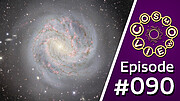
PR Video noirlab2429a
Cosmoview Episode 90: Dark Energy Camera Spies the Outskirts of the Swirling Southern Pinwheel Galaxy
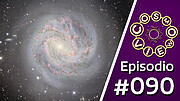
Cosmoview Episodio 90: Cerro Tololo registra un tesoro cósmico
de estrellas nacientes y supernovas exclusivo de los cielos del Sur
The picturesque spiral arms of Messier 83 exhibit a magnificent display of star formation in new image released by NSF NOIRLab
Twelve million light-years away lies the galactic masterpiece Messier 83, also known as the Southern Pinwheel Galaxy. Its swirling spiral arms display a high rate of star formation and have been host to six observed supernovae. This image was captured with the Department of Energy-fabricated Dark Energy Camera, mounted on the U.S. National Science Foundation Víctor M. Blanco 4-meter Telescope at Cerro Tololo Inter-American Observatory in Chile, a Program of NSF NOIRLab.
Messier 83, also known as the Southern Pinwheel Galaxy, is one of the most prominent spiral galaxies in the night sky. It’s named for its resemblance to the Pinwheel Galaxy and spans around 50,000 light-years, making it much smaller than the Milky Way galaxy, although it has a higher rate of star formation, as evidenced by the striking bursts of pink throughout its spiral arms. This display of intense starburst activity likely results from a past merger with another galaxy.
This image was captured with the Department of Energy-fabricated Dark Energy Camera (DECam), mounted on the U.S. National Science Foundation Víctor M. Blanco 4-meter telescope at Cerro Tololo Inter-American Observatory (CTIO), a Program of NSF NOIRLab.
Between 1750 and 1754, French astronomer Nicolas-Louis de Lacaille was studying the night sky with the aim of determining the distances to the planets. During this period he observed and cataloged 10,000 stars and identified 42 nebulous objects, including Messier 83, which he discovered in 1752 during his expedition to the Cape of Good Hope.
In 1781 Charles Messier added it to his famous catalog, describing it as a “nebula without stars,” reflecting the limited knowledge of galaxies at the time. It wasn’t until the 20th century, through the work of Edwin Hubble, that astronomers realized objects like Messier 83 are actually other galaxies far outside the Milky Way.
This image shows Messier 83’s well-defined spiral arms, filled with pink clouds of hydrogen gas where new stars are forming. Interspersed amongst these pink regions are bright blue clusters of hot, young stars whose ultraviolet radiation has blown away the surrounding gas. At the galaxy’s core, a yellow central bulge is composed of older stars, and a weak bar connects the spiral arms through the center, funneling gas from the outer regions toward the core. DECam’s high sensitivity captures Messier 83’s extended halo, and myriad more distant galaxies in the background.
Just as Messier 83 is filled with countless newly formed stars, the galaxy is also host to many dying stars. In the past century, astronomers have witnessed a total of six stellar explosions, called supernovae, in Messier 83 — a number matched by only two other galaxies. And while we have only detected these six stellar deaths, the galaxy is estimated to be filled with hundreds of thousands of ‘ghosts’ of dead stars called supernova remnants.
In 2006 a mysterious feature of Messier 83 was discovered by NSF NOIRLab astronomer Ruben Diaz and an international team of astronomers using the Gemini South telescope, one half of the International Gemini Observatory, funded in part by the NSF and operated by NSF NOIRLab. At the heart of this galaxy, they discovered a previously unseen concentration of mass resembling a second nucleus, likely the remnant of another galaxy that is being consumed by Messier 83 in an ongoing collision — possibly the same collision responsible for the starburst activity. The two nuclei, which likely contain black holes, are expected to merge to form a single nucleus in another 60 million years.
More information
NSF NOIRLab
(U.S. National Science Foundation National Optical-Infrared Astronomy
Research Laboratory), the U.S. center for ground-based optical-infrared
astronomy, operates the International Gemini Observatory (a facility of NSF, NRC–Canada, ANID–Chile, MCTIC–Brazil, MINCyT–Argentina, and KASI–Republic of Korea), NSF Kitt Peak National Observatory (KPNO), NSF Cerro Tololo Inter-American Observatory (CTIO), the Community Science and Data Center (CSDC), and NSF–DOE Vera C. Rubin Observatory (operated in cooperation with the Department of Energy’s SLAC National Accelerator Laboratory). It is managed by the Association of Universities for Research in Astronomy (AURA)
under a cooperative agreement with NSF and is headquartered in Tucson,
Arizona. The astronomical community is honored to have the opportunity
to conduct astronomical research on I’oligam Du’ag (Kitt Peak) in
Arizona, on Maunakea in Hawai‘i, and on Cerro Tololo and Cerro Pachón in
Chile. We recognize and acknowledge the very significant cultural role
and reverence that these sites have to the Tohono O’odham Nation, to the
Native Hawaiian community, and to the local communities in Chile,
respectively
Links
- Explore Messier 83 in more detail
- Photos of the Víctor M. Blanco 4-meter Telescope
- Videos of the Víctor M. Blanco 4-meter Telescope
- Photos of DECam
- Images taken by DECam
- Check out other NOIRLab Photo Releases
Contacts:
Josie Fenske
Jr. Public Information Officer
NSF NOIRLab
Email: josie.fenske@noirlab.edu


