Tuesday, September 20, 2011

Origin of Dinosaur-Killing Asteroid Remains a Mystery

Scientists think that a giant asteroid, which broke up long ago in the main asteroid belt between Mars and Jupiter, eventually made its way to Earth and led to the extinction of the dinosaurs. This artist's concept shows a broken-up asteroid. Image credit: NASA/JPL-Caltech. Full image and caption

PASADENA, Calif. -- Observations from NASA's Wide-field Infrared Survey Explorer (WISE) mission indicate the family of asteroids some believed was responsible for the demise of the dinosaurs is not likely the culprit, keeping open the case on one of Earth's greatest mysteries.

While scientists are confident a large asteroid crashed into Earth approximately 65 million years ago, leading to the extinction of dinosaurs and some other life forms on our planet, they do not know exactly where the asteroid came from or how it made its way to Earth. A 2007 study using visible-light data from ground-based telescopes first suggested the remnant of a huge asteroid, known as Baptistina, as a possible suspect.

According to that theory, Baptistina crashed into another asteroid in the main belt between Mars and Jupiter about 160 million years ago. The collision sent shattered pieces as big as mountains flying. One of those pieces was believed to have impacted Earth, causing the dinosaurs' extinction.

Since this scenario was first proposed, evidence developed that the so-called Baptistina family of asteroids was not the responsible party. With the new infrared observations from WISE, astronomers say Baptistina may finally be ruled out.

"As a result of the WISE science team's investigation, the demise of the dinosaurs remains in the cold case files," said Lindley Johnson, program executive for the Near Earth Object (NEO) Observation Program at NASA Headquarters in Washington. "The original calculations with visible light estimated the size and reflectivity of the Baptistina family members, leading to estimates of their age, but we now know those estimates were off. With infrared light, WISE was able to get a more accurate estimate, which throws the timing of the Baptistina theory into question."

WISE surveyed the entire celestial sky twice in infrared light from January 2010 to February 2011. The asteroid-hunting portion of the mission, called NEOWISE, used the data to catalogue more than 157,000 asteroids in the main belt and discovered more than 33,000 new ones.

Visible light reflects off an asteroid. Without knowing how reflective the surface of the asteroid is, it's hard to accurately establish size. Infrared observations allow a more accurate size estimate. They detect infrared light coming from the asteroid itself, which is related to the body's temperature and size. Once the size is known, the object's reflectivity can be re-calculated by combining infrared with visible-light data.

The NEOWISE team measured the reflectivity and the size of about 120,000 asteroids in the main belt, including 1,056 members of the Baptistina family. The scientists calculated the original parent Baptistina asteroid actually broke up closer to 80 million years ago, half as long as originally proposed.

This calculation was possible because the size and reflectivity of the asteroid family members indicate how much time would have been required to reach their current locations -- larger asteroids would not disperse in their orbits as fast as smaller ones. The results revealed a chunk of the original Baptistina asteroid needed to hit Earth in less time than previously believed, in just about 15 million years, to cause the extinction of the dinosaurs.

"This doesn't give the remnants from the collision very much time to move into a resonance spot, and get flung down to Earth 65 million years ago," said Amy Mainzer, a study co-author and the principal investigator of NEOWISE at NASA's Jet Propulsion Laboratory (JPL) in Pasadena. Calif. "This process is thought to normally take many tens of millions of years." Resonances are areas in the main belt where gravity nudges from Jupiter and Saturn can act like a pinball machine to fling asteroids out of the main belt and into the region near Earth.

The asteroid family that produced the dinosaur-killing asteroid remains at large. Evidence that a 10-kilometer (about 6.2-mile) asteroid impacted Earth 65 million years ago includes a huge, crater-shaped structure in the Gulf of Mexico and rare minerals in the fossil record, which are common in meteorites but seldom found in Earth's crust. In addition to the Baptistina results, the NEOWISE study shows various main belt asteroid families have similar reflective properties. The team hopes to use NEOWISE data to disentangle families that overlap and trace their histories.

"We are working on creating an asteroid family tree of sorts," said Joseph Masiero, the lead author of the study. "We are starting to refine our picture of how the asteroids in the main belt smashed together and mixed up."

JPL manages and operated WISE for NASA's Science Mission Directorate. The spacecraft was put into hibernation mode after it scanned the entire sky twice, completing its main objectives. The principal investigator, astronomer Edward Wright, is at UCLA. The mission was selected competitively under NASA's Explorers Program managed by the agency's Goddard Space Flight Center in Greenbelt, Md. The science instrument was built by the Space Dynamics Laboratory in Logan. The spacecraft was built by Ball Aerospace & Technologies Corp. in Boulder, Colo. Science operations and data processing take place at the Infrared Processing and Analysis Center at the California Institute of Technology in Pasadena. Caltech manages JPL for NASA.


Whitney Clavin 818-354-4673
Jet Propulsion Laboratory, Pasadena, Calif.
whitney.clavin@jpl.nasa.gov

Trent Perrotto 202-358-0321
Headquarters, Washington
trent.j.perrotto@nasa.gov

Monday, September 19, 2011

Gamma-ray bursts shed light on the nature of dark energy

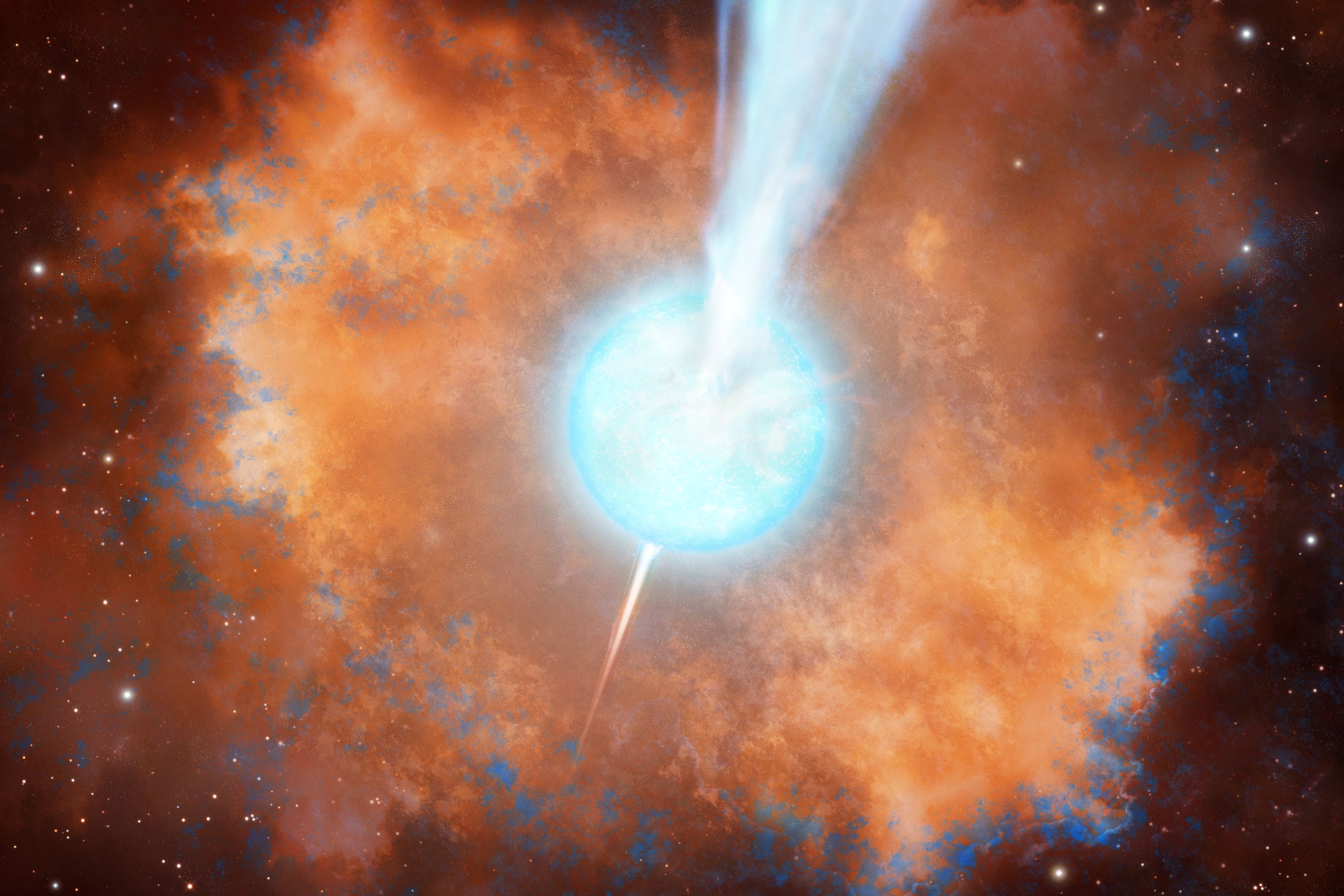
An artistic image of the explosion of a star leading to a gamma-ray burst
Source: FUW/Tentaris/Maciej Frołow

Dark energy is the basic constituent of the Universe today, one that is responsible for its accelerated expansion. Although astronomers observe the cosmological effects of the impact of dark energy, they still do not know exactly what it is. A new method for measuring the largest distances in the Universe developed by scientists from the Faculty of Physics, University of Warsaw and the University of Naples Federico II helps solve the mystery. A key role is played by the most powerful cosmic explosions – gamma-ray bursts.

What is the nature of dark energy, a recently discovered dominant constituent of the Universe today? Is expansion-accelerating dark energy an intrinsic property of space-time itself or rather a field unknown to science? A new distance-measuring method developed by scientists from the Faculty of Physics, University of Warsaw (FUW) and the University of Naples Federico II can provide the answer. “We are able to determine the distance of an explosion on the basis of the properties of the radiation emitted during gamma-ray bursts. Given that some of these explosions are related to the most remote objects in space that we know about, we are able, for the first time, to assess the speed of space-time expansion even in the relatively early periods after the Big Bang,” says Prof. Marek Demiański (FUW). The method was used to verify models of the structure of the Universe containing dark energy.

In 1998, during the analysis of the brightness of Type Ia supernovae, it was discovered that the most remote explosions seemed to be too weak. Type Ia supernovae appear in binary systems. One of the stars is a white dwarf, a relic of an evolutionary cycle of stars similar to the Sun. When the second star of the system enters the red giant phase and swells up, its external layers, containing mainly hydrogen, begin to fall onto the white dwarf, which gradually grows in mass. When the white dwarf reaches 1.4 solar masses, it explodes and is completely torn apart. Since the conditions that trigger the explosion are similar every time, Type Ia supernovae always release more or less the same amount of energy. Astronomers rely on this property to measure distances in space.

The fainter brightness of remote Type Ia supernovae was a clear indication that they were even more distant than assumed. Instead of slowing down the expansion, the Universe was accelerating. A new form of mass-energy – dark energy – needed to be introduced into the theory in order to reconcile the previous models of the Universe with the observations. The calculations indicate the existence of a huge amount of dark energy, nearly 20 times greater than the amount of mass-energy related to the world accessible to human senses. “Overnight, dark energy became, quite literally, the greatest mystery of the Universe,” says Prof. Demiański.

To this day no one knows exactly what dark energy is. There are two models explaining its nature. According to the first one, dark energy is a property described by the famous cosmological constant introduced by Albert Einstein. According to the second model, the accelerated expansion is caused by some unknown scalar field. “In other words, it is either-or: either space-time expands by itself or is expanded by a scalar physical field inside it,” says Prof. Demiański.

Examining the density of dark energy in various periods after the Big Bang can help choose the correct model. If the density remained constant, it would mean that dark energy is related to the cosmological constant, that is to say, the property of space-time. But if the acceleration of the Universe is caused by a scalar field, then, given the swelling-up of space-time, the density of dark energy should change. “This used to be a problem. In order to assess the changes in the density of dark energy immediately after the Big Bang, one needs to know how to measure the distance to very remote objects. So remote that even Type Ia supernovae connected to them are too faint to be observed,” says Prof. Demiański.

The group of Polish and Italian astrophysicists suggested using gamma-ray bursts (GRBs), the most powerful explosions observed in the Universe today, to measure the largest distances in the Universe. They analyzed the so-called long bursts that probably arise during the collapse of the core of a large star. The process leads to the formation of a black hole. The gamma radiation emitted at that time is so intense that even objects that exploded 400 million years after the Big Bang can be observed.

The main problem was how to assess the total energy of a burst. To that end, the scientists analyzed databases of previous gamma explosions. It turned out that a part of the explosions occurred in galaxies the distance to which could be measured using other methods, for example, by means of Type Ia supernovae. “We focused on those instances. We knew the distance to the galaxy and we also knew how much energy of the burst reached the Earth. This allowed us to calibrate the burst, that is to say, to calculate the total energy of the explosion,” explains Prof. Demiański.

The next step was to find statistical dependencies between various properties of the radiation emitted during a gamma-ray burst and the total energy of the explosion. Such relations were discovered. “We cannot provide a physical explanation of why certain properties of gamma-ray bursts are correlated,” points out Prof. Demiański. “But we can say that if registered radiation has such and such properties, then the burst had such and such energy. This allows us to use bursts as standard candles, to measure distances.”

The team of scientists from the universities in Warsaw and Naples, headed by Dr Ester Piedipalumbo, analyzed data gathered by astronomers. Extremely remote gamma-ray bursts are quite rare. The Amanti catalogue listed 95 such phenomena and failed to provide enough clues as to the exact nature of dark energy. “It is quite a disappointment. But what is important is the fact that we have in our hands a tool for verifying hypotheses about the structure of the Universe. All we need to do now is wait for the next cosmic fireworks,” concludes Prof. Demiański.

The insufficient amount of observational data remains the main problem in the data analysis of gamma-ray bursts. For this reason, many groups of astronomers and astrophysicists combine their efforts in order to register them in the fastest and most accurate manner possible. One of such projects is “Pi of the Sky”, a system of robotic telescopes for real-time monitoring of large areas of the sky, co-organized by the Faculty of Physics, University of Warsaw.

Friday, September 16, 2011

Milky Way’s Spiral Arms are the Product of an Intergalactic Collision Course

Computer model of the Milky Way and its smaller neighbor, the Sagittarius dwarf galaxy. The flat disk is the Milky Way, and the looping stream of material is made of stars torn from Sagittarius as a result of the strong gravity of our galaxy. The spiral arms began to emerge about two billion years ago, when the Sagittarius galaxy first collided with the Milky Way disk. Credit: Image by Tollerud, Purcell and Bullock/UC Irvine

UC Irvine models show dark matter packs a punch

Irvine, Calif., UC Irvine astronomers have shown how the Milky Way galaxy’s iconic spiral arms form, according to research published today in the journal Nature.

A dwarf galaxy named Sagittarius loaded with dark matter has careened twice through our much larger home galaxy in the past two billion years, according to telescope data and detailed simulations, and is lined up to do it again. As the galaxies collide, the force of the impact sends stars streaming from both in long loops. Those continue to swell with stars and are gradually tugged outward by the Milky Way’s rotation into a familiar ringed arm.

It’s the weighty dark matter from Sagittarius that provided the initial push, the researchers said.

“It’s kind of like putting a fist into a bathtub of water as opposed to your little finger,” said James Bullock, a theoretical cosmologist who studies galaxy formation.

The smaller galaxy pays a steep price though – sucked inward repeatedly by the Milky Way’s mightier gravity, it’s being ripped apart by the blows, sending huge amounts of its stars and dark matter reeling into the new arms.

“When all that dark matter first smacked into the Milky Way, 80 percent to 90 percent of it was stripped off,” explained lead author Chris Purcell, who did the work with Bullock at UCI and is now at the University of Pittsburgh. “That first impact triggered instabilities that were amplified, and quickly formed spiral arms and associated ring-like structures in the outskirts of our galaxy.”

The Sagittarius galaxy is due to strike the southern face of the Milky Way disk fairly soon, Purcell said – in another 10 million years or so.

Additional authors are UCI doctoral students Erik Tollerud and Miguel Rocha, and Sukanya Chakrabarti of Florida Atlantic University in Boca Raton.

About the University of California, Irvine: Founded in 1965, UCI is a top-ranked university dedicated to research, scholarship and community service. Led by Chancellor Michael Drake since 2005, UCI is among the most dynamic campuses in the University of California system, with nearly 28,000 undergraduate and graduate students, 1,100 faculty and 9,000 staff. Orange County’s largest employer, UCI contributes an annual economic impact of $4.2 billion. For more UCI news, visit www.today.uci.edu.

News Radio: UCI maintains on campus an ISDN line for conducting interviews with its faculty and experts. Use of this line is available for a fee to radio news programs/stations that wish to interview UCI faculty and experts. Use of the ISDN line is subject to availability and approval by the university.

Photo Links: Larger image of computer model

Web Links: Milky Way spiral arm formation video

Media Contact

Janet Wilson

University Communications

949-824-3969

janethw@uci.edu

Experts available: UCI maintains an online directory of faculty available as experts to the media.

Thursday, September 15, 2011

How single stars lost their companions

Not all stars are loners. In our home galaxy, the Milky Way, about half of all stars have a companion and travel through space in a binary system. But explaining why some stars are in double or even triple systems while others are single has been something of a mystery. Now a team of astronomers from Bonn University and the Max-Planck-Institute for Radio astronomy (also in Bonn) think they have the answer – different stellar birth environments decide whether a star holds on to its companion. The scientists publish their results in a paper in the journal Monthly Notices of the Royal Astronomical Society.

Hubble Space Telescope image of the open star cluster NGC 265.
Credit: European Space Agency / NASA /E. Olszewski
(University of Arizona)


Stars generally do not form in isolation but are born together in groups within clouds of gas and dust or nebulae. These stellar labour rooms produce binary star systems, which means that virtually all newborn stars have a companion. Most of these groups of stars disperse quickly so that their members become part of the Galaxy. But why, then, are not all stars seen in the sky binaries, but only half of them?

Before the groups of stars disperse, binary stars move through their birth sites and the group studied how they interact with other stars gravitationally. "In many cases the pairs are torn apart into two single stars, in the same way that a pair of dancers might be separated after colliding with another couple on a crowded dance floor", explains Michael Marks, a PhD student and member of the International Max-Planck Research School for Astronomy and Astrophysics. The population of binaries is therefore diminished before the stars spread out into the wider Galaxy.

The stellar nurseries do not all look the same and are crowded to different extents, something described by the density of the group. The more binaries form within the same space (higher density groups), the more interaction will take place between them and the more binary systems will be split up into single stars. This means that every group has a different composition of single and binary stars when the group disperses, depending on the initial density of stars.

By using computer models to calculate the resulting composition of stars and binaries in regions of different densities, the Bonn astronomers know how different types of birth sites will contribute single stars and binary systems to the wider Galaxy. "Working out the composition of the Milky Way from these numbers is simple: We just add up the single and binary stars in all the dispersed groups to build a population for the wider Galaxy", says Kroupa.

Marks explains how this new approach can be used much more widely: "This is the first time we have been able to compute the stellar content of a whole galaxy, something that was simply not possible until now. With our new method we can now calculate the stellar contents of many different galaxies and work out how many single and binary stars they have."


SCIENCE CONTACTS

Prof. Dr. Pavel Kroupa
Argelander-Institut für Astronomie der Universität Bonn
Tel: +49 (0)228 736140
Email: pavel@astro.uni-bonn.de

Michael Marks
Argelander-Institut für Astronomie der Universität Bonn
Max-Planck-Institut für Radioastronomie in Bonn
Tel: +49 (0)228 733653
Email: mmarks@astro.uni-bonn.de


PRESS CONTACT

Dr Robert Massey
Royal Astronomical Society
Tel: +44 (0)20 773 3307 x214
Mob: +44 (0)794 124 8035
Email: rm@ras.org.uk


IMAGE AND ANIMATIONS

A Hubble Space Telescope image of a typical open cluster (NGC265) can be found at http://www.hubblesite.org/gallery/album/star/star_cluster/pr2006017b/titles/true/ .Credit: European Space Agency and NASA, E. Olszewski (University of Arizona)

Animations of the interactions of binary stars can be seen at http://www.astro.uni-bonn.de/~jpflamm/nbody/overview.html . Credit: Jan Pflamm-Altenburg / Bonn Astronomy Institute


FURTHER INFORMATION

This research has been accepted for publication in the journal Monthly Notices of the Royal Astronomical Society and is available online. A preprint can be seen at http://arxiv.org/abs/1109.2896


NOTES FOR EDITORS

The Royal Astronomical Society

The Royal Astronomical Society (RAS, http://www.ras.org.uk) , founded in 1820, encourages and promotes the study of astronomy, solar-system science, geophysics and closely related branches of science. The RAS organizes scientific meetings, publishes international research and review journals, recognizes outstanding achievements by the award of medals and prizes, maintains an extensive library, supports education through grants and outreach activities and represents UK astronomy nationally and internationally. Its more than 3500 members (Fellows), a third based overseas, include scientific researchers in universities, observatories and laboratories as well as historians of astronomy and others.

Follow the RAS on Twitter via @royalastrosoc

Small distant galaxies host supermassive black holes

Astronomers detected supermassive black holes in 28 distant, low-mass galaxies, including the four shown in these Hubble Space Telescope images. Image credit: A. Koekemoer, Space Telescope Science Institute. HubbleSite

Using the Hubble Space Telescope to probe the distant universe, astronomers have found supermassive black holes growing in surprisingly small galaxies. The findings suggest that central black holes formed at an early stage in galaxy evolution.

"It's kind of a chicken or egg problem: Which came first, the supermassive black hole or the massive galaxy? This study shows that even low-mass galaxies have supermassive black holes," said Jonathan Trump, a postdoctoral researcher at the University of California, Santa Cruz. Trump is first author of the study, which has been accepted for publication in the Astrophysical Journal and is currently available online.

All massive galaxies host a central supermassive black hole, which may shine brightly as an active galactic nucleus if the black hole is pulling in nearby gas clouds. In the local universe, however, active black holes are rarely seen in small "dwarf" galaxies. The galaxies studied by Trump and his coauthors are about 10 billion light-years away, giving astronomers a view of galaxies as they appeared when the universe was less than a quarter of its current age.

"When we look 10 billion years ago, we're looking at the teenage years of the universe. So these are very small, young galaxies," Trump said.

The study, part of the Cosmic Assembly Near-infrared Deep Extragalactic Legacy Survey (CANDELS), used a powerful new instrument on the Hubble Space Telescope. The "slitless grism" on Hubble's WFC3 infrared camera provided detailed information about different wavelengths of light coming from the galaxies. Spectroscopy allows researchers to spread out the light from an object into its component colors or wavelengths. With Hubble's high spatial resolution, the researchers were able to get separate spectra from the center and the outer part of each galaxy. This enabled them to identify the tell-tale emissions from a central black hole.

"This is the first study that is capable of probing for the existence of small, low-luminosity black holes back in time," said coauthor Sandra Faber, University Professor of astronomy and astrophysics at UC Santa Cruz and CANDELS principal investigator. "Up to now, observations of distant galaxies have consistently reinforced the local findings--distant black holes actively accreting in big galaxies only. We now have a big puzzle: What happened to these dwarf galaxies?"

One possibility is that at least some of them are the progenitors of present-day massive galaxies like the Milky Way. "Some may remain small, and some may grow into something like the Milky Way," Trump said.

But according to Faber, both possibilities raise further questions. To become big galaxies today, the dwarf galaxies would have to grow at a rate much faster than standard models predict, she said. If they remain small, then nearby dwarf galaxies should also have central black holes. "There might be a large population of small black holes in dwarf galaxies that no one has noticed before," Faber said.

Trump noted that the distant dwarf galaxies are actively forming new stars. "Their star formation rate is about ten times that of the Milky Way," he said. "There may be a connection between that and the active galactic nuclei. When gas is available to form new stars, it's also available to feed the black hole."

In addition to the Hubble observations, the researchers obtained further evidence of active black holes in the galaxies from x-ray data acquired by NASA's Chandra X-ray Observatory. The study focused on 28 galaxies in a small patch of sky known as the Hubble Ultra Deep Field. Because each object was so small and faint, Trump combined the data from all 28 galaxies to improve the signal-to-noise ratio.

"This is a powerful technique that we can use for similar studies in the future on larger samples of objects," Trump said.

In addition to Trump and Faber, the coauthors of the paper include UC Santa Cruz astronomers Dale Kocevski, Elizabeth McGrath, David Koo, Mark Mozena, and Hassen Yesuf; Benjamin Weiner and Stephanie Juneau of the Steward Observatory; Claudia Scarlata of the University of Minnesota; Eric Bell of the University of Michigan; Elise Laird and Cyprian Rangel of Imperial College London; Renbin Yan of New York University; Hakim Atek and Harry Teplitz of the Spitzer Science Center, Caltech; Mark Dickinson and Jeyhan Kartaltepe of the National Optical Astronomical Observatories; Jennifer Donley, Henry Ferguson, Norman Grogin and Anton Koekemoer of the Space Telescope Science Institute; James Dunlop of the University of Edinburgh; Steven Finkelstein of Texas A&M University; Nimish Hathi of Carnegie Observatories; Kirpal Nandra of the Max Planck Institute for Extraterrestrial Physics; Jeffrey Newman of the University of Pittsburgh; Steven Rodney of Johns Hopkins University; and Amber Straughn of Goddard Space Flight Center.

This research is funded by NASA and the National Science Foundation.

About CANDELS

The Cosmic Assembly Near-infrared Deep Extragalactic Legacy Survey (CANDELS) is a powerful imaging survey of the distant universe being carried out with the Hubble Space Telescope. It is the largest project in the history of Hubble, with 902 assigned orbits of observing time. CANDELS makes use of the near-infrared WFC3 camera and the visible-light ACS camera. Together, these two cameras give unprecedented panchromatic coverage of galaxies from optical wavelengths to the near-infrared. The power to look deeper into space and further back in time will enable CANDELS to construct a "cosmic movie" of galaxy evolution that follows the life histories of galaxies from infancy to the present time. This work will cap Hubble's revolutionary series of discoveries on cosmic evolution and bequeath a legacy of precious data to future generations of astronomers. CANDELS will also test the reality of cosmic dark energy by measuring the brightness of type Ia supernovae.

From Star Wars to Science Fact: Tatooine-Like Planet Discovered

Kepler-16b, shown in this artist's conception, enjoys double sunsets as it circles a pair of stars. The orange (type K) and red (type M) stars orbit each other every 41 days, while Kepler-16b orbits them both every 229 days at a distance of 65 million miles. Kepler-16b is similar to Saturn in size and mass, with a surface temperature of about -100 to -150 degrees Fahrenheit. Credit: David A. Aguilar (CfA). High Resolution Image (jpg)


This animation shows the gas giant planet Kepler-16b orbiting a pair of stars located about 200 light-years from Earth. Kepler-16b is the first confirmed, unambiguous example of a circumbinary planet. Credit: NASA. Animation (mov)

Cambridge, MA - Although cold and gaseous rather than a desert world, the newfound planet Kepler-16b is still the closest astronomers have come to discovering Luke Skywalker's home world of Tatooine. Like Tatooine, Kepler-16b enjoys a double sunset as it circles a pair of stars approximately 200 light-years from Earth. It's not thought to harbor life, but its discovery demonstrates the diversity of planets in our galaxy.

"Kepler-16b is the first confirmed, unambiguous example of a circumbinary planet - a planet orbiting not one, but two stars," said Josh Carter of the Harvard-Smithsonian Center for Astrophysics (CfA). "Once again, we're finding that our solar system is only one example of the variety of planetary systems Nature can create."

Carter is second author on the study announcing the discovery, which appears in the Sept. 15th issue of the journal Science. He is presenting the finding today at the Extreme Solar Systems II conference in Jackson Hole, Wyoming.

Kepler-16b weighs about a third as much as Jupiter and has a radius three-fourths that of Jupiter, making it similar to Saturn in both size and mass. It orbits its two parent stars every 229 days at a distance of 65 million miles - similar to Venus' 225-day orbit.

Both stars are smaller and cooler than our Sun. As a result, Kepler-16b is quite cold, with a surface temperature of around -100 to - 150° Fahrenheit.

NASA's Kepler mission detected the planet through what is known as a planetary transit - an event where a star dims when a planet crosses in front of it. The planet's discovery was complicated by the fact that the two stars in the system eclipse each other, causing the total brightness to dim periodically.

Astronomers noticed that the system's brightness sometimes dipped even when the stars were not eclipsing one another, hinting at a third body. The additional dimming events reappeared at irregular time intervals, indicating that the stars were in different positions in their orbit each time the third body passed. This showed that this third body was circling, not just one, but both stars.

Although Kepler data provided the relative sizes and masses of the stars and planet, astronomers needed more information to get absolute numbers. The crucial missing information came from the Tillinghast Reflector Echelle Spectrograph (TRES) on the 60-inch telescope at the Smithsonian Astrophysical Observatory's Whipple Observatory in Arizona.

TRES monitored the changing velocity of the primary star as it moved around in its orbit. This yielded an orbital solution that set the scale of the Kepler-16 system. The team found that the two stars orbit each other every 41 days at an average distance of 21 million miles.

"Much of what we know about the sizes of stars comes from such eclipsing binary systems, and most of what we know about the size of planets comes from transits," said lead author and Kepler scientist Laurance Doyle of the SETI Institute. "Kepler-16 combines the best of both worlds, with stellar eclipses and planetary transits in one system."

For more information about the Kepler mission, visit: http://www.nasa.gov/kepler.

Headquartered in Cambridge, Mass., the Harvard-Smithsonian Center for Astrophysics (CfA) is a joint collaboration between the Smithsonian Astrophysical Observatory and the Harvard College Observatory. CfA scientists, organized into six research divisions, study the origin, evolution and ultimate fate of the universe.


For more information, contact:

David A. Aguilar
Director of Public Affairs
Harvard-Smithsonian Center for Astrophysics
617-495-7462
daguilar@cfa.harvard.edu

Christine Pulliam
Public Affairs Specialist
Harvard-Smithsonian Center for Astrophysics
617-495-7463
cpulliam@cfa.harvard.edu

Tuesday, September 13, 2011

Astronomers find extreme weather on an alien world

Astronomers have observed extreme brightness changes on a nearby brown dwarf that may indicate a storm grander than any seen yet on a planet. This finding could new shed light on the atmospheres and weather on extra-solar planets. Credit: Art by Jon Lomberg.

Astronomers find extreme weather on an alien world: Cosmic oddball may harbour a gigantic storm

TORONTO, ON – A University of Toronto-led team of astronomers has observed extreme brightness changes on a nearby brown dwarf that may indicate a storm grander than any seen yet on a planet. Because old brown dwarfs and giant planets have similar atmospheres, this finding could shed new light on weather phenomena of extra-solar planets.

As part of a large survey of nearby brown dwarfs – objects that occupy the mass gap between dwarf stars and giant planets – the scientists used an infrared camera on the 2.5m telescope at Las Campanas Observatory in Chile to capture repeated images of a brown dwarf dubbed 2MASS J21392676+0220226, or 2MASS 2139 for short, over several hours. In that short time span, they recorded the largest variations in brightness ever seen on a cool brown dwarf.

"We found that our target's brightness changed by a whopping 30 per cent in just under eight hours," said PhD candidate Jacqueline Radigan, lead author of a paper to be presented this week at the Extreme Solar Systems II conference in Jackson Hole, Wyoming and submitted to the Astrophysical Journal. "The best explanation is that brighter and darker patches of its atmosphere are coming into our view as the brown dwarf spins on its axis," said Radigan.

"We might be looking at a gigantic storm raging on this brown dwarf, perhaps a grander version of the Great Red Spot on Jupiter in our own solar system, or we may be seeing the hotter, deeper layers of its atmosphere through big holes in the cloud deck," said co-author Professor Ray Jayawardhana, Canada Research Chair in Observational Astrophysics at the University of Toronto and author of the recent book Strange New Worlds: The Search for Alien Planets and Life beyond Our Solar System.

According to theoretical models, clouds form in brown dwarf and giant planet atmospheres when tiny dust grains made of silicates and metals condense. The depth and profile of 2MASS 2139’s brightness variations changed over weeks and months, suggesting that cloud patterns in its atmosphere are evolving with time.

"Measuring how quickly cloud features change in brown dwarf atmospheres may allow us to infer atmospheric wind speeds eventually and teach us about how winds are generated in brown dwarf and planetary atmospheres," Radigan added.

The paper describing the findings, titled High Amplitude, Periodic Variability of a Cool Brown Dwarf: Evidence for Patchy, High-Contrast Cloud Features, is available online now.

Other co-authors of this work are David Lafrenière and Étienne Artigau at the Université de Montreal, Didier Saumon at Los Alamos National Laboratory, and Mark Marley at NASA Ames Research Center.

The research was supported by a Vanier Canada Graduate Scholarship awarded to Radigan, and a Research Tools and Instrumentation grant, a Discovery grant, a Steacie Fellowship and the Canada Research Chairs program, all awarded to Jayawardhana from the Natural Sciences and Engineering Research Council of Canada.

Note to media: To see an artist’s impression associated with this release, please visit: http://www.artsci.utoronto.ca/main/media-releases/storm-on-a-nearby-brown-dwarf

MEDIA CONTACTS:

Jacqueline Radigan
Department of Astronomy and Astrophysics
University of Toronto
radigan@astro.utoronto.ca
415-812-2229 (c) from Sept. 12-17 Ray Jayawardhana Department of Astronomy and Astrophysics University of Toronto
rayjay@astro.utoronto.ca
857-334-3406 (c) Sean Bettam Communications, Faculty of Arts & Science University of Toronto
s.bettam@utoronto.ca
416-946-7950

CoRoT-2a: Star Blasts Planet With X-rays

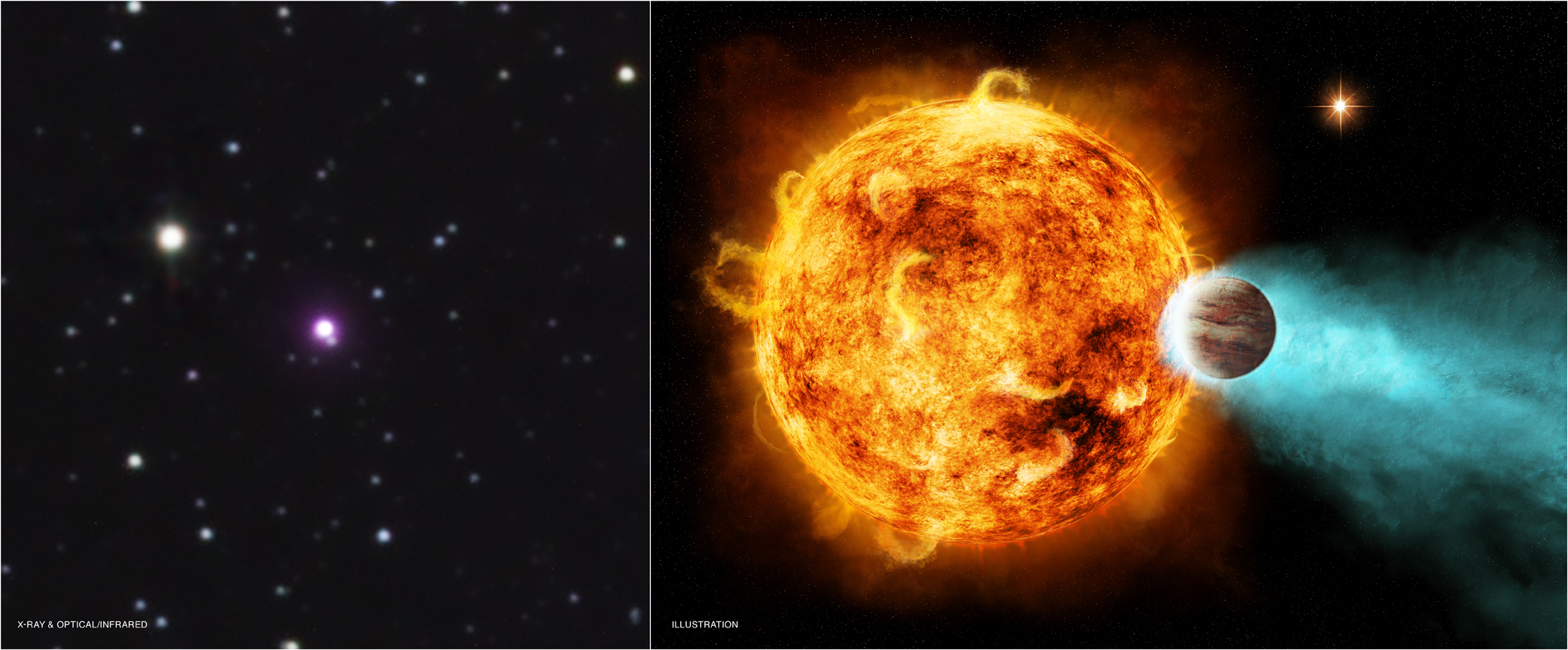
CoRoT-2a
Credit: X-ray: NASA/CXC/Univ of Hamburg/S.Schröter et al;
Optical: NASA/NSF/IPAC-Caltech/UMass/2MASS, UNC/CTIO/PROMPT;
Illustration: NASA/CXC/M.Weiss


JPEG (1.1 MB) - Tiff (89.4 MB) - PS (94.6 MB)

(Runtime: 00:28)

More Animations


This graphic contains an image and illustration of a nearby star, named CoRoT-2a, which has a planet in close orbit around it. The separation between the star and planet is only about 3 percent of the distance between the Earth and the Sun, causing some exotic effects not seen in our solar system.

The planet-hosting star is located in the center of the image. Data from NASA's Chandra X-ray Observatory are shown in purple, along with optical and infrared data from the Panchromatic Robotic Optical Monitoring and Polarimetry Telescopes (PROMPT) and the Two Micron All Sky Survey (2MASS). CoRoT-2a is surrounded by a purple glow showing that it is an X-ray source.

This star is pummeling its companion planet -- not visible in this image -- with a barrage of X-rays a hundred thousand times more intense than the Earth receives from the Sun. Data from Chandra suggest that high-energy radiation from CoRoT-2a is evaporating about 5 million tons of matter from the nearby planet every second, giving insight into the difficult survival path for some planets. The artist's representation shows the material, in blue, being stripped off the planet.

The Chandra observations provide evidence that CoRoT-2a is a very active star, with bright X-ray emission produced by powerful, turbulent magnetic fields. This magnetic activity is represented by the prominences and eruptions on the surface of the star in the illustration.

Such strong activity is usually found in much younger stars and may be caused by the proximity of the planet. The planet may be speeding up the star's rotation, causing its magnetic fields to remain active longer than expected. Support for this idea comes from observations of a likely companion star to CoRoT-2a that orbits at a distance about a thousand times greater than the distance between the Earth and the Sun. This star is visible in the image as the faint, nearby star located below and to the right of CoRoT-2a. It is also shown as the bright background star in the illustration. This star is not detected in X-rays, perhaps because it does not have a close-in planet like CoRoT-2b to cause it to stay active.

The planet, CoRoT-2b, was discovered by the French Space Agency's Convection, Rotation and planetary Transits (CoRoT) satellite in 2008. It is located about 880 light years from Earth and has a mass about 3 time that of Jupiter.

Fast Facts for CoRoT-2a:

Scale: Image is 4.5 arcmin across (1.15 light years)
Category: Normal Stars & Star Clusters
Coordinates: (J2000) RA 19h 27m 07.00s | Dec +01° 23' 02.00''
Constellation: Aquila
Observation Date: 24 June 2010
Observation Time: 4 hours 10 min
Obs. ID: 10989
Color Code: X-ray (Purple); Optical (Red, Green, Blue)
Instrument: ACIS
References: S.Schröter et al. 2011 A&A 53A A3; arXiv:1106.1522
Distance Estimate: About 880 light years

Herschel paints new story of galaxy evolution

Galaxy forming stars
A galaxy accretes mass from rapid, narrow streams of cold gas. These filaments provide the galaxy with continuous flows of raw material to feed its star-forming at a rather leisurely pace.

This theoretical scenario for galaxy formation is based on the numerical simulations presented by Dekel et al., 2009 (Nature, 457, 451D). However, the actual process of stream accretion onto a galaxy has never been directly observed and it remains speculative. Credits: ESA–AOES Medialab. HI-RES JPEG (Size: 1476 kb)


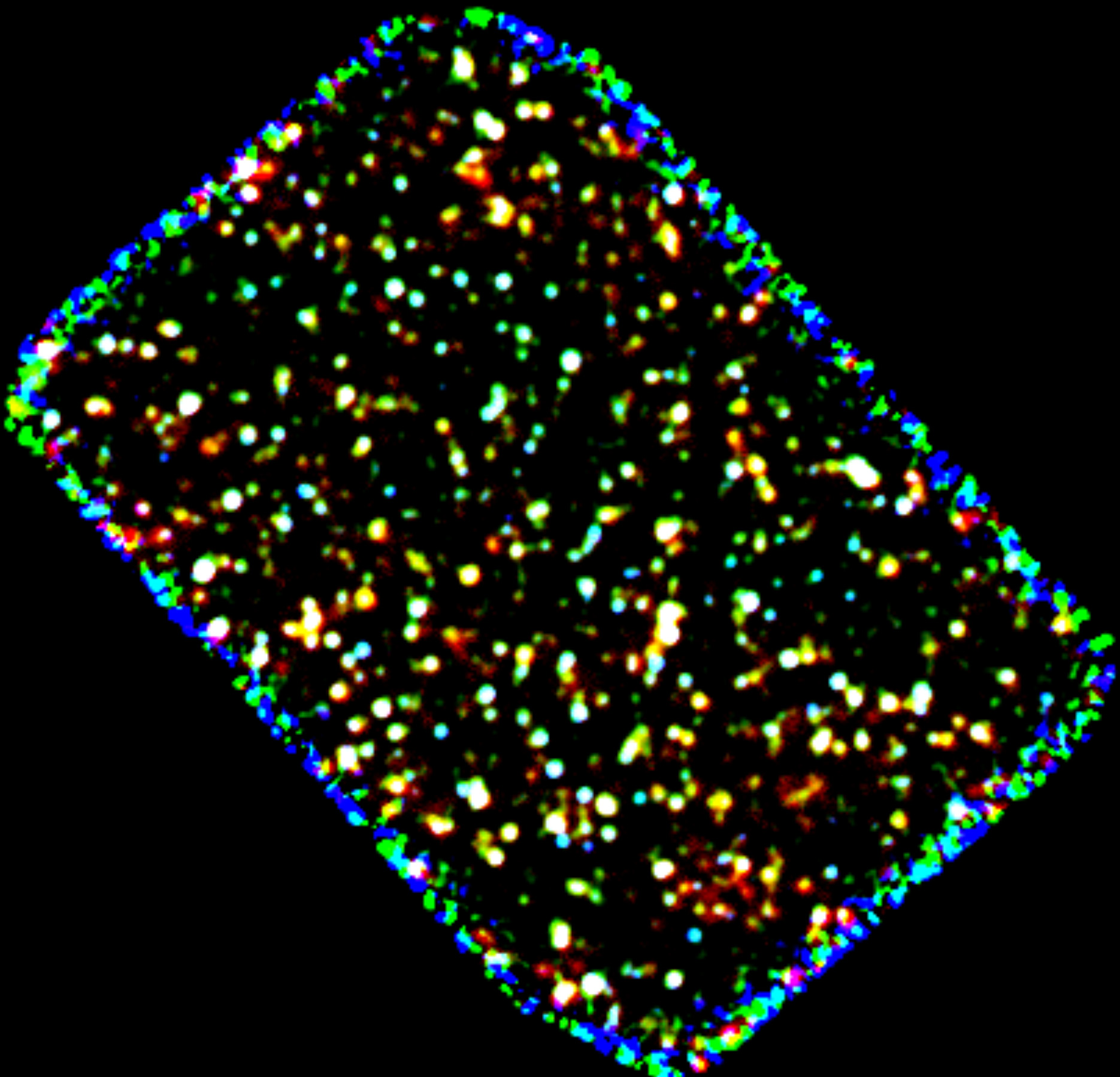
Herschel's view of GOODS-North
GOODS-North is a patch of sky in the northern hemisphere that covers an area of about a third the size of the Full Moon. This images was taken by Herschel at the following infrared wavelengths: 100μm (blue), 160μm (green) and 250μm (red). North is up and East is left. Credits: ESA/GOODS-Herschel consortium/David Elbaz . HI-RES JPEG (Size: 585 kb)

In the nearby, present-day Universe, such high birth rates are very rare and always seem to be triggered by galaxies colliding with each other. So, astronomers had assumed that this was true throughout history.

Herschel now shows that this is not the case by looking at galaxies that are very far away and thus seen as they were billions of years ago.

David Elbaz, CEA Saclay, France, and collaborators have analysed the Herschel data and find that galaxy collisions played only a minor role in triggering star births in the past, even though some young galaxies were creating stars at furious rates.

By comparing the amount of infrared light released at different wavelengths by these galaxies, the team has shown that the star birth rate depends on the quantity of gas they contain, not whether they are colliding.

Gas is the raw building material for stars and this work reveals a simple link: the more gas a galaxy contains, the more stars are born.

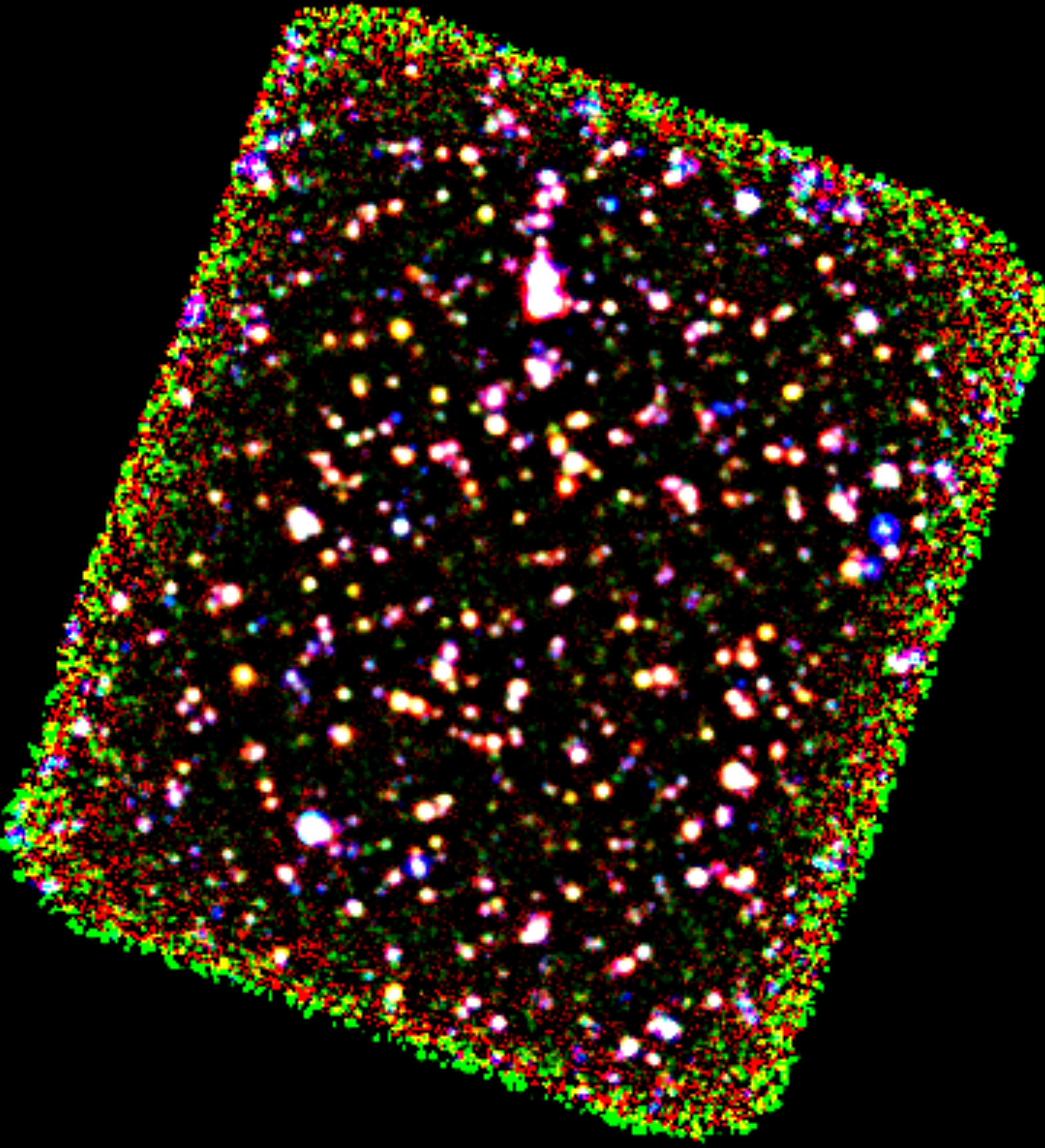
Herschel's view of GOODS-South
GOODS-South is a patch of sky in the southern hemisphere that covers an area of about a third the size of the Full Moon. This images was taken by Herschel and NASA's Spitzer space telescope at the following infrared wavelengths:24 μm (blue), 100 μm (green) and 160 μm (red). North is up and East is left. Credits: ESA/GOODS-Herschel consortium/NASA/JPL-Caltech/David Elbaz .HI-RES JPEG (Size: 1036 kb)

"It's only in those galaxies that do not already have a lot of gas that collisions are needed to provide the gas and trigger high rates of star formation", says Dr Elbaz.

This applies to today's galaxies because, after forming stars for more than 10 billion years, they have used up most of their gaseous raw material.

The research paints a much more stately picture of star births than before, with most galaxies sitting in space, growing slowly and naturally from the gas they attract from their surroundings.

"Herschel was conceived to study the history of star formation across cosmic time", says Göran Pilbratt, ESA Herschel Project Scientist.

"These new observations now change our perception of the history of the Universe."


Further information

Notes for Editors

'GOODS–Herschel: an infrared main sequence for star-forming galaxies' by D. Elbaz et al. is published in Astronomy & Astrophysics, 533, A119. It is available online at:
http://www.aanda.org/index.php?option=com_article&access=doi&doi=10.1051/0004-6361/201117239&Itemid=129

For further information, please contact:

Markus Bauer
ESA Science and Robotic Exploration Communication Officer
Tel: +31 71 565 6799
Mob: +31 61 594 3 954
Email: markus.bauer@esa.int

David Elbaz
CEA Saclay
Tel: +33 1 69 08 54 39
Email: delbaz@cea.fr

Göran Pilbratt
ESA Herschel Project Scientist
Tel: +31 71 565 3621
Email: gpilbratt@rssd.esa.int

Monday, September 12, 2011

Fifty New Exoplanets Discovered by HARPS

PR Image eso1134a
Artists’s impression of one of more than 50 new exoplanets found by HARPS: the rocky super-Earth HD 85512 b

PR Image eso1134b
Artists’s impression of one of more than 50 new exoplanets found by HARPS: the rocky super-Earth HD 85512 b

PR Image eso1134c
Artists’s impression of one of more than 50 new exoplanets found by HARPS:
the rocky super-Earth HD 85512 b

PR Image eso1134d
Artists’s impression of one of more than 50 new exoplanets found by HARPS: the rocky super-Earth HD 85512 b

Close-up view of the star HD 85512

PR Image eso1134f
The habitable zone around some stars with planets

PR Image eso1134g
Wide-field view of the sky around the star HD 85512

PR Video eso1134a
ESOcast 35: Fifty New Exoplanets

PR Video eso1134b
Animation of artist’s impression of the super-Earth planet HD 85512 b

PR Video eso1134c
Animation of artist’s impression of the super-Earth planet HD 85512 b

PR Video eso1134d
Zooming in on HD 85521 b

PR Video eso1134e
Video News Release 34: Fifty New Exoplanets

Richest haul of planets so far includes 16 new super-Earths


Astronomers using ESO’s world-leading exoplanet hunter HARPS have today announced a rich haul of more than 50 new exoplanets, including 16 super-Earths, one of which orbits at the edge of the habitable zone of its star. By studying the properties of all the HARPS planets found so far, the team has found that about 40% of stars similar to the Sun have at least one planet lighter than Saturn.

The HARPS spectrograph on the 3.6-metre telescope at ESO’s La Silla Observatory in Chile is the world’s most successful planet finder [1]. The HARPS team, led by Michel Mayor (University of Geneva, Switzerland), today announced the discovery of more than 50 new exoplanets orbiting nearby stars, including sixteen super-Earths [2]. This is the largest number of such planets ever announced at one time [3]. The new findings are being presented at a conference on Extreme Solar Systems where 350 exoplanet experts are meeting in Wyoming, USA.

“The harvest of discoveries from HARPS has exceeded all expectations and includes an exceptionally rich population of super-Earths and Neptune-type planets hosted by stars very similar to our Sun. And even better — the new results show that the pace of discovery is accelerating,” says Mayor.

In the eight years since it started surveying stars like the Sun using the radial velocity technique HARPS has been used to discover more than 150 new planets. About two thirds of all the known exoplanets with masses less than that of Neptune [4] were discovered by HARPS. These exceptional results are the fruit of several hundred nights of HARPS observations [5].

Working with HARPS observations of 376 Sun-like stars, astronomers have now also much improved the estimate of how likely it is that a star like the Sun is host to low-mass planets (as opposed to gaseous giants). They find that about 40% of such stars have at least one planet less massive than Saturn. The majority of exoplanets of Neptune mass or less appear to be in systems with multiple planets.

With upgrades to both hardware and software systems in progress, HARPS is being pushed to the next level of stability and sensitivity to search for rocky planets that could support life. Ten nearby stars similar to the Sun were selected for a new survey. These stars had already been observed by HARPS and are known to be suitable for extremely precise radial velocity measurements. After two years of work, the team of astronomers has discovered five new planets with masses less than five times that of Earth.

“These planets will be among the best targets for future space telescopes to look for signs of life in the planet’s atmosphere by looking for chemical signatures such as evidence of oxygen,” explains Francesco Pepe (Geneva Observatory, Switzerland), the lead author of one of the recent papers.

One of the recently announced newly discovered planets, HD 85512 b, is estimated to be only 3.6 times the mass of the Earth [6] and is located at the edge of the habitable zone — a narrow zone around a star in which water may be present in liquid form if conditions are right [7].

“This is the lowest-mass confirmed planet discovered by the radial velocity method that potentially lies in the habitable zone of its star, and the second low-mass planet discovered by HARPS inside the habitable zone,” adds Lisa Kaltenegger (Max Planck Institute for Astronomy, Heidelberg, Germany and Harvard Smithsonian Center for Astrophysics, Boston, USA), who is an expert on the habitability of exoplanets.

The increasing precision of the new HARPS survey now allows the detection of planets under two Earth masses. HARPS is now so sensitive that it can detect radial velocity amplitudes of significantly less than 4 km/hour [8] — less than walking speed.

"The detection of HD 85512 b is far from the limit of HARPS and demonstrates the possibility of discovering other super-Earths in the habitable zones around stars similar to the Sun," adds Mayor.

These results make astronomers confident that they are close to discovering other small rocky habitable planets around stars similar to our Sun. New instruments are planned to further this search. These include a copy of HARPS to be installed on the Telescopio Nazionale Galileo in the Canary Islands, to survey stars in the northern sky, as well as a new and more powerful planet-finder, called ESPRESSO, to be installed on ESO’s Very Large Telescope in 2016 [9]. Looking further into the future also the CODEX instrument on the European Extremely Large Telescope (E-ELT) will push this technique to a higher level.

"In the coming ten to twenty years we should have the first list of potentially habitable planets in the Sun's neighbourhood. Making such a list is essential before future experiments can search for possible spectroscopic signatures of life in the exoplanet atmospheres," concludes Michel Mayor, who discovered the first-ever exoplanet around a normal star in 1995.

Notes

[1] HARPS measures the radial velocity of a star with extraordinary precision. A planet in orbit around a star causes the star to regularly move towards and away from a distant observer on Earth. Due to the Doppler effect, this radial velocity change induces a shift of the star’s spectrum towards longer wavelengths as it moves away (called a redshift) and a blueshift (towards shorter wavelengths) as it approaches. This tiny shift of the star’s spectrum can be measured with a high-precision spectrograph such as HARPS and used to infer the presence of a planet.

[2] Planets with a mass between one and ten times that of the Earth are called super-Earths. There are no such planets in our Solar System, but they appear to be very common around other stars. Discoveries of such planets in the habitable zones around their stars are very exciting because — if the planet were rocky and had water, like Earth — they could potentially be an abode of life.

[3] Currently the number of exoplanets stands at close to 600. In addition to exoplanets found using radial velocity techniques, more than 1200 exoplanet candidates have been found by NASA’s Kepler mission using an alternative method — searching for the slight drop in the brightness of a star as a planet passes in front of it (transits) and blocks some of the light. The majority of planets discovered by this transit method are very distant from us. But, in contrast, the planets found by HARPS are around stars close to the Sun. This makes them better targets for many kinds of additional follow-up observations.

[4] Neptune has about seventeen times the mass of Earth.

[5] This huge observing programme is led by Stéphane Udry (Geneva Observatory, Switzerland).

[6] Using the radial velocity method, astronomers can only estimate a minimum mass for a planet as the mass estimate also depends on the tilt of the orbital plane relative to the line of sight, which is unknown. From a statistical point of view, this minimum mass is however often close to the real mass of the planet.

[7] So far, HARPS has found two super-Earths that may lie within the habitable zone. The first one, Gliese 581 d, was discovered in 2007 (eso0722). HARPS was also recently used to demonstrate that the other candidate super-Earth in the habitable zone around the star Gliese 581 (Gliese 581 g) does not exist.

[8] With large numbers of measurements, the detection sensitivity of HARPS is close to 100% for super-Earths of ten Earth-masses with orbital periods of up to one year, and even when considering planets of three Earth masses with a one-year orbit, the probability of detection remains close to 20%.

[9] ESPRESSO, the Echelle SPectrograph for Rocky Exoplanet and Stable Spectroscopic Observations, is to be installed on the ESO Very Large Telescope. Currently undergoing preliminary design, it is scheduled to start operating in 2016. ESPRESSO will feature radial velocity precision of 0.35 km/h or less. For comparison, Earth induces a 0.32 km/h radial velocity on the Sun. This resolution should thus enable ESPRESSO to discover Earth-mass planets in the habitable zone of low-mass stars.
More information

The results are being presented on 12 September 2011 at the conference on Extreme Solar Systems held at the Grand Teton National Park, Wyoming, USA.

A summary is presented in the following paper (in preparation): “The HARPS search for southern extra-solar planets, XXXIV — Occurrence, mass distribution and orbital properties of super-Earths and Neptune-type planets” to appear in the journal Astronomy & Astrophysics.

The team is composed of M. Mayor (Observatoire de Genève [OAUG], Switzerland), M. Marmier (OAUG), C. Lovis (OAUG), S. Udry (OAUG), D. Ségransan (OAUG), F. Pepe (OAUG), W. Benz (Physikalisches Institut Universität Bern, Switzerland), J. L. Bertaux (Service d’Aéronomie, Paris, France), F. Bouchy (Institut d’Astrophysique de Paris, Université Pierre & Marie Curie, France and Observatoire de Haute-Provence/CNRS, France), X. Dumusque (OAUG), G. LoCurto (ESO, Germany), C. Mordasini (Max Planck Institute for Astronomy, Germany), D. Queloz (OAUG), N. C. Santos (Centro de Astrofísica da Universidade do Porto, Portugal and Departamento de Física de Astronomia, Faculdade de Ciências da Universidade do Porto, Portugal), D. Queloz (OAUG).

ESO, the European Southern Observatory, is the foremost intergovernmental astronomy organisation in Europe and the world’s most productive astronomical observatory. It is supported by 15 countries: Austria, Belgium, Brazil, the Czech Republic, Denmark, France, Finland, Germany, Italy, the Netherlands, Portugal, Spain, Sweden, Switzerland and the United Kingdom. ESO carries out an ambitious programme focused on the design, construction and operation of powerful ground-based observing facilities enabling astronomers to make important scientific discoveries. ESO also plays a leading role in promoting and organising cooperation in astronomical research. ESO operates three unique world-class observing sites in Chile: La Silla, Paranal and Chajnantor. At Paranal, ESO operates the Very Large Telescope, the world’s most advanced visible-light astronomical observatory and two survey telescopes. VISTA works in the infrared and is the world’s largest survey telescope and the VLT Survey Telescope is the largest telescope designed to exclusively survey the skies in visible light. ESO is the European partner of a revolutionary astronomical telescope ALMA, the largest astronomical project in existence. ESO is currently planning a 40-metre-class European Extremely Large optical/near-infrared Telescope, the E-ELT, which will become “the world’s biggest eye on the sky”.

Links

Science papers in Astronomy & Astrophysics:

HARPS
ESPRESSO
Gliese 581
Photos of La Silla Observatory

Contacts

Stéphane Udry
Observatoire de l’Université de Genève
Switzerland
Tel: +41 22 379 24 67
Email: stephane.udry@unige.ch

Francesco Pepe
Observatoire de l’Université de Genève
Switzerland
Tel: +41 223 792 396
Cell: +41 79 302 47 40
Email: francesco.pepe@unige.ch

Lisa Kaltenegger
Research Group Leader, Max Planck Institute for Astronomy
Heidelberg, Germany
Email: kaltenegger@mpia.de

Richard Hook
La Silla, Paranal, E-ELT & Survey Telescopes Press Officer
Garching bei München, Germany
Tel: +49 89 3200 6655
Email: rhook@eso.org

Friday, September 09, 2011

Fermi's Latest Gamma-ray Census Highlights Cosmic Mysteries

This all-sky image, constructed from two years of observations by NASA's Fermi Gamma-ray Space Telescope, shows how the sky appears at energies greater than 1 billion electron volts (1 GeV). Brighter colors indicate brighter gamma-ray sources. For comparison, the energy of visible light is between 2 and 3 electron volts. A diffuse glow fills the sky and is brightest along the plane of our galaxy (middle). Discrete gamma-ray sources include pulsars and supernova remnants within our galaxy as well as distant galaxies powered by supermassive black holes. (Credit: NASA/DOE/Fermi LAT Collaboration). Larger image - Unlabeled image - Poster (300 dpi pdf)

One of the scientists who led the new compilation, Tosti today presented a paper on the catalog at a meeting of the American Astronomical Society's High Energy Astrophysics Division in Newport, R.I. "What is perhaps the most intriguing aspect of our new catalog is the large number of sources not associated with objects detected at any other wavelength," he noted.

Indeed, if the Fermi catalog were a recipe, the two major ingredients would be active galaxies and pure mystery. To them, add in a pinch of pulsars, a dollop of supernova remnants, and a dash of other celestial objects, such as globular star clusters and galaxies like our own Milky Way.

Active galaxies called blazars constitute the single largest source class in the second Fermi LAT catalog, but nearly a third of the sources are unassociated with objects at any other wavelength. Their natures are unknown. (Credit: NASA's Goddard Space Flight Center). Larger image

Astronomers delight in the possibility of finding new types of gamma-ray-emitting objects within the "unassociated sources" that constitute roughly a third of the catalog. But Fermi's LAT is revealing gamma-rays from an increasing -- and sometimes, surprising -- variety of astronomical objects. To highlight the range of LAT discoveries, the Fermi team created the following "top ten" list of five sources within the Milky Way and five beyond our galaxy.

The top five sources within our galaxy are:

The Crab Nebula: The famous Crab Nebula, located in the constellation Taurus, is the wreckage of an exploded star whose light reached Earth in 1054. Located 6,500 light-years away, the Crab is one of the most studied objects in the sky. At the heart of an expanding gas cloud lies what's left of the original star's core, a superdense neutron star (also called a pulsar) that spins 30 times a second. Until recently, all of the Crab's high-energy emissions were thought to be the result of physical processes near the pulsar that tapped into this rapid spin.

For decades, most astronomers regarded the Crab Nebula as the steadiest beacon at X-ray energies. But data from several orbiting instruments -- including Fermi's Gamma-ray Burst Monitor -- now show unexpected variations. Astronomers have shown that since 2008, the nebula has faded by 7 percent at high energies, a reduction likely tied to the environment around its central neutron star.

Since 2007, Fermi and the Italian Space Agency's AGILE satellite have detected several short-lived gamma-ray flares at energies hundreds of times higher than the nebula's observed X-ray variations. In April, the satellites detected two of the most powerful yet recorded.

To account for these "superflares," scientists say that electrons near the pulsar must be accelerated to energies a thousand trillion (1015) times greater than that of visible light -- and far beyond what can be achieved by the Large Hadron Collider near Geneva, Switzerland, now the most powerful particle accelerator on Earth.

Fermi's LAT mapped GeV-gamma-ray emission (magenta) from the W44 supernova remnant. The features clearly align with filaments detectable in other wavelengths. This composite merges X-rays (blue) from the Germany-led ROSAT mission, infrared (red) from NASA's Spitzer Space Telescope, and radio (orange) from the NRAO's Very Large Array near Socorro, N.M. Credit: NASA/DOE/Fermi LAT Collaboration, ROSAT, JPL-Caltech, and NRAO/AUI. Larger image

W44: Another interesting supernova remnant detected by Fermi's LAT is W44. Thought to be about 20,000 years old -- middle-age for a supernova remnant -- W44 is located about 9,800 light-years away in the constellation Aquila. The LAT not only detects this remnant, it actually reveals GeV gamma rays coming from places where the remnant's expanding shock wave is known to be interacting with cold, dense gas clouds.

Such observations are important in solving a long-standing problem in astrophysics: the origin of cosmic rays. Cosmic rays are particles -- mainly protons -- that move through space at nearly the speed of light. Magnetic fields deflect the particles as they race across the galaxy, and this scrambles their paths and masks their origins. Scientists can't say for sure where the highest-energy cosmic rays come from, but they regard supernova remnants as a best bet.

In 1949, the Fermi telescope's namesake, physicist Enrico Fermi, suggested that the highest-energy cosmic rays were accelerated in the magnetic fields of gas clouds. In the decades that followed, astronomers showed that the magnetic fields in the expanding shock wave of a supernova remnant is just about the best location for this process to work.

So far, LAT observations of W44 and several other remnants strongly suggest that the gamma-ray emission arises from accelerated protons as they collide with gas atoms.

V407 Cygni: V407 Cygni is a so-called symbiotic binary system, one that contains a compact white dwarf and a red giant star that has swollen to about 500 times the size of the sun. Lying about 9,000 light-years away in the constellation Cygnus, the system occasionally flares up when gas from the red giant accumulates on the dwarf's surface and eventually explodes. The event is sometimes called a nova (after a Latin term meaning "new star").

When the system's most recent eruption occurred in March 2010, Fermi's LAT defied expectations and detected the nova as a brilliant source. Scientists simply didn't expect that this type of outburst had the power to produce high-energy gamma rays.

Pulsar PSR J0101-6422: Pulsars -- rapidly rotating neutron stars -- constitute about six percent of the new catalog. In some cases the LAT can detect gamma-ray pulses directly, but in many cases pulses were first found at radio wavelengths based on suspicions that a faint LAT source might be a pulsar. PSR J0101-6422 is located in the southern constellation of Tucana, its quirky name reflecting its position in the sky.

"This pulsar turns out to be a great example of the cooperation between the Fermi team and radio astronomers -- scientists working in widely separated parts of the electromagnetic spectrum," said David Thompson at NASA's Goddard Space Flight Center in Greenbelt, Md., who co-led the catalog team.

The Fermi team originally took notice of the object as a fairly bright but unidentified gamma-ray source in an earlier LAT catalog. Because the distribution of gamma-ray energies in the source resembled what is normally seen in pulsars, radio astronomers in Australia took a look at it using their Parkes radio telescope.

Pulsars are neutron stars, compact objects packing more mass than the sun's into a sphere roughly the size of Washington, D.C. Lighthouse-like beams of radiation powered by the pulsar's rapid rotation and strong magnetic field sweep across the sky with every spin, and astronomers can detect these beams if they happen to sweep toward Earth.

The Parkes study found radio signals from a pulsar rotating at nearly 400 times a second -- comparable to the spin of a kitchen blender -- at the same position as the unknown Fermi source. With this information, the LAT team was able to discover that PSR J0101-6422 also blinks in gamma rays at the same incredible rate.

2FGL J0359.5+5410: Fermi scientists don't know what to make of this source, located in the constellation Camelopardalis. It resides near the populous midplane of our galaxy, which increases the chance that it's actually an object in the Milky Way. While its gamma-ray spectrum resembles that of a pulsar, pulsations have not been detected and it isn't associated with a known object at other wavelengths.

The top five sources beyond our galaxy are:

This radio, optical and gamma-ray composite illustrates the full extent of Cen A's vast radio-emitting lobes. Radio data (orange) reveal that the structures span more than 1.4 million light-years, and Fermi's LAT data (purple) show that they also emit gamma rays. Credit: NASA/DOE/Fermi LAT Collaboration, Capella Observatory, and Ilana Feain, Tim Cornwell, and Ron Ekers (CSIRO/ATNF), R. Morganti (ASTRON), and N. Junkes (MPIfR). Larger image - Unlabeled image

Centaurus A:
The giant elliptical galaxy NGC 5128 is located 12 million light-years away in the southern constellation Centaurus. One of the closest active galaxies, it hosts the bright radio source designated Cen A. Much of the radio emission arises from million-light-year-wide lobes of gas hurled out by the supermassive black hole at the galaxy's center.

Fermi's LAT detects high-energy gamma rays from an extended region around the galaxy that corresponds to the radio-emitting lobes. The radio emission comes from fast-moving particles. When a lower-energy photon collides with one of these particles, the photon receives a kick that boosts its energy into the gamma-ray regime. It's a process that sounds more like billiards than astrophysics, but Fermi's LAT shows that it's happening in Cen A.

The Andromeda Galaxy (M31): At a distance of 2.5 million light-years, the Andromeda Galaxy is the nearest spiral galaxy, one of similar size and structure as our own Milky Way. Easily visible to the naked eye in a dark sky, it's also a favorite target of sky gazers.

The LAT team expected to detect M31 because it's so similar to our own galaxy, where a bright band of diffuse emission creates the most prominent feature in the gamma-ray sky. These gamma rays are mostly produced when high-energy cosmic rays smash into the gas between the stars.

"It took two years of LAT observations to detect M31," said Jürgen Knödlseder at the Research Institute for Astrophysics and Planetology in Toulouse, France. Currently a visiting scientist at the SLAC National Accelerator Laboratory, he worked on the M31 study. "We concluded that the Andromeda Galaxy has fewer cosmic rays than our own Milky Way, probably because M31 forms stars -- including those that die as supernovae, which help produce cosmic rays -- more slowly than our galaxy."

Plumes of glowing hydrogen blast from the center of M82, a well known galaxy undergoing a torrent of star formation. This mosaic of six images taken in 2006 by the Hubble Space Telescope is the sharpest ever obtained of the entire galaxy. Credit: NASA, ESA, and The Hubble Heritage Team (STScI/AURA). Larger image

The Cigar Galaxy (M82).
What works for the Andromeda Galaxy works even better for M82, a so-called starburst galaxy that is also a favorite of amateur astronomers. M82 is located 12 million light-years away in the constellation Ursa Major.

M82's central region forms young stars at a rate some 10 times higher than the Milky Way does, activity that also guarantees a high rate of supernovae as the most short-lived stars come to explosive ends. Eventually, M82's superpowered star formation will subside as the gas needed to make new stars is consumed, but that may be tens of millions of years in the future. For now, it's a bright source of gamma rays for Fermi.

Blazar PKS 0537-286: At the core of an active galaxy is a massive black hole that drives jets of particles moving near the speed of light. Astronomers call the galaxy a blazar when one of these jets is pointed our way -- the best view for seeing dramatic flares as conditions change within the jet.

PKS 0537-286 is a variable blazar in the constellation Leo and the second most distant LAT object. Astronomers have determined that the galaxy lies at a redshift of 3.1, more than 11.7 billion light-years away. (Expressed more precisely, the blazar's gamma-ray photons have been traveling for at least 11.7 billion years before being detected by Fermi's LAT).

The blazar is the farthest active galaxy in the Fermi catalog to show variability. Astronomers are witnessing changes in the jet powered by this galaxy's supermassive black hole that occurred when the universe was just 2 billion years old, or 15 percent of its current age

Active galaxies called blazars make up the largest class of objects detected by Fermi's Large Area Telescope (LAT). Massive black holes in the hearts of these galaxies fire particle jets in our direction. Fermi team member Elizabeth Hays narrates this quick tour of blazars, which includes LAT movies showing how rapidly their emissions can change. (Credit: NASA's Goddard Space Flight Center). Download this video in broadcast quality from NASA Goddard's Scientific Visualization Studio

2FGL J1305.0+1152: The last item is another mystery object, one located in the constellation Virgo and high above our galaxy's midplane. It remains faint even after two years of LAT observations.

One clue to classifying these objects lies in their gamma-ray spectrum -- that is, the relative number of gamma rays seen at different energies. At some energy, the spectra of many objects display what astronomers call a "spectral break," that is, a greater-than-expected drop-off in the number of gamma rays seen at increasing energies.

If this were a pulsar, it would show a fast cutoff at higher energies. Many blazars exhibit much more gradual cutoffs. But 2FGL J1305.0+1152 shows no evidence of a spectral break at all, leaving its nature -- for the time being, anyway -- a true mystery.

Related Links

Fermi Spots 'Superflares' in the Crab Nebula
NASA Satellites Find High-Energy Surprises in 'Constant' Crab Nebula
Fermi Closes on Source of Cosmic Rays
Fermi Detects 'Shocking' Surprise from Supernova's Little Cousin
Fermi Maps an Active Galaxy's 'Smokestack Plumes'
Fermi's Best-Ever Look at the Gamma-Ray Sky
Active Galaxies Flare and Fade in Fermi Telescope All-Sky Movie
Fermi Sees Brightest-Ever Blazar Flare

Francis Reddy
NASA's Goddard Space Flight Center, Greenbelt, Md.