Credit: X-ray: NASA/CXC/SAO/I.Pillitteri et al; Optical: DSS; Illustration: NASA/CXC/M.Weiss
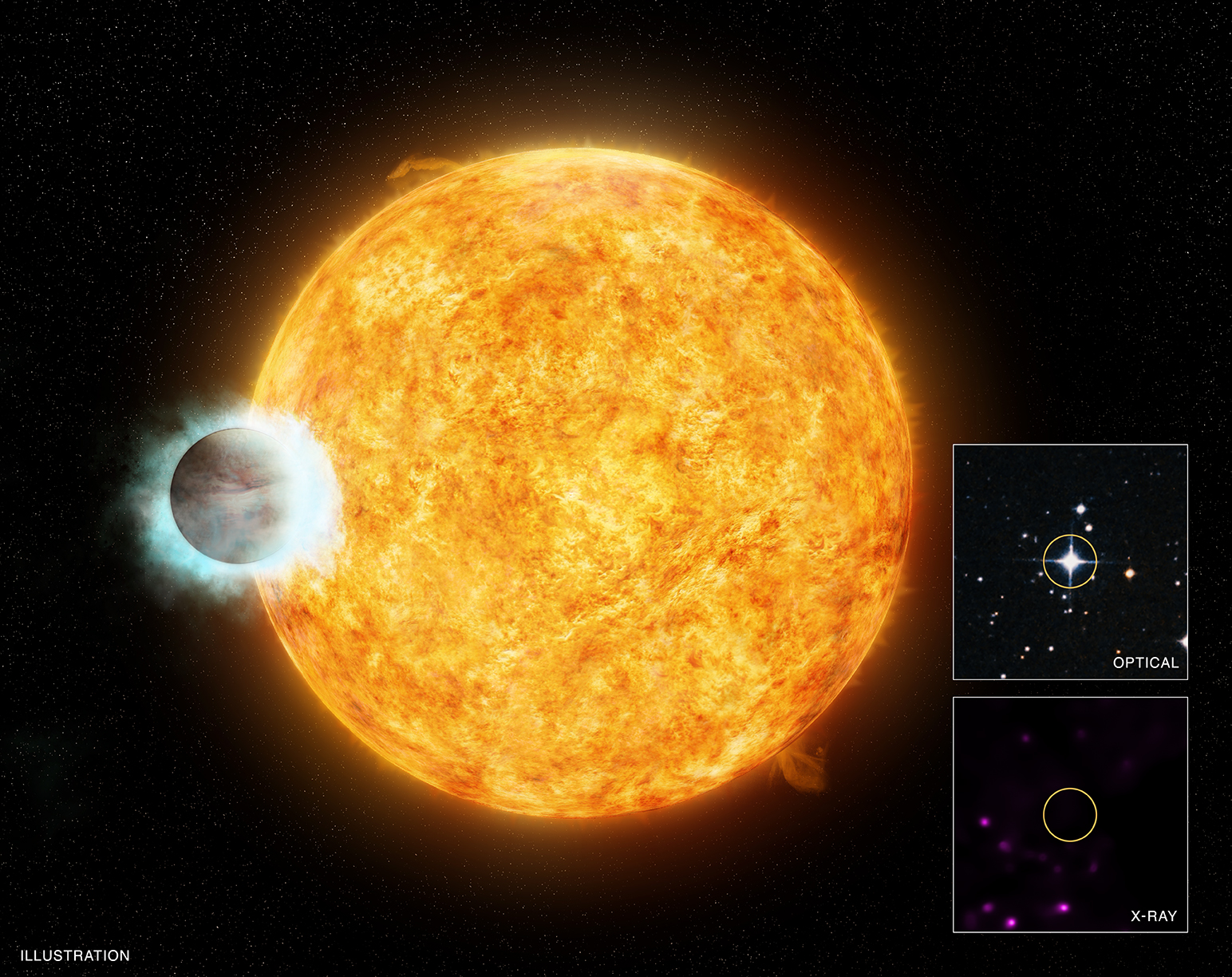
A new study using data from NASA's Chandra X-ray Observatory has shown that a planet is making the star that it orbits act much older than it actually is, as explained in our latest press release. The artist's illustration featured in the main part of this graphic depicts the star, WASP-18, and its planet, WASP-18b.
WASP-18b is a "hot Jupiter," a giant exoplanet that orbits very close to its star, located about 330 light years
from Earth. Specifically, the mass of WASP-18b is estimated to be about
ten times that of Jupiter, yet it orbits its star about once every 23
hours. By comparison, it takes Jupiter about 12 years to complete one
trip around the Sun from its great distance.
The new Chandra data of the WASP-18 system show that this huge planet
is so close to its star that it may be causing a dampening of the
star's magnetic field. As stars age, their X-ray
and magnetic activity decreases. Astronomers determined that WASP-18 is
only between 500 million and 2 billion years old, a relatively young
age for a star. Given this age, astronomers expect that WASP-18 would be
giving off copious amounts of X-rays.
Surprisingly, the long Chandra observations reveal no X-rays being
emitted from WASP-18, as seen in the lower inset box. The same
field-of-view in the upper inset box shows that in optical light WASP-18
is a bright source. Using established relations between the magnetic
activity and X-ray emission of stars and their age, the researchers
concluded that WASP-18 is about 100 times less active than it should be
at its age.
The low amount of magnetic activity from WASP-18 is shown in the artist's illustration
by the lack of sunspots and strong flares on the surface of the star.
The weak X-ray emission from the star has relatively little effect on
the outer atmosphere of the nearby planet, giving it a symmetrical
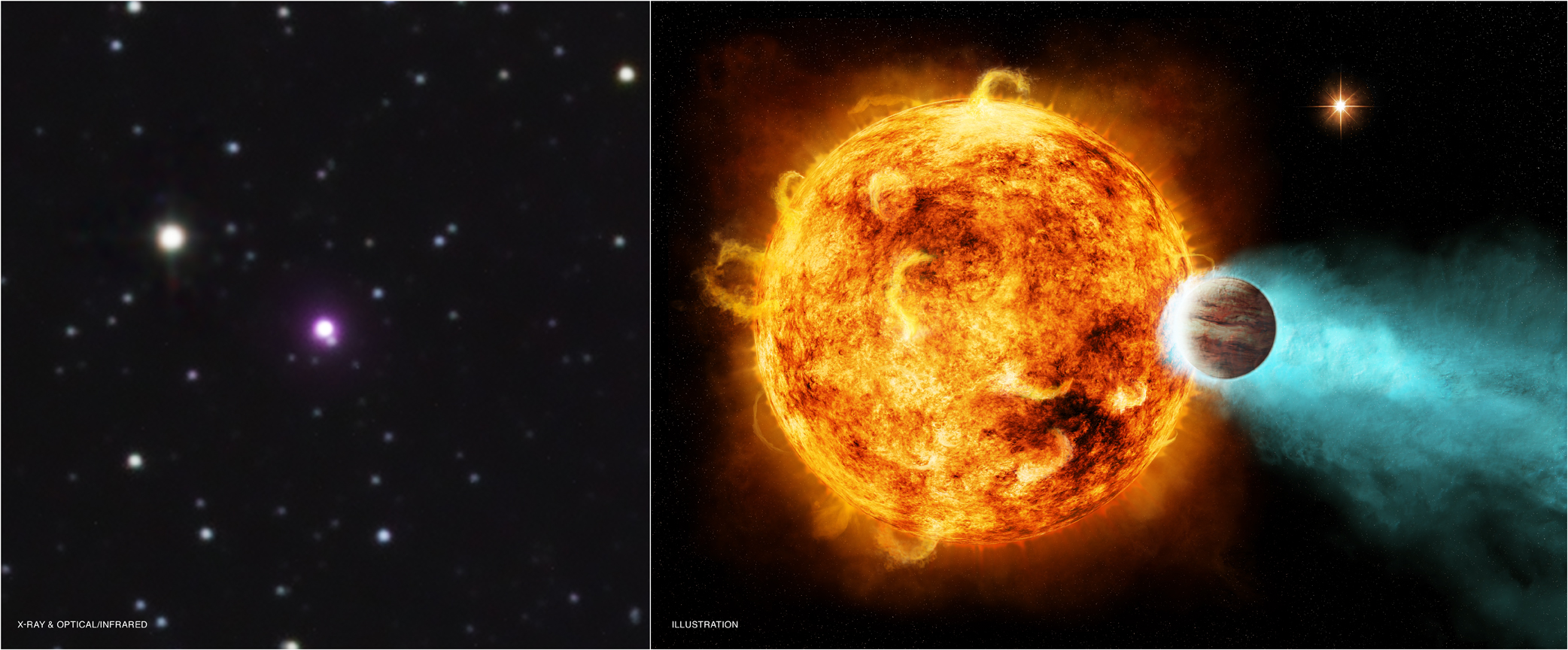
appearance. By contrast, much stronger X-rays from the star CoRoT-2a are eroding the atmosphere of its nearby planet, producing a tail-like appearance.
Tidal forces from the gravitational pull of the massive planet -
similar to those the Moon has on Earth's tides but on a much larger
scale - may be responsible for disrupting the magnetic field of the
star. The strength of the magnetic field in a star depends on the amount
of convection, the process by which hot gas moves around the stellar
interior. The planet's gravity may cause motions of gas inside the star
that weaken the convection. Because WASP-18 has a narrower convection
zone than most stars, it is more vulnerable to the impact of tidal
forces that tug at it.
The effect of tidal forces from the planet may also explain an
unusually high amount of lithium found in earlier, optical studies of
WASP-18. Lithium is usually abundant in younger stars, but over time
convection carries lithium to the hot inner regions of a star, where it
is destroyed by nuclear reactions. If there is less convection, the
lithium does not circulate into the interior of the star as much,
allowing more of it to survive.
These results were published in the July 2014 issue of Astronomy and Astrophysics and are available online.
The first author is Ignazio Pillitteri of the Istituto Nazionale di
Astrofisica (INAF)-Osservatorio Astronomico di Palermo in Italy. The
co-authors are Scott Wolk of the Harvard-Smithsonian Center for
Astrophysics in Cambridge, Massachusetts; Salvatore Sciortino also from
INAF-Osservatorio Astronomico di Palermo in Italy and Victoria Antoci from Aarhus University in Denmark.
Fast Facts for WASP-18:
Scale: Inset image is about 5.3 arcmin across (about 0.5 light years)
Category: Normal Stars & Star Clusters
Coordinates (J2000): RA 01h 37m 25.00s | Dec -45º 40' 40.30"
Constellation: Phoenix
Observation Date: 26 Feb 2013
Observation Time: 23 hours 43 min.
Obs. ID: 14566
Instrument: ACIS
References: Pillitteri, I et al, 2014, A&A, 567, 128; arXiv:1406.2620
Color Code: Inset: X-ray (Pink), Optical (Red, Green, Blue)
Distance Estimate: About 326 light years
Fast Facts for WASP-18:
Scale: Inset image is about 5.3 arcmin across (about 0.5 light years)
Category: Normal Stars & Star Clusters
Coordinates (J2000): RA 01h 37m 25.00s | Dec -45º 40' 40.30"
Constellation: Phoenix
Observation Date: 26 Feb 2013
Observation Time: 23 hours 43 min.
Obs. ID: 14566
Instrument: ACIS
References: Pillitteri, I et al, 2014, A&A, 567, 128; arXiv:1406.2620
Color Code: Inset: X-ray (Pink), Optical (Red, Green, Blue)
Distance Estimate: About 326 light years
Source: NASA’s Chandra X-ray Observatory