Wednesday, December 16, 2009

Giant Planet Set for a Cataclysmic Show

The fluctuation in light from the QS Virginis system over a period of 1.2 hours.
Credit: Shengbang Qian, National Astronomical Observatories,
Chinese Academy of Sciences.

A team of Chinese astronomers have discovered a giant planet close to the exotic binary star system QS Virginis. Although dormant now, in the future the two stars will one day erupt in a violent nova outburst. Professor Shengbang Qian of Yunnan Observatory leads the team of scientists who report their work in the journal Monthly Notices of the Royal Astronomical Society.

QS Virginis lies in the direction of the constellation of Virgo and is about 157 light years from the Sun. The system is made up of a cool red dwarf and a hot dense white dwarf (an object similar to the remnant that will be left behind by the Sun at the end of its life). The two stars are just 840000 km (525000 miles) apart or about twice the distance from the Earth to the Moon. Being so close together they race around each other, taking just 3 hours and 37 minutes to complete each orbit. No Earth-based telescope can see them as separate stars, but as they move around the two stars successively eclipse one another, leading to a characteristic periodic dip in the brightness of the system.

In many close binaries, described as ‘cataclysmic variables (CVs)’, material flows from one star to its denser companion. The stars of QS Virginis are only slightly too far apart for this to happen and so are a ‘hibernating’ CV and relatively quiet at the moment.

Professor Qian’s team looked closely at the way the light from QS Virginis fluctuated throughout each orbit. By timing the eclipses, they found that the duration of the orbit changed with the time of mid-eclipse periodically advanced or delayed.

This shift is explained by an unseen third object exerting a gravitational pull on the two stars, so that sometimes the light has to travel a little further and sometimes a little less to reach us. From their measurements, the Chinese team deduced that there is a giant planet, with a minimum of 6.4 times the mass of Jupiter, at an average distance from the stars of 4.2 times that from the Earth to the Sun (about 630 million km or 394 million miles).

The new world is the first to be found in orbit around a close pair of stars of this type. Although almost certainly uninhabited, a hypothetical observer there would see a pair of rather small ‘Suns’ – one red and one white appearing very close together in the sky.

But things will not look this way forever. The red dwarf star is being braked by the interaction between its stellar wind and magnetic field and is decelerating. As it loses energy it is moving closer to the white dwarf and sometime in the next few thousand years it will be near enough that hydrogen will start to be dragged off the red dwarf by its companion star.

The hydrogen will then slowly accumulate on the white dwarf and build up in a hot dense layer close to the star’s surface. In due course the density and temperature of the base of the hydrogen layer will become high enough for nuclear fusion reactions to start, where the hydrogen is very quickly fused to heavier helium. The resulting nuclear explosion will lead to a spectacular outburst of radiation and the binary system will temporarily become many times brighter than normal.

These ‘nova’ events are bright enough that they are often seen by amateur astronomers on Earth, so the view of the outburst from the newly discovered planet will be dramatic (and potentially dangerous for any extraterrestrial tourists who go there to watch it).

But Professor Qian sees this as a real opportunity for terrestrial astronomers. “For once we have advance notice of the formation of a cataclysmic variable and the chance to study what will happen to the planet in orbit around it. The scientific community should watch this system over the decades ahead – it should give us a real insight into these exotic stars.”

CONTACT

Professor Shengbang Qian
National Astronomical Observatories / Yunnan Observatory
Chinese Academy of Sciences
PO Box 110
650011
Kunming
P. R. China
Tel: +86-871-3920137
Mob: +86-13238663188
E-mail:
qsb@ynao.ac.cn

FURTHER INFORMATION AND IMAGES

Please contact Robert Massey (details above) for access to high-resolution images.
An Early View of the MNRAS paper can be found at
http://www3.interscience.wiley.com/journal/122683015/abstract

NOTES FOR EDITORS

THE ROYAL ASTRONOMICAL SOCIETY

The Royal Astronomical Society (RAS), founded in 1820, encourages and promotes the study of astronomy, solar-system science, geophysics and closely related branches of science. The RAS organizes scientific meetings, publishes international research and review journals, recognizes outstanding achievements by the award of medals and prizes, maintains an extensive library, supports education through grants and outreach activities and represents UK astronomy nationally and internationally. Its more than 3000 members (Fellows), a third based overseas, include scientific researchers in universities, observatories and laboratories as well as historians of astronomy and others.

Royal Astronomical Society Press Release
Ref: RAS PN 09/64
15th December 2009
EMBARGOED UNTIL 0001 GMT, 16TH DECEMBER 2009

Issued by:
Dr Robert Massey
Press and Policy Officer
Royal Astronomical Society
Tel: +44 (0)20 7734 3307
Mob: +44 (0)794 124 8035
E-mail:
rm@ras.org.uk

Tuesday, December 15, 2009

Close-up Photos of Dying Star Show Our Sun's Fate

Chi Cygni, shown in this artist's conception, is a red giant star nearing the end of its life. As it runs out of fuel, it pulses in and out, beating like a giant heart and ejecting shells of material. Observations by the Infrared Optical Telescope Array found that, at minimum radius, Chi Cygni shows marked inhomogeneities due to roiling "hotspots" on its surface. Credit: ESO/L. Calçada


Chi Cygni changes brightness dramatically and regularly every 408 days due to in-and-out pulsations. Using interferometry to image the star's surface at four separate times, astronomers found that the star grows to a diameter of 480 million miles - large enough to engulf the asteroid belt - before shrinking to a minimum diameter of 300 million miles. Chi Cygni also shows significant hotspots near minimum radius. Credit: Sylvestre Lacour, Observatoire de Paris


Animation (mov)
This movie combines infrared images of the surface of Chi Cygni, obtained with IOTA, with visual brightness measurements provided by the American Association of Variable Star Observers (AAVSO). Chi Cygni demonstrates a 408-day-period of expanding and dimming, followed by contracting and brightening. Credit: Sylvestre Lacour, Observatoire de Paris

Cambridge, MA - About 550 light-years from Earth, a star like our Sun is writhing in its death throes. Chi Cygni has swollen in size to become a red giant star so large that it would swallow every planet out to Mars in our solar system. Moreover, it has begun to pulse dramatically in and out, beating like a giant heart. New close-up photos of the surface of this distant star show its throbbing motions in unprecedented detail.

"This work opens a window onto the fate of our Sun five billion years from now, when it will near the end of its life," said lead author Sylvestre Lacour of the Observatoire de Paris.

As a sunlike star ages, it begins to run out of hydrogen fuel at its core. Like a car running out of gas, its "engine" begins to splutter. On Chi Cygni, we see those splutterings as a brightening and dimming, caused by the star's contraction and expansion. Stars at this life stage are known as Mira variables after the first such example, Mira "the Wonderful," discovered by David Fabricius in 1596. As it pulses, the star is puffing off its outer layers, which in a few hundred thousand years will create a beautifully gleaming planetary nebula.

Chi Cygni pulses once every 408 days. At its smallest diameter of 300 million miles, it becomes mottled with brilliant spots as massive plumes of hot plasma roil its surface. (Those spots are like the granules on our Sun's surface, but much larger.) As it expands, Chi Cygni cools and dims, growing to a diameter of 480 million miles - large enough to engulf and cook our solar system's asteroid belt.

For the first time, astronomers have photographed these dramatic changes in detail. They reported their work in the December 10 issue of The Astrophysical Journal.

"We have essentially created an animation of a pulsating star using real images," stated Lacour. "Our observations show that the pulsation is not only radial, but comes with inhomogeneities, like the giant hotspot that appeared at minimum radius."

Imaging variable stars is extremely difficult, for two main reasons. The first reason is that such stars hide within a compact and dense shell of dust and molecules. To study the stellar surface within the shell, astronomers observe the stars at a specific wavelength of infrared light. Infrared allows astronomers to see through the shell of molecules and dust, like X-rays enable physicians to see bones within the human body.

The second reason is that these stars are very far away, and thus appear very small. Even though they are huge compared to the Sun, the distance makes them appear no larger than a small house on the moon as seen from Earth. Traditional telescopes lack the proper resolution. Consequently, the team turned to a technique called interferometry, which involves combining the light coming from several telescopes to yield resolution equivalent to a telescope as large as the distance between them.

They used the Smithsonian Astrophysical Observatory's Infrared Optical Telescope Array, or IOTA, which was located at Whipple Observatory on Mount Hopkins, Arizona.

"IOTA offered unique capabilities," said co-author Marc Lacasse of the Harvard-Smithsonian Center for Astrophysics (CfA). "It allowed us to see details in the images which are about 15 times smaller than can be resolved in images from the Hubble Space Telescope."

The team also acknowledged the usefulness of the many observations contributed annually by amateur astronomers worldwide, which were provided by the American Association of Variable Star Observers (AAVSO).

In the forthcoming decade, the prospect of ultra-sharp imaging enabled by interferometry excites astronomers. Objects that, until now, appeared point-like are progressively revealing their true nature. Stellar surfaces, black hole accretion disks, and planet forming regions surrounding newborn stars all used to be understood primarily through models. Interferometry promises to reveal their true identities and, with them, some surprises.Headquartered in Cambridge, Mass., the Harvard-Smithsonian Center for Astrophysics (CfA) is a joint collaboration between the Smithsonian Astrophysical Observatory and the Harvard College Observatory. CfA scientists, organized into six research divisions, study the origin, evolution and ultimate fate of the universe.

For more information, contact:

David A. Aguilar
Director of Public Affairs
Harvard-Smithsonian Center for Astrophysics
617-495-7462

daguilar@cfa.harvard.edu

Christine Pulliam
Public Affairs Specialist
Harvard-Smithsonian Center for Astrophysics
617-495-7463

cpulliam@cfa.harvard.edu

Hubble's Festive View of a Grand Star-Forming Region

Credit: NASA, ESA, and F. Paresce (INAF-IASF, Bologna, Italy), R. O'Connell (University of Virginia, Charlottesville), and the Wide Field Camera 3 Science Oversight Committee

Just in time for the holidays: a Hubble Space Telescope picture postcard of hundreds of brilliant blue stars wreathed by warm, glowing clouds. The festive portrait is the most detailed view of the largest stellar nursery in our local galactic neighborhood.

The massive, young stellar grouping, called R136, is only a few million years old and resides in the 30 Doradus Nebula, a turbulent star-birth region in the Large Magellanic Cloud (LMC), a satellite galaxy of our Milky Way. There is no known star-forming region in our galaxy as large or as prolific as 30 Doradus.

Many of the diamond-like icy blue stars are among the most massive stars known. Several of them are over 100 times more massive than our Sun. These hefty stars are destined to pop off, like a string of firecrackers, as supernovas in a few million years.

The image, taken in ultraviolet, visible, and red light by Hubble's Wide Field Camera 3, spans about 100 light-years. The nebula is close enough to Earth that Hubble can resolve individual stars, giving astronomers important information about the stars' birth and evolution.

The brilliant stars are carving deep cavities in the surrounding material by unleashing a torrent of ultraviolet light, and hurricane-force stellar winds (streams of charged particles), which are etching away the enveloping hydrogen gas cloud in which the stars were born. The image reveals a fantasy landscape of pillars, ridges, and valleys, as well as a dark region in the center that roughly looks like the outline of a holiday tree. Besides sculpting the gaseous terrain, the brilliant stars can also help create a successive generation of offspring. When the winds hit dense walls of gas, they create shocks, which may be generating a new wave of star birth.

The movement of the LMC around the Milky Way may have triggered the massive cluster's formation in several ways. The gravitational tug of the Milky Way and the companion Small Magellanic Cloud may have compressed gas in the LMC. Also, the pressure resulting from the LMC plowing through the Milky Way's halo may have compressed gas in the satellite. The cluster is a rare, nearby example of the many super star clusters that formed in the distant, early universe, when star birth and galaxy interactions were more frequent. Previous Hubble observations have shown astronomers that super star clusters in faraway galaxies are ubiquitous.

The LMC is located 170,000 light-years away and is a member of the Local Group of Galaxies, which also includes the Milky Way.

The Hubble observations were taken Oct. 20-27, 2009. The blue color is light from the hottest, most massive stars; the green from the glow of oxygen; and the red from fluorescing hydrogen.

For additional information, contact:

Donna Weaver / Ray Villard
Space Telescope Science Institute, Baltimore, Md.
410-338-4493 / 410-338-4514

dweaver@stsci.edu / villard@stsci.edu

Francesco Paresce
National Institute for Astrophysics (INAF/IASF), Bologna, Italy
011-39-51-946576

fparesce@iasfbo.inaf.it

Robert O'Connell
University of Virginia, Charlottesville, Va.
434-924-7494

rwo@virginia.edu

Object Names: 30 Doradus, 30 Dor

Image Type: Astronomical

See the rest:

Monday, December 14, 2009

New planet discoveries suggest low-mass planets are common around nearby stars

61 Virginis is one of only a handful of truly Sun-like stars that can be seen with the naked eye. Astronomers have discovered three low-mass planets orbiting the star. The image above is from NASA's Sky View.

This image from a simulation of atmospheric flow shows temperature patterns on one of the newly discovered planets (61Virb), which is hot enough that it glows with its own thermal emission. A movie of the simulation is posted at the bottom of this story, showing global atmospheric flow for one full orbit of the planet around its star. Credit: J. Langton, Principia College

An international team of planet hunters has discovered as many as six low-mass planets around two nearby Sun-like stars, including two "super-Earths" with masses 5 and 7.5 times the mass of Earth. The researchers, led by Steven Vogt of the University of California, Santa Cruz, and Paul Butler of the Carnegie Institution of Washington, said the two "super-Earths" are the first ones found around Sun-like stars.

"These detections indicate that low-mass planets are quite common around nearby stars. The discovery of potentially habitable nearby worlds may be just a few years away," said Vogt, a professor of astronomy and astrophysics at UCSC.

The team found the new planet systems by combining data gathered at the W. M. Keck Observatory in Hawaii and the Anglo-Australian Telescope (AAT) in New South Wales, Australia. Two papers describing the new planets have been accepted for publication in the Astrophysical Journal.

Three of the new planets orbit the bright star 61 Virginis, which can be seen with the naked eye under dark skies in the Spring constellation Virgo. Astronomers and astrobiologists have long been fascinated with this particular star, which is only 28 light-years away. Among hundreds of our nearest stellar neighbors, 61 Vir stands out as being the most nearly similar to the Sun in terms of age, mass, and other essential properties. Vogt and his collaborators have found that 61 Vir hosts at least three planets, with masses ranging from about 5 to 25 times the mass of Earth.

Recently, a separate team of astronomers used NASA's Spitzer Space Telescope to discover that 61 Vir also contains a thick ring of dust at a distance roughly twice as far from 61 Vir as Pluto is from our Sun. The dust is apparently created by collisions of comet-like bodies in the cold outer reaches of the system.

"Spitzer's detection of cold dust orbiting 61 Vir indicates that there's a real kinship between the Sun and 61 Vir," said Eugenio Rivera, a postdoctoral researcher at UCSC. Rivera computed an extensive set of numerical simulations to find that a habitable Earth-like world could easily exist in the as-yet unexplored region between the newly discovered planets and the outer dust disk.

According to Vogt, the planetary system around 61 Vir is an excellent candidate for study by the new Automated Planet Finder (APF) Telescope recently constructed at Lick Observatory on Mount Hamilton near San Jose. "Needless to say, we're very excited to continue monitoring this system using APF," said Vogt, who is the principal investigator for the APF and is building a spectrometer for the new telescope that is optimized for finding planets.

The second new system found by the team features a 7.5-Earth-mass planet orbiting HD 1461, another near-perfect twin of the Sun located 76 light-years away. At least one and possibly two additional planets also orbit the star. Lying in the constellation Cetus, HD 1461 can be seen with the naked eye in the early evening under good dark-sky conditions.

The 7.5-Earth-mass planet, assigned the name HD 1461b, has a mass nearly midway between the masses of Earth and Uranus. The researchers said they cannot tell yet if HD 1461b is a scaled-up version of Earth, composed largely of rock and iron, or whether, like Uranus and Neptune, it is composed mostly of water.

According to Butler, the new detections required state-of-the-art instruments and detection techniques. "The inner planet of the 61 Vir system is among the two or three lowest-amplitude planetary signals that have been identified with confidence," he said. "We've found there is a tremendous advantage to be gained from combining data from the AAT and Keck telescopes, two world-class observatories, and it's clear that we'll have an excellent shot at identifying potentially habitable planets around the very nearest stars within just a few years."

The 61 Vir and HD 1461 detections add to a slew of recent discoveries that have upended conventional thinking regarding planet detection. In the past year, it has become evident that planets orbiting the Sun's nearest neighbors are extremely common. According to Butler, current indications are that fully one-half of nearby stars have a detectable planet with mass equal to or less than Neptune's.

The Lick-Carnegie Exoplanet Survey Team led by Vogt and Butler uses radial velocity measurements from ground-based telescopes to detect the "wobble" induced in a star by the gravitational tug of an orbiting planet. The radial-velocity observations were complemented with precise brightness measurements acquired with robotic telescopes in Arizona by Gregory Henry of Tennessee State University.

"We don't see any brightness variability in either star," said Henry. "This assures us that the wobbles really are due to planets and not changing patterns of dark spots on the stars."

Due to improvements in equipment and observing techniques, these ground-based methods are now capable of finding Earth-mass objects around nearby stars, according to team member Gregory Laughlin, professor of astronomy and astrophysics at UCSC.

"It's come down to a neck-and-neck race as to whether the first potentially habitable planets will be detected from the ground or from space," Laughlin said. "A few years ago, I'd have put my money on space-based detection methods, but now it really appears to be a toss-up. What is truly exciting about the current ground-based radial velocity detection method is that it is capable of locating the very closest potentially habitable planets."

The Lick-Carnegie Exoplanet Survey Team has developed a publicly available tool, the Systemic Console, which enables members of the public to search for the signals of extrasolar planets by exploring real data sets in a straightforward and intuitive way. This tool is available online at www.oklo.org.

This research was supported by the National Science Foundation and NASA. In addition to Vogt, Butler, Rivera, Laughlin, and Henry, the coauthors of the 61 Vir paper include Rob Wittenmyer, C. G. Tinney, and Jeremy Bailey of the University of New South Wales; Simon O'Toole and Hugh Jones of the University of Hertfordshire; Stefano Meschiari of UCSC; Brad Carter of the University of Southern Queensland; and Konstantin Batygin of Caltech. The authors of the HD 1461 paper are Rivera, Butler, Vogt, Laughlin, Henry, and Meschiari.

Additional information about this planet search team is available at Greg Laughlin's Systemic Blog, Steve Vogt's web page, and Paul Butler's Earthbound Planet Search web site.

By Tim Stephens (831) 459-2495; stephens@ucsc.edu

Born in beauty: proplyds in the Orion Nebula

Image credit: NASA, ESA and L. Ricci (ESO)


Videos: Video 1 - Video 2

A collection of 30 never-before-released images of embryonic planetary systems in the Orion Nebula are the highlight of the longest single Hubble Space Telescope project ever dedicated to the topic of star and planet formation. Also known as proplyds, or protoplanetary discs, these modest blobs surrounding baby stars are shedding light on the mechanism behind planet formation. Only the NASA/ESA Hubble Space Telescope, with its high resolution and sensitivity, can take such detailed pictures of circumstellar discs at optical wavelengths.

Looking like a graceful watercolour painting, the Orion Nebula is one of the most photogenic objects in space and one of the Hubble Space Telescope's favourite targets. As newborn stars emerge from the nebula's mixture of gas and dust, protoplanetary discs, also known as proplyds, form around them: the centre of the spinning disc heats up and becomes a new star, but remnants around the outskirts of the disc attract other bits of dust and clump together. Proplyds are thought to be young planetary systems in the making. In an ambitious survey of the familiar nebula using Hubble's Advanced Camera for Surveys (ACS), researchers have discovered 42 protoplanetary discs.

Visible to the naked eye, the Orion Nebula has been known since ancient times, but was first described in the early 17th century by the French astronomer Nicolas-Claude Fabri de Peiresc — who is given credit for discovering it. At 1500 light-years away, the nebula, also known as Messier 42, is the closest star-forming region to Earth with stars massive enough to heat up the surrounding gas, setting it ablaze with colour, and making the region stand out to stargazers.

Within the awe-inspiring, gaseous folds of Orion, researchers have identified two different types of discs around young and forming stars: those that lie close to the brightest star in the cluster (Theta 1 Orionis C) and those farther away from it. This bright star heats up the gas in nearby discs, causing them to shine brightly. Discs that are farther away do not receive enough energetic radiation from the star to heat up the gas and so they can only be detected as dark silhouettes against the background of the bright nebula, as the dust that surrounds these discs absorbs background visible light. By studying these silhouetted discs, astronomers are better able to characterize the properties of the dust grains that are thought to bind together and possibly form planets like our own.

The brighter discs are indicated by a glowing cusp in the excited material and facing the bright star, but which we see at a random orientation within the nebula, so some appear edge on, and others face on, for instance. Other interesting features enhance the look of these captivating objects, such as emerging jets of matter and shock waves. The dramatic shock waves are formed when the stellar wind from the nearby massive star collides with the gas in the nebula, sculpting boomerang shapes or arrows or even, in the case of 181-825, a space jellyfish!

It is relatively rare to see visible images of proplyds, but the high resolution and sensitivity of Hubble and the Orion Nebula’s proximity to Earth allow for precise views of these potential planetary systems.

This proplyd atlas is the first scientific outcome from the HST Treasury Program on the Orion Nebula. Treasury Programs are carried out to allow scientists to conduct comprehensive studies over longer periods since time on the in-demand Hubble Space Telescope is strictly allocated. High resolution imaging of protoplanetary discs is an example of a science discovery that has led to better technology and is one of the main science cases for the Atacama Large Millimeter/submillimeter Array (ALMA), one of the largest ground-based astronomy projects of the next decade. ALMA will observe the dust at longer wavelengths, in emission (instead of in absorption as we see it at optical wavelengths) with an angular resolution up to 10 times better than that of Hubble.

Notes for editors:

The Hubble Space Telescope is a project of international cooperation between ESA and NASA.

Image credit: NASA, ESA and L. Ricci (ESO)

Contacts:

Colleen Sharkey
Hubble/ESA, Garching, Germany
Tel: +49-89-3200-6306
Cell: +49-015115373591
E-mail:
csharkey@eso.org

Luca Ricci
European Southern Observatory
Tel: +49-89-3200-6635
E-mail:
lricci@eso.org

Saturday, December 12, 2009

VISTA: Pioneering New Survey Telescope Starts Work

The Hidden Fires of the Flame Nebula

One Million Stars — towards the Dark Heart of the Milky Way

The Fornax Cluster of Galaxies

VISTA: the Visible and Infrared Survey Telescope for Astronomy

Details of the VISTA Flame Nebula Image

Details of the VISTA Galactic Centre Image

Details of the VISTA Fornax Galaxy Cluster image

Visible/IR Comparison of the VISTA Flame Nebula Image

Visible/IR Comparison of the VISTA Galactic Centre Image

VISTA’s Giant Infrared Camera

The Region of Orion’s Belt and the Flame Nebula

Wide-field View of the Centre of the Milky Way

Wide-field View of the Fornax Galaxy Cluster

The Hidden Fires of the Flame Nebula (Full Frame)

ESOCast 12: VISTA: A Pioneering New Survey Telescope Starts Work

Video News Release

Time-lapse video of VISTA at work (Part One)

Time-lapse video of VISTA at work (Part Two)

Zooming in on VISTA’s view
of the Flame Nebula

Zooming in on VISTA’s view of the centre of the Milky Way

Zooming in on VISTA’s view of the Fornax Galaxy Cluster

Infrared-visual crossfade,
Flame Nebula

Infrared-visual crossfade, centre of the Milky Way

Infrared-visual Crossfade, Flame Nebula (Annotated)

Infrared-visual crossfade, centre of the Milky Way (Annotated)

Panning across VISTA’s view of the Flame Nebula

Panning across VISTA’s view of the Centre of the Milky Way

Panning across VISTA’s view of the Fornax Galaxy Cluster

Video News Release (B-roll)

3D animation of the VISTA telescope

A new telescope — VISTA (the Visible and Infrared Survey Telescope for Astronomy) — has just started work at ESO’s Paranal Observatory and has made its first release of pictures. VISTA is a survey telescope working at infrared wavelengths and is the world’s largest telescope dedicated to mapping the sky. Its large mirror, wide field of view and very sensitive detectors will reveal a completely new view of the southern sky. Spectacular new images of the Flame Nebula, the centre of our Milky Way galaxy and the Fornax Galaxy Cluster show that it is working extremely well.

VISTA is the latest telescope to be added to ESO’s Paranal Observatory in the Atacama Desert of northern Chile. It is housed on the peak adjacent to the one hosting the ESO Very Large Telescope (VLT) and shares the same exceptional observing conditions. VISTA’s main mirror is 4.1 metres across and is the most highly curved mirror of this size and quality ever made — its deviations from a perfect surface are less than a few thousandths of the thickness of a human hair — and its construction and polishing presented formidable challenges.

VISTA was conceived and developed by a consortium of 18 universities in the United Kingdom [1] led by Queen Mary, University of London and became an in-kind contribution to ESO as part of the UK's accession agreement. The telescope design and construction were project-managed by the Science and Technology Facilities Council's UK Astronomy Technology Centre (STFC, UK ATC). Provisional acceptance of VISTA was formally granted by ESO at a ceremony at ESO's Headquarters in Garching, Germany, attended by representatives of Queen Mary, University of London and STFC, on 10 December 2009 and the telescope will now be operated by ESO.

“VISTA is a unique addition to ESO’s observatory on Cerro Paranal. It will play a pioneering role in surveying the southern sky at infrared wavelengths and will find many interesting targets for further study by the Very Large Telescope, ALMA and the future European Extremely Large Telescope,” says Tim de Zeeuw, the ESO Director General.

At the heart of VISTA is a 3-tonne camera containing 16 special detectors sensitive to infrared light, with a combined total of 67 million pixels. Observing at wavelengths longer than those visible with the human eye allows VISTA to study objects that are otherwise impossible to see in visible light because they are either too cool, obscured by dust clouds or because they are so far away that their light has been stretched beyond the visible range by the expansion of the Universe. To avoid swamping the faint infrared radiation coming from space, the camera has to be cooled to -200 degrees Celsius and is sealed with the largest infrared-transparent window ever made. The VISTA camera was designed and built by a consortium including the Rutherford Appleton Laboratory, the UK ATC and the University of Durham in the United Kingdom.

Because VISTA is a large telescope that also has a large field of view it can both detect faint sources and also cover wide areas of sky quickly. Each VISTA image captures a section of sky covering about ten times the area of the full Moon and it will be able to detect and catalogue objects over the whole southern sky with a sensitivity that is forty times greater than that achieved with earlier infrared sky surveys such as the highly successful Two Micron All-Sky Survey. This jump in observational power — comparable to the step in sensitivity from the unaided eye to Galileo’s first telescope — will reveal vast numbers of new objects and allow the creation of far more complete inventories of rare and exotic objects in the southern sky.

“We're delighted to have been able to provide the astronomical community with the VISTA telescope. The exceptional quality of the scientific data is a tribute to all the scientists and engineers who were involved in this exciting and challenging project,” adds Ian Robson, Head of the UK ATC.

The first released image shows the Flame Nebula (NGC 2024), a spectacular star-forming cloud of gas and dust in the familiar constellation of Orion (the Hunter) and its surroundings. In visible light the core of the object is hidden behind thick clouds of dust, but the VISTA image, taken at infrared wavelengths, can penetrate the murk and reveal the cluster of hot young stars hidden within. The wide field of view of the VISTA camera also captures the glow of NGC 2023 and the ghostly form of the famous Horsehead Nebula.

The second image is a mosaic of two VISTA views towards the centre of our Milky Way galaxy in the constellation of Sagittarius (the Archer). Vast numbers of stars are revealed — this single picture shows about one million stars — and the majority are normally hidden behind thick dust clouds and only become visible at infrared wavelengths.

For the final image, VISTA has stared far beyond our galaxy to take a family photograph of a cluster of galaxies in the constellation of Fornax (the Chemical Furnace). The wide field allows many galaxies to be captured in a single image including the striking barred-spiral NGC 1365 and the big elliptical galaxy NGC 1399.

VISTA will spend almost all of its time mapping the southern sky in a systematic fashion. The telescope is embarking on six major sky surveys with different scientific goals over its first five years. One survey will cover the entire southern sky and others will be dedicated to smaller regions to be studied in greater detail. VISTA's surveys will help our understanding of the nature, distribution and origin of known types of stars and galaxies, map the three-dimensional structure of our galaxy and the neighbouring Magellanic Clouds, and help determine the relation between the structure of the Universe and the mysterious dark energy and dark matter.

The huge data volumes — typically 300 gigabytes per night or more than 100 terabytes per year — will flow back into the ESO digital archive and will be processed into images and catalogues at data centres in the United Kingdom at the Universities of Cambridge and Edinburgh. All data will become public and be available to astronomers around the globe.

Jim Emerson of Queen Mary, University of London and leader of the VISTA consortium, is looking forward to a rich harvest of science from the new telescope: “History has shown us some of the most exciting results that come out of projects like VISTA are the ones you least expect — and I’m personally very excited to see what these will be!”

Notes

[1] The VISTA Consortium is led by Queen Mary, University of London and consists of: Queen Mary, University of London; Queen's University of Belfast; University of Birmingham; University of Cambridge; Cardiff University; University of Central Lancashire; University of Durham; The University of Edinburgh; University of Hertfordshire; Keele University; Leicester University; Liverpool John Moores University; University of Nottingham; University of Oxford; University of St Andrews; University of Southampton; University of Sussex and University College London.

More Information

ESO, the European Southern Observatory, is the foremost intergovernmental astronomy organisation in Europe and the world’s most productive astronomical observatory. It is supported by 14 countries: Austria, Belgium, the Czech Republic, Denmark, France, Finland, Germany, Italy, the Netherlands, Portugal, Spain, Sweden, Switzerland and the United Kingdom. ESO carries out an ambitious programme focused on the design, construction and operation of powerful ground-based observing facilities enabling astronomers to make important scientific discoveries. ESO also plays a leading role in promoting and organising cooperation in astronomical research. ESO operates three unique world-class observing sites in Chile: La Silla, Paranal and Chajnantor. At Paranal, ESO operates the Very Large Telescope, the world’s most advanced visible-light astronomical observatory and VISTA, the world’s largest survey telescope. ESO is the European partner of a revolutionary astronomical telescope ALMA, the largest astronomical project in existence. ESO is currently planning a 42-metre European Extremely Large optical/near-infrared Telescope, the E-ELT, which will become “the world’s biggest eye on the sky”.

Links

Contacts

Prof. Jim Emerson
Queen Mary, University of London, UK
Phone: +44 794 127 1548
E-mail:
j.p.emerson@qmul.ac.uk

PIO Contacts

Richard Hook
ESO Survey Telescopes PIO
Phone: +49 151 1055 5780
E-mail:
rhook@eso.org

Julia Maddock
Science and Technology Facilities Council, UK
Phone: +44 1793 44 2094
E-mail:
julia.maddock@stfc.ac.uk

Siân Halkyard
Queen Mary, University of London, UK
Phone: +44 20 7882 7454
E-mail:
s.halkyard@qmul.ac.uk

ESO Survey Telescopes PIO: Richard Hook - +49 151 1055 5780 - rhook@eso.org
ESO Press Officer in Chile: Valeria Foncea - +56 2 463 3123 - vfoncea@eso.org

National contacts for the media: http://www.eso.org/public/outreach/eson/
You may automatically receive notification and the full texts via email by subscribing to the ESO-NEWS Mailing List

Fermi Sees Brightest-Ever Blazar Flare

Unprecedented flares from the blazar 3C 454.3 in the constellation Pegasus now make it the brightest persistent gamma-ray source in the sky. That title usually goes to the Vela pulsar in our galaxy, which is millions of times closer. These all-sky images, which show the numbers of high-energy gamma-rays captured by Fermi's Large Area Telescope on December 3 and November 18, clearly show the change. Credit: NASA/DOE/Fermi LAT Collaboration

A galaxy located billions of light-years away is commanding the attention of NASA's Fermi Gamma-ray Space Telescope and astronomers around the globe. Thanks to a series of flares that began September 15, the galaxy is now the brightest source in the gamma-ray sky -- more than ten times brighter than it was in the summer.

Astronomers identify the object as 3C 454.3, an active galaxy located 7.2 billion light-years away in the constellation Pegasus. But even among active galaxies, it's exceptional.

"We're looking right down the barrel of a particle jet powered by the galaxy's supermassive black hole," said Gino Tosti at the National Institute of Nuclear Physics in Perugia, Italy. "Some change within that jet -- we don't know what -- is likely responsible for these flares."

Blazars, like many active galaxies, emit oppositely directed jets of particles traveling near the speed of light when matter falls toward their central supermassive black holes. What makes a blazar so bright in gamma rays is its orientation: One of the jets happens to be aimed straight at us.

Most of the time, the brightest persistent source in the gamma-ray sky is the Vela pulsar, which at a distance of about 1,000 light-years lies practically next door.

"3C 454.3 is millions of times farther away, yet the current flare makes it twice as bright as Vela," said Lise Escande at the Center for Nuclear Studies in Gradignan, near Bordeaux, France. "That represents an incredible energy release, and one the source can't sustain for very long."

According to Massimo Villata at Italy's Torino Observatory, 3C 454.3 also is flaring at radio and visible wavelengths, if less dramatically. "In red light, the blazar brightened by more than two and a half times to magnitude 13.7, and it is also very bright at high radio frequencies."

The Fermi team is alerting astronomers to monitor the event over as broad a range of wavelengths as possible. "That's our best bet for understanding what's going on inside that jet," Tosti said.

Related Link:

NASA's Fermi Mission, Namibia's HESS Telescopes Explore a Blazar

Francis Reddy
NASA's Goddard Space Flight Center

Friday, December 11, 2009

Suzaku Catches Retreat of a Black Hole's Disk

GX 339-4, illustrated here, is among the most dynamic binaries in the sky, with four major outbursts in the past seven years. In the system, an evolved star no more massive than the sun orbits a black hole estimated at 10 solar masses. Credit: ESO/L. Calçada

Studies of one of the galaxy's most active black-hole binaries reveal a dramatic change that will help scientists better understand how these systems expel fast-moving particle jets.

Binary systems where a normal star is paired with a black hole often produce large swings in X-ray emission and blast jets of gas at speeds exceeding one-third that of light. What fuels this activity is gas pulled from the normal star, which spirals toward the black hole and piles up in a dense accretion disk.

"When a lot of gas is flowing, the dense disk reaches nearly to the black hole," said John Tomsick at the University of California, Berkeley. "But when the flow is reduced, theory predicts that gas close to the black hole heats up, resulting in evaporation of the innermost part of the disk." Never before have astronomers shown an unambiguous signature of this transformation.

To look for this effect, Tomsick and an international group of astronomers targeted GX 339-4, a low-mass X-ray binary located about 26,000 light-years away in the constellation Ara. There, every 1.7 days, an evolved star no more massive than the sun orbits a black hole estimated at 10 solar masses. With four major outbursts in the past seven years, GX 339-4 is among the most dynamic binaries in the sky.

In September 2008, nineteen months after the system's most recent outburst, the team observed GX 339-4 using the orbiting Suzaku X-ray observatory, which is operated jointly by the Japan Aerospace Exploration Agency and NASA. At the same time, the team also observed the system with NASA's Rossi X-ray Timing Explorer satellite.

Instruments on both satellites indicated that the system was faint but in an active state, when black holes are known to produce steady jets. Radio data from the Australia Telescope Compact Array confirmed that GX 339-4's jets were indeed powered up when the satellites observed.

Despite the system's faintness, Suzaku was able to measure a critical X-ray spectral line produced by the fluorescence of iron atoms. "Suzaku's sensitivity to iron emission lines and its ability to measure the shapes of those lines let us see a change in the accretion disk that only happens at low luminosities," said team member Kazutaka Yamaoka at Japan's Aoyama Gakuin University.

X-ray photons emitted from disk regions closest to the black hole naturally experience stronger gravitational effects. The X-rays lose energy and produce a characteristic signal. At its brightest, GX 339-4's X-rays can be traced to within about 20 miles of the black hole. But the Suzaku observations indicate that, at low brightness, the inner edge of the accretion disk retreats as much as 600 miles.

"We see emission only from the densest gas, where lots of iron atoms are producing X-rays, but that emission stops close to the black hole -- the dense disk is gone," explained Philip Kaaret at the University of Iowa. "What's really happening is that, at low accretion rates, the dense inner disk thins into a tenuous but even hotter gas, rather like water turning to steam."

The dense inner disk has a temperature of about 20 million degrees Fahrenheit, but the thin evaporated disk may be more than a thousand times hotter.

The study, which appears in the Dec. 10 issue of The Astrophysical Journal Letters, confirms the presence of low-density accretion flow in these systems. It also shows that GX 339-4 can produce jets even when the densest part of the disk is far from the black hole.

"This doesn't tell us how jets form, but it does tell us that jets can be launched even when the high-density accretion flow is far from the black hole," Tomsick said. "This means that the low-density accretion flow is the most essential ingredient for the formation of a steady jet in a black hole system."

Francis Reddy
NASA's Goddard Space Flight Center

Thursday, December 10, 2009

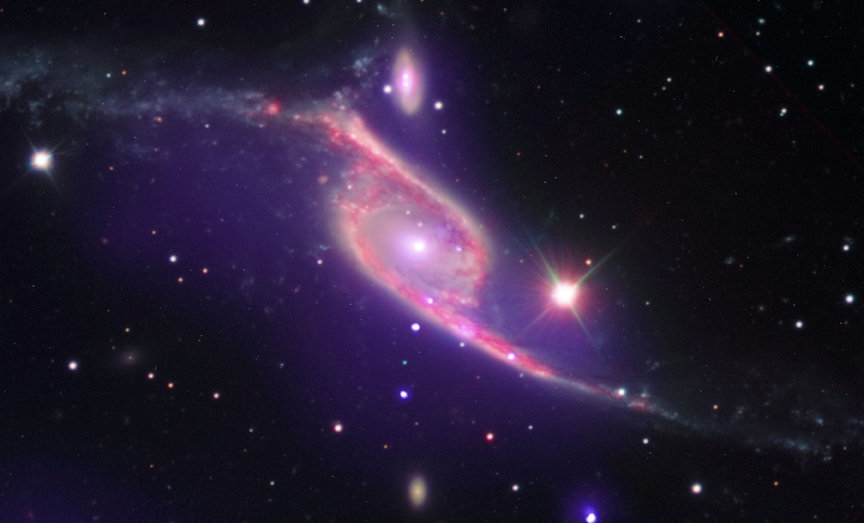
IC 4970 and NGC 6872: Galaxy Collision Switches on Black Hole

Credit X-ray: NASA/CXC/SAO/M.Machacek;
Optical: ESO/VLT;
This composite image of data from three different telescopes shows an ongoing collision between two galaxies, NGC 6872 and IC 4970. X-ray data from NASA's Chandra X-ray Observatory is shown in purple, while Spitzer Space Telescope's infrared data is red and optical data from ESO's Very Large Telescope (VLT) is colored red, green and blue.

Astronomers think that supermassive black holes exist at the center of most galaxies. Not only do the galaxies and black holes seem to co-exist, they are apparently inextricably linked in their evolution. To better understand this symbiotic relationship, scientists have turned to rapidly growing black holes - so-called active galactic nucleus (AGN) - to study how they are affected by their galactic environments.

The latest data from Chandra and Spitzer show that IC 4970, the small galaxy at the top of the image, contains an AGN, but one that is heavily cocooned in gas and dust. This means in optical light telescopes, like the VLT, there is little to see. X-rays and infrared light , however, can penetrate this veil of material and reveal the light show that is generated as material heats up before falling onto the black hole (seen as a bright point-like source).

Despite this obscuring gas and dust around IC 4970, the Chandra data suggest that there is not enough hot gas in IC 4970 to fuel the growth of the AGN. Where, then, does the food supply for this black hole come from? The answer lies with its partner galaxy, NGC 6872. These two galaxies are in the process of undergoing a collision, and the gravitational attraction from IC 4970 has likely pulled over some of NGC 6872's deep reservoir of cold gas (seen prominently in the Spitzer data), providing a new fuel supply to power the giant black hole.

Fast Facts for NGC 6872:

Scale: Image is 347 arcsec across (310,000 light years)
Category: Normal Galaxies & Starburst Galaxies
Coordinates:(J2000) RA 20h 16m 57s | Dec -70° 46' 06
Constellation: Pavo
Observation Date December 14 & 16, 2005
Observation Time: 21 hours
Obs. ID: 7248, 7059
Color Code: X-ray (Purple); Optical (Red, Green, Blue)
Instrument: ACIS
References: Machacek, et al., 2008 ApJ 674 142-150
Distance Estimate: About 180 million light years (redshift = 0.01338)

A faint star orbiting the Big Dipper's Alcor discovered

Caption: Alcor, a star in the middle of the Big Dipper's handle, has a newly found red dwarf companion (circled in green). Project 1640 astronomers discovered the faint star by blocking out almost all of Alcor's light with a coronagraph. The halo of speckles around the coronagraph's occulting mask is caused by the wave-like properties of light from Alcor's residual glare. The actual diameters of both stars take up just a tiny fraction of a pixel. Credit: Project 1640/AMNH and Digital Universe Atlas

Project 1640 sees the unknown using a novel technique known to Galileo

Next time you spy the Big Dipper, keep in mind that there is another star, invisible to the unaided eye, contributing to this constellation. According to a new paper published in The Astrophysical Journal, one of the stars that makes the bend in the ladle's handle, Alcor, has a smaller red dwarf companion. Newly discovered Alcor B orbits its larger sibling and was caught in the act with an innovative technique called "common parallactic motion" by members of Project 1640, an international collaborative team that includes astrophysicists at the American Museum of Natural History, the University of Cambridge's Institute of Astronomy, the California Institute of Technology, and NASA's Jet Propulsion Laboratory.

"We used a brand new technique for determining that an object orbits a nearby star, a technique that's a nice nod to Galileo," says Ben R. Oppenheimer, Curator and Professor in the Department of Astrophysics at the Museum. "Galileo showed tremendous foresight. Four hundred years ago, he realized that if Copernicus was right—that the Earth orbits the Sun—they could show it by observing the "parallactic motion" of the nearest stars. Incredibly, Galileo tried to use Alcor to see it but didn't have the necessary precision." If Galileo had been able to see change over time in Alcor's position, he would have had conclusive evidence that Copernicus was right. Parallactic motion is the way nearby stars appear to move in an annual, repeatable pattern relative to much more distant stars, simply because the observer on Earth is circling the Sun and sees these stars from different places over the year.

Alcor is a relatively young star twice the mass of the Sun. Stars this massive are relatively rare, short-lived, and bright. Alcor and its cousins in the Big Dipper formed from the same cloud of matter about 500 million years ago, something unusual for a constellation since most of these patterns in the sky are composed of unrelated stars. Alcor shares a position in the Big Dipper with another star, Mizar. In fact, both stars were used as a common test of eyesight—being able to distinguish "the rider from the horse"—among ancient people. One of Galileo's colleagues observed that Mizar itself is actually a double, the first binary star system resolved by a telescope. Many years later, the two components Mizar A and B were themselves determined each to be tightly orbiting binaries, altogether forming a quadruple system.

Now, Alcor, which is near the four stars of the Mizar system, also has a companion. This March, members of Project 1640 attached their coronagraph and adaptive optics to the 200-inch Hale Telescope at the Palomar Observatory in California and pointed to Alcor. "Right away I spotted a faint point of light next to the star," says Neil Zimmerman, a graduate student at Columbia University who is doing his PhD dissertation at the Museum. "No one had reported this object before, and it was very close to Alcor, so we realized it was probably an unknown companion star."

The team retuned a few months later and re-imaged the star, hoping to prove that the two stars are companions by mapping the tiny movement of both in relation to very distant background stars as the Earth moves around the Sun, in other words, by mapping its parallactic motion. If the proposed companion were just a background star, it wouldn't move along with Alcor.

"We didn't have to wait a whole year to get the results," says Oppenheimer. "We went back 103 days later and found the companion had the same motion as Alcor. Our technique is powerful and much faster than the usual way of confirming that objects in the sky are physically related." The more typical method involves observing the pair of objects over much longer periods of time, even years, to show that the two are moving through space together.

Alcor and its newly found, smaller companion Alcor B are both about 80 light-years away and orbit each other every 90 years or more. Over one year, the Alcor pair moves in an ellipse on the sky about 0.08 arc seconds in width because of the Earth's orbit around the Sun. This amount of motion, 0.08 arcsec, is about 1,000 times smaller than the eye can discern, but a fraction of this motion was easily measured by the Project 1640 scientists.

The team was also able to determine the color, brightness, and even rough composition of Alcor B because the novel method of observation that Project 1640 uses records images at many different colors simultaneously. The team determined that Alcor B is a common type of M-dwarf star or red dwarf that is about 250 times the mass of Jupiter, or roughly a quarter of the mass of our Sun. The companion is much smaller and cooler than Alcor A.

"Red dwarfs are not commonly reported around the brighter higher mass type of star that Alcor is, but we have a hunch that they are actually fairly common," says Oppenheimer. "This discovery shows that even the brightest and most familiar stars in the sky hold secrets we have yet to reveal."

The team plans to use parallactic motion again in the future. "We hope to use the same technique to check that other objects we find like exoplanets are truly bound to their host stars," says Zimmerman. "In fact, we anticipate other research groups hunting for exoplanets will also use this technique to speed up the discovery process."

***

In addition to Zimmerman and Oppenheimer, authors include Anand Sivaramakrishnan, Sasha Hinkley, and Douglas Brenner of the Astrophysics Department at the Museum; Lynne Hillenbrand, Charles Beichman, Justin Crepp, Antonin Bouchez and Richard Dekany of the California Institute of Technology; Ian Parry, David King, and Stephanie Hunt of the Institute of Astronomy at Cambridge University; Rémi Soummer of the Space Telescope Institute in Baltimore; and Gautam Vasisht, Rick Burruss, Michael Shao, Lewis Roberts, and Jennifer Roberts of the Jet Propulsion Laboratory at California Institute of Technology. Project 1640 is funded by the National Science Foundation.

Contact:

Source: EurekaAlert