Wednesday, October 12, 2011

Distant Galaxies Reveal The Clearing of the Cosmic Fog

PR Image eso1138a
Artist’s impression of galaxies at the end of the era of reionisation

PR Image eso1138b
A galaxy seen when the Universe was only 820 million years old

PR Image eso1138c
A galaxy seen when the Universe was only 840 million years old

PR Video eso1138a
Animation of artist’s impression of galaxies at the end of the era of reionisation

Scientists have used ESO’s Very Large Telescope to probe the early Universe at several different times as it was becoming transparent to ultraviolet light. This brief but dramatic phase in cosmic history — known as reionisation — occurred around 13 billion years ago. By carefully studying some of the most distant galaxies ever detected, the team has been able to establish a timeline for reionisation for the first time. They have also demonstrated that this phase must have happened quicker than astronomers previously thought.

An international team of astronomers used the VLT as a time machine, to look back into the early Universe and observe several of the most distant galaxies ever detected. They have been able to measure their distances accurately and find that we are seeing them as they were between 780 million and a billion years after the Big Bang [1].
The new observations have allowed astronomers to establish a timeline for what is known as the age of reionisation [2] for the first time. During this phase the fog of hydrogen gas in the early Universe was clearing, allowing ultraviolet light to pass unhindered for the first time.

The new results, which will appear in the Astrophysical Journal, build on a long and systematic search for distant galaxies that the team has carried out with the VLT over the last three years.

“Archaeologists can reconstruct a timeline of the past from the artifacts they find in different layers of soil. Astronomers can go one better: we can look directly into the remote past and observe the faint light from different galaxies at different stages in cosmic evolution,” explains Adriano Fontana, of INAF Rome Astronomical Observatory who led this project. “The differences between the galaxies tell us about the changing conditions in the Universe over this important period, and how quickly these changes were occurring.”

Different chemical elements glow brightly at characteristic colours. These spikes in brightness are known as emission lines. One of the strongest ultraviolet emission lines is the Lyman-alpha line, which comes from hydrogen gas [3]. It is bright and recognisable enough to be seen even in observations of very faint and faraway galaxies.

Spotting the Lyman-alpha line for five very distant galaxies [4] allowed the team to do two key things: first, by observing how far the line had been shifted toward the red end of the spectrum, they were able to determine the galaxies’ distances, and hence how soon after the Big Bang they could see them [5]. This let them place them in order, creating a timeline which shows how the galaxies’ light evolved over time. Secondly, they were able to see the extent to which the Lyman-alpha emission — which comes from glowing hydrogen within the galaxies — was reabsorbed by the neutral hydrogen fog in intergalactic space at different points in time.

“We see a dramatic difference in the amount of ultraviolet light that was blocked between the earliest and latest galaxies in our sample,” says lead author Laura Pentericci of INAF Rome Astronomical Observatory. “When the Universe was only 780 million years old this neutral hydrogen was quite abundant, filling from 10 to 50% of the Universe’ volume. But only 200 million years later the amount of neutral hydrogen had dropped to a very low level, similar to what we see today. It seems that reionisation must have happened quicker than astronomers previously thought.”

As well as probing the rate at which the primordial fog cleared, the team’s observations also hint at the likely source of the ultraviolet light which provided the energy necessary for reionisation to occur. There are several competing theories for where this light came from — two leading candidates are the Universe’s first generation of stars [6], and the intense radiation emitted by matter as it falls towards black holes.

"The detailed analysis of the faint light from two of the most distant galaxies we found suggests that the very first generation of stars may have contributed to the energy output observed," says Eros Vanzella of the INAF Trieste Observatory, a member of the research team. "These would have been very young and massive stars, about five thousand times younger and one hundred times more massive than the Sun, and they may have been able to dissolve the primordial fog and make it transparent."

The highly accurate measurements required to confirm or disprove this hypothesis, and show that the stars can produce the required energy, require observations from space, or from ESO’s planned European Extremely Large Telescope, which will be the world’s largest eye on the sky once completed early next decade.

Studying this early period in cosmic history is technically challenging because accurate observations of extremely distant and faint galaxies are needed, a task which can only be attempted with the most powerful telescopes. For this study, the team used the great light-gathering power of the 8.2-metre VLT to carry out spectroscopic observations, targetting galaxies first identified by the NASA/ESA Hubble Space Telescope and in deep images from the VLT.

Notes

[1] The most distant galaxy that has been reported with a distance measured by spectroscopy is at a redshift of 8.6, placing it 600 million years after the Big Bang (eso1041). There is a candidate galaxy thought to be at a redshift of about 10 (480 million years after the Big Bang) identified by the Hubble Space Telescope, but this is awaiting confirmation. The most distant galaxy in this study is at a redshift of 7.1, placing it 780 million years after the Big Bang. The Universe today is 13.7 billion years old. The new sample of five confirmed galaxies with Lyman-alpha detections (out of 20 candidates) includes half of all galaxies known at z>7.

[2] At the time the first stars and galaxies formed, the Universe was filled with electrically neutral hydrogen gas, which absorbs ultraviolet light. As the ultraviolet radiation from these early galaxies excited the gas, making it electrically charged (ionised), it gradually became transparent to ultraviolet light. This process is technically known as reionisation, as there is thought to have been a brief period within the first 100 000 years after the Big Bang in which the hydrogen was also ionised.

[3] The team measured the effects of the hydrogen fog using spectroscopy, a technique which involves splitting and spreading out the light from the galaxy into its component colours, much like a prism splits sunlight into a rainbow.

[4] The team used the VLT to study the spectra of 20 candidate galaxies at redshifts close to 7. These come from deep imaging studies of three separate fields. Of these 20 targets five were found to have clearly detected Lyman-alpha emission. This is currently the only set of spectroscopically confirmed galaxies around z=7.

[5] Because the Universe is expanding, the wavelength of light from objects gets stretched as it passes through space. The further light has to travel, the more its wavelength is stretched. As red is the longest wavelength visible to our eyes, the characteristic red colour this gives to extremely distant objects has become known as ‘redshift’. Although it is technically a measure of how the colour of an object’s light has been affected, it is also by extension a measure both of the object’s distance, and of how long after the Big Bang we see it.

[6] Astronomers classify stars into three categories, known as Population I, Population II and Population III. Population I stars, like our Sun, are rich in heavier elements synthesised in the hearts of older stars and in supernova explosions: as they are made up from the wreckage of previous generations of stars, they only came into existence later in the Universe. Population II stars have fewer heavy elements in them and are predominantly made up of the hydrogen, helium and lithium created during the Big Bang. These are older stars, though there are still many of them in existence in the Universe today. Population III stars have never been directly observed, though they are thought to have existed in the early years of the Universe. As these contained only the material created during the Big Bang, they contained no heavier elements at all. Because of the role of heavier elements in the formation of stars, only very large stars with very short lifespans were able to form at this stage, and so all the Population III stars quickly ended their lives in supernovae in the early years of the Universe. Up to now, no solid evidence of Population III stars has been confirmed even in observations of very distant galaxies.
More information

This research was presented in a paper “Spectroscopic Confirmation of z∼7 LBGs: Probing the Earliest Galaxies and the Epoch of Reionization”, to appear in the Astrophysical Journal.

The team is composed of L.Pentericci (INAF Osservatorio Astronomico di Roma, Rome, Italy [INAF-OAR]), A. Fontana (INAF-OAR), E. Vanzella (INAF Osservatorio Astronomico di Trieste, Trieste, Italy [INAF-OAT]), M. Castellano (INAF-OAR), A. Grazian (INAF-OAR), M. Dijkstra (Max-Planck-Institut für Astrophysik, Garching, Germany), K. Boutsia (INAF-OAR), S. Cristiani (INAF-OAT), M. Dickinson (National Optical Astronomy Observatory, Tucson, USA), E. Giallongo (INAF-OAR), M. Giavalisco (University of Massachusetts, Amherst, USA), R. Maiolino (INAF-OAR), A. Moorwood (ESO, Garching), P. Santini (INAF-OAR).

ESO, the European Southern Observatory, is the foremost intergovernmental astronomy organisation in Europe and the world’s most productive astronomical observatory. It is supported by 15 countries: Austria, Belgium, Brazil, the Czech Republic, Denmark, France, Finland, Germany, Italy, the Netherlands, Portugal, Spain, Sweden, Switzerland and the United Kingdom. ESO carries out an ambitious programme focused on the design, construction and operation of powerful ground-based observing facilities enabling astronomers to make important scientific discoveries. ESO also plays a leading role in promoting and organising cooperation in astronomical research. ESO operates three unique world-class observing sites in Chile: La Silla, Paranal and Chajnantor. At Paranal, ESO operates the Very Large Telescope, the world’s most advanced visible-light astronomical observatory and two survey telescopes. VISTA works in the infrared and is the world’s largest survey telescope and the VLT Survey Telescope is the largest telescope designed to exclusively survey the skies in visible light. ESO is the European partner of a revolutionary astronomical telescope ALMA, the largest astronomical project in existence. ESO is currently planning a 40-metre-class European Extremely Large optical/near-infrared Telescope, the E-ELT, which will become “the world’s biggest eye on the sky”.

Links
Research paper
Photos of the VLT

Contacts

Dr. Laura Pentericci
INAF Rome Astronomical Observatory
Rome, Italy
Tel: +39 06 94 286 450
Email: laura.pentericci@oa-roma.inaf.it

Dr. Adriano Fontana

INAF Rome Astronomical Observatory
Rome, Italy
Tel: +39 06 94 286 456
Email: adriano.fontana@oa-roma.inaf.it

Richard Hook
ESO, La Silla, Paranal, E-ELT and Survey Telescopes Public Information Officer
Garching bei München, Germany
Tel: +49 89 3200 6655
Email: rhook@eso.org

Tuesday, October 11, 2011

"Failed Stars" Galore with One Youngster Only Six Times Heftier than Jupiter

Figure 1: Brown dwarfs in the young star cluster NGC 1333. This photograph combines optical and infrared images taken with the Subaru Telescope. Brown dwarfs newly identified by the SONYC Survey are circled in yellow, while previously known brown dwarfs are circled in white. The arrow points to the least massive brown dwarf known in NGC 1333; it is only about six times heftier than Jupiter. Credit: SONYC Team/Subaru Telescope. Large Image

‪
Figure 2: Spectra of several brown dwarfs in the young star cluster NGC1333, taken with the FMOS instrument on the Subaru Telescope. The spectra show a characteristic peak around 1670nm. Water steam in a brown dwarf's atmosphere absorbs radiation on both sides of the peak. The plot shows that the strength of the water absorption increases in cooler objects (from 3000 to 2200K). FMOS allows astronomers to take spectra for many objects simultaneously, a crucial advantage for the SONYC Survey. Credit: SONYC Team/Subaru Telescope. Large Image

An international team of astronomers has discovered over two-dozen new free-floating brown dwarfs that reside in two young star clusters. One brown dwarf is a lightweight youngster only about six times heftier than Jupiter. What's more, one cluster contains a surprising surplus of brown dwarfs; it harbors half as many of these astronomical oddballs as normal stars. These findings come from deep surveys and extensive follow-up observations using the Subaru Telescope in Hawaii and the Very Large Telescope (VLT) in Chile, two of the world's largest optical-infrared telescopes.

Sometimes described as failed stars, brown dwarfs are unusual celestial objects that straddle the boundary between stars and planets. When young, they glow brightly from the heat of formation, but they eventually cool down and end up with atmospheres that exhibit planet-like characteristics.

During the course of the SONYC (Substellar Objects in Nearby Young Clusters) Survey, astronomers used Subaru Telescope to take extremely deep images of the NGC 1333 (Figure 1) and rho Ophiuchi star clusters at both optical and infrared wavelengths. Once they identified candidate brown dwarfs from their very red colours, the research team verified their nature with spectra taken at Subaru and the VLT. The team's findings are reported in two upcoming papers in the Astrophysical Journal and will be presented this week at a scientific conference in Garching, Germany.

The six-Jupiter-mass brown dwarf found in the NGC 1333 cluster is one of the puniest free-floating objects known. "Its mass is comparable to those of giant planets, yet it doesn't circle a star. How it formed is a mystery," said Aleks Scholz of the Dublin Institute for Advanced Studies in Ireland, lead author of the first paper.

Several other newly identified brown dwarfs in both NGC 1333 (Figure 2) and rho Ophiuchi clusters have masses that are less than 20 times the mass of Jupiter-placing them at the low end of the mass range for known brown dwarfs. "Brown dwarfs seem to be more common in NGC 1333 than in other young star clusters. That difference may be hinting at how different environmental conditions affect their formation," said Koraljka Muzic of the University of Toronto in Canada, lead author of the second paper.

"Our findings suggest once again that objects not much bigger than Jupiter could form the same way as stars do. In other words, nature appears to have more than one trick up its sleeve for producing planetary mass objects," said Ray Jayawardhana of the University of Toronto, who is the principal investigator of the SONYC Survey.

"We could not have made these exciting discoveries if not for the remarkable capabilities of Subaru and the VLT. Instruments that can image large patches of the sky and take hundreds of spectra at once are key to our success," said Motohide Tamura of the National Astronomical Observatory of Japan.

Other co-authors of this work are Vincent Geers of ETH Zurich in Switzerland and Mariangela Bonavita of the University of Toronto.

The papers are to appear in the Astrophysical Journal and can be accessible from the following links:
  • Alexander Scholz, Koraljka Muzic, Vincent Geers, Mariangela Bonavita, Ray Jayawardhana, and Motohide Tamura "Substellar Objects in Nearby Young Clusters (SONYC) IV: A Census of Very Low Mass Objects in NGC1333" (link)
  • Koraljka Muzic, Alexander Scholz, Vincent Geers, Ray Jayawardhana, and Motohide Tamura "Substellar Objects in Nearby Young Clusters (SONYC) V: New Brown Dwarfs in ρ Ophiuchi" (link)

Friday, October 07, 2011

Spot the Difference — Hubble spies another globular cluster, but with a secret

NGC 5024 - Messier 53
Credit: ESA/Hubble & NASA


Thousands and thousands of brilliant stars make up this globular cluster, Messier 53, captured with crystal clarity in this image from the NASA/ESA Hubble Space Telescope. Bound tightly by gravity, the cluster is roughly spherical and becomes denser towards its heart.

These enormous sparkling spheres are by no means rare, and over 150 exist in the Milky Way alone, including Messier 53. It lies on the outer edges of the galaxy, where many other globular clusters are found, almost equally distant from both the centre of our galaxy and the Sun. Although they are relatively common, the famous astronomer William Herschel, not at all known for his poetic nature, once described a globular cluster as “one of the most beautiful objects I remember to have seen in the heavens”, and it is clear to see why.

Globular clusters are much older and larger than open clusters, meaning they are generally expected to contain more old red stars and fewer massive blue stars. But Messier 53 has surprised astronomers with its unusual number of a type of star called blue stragglers.

These youngsters are rebelling against the theory of stellar evolution. All the stars in a globular cluster are expected to form around the same time, so they are expected follow a specific trend set by the age of the cluster and based on their mass. But blue stragglers don’t follow that rule; they appear to be brighter and more youthful than they have any right to be. Although their precise nature remains mysterious these unusual objects are probably formed by close encounters, possibly collisions, between stars in the crowded centres of globular clusters.

This picture was put together from visible and infrared exposures taken with the Wide Field Channel of Hubble's Advanced Camera for Surveys.The field of view is approximately 3.4 arcminutes across.

Thursday, October 06, 2011

University of Texas-led Team Discovers Unusual Multi-Planet System with NASA's Kepler Spacecraft

The top graphic shows the orbits of the three known planets orbiting Kepler-18 as compared to Mercury's orbit around the Sun. The bottom graphic shows the relative sizes of the Kepler-18 and its known planets to the Sun and Earth. Credit: Tim Jones/McDonald Obs./UT-Austin. Hi-Res Image

NANTES, France — A team of researchers led by Bill Cochran of The University of Texas at Austin has used NASA’s Kepler spacecraft to discover an unusual multiple-planet system containing a super-Earth and two Neptune-sized planets orbiting in resonance with each other. They will announce the find today in Nantes, France at a joint meeting of the American Astronomical Society’s Division of Planetary Science and the European Planetary Science Conference. The research will be published in a special Kepler issue of The Astrophysical Journal Supplement Series in November.

Cochran’s team is announcing three planets orbiting Kepler-18, a star similar to the Sun. Kepler-18 is just 10 percent larger than the Sun and contains 97 percent of the Sun’s mass. It may host more planets than the three announced today.

The planets are designated b, c, and d. All three planets orbit much closer to Kepler-18 than Mercury does to the Sun. Orbiting closest to Kepler-18 with a 3.5-day period, planet b weighs in at about 6.9 times the mass of Earth, and twice Earth’s size. Planet b is considered a “super-Earth.” Planet c has a mass of about 17 Earths, is about 5.5 times Earth’s size, and orbits Kepler-18 in 7.6 days. Planet d weighs in at 16 Earths, at 7 times Earth’s size, and has a 14.9-day orbit. The masses and sizes of c and d qualify them as low-density “Neptune-class” planets.

Planet c orbits the star twice for every one orbit d makes. But the times that each of these planets transit the face of Kepler-18 “are not staying exactly on that orbital period,” Cochran says. “One is slightly early when the other one is slightly late, [then] both are on time at the same time, and then vice-versa.”

Scientifically speaking, c and d are orbiting in a 2:1 resonance. “It means they’re interacting with each other,” Cochran explains. “When they are close to each other ... they exchange energy, pull and tug on each other.”

Kepler uses the “transit method” to look for planets. It monitors a star’s brightness over time, looking for periodic dips that could indicate a planet passing in front of the star. A large part of the Kepler science team’s work is proving that potential planets they find aren’t something else that mimics the transit signature (such as a perfectly aligned background star, specifically either an eclipsing binary star or a single star orbited by a giant planet). That follow-up work to Kepler is done by scores of scientists using ground-based telescopes the world over (including several at The University of Texas at Austin’s McDonald Observatory) as well as Spitzer Space Telescope.

Kepler-18's planets c and d did astronomers a favor by proving their planet credentials up front via their orbital resonance; they had to be in the same planetary system as each other for the resonance to occur.

Confirming the planetary bona fides of planet b, the super-Earth, was much more complicated, Cochran says. His team used a technique called “validation,” instead of verification. They set out to figure out the probability that it could be something other than a planet.

First, they used the Palomar 5-meter (200-inch) Hale Telescope with adaptive optics to take an extremely high-resolution look at the space around Kepler-18. They wanted to see if anything close to the star could be positively identified as a background object that would cause the transit signal they had attributed to a super-Earth.

“We successively went through every possible type of object that could be there,” Cochran says. “There are limits on the sort of objects that can be there at different distances from the star.” Astronomers know how many of different types of objects (various kinds of stars, background galaxies, and more) are seen on average in the sky. They didn’t find anything in the Palomar image.

“There’s a small possibility that [planet b] is due to a background object, but we’re very confident that it’s probably a planet,” Cochran says. His team calculated that the likelihood the object is a planet is 700 times more likely than the likelihood that it’s a background object.The process is called “planet validation,” rather than the usual “planet verification.” Cochran says it’s important to understand the difference — not just for this system, but for future discoveries from Kepler and other missions.

“We’re trying to prepare the astronomical community and the public for the concept of validation,” he says. “The goal of Kepler is to find an Earth-sized planet in the habitable zone [where life could arise], with a one-year orbit.
Proving that such an object really is a planet is very difficult [with current technology]. When we find what looks to be a habitable Earth, we’ll have to use a validation process, rather than a confirmation process. We’re going to have to make statistical arguments.”

Kepler was selected as the tenth NASA Discovery mission. NASA Ames Research Center, Moffett Field, Calif., is the home organization of the science principal investigator, and is responsible for the ground system development, mission operations and science data analysis. Jet Propulsion Laboratory, Pasadena, Calif., managed the Kepler mission development. Ball Aerospace & Technologies Corp. of Boulder, Colo., developed the Kepler flight system and supports mission operations with the Laboratory for Atmospheric and Space Physics at the University of Colorado, Boulder. The Space Telescope Science Institute in Baltimore archives, hosts, and distributes the Kepler science data. For more information about the Kepler mission, visit http://www.nasa.gov/kepler.


Media Contacts:

Rebecca Johnson
McDonald Observatory Press Officer, 512-475-6763

Michele Johnson
Kepler Press Officer
NASA Ames Research Center, 650-604-4789

Vishnu Reddy
AAS Division of Planetary Sciences Press Officer, +49 555-15787579623

Anita Heward
European Planerary Science Congress Press Officer, +44 (0) 7756 034243

Science Contact:
Dr. William Cochran, 512-471-6474

***

Bill Cochran is a Senior Research Scientist with The University of Texas at Austin McDonald Observatory. He is also Co-Investigator of NASA's Kepler mission to search for Earth-like planets in the Milky Way galaxy. Credit: McDonald Obs./UT-Austin.

Crab Pulsar Dazzles Astronomers with its Gamma-Ray Beams

An artist's conception of the pulsar at the center of the Crab Nebula, with a Hubble Space Telescope photo of the nebula in the background. Researchers using the Veritas telescope array have discovered pulses of high-energy gamma rays coming from this object. Credit: David A. Aguilar / NASA / ESA. High Resolution Image (jpg) - Low Resolution Image (jpg)

This artist's conception shows the Crab Nebula pulsar, which astronomers discovered to be sending out pulses of gamma rays with energies exceeding 100 billion electron-volts (100 GeV). A pulsar is a spinning neutron star - the collapsed core of a massive star that exploded as a supernova. Credit: David A. Aguilar (CfA). High Resolution Image (jpg) - Low Resolution Image (jpg)

An artist’s rendering of the VERITAS array detecting gamma-ray pulses from the Crab Nebula. Credit: José Francisco Salgado based on images by M. SubbaRao, S. Criswell, B. Humensky, and J.F. Salgado. Low Resolution Image (jpg)

Cambridge, MA - A thousand years ago, a brilliant beacon of light blazed in the sky, shining brightly enough to be seen even in daytime for almost a month. Native American and Chinese observers recorded the eye-catching event. We now know that they witnessed an exploding star, which left behind a gaseous remnant known as the Crab Nebula.

The same object that dazzled skygazers in 1054 C.E. continues to dazzle astronomers today by pumping out radiation at higher energies than anyone expected. Researchers have detected pulses of gamma rays with energies exceeding 100 billion electron-volts (100 GeV) -- a million times more energetic than medical X-rays and 100 billion times more than visible light.

"If you asked theorists a year ago whether we would see gamma-ray pulses this energetic, almost all of them would have said, 'No.' There's just no theory that can account for what we've found," said corresponding author Martin Schroedter of the Harvard-Smithsonian Center for Astrophysics (CfA).

The gamma rays come from an extreme object at the Crab Nebula's center known as a pulsar. A pulsar is a spinning neutron star -- the collapsed core of a massive star. Although only a few miles across, a neutron star is so dense that it weighs more than the Sun.

Rotating about 30 times a second, the Crab pulsar generates beams of radiation from its spinning magnetic field. The beams sweep around like a lighthouse beacon because they're not aligned with the star's rotation axis. So although the beams are steady, they're detected on Earth as rapid pulses of radiation.

The discovery was reported by an international team of scientists in a paper in the October 7 issue of Science. Corresponding author Nepomuk Otte, a postdoctoral researcher at the University of California, Santa Cruz, said that some researchers had told him he was crazy to even look for pulsar emission in this energy realm.

"It turns out that being persistent and stubborn helps," Otte said. "These results put new constraints on the mechanism for how the gamma-ray emission is generated."

Some possible scenarios to explain the data have been put forward, but it will take more data, or even a next-generation observatory, to really understand the mechanisms behind these gamma-ray pulses.

The gamma-ray pulses were detected by the Very Energetic Radiation Imaging Telescope Array System (VERITAS) -- the most powerful very-high-energy gamma-ray observatory in the Northern Hemisphere. VERITAS is located at the Smithsonian's Whipple Observatory, just south of Tucson, Ariz.

Astronomers observe very-high-energy gamma rays with ground-based Cherenkov telescopes. These gamma rays, coming from cosmic "particle accelerators," are absorbed in Earth's atmosphere, where they create a short-lived shower of subatomic particles. The Cherenkov telescopes detect the faint, extremely short flashes of blue light that these particles emit (named Cherenkov light) using extremely sensitive cameras. The images can be used to infer the arrival direction and initial energy of the gamma rays.

This technique is used by gamma-ray observatories throughout the world, and was pioneered under the direction of CfA's Trevor Weekes using the 10-meter Cherenkov telescope at Whipple Observatory. The Whipple 10-meter telescope was used to detect the first Galactic and extragalactic sources of very-high-energy gamma rays.

VERITAS continues the tradition of Whipple's 10-meter telescope. It is comprised of an array of four 12-meter-diameter Cherenkov telescopes. VERITAS began full-scale observations in September 2007. The telescopes are used to study the remnants of exploded stars, distant galaxies, powerful gamma-ray bursts, and to search for evidence of mysterious dark matter particles.

VERITAS is funded by the U.S. Department of Energy Office of Science, the U.S. National Science Foundation, the Smithsonian Institution, the Natural Sciences and Engineering Research Council of Canada, the Science Foundation Ireland and the STFC of the U.K.

Headquartered in Cambridge, Mass., the Harvard-Smithsonian Center for Astrophysics (CfA) is a joint collaboration between the Smithsonian Astrophysical Observatory and the Harvard College Observatory. CfA scientists, organized into six research divisions, study the origin, evolution and ultimate fate of the universe.

For more information, contact:

David A. Aguilar
Director of Public Affairs
Harvard-Smithsonian Center for Astrophysics
617-495-7462
daguilar@cfa.harvard.edu

Christine Pulliam
Public Affairs Specialist
Harvard-Smithsonian Center for Astrophysics
617-495-7463
cpulliam@cfa.harvard.edu

Astronomers Find Elusive Planets in Decade-Old Hubble Data

HR 8799
Credit: NASA, ESA, and R. Soummer (STScI)
Release Images

In a painstaking re-analysis of Hubble Space Telescope images from 1998, astronomers have found visual evidence for two extrasolar planets that went undetected back then.

Finding these hidden gems in the Hubble archive gives astronomers an invaluable time machine for comparing much earlier planet orbital motion data to more recent observations. It also demonstrates a novel approach for planet hunting in archival Hubble data.

Four giant planets are known to orbit the young, massive star HR 8799, which is 130 light-years away. In 2007 and 2008 the first three planets were discovered in near-infrared ground-based images taken with the W.M. Keck Observatory and the Gemini North telescope by Christian Marois of the National Research Council in Canada and his team. Marois and his colleagues then uncovered the fourth and innermost planet in 2010. This is the only multiple-exoplanet system for which astronomers have obtained direct snapshots.

In 2009 David Lafreniere of the University of Montreal recovered hidden exoplanet data in Hubble images of HR 8799 taken in 1998 with the Near Infrared Camera and Multi-Object Spectrometer (NICMOS). He identified the position of the outermost planet known to orbit the star. This first demonstrated the power of a new data-processing technique for retrieving faint planets buried in the glow of the central star.

A new analysis of the same archival NICMOS data by Remi Soummer of the Space Telescope Science Institute in Baltimore has recovered all three of the outer planets. The fourth, innermost planet is 1.5 billion miles from the star and cannot be seen because it is on the edge of the NICMOS coronagraphic spot that blocks the light from the central star.

By finding the planets in multiple images spaced over years of time, the orbits of the planets can be tracked. Knowing the orbits is critical to understanding the behavior of multiple-planet systems because massive planets can perturb each other's orbits. "From the Hubble images we can determine the shape of their orbits, which brings insight into the system stability, planet masses and eccentricities, and also the inclination of the system," says Soummer.

These results are to be published in the Astrophysical Journal.

The three outer gas-giant planets have approximately 100-, 200-, and 400-year orbits. This means that astronomers need to wait a very long time to see how the planets move along their paths. The added time span from the Hubble data helps enormously. "The archive got us 10 years of science right now," he says. "Without this data we would have had to wait another decade. It's 10 years of science for free."

Nevertheless, the slowest-moving, outermost planet has barely changed position in 10 years. "But if we go to the next inner planet we see a little bit of an orbit, and the third inner planet we actually see a lot of motion," says Soummer.

The planets weren't found in 1998 when the Hubble observations were first taken because the methods used to detect them were not available at that time. When astronomers subtracted the light from the central star to look for the residual glow of planets, the residual light scatter was still overwhelming the faint planets.

Lafreniere developed a way to improve this type of analysis by using a library of reference stars to more precisely remove the "fingerprint" glow of the central star. Soummer's team took Lafreniere's method a step further and used 466 images of reference stars taken from a library containing over 10 years of NICMOS observations assembled by Glenn Schneider of the University of Arizona.

Soummer's team further increased contrast and minimized residual starlight. They completely removed the diffraction spikes, which are artifacts common to telescope imaging systems. This allowed them to see two of the faint inner planets in the Hubble data. The planets recovered in the NICMOS data are about 1/100,000th the brightness of the parent star when viewed in near-infrared light.

Soummer's team included recent undergraduates. "This work was a formidable opportunity to experience a challenging research project with a professional astronomer right after undergrad," says Brendan Hagan, a recent graduate from Goucher College. "We worked long and hard to achieve this result, and what's really exciting now is that we're going to apply the same method to a bunch of other stars, and hopefully we'll make some discoveries of our own," he adds.

Soummer next plans to analyze approximately 400 other stars in the NICMOS archive with the same technique, improving image quality by a factor of 10 over the imaging methods used when the data were obtained.

He and his team selected the stars from a half dozen surveys. "We wanted to revisit surveys taken of young, nearby stars, as these are prime targets for imaging exoplanets," says Laurent Pueyo, a NASA Sagan Fellow working with Soummer. "Stars with evidence of circumstellar dust will also be good targets, as this is commonly linked with planet formation."

Soummer's work demonstrates the power of the Hubble Space Telescope data archive, which harbors images and spectral information from over 20 years of Hubble observations. Astronomers tap into this library to complement new observations with a wealth of invaluable data already gathered, yielding much more discovery potential than new observations alone.

From the NICMOS archive data Soummer's team will assemble a list of planetary candidates to be confirmed by ground-based telescopes. If new planets are discovered they will once again have several years' worth of orbital motion to measure.

CONTACT

Ray Villard
Space Telescope Science Institute, Baltimore, Md.
410-338-4514
villard@stsci.edu

Rémi Soummer
Space Telescope Science Institute, Baltimore, Md.
410-338-4737
soummer@stsci.edu

Wednesday, October 05, 2011

The First Detection of Abundant Carbon in the Early Universe

Figure 1: The optical image of TN J0924-2201, a very distant radio galaxy at z = 5.19, obtained with the Hubble Space Telescope.

Figure 2: The deep optical spectrum of TN J0924-2201 obtained with FOCAS on the Subaru Telescope. The red arrows point to the carbon emission line (CIVλ1549).

A research team of astronomers, mainly from Ehime University and Kyoto University in Japan, has successfully detected a carbon emission line (CIVλ1549) in the most distant radio galaxy known so far in the early universe. Using the Faint Object Camera and Spectrograph (FOCAS) on the Subaru Telescope, the team observed the radio galaxy TN J0924-2201, which is 12.5 billion light years away, and was able to measure its chemical composition for the first time. Their investigation of the detected carbon line showed that a significant amount of carbon existed as early as 12.5 billion years ago, less than a billion years after the Big Bang. This important finding contributes to our understanding of the chemical evolution of the universe and may provide clues about the chemical nature of humans, who are composed of various elements such as carbon and oxygen.

Our universe began with the Big Bang, about 13.7 billion years ago. Hydrogen and helium were the only elements in this newly created universe. If these were the only elements, when and how did other elements, the so-called "metals" heavier than hydrogen and helium, originate? The answer lies in the stars shining in the night sky. Supernovae phenomena as well as nuclear fusion in stars have given rise to the variety of elements that exist today. Chemical enrichment of the universe has progressed through the birth and death of numerous stars over an immense cosmological timescale. Understanding the chemical evolution of the universe reveals a lot about the evolution of the universe itself and the sources of our human chemistry.

Astronomers have studied chemical evolution by measuring the metallicity of astronomical objects at various redshifts. Metallicity refers to the abundance of elements heavier than hydrogen and helium that occur in celestial objects. Redshifts relate to how much a wavelength has been stretched by the expansion of the universe; the greater the redshift value (z) for a galaxy, the more distant it is in time and space. Therefore, measurement of the spectra of galaxies with greater redshift values provides information about the metallicity of the early universe. Radio galaxies are particularly appropriate objects for such measurements since they shine so brightly in optical as well as radio wavelengths.

The current research team concentrated their efforts on measuring the metallicity of a radio galaxy at a redshift higher than had been investigated in the past. Although their previous research yielded measurements of the metallicity of radio galaxies with redshift values of less than four, their findings suggested that the main epoch of major metallicity evolution had occurred at even higher redshifts, during a much earlier time. Therefore, they focused their observations on TN J0924-2201 (Figure 1), the most distant radio galaxy known; it has a high redshift value of more than 5 (z = 5.19) and is 12.5 billion light years away.

Using FOCAS on the Subaru Telescope, they obtained a deep optical spectrum of the galaxy and successfully detected, for the first time, a carbon emission line (CIVλ1549) from its ionized nebula (Figure 2). It appeared that TN J0924-2201 had already experienced significant chemical evolution at z > 5. The detection of this emission line in this early galaxy confirmed their conjecture that an abundance of metals was already present in the ancient universe as far back as 12.5 billion years ago--at z > 5. The research opens the door for future investigations of the metallicity of galaxies in the early universe with redshift values of more than five.


Reference:
Kenta Matsuoka, Tohru Nagao, Roberto Maiolino, Alessandro Marconi, Yoshiaki Taniguchi, A&A, 532, L10, "Chemical properties in the most distant radio galaxy"

Team members:
Kenta Matsuoka (Ehime University/Kyoto University)
Tohru Nagao (Kyoto University)
Roberto Maiolino (Rome Observatory)
Alessandro Marconi (University of Florence)
Yoshiaki Taniguchi (Ehime University)

Did Earth's oceans come from comets?

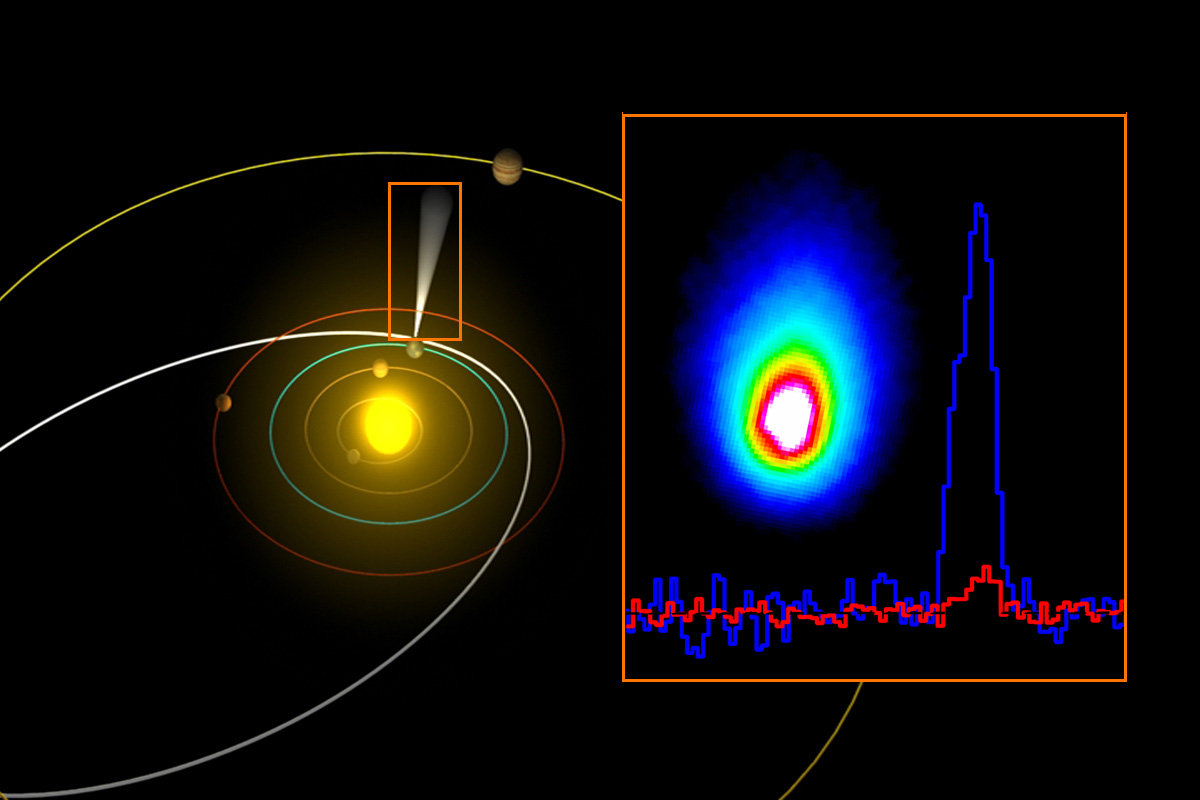
Comet Hartley 2 observed by ESA’s Herschel
This illustration shows the orbit of comet Hartley 2 in relation to those of the five innermost planets of the Solar System. The comet made its latest close pass of Earth on 20 October, coming to 19.45 million km. On this occasion, Herschel observed the comet. The inset on the right side shows the image obtained with Herschel’s PACS instrument. The two lines are the water data from HIFI instrument. Credits: ESA/AOES Medialab; Herschel/HssO Consortium. HI-RES JPEG (Size: 168 kb)

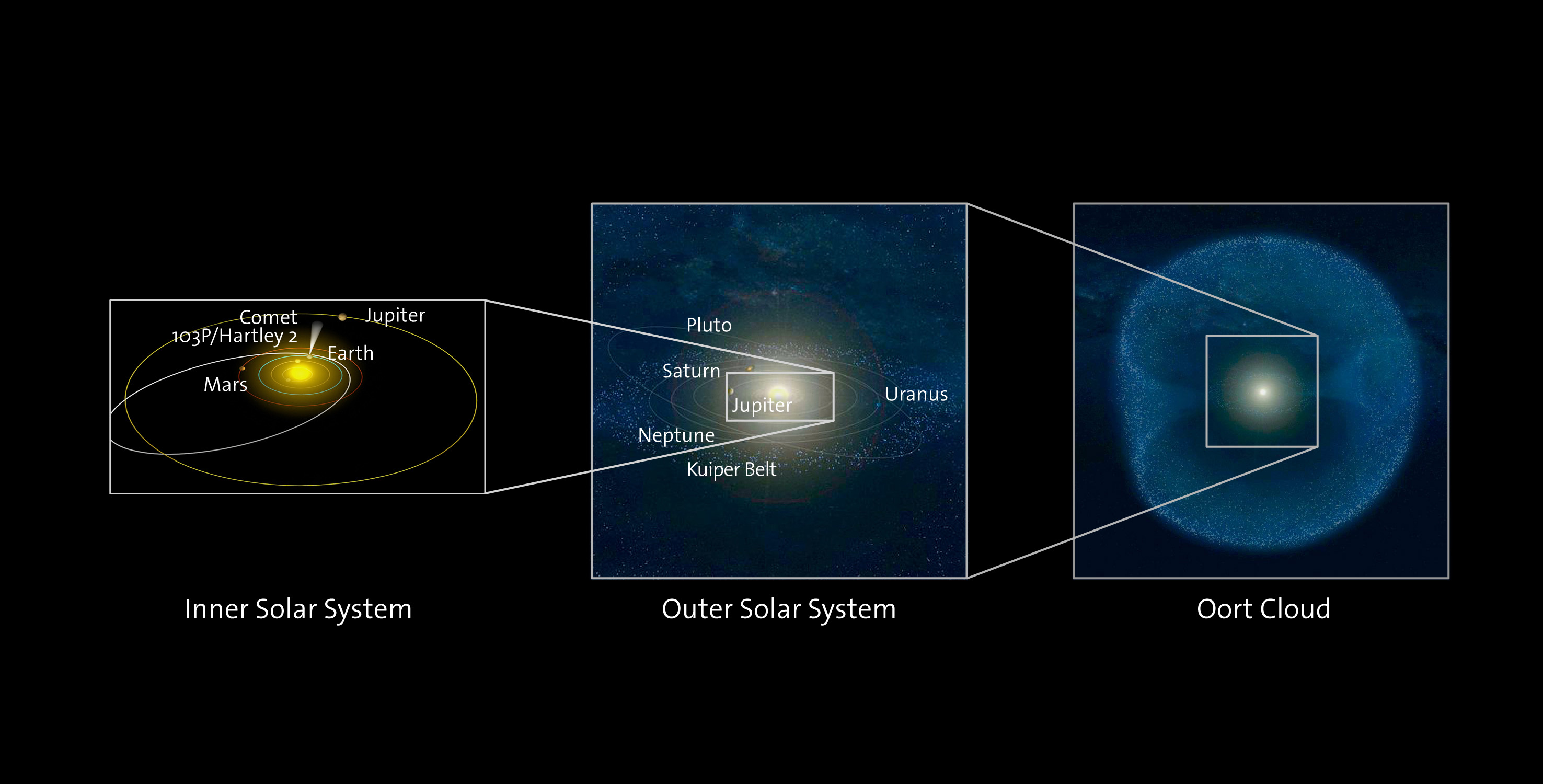
Comet Hartley 2’s orbit in context
The left panel shows Comet Hartley 2’s orbit. The central panel shows a larger portion of the Solar System, including the Kuiper Belt. The Kuiper Belt is one of the two main reservoirs of comets in the Solar System. Comets like Hartley 2 are believed to have formed here and to have migrated inwards. The right panel shows the Oort Cloud, the other main reservoir of comets located well beyond the outer Solar System. Credits: ESA/AOES Medialab. HI-RES JPEG (Size: 458 kb)

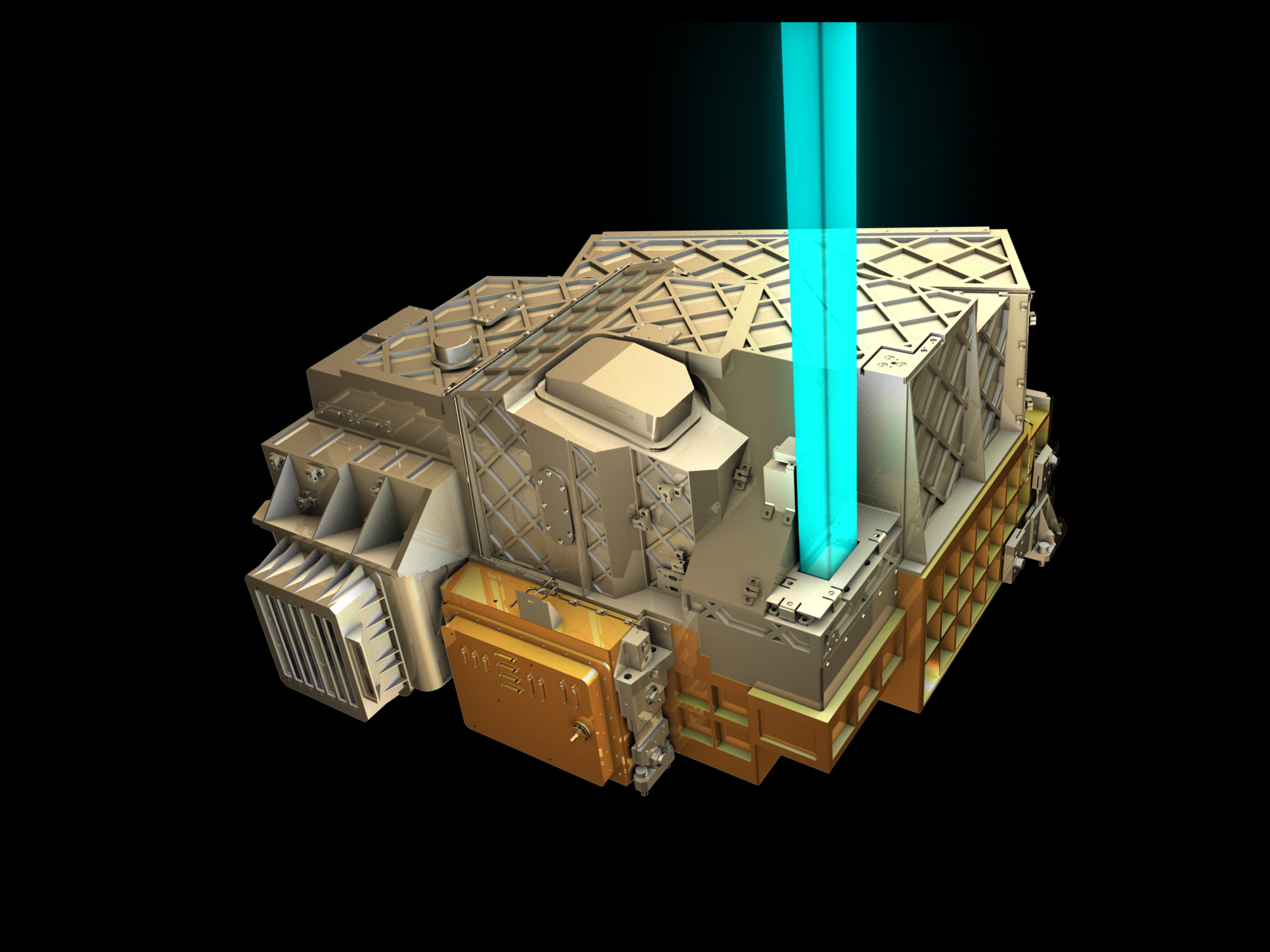
The Heterodyne Instrument for the Far Infrared (HIFI) is a high-resolution heterodyne spectrometer. It works by mixing the incoming signal with a stable monochromatic signal, generated by a local oscillator, and extracting the frequency difference for further processing in a spectrometer. HIFI will have seven separate local oscillators covering two bands from 480-1250 gigaHertz and 1410–1910 gigaHertz. HIFI was developed by a consortium led by SRON (Groningen, The Netherlands). Credits: ESA (image by C. Carreau). HI-RES JPEG (Size: 1020 kb)

ESA's Herschel infrared space observatory has found water in a comet with almost exactly the same composition as Earth's oceans. The discovery revives the idea that our planet's seas could once have been giant icebergs floating through space.

The origin of Earth's water is hotly debated. Our planet formed at such high temperatures that any original water must have evaporated. Yet today, two-thirds of the surface is covered in water and this must have been delivered from space after Earth cooled down.

Comets seem a natural explanation: they are giant icebergs travelling through space with orbits that take them across the paths of the planets, making collisions possible. The impact of comet Shoemaker-Levy 9 on Jupiter in 1994 was one such event. But in the early Solar System, when there were larger numbers of comets around, collisions would have been much more common.

However, until now, astronomers' observations have failed to back up the idea that comets provided Earth's water. The key measurement they make is the level of deuterium – a heavier form of hydrogen – found in water.

All the deuterium and hydrogen in the Universe was made just after the Big Bang, about 13.7 billion years ago, fixing the overall ratio between the two kinds of atoms. However, the ratio seen in water can vary from location to location. The chemical reactions involved in making ice in space lead to a higher or lower chance of a deuterium atom replacing one of the two hydrogen atoms in a water molecule, depending on the particular environmental conditions.

Thus, by comparing the deuterium to hydrogen ratio found in the water in Earth's oceans with that in extraterrestrial objects, astronomers can aim to identify the origin of our water.

All comets previously studied have shown deuterium levels around twice that of Earth's oceans. If comets of this kind had collided with Earth, they could not have contributed more than a few percent of Earth's water. In fact, astronomers had begun to think that meteorites had to be responsible, even though their water content is much lower.

Now, however, Herschel has studied comet Hartley 2 using HIFI, the most sensitive instrument so far for detecting water in space, and has shown that at least this one comet does have ocean-like water.

"Comet Hartley's deuterium-to-hydrogen ratio is almost exactly the same as the water in Earth's oceans," says Paul Hartogh, Max-Planck-Institut für Sonnensystemforschung, Katlenburg-Lindau, Germany, who led the international team of astronomers in this work.

The key to why comet Hartley 2 is different may be because of where it was born: far beyond Pluto, in a frigid region of the Solar System known as the Kuiper Belt.

The other comets previously studied by astronomers are all thought to have formed near to Jupiter and Saturn before being thrown out by the gravity of those giant planets, only to return much later from great distances.

Thus the new observations suggest that perhaps Earth's oceans came from comets after all – but only a specific family of them, born in the outer Solar System. Out there in the deep cold, the deuterium to hydrogen ratio imprinted into water ice might have been quite different from that which arose in the warmer inner Solar System.

Herschel is now looking at other comets to see whether this picture can be backed up.

"Thanks to this detection made possible by Herschel, an old, very interesting discussion will be revived and invigorated," says Göran Pilbratt, ESA Herschel Project Scientist.

"It will be exciting to see where this discovery will take us."

Contact for further information:

Markus Bauer ESA Science and Robotic Exploration Communication Officer Email: markus.bauer@esa.int
Tel: +31 71 565 6799 Mob: +31 61 594 3 954

Paul Hartogh
Max-Planck-Institut für Sonnensystemforschung
Tel: +49 5556 979 342
Email: hartogh@mps.mpg.de

Göran Pilbratt
ESA Herschel Project Scientist
Tel: +31 71 565 3621
Email: gpilbratt@rssd.esa.int

Notes to editors
Ocean-like water in the Jupiter-family comet 103P/Hartley 2 by Paul Hartogh et al. is published online today DOI: 10.1038/nature10519 - http://dx.doi.org/10.1038/nature10519.

Herschel studied comet Hartley on 17 November 2010 using the Heterodyne Instrument for the Far Infrared (HIFI).

Closer to the Sun than ever

Solar Flare (Credits: NASA SDO)
Large Image

Scientists in Potsdam are preparing for the start of ESA’s “Solar Orbiter” mission

On 4 October 2011 the European Space Agency (ESA) has selected the Solar Orbiter mission for implementation. This spacecraft will investigate how the Sun influences its environment with the launch date planned for 2017. The Leibniz Institute for Astrophysics Potsdam (AIP) contributes with instrumentation for this mission.

AIP scientists and engineers are designing the imager, a 55 cm long telescope tube, for the remote sensing X-ray telescope STIX (“Spectrometer/Telescope for Imaging X-rays”). STIX is built by a collaboration of institutes from France, Poland, Czech Republic, Ireland, Austria, and Italy, led by Switzerland. The AIP is the only German institute in the STIX team.

Solar Orbiter will approach and revolve around the Sun at a distance of only a quarter of our Earth’s orbit. It will commence data acquisition after a three years cruise phase. This mission will enable the scientists for the first time to co-rotate with the Sun and observe the same spot for an extended period of time. These observations will lead to a deeper understanding of the evolution of sunspots, solar flares and the solar magnetic field.

The solar physicists at AIP are interested particularly in energetic particles that are released during solar flares. Therefore, in collaboration with the Christian-Albrechts-Universität in Kiel, AIP builds electronic components for the particle detector suite EPD (Energetic Particle Detector). The solar wind, solar flares and coronal mass ejections are parts of space weather, which has an important impact on Earth, our climate, and our technologically advanced civilization.

Equipped with numerous instruments, from a very close and unique perspective, Solar Orbiter will try to answer many of the still open questions of solar physics. Indeed, Solar Orbiter is expected to open a new chapter in solar science.


Images and Video

Image #1: An image of the Sun taken by SDO on October 4, 2011. The fine structures visible in the million degree Celsius corona are formed by constantly changing magnetic field lines (Credits: NASA SDO) - http://sdo.gsfc.nasa.gov/assets/img/browse/2011/10/04/20111004_001456_4096_0193.jpg

Image #2: A moderately strong flare observed on September 25, 2011. A plasma cloud had been ejected into space but a big fraction of it fell back to the Sun (Credits: NASA SDO) - ftp://sohoftp.nascom.nasa.gov/incoming/steele/SDO/304flare_Sept.tif

Image #3: The X-ray telescope STIX consists of a telescope tube and the detector electronics module behind it. The fine tungsten grids provide high energy and angular resolution.

Contact: Science Contact: Prof. Dr. Gottfried Mann (PI) Leibniz-Institut für Astrophysik Potsdam (AIP) Tel. +49-331-7499-292
Dr. Hakan Önel Leibniz-Institut für Astrophysik Potsdam (AIP) Tel. +49-331-7499-261 email: honel@aip.de


Press Contact:

Dr. Gabriele Schönherr,
Tel.: +49-331-7499-383


Kerstin Mork,
Tel.: +49-331-7499-469

Leibniz-Institut für Astrophysik Potsdam (AIP)

email:
presse@aip.de

***

The key topics of the Leibniz Institute for Astrophysics are cosmic magnetic fields and extragalactic astrophysics. A considerable part of the institute's efforts aim at the development of research technology in the fields of spectroscopy, robotic telescopes, and e-science. The AIP is the successor of the Berlin Observatory founded in 1700 and of the Astrophysical Observatory of Potsdam founded in 1874. The latter was the world's first observatory to emphasize explicitly the research area of astrophysics.The AIP is a foundation according to civil law and is a member of the Leibniz Association. The Leibniz Association is a network of 87 independent research institutes and scientific service facilities, which strive for scientific solutions for major social challenges.

Tuesday, October 04, 2011

The Most Distant and Ancient Supernovae in the Young Universe

Figure 1: The type Ia supernova in the inset above, one of 150 in the full sample, exploded some 10 billion years ago and is one of the oldest and farthest type Ia supernovae observed to date. Except for a handful of stars, all of the objects in the above image are galaxies. (Click image to enlarge.)

Figure 2: This image shows 22 out of 150 supernovae, only 10% of the Subaru Deep Field. With the exception of a few nearby Milky Way stars, each point of light in the image is a galaxy, which consists of tens of billions of stars. Every triplet of frames focuses on different aspects of one event: the galaxy before the explosion; with the supernova in progress; and isolation of light from the supernova, as shown in a digital "difference image."


A team of Japanese, Israeli, and U.S. astronomers used the Subaru Telescope to assemble the largest sample ever found of the most distant exploding stars called supernovae, which emitted their light about ten billion years ago, long before the Earth was formed. The researchers used this sample of ancient supernovae to determine how frequently such explosions of stars occurred in the young universe.

Supernovae have substantial importance in astrophysics. They are nature's element factories: essentially all of the elements in the periodic table that are heavier than oxygen were formed through nuclear reactions immediately preceding and during these colossal explosions. The explosions fling these elements into interstellar space, where they serve as raw materials for new generations of stars and planets. Thus, the atoms in our bodies, like the calcium atoms in our bones or the iron atoms in our blood, were created in supernovae. By tracking the frequency and types of supernova explosions back through cosmic time, astronomers can reconstruct the universe's history of element creation, from the plain mix of hydrogen and helium that existed for the first billion years or so after the Big Bang, up to the elemental richness we see today.

However, looking back in time requires looking out to great distances, which means that even these bright explosions are exceedingly faint and difficult to spot. To overcome this obstacle, the team took advantage of a combination of the Subaru Telescope's assets: the huge light-collecting power of its large 8.2 meter primary mirror; the sharpness of its images, and the wide field of view of its prime focus camera (Suprime-Cam). On four separate occasions, they pointed the telescope toward one single field called the Subaru Deep Field, which spans an area of the sky similar to that covered by the full moon and had previously been studied in great detail by Subaru scientists. By "staring" with the telescope at this single field, they let the faint light from the most distant galaxies and supernovae accumulate over several nights at a time, thus forming a very long and deep exposure of the field. Each of the four observations caught about 40 supernovae in the act of exploding among the 150,000 galaxies in the field. Altogether, the team discovered 150 explosions, including a dozen that rank among the most distant and ancient ever seen.

The team's analysis of the data showed that supernovae of the so-called "thermonuclear" type were exploding about five times more frequently in the young universe, about ten billion years ago, than they do today. Thermonuclear supernovae, often called Type-Ia supernovae, are one of the main sources of the element iron in the universe. Equally important, these explosions have served as cosmic distance markers for astronomers. Over the past decade, they have revealed that the expansion of the universe, in which all galaxies are receding from each other, is actually accelerating under the influence of mysterious dark energy. However, the nature of the thermonuclear supernovae themselves is poorly understood, and there has been fierce debate about the identity of the pre-explosion stars or stellar systems. By revealing the range of the ages of the stars that explode in this way, the team's new findings provide some important clues to solving this mystery. The results correspond closely to a scenario in which a thermonuclear supernovae is the outcome of the merger of a pair of compact stellar remnants called white dwarfs. Future observations with the next-generation Subaru imaging camera, Hyper Suprime-Cam, will permit the discovery of even larger and more distant supernova samples, and allow for further testing of this conclusion.

The results are described in a paper by Graur et al. in the October 2011 issue of the Monthly Notices of the Royal Astronomical Society. The title is "Supernovae in the Subaru Deep Field: the rate and delay-time distribution of type Ia supernovae out to redshift 2".

Team members:

O. Graur (Tel-Aviv University,Israel)
D. Poznanski (LBNL, UC Berkeley, USA; Tel-Aviv University, Israel)
D. Maoz (Tel-Aviv University,Israel)
N. Yasuda (University of Tokyo, Japan)
T. Totani (Kyoto University, Japan)
M. Fukugita (University of Tokyo, Japan)
A. V. Filippenko (UC Berkeley, USA)
R. J. Foley (Harvard/Smithsonian Center for Astrophysics, USA)
J. M. Silverman (UC Berkeley, USA)
A. Gal-Yam (Weizmann Institute of Science, Israel)
A. Horesh (Tel-Aviv University, Israel; Caltech, USA)
B. T. Jannuzi (National Optical Astronomy Observatory, USA)

Monday, October 03, 2011

ALMA Opens Its Eyes

PR Image eso1137a
Antennae Galaxies composite of ALMA and Hubble observations

PR Image eso1137b
Antennae Galaxies composite of ALMA and Hubble observations

PR Image eso1137c
ALMA view of the Antennae Galaxies

PR Image eso1137d
Antennae Galaxies, side-by-side comparison of ALMA and VLT observations

PR Image eso1137e
The Antennae Galaxies in the constellation of Corvus

PR Image eso1137f
Wide-field view of the region around the Antennae Galaxies

More Images

Nineteen ALMA antennas on the Chajnantor plateau

PR Image eso1137i
ALMA antennas on the Chajnantor Plateau, seen from nearby Cerro Toco

Videos

PR Video eso1137d
Zooming on ALMA’s view of the Antennae Galaxies

PR Video eso1137e
Panning across the ALMA and Hubble views of the Antennae Galaxies (crossfade)

PR Video eso1137f
Panning across the ALMA and Hubble views of the Antennae Galaxies

The full release, images and videos are available on:
http://www.eso.org/public/news/eso1137/

The most powerful millimetre/submillimetre-wavelength telescope in the world opens for business and reveals its first image


Humanity's most complex ground-based astronomy observatory, the Atacama Large Millimeter/submillimeter Array (ALMA), has officially opened for astronomers. The first released image, from a telescope still under construction, reveals a view of the Universe that cannot be seen at all by visible-light and infrared telescopes. Thousands of scientists from around the world have competed to be among the first few researchers to explore some of the darkest, coldest, furthest, and most hidden secrets of the cosmos with this new astronomical tool.

At present, around a third of ALMA’s eventual 66 radio antennas, with separations up to only 125 metres rather than the maximum 16 kilometres, make up the growing array on the Chajnantor plateau in northern Chile, at an elevation of 5000 metres. And yet, even under construction, ALMA has become the best telescope of its kind — as reflected by the extraordinary number of astronomers who requested time to observe with ALMA.

“Even in this very early phase ALMA already outperforms all other submillimetre arrays. Reaching this milestone is a tribute to the impressive efforts of the many scientists and engineers in the ALMA partner regions around the world who made it possible,” said Tim de Zeeuw, Director General of ESO, the European partner in ALMA.

ALMA observes the Universe in light with millimetre and submillimetre wavelengths, roughly one thousand times longer than visible-light wavelengths. Using these longer wavelengths allows astronomers to study extremely cold objects in space — such as the dense clouds of cosmic dust and gas from which stars and planets form — as well as very distant objects in the early Universe.

ALMA is radically different from visible-light and infrared telescopes. It is an array of linked antennas acting as a single giant telescope, and it detects much longer wavelengths than those of visible light. Its images therefore look quite unlike more familiar pictures of the cosmos.

The ALMA team has been busy testing the observatory’s systems over the past few months, in preparation for the first round of scientific observations, known as Early Science. One outcome of their tests is the first image published from ALMA, albeit from what is still very much a growing telescope. Most of the observations used to create this image of the Antennae Galaxies were made using only twelve antennas working together — far fewer than will be used for the first science observations — and with the antennas much closer together as well. Both of these factors make the new image just a taster of what is to come. As the observatory grows, the sharpness, efficiency, and quality of its observations will increase dramatically as more antennas become available and the array grows in size [1].

The Antennae Galaxies are a pair of colliding galaxies with dramatically distorted shapes. While visible light shows us the stars in the galaxies, ALMA’s view reveals something that cannot be seen in visible light: the clouds of dense cold gas from which new stars form [2]. This is the best submillimetre-wavelength image ever made of the Antennae Galaxies.

Massive concentrations of gas are found not only in the hearts of the two galaxies but also in the chaotic region where they are colliding. Here, the total amount of gas is billions of times the mass of our Sun — a rich reservoir of material for future generations of stars. Observations like these open a new window on the submillimetre Universe and will be vital in helping us understand how galaxy collisions can trigger the birth of new stars. This is just one example of how ALMA reveals parts of the Universe that cannot be seen with visible-light and infrared telescopes.

ALMA could accept only about a hundred or so projects for this first nine-month phase of Early Science. Nevertheless, over the last few months, keen astronomers from around the world have submitted over 900 proposals for observations. This ninefold level of oversubscription is a record for a telescope. The successful projects were chosen based on their scientific merit, their regional diversity, and also their relevance to ALMA’s major science goals.

"We are living in a historic moment for science and particularly for astronomy, and perhaps also for the evolution of humanity, because we start to use the greatest observatory under construction at the moment," said Thijs de Graauw, Director of ALMA.

One of the projects chosen for ALMA Early Science observations was that of David Wilner from the Harvard–Smithsonian Center for Astrophysics in Cambridge, Massachusetts, USA. Wilner said, “My team hunts for the building blocks of solar systems, and ALMA is uniquely equipped to spot them.”

His team’s target is AU Microscopii, a star 33 light-years away that is only 1% of the age of our Sun. “We will use ALMA to image the ‘birth ring’ of planetesimals that we believe orbits this young star. Only with ALMA, however, can we hope to discover clumps in these dusty asteroid belts, which can be the markers of unseen planets.” Wilner and his team will share their data with a European team who also requested ALMA observations of this nearby, dust-ringed star.

Any hunt for habitable planets around other stars often begins with a hunt for water in those distant solar systems. Debris discs, the swarms of dust, gas, and rocks around stars, are suspected also to contain craggy ice chunks filled with frozen water, gas, and possibly even organic molecules — the astrochemistry of life.

Simon Casassus, from the University of Chile, and his team will use ALMA to observe the gas and dust disc around HD142527, a young star that is 400 light-years away. “The dusty disc around this star has a very large gap, which may have been carved by the formation of giant planets,” said Casassus. “Outside the gap, this disc contains enough gas to make about a dozen Jupiter-sized planets. Inside the gap, a young gaseous giant planet could still be forming, if there is gaseous material available.” Their ALMA observations will measure the mass and physical conditions of gas interior to the gap. “Thus, ALMA gives us a chance to observe planet formation, or its most recent wake,” said Casassus.

Further away, 26 000 light-years from us in the centre of our galaxy, sits Sagittarius A*, a supermassive black hole four million times the mass of our Sun. Gas and dust between it and us hide it from our optical telescopes. However, ALMA is tuned to see through the galactic murk and give us tantalising views of Sagittarius A*.

Heino Falcke, an astronomer at Radboud University Nijmegen in the Netherlands, said “ALMA will let us watch flares of light coming from around this supermassive black hole, and make images of the gas clouds caught by its immense pull. This will let us study this monster’s messy feeding habits. We think that some of the gas may be escaping its grip, at close to the speed of light.”

Like the black outlines in a child’s colouring book, cosmic dust and cold gas trace out structures inside galaxies, even if we can’t see those galaxies clearly. At the outer fringes of our visible Universe lie the mysterious starburst galaxies, bright islands in an otherwise calm, dark cosmos. ALMA will hunt for cold gas and dust tracers here, as far back as a few hundred million years after the Big Bang, at a time astronomers call “cosmic dawn”.

Masami Ouchi of the University of Tokyo in Japan will use ALMA to observe Himiko, a very distant galaxy churning out at least 100 Suns’ worth of stars every year and surrounded by a giant, bright nebula. “Other telescopes cannot show us why Himiko is so bright and how it has developed such a huge, hot nebula when the ancient Universe all around it is so calm and dark,” said Ouchi. “ALMA can show us the cold gas deep in Himiko’s star-forming nebula, tracing the movements and activities inside, and we will finally see how galaxies started forming at the cosmic dawn.”

During its Early Science observations, ALMA will continue its construction phase in the Chilean Andes, high on the remote Chajnantor Plain in the harsh Atacama Desert. Each new, climate-armoured antenna will join the array and be linked via fibre optic cabling. The views from each distant antenna are assembled into one large view by one of the world’s fastest special-purpose supercomputers, the ALMA correlator, which can perform 17 quadrillion [3] operations per second.

By 2013, ALMA will be an up to 16-km wide array of 66 ultra-precision millimetre/submillimetre wave radio antennas working together as one telescope and built by ALMA’s multinational partners in Europe, North America and East Asia.

The Atacama Large Millimeter/submillimeter Array (ALMA), an international astronomy facility, is a partnership of Europe, North America and East Asia in cooperation with the Republic of Chile. ALMA is funded in Europe by the European Southern Observatory (ESO), in North America by the U.S. National Science Foundation (NSF) in cooperation with the National Research Council of Canada (NRC) and the National Science Council of Taiwan (NSC) and in East Asia by the National Institutes of Natural Sciences (NINS) of Japan in cooperation with the Academia Sinica (AS) in Taiwan. ALMA construction and operations are led on behalf of Europe by ESO, on behalf of North America by the National Radio Astronomy Observatory (NRAO), which is managed by Associated Universities, Inc. (AUI) and on behalf of East Asia by the National Astronomical Observatory of Japan (NAOJ). The Joint ALMA Observatory (JAO) provides the unified leadership and management of the construction, commissioning and operation of ALMA.

Notes

[1] The quality of images from an interferometric telescope like ALMA depends on both the separations and the number of the antennas. Larger separations mean that sharper images can be created and if more antennas are working together more detailed images can be produced. More information about ALMA and interferometry can be found at: http://www.eso.org/public/teles-instr/alma/interferometry.html.

[2] The observations were made at specific wavelengths of millimetre and submillimetre light, tuned to detect carbon monoxide molecules in the otherwise invisible hydrogen clouds, where new stars are forming.

[3] 1.7x10¹⁶ operations per second.

More information

ESO, the European Southern Observatory, is the foremost intergovernmental astronomy organisation in Europe and the world’s most productive astronomical observatory. It is supported by 15 countries: Austria, Belgium, Brazil, the Czech Republic, Denmark, France, Finland, Germany, Italy, the Netherlands, Portugal, Spain, Sweden, Switzerland and the United Kingdom. ESO carries out an ambitious programme focused on the design, construction and operation of powerful ground-based observing facilities enabling astronomers to make important scientific discoveries. ESO also plays a leading role in promoting and organising cooperation in astronomical research. ESO operates three unique world-class observing sites in Chile: La Silla, Paranal and Chajnantor. At Paranal, ESO operates the Very Large Telescope, the world’s most advanced visible-light astronomical observatory and two survey telescopes. VISTA works in the infrared and is the world’s largest survey telescope and the VLT Survey Telescope is the largest telescope designed to exclusively survey the skies in visible light. ESO is the European partner of a revolutionary astronomical telescope ALMA, the largest astronomical project in existence. ESO is currently planning a 40-metre-class European Extremely Large optical/near-infrared Telescope, the E-ELT, which will become “the world’s biggest eye on the sky”.

Links

ESO ALMA pages
Pictures of ALMA
JAO’s ALMA web pages
NRAO’s ALMA web pages
NAOJ’s ALMA web pages

Contacts

Paola Andreani
European ARC Manager, ESO
Garching, Germany
Tel: +49 89 3200 6576
Email: pandrean@eso.org

Douglas Pierce-Price
ESO Public Information Officer
Garching, Germany
Tel: +49 89 3200 6759
Email: dpiercep@eso.org

Lars-Åke Nyman
Head of Science Operations, Joint ALMA Observatory
Santiago, Chile
Tel: +56 2 467 6127
Email: lnyman@alma.cl

William Garnier
Education and Public Outreach Officer, Joint ALMA Observatory
Santiago, Chile
Tel: +56 2 467 6119
Email: wgarnier@alma.cl

Mark McKinnon
North American ALMA Project Manager
USA
Tel: +1 434-296-0229
Email: mmckinno@nrao.edu

Tania Burchell
Science Writer, National Radio Astronomy Observatory
Charlottesville, USA
Tel: +1 434 244 6812
Email: tburchel@nrao.edu

Sachiko K. Okumura
East Asian ARC Manager, National Astronomical Observatory of Japan
Japan
Tel: +81 422 34 3782
Email: sachiko.k.okumura@nao.ac.jp

Masaaki Hiramatsu
Education & Public Outreach Officer, National Astronomical Observatory of Japan
Japan
Tel: +81 422 34 3900 ext.3150
Email: hiramatsu.masaaki@nao.ac.jp


Friday, September 30, 2011

An Arc Sculpted by Gravity

LRG-4-606
Credit: ESA/Hubble & NASA

This NASA/ESA Hubble Space Telescope image shows remarkable structures in a galaxy cluster around an object called LRG-4-606. LRG stands for Luminous Red Galaxy, and is the acronym given to a large collection of bright red galaxies found in the Sloan Digital Sky Survey (SDSS). These objects are mostly massive elliptical galaxies composed of huge numbers of old stars.

It is sobering to contemplate the sheer number of stars that this image must contain — hundreds of billions — but it also features one of the strangest phenomena known to astronomers. This particular red galaxy and its surrounding galaxies happen to be positioned so that their strong gravitational field has a dramatic effect.
Left of centre in the picture, blue galaxies in the background have been stretched and warped out of shape into narrow, pale blue arcs. This is because of an effect called gravitational lensing. The galaxy cluster has such a strong gravitational field that it is curving the fabric of space and amplifying the starlight from much more distant galaxies. Gravitational lensing normally creates elongated arcs and here, unusually, the alignment of the galaxies has made the separate arcs combine to form a half-circle.

This picture was assembled from a collection of exposures in visible and near infrared light taken with Hubble’s Wide Field Camera 3. The field of view is approximately 3 by 3 arcminutes.