Showing posts with label Comet Hartley 2. Show all posts

Thursday, June 27, 2013

Herschel sheds light on role of water

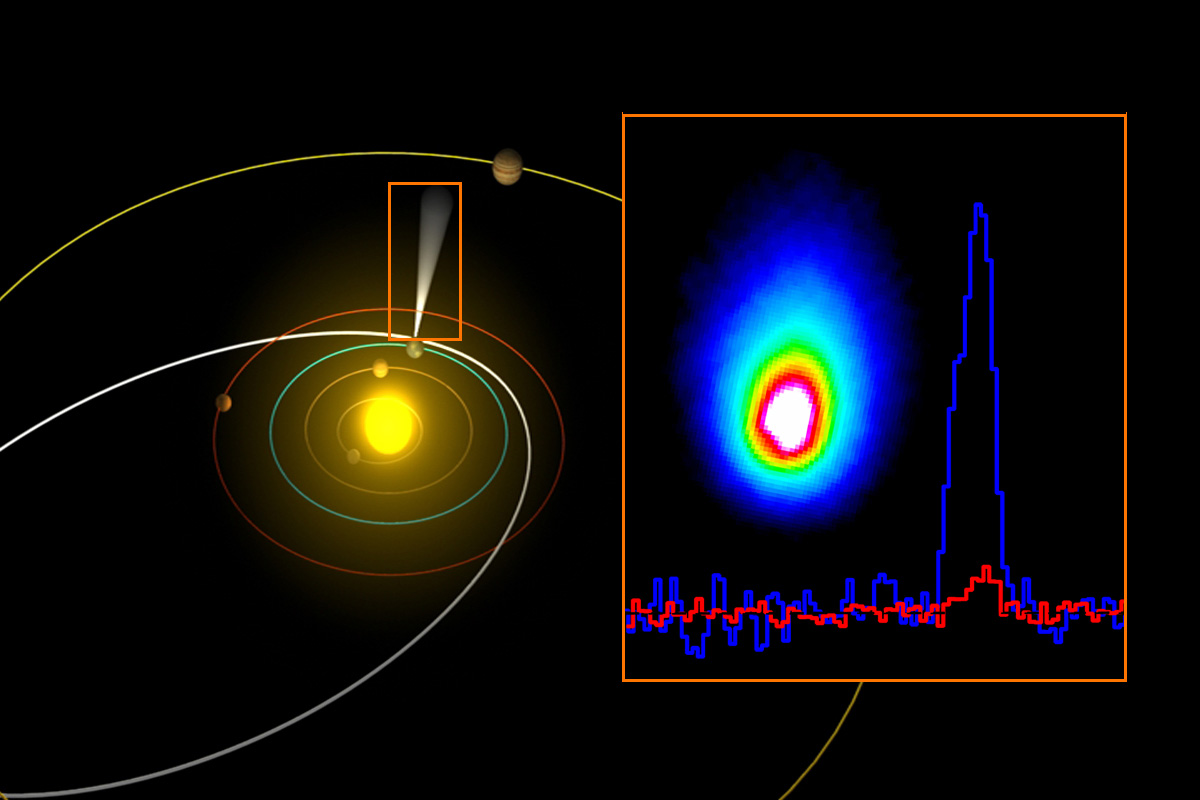
The location of Comet Hartley 2 and the Herschel image of it (inset). 
Click here for more information. Image Credit: ESA/NASA/Herschel/HSSO

Artist's impression of the disc of gas and dust around the star TW Hydrae. 
Click here for more information. Image credit: ESA/NASA/JPL-Caltech/WISH 

One of the most interesting molecules that astronomers like to study is water, which is so abundant on the Earth and though to be crucial for life. Water can form relatively easily, providing the temperature is not too high, and the outer regions of our own Solar system are full of icy bodies. Observations of water are very hard to observed from the Earth as the atmosphere interferes with the measurements, and so studying water requires spacecraft. Far from Earth, the HIFI instrument on board Herschel is studying the role of water in not just our own Solar System, but also in others.

In late 2010 the comet Hartley 2 passed relatively close to Earth, though it has not always ventured this close to the Sun. Hartley 2 originated in an outer region of the Solar System called the Kuiper Belt, but was put on an orbit that brings it in to the inner Solar System after encounters with planets and other large bodies. The HIFI instrument onboard Herschel measured the composition of the water in the comet, and found that it is very similar to that of the water in the Earth's oceans.

The idea that comets seeded the water on Earth has been a favourite among many astronomers for decades, as there are few other ways to explain where the water came from. However the composition of the water in most of the comets studied doesn't match that of the ocean water, and this has long been a thorn in the side of the proponents of the idea. Most of these comets formed relatively close to the Sun, around where Jupiter orbits, but Hartley 2 is the first comet to be investigated that formed much further out. The fact that the composition of the water in Hartley 2 is so similar lends further weight to the theory that comets seeded our oceans, though perhaps it was mainly this particular type of comet that did the seeding.

HIFI is sensitive enough to look at the material orbiting other stars, such as TW Hydrae in the constellation of Hydra. This star is a little less massive than the Sun but which is much, much younger. At only 10 million years old, TW Hydrae is still in its adolescent years, and has a disc of gas and dust around it. It is thought that our own Sun would have started out like this, with the planets forming after tens or hundreds of millions of years.

TW Hydrae is 175 light years away from the Sun, far too distant for any of Herschel's instruments to see in detail. The sensitivity of the HIFI instrument allows it to detect the faint signature of water vapour, and a careful study of the signature allows astronomers to work out the temperature of the water vapour and where it is in the disk. The water vapour is stripped from grains of ice by the light from the star, but is found at temperatures below 100 K (-170 Celsius). This is much colder than has been found previously around other stars, and indicates that the water vapour is present throughout the disc.

Water plays a crucial role in planetary systems, as it allows grains of dust to clump together and form asteroids, which later collect together to form the planets. Studying the presence of water, and the conditions in which it is found, is vital for understanding how Solar Systems such as our own formed.


Wednesday, October 05, 2011

Did Earth's oceans come from comets?

Comet Hartley 2 observed by ESA’s Herschel
This illustration shows the orbit of comet Hartley 2 in relation to those of the five innermost planets of the Solar System. The comet made its latest close pass of Earth on 20 October, coming to 19.45 million km. On this occasion, Herschel observed the comet. The inset on the right side shows the image obtained with Herschel’s PACS instrument. The two lines are the water data from HIFI instrument. Credits: ESA/AOES Medialab; Herschel/HssO Consortium. HI-RES JPEG (Size: 168 kb)

Comet Hartley 2’s orbit in context
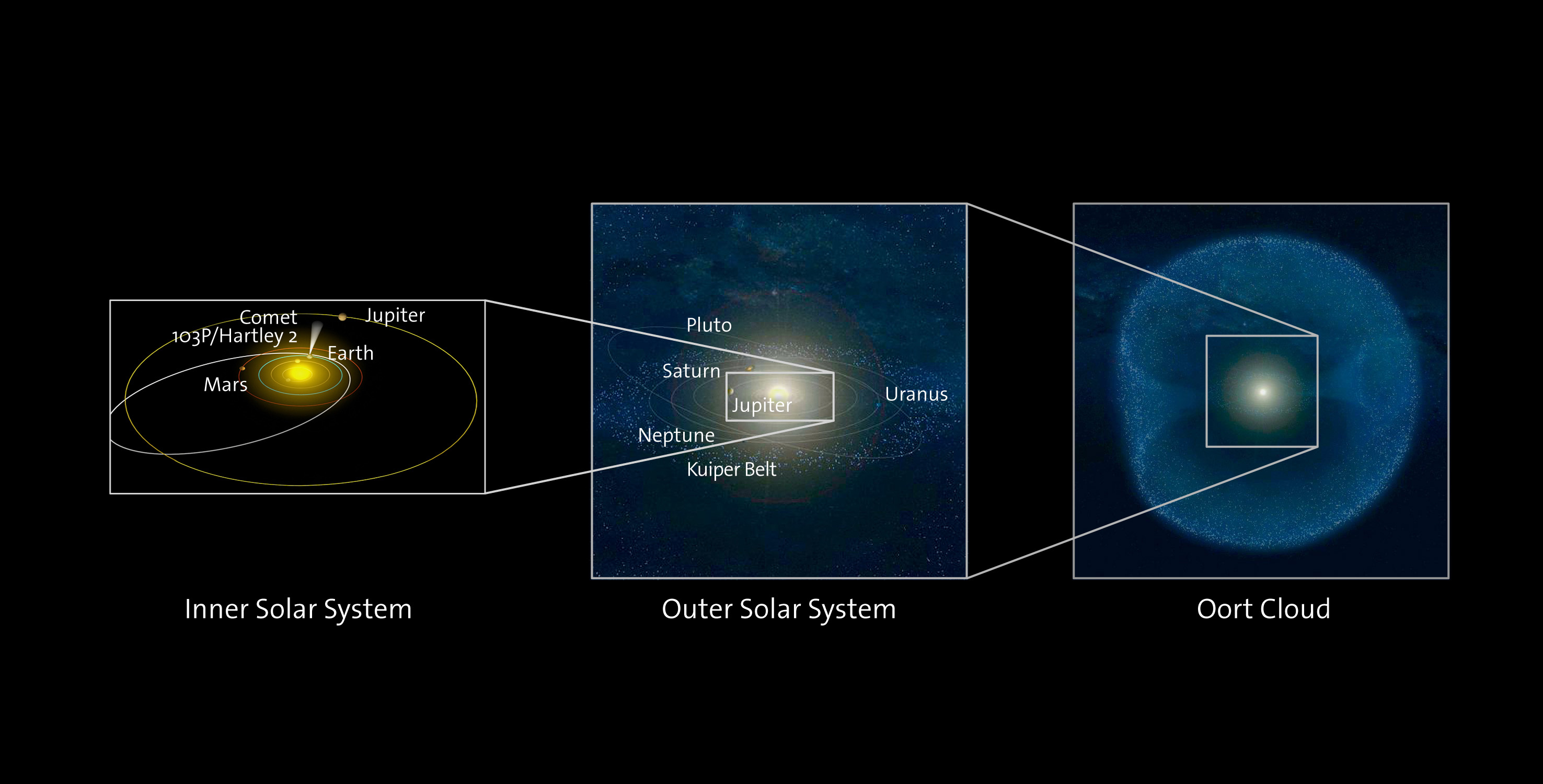
The left panel shows Comet Hartley 2’s orbit. The central panel shows a larger portion of the Solar System, including the Kuiper Belt. The Kuiper Belt is one of the two main reservoirs of comets in the Solar System. Comets like Hartley 2 are believed to have formed here and to have migrated inwards. The right panel shows the Oort Cloud, the other main reservoir of comets located well beyond the outer Solar System. Credits: ESA/AOES Medialab. HI-RES JPEG (Size: 458 kb)

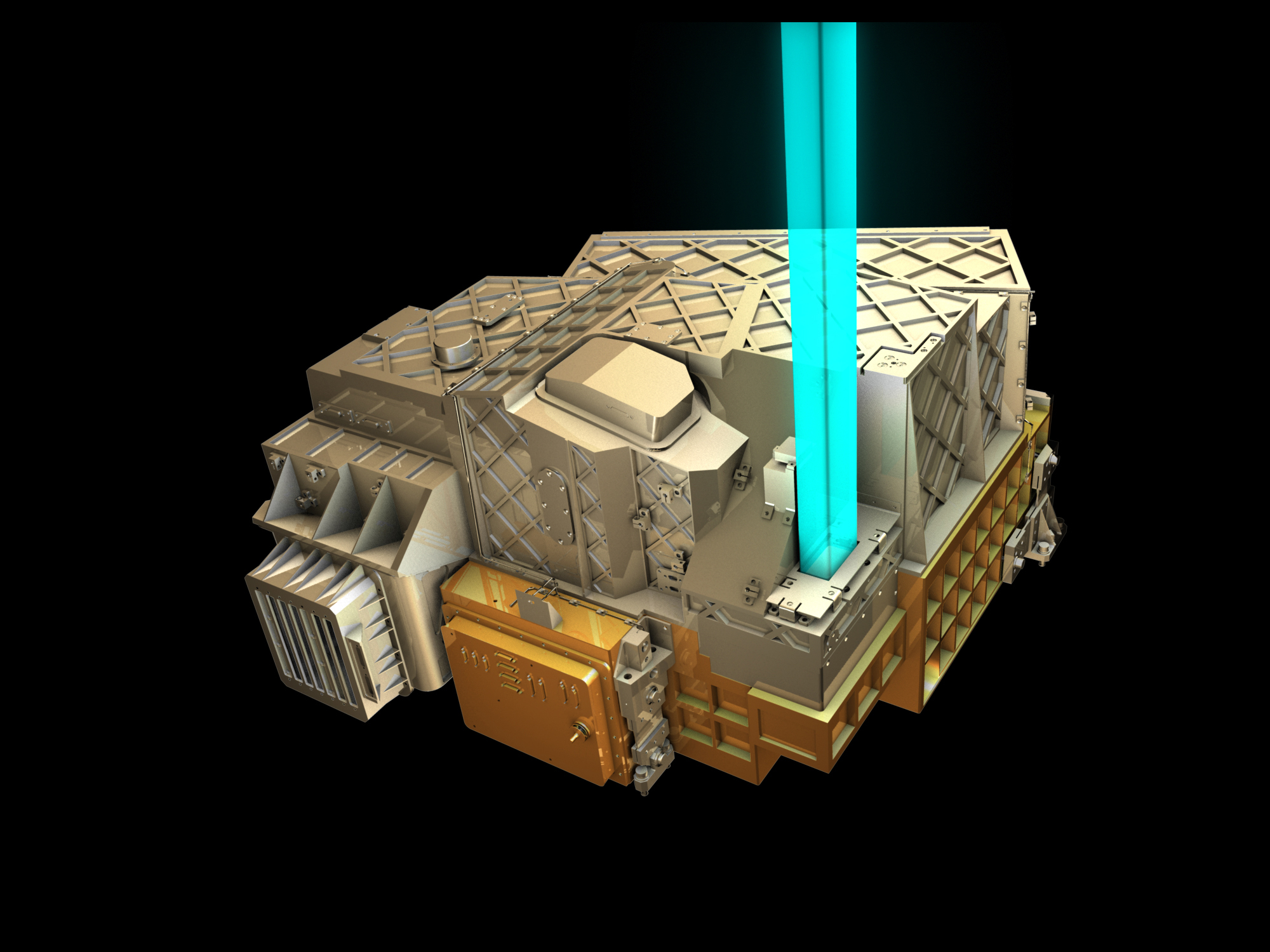
The Heterodyne Instrument for the Far Infrared (HIFI) is a high-resolution heterodyne spectrometer. It works by mixing the incoming signal with a stable monochromatic signal, generated by a local oscillator, and extracting the frequency difference for further processing in a spectrometer. HIFI will have seven separate local oscillators covering two bands from 480-1250 gigaHertz and 1410–1910 gigaHertz. HIFI was developed by a consortium led by SRON (Groningen, The Netherlands). Credits: ESA (image by C. Carreau). HI-RES JPEG (Size: 1020 kb)

ESA's Herschel infrared space observatory has found water in a comet with almost exactly the same composition as Earth's oceans. The discovery revives the idea that our planet's seas could once have been giant icebergs floating through space.

The origin of Earth's water is hotly debated. Our planet formed at such high temperatures that any original water must have evaporated. Yet today, two-thirds of the surface is covered in water and this must have been delivered from space after Earth cooled down.

Comets seem a natural explanation: they are giant icebergs travelling through space with orbits that take them across the paths of the planets, making collisions possible. The impact of comet Shoemaker-Levy 9 on Jupiter in 1994 was one such event. But in the early Solar System, when there were larger numbers of comets around, collisions would have been much more common.

However, until now, astronomers' observations have failed to back up the idea that comets provided Earth's water. The key measurement they make is the level of deuterium – a heavier form of hydrogen – found in water.

All the deuterium and hydrogen in the Universe was made just after the Big Bang, about 13.7 billion years ago, fixing the overall ratio between the two kinds of atoms. However, the ratio seen in water can vary from location to location. The chemical reactions involved in making ice in space lead to a higher or lower chance of a deuterium atom replacing one of the two hydrogen atoms in a water molecule, depending on the particular environmental conditions.

Thus, by comparing the deuterium to hydrogen ratio found in the water in Earth's oceans with that in extraterrestrial objects, astronomers can aim to identify the origin of our water.

All comets previously studied have shown deuterium levels around twice that of Earth's oceans. If comets of this kind had collided with Earth, they could not have contributed more than a few percent of Earth's water. In fact, astronomers had begun to think that meteorites had to be responsible, even though their water content is much lower.

Now, however, Herschel has studied comet Hartley 2 using HIFI, the most sensitive instrument so far for detecting water in space, and has shown that at least this one comet does have ocean-like water.

"Comet Hartley's deuterium-to-hydrogen ratio is almost exactly the same as the water in Earth's oceans," says Paul Hartogh, Max-Planck-Institut für Sonnensystemforschung, Katlenburg-Lindau, Germany, who led the international team of astronomers in this work.

The key to why comet Hartley 2 is different may be because of where it was born: far beyond Pluto, in a frigid region of the Solar System known as the Kuiper Belt.

The other comets previously studied by astronomers are all thought to have formed near to Jupiter and Saturn before being thrown out by the gravity of those giant planets, only to return much later from great distances.

Thus the new observations suggest that perhaps Earth's oceans came from comets after all – but only a specific family of them, born in the outer Solar System. Out there in the deep cold, the deuterium to hydrogen ratio imprinted into water ice might have been quite different from that which arose in the warmer inner Solar System.

Herschel is now looking at other comets to see whether this picture can be backed up.

"Thanks to this detection made possible by Herschel, an old, very interesting discussion will be revived and invigorated," says Göran Pilbratt, ESA Herschel Project Scientist.

"It will be exciting to see where this discovery will take us."

Contact for further information:

Markus Bauer ESA Science and Robotic Exploration Communication Officer Email: markus.bauer@esa.int
Tel: +31 71 565 6799 Mob: +31 61 594 3 954

Paul Hartogh
Max-Planck-Institut für Sonnensystemforschung
Tel: +49 5556 979 342
Email: hartogh@mps.mpg.de

Göran Pilbratt
ESA Herschel Project Scientist
Tel: +31 71 565 3621
Email: gpilbratt@rssd.esa.int

Notes to editors
Ocean-like water in the Jupiter-family comet 103P/Hartley 2 by Paul Hartogh et al. is published online today DOI: 10.1038/nature10519 - http://dx.doi.org/10.1038/nature10519.

Herschel studied comet Hartley on 17 November 2010 using the Heterodyne Instrument for the Far Infrared (HIFI).

Thursday, June 16, 2011

Science Paper Details NASA Epoxi Flyby of Hyper Comet

This image of comet Hartley 2 was taken as NASA’s EPOXI mission flew by around 6:59 a.m. PDT (9:59 a.m. EDT), from a distance of about 435 miles (700 kilometers). credit: NASA/JPL-Caltech/UMD .

A large, diffuse cloud of CN gas surrounds the nucleus of Hartley 2 in this image from NASA's EPOXI mission. The gas forms a cloud of more than 200,000 kilometers (about 124,000 miles) in radius, compared to the comet's size of about 2 kilometers (1.24 miles). Credit: NASA/JPL-Caltech/UMD.

PASADENA, Calif. – Comet Hartley 2's hyperactive state, as studied by NASA's EPOXI mission, is detailed in a new paper published in this week's issue of the journal Science.

After visiting a comet and imaging distant stars for hints of extrasolar planets, you could say the spacecraft used for EPOXI had seen its fair share of celestial wonders. But after about 3.2 billion miles (5.1 billion kilometers) of deep space travel, one final wonder awaited the mission's project and science teams. On Nov. 4, 2010, the EPOXI mission spacecraft flew past a weird little comet called Hartley 2.

"From all the imaging we took during approach, we knew the comet was a little skittish even before flyby," said EPOXI Project Manager Tim Larson of NASA's Jet Propulsion Laboratory in Pasadena, Calif. "It was moving around the sky like a knuckleball and gave my navigators fits, and these new results show this little comet is downright hyperactive."

The EPOXI mission found that the strong activity in water release and carbon dioxide-powered jets did not occur equally in the different regions of the comet. During the spacecraft's flyby of the comet – with closest approach of 431 miles (694 kilometers) – carbon-dioxide-driven jets were seen at the ends of the comet, with most occurring at the small end. In the middle region, or waist of the comet, water was released as vapor with very little carbon dioxide or ice. The latter findings indicate that material in the waist likely came off the ends of the comet and was redeposited.

"Hartley 2 is a hyperactive little comet, spewing out more water than most other comets its size," said Mike A'Hearn, principal investigator of EPOXI from the University of Maryland, College Park. "When warmed by the sun, dry ice -- frozen carbon dioxide -- deep in the comet's body turns to gas jetting off the comet and dragging water ice with it."

Although Hartley 2 is the only such hyperactive comet visited by a spacecraft, scientists know of at least a dozen other comets that also are relatively high in activity for their size and which are probably driven by carbon dioxide or carbon monoxide.

"These could represent a separate class of hyperactive comets," said A'Hearn. "Or they could be a continuum in comet activity extending from Hartley 2-like comets all the way to the much less active, 'normal' comets that we are more used to seeing."

The study provides several new twists in the unfolding story of this small cometary dynamo, including: (1) Hartley 2 has an 'excited state of rotation' because it spins around one axis, but also tumbles around a different axis; and (2) on its larger, rougher ends, the comet's surface is dotted with glittering blocks that can reach approximately 165 feet (50 meters) high and 260 feet (80 meters) wide. The block-like, shiny objects, some as big as one block long and 16 stories tall, appear to be two to three times more reflective than the surface average.

EPOXI was an extended mission that utilized the already "in-flight" Deep Impact spacecraft to explore distinct celestial targets of opportunity. The name EPOXI itself is a combination of the names for the two extended mission components: the extrasolar planet observations, called Extrasolar Planet Observations and Characterization (EPOCh), and the flyby of comet Hartley 2, called the Deep Impact Extended Investigation (DIXI). The spacecraft retained the name "Deep Impact." During its approach, encounter and departure from comet Hartley 2, the spacecraft beamed back more than 117,000 images and spectra.

JPL managed the EPOXI and Deep Impact missions for NASA's Science Mission Directorate, Washington. The EPOXI mission was part of the Discovery Program managed at NASA's Marshall Space Flight Center in Huntsville, Ala. The University of Maryland, College Park, is home to Michael A'Hearn, principal investigator for EPOXI. Drake Deming of NASA's Goddard Space Flight Center, Greenbelt, Md., is the science lead for the EPOXI mission's extrasolar planet observations. The spacecraft was built for NASA by Ball Aerospace & Technologies Corp., Boulder, Colo.

DC Agle 818-393-9011
Jet Propulsion Laboratory, Pasadena, Calif
agle@jpl.nasa.gov

Tuesday, May 17, 2011

At the Heart of Hartley-2, a New Breed of Comet?

Jets spew out ice and carbon dioxide from one end of comet Hartley-2 in this EPOXI image, while water vapor gets released from the middle region. The differences suggest that the comet's core is made of at least two different ices. Ground-based measurements suggest the presence of a third ice. Credit: NASA/JPL-Caltech/UMD

At the heart of every comet lies a remnant of the dawn of the solar system. Or is that remnants? Astronomers don't know, but the answer would give them a clearer picture of exactly how comets were born eons ago at the birth of the Solar System. Did thin tendrils of dust and ice get drawn slowly inward and pack themselves into a single, uniform mass? Or did a hodge-podge of mini-comets come together to form the core for a comet of substance?

For Hartley-2, the answer so far is neither. "We haven't seen a comet like this before," says Michael Mumma of NASA's Goddard Space Flight Center in Greenbelt, Md. "Hartley-2 could be the first of a new breed."

Both data collected by Mumma's team and detailed images of the comet taken by NASA's EPOXI mission reveal that the comet's core is not uniform. "We have evidence of two different kinds of ice in the core, possibly three," says Mumma. "But we can also see that the comet's overall composition is very consistent. So, something subtle is happening. We're not sure what that is."

The researchers observed Hartley-2 six times during the summer, fall and winter of 2010, both before and after the EPOXI mission's Deep Impact spacecraft had its November rendezvous with the comet. Using telescopes perched high in the mountains of Hawaii and Chile, Mumma's team studied the comet's coma—the aura of gas, dust and ice particles that surround the core. The findings of Mumma and his colleagues at Catholic University of America in Washington, D.C., the University of Missouri in St. Louis, the University of Hawaii in Honolulu, the California Institute of Technology in Pasadena, the Max Planck Institute for Solar System Research in Katlenburg-Lindau, Germany, and Rowan University in Glassboro, N.J., are being reported in a special issue of Astrophysical Journal Letters on May 16, 2011

The gases and rocky particles that make up the coma are the clues that astronomers use to deduce what the core is made of, and thus its origin. To see which types of molecules are there, researchers check for telltale signatures in the near-infrared region of light, at wavelengths from 2.9 to 3.8 micrometers. In this way, it's also possible to tell how plentiful each type of molecule is.

Ices in Hartley-2 are mostly made of water, along with traces of many other types of molecules, the team learned. This is in addition to the plentiful carbon dioxide detected in the comet in 1997 by the European Space Agency’s Infrared Space Observatory. Mumma and colleagues paid close attention to the levels of water and seven other molecules that evaporate easily. The molecules remain frozen either on or below the core’s surface until the warming rays of the sun vaporize them; then, they are swept into the coma.

The release of the molecules depends a great deal on exposure to the sun. The researchers knew that in 2009 ground-based observers had detected telltale signs that the core was rotating quickly. So the team was interested in what would happen to the production levels of these molecules as the comet rotated every 18 hours, giving each of its faces a turn to bathe in sunlight. Turns out, they saw something that nobody has seen before.

First of all, they saw the comet's wild side. "The amount of water changed dramatically night by night and even within a single night—in some cases, doubling in that time," says Mumma. But, in truth, Hartley-2 isn't the only comet to get caught being fickle.

What surprised the researchers was this: as the amount of water went up, so did the amounts of the other gases. And as the amount of water went down, the others did, too. "This is the first time anyone has seen an entire suite of these gases change in the same way at the same time," says Mumma.

This result is important for astronomers, he notes, because they often study the gases in a comet's coma one at a time. "But this suggests that if you look at one gas on one night and another the next night, the production rates might change quite a bit. The findings could be different than if you measured the two gases together," he says. "And in the worst case, you could get the wrong idea about the composition of the comet."

Beyond that, Mumma says, "this tells us that the overall composition of the gas in the coma did not change." Taken by itself, this might seem to imply that the core of the comet is uniform. But when the findings of the EPOXI science team are considered, the picture gets more complicated.

"The fact that the gases all vary together is somewhat puzzling, because EPOXI found a large variation in the release of carbon dioxide relative to water," says the head of the EPOXI science team, Michael A'Hearn of the University of Maryland. "At this point the interpretation is pretty speculative."

EPOXI's Deep Impact spacecraft had a rendezvous with the comet in November 2010. The rich images taken then of the comet's surface revealed small, volcano-like "jets" spewing out carbon dioxide gas and water ice at one end. The jets activate when sunlight warms that end of the comet, turning the frozen carbon dioxide (aka dry ice) below the surface into gas that escapes through open holes.

The researchers think that chunks of water ice are glued together in the comet's core by the frozen carbon dioxide, which evaporates before the water ice. "The carbon dioxide gas drags with it chunks of ice, which later evaporate to provide much of the water vapor in the coma," A'Hearn explains.

Researchers had never seen this before. "In other comets that have been visited, most of the water appears to be converted into gas below or at the surface," says A'Hearn. "We have not seen icy grains, or at least, very few, being dragged into the coma."

But the whole core is not made the same way. EPOXI revealed that the carbon dioxide jets are not found at the large end of the comet, and in the middle region, water vapor is released without any carbon dioxide. "So clearly, when we look at the comet up close, the composition of the core changes from one region to another," Mumma says.

Mumma's team found more evidence that Hartley-2's core is not uniform. They did so by looking carefully at four types of gas to see in which directions their molecules traveled after release. They saw that water and another gas, methanol, came off the comet in all directions. "Because they are found together, we infer that they come from the same chunks of ice," he explains.

"So, we have water ice with methanol in it, and we have carbon dioxide ice. Both are in the comet's core," Mumma says. "We may also have a third type of ice, made from ethane."

That possibility is based on the fact that ethane, unlike water and methanol, was released strongly in one direction. "This is actually rather profound," says Mumma. "It suggests that some molecules, such as methanol, may be mixed with water, while others, such as ethane, are not. This isn't the way we've thought of comets, before now."

More research needs to be done, and whether all comets behave like Hartley-2 isn't known, Mumma adds. "But now that we know what this one does, we have a baseline to compare other comets against."
Elizabeth Zubritsky
NASA's Goddard Space Flight Center, Greenbelt, Md.

Thursday, November 18, 2010

NASA Spacecraft Sees Cosmic Snow Storm During Comet Encounter

The Many Faces of Hartley 2
Infrared scans of comet Hartley 2 by NASA's EPOXI mission spacecraft show carbon dioxide, dust, and ice being distributed in a similar way and emanating from apparently the same locations on the nucleus. Full image and caption

PASADENA, Calif. -- The EPOXI mission's recent encounter with comet Hartley 2 provided the first images clear enough for scientists to link jets of dust and gas with specific surface features. NASA and other scientists have begun to analyze the images.

The EPOXI mission spacecraft revealed a cometary snow storm created by carbon dioxide jets spewing out tons of golf-ball to basketball-sized fluffy ice particles from the peanut-shaped comet's rocky ends. At the same time, a different process was causing water vapor to escape from the comet's smooth mid-section. This information sheds new light on the nature of comets and even planets.

Scientists compared the new data to data from a comet the spacecraft previously visited that was somewhat different from Hartley 2. In 2005, the spacecraft successfully released an impactor into the path of comet Tempel 1, while observing it during a flyby.

"This is the first time we've ever seen individual chunks of ice in the cloud around a comet or jets definitively powered by carbon dioxide gas," said Michael A'Hearn, principal investigator for the spacecraft at the University of Maryland. "We looked for, but didn't see, such ice particles around comet Tempel 1."

The new findings show Hartley 2 acts differently than Tempel 1 or the three other comets with nuclei imaged by spacecraft. Carbon dioxide appears to be a key to understanding Hartley 2 and explains why the smooth and rough areas scientists saw respond differently to solar heating, and have different mechanisms by which water escapes from the comet's interior.

"When we first saw all the specks surrounding the nucleus, our mouths dropped," said Pete Schultz, EPOXI mission co-investigator at Brown University. "Stereo images reveal there are snowballs in front and behind the nucleus, making it look like a scene in one of those crystal snow globes."

Data show the smooth area of comet Hartley 2 looks and behaves like most of the surface of comet Tempel 1, with water evaporating below the surface and percolating out through the dust. However, the rough areas of Hartley 2, with carbon dioxide jets spraying out ice particles, are very different.

"The carbon dioxide jets blast out water ice from specific locations in the rough areas resulting in a cloud of ice and snow," said Jessica Sunshine, EPOXI deputy principal investigator at the University of Maryland. "Underneath the smooth middle area, water ice turns into water vapor that flows through the porous material, with the result that close to the comet in this area we see a lot of water vapor."

Engineers at NASA's Jet Propulsion Laboratory in Pasadena, Calif., have been looking for signs ice particles peppered the spacecraft. So far they found nine times when particles, estimated to weigh slightly less than the mass of a snowflake, might have hit the spacecraft but did not damage it.

"The EPOXI mission spacecraft sailed through Hartley 2's ice flurries in fine working order and continues to take images as planned of this amazing comet," said Tim Larson, EPOXI project manager at JPL.

Scientists will need more detailed analysis to determine how long this snow storm has been active, and whether the differences in activity between the middle and ends of the comet are the result of how it formed some 4.5 billion years ago or are because of more recent evolutionary effects.

EPOXI is a combination of the names for the mission's two components: the Extrasolar Planet Observations and Characterization (EPOCh), and the flyby of comet Hartley 2, called the Deep Impact Extended Investigation (DIXI).

JPL manages the EPOXI mission for the Science Mission Directorate at NASA Headquarters in Washington. The spacecraft was built for NASA by Ball Aerospace & Technologies Corp., in Boulder, Colo.

For more information about EPOXI, visit: http://www.nasa.gov/epoxi

Contact

Jia-Rui Cook 818-359-3241

Jet Propulsion Laboratory, Pasadena, Calif.
jccook@jpl.nasa.gov

Dwayne Brown 202-358-1726
NASA Headquarters, Washington
Dwayne.c.brown@nasa.gov

Lee Tune 301-405-4679
University of Maryland, College Park, Md.
ltune@umd.edu

Thursday, November 04, 2010

NASA Mission Successfully Flies by Comet Hartley 2

This close-up view of comet Hartley 2 was taken by NASA's EPOXI mission during its flyby of the comet on Nov. 4, 2010. It was captured by the spacecraft's Medium-Resolution Instrument. Image credit: NASA/JPL-Caltech/UMD. Full image and caption

PASADENA, CALIF. - NASA's EPOXI mission successfully flew by comet Hartley 2 at about 7 a.m. PDT (10 a.m. EDT) today, and the spacecraft has begun returning images. Hartley 2 is the fifth comet nucleus visited by a spacecraft.

Scientists and mission controllers are currently viewing never-before-seen images of Hartley 2 appearing on their computer terminal screens.

"The mission team and scientists have worked hard for this day," said Tim Larson, EPOXI project manager at NASA's Jet Propulsion Laboratory, Pasadena, Calif. "It's good to see Hartley 2 up close."

Mission navigators are working to determine the spacecraft's closest approach distance. Preliminary estimates place the spacecraft close to the planned-for 700 kilometers (435 miles). Eight minutes after closest approach, at 6:59:47 a.m. PDT ( 9:59:47 a.m. EDT), the spacecraft's high-gain antenna was pointed at Earth and began downlinking vital spacecraft health and other engineering data stored aboard the spacecraft's onboard computer during the encounter. About 20 minutes later, the first images of the encounter made the 37-million-kilometer (23-million-mile) trip from the spacecraft to NASA's Deep Space Network antennas in Goldstone, Calif., appearing moments later on the mission's computer screens.

"We are all holding our breath to see what discoveries await us in the observations near closest approach," said EPOXI principal investigator Michael A'Hearn of the University of Maryland, College Park.

A post-encounter news conference will be held at 1 p.m. PDT (4 p.m. EDT) in the von Karman auditorium at JPL. It will be carried live on NASA TV. Downlink and schedule information is online at http://www.nasa.gov/ntv. The event will also be carried live on http://www.ustream.tv/nasajpl2.

EPOXI is an extended mission that utilizes the already "in-flight" Deep Impact spacecraft to explore distinct celestial targets of opportunity. The name EPOXI itself is a combination of the names for the two extended mission components: the extrasolar planet observations, called Extrasolar Planet Observations and Characterization (EPOCh), and the flyby of comet Hartley 2, called the Deep Impact Extended Investigation (DIXI). The spacecraft has retained the name "Deep Impact."

JPL manages the EPOXI mission for NASA's Science Mission Directorate, Washington. The University of Maryland is home to the mission's principal investigator, Michael A'Hearn. Drake Deming of NASA's Goddard Space Flight Center, Greenbelt, Md., is the science lead for the mission's extrasolar planet observations. The spacecraft was built for NASA by Ball Aerospace & Technologies Corp., Boulder, Colo.

For more information about EPOXI visit:
http://www.nasa.gov/epoxi and http://epoxi.umd.edu/

DC Agle 818-354-5011
Jet Propulsion Laboratory, Pasadena, Calif.
agle@jpl.nasa.gov

Dwayne Brown 202-358-1726
NASA Headquarters, Washington
dwayne.c.brown@nasa.gov

Lee Tune 301-405-4679
University of Maryland, College Park
ltune@umd.edu

Tuesday, October 19, 2010

The Comet Cometh: Hartley 2 Visible in Night Sky

This image of comet Hartley 2 was captured by amateur astronomer Byron Bergert on Oct. 6 in Gainesville, Florida using a 106 mm Takahashi astrograph. Image credit: Byron Berger. Larger image

The animation shows Comet Hartley 2 moving through the night sky on Oct. 1, 2010 as captured by amateur astronomer Patrick Wiggins of Utah. The animated gif consists of a series of 13 ten-second exposures of the comet each spaced five minutes apart between 0901 and 1004 UTC. Wiggins, who is also a NASA/JPL Solar System Ambassador, used a 35cm Celestron C-14 operating at f/5.5. Image Credit: Patrick Wiggins, NASA/JPL Solar System Ambassador

Backyard stargazers with a telescope or binoculars and a clear night's sky can now inspect the comet that in a little over two weeks will become only the fifth in history to be imaged close up. Comet Hartley 2 will come within 17.7 million kilometers (11 million miles) of Earth this Wed., Oct. 20 at noon PDT (3 p.m. EDT). NASA's EPOXI mission will come within 700 kilometers (435 miles) of Hartley 2 on Nov. 4.

"On October 20, the comet will be the closest it has ever been since it was discovered in 1986 by Australian astronomer Malcolm Hartley," said Don Yeomans, head of NASA's Near-Earth Object Office at the Jet Propulsion Laboratory in Pasadena, Calif. and a member of the EPOXI science team. "It's unusual for a comet to approach this close. It is nice of Mother Nature to give us a preview before we see Hartley 2 in all its cometary glory with some great close-up images less than two weeks later."

Comet Hartley 2, also known as 103P/Hartley 2, is a relatively small, but very active periodic comet that orbits the sun once every 6.5 years. From dark, pristine skies in the Northern Hemisphere, the comet should be visible with binoculars as a fuzzy object in the constellation Auriga, passing south of the bright star Capella. Viewing of Hartley 2 from high ambient light locations including urban areas may be more difficult.

In the early morning hours of Oct. 20, the optimal dark sky window for mid-latitude northern observers is under two hours in length. This dark interval will occur between the time when the nearly-full moon sets at about 4:50 a.m. (local time) and when the morning twilight begins at about 6:35 a.m.

By October 22, the comet will have passed through the constellation Auriga. It will continue its journey across the night sky in the direction of the constellation Gemini.

EPOXI is an extended mission that utilizes the already "in-flight" Deep Impact spacecraft to explore distinct celestial targets of opportunity. The name EPOXI itself is a combination of the names for the two extended mission components: the extrasolar planet observations, called Extrasolar Planet Observations and Characterization (EPOCh), and the flyby of comet Hartley 2, called the Deep Impact Extended Investigation (DIXI). The spacecraft will continue to be referred to as "Deep Impact."

JPL manages the EPOXI mission for NASA's Science Mission Directorate, Washington. The University of Maryland, College Park, is home to the mission's principal investigator, Michael A'Hearn. Drake Deming of NASA's Goddard Space Flight Center, Greenbelt, Md., is the science lead for the mission's extrasolar planet observations. The spacecraft was built for NASA by Ball Aerospace & Technologies Corp., Boulder, Colo.

Images and videos of comet Hartley 2 from both amateur observers and major observatories are online at: http://aop.astro.umd.edu/gallery/hartley.shtml

For more information about EPOXI visit http://epoxi.umd.edu/

DC Agle 818-393-9011
Jet Propulsion Laboratory, Pasadena, Calif.
agle@jpl.nasa.gov

Friday, October 15, 2010

NASA Spacecraft Hurtles Toward Active Comet Hartley 2

NASA's Deep Impact/EPOXI spacecraft is hurtling toward Comet Hartley 2 for a breathtaking 435-mile flyby on Nov. 4th. Mission scientists say all systems are go for a close encounter with one of the smallest yet most active comets they've seen.

"There are billions of comets in the solar system, but this will be only the fifth time a spacecraft has flown close enough to one to snap pictures of its nucleus," says Lori Feaga of the EPOXI science team. "This one should put on quite a show!"

Cometary orbits tend to be highly elongated; they travel far from the sun and then swing much closer. At encounter time, Hartley 2 will be nearing the sun and warming up after its cold, deep space sojourn. The ices in its nucleus will be vaporizing furiously – spitting dust and spouting gaseous jets.

"Hartley 2's nucleus is small, less than a mile in diameter," says Feaga. "But its surface offgasses at a higher rate than nuclei we've seen before. We expect more jets and outbursts from this one."

Artist's concept of the spacecraft's previous encounter with Comet Tempel 1

EPOXI will swoop down into the comet's bright coma – the sparkling aura of debris, illuminated by the sun – shrouding the nucleus. The spacecraft's cameras, taking high-resolution (7 meters per pixel at closest approach) pictures all the while, will reveal this new world in all its fizzy glory.

"We hope to see features of the comet's scarred face: craters, fractures, vents," says Sebastien Besse of the science team. "We may even be able to tell which features are spewing jets!"

The spacecraft's instruments are already trained on their speeding target.

"We're still pretty far out, so we don't yet see a nucleus," explains Besse. "But our daily observations with the spectrometer and cameras are already helping us identify the species and amounts of gases in the coma and learn how they evolve over time as we approach."

Comet Hartley 2, photographed on Oct. 13 by Science@NASA reader Nick Howes using the 2-meter Faulkes North Telescope in Hawaii. Hi-Res

"These flybys help us figure out what happened 4 1/2 billion years ago," says Feaga. "So far we've only seen four nucleii. We need to study more comets to learn how they differ and how they are the same. This visit will help, especially since Hartley 2 is in many ways unlike the others we've seen."

EPOXI will provide not only a birds-eye view of a new world but the best extended view of a comet in history.

"This spacecraft is built for close encounters. Its instruments and our planned observations are optimized for this kind of mission. When, as Deep Impact, it flew by Tempel 1, it turned its instruments away from the nucleus to protect them from debris blasted up by the impactor. This time we won't turn away."

The aim of the mission is to gather details about what the nucleus is made of and compare it to other comets. Because comets spend much of their time far from the sun, the cold preserves their composition – and that composition tells a great story.

"Comets are left-overs from the 'construction' of our solar system," explains Besse. "When the planets formed out of the 'stuff' in the solar nebula spinning around the sun, comets weren't drawn in."

Researchers study these pristine specimens of the primal solar system to learn something about how it formed, and how it birthed a life-bearing planet like Earth.

The EPOXI team will be waiting at NASA's Jet Propulsion Laboratory.

"We'll start diving into the data as soon as we receive it," says Feaga. "We'll work round the clock, on our toes the whole time, waiting for the next thing to come down."

Sounds like it could be intense.

"It's already intense," says Besse. "We're getting more and more data, but at encounter we'll be flooded!"

And that will be only the beginning.

Author: Dauna Coulter | Editor: Dr. Tony Phillips | Credit: Science@NASA